
What the Paper Actually Wants From This Chapter
NEET allows a little over a minute per question and removes one mark for a wrong one. That single arithmetic fact decides how this chapter should be revised. A question that needs a quadratic solved, an ICE table filled and three logarithms looked up is not a NEET question. A question that needs one sentence recalled correctly, or one substitution made into a formula already memorised, is.
Equilibrium is long, but the slice of it that reaches the paper is narrow and highly repetitive. The ionic half supplies more questions than the chemical half, and within the ionic half the recall items — which salt is acidic, what is the conjugate base, what does a common ion do — outnumber the numerical items.
| Topic | Share of this chapter's questions | What the question looks like | Time it should take |
|---|---|---|---|
| Le Chatelier predictions | about 20% | A stated change; name the direction of shift | 20 s |
| - relation | about 15% | Read off the equation and substitute | 20 s |
| Acid-base definitions, conjugate pairs | about 15% | Identify the conjugate base, or the Lewis acid | 15 s |
| , , degree of ionisation | about 15% | One application of Ostwald's dilution law | 45 s |
| pH of strong acids and bases | about 10% | A logarithm and a subtraction from 14 | 30 s |
| Salt hydrolysis | about 10% | Which salt gives | 15 s |
| Solubility product | about 10% | from , or an ionic-product comparison | 45 s |
| Buffers | about 5% | Henderson-Hasselbalch, one substitution | 30 s |
Read the right-hand column again. Six of the eight rows should be finished in under a minute, and three of them in under twenty seconds. Anything that takes you longer than the time shown is a technique problem, not a chemistry problem.
The marks arithmetic behind every guess
A correct answer is worth and a wrong one , so a blind guess among four options has an expected value of marks — barely positive, and not worth the seconds it costs. Eliminate one option and the expectation rises to . Eliminate two and it reaches . That is the whole case for the elimination habits later in this section: they are not a substitute for knowing the chemistry, they are what converts partial knowledge into marks. A question where you can rule out nothing at all should be left blank and revisited, and this chapter almost never produces such a question, because direction, sign and side-of-7 arguments cut the field before any calculation begins.
The four question shapes
Straight single-correct. One stem, four options, one right. The large majority of what this chapter contributes.
Assertion-Reason. Two statements, and you must decide whether each is true and whether the second explains the first. This chapter supplies the raw material for a lot of these because it is full of true statements that do not explain each other. "A catalyst does not change the equilibrium yield" is true; "a catalyst lowers the activation energy" is also true; the second is a correct reason for the first only if you argue that it lowers the barrier equally in both directions. Read such pairs slowly.
Match the column. Four salts against four pH ranges, or four changes against four shift directions. The hydrolysis grid and the Le Chatelier grid in this section are built to be matched from memory.
Statement I and Statement II. Judge each statement independently as true or false. Hedges decide these: "pH 7 is neutral" is false as written and true if "at 298 K" is attached.
What this chapter does not ask you to do
Full derivations are not examined, but their results are. You will not be asked to derive ; you will be asked to apply it in one line. You will not be asked to solve the exact quadratic for a weak acid; you will be asked for . Buffer capacity, titration curves, indicator choice and selective precipitation sit outside what the paper asks for here, and time spent on them is time not spent on the eight rows above.
[NEET] The single highest-return habit in this chapter is deciding, before you compute anything, whether the answer should be greater than 7 or less than 7, larger than 1 or smaller than 1, a shift left or a shift right. That decision alone eliminates two options in most questions, and in a paper with negative marking, an eliminated option is worth almost as much as a computed answer.
Definitions To Have Word-Perfect
Recall questions in this chapter are graded on single words. "Rate" instead of "concentration", "stops" instead of "continues", "equal" instead of "constant" — each of those swaps turns a correct statement into a wrong option. Learn the sentence, not the idea.
| Term | The sentence to have word-perfect | The word that must be there |
|---|---|---|
| Dynamic equilibrium | The state at which the rate of the forward reaction equals the rate of the reverse reaction, so the concentrations of all species remain constant while both reactions continue | continue — never "stop" |
| Law of mass action | At a given temperature the rate of a reaction is proportional to the product of the molar concentrations of the reactants, each raised to the power of its stoichiometric coefficient | stoichiometric coefficient |
| Equilibrium constant | The ratio of the product of the equilibrium molar concentrations of the products to that of the reactants, each raised to its stoichiometric coefficient | equilibrium concentrations |
| Homogeneous equilibrium | An equilibrium in which all the reactants and products are present in the same phase | same phase |
| Heterogeneous equilibrium | An equilibrium in which the reactants and products are present in more than one phase | more than one phase |
| Reaction quotient | The same expression as the equilibrium constant, evaluated with the concentrations present at any instant rather than at equilibrium | any instant |
| Le Chatelier's principle | When a system at equilibrium is subjected to a change in concentration, pressure or temperature, the equilibrium shifts in the direction that tends to counteract the imposed change | counteract the change |
| Arrhenius acid and base | An acid gives in aqueous solution; a base gives in aqueous solution | aqueous — the definition dies without water |
| Bronsted-Lowry acid and base | An acid is a proton donor and a base is a proton acceptor | proton, not hydrogen atom |
| Lewis acid and base | An acid is an electron-pair acceptor and a base is an electron-pair donor | electron pair |
| Conjugate acid-base pair | Two species that differ by exactly one proton, the acid being the one with the extra proton | one proton, and one only |
| Amphiprotic (amphoteric) species | A species that can both donate and accept a proton, so it can act as an acid or as a base | both donate and accept |
| Common ion effect | The suppression of the ionisation of a weak electrolyte on adding a strong electrolyte that supplies an ion already present in the equilibrium | suppression of ionisation |
| Buffer solution | A solution that resists a change in its pH on dilution or on adding a small amount of acid or alkali | resists a change |
| Solubility product | For a sparingly soluble salt, the product of the molar concentrations of its ions in a saturated solution, each raised to the power of its coefficient in the dissolution equation | saturated solution |
The four sentences most often mis-stated
Equilibrium is dynamic. The two reactions do not stop; their rates become equal. An option that says "the reaction stops" or "the forward reaction is complete" is wrong on sight.
depends only on temperature. Not on pressure, not on volume, not on the initial concentrations, not on the presence of a catalyst, not on the direction from which equilibrium was reached. Change the temperature and changes; change anything else and stands still while the composition moves.
A conjugate pair differs by one proton, not by one charge unit alone. and are not a conjugate pair — they differ by two protons. and are.
Every Bronsted base is a Lewis base, but not every Lewis acid is a Bronsted acid. accepts an electron pair and has no proton to donate, so it is a Lewis acid and not a Bronsted acid. This asymmetry is a standard assertion-reason target.
Key Point (Definition): A conjugate acid-base pair is a pair of species differing by a single proton. Removing a proton from an acid gives its conjugate base; adding a proton to a base gives its conjugate acid. The stronger the acid, the weaker its conjugate base.
The One Formula Card
Everything numerical in this chapter comes out of the block below. Copy it onto one side of one sheet and revise nothing else the night before.
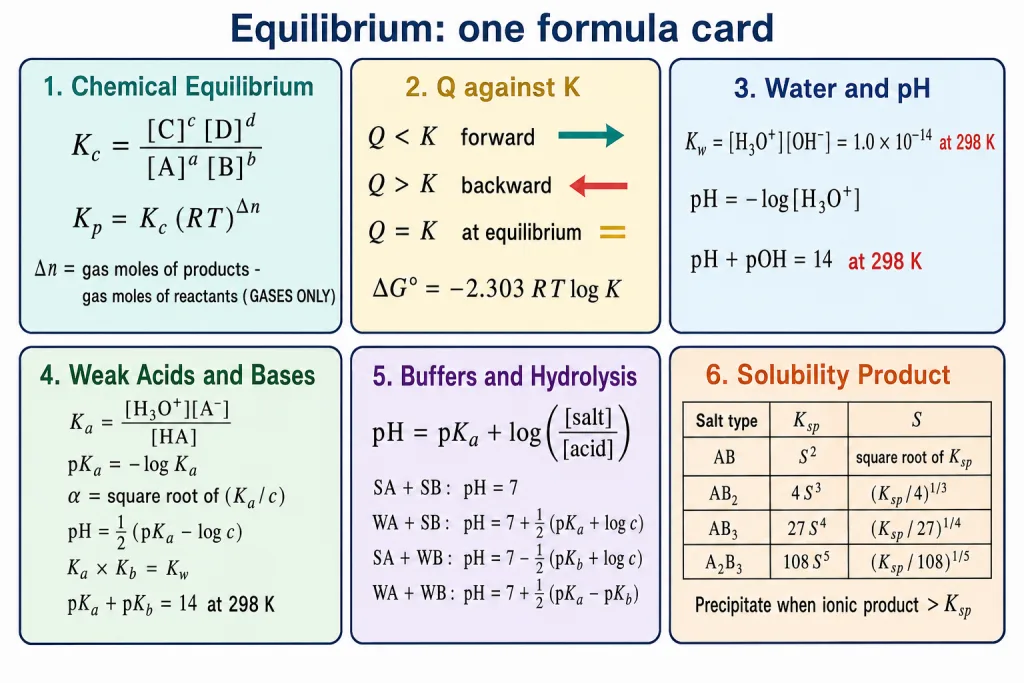
Chemical equilibrium
For ,
with when pressures are in bar, or when they are in atm. counts gases only; pure solids and pure liquids are left out of both the expression and the count.
Units follow as well. carries units of and units of , so both are dimensionless whenever . Strictly, equilibrium constants written with activities are always dimensionless, and the units quoted in a question are a convenience; an option offering in has confused the two constants.
Direction from the reaction quotient:
Manipulating a written equilibrium: reversing it gives , multiplying the whole equation by gives , and adding two equations multiplies their constants.
Thermodynamic link:
A negative means and products favoured; a positive means ; means .
Water, pH and pOH
The number 14 carries a temperature with it. rises as water is heated, so at , where , the sum is and neutral water has while still being exactly neutral. Neutral means , and only at 298 K does that read 7.
Weak acids and weak bases
Ostwald's dilution law, for a weak electrolyte of concentration :
Those three lines are approximations. They come from writing , and they are trustworthy only while the degree of ionisation is small — roughly , which in practice means . For a comparatively strong weak acid, or a very dilute solution of any weak acid, the approximation fails and the quadratic is needed. Ostwald's law is not applied to a strong acid at all, since a strong acid has no ionisation equilibrium to describe.
For a conjugate pair:
Buffers
Equal concentrations of salt and acid give exactly, because . That is also the half-neutralisation point of a weak acid titrated with a strong base.
The four hydrolysis pH formulae
Only the last of the four is free of , which is why the pH of an ammonium acetate solution barely moves on dilution. The in the middle two is negative for any solution more dilute than , which is why a acetate solution is less basic than a one.
Solubility product
For with molar solubility ,
| Formula type | Example | in terms of | in terms of |
|---|---|---|---|
| AB | , | ||
| or | , | ||
| or | |||
| ; is and gives the same | |||
| rare, but the arithmetic is the same |
Precipitation happens when the ionic product exceeds . Equal to means a saturated solution and no further precipitation; less than means the solution is unsaturated and more solid will dissolve.
The Le Chatelier Recall Grid
Every Le Chatelier question is one row of the grid below. The third column is the one that is answered wrongly most often, and it is the same entry in every row but one.
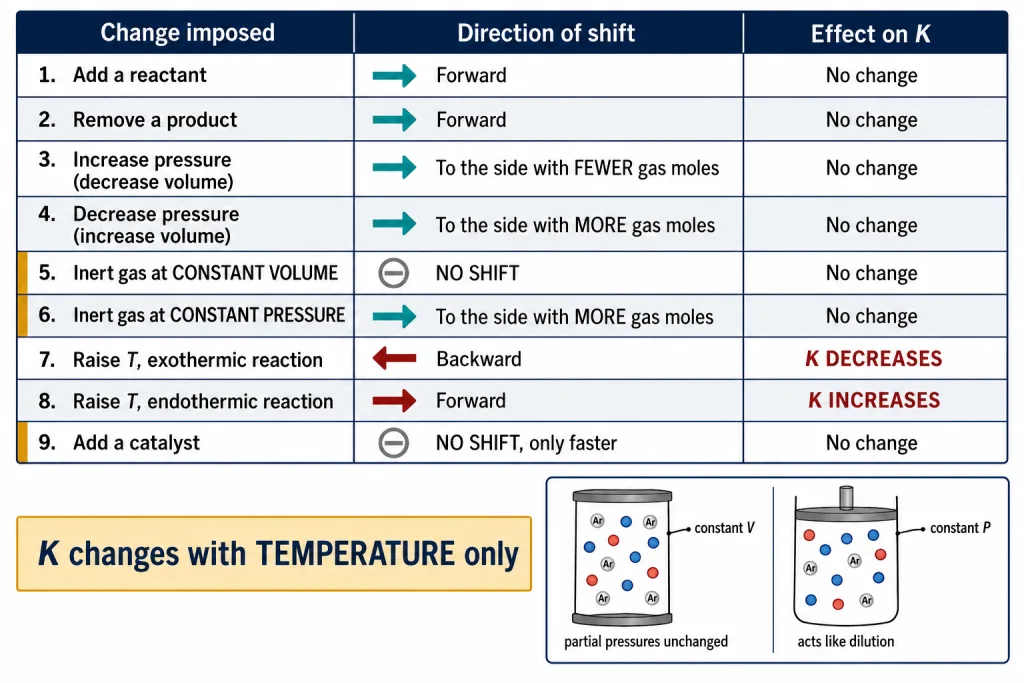
| Change imposed on a system at equilibrium | Direction of shift | Effect on |
|---|---|---|
| Add more of a reactant | Forward, to consume it | No change |
| Remove a product as it forms | Forward, to replace it | No change |
| Add more of a product | Backward | No change |
| Increase the pressure by decreasing the volume | Towards the side with fewer moles of gas | No change |
| Decrease the pressure by increasing the volume | Towards the side with more moles of gas | No change |
| Change the pressure when | No shift at all | No change |
| Add an inert gas at constant volume | No shift — partial pressures are untouched | No change |
| Add an inert gas at constant pressure | Towards the side with more moles of gas | No change |
| Raise the temperature of an exothermic reaction | Backward, towards reactants | decreases |
| Raise the temperature of an endothermic reaction | Forward, towards products | increases |
| Add a catalyst | No shift | No change |
| Add more of a pure solid or pure liquid already present | No shift | No change |
| Dilute a solution of a weak electrolyte | Towards more ions, so ionisation increases | No change |
The three rows that decide the marks
Inert gas at constant volume. Adding argon to a sealed rigid vessel raises the total pressure but leaves every partial pressure exactly where it was, because each gas still occupies the same volume in the same amount. is built from partial pressures, so does not move, so nothing shifts. The wrong answer is always "shifts towards fewer moles", produced by looking at the total pressure and stopping there.
Inert gas at constant pressure. Holding the total pressure fixed while adding argon forces the volume to expand. Expansion lowers every partial pressure, which is exactly what dilution does, and the system answers by moving to the side with more moles of gas. When even this change does nothing.
Catalyst. A catalyst lowers the activation energy of the forward and reverse paths by the same amount, so it multiplies both rates by the same factor and leaves their ratio — which is — untouched. It shortens the time taken to reach equilibrium and changes nothing about where equilibrium lies. Any option saying a catalyst increases the yield is wrong.
Key Point: changes with temperature and with nothing else. Concentration, pressure, volume, an inert gas and a catalyst all move the composition towards a new position; only temperature moves the constant itself.
Reading the temperature row off a
Write the enthalpy into the equation as though it were a substance. For an exothermic reaction, heat is a product:
Raising the temperature is adding a product, so the system shifts backward and the yield of ammonia falls. Lowering it shifts forward. For an endothermic reaction heat is a reactant and every statement reverses. This trick answers the temperature question in about five seconds and never fails.
[NEET] For a question that imposes several changes at once on the Haber process, treat each one independently against the grid, then count. Two changes that both favour the forward direction reinforce; one of each cancels in effect, and the question is then testing whether you noticed.
The Salt Hydrolysis Grid and the Conjugate-Pair Habit
Four salt types, four outcomes. The grid below answers every "which of these solutions is acidic" question without any calculation at all.
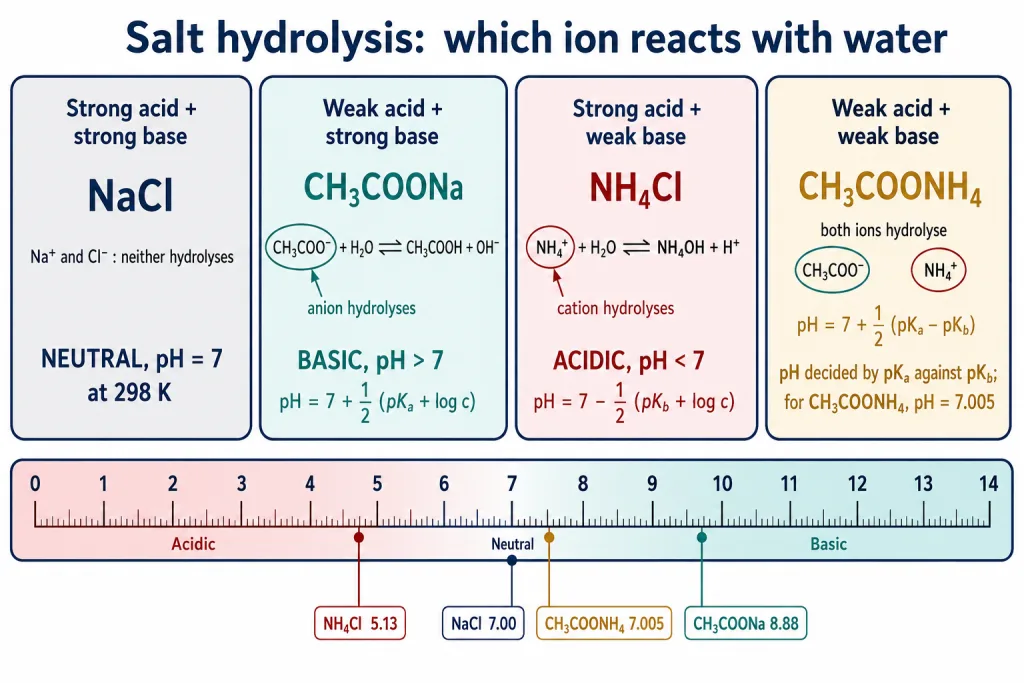
| Salt made from | Which ion hydrolyses | Nature of solution | Example | pH formula |
|---|---|---|---|---|
| Strong acid + strong base | Neither | Neutral, at 298 K | , , | |
| Weak acid + strong base | The anion | Basic, | , , | |
| Strong acid + weak base | The cation | Acidic, | , , | |
| Weak acid + weak base | Both | Decided by which is weaker | , |
The rule behind the grid
The ion that came from the weak partner is the one that hydrolyses. It is the strong conjugate of a weak parent, so it grabs a proton from water — or gives one to water — and leaves the solution unbalanced. The ion from the strong partner is the weak conjugate of a strong parent, so it is inert towards water and simply gets hydrated.
Applied to acetate: acetic acid is weak, so the acetate ion is a reasonably strong base and pulls a proton off water, releasing and making the solution basic. Applied to ammonium: ammonia is a weak base, so the ammonium ion is a reasonably strong acid and hands a proton to water, releasing and making the solution acidic. Nothing else needs to be remembered.
For the fourth row the two effects compete. If the acid is the stronger of the two parents and the solution is acidic; if it is basic; if they are equal the solution is neutral. Ammonium acetate has and , so its pH is — neutral for every practical purpose, and a standard match-the-column answer.
The degree of hydrolysis follows the same pattern as the degree of ionisation. For a salt of a weak acid and a strong base, with , so hydrolysis increases on dilution and increases as the parent acid gets weaker. Sodium cyanide hydrolyses far more than sodium acetate at the same concentration, because hydrocyanic acid is much the weaker of the two acids, and a cyanide solution is correspondingly more basic. The cation of a strong base and the anion of a strong acid are left out of all of this: and are such feeble conjugates that their reaction with water is negligible, and they merely get hydrated.
Key Point: The salt of a weak acid and a strong base is basic; the salt of a strong acid and a weak base is acidic. The weak partner decides, and the salt takes the opposite character to that partner's own solution.
Conjugate pairs at speed
Take one proton away for the conjugate base; add one for the conjugate acid. Adjust the charge by one unit in the matching direction.
| Species | Its conjugate base | Its conjugate acid |
|---|---|---|
Every species in the left-hand column has both a conjugate acid and a conjugate base, which makes each of them amphiprotic. , , , , and are the amphiprotic species this chapter keeps returning to. belongs there too, which surprises people, because it can lose a proton to give the amide ion.
The Lewis list
Four categories cover almost every Lewis acid that appears: species with an incomplete octet (, , ), simple cations (, , , ), molecules with an expandable octet (, , ) and molecules with a multiple bond to an electronegative atom (, ). Lewis bases are anything with a lone pair: , , , , .
Elimination Habits That Turn a Calculation Into a Ten-Second Answer
None of the habits below are shortcuts in the sense of skipping chemistry. Each of them is a piece of chemistry used to rule options out before the arithmetic starts.
Read off the equation and stop
A - question is finished as soon as is known, because the four options are almost always , , and . Count gaseous moles on the right, subtract gaseous moles on the left, and pick the matching exponent.
| Reaction | Relation | |
|---|---|---|
The last two rows carry the trap. counts gases only, so the solid carbonate and the solid carbon contribute nothing. Counting them does different damage in the two rows. In the carbon row it gives and a wrong option that was placed there for exactly that reason. In the carbonate row it gives , which happens to be the right answer reached by the wrong route — and that is worse, because the habit survives to fail on the next question.
Decide which side of 7 the answer sits on first
Before touching a logarithm, settle whether the pH is above 7 or below 7. An acid, an acidic salt, or any solution with gives a pH below 7. A base, a basic salt, or a buffer built on ammonia gives a pH above 7. Half the options usually sit on the wrong side and can be struck out immediately.
The same idea applied to pOH: if the question hands you a base, compute pOH first, because that is the natural quantity, and subtract from 14 at the very end. Reporting the pOH as the pH is the most common single error in this chapter.
Sanity-check the magnitude
An ordinary aqueous solution cannot have a pH above 14 or below 0. Those values correspond to and , which no dilute solution in this chapter reaches. If a computed pH comes out as or , a power of ten has been dropped or a sign flipped. Options carrying such values are decoys, put there to catch a dropped negative sign.
A second magnitude check: a weak acid cannot be more acidic than a strong acid of the same concentration. If acetic acid comes out at , the calculation has quietly treated it as fully ionised. The right answer is near 2.9, and is the option waiting for that mistake.
Use to skip a step
Whenever a question hands you of a base and asks about the acidity of its conjugate — or hands you and asks about the basicity of the conjugate base — convert with instead of going back through . Ammonia has , so and the ammonium ion has without a single division. This one substitution removes a whole line from every hydrolysis and buffer calculation. The relation holds at 298 K, since the 14 is .
Recognise on sight
Three different questions have the same answer. A buffer with equal concentrations of the weak acid and its salt has . A weak acid half-neutralised by a strong base has , because half of it is now salt and half is still acid. An indicator changes colour when , for the same reason. Spot the words "equimolar", "half-neutralised" or "half of the acid has been neutralised" and write the answer down.
The mirrored statement for a basic buffer is when the base and its salt are equimolar, giving .
Read the extent of reaction off the size of
A question asking whether a reaction "goes almost to completion" or "hardly proceeds" is answered by the magnitude of alone, with no composition calculated. A value above about means products dominate and the reaction is essentially complete; a value below about means reactants dominate and almost nothing happens; anything between those bounds means appreciable amounts of both are present at equilibrium. The same reading applies through : a large negative pairs with a large , a large positive one with a tiny , and with . What never tells you is how fast the reaction gets there — a huge with a huge activation energy still gives a mixture that sits unchanged for years, and any option linking the size of to the rate is wrong.
Two more instant answers
Dilution of a buffer does not change its pH. Henderson-Hasselbalch contains a ratio of concentrations, and dilution divides both by the same factor. An option claiming the pH rises or falls on tenfold dilution of a buffer is wrong, and this is one of the fastest marks in the chapter.
A common ion always decreases solubility and always suppresses ionisation. Direction alone eliminates two options in almost every common-ion question, and often the answer is simply "decreases".
The Traps Table
Each row below is a mistake with a name, the wrong answer it produces, and the correction. Read the middle column; those are the distractors.
| The trap | What it produces | The correction |
|---|---|---|
| Quoting as neutral at any temperature | A "true" verdict on a false statement | Neutral means ; that reads 7 only at 298 K, and at 310 K |
| Counting solids or liquids in | Wrong exponent in | counts moles of gas only |
| Putting solids or liquids into the expression | An extra factor that does not belong | Pure solids and pure liquids have activity 1 and are omitted |
| Forgetting a stoichiometric coefficient as a power | out by a whole power | Every coefficient becomes an exponent, including the 2 in |
| Reporting pOH as the pH | instead of , instead of | Subtract from 14 at 298 K before writing the answer |
| Ignoring the 2 in or | pH low by about | the molarity of the salt |
| Using for a weak acid | for acetic acid | A weak acid needs |
| Forgetting the square root in Ostwald's law | instead of | , not |
| Using Ostwald's law when is large | An greater than 1 | Valid only for small ionisation, roughly ; otherwise solve the quadratic |
| Saying a catalyst raises the yield | Wrong option in every catalyst question | A catalyst changes the time to reach equilibrium, never the position |
| Saying changes with pressure or concentration | Wrong option in every Le Chatelier question | changes with temperature only |
| Shifting the equilibrium on adding inert gas at constant volume | "Shifts to fewer moles" | Partial pressures are unchanged, so is unchanged and nothing shifts |
| Writing for every salt | wrong by orders of magnitude | Use ; gives |
| Comparing values across different formula types | "Smaller means less soluble" | Only valid within one formula type; convert to before comparing |
| Saying a common ion increases solubility | Wrong direction | A common ion always decreases solubility |
| Inverting the Henderson-Hasselbalch ratio | pH on the wrong side of | The salt is on top: |
| Claiming a buffer changes pH on dilution | Wrong option in every buffer question | The ratio is unchanged, so the pH is unchanged |
| Using on a non-conjugate pair | A nonsense | The relation holds only for an acid and its own conjugate base, at 298 K |
| Taking for | An acid made basic | At such dilution the water contributes; the pH is slightly below 7, about |
| Treating and as a conjugate pair | Wrong pair chosen | A conjugate pair differs by exactly one proton |
The hedges to keep attached
Half the wrong answers in this chapter come from a true statement stripped of its condition. Five conditions carry almost all the weight, and each of them should be spoken silently every time the corresponding formula is used.
is neutral at 298 K. at 298 K. at 298 K and for a conjugate pair.
A catalyst never shifts the position of equilibrium.
changes only with temperature.
counts gases only.
Ostwald's approximation needs a small degree of ionisation.
[NEET] Assertion-reason items are built out of exactly these hedges. A stem that reads "pH of a neutral solution is 7" with no temperature attached is designed to be marked false, and a stem that reads "pH of a neutral solution is 7 at 298 K" is designed to be marked true. Read for the condition before deciding.
Question 1: Six - relations in under a minute
Write the relation between and for each of the following, stating in each case.
(a) (b) (c) (d) (e) (f)
Answer:
I count only the gaseous moles, right side minus left side, and read the exponent straight off.
(a) One gaseous mole on the right, two on the left. , so .
(b) The two solids do not count. One gaseous mole on the right, none on the left. , so .
(c) Two gaseous moles on each side. , so .
(d) Four gaseous moles of water on the right, four gaseous moles of hydrogen on the left; the iron and the oxide are solids. , so .
(e) Two gaseous moles on the right, three on the left. , so .
(f) The solid does not count. Two gaseous moles on the right, none on the left. , so .
Ans: (a) , (b) , (c) , (d) , (e) , (f) Watch out: In (d) the temptation is to count the solids as well, which makes the right side and the left side , producing . In (b) counting the solid oxide gives by accident, which is right for the wrong reason and will fail on the next question. Cross out every and with a pencil stroke before counting.
Question 2: One reaction, five imposed changes
For , , state the direction of shift and the effect on for each change: (a) the volume is halved, (b) helium is added at constant volume, (c) helium is added at constant pressure, (d) the temperature is raised, (e) a vanadium pentoxide catalyst is added.
Answer:
(a) Halving the volume doubles the pressure. The system counteracts by moving to the side with fewer gaseous moles. There are two on the right and three on the left, so it shifts forward. is unchanged.
(b) At constant volume, helium changes the total pressure but not the volume available to each gas, so every partial pressure stays where it was. is unchanged, so no shift occurs. is unchanged.
(c) At constant pressure the vessel must expand to accommodate the helium. Expansion lowers every partial pressure, and the system responds as it would to dilution by shifting towards more gaseous moles — backward, towards and . is unchanged.
(d) The reaction is exothermic, so heat sits on the product side. Raising the temperature adds a product and the system shifts backward. This is the one change that alters the constant: decreases.
(e) The catalyst speeds both directions equally. No shift, unchanged; only the time taken to arrive at equilibrium is shortened.
Ans: (a) forward, same; (b) no shift, same; (c) backward, same; (d) backward, decreases; (e) no shift, same Watch out: Only (d) touches . A student who marks "K increases" for (a) because more product forms has confused the position of equilibrium with the constant that defines it.
Question 3: Conjugate pairs, amphiprotic species and Lewis acids
(a) Write the conjugate base of , and . (b) Write the conjugate acid of , and . (c) Which of , , and are amphiprotic? (d) Classify , , and as Lewis acids or Lewis bases.
Answer:
(a) Remove one proton and lower the charge by one unit: , , .
(b) Add one proton and raise the charge by one unit: , , .
(c) A species is amphiprotic if it has a proton to donate and a lone pair to accept one. can give a proton to make and take one to make , so it qualifies. does the same, giving or . has no proton to donate, so it is only a base. has no proton to donate and is the conjugate of a strong acid, so it is neither.
(d) has an incomplete octet and accepts an electron pair, so it is a Lewis acid. is a cation with vacant orbitals, so it is a Lewis acid. and each carry lone pairs and donate them, so both are Lewis bases.
Ans: (a) , , ; (b) , , ; (c) and ; (d) Lewis acids and , Lewis bases and Watch out: has no proton at all, so it is a Lewis acid that is not a Bronsted acid. Any statement making the two definitions equivalent is false in this direction.
Question 4: pH of a strong base with a divalent cation
Calculate the pH of a solution of at 298 K.
Answer:
Barium hydroxide is a strong base and gives two hydroxide ions per formula unit:
Before computing I already knew the answer had to be well above 7, because the solution is a strong base, so the two options below 7 were discardable on sight.
Ans: Watch out: Two errors are waiting. Dropping the factor of 2 gives , and . Reporting the pOH as the pH gives , an acidic value for a hydroxide solution, which the "above or below 7" check catches instantly.
Question 5: Weak acid pH and degree of ionisation
Acetic acid has at 298 K. For a solution, calculate the degree of ionisation, and the pH.
Answer:
First I check that the approximation is safe. , comfortably above 400, so the ionisation is small and Ostwald's law applies.
Only 1.87% of the acid is ionised, which confirms the approximation after the event.
The formula-card route gives the same number in one line. and , so
Ans: (1.87%), , Watch out: Forgetting the square root gives and a pH near 4.8. Treating the acid as strong gives , which is the pH of a strong acid of that concentration and is the standard decoy.
Question 6: Using to save a step
The of ammonia is at 298 K. Find , the of the ammonium ion, and the pH of a ammonium chloride solution.
Answer:
The ammonium ion is the conjugate acid of ammonia, so I use the conjugate-pair relation at 298 K rather than dividing by :
Ammonium chloride is the salt of a strong acid and a weak base, so only the cation hydrolyses and the solution must be acidic. Its pH sits below 7, which already discards half of any option set.
Ans: , , Watch out: The relation links an acid to its own conjugate base. Applying it to, say, the of acetic acid and the of ammonia produces a number that means nothing, because those two are not a conjugate pair.
Question 7: Four salts in order of increasing pH
Arrange solutions of , , and in order of increasing pH. Take and .
Answer:
I classify each salt first, which orders three of the four before any arithmetic.
is strong acid with weak base, so it is acidic. is strong acid with strong base, so it is neutral. is weak acid with strong base, so it is basic. is weak with weak, so it depends on the two constants.
Now the numbers.
Ans: , that is Watch out: Ammonium acetate is very slightly basic here only because acetic acid is a shade weaker than ammonia on these constants. Treating it as exactly neutral is fine for a "which is acidic" question and wrong for a strict ordering question. The concentration term appears in the two middle formulae but not in the weak-weak formula, which is why diluting ammonium acetate leaves its pH essentially fixed.
Question 8: Designing a buffer, and what dilution does to it
(a) A buffer is made in acetic acid and in sodium acetate. Find its pH, given . (b) What ratio of salt to acid gives a buffer of ? (c) The buffer in (a) is diluted tenfold with water. What is its new pH?
Answer:
(a) Henderson-Hasselbalch with equal concentrations:
(b) Rearranging for the ratio:
With the acid held at , the acetate must be .
(c) Dilution divides both concentrations by 10. The ratio is , unchanged, so
Ans: (a) , (b) , (c) , unchanged Watch out: Part (a) is the equimolar case and part (c) is the dilution case, and both are answered by inspection once the ratio is seen. Inverting the ratio in (b) gives and a pH of , on the wrong side of — the salt goes on top.
Question 9: Smaller does not mean less soluble
and at 298 K. Which salt has the greater molar solubility in pure water?
Answer:
The two salts have different formula types, so their values cannot be compared directly. I convert each to a solubility.
For , one ion of each kind gives :
For , the silver ion concentration is and the chromate is :
Silver chromate has the smaller and the larger solubility, by a factor of about five.
Ans: is the more soluble, against for Watch out: Reading the two values side by side and answering ", because its is larger" is the trap the question is built around. Comparing values directly is legitimate only when both salts have the same formula type, such as against . Using for the chromate gives , which is the wrong-formula-type answer placed among the options.
Question 10: Precipitation check and the common ion effect
at 298 K. (a) Equal volumes of and are mixed. Will barium sulphate precipitate? (b) Find the solubility of in pure water and in .
Answer:
(a) Mixing equal volumes halves every concentration:
is larger than , by a factor of about 90, so precipitation occurs.
(b) In pure water, :
In sodium sulphate the sulphate concentration is fixed by the added salt. With the new solubility, and , since is tiny:
The common sulphate ion has cut the solubility by a factor of about .
Ans: (a) yes, ; (b) in water and in Watch out: Forgetting to halve the concentrations on mixing gives — still a precipitate, so the error hides here, but it changes the answer whenever the question asks how far above the ionic product sits. In part (b) the direction is enough to eliminate two options: a common ion always decreases solubility.