
Equilibrium in Physical Processes
A physical process changes the state of a substance without changing what the substance is. Ice melts, water evaporates, iodine sublimes, sugar dissolves. In each case particles move from one phase to another and no new substance is made. Every one of these changes can also run backwards — water freezes, vapour condenses, iodine vapour deposits, dissolved sugar crystallises.
When both directions run at once and at the same speed, the system stops changing on the outside. That is equilibrium.
Key Point (Definition): Equilibrium is the state of a system in which two opposing processes occur at the same rate, so that all measurable properties of the system — the mass of each phase, the pressure, the concentration, the colour — stop changing with time.
The word "stop" applies only to the measurable properties. The processes themselves never stop. Molecules keep leaving the liquid and keep returning to it. Only the two rates are equal, so nothing accumulates. This is what is meant by calling equilibrium dynamic.
The double half-arrow is not decoration. It says that both directions are running simultaneously. A single arrow would mean a one-way change, and a one-way change never reaches equilibrium.
Equilibrium is possible only in a closed system
Take three watch glasses holding 1 mL each of acetone, ethyl alcohol and water, and leave them open on a bench. All three eventually dry out. The time taken depends on the nature of the liquid, the amount of liquid and the temperature, but the end point is the same in every case: no liquid left.
Nothing about the evaporation itself changed. Molecules leave the surface at a steady rate for a given liquid at a given temperature. What fails is the return journey. The escaped molecules disperse into the whole volume of the room, so very few of them ever find their way back to that small surface. The rate of condensation stays far below the rate of evaporation, the two can never become equal, and the liquid disappears.
Now cap the same watch glass inside a closed box. The escaping molecules have nowhere to go. Their number in the space above the liquid climbs, collisions with the surface become more frequent, and the rate of condensation climbs with it. It climbs until it equals the rate of evaporation, and there the system settles.
Key Point: An open system loses matter to the surroundings, so a reverse process can never catch up with the forward one. Equilibrium in a physical process is reached only in a closed system at a fixed temperature.
| Feature | Open system | Closed system |
|---|---|---|
| Escaping particles | disperse into the surroundings | remain in the vessel |
| Rate of forward process | constant | constant |
| Rate of reverse process | stays small | rises until it equals the forward rate |
| Final state | one phase disappears completely | both phases present, amounts constant |
| Equilibrium | never reached | reached |
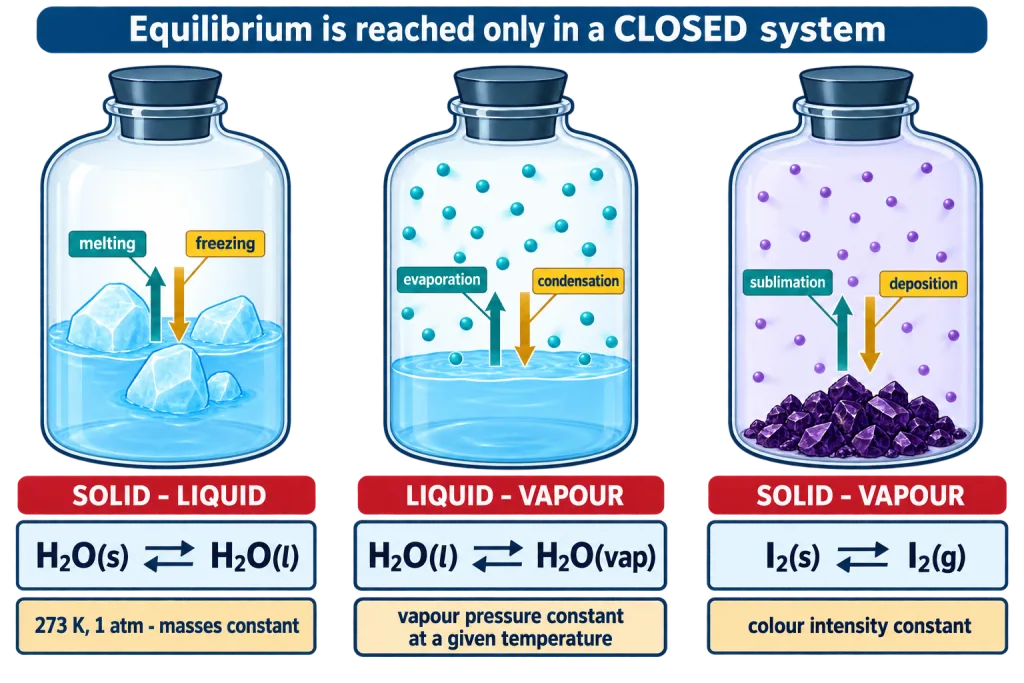
Three phase changes carry all the physics of this section:
Two more physical equilibria sit alongside them: a solid dissolving in a liquid, and a gas dissolving in a liquid. All five behave the same way, and the last part of this section pulls out what they share.
[NEET] A statement such as "at equilibrium the forward and backward reactions stop" is false in every context in this chapter. The rates become equal; they do not become zero.
Solid-Liquid Equilibrium
Put ice and water together in a perfectly insulated thermos flask — no heat crosses the walls in either direction — at 273 K and atmospheric pressure. Leave it and watch.
Two things are observed. The mass of ice and the mass of water do not change with time. The temperature stays at 273 K.
Nothing at the boundary is quiet, though. Molecules of liquid water collide with the ice surface, lose enough energy, and lock into the lattice. At the same time molecules at the surface of the ice pick up enough energy to break free into the liquid. Both migrations run continuously.
The masses stay fixed because the rate at which molecules leave the ice equals the rate at which molecules join it. For every molecule that melts, one freezes.
Two inferences follow, and they are the template for every equilibrium in this chapter:
- Both opposing processes occur simultaneously.
- Both occur at the same rate, so the amounts of ice and of water remain constant.
The melting point is a single temperature
Ice and water coexist only at one particular temperature for a given pressure. Warm the flask slightly above 273 K and melting outruns freezing until the last of the ice is gone. Cool it slightly below and freezing wins until the last of the water is gone. Only at 273 K, at 1 atm, do the two rates match.
Key Point (Definition): For a pure substance at atmospheric pressure, the temperature at which the solid and liquid phases are in equilibrium is the normal melting point (equivalently the normal freezing point) of that substance.
The insulation matters. If heat leaks in the ice melts; if heat leaks out the water freezes. The constant masses belong to the closed, insulated system.
Key Point: For a solid-liquid equilibrium there is exactly one temperature at 1.013 bar at which the two phases coexist — the melting point. With no exchange of heat with the surroundings, the mass of each phase remains constant.
[Board] A frequent question asks what happens to the temperature while ice melts in an insulated flask. It stays at 273 K throughout, because the heat supplied goes into breaking the lattice, not into raising the temperature, and the two phases remain in equilibrium the whole time.
Liquid-Vapour Equilibrium and Vapour Pressure
The vapour pressure of a liquid can be measured directly, and the experiment shows the equilibrium arriving in real time.
The closed-box experiment
A transparent box carries a U-tube of mercury — a manometer — connected to its inside. Anhydrous calcium chloride (or phosphorus pentoxide) is left in the box for a few hours to dry the air completely. The drying agent is then removed by tilting the box, and a watch glass holding water is quickly placed inside. The box is closed.
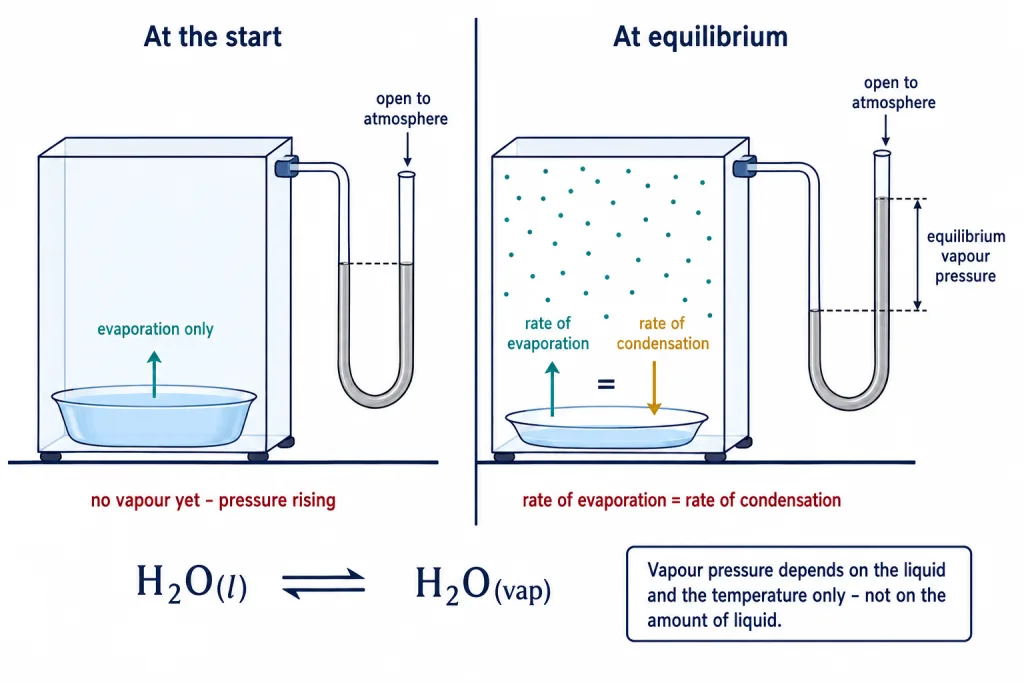
Two observations follow. The mercury level in the right limb of the manometer rises steadily at first, then more and more slowly, and finally settles at a constant value. The volume of water in the watch glass falls.
Reading it step by step:
- At the start the box holds no water vapour, so the pressure inside is due to dry air alone.
- Water evaporates. Each molecule added to the gas phase adds to the pressure, so the mercury rises.
- The rate of evaporation is constant throughout, because it depends only on the liquid and the temperature.
- As vapour builds up, molecules begin returning to the liquid. The rate of condensation grows.
- The pressure therefore rises more and more slowly, because the net gain of vapour molecules is shrinking.
- When the rate of condensation has grown to equal the rate of evaporation, there is no net evaporation at all. The pressure stops changing.
Key Point (Definition): The constant pressure exerted by the vapour of a liquid in equilibrium with the liquid at a given temperature is the equilibrium vapour pressure of that liquid, usually shortened to its vapour pressure.
What vapour pressure does and does not depend on
Vapour pressure depends on two things only: the nature of the liquid and the temperature. It rises as the temperature rises, because a larger fraction of molecules carry enough kinetic energy to escape.
It does not depend on the amount of liquid taken, on the surface area of the liquid, or on the volume of the space above it. Adding more water to the watch glass, or using a wider dish, changes how fast equilibrium is reached, not the pressure at which it settles. This is the single most tested idea in the section.
Repeating the experiment with methyl alcohol, acetone and ether gives different constant pressures at the same temperature. Each liquid has its own vapour pressure.
Key Point: A liquid with a higher vapour pressure at a given temperature is more volatile and has a lower boiling point.
Boiling point and external pressure
Water and water vapour are in equilibrium at 1.013 bar and in a closed vessel. That temperature is the normal boiling point of water.
Key Point (Definition): For a pure liquid at one atmosphere (1.013 bar), the temperature at which the liquid and its vapour are in equilibrium is the normal boiling point of the liquid.
A liquid boils when its vapour pressure becomes equal to the pressure pushing down on its surface. Change that external pressure and the boiling point moves with it.
- At high altitude the atmospheric pressure is lower, so a lower vapour pressure suffices, and water boils below . Food takes longer to cook because it is being cooked at a lower temperature.
- In a pressure cooker the trapped steam raises the pressure above 1 atm, so the vapour pressure must climb higher before boiling starts. Water boils near and food cooks faster.
[JEE/NEET] The boiling point of a liquid is a property of the liquid and the external pressure. The normal boiling point is only the special value measured at 1.013 bar.
Solid-Vapour Equilibrium
Some solids pass straight into the vapour phase without melting. Seal such a solid in a closed vessel and the same balance appears.
Place solid iodine in a closed vessel. The vessel slowly fills with violet vapour, and the colour deepens with time. After a while the intensity of the violet stops changing. Equilibrium has been reached.
Solid iodine sublimes to give iodine vapour, and iodine vapour condenses back to solid iodine. Both continue; the constant colour says only that their rates are now equal, because the concentration of vapour has stopped changing. The colour is the measurable property doing the work here, exactly as the mercury level did in the manometer experiment.
Other solids behaving the same way in a closed vessel:
Solid carbon dioxide — dry ice — is the everyday example. At ordinary atmospheric pressure it never becomes a liquid. It passes directly to gas, which is why it leaves no puddle and why it is used to keep ice cream cold. In the open air the vapour drifts away and the block simply shrinks to nothing: an open system, no equilibrium. Seal the same block in a strong closed container and the gas pressure rises until the rate of sublimation equals the rate of deposition.
The constant quantity for a solid-vapour equilibrium is the vapour pressure of the solid at that temperature, sometimes called the sublimation pressure. Like the vapour pressure of a liquid, it depends only on the substance and the temperature, never on how much solid is present.
[JEE Main] Camphor and naphthalene balls left in a cupboard shrink and vanish over months. Nothing melts. This is sublimation into an open system, so no equilibrium is ever established.
Equilibrium in the Dissolution of a Solid in a Liquid
Only a limited amount of salt or sugar dissolves in a given amount of water at room temperature. Add more and it lies at the bottom, untouched by any amount of stirring.
Make a thick sugar syrup by dissolving sugar at a high temperature, then cool it to room temperature. Sugar crystals separate out. The solution could hold that much sugar when hot; it cannot hold it when cool.
Key Point (Definition): A saturated solution is one in which no more solute can dissolve at a given temperature in the presence of undissolved solute. The concentration of solute in a saturated solution at that temperature is the solubility of the solute.
In a saturated solution, undissolved solid sits in contact with the solution, and a dynamic equilibrium exists between the two:
Solid keeps dissolving and dissolved sugar keeps crystallising, at matching rates, so the amount of solid and the concentration of the solution both stay fixed.
The radioactive sugar experiment
An unchanging concentration by itself does not prove that anything is happening. A solution that had simply stopped dissolving would look identical. The proof that the equilibrium is dynamic comes from a labelling experiment.
Drop some radioactive sugar into a saturated solution of ordinary, non-radioactive sugar, with undissolved solid present. Initially all the radioactivity is in the added solid; the solution contains none.
After some time, radioactivity is detected both in the solution and in the undissolved solid. The ratio of radioactive to non-radioactive molecules in the solution rises and then settles at a constant value.
Nothing else changed. The concentration of sugar in the solution was constant before the radioactive sugar was added and constant afterwards. Yet labelled molecules crossed from the solid into the solution, and unlabelled molecules crossed the other way, until the label was shared evenly between the two phases. Molecules must therefore be exchanging continuously across the boundary in both directions.
Key Point: The radioactive sugar experiment shows that at equilibrium the exchange between phases continues. Constant concentration means equal rates, not zero rates.
Key Point: For the dissolution of a solid in a liquid, the constant quantity is the solubility — the concentration of solute in the saturated solution at a given temperature.
[Board] The experiment is a favourite one-mark question. The answer required is the dynamic nature of equilibrium, evidenced by radioactivity appearing in the solution while the total concentration stays constant.
Equilibrium in the Dissolution of a Gas in a Liquid and Henry's Law
Open a soda water bottle and carbon dioxide fizzes out at once. The gas was dissolved a moment earlier and is not dissolved now, and nothing about the liquid changed except the pressure above it.
Inside the sealed bottle there is an equilibrium between carbon dioxide molecules in the gas space and carbon dioxide molecules dissolved in the drink:
Molecules cross from the gas into the liquid and back again at equal rates, so the amount dissolved stays constant while the bottle is closed.
Henry's law
Key Point (Definition): Henry's law states that the mass of a gas dissolved in a given mass of solvent at any temperature is proportional to the pressure of the gas above the solvent.
Here is the mass of gas dissolved in a fixed mass of solvent, is the partial pressure of that gas above the solution, and is a constant for a given gas, a given solvent and a given temperature (the symbol is deliberately avoided here, because in Class 12 it is reserved for the form , in which the constant multiplies the mole fraction of the dissolved gas and therefore runs the opposite way — a large there means a less soluble gas, whereas a large here means a more soluble one). Double the partial pressure and the dissolved mass doubles. Cut it to a tenth and the dissolved mass falls to a tenth.
Two conditions attach to the law and both are examined:
- The pressure that matters is the partial pressure of that particular gas, not the total pressure above the liquid.
- The amount dissolved decreases as the temperature rises. Warm soda holds less gas than cold soda, which is why a warm drink fizzes more violently when opened.
Written as an equilibrium constant, the law says that the ratio of the concentrations in the two phases is fixed:
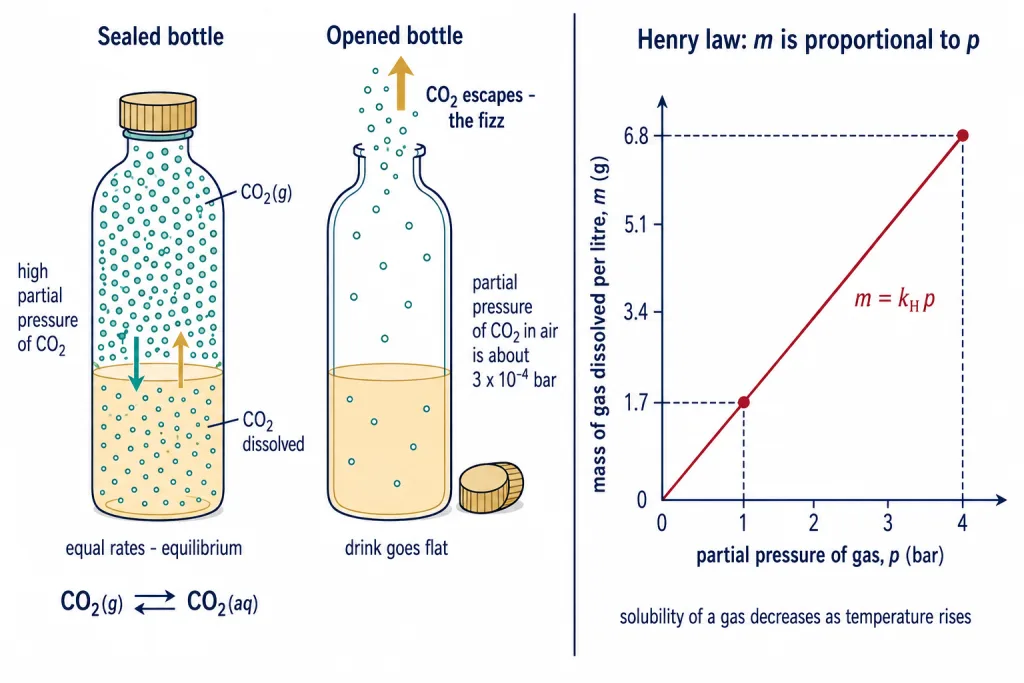
Why soda water goes flat
A soda water bottle is sealed under a high pressure of carbon dioxide, where the solubility of the gas in water is high. The moment the cap comes off, the gas space is replaced by ordinary air, in which the partial pressure of carbon dioxide is only about bar. The system is now far from equilibrium at the new pressure, so dissolved gas escapes rapidly — the fizz — until a new equilibrium is set up at that much lower partial pressure. Left open for long enough, almost all the dissolved carbon dioxide leaves and the drink turns flat.
The same law explains why deep-sea divers must ascend slowly: nitrogen dissolved in the blood at depth comes out as bubbles if the pressure drops too fast.
[JEE Main] Henry's law problems are almost always a single proportion. Write and put the numbers in. The common error is to use total pressure where the partial pressure of the one gas is required.
General Characteristics of Physical Equilibria
The five systems in this section look nothing alike, yet the same statements are true of every one of them.
| Process | Equilibrium | Quantity that stays constant |
|---|---|---|
| Liquid-vapour | constant at a given temperature | |
| Solid-liquid | melting point fixed at constant pressure | |
| Solid-vapour | constant at a given temperature | |
| Solid dissolving | concentration of solute in solution constant at a given temperature | |
| Gas dissolving | constant at a given temperature |
The right-hand column is the point. Each physical equilibrium is characterised by the constant value of one particular parameter at a given temperature — and that constant value is the equilibrium constant for that process.
The four characteristics
| Characteristic | What it means | Evidence in this section |
|---|---|---|
| Equilibrium is reached only in a closed system at a fixed temperature | matter cannot leave, so the reverse process can catch up | open watch glasses dry out completely; the same liquid in a closed box reaches a constant vapour pressure |
| Equilibrium is dynamic | both opposing processes continue, at equal rates, so the condition is stable but not still | radioactive sugar spreads into the solution while the concentration stays constant |
| All measurable properties become constant | pressure, concentration, mass of each phase, colour, temperature stop changing | mercury level settles; iodine colour stops deepening; masses of ice and water stay fixed |
| Each equilibrium has an equilibrium constant | one parameter takes a fixed value at a given temperature | vapour pressure, solubility, |
One further point. The magnitude of that constant quantity tells how far the physical process has gone before equilibrium was reached. A liquid with a large vapour pressure has sent a lot of material into the vapour phase; a solute with a large solubility has sent a lot of material into solution. Small constant, small extent.
Key Point: Equilibrium is possible only in a closed system at a given temperature; both opposing processes occur at the same rate in a dynamic but stable condition; all measurable properties of the system remain constant; and the equilibrium is characterised by the constant value of one parameter, whose magnitude measures the extent of the process.
Mistakes that cost marks
- Saying the process "stops" at equilibrium. It does not. The rates become equal.
- Claiming vapour pressure depends on the amount of liquid or the size of the container. It depends only on the liquid and the temperature.
- Quoting the boiling point of water as without conditions. That value belongs to 1.013 bar.
- Using total pressure in a Henry's law calculation instead of the partial pressure of the dissolving gas.
- Forgetting that gas solubility falls as temperature rises, while the solubility of most solids rises.
Worked Questions
Question 1: Sudden expansion of a sealed container
A liquid is in equilibrium with its vapour in a sealed container at a fixed temperature. The volume of the container is suddenly increased. (a) What is the initial effect on the vapour pressure? (b) How do the rates of evaporation and condensation change initially? (c) What happens when equilibrium is finally restored, and what is the final vapour pressure?
Answer:
First I note that the temperature is fixed, and vapour pressure at equilibrium depends only on the liquid and the temperature.
(a) The same number of vapour molecules now occupy a larger volume, so the vapour pressure falls immediately.
(b) The rate of evaporation depends on the liquid and the temperature, neither of which changed, so it stays the same. The rate of condensation depends on how often vapour molecules strike the surface, and the vapour is now more dilute, so the rate of condensation falls.
(c) Evaporation now exceeds condensation, so more liquid evaporates. Vapour molecules accumulate until the rate of condensation has climbed back to the rate of evaporation. The final vapour pressure is the same as the original vapour pressure, because the temperature is unchanged. Some liquid has been used up in getting there.
Ans: (a) falls; (b) evaporation unchanged, condensation falls; (c) equilibrium is restored with less liquid and the same vapour pressure as before. Watch out: The final answer is "the same", not "lower". The pressure drop is only the momentary effect of the expansion.
Question 2: Watch glass in the open and in a box
1 mL of acetone in an open watch glass evaporates completely in a few minutes, but the same 1 mL sealed in a small box stops evaporating after a short while with liquid still present. Account for both observations.
Answer:
The rate of evaporation is the same in both cases, since it depends only on acetone and the temperature.
In the open watch glass the escaping molecules disperse into the whole room. Almost none return to the small liquid surface, so the rate of condensation stays negligible. Evaporation always exceeds condensation and the liquid disappears. This is an open system, so no equilibrium is possible.
In the closed box the vapour cannot leave. Its concentration above the liquid rises, more molecules strike the surface, and the rate of condensation rises until it equals the rate of evaporation. The system is then at equilibrium, with liquid and vapour both present.
Ans: An open system loses vapour and never reaches equilibrium; a closed system builds up vapour until the two rates are equal.
Question 3: Vapour pressure at 373 K
Water boils at 373 K under an external pressure of 1.013 bar. What is the equilibrium vapour pressure of water at 373 K, and what would happen to the boiling temperature if the external pressure were reduced to 0.60 bar?
Answer:
A liquid boils at the temperature where its vapour pressure equals the external pressure. Since water boils at 373 K under 1.013 bar, the vapour pressure of water at 373 K is 1.013 bar.
If the external pressure is lowered to 0.60 bar, boiling begins as soon as the vapour pressure reaches 0.60 bar. Vapour pressure increases with temperature, so a vapour pressure of 0.60 bar is reached below 373 K. The boiling temperature falls.
Ans: Vapour pressure at 373 K is 1.013 bar; at 0.60 bar external pressure water boils below 373 K. Watch out: This is why water boils near 363 K on a high mountain and why rice takes longer to cook there.
Question 4: Solubility of carbon dioxide under pressure
At 293 K, 1 litre of water dissolves 1.7 g of carbon dioxide when the partial pressure of above it is 1.0 bar. A bottling plant seals the drink under a partial pressure of 4.0 bar at the same temperature. Calculate the mass of dissolved in 1 litre of the sealed drink.
Answer:
First I write Henry's law as a proportion at constant temperature:
Substituting , , :
Ans: 6.8 g of per litre. Watch out: Dividing by 4.0 instead of multiplying gives , which would mean gas becomes less soluble as pressure rises.
Question 5: Why the drink goes flat
The bottle in Question 4 is opened and left standing in air, where the partial pressure of carbon dioxide is bar. Calculate the mass of that 1 litre of the drink can hold once the new equilibrium is reached at 293 K, and comment.
Answer:
The temperature is unchanged, so the same proportionality applies, with at :
Roughly half a milligram per litre, against 6.8 g in the sealed bottle. Almost all of the dissolved gas must leave the liquid, which it does as the visible fizz, and after that the drink tastes flat.
Ans: ; over 99.99 per cent of the dissolved escapes.
Question 6: Reading the radioactive sugar experiment
Radioactive sugar is dropped into a saturated solution of ordinary sugar that already contains undissolved solid. After some time radioactivity is found in the solution as well as in the solid, while the concentration of sugar in the solution has not changed. What does the experiment prove, and what would have been seen if equilibrium were static?
Answer:
Radioactivity appearing in the solution means labelled molecules travelled from the solid into the solution. Radioactivity remaining in the solid, and the ratio settling at a constant value, means unlabelled molecules travelled the other way. Both journeys occurred during a period in which the measured concentration never changed, so the two rates must have been equal.
If equilibrium were static, nothing would cross the boundary after saturation. The radioactive label would have stayed entirely in the added solid, and the solution would have shown no radioactivity at all.
Ans: The experiment proves that equilibrium is dynamic — dissolution and crystallisation continue at equal rates.
Question 7: Iodine in a closed vessel
Solid iodine is sealed in an evacuated vessel at constant temperature and the violet colour deepens until it becomes constant. (a) Write the equilibrium. (b) What does the constant colour indicate? (c) A little more solid iodine is added. What happens to the intensity of the colour?
Answer:
(a)
(b) The intensity of the violet colour measures the concentration of iodine vapour. A constant intensity means the vapour concentration has stopped changing, so the rate of sublimation now equals the rate of condensation.
(c) The vapour pressure of a solid depends only on the substance and the temperature, not on how much solid is present. Adding more solid iodine leaves the vapour concentration unchanged, so the colour intensity does not change.
Ans: (a) ; (b) equal rates of sublimation and condensation; (c) no change in intensity. Watch out: More solid does not mean more vapour. Only the surface layer takes part, and the vapour has already reached its equilibrium pressure.
Question 8: Ice and water in a thermos
Ice and water are in equilibrium in a perfectly insulated flask at 273 K and 1 atm. State what happens to (a) the mass of ice, (b) the temperature, and (c) the rate at which molecules leave the ice, if the flask is left undisturbed. What would change if the flask were not insulated and the room were at 300 K?
Answer:
(a) The mass of ice stays constant, because the rate of melting equals the rate of freezing.
(b) The temperature stays at 273 K.
(c) The rate at which molecules leave the ice stays constant and is not zero. It is exactly matched by the rate at which molecules join the ice.
Without insulation, heat flows in from the 300 K surroundings. The extra energy makes melting faster than freezing, so ice is consumed. The temperature holds at 273 K while any ice remains, and only after the last of the ice has melted does the water begin to warm towards 300 K.
Ans: In the insulated flask the masses, the temperature and both rates stay constant; without insulation the ice melts away at 273 K and the water then warms.
Question 9: Sorting the physical equilibria
For each of the following, state whether equilibrium can be reached, and if so name the quantity that becomes constant: (a) camphor subliming in an open cupboard, (b) a saturated solution of common salt in contact with undissolved salt in a stoppered flask, (c) nitrogen gas over water in a sealed cylinder, (d) ether in a corked bottle.
Answer:
(a) The cupboard is an open system, so the vapour drifts away and the rate of condensation never catches up. No equilibrium; the camphor disappears.
(b) The flask is closed. Equilibrium is reached, and the constant quantity is the concentration of salt in the saturated solution — its solubility at that temperature.
(c) The cylinder is closed. Equilibrium is reached, and the constant quantity is the ratio at that temperature, which is the content of Henry's law.
(d) The bottle is closed. Equilibrium is reached, and the constant quantity is the vapour pressure of ether at that temperature.
Ans: (a) no equilibrium; (b) solubility; (c) ; (d) vapour pressure of ether. Watch out: The deciding question in every part is whether matter can escape. If it can, there is no equilibrium, whatever else is true.