
Card 1 — Physical Equilibrium
Every physical equilibrium is a closed-system balance between two opposing physical changes running at the same rate.
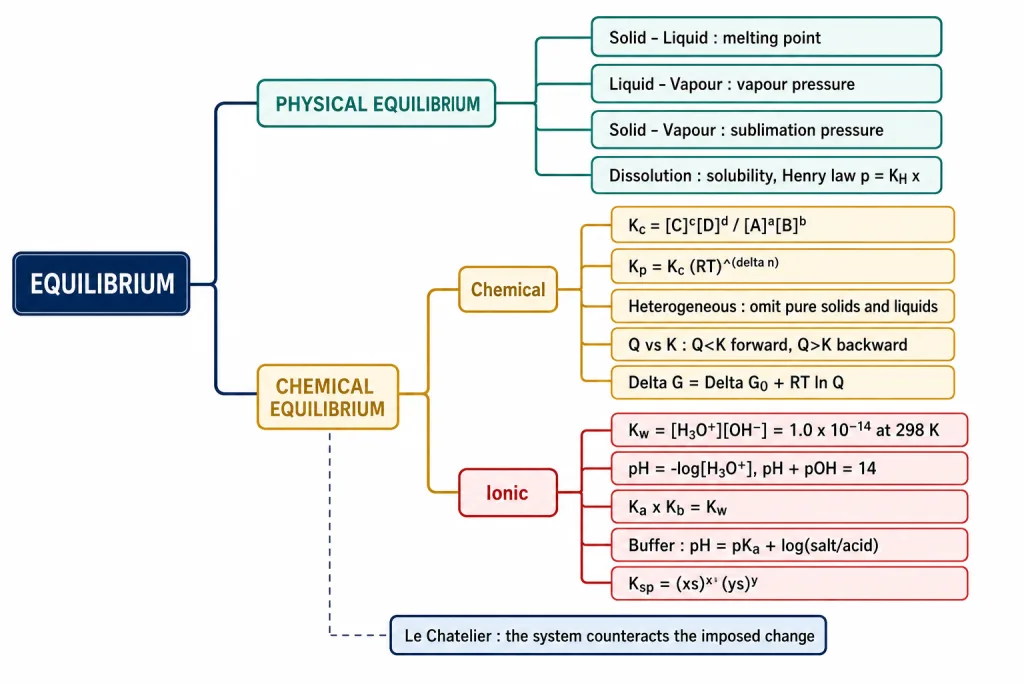
The four types and the constant each one fixes
| Process | Equation | What stays constant at a fixed temperature | Name of the constant |
|---|---|---|---|
| Solid-liquid | The melting point at a fixed pressure; the two phases coexist only at that one temperature | Melting point at | |
| Liquid-vapour | The vapour pressure above the liquid | Equilibrium vapour pressure | |
| Solid-vapour | The vapour pressure of the solid (sublimation) | ||
| Solid dissolving | The concentration of the saturated solution | Solubility | |
| Gas dissolving | The ratio | The equilibrium constant of the dissolution, related to Henry's constant by Henry's law |
Henry's law in one line
Key Point (Definition): The mass of a gas dissolved in a given mass of solvent at a fixed temperature is proportional to the pressure of that gas above the solvent, , equivalently where is the mole fraction of the dissolved gas.
- Raising pressure raises dissolved gas. Opening a soda bottle drops the pressure, so gas fizzes out until the new equilibrium is reached.
- Raising temperature lowers gas solubility. Dissolution of a gas is exothermic.
- A boiling liquid is the case where its vapour pressure equals the external pressure, so the boiling point rises when the external pressure rises.
General characteristics of every physical equilibrium
- Possible only in a closed system at a given temperature. Leave the vessel open and the vapour escapes, and no equilibrium is reached.
- Both opposing processes continue at the same rate — a dynamic, not a static, condition.
- All measurable properties (pressure, concentration, colour, density) stop changing.
- Each equilibrium is characterised by a constant value of one parameter at a given temperature, listed in the table above.
- The magnitude of that parameter says how far the physical process went before stopping.
Fast facts worth a mark each
| Statement | Correct or wrong |
|---|---|
| At the melting point the ice stops melting | Wrong. Melting and freezing continue at equal rates |
| Vapour pressure depends on the amount of liquid present | Wrong. It depends only on the liquid and the temperature |
| Vapour pressure depends on the surface area of the liquid | Wrong. Surface area changes the rate, not the equilibrium pressure |
| Adding more solid sugar to a saturated solution raises the concentration | Wrong. Concentration is fixed at saturation |
| Radioactive sugar added to a saturated solution ends up in the solution too | Correct, and this is the proof that dissolution is dynamic |
| Solubility of a gas falls as temperature rises | Correct |
[NEET] The single most-asked line here is the definition of the dynamic condition: the two rates are equal, and nothing stops.
Card 2 — Chemical Equilibrium and Its Dynamic Nature
Reversible and irreversible
| Reversible reaction | Irreversible reaction |
|---|---|
| Products re-form the reactants under the same conditions | Products do not re-form reactants |
| Written with | Written with |
| Reaches equilibrium with all species present | Goes to completion; one reactant is exhausted |
| Burning of a hydrocarbon in excess oxygen |
Equilibrium can be reached from either direction. Start with only and , or only , and at the same temperature the same equilibrium constant results.
What is constant and what is not
| Constant at equilibrium | Not constant, and never claimed to be |
|---|---|
| Concentration of every species | The two rates before equilibrium is reached |
| Total pressure and density | The amounts of reactant and product, which are almost never equal |
| Colour, refractive index, every measurable property | The individual molecules, which keep reacting |
| The rate of the forward reaction, now equal to the reverse rate | The reaction itself — it does not stop |
Key Point (Definition): Chemical equilibrium is the state of a reversible reaction at which the rate of the forward reaction equals the rate of the reverse reaction, so that the concentrations of all reactants and products remain constant with time while both reactions continue.
The evidence that equilibrium is dynamic
| Experiment | Observation | What it proves |
|---|---|---|
| Haber process run with and , then repeated starting from | The same equilibrium mixture at the same temperature | Equilibrium is reached from both directions |
| mixed with over a catalyst at equilibrium | , and appear | The bonds keep breaking and re-forming |
| and mixed at equilibrium | forms with no net change in the amounts of and | Exchange without net reaction — the definition of dynamic |
| Radioactive iodine added to a saturated iodine solution | Radioactivity appears in the solid as well | Physical equilibria are dynamic too |
The shape of the approach to equilibrium
- The forward rate falls as reactants are used up; the reverse rate rises from zero as products build up.
- The two curves meet, and from that moment the concentrations flatten.
- The time taken to reach equilibrium says nothing about how far the reaction goes. A catalyst changes the time, not the destination.
Traps
| Wrong statement | Right statement |
|---|---|
| At equilibrium the forward and reverse reactions stop | Both continue, at equal rates |
| At equilibrium the concentrations of reactants and products are equal | They are constant, and generally very unequal |
| Equilibrium can be reached in an open vessel | Only in a closed system, unless nothing escapes |
| A fast reaction has a large | Speed and extent are unrelated |
[Board] The written answer that scores is "the rates become equal, so the concentrations stay constant while both reactions continue".
Card 3 — The Equilibrium Constant
The expression
For at a fixed temperature,
- Products on top, reactants below.
- The powers are the stoichiometric coefficients of the balanced equation, nothing else.
- The concentrations are the equilibrium concentrations in .
- depends only on temperature. Not on pressure, volume, initial concentrations, catalyst, or the direction from which equilibrium was approached.
Key Point (Definition): Law of mass action — at a given temperature the rate of a reaction is proportional to the product of the molar concentrations of the reactants, each raised to the power of its stoichiometric coefficient. Equating forward and reverse rates at equilibrium gives .
What the magnitude of tells you
| Value of | Position of equilibrium | How to describe it |
|---|---|---|
| Products dominate | Reaction is nearly complete; reactants present only in traces | |
| Comparable amounts of both | Appreciable quantities of reactants and products | |
| Reactants dominate | Reaction barely proceeds |
says how far, never how fast. A large with a large activation energy gives a reaction that is complete in principle and imperceptible in practice.
The manipulation rules
| Operation on the equation | New equilibrium constant | Worked check with |
|---|---|---|
| Reverse the equation | ||
| Multiply the whole equation by | Doubling gives | |
| Divide the equation by (halve it) | Halving gives | |
| Add two equations | With , | |
| Subtract equation 2 from equation 1 |
Combine them in order. Reversing and doubling gives , which for is .
Units
carries units unless , and a computed from concentrations or pressures may be quoted with those units. The thermodynamic used in is dimensionless, because each concentration or pressure is first expressed relative to its standard state, or .
Traps
| Error | Fix |
|---|---|
| Using initial concentrations in | Only equilibrium concentrations belong there |
| Forgetting the power on a coefficient of or | Square or cube that concentration |
| Changing because the volume changed | is fixed at fixed temperature; the concentrations adjust |
| Adding and for added equations | Multiply them |
| Doubling when the equation is doubled | Square it |
[JEE Main] Multi-step questions almost always test the combination rule: write each given step, adjust each , then multiply.
Card 4 — and
For gaseous equilibria, partial pressures may replace concentrations.
Substituting gives the relation to memorise:
The rules for
- Count gases only. Solids, pure liquids and dissolved species contribute nothing.
- Use the coefficients of the balanced equation.
- when pressures are in bar; when they are in atm. is always in kelvin.
The three cases
| Case | Meaning | Example | Relation |
|---|---|---|---|
| Gas moles increase | , | , so | |
| Gas moles unchanged | , | , both dimensionless | |
| Gas moles decrease | , | , so |
Worked values to have ready
| Equilibrium | ||
|---|---|---|
Partial pressure shortcuts
- , where is the mole fraction.
- Mole fraction , and mole fractions of all species sum to .
- Only , and the dimensionless thermodynamic appear in this chapter; partial pressures are the bridge between the first two.
Traps
| Error | Value it produces | Fix |
|---|---|---|
| Reactants minus products | Sign of the exponent flips | Products minus reactants, always |
| Counting a solid or a pure liquid | Wrong | Gases only |
| Ignoring coefficients | For ammonia, instead of | Use the balanced coefficients |
| Using in degrees Celsius | far too small | Kelvin only |
| Using with L and bar | Factor of error |
[NEET] Reading off the equation and substituting is a twenty-second question. It appears almost every year in some form.
Card 5 — Heterogeneous Equilibria
A heterogeneous equilibrium has reactants and products in more than one phase.
The omission rule and its reason
Key Point: Pure solids and pure liquids do not appear in the equilibrium constant expression, because their concentration — mass per unit volume, fixed by density and molar mass — cannot change while any of the substance is present. Formally their activity is .
- Density and molar mass are constants of the substance, so is a constant. Constants are absorbed into .
- Amount of solid does not matter. Doubling the mass of changes nothing.
- Presence of the solid does matter. Remove all of it and there is no equilibrium left to speak of.
- A solvent present in large excess, such as water in a dilute aqueous equilibrium, is treated the same way and left out.
Equations beside their expressions
| Equilibrium | ||
|---|---|---|
| not used |
The single-gas cases
When one gas alone appears, equals its partial pressure and therefore equals the total pressure of the closed vessel, once any air is excluded. This gives the fastest questions in the chapter: for decomposing at a stated temperature, .
For , the two gases are produced in a ratio, so each has partial pressure and
The same reasoning gives for and for .
Traps
| Error | Fix |
|---|---|
| Writing in the denominator | Omit every pure solid |
| Including liquid water in an aqueous equilibrium | Omit it; it is the solvent in excess |
| Omitting because it is water | Steam is a gas and is included |
| Saying more solid shifts the equilibrium | Amount of solid has no effect |
| Forgetting the power on steam and hydrogen | Coefficients still become powers |
[Board] State the reason with the answer: their concentrations are constant, so they are absorbed into .
Card 6 — , Direction of Reaction, and the ICE Method
The reaction quotient
is the same expression as , evaluated with the concentrations present at any instant, not necessarily at equilibrium.
| Comparison | Meaning | Which way the reaction moves |
|---|---|---|
| Too few products | Forward, left to right, until rises to | |
| Too many products | Backward, right to left, until falls to | |
| The mixture already satisfies the expression | No net change; the system is at equilibrium |
The same test works in pressures with against .
What predicts and what it does not
| predicts | does not predict |
|---|---|
| The extent of reaction — how far it goes | The rate, or the time taken |
| The direction of net change from any given mixture, through | The mechanism |
| The equilibrium concentrations from the initial ones | Whether the reaction happens at a measurable speed |
The ICE recipe
- Write the balanced equation. Every power and every coefficient in the rest of the working comes from it.
- Rule three rows: Initial, Change, Equilibrium. Work in — divide moles by the volume of the vessel first.
- Enter the initial concentrations. Anything not present starts at zero.
- Enter the change as , , , , with the coefficients as multipliers. One unknown only.
- Add the columns to get the equilibrium row.
- Substitute into and solve for .
- Approximate if is small: assume is negligible beside the initial concentration. Valid when comes out below about of that concentration; check it afterwards and solve the quadratic if it fails.
- Reject any root that makes a concentration negative or larger than the total available.
- Convert back into the quantity that was asked — concentration, moles, partial pressure or degree of dissociation.
Degree of dissociation
For starting from with degree of dissociation , the equilibrium amounts are , , , giving
In terms of a total pressure , the same reaction — one mole giving two different products — has
A reactant giving two moles of the same product carries an extra factor of 4, from squaring the coefficient 2:
So takes the first form and the second. Attaching the 4 to the first pattern is the commonest slip in the topic.
Traps
| Error | Fix |
|---|---|
| Using moles instead of concentrations | Divide by the volume before starting |
| Forgetting the coefficient in the change row | for a coefficient of |
| Making the approximation when is large | Solve the quadratic |
| Keeping a negative root | Discard it |
| Answering with when the question asked for a concentration | Read the last line of the question again |
[JEE Main] The most common single mistake in a full ICE problem is dropping a stoichiometric multiplier in the change row.
Card 7 — Equilibrium and Gibbs Energy
The two equations
At equilibrium and , which gives
Use here, and answer in or . At , , so
The sign table
| Position of equilibrium | Reaction as written | |||
|---|---|---|---|---|
| Large and negative | Large positive | Far to the right | Spontaneous; nearly complete | |
| Slightly negative | Small positive | Products favoured | Proceeds appreciably | |
| Zero | Balanced | At standard conditions the mixture is already at equilibrium | ||
| Slightly positive | Small negative | Reactants favoured | Proceeds only slightly | |
| Large and positive | Large negative | Far to the left | Non-spontaneous as written; the reverse is spontaneous |
against
| Refers to the actual mixture at the actual composition | Refers to all species in their standard states |
| Changes continuously as the reaction proceeds | A fixed number for a given reaction at a given temperature |
| Zero at equilibrium, always | Zero only when |
| Sign gives the direction of spontaneous change now | Sign gives whether exceeds |
A negative does not mean the reaction goes to completion, and a positive does not mean nothing happens. Both statements are about the size of , not about totality.
Useful conversions
| at | ||
|---|---|---|
Traps
| Error | Fix |
|---|---|
| Dropping the minus sign in | A negative must give ; check the sign against the table |
| Mixing and | |
| Using in this equation | Use |
| Reporting in after using in | Divide by once, deliberately |
| Setting at equilibrium | at equilibrium; is a constant |
[JEE/NEET] The favourite one-liner: implies , not .
Card 8 — Le Chatelier's Principle
Key Point (Definition): When a system at equilibrium is subjected to a change in concentration, pressure or temperature, the equilibrium shifts in the direction that tends to counteract the effect of the imposed change.
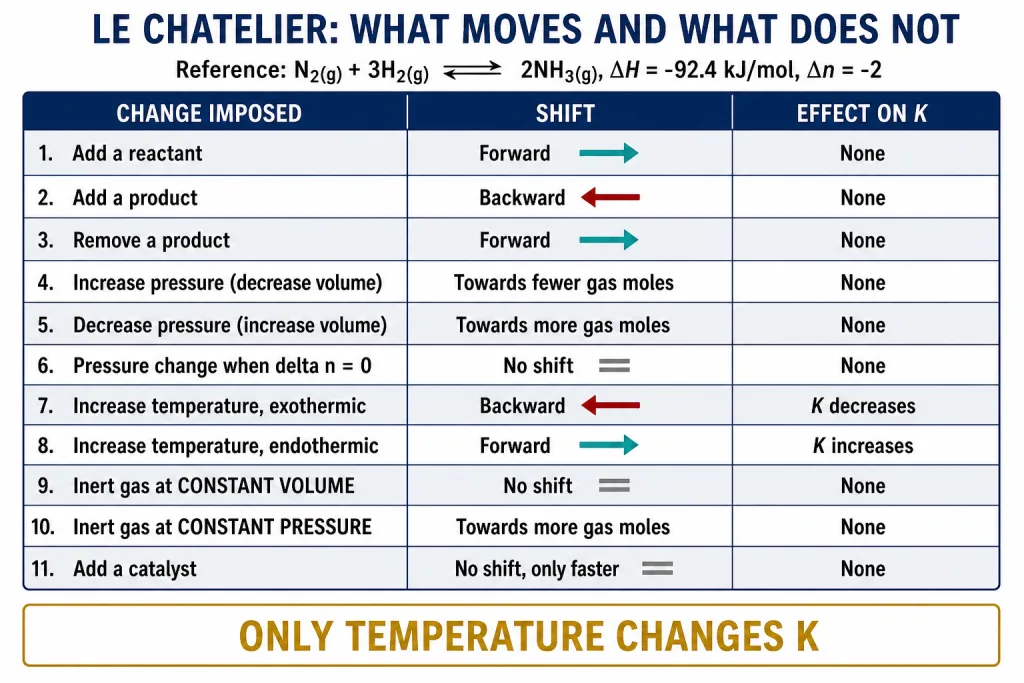
The full grid
Reference reaction: , , .
| Change imposed | Shift | Effect on | Reason |
|---|---|---|---|
| Add a reactant ( or ) | Forward | None | falls below |
| Remove a reactant | Backward | None | rises above |
| Add a product () | Backward | None | rises above |
| Remove a product as it forms | Forward | None | falls below ; the basis of driving a reaction to completion |
| Increase pressure by decreasing volume | Towards fewer gas moles — forward here | None | The system reduces the number of gas molecules |
| Decrease pressure by increasing volume | Towards more gas moles — backward here | None | Same rule, other way |
| Pressure change when | No shift | None | Both sides have the same gas count |
| Increase temperature, exothermic reaction | Backward | decreases | Heat is a product; the system absorbs the added heat |
| Increase temperature, endothermic reaction | Forward | increases | Heat is a reactant |
| Decrease temperature, exothermic reaction | Forward | increases | Yield rises but the rate falls |
| Add an inert gas at constant volume | No shift | None | Partial pressures of the reacting gases are unchanged |
| Add an inert gas at constant pressure | Towards more gas moles — backward here | None | The volume must expand, so the reacting partial pressures fall; behaves like dilution |
| Dilute an aqueous equilibrium with water | Towards more dissolved particles | None | Same logic as constant-pressure inert gas |
| Add a catalyst | No shift | None | Both rates are raised equally; only the time to equilibrium falls |
| Add more pure solid or pure liquid | No shift | None | Its concentration is constant |
Temperature is the only change that alters . Everything else moves the composition to a new position with the same .
Reading the shift from the equation
- Write for gases. Pressure questions are decided by its sign alone.
- Write as heat on the correct side. Temperature questions are then a concentration question.
- For a concentration change, ask which way moved relative to .
Industrial applications
| Process | Equation | Conditions and why |
|---|---|---|
| Haber synthesis of ammonia | , exothermic, | High pressure favours the forward shift; temperature about , near degrees Celsius, is a compromise between yield and rate; iron catalyst; ammonia removed by liquefaction |
| Contact process | , exothermic, | Near-atmospheric pressure, about — with the conversion is already near-complete, so high pressure is not worth paying for; temperature near as a compromise; catalyst; excess air |
| Manufacture of | , endothermic | High temperature and continuous removal of |
[NEET] Every Le Chatelier question reduces to two numbers written on the equation: the sign of and the side heat sits on.
Card 9 — Acids and Bases
The three definitions
| Definition | Acid | Base | Scope | Fails on |
|---|---|---|---|---|
| Arrhenius | Gives in water | Gives in water | Aqueous solutions only | , which has no ; non-aqueous systems |
| Bronsted-Lowry | Proton donor | Proton acceptor | Any proton-transfer system, any solvent | , — no proton is involved |
| Lewis | Electron-pair acceptor | Electron-pair donor | The widest in reach: it covers species carrying no proton at all | , a Bronsted acid with no vacant orbital and so not a Lewis acid |
Every Bronsted base is a Lewis base, and every Arrhenius acid is a Bronsted acid, but the acid classes do not nest. The Lewis definition is wider only in the sense that it reaches species with no proton at all (, , ); is a Bronsted acid and not a Lewis acid.
Conjugate pairs
Key Point: A conjugate acid-base pair is two species differing by exactly one proton. The acid is the member with the extra proton.
| Acid | Its conjugate base | Base | Its conjugate acid |
|---|---|---|---|
The stronger the acid, the weaker its conjugate base. from the strong acid is so weak a base that it does not hydrolyse at all.
Amphiprotic species
Species that can both donate and accept a proton: , , , , , , and amino acids.
Lewis acids and bases
| Lewis acids | Why | Lewis bases | Why |
|---|---|---|---|
| , , | Incomplete octet, six electrons | , , , | Lone pair on N or O |
| , , , | Cations accepting lone pairs | , , , | Anions with lone pairs |
| , , | Expandable octet | , alkenes | Lone pair or electrons |
| , | Multiply bonded central atom accepts a pair | , | Strongly electron-rich anions |
Traps
| Error | Fix |
|---|---|
| Calling and a conjugate pair | They differ by two protons; the pair is and |
| Calling an Arrhenius base | It has no ; it is Bronsted and Lewis |
| Calling a Bronsted acid | No proton; Lewis only |
| Saying a strong acid has a strong conjugate base | The stronger the acid, the weaker its conjugate base |
[Board] Write both equations for an amphiprotic species. One equation alone does not prove the term.
Card 10 — Water, pH and pOH
The ionic product of water
- at , so in pure water .
- Autoionisation is endothermic, so rises with temperature.
- The degree of ionisation of water at is about , or roughly two molecules in a billion.
- holds in every aqueous solution, acidic or basic, not only in pure water.
| Temperature | Neutral | Neutral pH | |
|---|---|---|---|
Key Point: Neutrality means , not pH . Water at has pH and is still perfectly neutral.
Definitions
| Solution at | pH | |
|---|---|---|
| Acidic | ||
| Neutral | ||
| Basic |
A change of one pH unit is a tenfold change in . pH values below and above are perfectly possible in concentrated solutions.
Strong acids and bases
Strong electrolytes are completely ionised, so the ion concentration comes straight from the stoichiometry.
| Solution | or | pH at |
|---|---|---|
| (both protons) | ||
| , pOH | ||
| , pOH | ||
| Water contributes; solve | , never |
The last row is the standard trap. Below about the ions from water can no longer be ignored, and an acid can never give pH above .
[JEE Main] Remember the two-source calculation: with , giving , pOH , pH .
Card 11 — Weak Acids and Bases
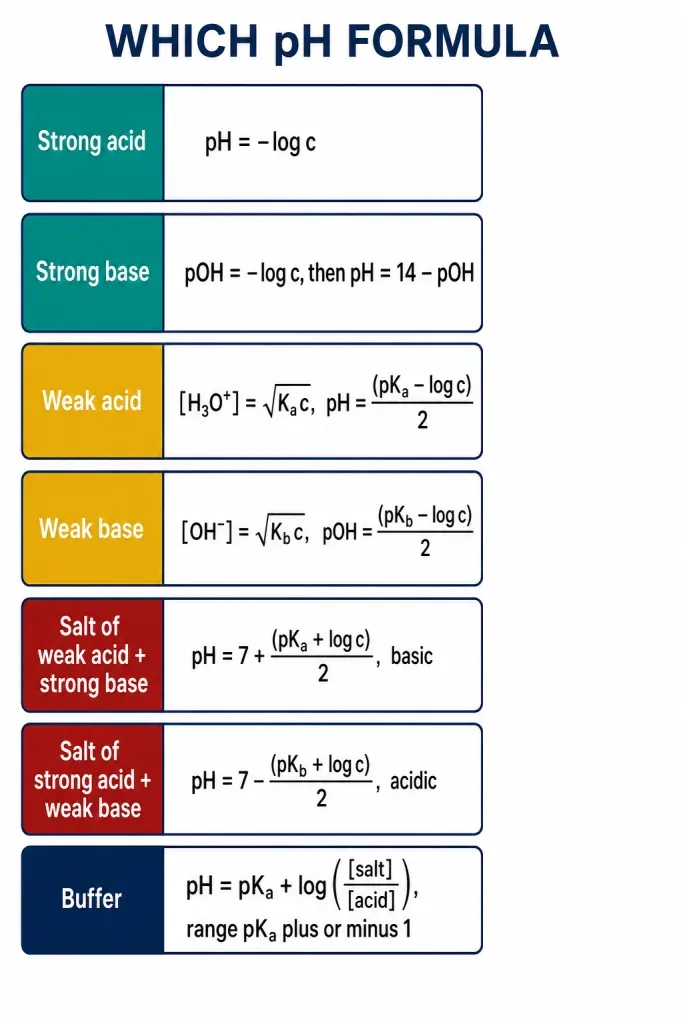
The constants
Larger means a stronger acid; larger means a weaker acid. The two run in opposite directions, and confusing them is the most expensive one-line error in this half of the chapter.
Ostwald's dilution law
For a weak electrolyte of initial concentration and degree of ionisation ,
When , that is when or ionisation is below about ,
and for a weak base
rises on dilution — it varies as — while falls. Dilute a weak acid tenfold and rises by but the pH rises by .
The conjugate relation
This holds only for a conjugate pair — with , with . It is not a relation between an unrelated acid and base.
Values worth carrying into the exam
| Weak acid | at | |
|---|---|---|
| Hydrofluoric acid, | ||
| Nitrous acid, | ||
| Formic acid, | ||
| Benzoic acid, | ||
| Acetic acid, | ||
| Niacin, | ||
| Hypochlorous acid, | ||
| Hydrocyanic acid, | ||
| Phenol, |
| Weak base | at | |
|---|---|---|
| Dimethylamine, | ||
| Triethylamine, | ||
| Ammonia, | ||
| Pyridine, | ||
| Aniline, |
Polyprotic acids and acid strength
- always, by three to five orders of magnitude, because pulling a proton off an increasingly negative ion is harder. Use alone for the pH.
- Down a group, bond strength decides: , acid strength increasing.
- Across a period, polarity decides: , acid strength increasing.
[NEET] with a clean square root is one of the two or three calculations this chapter contributes to the paper.
Card 12 — Common Ion Effect, Hydrolysis and Buffers
Common ion effect
Key Point (Definition): Adding to a weak electrolyte a strong electrolyte that supplies an ion already present in the ionisation equilibrium suppresses that ionisation, shifting the equilibrium backwards by Le Chatelier's principle.
- does not change. falls and the pH moves.
- Sodium acetate added to acetic acid lowers and raises the pH.
- Ammonium chloride added to ammonia lowers and lowers the pH.
- The same effect lowers the solubility of a sparingly soluble salt in a solution of one of its own ions.
Salt hydrolysis — the four combinations
| Salt from | Ion that hydrolyses | Nature of solution | pH formula at | Example |
|---|---|---|---|---|
| Strong acid + strong base | Neither | Neutral, pH | , , | |
| Weak acid + strong base | The anion, giving | Basic, pH | , , | |
| Strong acid + weak base | The cation, giving | Acidic, pH | , , | |
| Weak acid + weak base | Both | Decided by the two constants | , |
For the weak-weak case: gives an acidic solution, a basic one, and a neutral one. The pH here is independent of concentration.
Hydrolysis constant and degree of hydrolysis
That form belongs to the two salts with a single weak parent, where only one ion hydrolyses; for them the degree of hydrolysis rises on dilution, exactly as does. For the salt of a weak acid and a weak base both ions hydrolyse together, the concentration cancels out of the expression, and
which carries no at all — the same reason the pH formula for that case carries no either.
Buffers
Key Point (Definition): A buffer resists a change in pH on dilution or on adding a small amount of strong acid or alkali.
| Type | Made from | Governing constant | pH |
|---|---|---|---|
| Acidic buffer | Weak acid + its salt with a strong base () | ||
| Basic buffer | Weak base + its salt with a strong acid () | , then | |
| Salt of weak acid and weak base | alone | Both |
That first equation is the Henderson-Hasselbalch equation. Facts attached to it:
- Equal salt and acid gives , the point of maximum buffer capacity.
- Working range is , corresponding to a salt-to-acid ratio between and .
- Only the ratio matters, so dilution does not change the pH — though it does reduce buffer capacity.
- To design a buffer of a required pH, pick a weak acid with within one unit of that pH, then set the ratio from the equation.
- Blood is held at pH mainly by , with and proteins assisting.
Traps
| Error | Fix |
|---|---|
| Using inside the Henderson equation for an acidic buffer | Convert with first |
| Inverting the ratio to | Salt over acid; check that more salt must raise the pH |
| Reporting pOH as pH for a basic buffer | Subtract from |
| Believing solution is basic because is strong | Neither ion hydrolyses; pH |
| Using in the weak acid-weak base pH | That formula has no in it |
Card 13 — Solubility Product, and the Mistakes That Cost the Most Marks
by formula type
For with molar solubility ,
| Type | Example | in terms of | from |
|---|---|---|---|
| , | |||
| or | , | ||
| or | |||
values may be compared directly to rank solubility only for salts of the same formula type.
Precipitation
| Comparison | Outcome |
|---|---|
| Unsaturated; more solid dissolves; no precipitate | |
| Saturated; the solution is exactly at equilibrium | |
| Supersaturated; precipitation occurs until falls back to |
When two solutions are mixed, the volumes add, so every concentration is diluted before is evaluated.
Common ion effect on solubility
Adding a common ion drives the dissolution equilibrium backwards and lowers solubility, while itself is unchanged. For with :
- In pure water, .
- In , , so — about 7,500 times smaller.
Salts of weak acids, such as sulphides, phosphates and carbonates, become more soluble at lower pH, because removes the anion.
Sixteen errors and their fixes
- Using initial concentrations in the expression. Only equilibrium concentrations belong there; initial values belong in the first row of the ICE table.
- Saying the reaction stops at equilibrium. Both reactions continue at equal rates.
- Saying reactant and product concentrations become equal. They become constant, and are usually very unequal.
- Including a pure solid or pure liquid in . Omit them; their activity is .
- Leaving out of because it is water. Steam is a gas and is included.
- Reactants minus products in . The sign of the exponent flips and is out by .
- Forgetting the stoichiometric power. For the concentration is squared; for it is cubed.
- Adding values for added equations. Multiply them. Reverse inverts; scale by raises to the power .
- Claiming a catalyst raises the yield, or that pressure changes . Only temperature changes .
- Treating inert gas at constant volume as a dilution. At constant volume nothing shifts; only at constant pressure does the dilution argument apply.
- Using moles instead of concentrations in an ICE table. Divide by the volume first.
- Forgetting the in Ostwald's law. , not . The second gives an answer smaller by a factor of .
- Reporting pOH as pH. For any base question, finish with at .
- Assuming pH is neutral at every temperature. Neutral means ; at that is pH .
- Giving pH above for a very dilute acid. For the answer is , because water contributes.
- Inverting the Henderson ratio, or using for an salt. Salt over acid; for .
60-second revision
- Equilibrium is dynamic; rates equal, concentrations constant, nothing stops.
- from the balanced equation, powers are the coefficients, only temperature changes it.
- , gases only, products minus reactants.
- Pure solids and pure liquids are left out.
- forward, backward, equilibrium.
- ; negative means .
- Le Chatelier: shift counteracts the change; inert gas at constant volume does nothing; catalyst changes only the time.
- Bronsted acid donates a proton; Lewis acid accepts an electron pair; a conjugate pair differs by one proton.
- , , both at .
- Weak acid: , , .
- Salt pH: weak acid-strong base basic, strong acid-weak base acidic, both strong neutral.
- Buffer: , range .
- ; precipitation when ; a common ion lowers solubility but never .