Pure water conducts electricity. The conductance is minute, and a sensitive bridge is needed to detect it at all, but it is not zero. Charge cannot move through a liquid of neutral molecules, so pure water must contain ions.
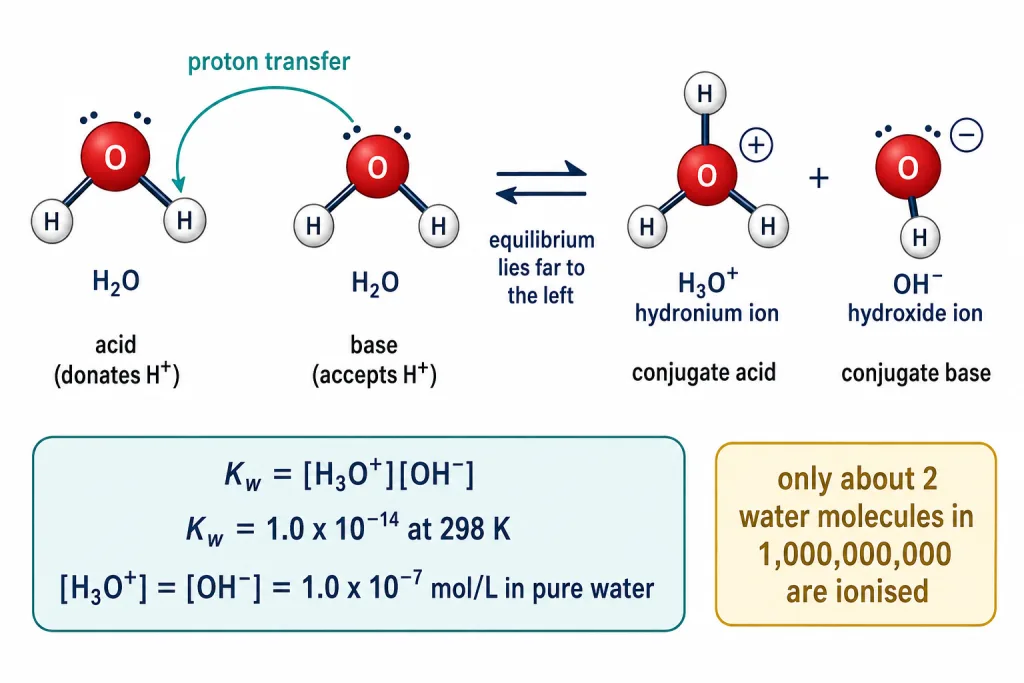
Water is amphiprotic: the same molecule can donate a proton and can accept one. In pure water there is nothing else for a water molecule to react with, so it reacts with another water molecule. One acts as the acid and hands over a proton; the other acts as the base and takes it.
H2O(l)+H2O(l)⇌H3O+(aq)+OH−(aq)
Reading the equation from left to right, the first H2O is the acid and the second is the base; H3O+ is the conjugate acid of the second and OH− is the conjugate base of the first. The process goes by three names in different books — self-ionisation, autoprotolysis and autoionisation — and they all mean this one proton transfer.
The equilibrium constant for the transfer is
K=[H2O][H3O+][OH−]
Water here is a pure liquid in vast excess. Its concentration is fixed by its own density and does not change measurably when a trace of it ionises, so it is absorbed into the constant on the left. What remains is a new constant with a name of its own.
Key Point (Definition): The ionic product of water, Kw, is the product of the molar concentrations of hydronium and hydroxide ions in water at a given temperature:
Kw=[H3O+][OH−]
At 298 K, Kw=1.0×10⁻¹⁴.
Experiment fixes the value. Careful conductance measurements on the purest water obtainable give [H3O+]=1.0×10⁻⁷molL−1 at 298 K. The proton transfer produces one OH− for every H3O+, and pure water starts with neither, so the two concentrations must be equal:
[H3O+]=[OH−]=1.0×10⁻⁷molL−1
Kw=(1.0×10⁻⁷)(1.0×10⁻⁷)=1.0×10⁻¹⁴M2at 298 K
The units M2 follow from the definition, but Kw is normally quoted as a bare number, because each concentration is understood to be divided by the standard concentration of 1M.
Two pieces of shorthand appear everywhere and both are safe to use. A bare proton does not exist in water — it is always attached to at least one water molecule — but H+ is written for H3O+ to save space, so Kw=[H+][OH−] means the same thing. And the equation is often condensed to 2H2O(l)⇌H3O+(aq)+OH−(aq).
[JEE/NEET]Kw is an equilibrium constant, so it depends on temperature and on nothing else. Adding acid, adding alkali, adding salt or diluting the solution does not change its value. Those changes move the two concentrations in opposite directions; their product stays put.
Only Two Molecules in a Billion
The concentration of H3O+ in pure water can be got straight from Kw without any experimental input beyond the constant itself. Pure water is electrically neutral and the only ions present come from the self-ionisation, so the two concentrations are equal. Writing each as x,
x×x=1.0×10⁻¹⁴x=1.0×10−14=1.0×10⁻⁷molL−1
That figure needs comparing with the water itself. The density of pure water is 1000gL−1 and its molar mass is 18.0gmol−1, so
[H2O]=18.0gmol−11000gL−1=55.55molL−1
The fraction that has ionised is then
55.551.0×10−7=1.8×10⁻⁹≈2 in 109
About two water molecules in a billion are ionised at any instant. The equilibrium lies overwhelmingly on the side of undissociated water, which is exactly what an equilibrium constant of 10−14 says. It also explains why water is such a poor conductor while still not being an insulator.
The number of ions is small in fraction but not small in count. One litre of water holds roughly 3.3×1025 molecules, of which about 6×10¹⁶ are ionised at any moment — enough particles to carry a measurable current, and more than enough to control the chemistry of everything dissolved in the water.
Kw is not a property of pure water alone. The self-ionisation equilibrium is present in every aqueous solution, so the relation holds everywhere.
Key Point: In any aqueous solution at 298 K, [H3O+][OH−]=1.0×10⁻¹⁴. Hydronium and hydroxide ions coexist in every solution; adding acid does not remove hydroxide ions, it only pushes their concentration down so that the product is unchanged.
A 0.1M solution of HCl has [H3O+]=0.1M, and therefore [OH−]=10−14/10−1=10−13M. Hydroxide has not vanished; it has been suppressed by a factor of a million relative to pure water.
The same relation gives the classification of solutions, and this classification is the one that never breaks.
Solution
Condition
At 298 K
Acidic
[H3O+]>[OH−]
[H3O+]>10−7M
Neutral
[H3O+]=[OH−]
[H3O+]=10−7M
Basic
[H3O+]<[OH−]
[H3O+]<10−7M
The middle column is the definition. The right-hand column is a consequence that is true at 298 K and at no other temperature, for the reason taken up next.
Kw Rises with Temperature, and the Neutral Point Moves
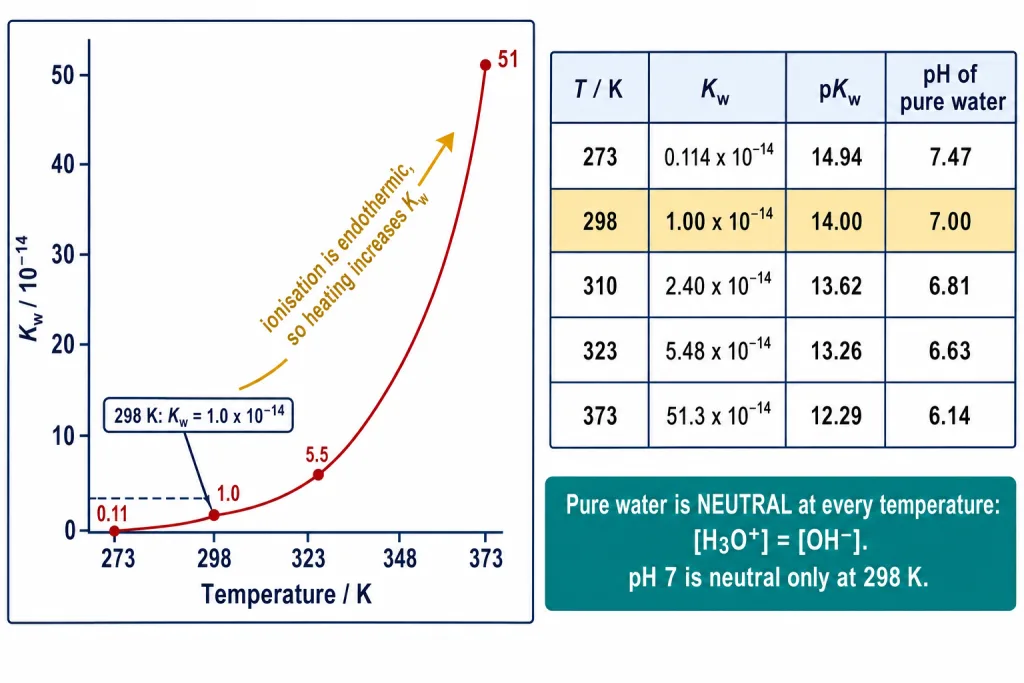
Breaking an O−H bond costs energy. The self-ionisation of water is endothermic, with ΔH≈+57.3kJmol−1 for the forward change. Le Chatelier's principle then settles the temperature behaviour at once: supplying heat to an endothermic equilibrium drives it forward, so hot water contains more H3O+ and more OH− than cold water, and Kw is larger.
T / K
Kw
pKw
pH of pure water
273
0.114×10⁻¹⁴
14.94
7.47
283
0.292×10⁻¹⁴
14.53
7.27
298
1.008×10⁻¹⁴
14.00
7.00
310
2.70×10⁻¹⁴
13.57
6.78
323
5.48×10⁻¹⁴
13.26
6.63
373
51.3×10⁻¹⁴
12.29
6.14
Read the last column carefully. Pure water at 373 K has a pH of 6.14. Nothing has been added to it. It contains exactly as many hydroxide ions as hydronium ions, because the only source of either is the same proton transfer. Pure water at 373 K is neutral, and its pH is 6.14.
Key Point: Neutral means [H3O+]=[OH−]. It does not mean pH 7. The neutral pH equals 21pKw, which is 7.00 only at 298 K. Above 298 K the neutral pH is below 7; below 298 K it is above 7.
The arithmetic behind the last column is one line. In pure water [H3O+]=Kw, so
pHneutral=−logKw=21pKw
At 310 K, Kw=2.7×10⁻¹⁴, so pKw=13.57 and neutral water has pH 6.78.
This is the single most-tested trap in the whole of ionic equilibrium, and it is worth stating in the three ways an examiner can phrase it.
Water heated from 298 K to 373 K shows a falling pH. It does not become acidic. The falling pH and the falling neutral point move together.
A solution of pH 6.9 at 310 K is basic, because the neutral point at 310 K is 6.78. The same pH at 298 K would be acidic.
Human blood is at 310 K and has pH 7.4. Measured against the neutral value 6.78 at that temperature, blood is distinctly basic — more so than the number 7.4 suggests when compared against 7.
[JEE Main] A question that gives a value of Kw different from 10−14 is telling you the temperature is not 298 K. Every relation containing the number 14 must then be rebuilt from pKw.
One thing does not change with temperature: the definition of acidic and basic. A solution is acidic when it holds more hydronium than hydroxide, whatever the thermometer reads. The pH number that marks the boundary is what moves.
The pH Scale and pOH
Concentrations such as 1.0×10⁻⁷ and 3.8×10⁻³ are awkward to compare and clumsy to plot. S. P. L. Sorensen replaced them with the logarithm of the concentration, taken negative so that ordinary solutions get small positive numbers.
Strictly the definition uses the activity aH+ of the hydrogen ion, a dimensionless quantity. In dilute solutions — below about 0.01M — the activity is equal in magnitude to the molarity, and the working definition is
pH=−logaH+=−log{molL−1[H+]}
Key Point (Definition):pH=−log10[H3O+], where the concentration is in molL−1. pH itself has no units.
The lower-case p is a general operator meaning "minus the logarithm to base ten", and it is applied to whatever follows it. Three uses appear constantly:
pOH=−log[OH−]pKw=−logKwpKa=−logKa
Applying the operator to the ionic product links pH and pOH. Starting from Kw=[H3O+][OH−] and taking −log of both sides,
−logKw=−log[H3O+]−log[OH−]
pKw=pH+pOH
At 298 K, Kw=10−14 and pKw=14.00, giving the relation everybody quotes.
Key Point:pH+pOH=pKw=14.00at 298 K. At any other temperature the sum equals pKw at that temperature — 13.57 at 310 K, 12.29 at 373 K.
Two quick applications show the machinery working. A 10−2M solution of HCl has [H+]=10−2M, so pH=2. A solution of NaOH with [OH−]=10−4M has [H3O+]=10−14/10−4=10−10M, so pH=10; equivalently pOH=4 and pH=14−4=10.
The scale is not fenced in at 0 and 14. Those limits come from the accidental values [H+]=1M and [OH−]=1M, and stronger solutions run past them. A 10M solution of a strong acid has pH=−log10=−1; concentrated hydrochloric acid sits near −1.0 and a saturated solution of sodium hydroxide near 15. Negative pH values are unusual but not forbidden.
Measurement matches the arithmetic in two grades of precision. pH paper carries strips that take different colours at the same pH, and reading the combination fixes the pH over the range 1 to 14 to about ±0.5. A pH meter measures the pH-dependent electrical potential of the solution and resolves it to about 0.001.
One pH Unit Is a Factor of Ten
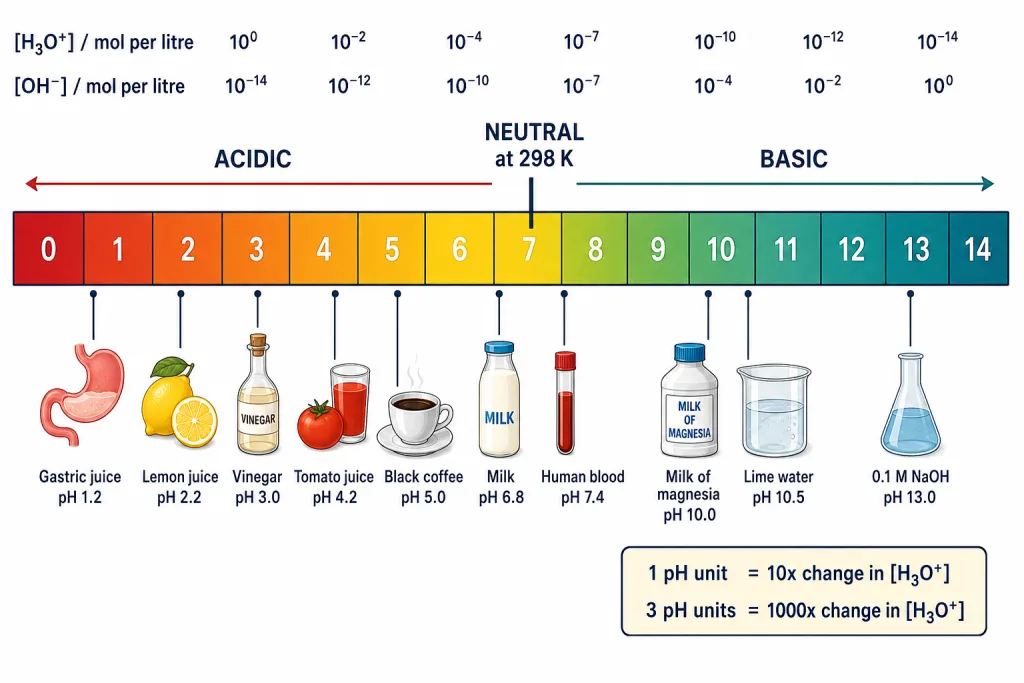
Because the scale is logarithmic, differences in pH are ratios in concentration.
pH falls by 1⟺[H3O+] rises 10 times
A change of 2 units is a factor of 100, a change of 3 units a factor of 1000. Lemon juice at pH 2.2 and black coffee at pH 5.0 differ by 2.8 units, so lemon juice holds about 102.8≈630 times more hydronium ion. Gastric juice at pH 1.2 and milk at pH 6.8 are 5.6 units apart, so the gastric juice holds about four hundred thousand times more hydronium ion, 105.6≈4×10⁵ — a gap that no linear scale would ever fit on one page.
The same compression is why small pH differences in biology matter so much. Blood held at 7.4 rather than 7.0 differs in hydronium concentration by a factor of 2.5, and blood outside the range 7.0 to 7.8 is fatal.
Fluid
pH
Fluid
pH
Saturated NaOH solution
≈15
Black coffee
5.0
0.1MNaOH
13
Tomato juice
≈4.2
Lime water
10.5
Soft drinks, vinegar
≈3.0
Milk of magnesia
10
Lemon juice
≈2.2
Egg white, sea water
7.8
Gastric juice
≈1.2
Human blood
7.4
1MHCl
≈0
Milk
6.8
Concentrated HCl
≈−1.0
Human saliva
6.4
Reading the table downwards on the right and upwards on the left gives the whole range of ordinary aqueous chemistry: sixteen pH units, sixteen powers of ten in hydronium concentration.
[NEET] Comparing acidity is a subtraction, never a division. A solution of pH 2 is not "three times more acidic" than one of pH 6; it is 104 times more acidic. Dividing pH values has no meaning at all.
pH of Strong Acids and Strong Bases
A strong acid is completely ionised in aqueous solution, so every mole of acid delivers its ionisable protons to the water. The hydronium concentration is the acid concentration multiplied by the number of protons the formula can release.
[H3O+]=n×cacidpH=−log[H3O+]
For a strong base the route runs through pOH.
[OH−]=n×cbasepOH=−log[OH−]pH=14−pOH(298 K)
The multiplier n is where marks are lost, so it is worth tabulating.
Solute
Ionisation
n
Illustration
HCl, HBr, HI, HNO3, HClO4
one proton
1
0.01M gives [H3O+]=0.01M
H2SO4
two protons
2
0.005M gives [H3O+]=0.01M
NaOH, KOH
one hydroxide
1
0.01M gives [OH−]=0.01M
Ca(OH)2, Ba(OH)2, Sr(OH)2
two hydroxides
2
0.005M gives [OH−]=0.01M
Key Point: The stoichiometric factor multiplies the concentration, before the logarithm is taken. It never multiplies or divides the pH. For 0.005MH2SO4 the answer is pH=−log(0.01)=2.00, not −log(0.005)=2.30 and not 2.30/2.
A refinement about sulphuric acid is worth knowing even though the Class 11 treatment ignores it. Only the first proton is given up completely; the second comes from HSO4−, which is a moderately strong acid with Ka2=1.2×10⁻², not a strong one. Treating both protons as fully ionised is an approximation, and it is the approximation intended whenever a question says "assume complete ionisation".
Calcium hydroxide raises a different practical point. It is only sparingly soluble, so a "0.005M solution" means that much has actually dissolved; whatever dissolves is completely ionised into Ca2+ and two OH−.
Four logarithms carry almost every strong-acid question in an exam hall: log2=0.301, log3=0.477, log5=0.699, log7=0.845. From these, log4=0.602, log6=0.778, log8=0.903 and log9=0.954 follow by addition.
Going Backwards: Concentration from pH
Reversing the definition needs an antilogarithm.
[H3O+]=10−pH[OH−]=10−pOH=[H3O+]Kw
An integer pH is immediate: pH=5 gives [H3O+]=10−5molL−1.
A non-integer pH needs the exponent split into a whole number and a positive decimal, because tables of antilogarithms only handle the decimal part. The rule is to write the negative exponent as a negative integer plus a positive fraction.
The common wreck is to read the decimal part as the mantissa of the answer and write 4.5×10⁻⁵ for a pH of 4.50. The correct value 3.16×10⁻⁵ is smaller, and the two differ by more than 40 per cent.
A sanity check costs nothing. A pH between 4 and 5 must give a concentration between 10−5 and 10−4, and closer to which end depends on which pH it is nearer. Since 4.50 sits in the middle, 3.16×10⁻⁵ is right and anything outside 10−5 to 10−4 is wrong.
Once [H3O+] is known, [OH−] follows from Kw in one division, or from pOH=14−pH in one subtraction at 298 K. For pH=4.50: pOH=9.50 and [OH−]=10−9.50=3.16×10⁻¹⁰molL−1.
For a strong monobasic acid the concentration found this way is also the concentration of the acid, since ionisation is complete. For a weak acid it is not — the acid concentration is much larger than the hydronium concentration, and recovering it needs Ka.
Very Dilute Acids: When Water's Own Ions Cannot Be Ignored
Applying pH=−logc to a 1.0×10⁻⁸M solution of HCl gives pH=8. That answer is not merely inaccurate; it is impossible.
Adding an acid to water can only raise the hydronium concentration. A pH of 8 means [H3O+]=10−8M, which is less than the 10−7M present in the pure water before the acid was added, and it means [OH−]=10−6M, a hundred times the hydronium concentration. A solution of hydrochloric acid cannot be basic.
The mistake is in the assumption, not the arithmetic. Writing [H3O+]=c silently assumes the acid supplies all the hydronium ion. At c=0.1M that is a superb assumption: the water contributes at most 10−7M out of 0.1M, one part in a million. At c=10−8M the water is the major supplier, and the acid is the small correction.
Both sources have to be counted. Take x as the hydroxide concentration in the final solution, all of which came from water.
HCl(aq)+H2O(l)→H3O+(aq)+Cl−(aq)gives 10−8M
2H2O(l)⇌H3O+(aq)+OH−(aq)gives x
The solution must be electrically neutral, so the total hydronium concentration is
[H3O+]=10−8+x
Substituting into Kw:
(10−8+x)(x)=10−14
x2+10−8x−10−14=0
x=2−10−8+(10−8)2+4×10−14=9.5×10⁻⁸molL−1
So [OH−]=9.5×10⁻⁸M, pOH=7.02, and
pH=14−7.02=6.98
Checking directly: [H3O+]=10−8+9.5×10−8=1.05×10⁻⁷M, and −log(1.05×10⁻⁷)=6.98. The two routes agree.
Key Point: A 10−8M solution of HCl has pH=6.98 — just below 7, faintly acidic, exactly as adding a trace of acid to water should be. It is never 8.
Solving the quadratic in general form gives a single expression covering every strong monobasic acid:
[H3O+]=2c+c2+4Kw
c of HCl / molL−1
true pH
naive −logc
10−4
4.00
4.00
10−6
6.00
6.00
10−7
6.79
7.00
10−8
6.98
8.00
10−9
7.00
9.00
The pattern is a working rule. For c above about 10−6M the water contributes nothing worth keeping and pH=−logc is safe. Between 10−6 and 10−8M the quadratic is compulsory. Below that, the acid is swamped and the pH creeps back towards 7 from underneath, never crossing it.
The mirror image holds for a very dilute strong base. A 10−8M solution of NaOH has pOH=6.98 and therefore pH=7.02 — just above 7, never 6.
[JEE Main] Two checks catch this every time. An acid solution must have pH below the neutral value; a base solution must have pH above it. If a calculation puts a strong acid above 7 or a strong base below 7, the water's own ionisation was dropped.
Question 1: pH of a dilute strong acid
Calculate the pH and [OH−] of a 1.0×10⁻³M solution of HNO3 at 298 K.
Answer:
Nitric acid is a strong monobasic acid, so it is completely ionised and one mole gives one mole of H3O+.
[H3O+]=1.0×10⁻³molL−1
pH=−log(1.0×10⁻³)=3.00
For the hydroxide concentration I divide Kw by the hydronium concentration.
[OH−]=1.0×10−31.0×10−14=1.0×10⁻¹¹molL−1
Ans:pH=3.00, [OH−]=1.0×10⁻¹¹molL−1
Question 2: pH of a soft drink
The hydrogen ion concentration in a sample of soft drink is 3.8×10⁻³M. Find its pH.
Answer:
I take the negative logarithm and split the product.
pH=−log(3.8×10⁻³)=−{log3.8+log10−3}
=−{0.58+(−3.0)}=2.42
The value lies below 7, so the drink is acidic, which matches the carbonic and phosphoric acid in it.
Ans:pH=2.42
Question 3: A dibasic strong acid
Calculate the pH of 0.005MH2SO4 at 298 K, assuming both protons are completely ionised.
Answer:
Each formula unit supplies two protons, so I multiply the concentration by two before taking any logarithm.
[H3O+]=2×0.005=0.01molL−1
pH=−log(1.0×10⁻²)=2.00
Ans:pH=2.00Watch out: Using −log(0.005) gives 2.30 and forgets the second proton. Dividing 2.30 by two gives 1.15 and applies the factor to the wrong quantity. The two multiplies the concentration.
Question 4: pH of a strong monoacidic base
Calculate the pH of 0.02MNaOH at 298 K.
Answer:
Sodium hydroxide is completely ionised and gives one hydroxide ion per formula unit.
[OH−]=0.02=2×10⁻²molL−1
pOH=−log(2×10⁻²)=2−0.301=1.70
pH=14.00−1.70=12.30
Ans:pH=12.30Watch out: Stopping at 1.70 reports the pOH as the pH and turns a strong alkali into a strong acid.
Question 5: pH of a strong diacidic base
Calculate the pH of a 0.005M solution of Ca(OH)2 at 298 K.
Answer:
Calcium hydroxide releases two hydroxide ions per formula unit, so the hydroxide concentration is twice the salt concentration.
[OH−]=2×0.005=0.01molL−1
pOH=−log(1.0×10⁻²)=2.00
pH=14.00−2.00=12.00
Ans:pH=12.00Watch out: Ignoring the second hydroxide gives pOH=2.30 and pH=11.70.
Question 6: Concentration from a non-integer pH
A solution has pH=4.50 at 298 K. Find [H3O+] and [OH−].
Answer:
I take the antilogarithm, splitting the exponent into a whole number and a positive decimal.
[H3O+]=10−4.50=100.50×10−5=3.16×10⁻⁵molL−1
Then pOH=14.00−4.50=9.50.
[OH−]=10−9.50=3.16×10⁻¹⁰molL−1
A check: the product is 3.16×10−5×3.16×10−10=1.0×10⁻¹⁴, as it must be.
Ans:[H3O+]=3.16×10⁻⁵molL−1, [OH−]=3.16×10⁻¹⁰molL−1Watch out: Writing 4.5×10⁻⁵ copies the decimal part of the pH into the mantissa. That is not what an antilogarithm does.
Question 7: A basic solution
The pH of a solution is 9.70 at 298 K. Calculate [H+] and [OH−].
Answer:
[H+]=10−9.70=100.30×10−10=2.0×10⁻¹⁰molL−1
[OH−]=2.0×10−101.0×10−14=5.0×10⁻⁵molL−1
Hydroxide exceeds hydronium by a large factor, so the solution is basic, consistent with a pH above 7.
Ans:[H+]=2.0×10⁻¹⁰molL−1, [OH−]=5.0×10⁻⁵molL−1
Question 8: Neutral water at 373 K
At 373 K the ionic product of water is 5.13×10⁻¹³. Find the pH of pure water at this temperature and state whether the water is acidic, basic or neutral.
Answer:
Pure water contains equal concentrations of the two ions, so each equals Kw.
[H3O+]=5.13×10−13=7.16×10⁻⁷molL−1
pH=−log(7.16×10⁻⁷)=7−0.855=6.14
Alternatively pKw=−log(5.13×10⁻¹³)=12.29 and the neutral pH is half of that, 6.145.
Since [H3O+]=[OH−], the water is neutral.
Ans:pH=6.14; the water is neutral
Watch out: A pH of 6.14 looks acidic only because 7 has been memorised as the neutral value. Neutrality is the equality of the two ion concentrations, and 7 is the neutral pH at 298 K alone.
Question 9: Mixing a strong acid and a strong base
50mL of 0.2MHCl is mixed with 50mL of 0.1MNaOH at 298 K. Calculate the pH of the mixture.
Answer:
I work in millimoles, since the volumes are in millilitres.
H+ taken: 50×0.2=10mmol
OH− taken: 50×0.1=5mmol
Neutralisation removes 5mmol of each, leaving 5mmol of H+ in a total volume of 100mL.
[H3O+]=100mL5mmol=0.05molL−1
pH=−log(5×10⁻²)=2−0.699=1.30
Ans:pH=1.30Watch out: Forgetting that the volume doubles gives [H3O+]=0.1M and pH=1.00.
Question 10: A very dilute strong acid
Calculate the pH of a 1.0×10⁻⁸M solution of HCl at 298 K.
Answer:
At this concentration the acid supplies less hydronium ion than the water does, so both sources must be counted.
2H2O(l)⇌H3O+(aq)+OH−(aq), with Kw=[H3O+][OH−]=10−14
I let x=[OH−], which comes entirely from the water. The acid contributes 10−8M of hydronium and the water contributes x, so
[H3O+]=10−8+x
(10−8+x)(x)=10−14
x2+10−8x−10−14=0
x=9.5×10⁻⁸molL−1
pOH=−log(9.5×10⁻⁸)=7.02, so pH=14.00−7.02=6.98.
Ans:pH=6.98Watch out: The naive −log(10−8)=8 says that adding acid to water made it basic. Any answer above 7 for an acid solution at 298 K is wrong by inspection.
Question 11: Reading Kw off a measured pH
At a certain temperature the pH of pure water is 6.50. Calculate Kw and [OH−] at that temperature.
Answer:
The water is pure, so the two ion concentrations are equal.
[H3O+]=10−6.50=3.16×10⁻⁷molL−1=[OH−]
Kw=(3.16×10⁻⁷)2=1.0×10⁻¹³
The value exceeds 10−14, so this temperature is above 298 K.
Ans:Kw=1.0×10⁻¹³, [OH−]=3.16×10⁻⁷molL−1Watch out: Reporting Kw=10−6.5 skips the squaring. Kw is the product of two concentrations, not one of them.
What to Carry Forward
The whole section runs on one equilibrium and one operator.
Relation
Where it holds
Kw=[H3O+][OH−]
every aqueous solution, at the stated temperature
Kw=1.0×10⁻¹⁴
298 K only
pH=−log[H3O+], pOH=−log[OH−]
always
pH+pOH=pKw
always
pH+pOH=14.00
298 K only
neutral pH =21pKw
always; equals 7.00 at 298 K only
Five errors account for most of the marks lost here.
Treating pH 7 as the definition of neutral. Neutral is [H3O+]=[OH−]; the number 7 belongs to 298 K.
Applying the stoichiometric factor to the pH instead of the concentration, so 0.005MH2SO4 comes out as 2.30 or 1.15 rather than 2.00.
Reporting pOH as pH for an alkali, which converts a pH of 12.30 into 1.70.
Copying the decimal part of a pH into the mantissa of the concentration, giving 4.5×10⁻⁵ where 3.16×10⁻⁵ is meant.
Writing pH 8 for 10−8MHCl instead of 6.98, by ignoring the hydronium ion the water itself supplies.
The next section takes the same Kw and the same logarithms into weak acids and weak bases, where ionisation is partial and Ka and Kb decide how far it goes.
Ready to test your knowledge?
Take a quick interactive quiz on this topic —
free, works without login.