
Two classifications, applied to every compound
More than a hundred million organic compounds are on record. Nobody learns them one at a time. Every compound is instead placed twice — once by the shape of its carbon skeleton, and once by the functional group it carries.
The two classifications are independent. Cyclohexanol and hexan-1-ol carry the same functional group on different skeletons; cyclohexanol and cyclohexanone carry different groups on the same skeleton. Fix both slots and you already know a great deal about a molecule you have never met.
Key Point: The skeleton classification answers "what is the carbon framework?" The functional group classification answers "what will this react as?" Both are needed.
The first cut: chain or ring
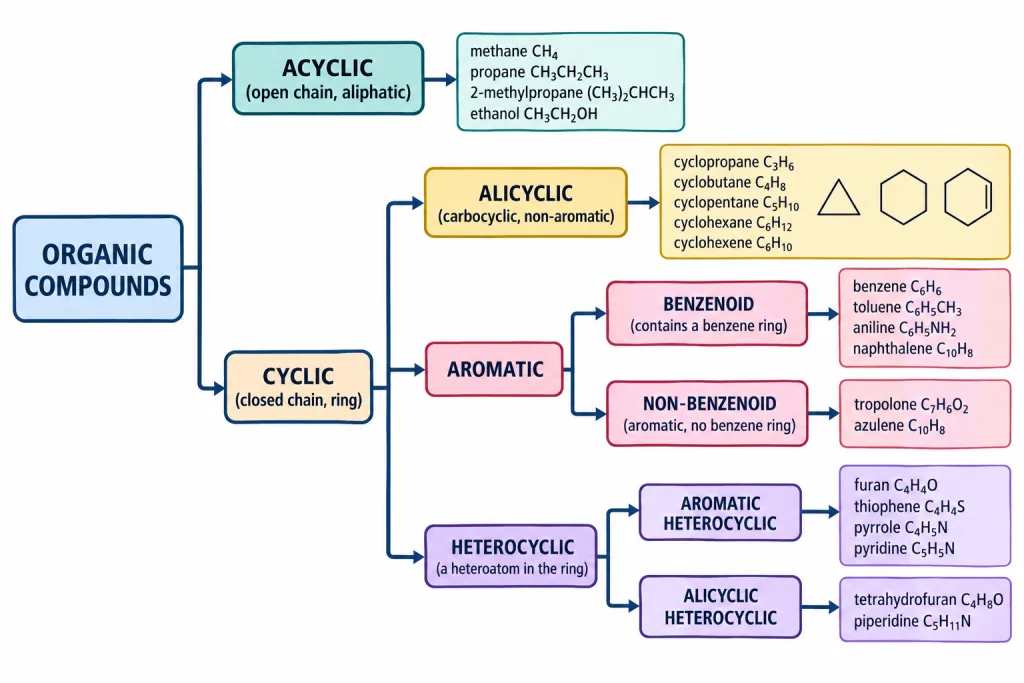
Ask one question of the carbon framework — do the carbons form an unclosed chain, or close into a ring?
Acyclic compounds (open chain compounds, or aliphatic compounds) have a skeleton with free ends. The chain may be straight or branched; branching does not close it.
methane, propane and propan-1-ol are all acyclic, and so is the branched skeleton of 2-methylpropane, .
Cyclic compounds (closed chain or ring compounds) have at least one ring in the skeleton. Once a ring closes, the hydrogen count drops by two compared with the open chain of the same carbon count — hexane is but cyclohexane is .
The three ring families
Cyclic compounds split three ways, and two questions do the splitting.
- Does the ring contain any atom other than carbon? Every ring atom carbon means carbocyclic. One or more ring atoms of nitrogen, oxygen or sulphur means heterocyclic.
- Is the ring aromatic? An aromatic ring is cyclic, planar, conjugated all the way round, and holds pi electrons with a whole number — Huckel's count. Failing any one of those makes it non-aromatic.
The two questions together give the families you have to name: alicyclic, aromatic (benzenoid and non-benzenoid), and heterocyclic (aromatic and alicyclic).
Alicyclic compounds
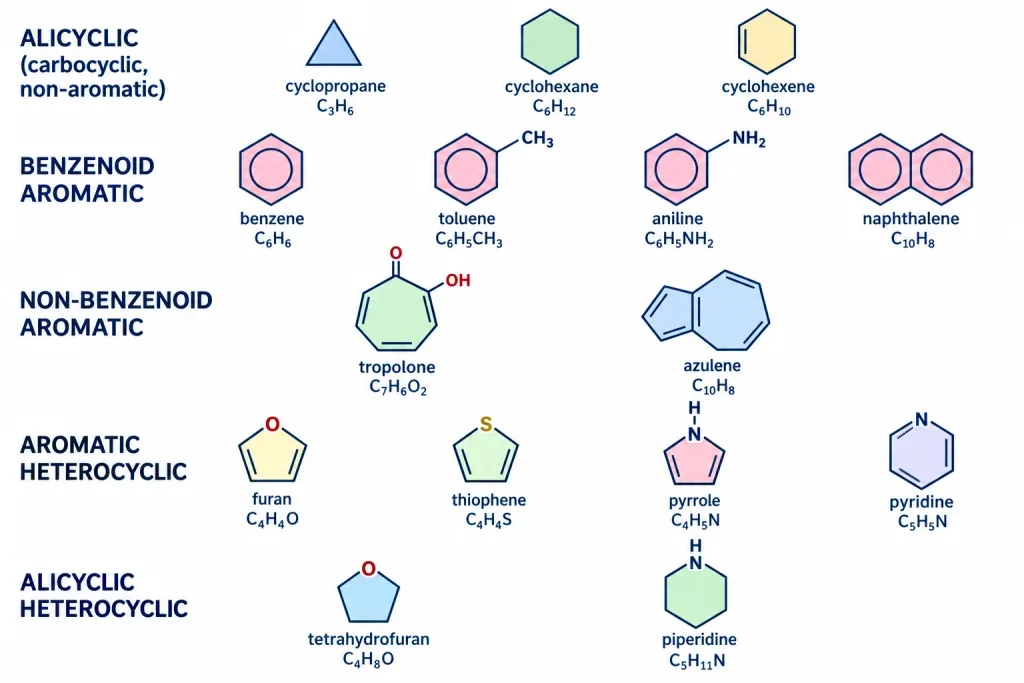
An alicyclic compound has a carbocyclic ring — every ring atom carbon — that is not aromatic. The name contracts "aliphatic cyclic": these rings behave much like open chains rather than like benzene.
| Compound | Molecular formula | Ring |
|---|---|---|
| cyclopropane | three-membered, saturated | |
| cyclobutane | four-membered, saturated | |
| cyclopentane | five-membered, saturated | |
| cyclohexane | six-membered, saturated | |
| cyclohexene | six-membered, one double bond | |
| cyclohexa-1,3-diene | six-membered, two double bonds |
Cyclohexene and cyclohexa-1,3-diene are worth a second look. Both are cyclic and unsaturated, and both are still alicyclic. Cyclohexene has one double bond, so only two pi electrons and no conjugation round the ring; cyclohexa-1,3-diene has four pi electrons and a saturated stretch that breaks the conjugation. Neither reaches in a fully conjugated ring.
Key Point (Definition): Alicyclic = carbocyclic and non-aromatic. Unsaturation alone does not make a ring aromatic; the ring must also be planar, fully conjugated and carry pi electrons.
[NEET] Two rings that get misfiled constantly: cyclohexene is alicyclic despite the double bond, and tetrahydrofuran is not alicyclic in the carbocyclic sense, because its ring contains an oxygen. Tetrahydrofuran belongs with the heterocycles.
Aromatic compounds
An aromatic compound contains at least one aromatic ring — planar, cyclic, fully conjugated, holding pi electrons. Benzene, , is the parent: six sp2 carbons in a flat hexagon, six pi electrons in one delocalised cloud, all six C-C bonds equal at 139 pm and all angles 120 degrees, with a resonance energy of 150 kJ/mol.
Aromatic compounds then divide by a single test: is there a benzene ring in the molecule?
Benzenoid aromatic compounds
A benzenoid compound contains one or more benzene rings — six-membered, all-carbon, aromatic.
| Compound | Formula | What is on the ring |
|---|---|---|
| benzene | nothing; the parent ring | |
| toluene | one methyl group | |
| aniline | one amino group | |
| phenol | one hydroxyl group | |
| nitrobenzene | one nitro group | |
| naphthalene | two benzene rings fused along one bond | |
| anthracene | three benzene rings fused in a row |
Aniline is benzenoid even though it contains nitrogen, and phenol is benzenoid even though it contains oxygen. Neither heteroatom sits in the ring; both hang off it as a substituent, and the ring itself is still all carbon. A heteroatom in a side group against a heteroatom in the ring is what decides benzenoid against heterocyclic.
Non-benzenoid aromatic compounds
A non-benzenoid aromatic compound is aromatic but has no benzene ring anywhere in it. The aromatic ring is some size other than six, or the aromatic system is spread over a fused pair of odd-membered rings.
- Tropolone, . A seven-membered carbon ring carrying a carbonyl group and, on the carbon next to it, a hydroxyl group. Planar and conjugated all the way round, so it behaves aromatically, yet there is no hexagon in the molecule.
- Azulene, . A five-membered ring fused to a seven-membered ring along a shared bond, with ten pi electrons delocalised over the whole framework — with . Azulene is an isomer of naphthalene, yet naphthalene is benzenoid and azulene is not.
Key Point: Benzenoid means "has a benzene ring". Non-benzenoid means "aromatic without one". Aromatic is the bigger box; benzenoid is one compartment inside it.
Heterocyclic compounds
A heterocyclic compound has at least one ring atom that is not carbon. The commonest heteroatoms in a ring are oxygen, nitrogen and sulphur. Heterocycles then split the same way any ring does — aromatic or not.
Aromatic heterocyclic compounds
| Compound | Formula | Ring | Heteroatom |
|---|---|---|---|
| furan | five-membered, two double bonds | O | |
| thiophene | five-membered, two double bonds | S | |
| pyrrole | five-membered, two double bonds, N-H | N | |
| pyridine | six-membered, three double bonds | N |
Furan, thiophene and pyrrole are five-membered rings with only two double bonds, supplying four pi electrons. The heteroatom makes up the shortfall by donating one lone pair into the ring pi system: , with . All three are planar and aromatic.
Pyridine works differently. Its three ring double bonds already give six pi electrons, so the nitrogen lone pair stays in an sp2 orbital lying in the plane of the ring, taking no part in the pi cloud. That one fact explains a comparison asked again and again: pyridine is a reasonable base, while pyrrole is an extremely weak one, because donating pyrrole's lone pair would destroy the aromatic six.
[JEE Main] The lone pair question is the whole of pyrrole against pyridine. In pyrrole the nitrogen lone pair is part of the aromatic system; in pyridine it is not.
Alicyclic heterocyclic compounds
Saturate a heteroaromatic ring and the aromaticity goes while the heteroatom stays, leaving a non-aromatic heterocycle: alicyclic heterocyclic.
| Compound | Formula | Relationship |
|---|---|---|
| tetrahydrofuran | fully saturated furan | |
| tetrahydrothiophene | fully saturated thiophene | |
| pyrrolidine | fully saturated pyrrole | |
| piperidine | fully saturated pyridine |
Tetrahydrofuran and piperidine are the two named in almost every question on this box. Tetrahydrofuran is a five-membered ring of four carbons and one oxygen with no double bonds at all. Piperidine is a six-membered ring of five carbons and one N-H, again fully saturated. Count the hydrogens and the saturation shows: furan gains four to become tetrahydrofuran , pyridine gains six to become piperidine .
The whole tree in one place
- Acyclic (open chain, aliphatic): methane, propane, 2-methylpropane, ethanol
- Cyclic
- Alicyclic (carbocyclic, non-aromatic): cyclopropane, cyclohexane, cyclohexene
- Aromatic
- Benzenoid (has a benzene ring): benzene, toluene, aniline, phenol, naphthalene
- Non-benzenoid (aromatic, no benzene ring): tropolone, azulene
- Heterocyclic (a heteroatom in the ring)
- Aromatic heterocyclic: furan, thiophene, pyrrole, pyridine
- Alicyclic heterocyclic: tetrahydrofuran, pyrrolidine, piperidine
Reading the tree in exam conditions
Three checks, in this order, place any ring compound correctly.
Check 1 — is there a ring at all? No ring means acyclic, and the classification stops.
Check 2 — is every ring atom carbon? No means heterocyclic, leaving only the aromatic-or-not question. Yes means carbocyclic, and you go on.
Check 3 — is the ring aromatic? Planar, cyclic, fully conjugated, pi electrons. No means alicyclic. Yes means aromatic, and one last look decides benzenoid (a hexagon of six aromatic carbons is present) against non-benzenoid.
Two worked paths:
- Aniline. Ring present. Every ring atom is carbon — the hangs off the ring rather than sitting in it. The ring is aromatic and a benzene hexagon is present. Verdict: aromatic, benzenoid.
- Piperidine. Ring present, one ring atom nitrogen, so heterocyclic; fully saturated, so not aromatic. Verdict: alicyclic heterocyclic.
[Board] The single most common misfiling is putting a heteroatom-containing substituted benzene, such as phenol or aniline, into the heterocyclic box. Ask where the heteroatom sits — in the ring, or on the ring.
The functional group
Almost every reaction an organic compound undergoes happens at one small part of the molecule.
Key Point (Definition): A functional group is the atom or group of atoms bonded to the carbon skeleton that gives the molecule its characteristic chemical properties. It is the seat of reactivity: change the functional group and you change the chemistry completely, even if the carbon skeleton is untouched.
Ethanol, , and ethanoic acid, , are both two-carbon compounds, yet only the acid turns blue litmus red and fizzes with sodium carbonate. The difference is against . Ethanol and butan-1-ol have different skeletons and the same group, and their chemistry runs in parallel — both give hydrogen with sodium, both esterify with an acid.
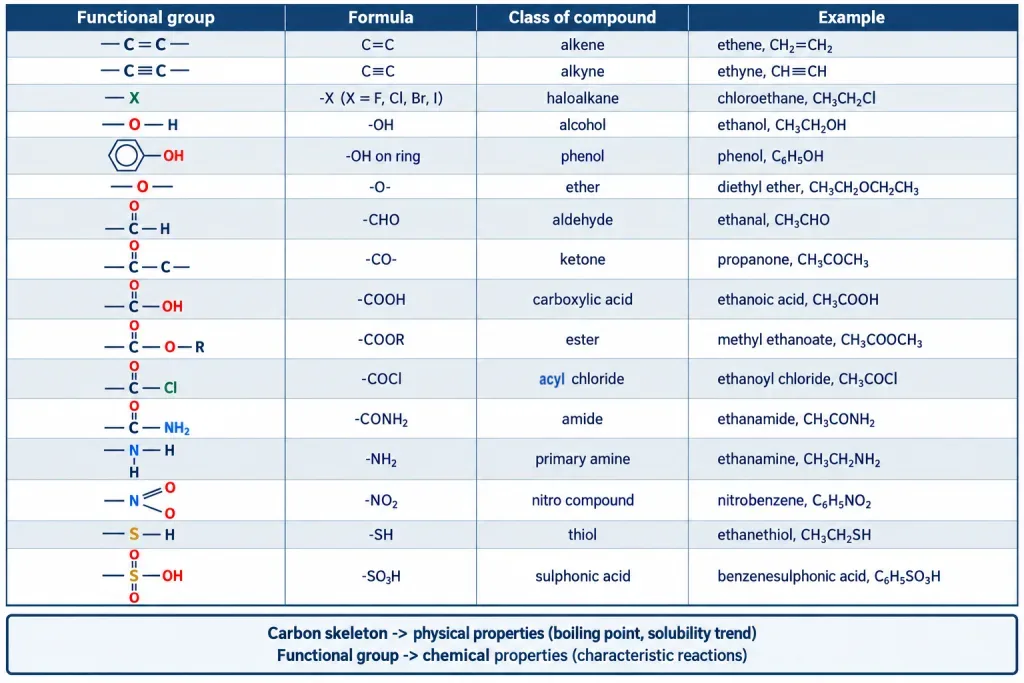
The classes you must recognise on sight
| Functional group | Condensed formula | Class of compound | Named example |
|---|---|---|---|
| carbon-carbon double bond | alkene | ethene, | |
| carbon-carbon triple bond | alkyne | ethyne, | |
| halogen | (X = F, Cl, Br, I) | haloalkane | chloroethane, |
| hydroxyl on a chain | alcohol | ethanol, | |
| hydroxyl on a benzene ring | phenol | phenol, | |
| oxy bridge | ether | diethyl ether, | |
| aldehyde group | aldehyde | ethanal, | |
| carbonyl between two carbons | ketone | propanone, | |
| carboxyl | carboxylic acid | ethanoic acid, | |
| ester group | ester | methyl ethanoate, | |
| acid chloride group | acid chloride | ethanoyl chloride, | |
| amide group | amide | ethanamide, | |
| cyano | nitrile | ethanenitrile, | |
| amino | primary amine | ethanamine, | |
| nitro | nitro compound | nitrobenzene, | |
| thiol (mercapto) | thiol | ethanethiol, | |
| sulphonic acid group | sulphonic acid | benzenesulphonic acid, |
Two pairs in that table are separated by very little on paper and by a great deal in the laboratory.
- against . In an aldehyde the carbonyl carbon carries a hydrogen; in a ketone it carries two carbons. That hydrogen is why aldehydes reduce Tollens reagent and ketones do not.
- against . Amino is basic and electron donating by resonance; nitro heads the standard series and makes a ring far less reactive.
Which properties come from where
The carbon skeleton and the functional group divide the work between them.
The carbon skeleton mostly settles the physical properties. Within one family, boiling point, melting point and density climb steadily as the chain lengthens, because van der Waals attraction grows with surface area, and branching lowers the boiling point by making the molecule more compact. None of that depends on which group is at the end.
The functional group settles the chemistry. Which reagents attack, what products form, whether the compound is acidic or basic, how it is oxidised — all of it is the group's business.
Key Point: Skeleton for physical properties, functional group for chemical properties — a working rule, not an absolute one. A hydrogen-bonding group such as or lifts a whole family's boiling points above the corresponding hydrocarbons: ethanol boils at while propane, of almost the same molar mass, boils at . The group sets the family's level; the skeleton sets the gradation within it.
Question 1: Sorting five rings into their boxes
Classify cyclohexane, benzene, pyridine, tetrahydrofuran and azulene.
Answer:
I run three checks on each — is there a ring, is every ring atom carbon, is the ring aromatic.
Cyclohexane: all-carbon six-ring, no double bonds, so no conjugation and no aromatic count. Carbocyclic and non-aromatic.
Benzene: all-carbon six-ring, planar, fully conjugated, six pi electrons. Aromatic, and a benzene hexagon is present.
Pyridine: one ring atom is nitrogen, so heterocyclic. Three double bonds give six pi electrons in a planar conjugated ring, so aromatic.
Tetrahydrofuran: oxygen in the ring, so heterocyclic; fully saturated, so not aromatic.
Azulene: fused five- and seven-membered all-carbon rings, ten pi electrons delocalised, so aromatic; no hexagon anywhere, so not benzenoid.
Ans: cyclohexane — alicyclic; benzene — aromatic benzenoid; pyridine — aromatic heterocyclic; tetrahydrofuran — alicyclic heterocyclic; azulene — aromatic non-benzenoid. Watch out: Tetrahydrofuran looks like a plain saturated ring and gets called alicyclic. The ring oxygen makes it a heterocycle first.
Question 2: Why furan counts as aromatic
Furan is , a five-membered ring containing oxygen. Show that it meets the aromatic conditions.
Answer:
I count the pi electrons in the ring. Two carbon-carbon double bonds give four, and four is not for any whole number.
The oxygen makes up the shortfall. One of its two lone pairs sits in a p orbital perpendicular to the ring, lined up with the four carbon p orbitals, and joins the pi system. That adds two.
Total . Setting gives . The ring is cyclic and planar, and the p orbitals run right round without a break.
Ans: Furan is cyclic, planar and fully conjugated with 6 pi electrons, with , so it is aromatic. Watch out: Only one of the oxygen lone pairs enters the pi cloud; the other stays in an sp2 orbital in the plane of the ring.
Question 3: Pyridine and pyrrole as bases
Both are aromatic and both have a ring nitrogen. Why is pyridine much the stronger base?
Answer:
Pyrrole has only two double bonds in its five-membered ring, so four pi electrons. It needs six, so the nitrogen lone pair goes into the p orbital and becomes part of the pi cloud. Handing that lone pair to a proton would break the delocalisation and cost the ring its aromatic stabilisation, so pyrrole resists.
Pyridine has three double bonds in a six-membered ring and already has six pi electrons. Nothing is needed from the nitrogen, so its lone pair stays in an sp2 orbital lying in the ring plane, pointing outwards, taking no part in the pi system. Donating it costs nothing.
Ans: Pyridine holds its lone pair in an in-plane sp2 orbital, free to donate; pyrrole commits its lone pair to the aromatic pi system, so pyrrole is a very weak base.
Question 4: Class and series from a condensed formula
For , and name the group, the class, the homologous series with its general formula, and the value of .
Answer:
ends in , a carboxyl, so it is a carboxylic acid. Molecular formula ; the acid series is and at that gives . Butanoic acid.
In the carbonyl carbon has a methyl on one side and an ethyl on the other, so both neighbours are carbon. Ketone, not aldehyde. , series , . Butan-2-one.
In the oxygen bridges two carbon groups and carries no hydrogen, so it is an ether. , series , . Ethyl methyl ether.
Ans: butanoic acid, carboxylic acid, , ; butan-2-one, ketone, , ; ethyl methyl ether, ether, , . Watch out: Butan-2-one and butanal are both and share a general formula, so the formula alone cannot fix the class. Look at what the carbonyl carbon is bonded to.
Question 5: Producing a member from a general formula
Write the straight-chain member of the alkynes at , the primary amines at and the aldehydes at .
Answer:
Alkynes, , at : hydrogens , so . That is pent-1-yne, . Counting back off the structure: .
Primary amines, , at : hydrogens , so . That is butan-1-amine, . Counting back: .
Aldehydes, , at : hydrogens , so . That is propanal, . Counting back: .
Ans: pent-1-yne ; butan-1-amine ; propanal . Watch out: Always count the hydrogens back off the structure you drew. It catches a mis-substituted general formula at once.
Question 6: Homologue, isomer or neither
Decide the relationship in each pair: (a) butane and pentane; (b) butan-1-ol and diethyl ether; (c) methane and ethene; (d) propanoic acid and butanoic acid; (e) cyclohexanol and hexan-1-ol.
Answer:
(a) and differ by , and both are alkanes. Homologues.
(b) Both are with different structures. Isomers, and functional isomers, since one is an alcohol and one an ether.
(c) and . The gap looks like but is in fact a bare carbon, and in any case methane is an alkane, , while ethene is an alkene, . Different series, so neither.
(d) and differ by , and both are carboxylic acids. Homologues.
(e) and differ by , which is neither the same formula nor a gap. Neither — although both carry , so their chemistry still runs alike.
Ans: (a) homologues; (b) isomers; (c) neither; (d) homologues; (e) neither. Watch out: Closing a ring costs two hydrogens, so a ring and a chain of the same carbon count almost always come out as neither.
Homologous series
Write the alcohols out in order of carbon count and the pattern is obvious.
Each member is the one before it plus a unit, every member carries and fits , and the boiling points climb in an even ladder.
Key Point (Definition): A homologous series is a family of organic compounds in which successive members differ by one unit, all members contain the same functional group, all members fit one general formula, and the physical properties show a regular gradation with increasing molar mass. Individual members are called homologues.
Four features, and all four have to hold.
- Successive members differ by . In mass terms that is u between neighbours, so members three places apart differ by 42 u.
- Same functional group throughout. All the alcohols liberate hydrogen with sodium; all the carboxylic acids liberate carbon dioxide with a carbonate.
- One general formula. Substitute a whole number for and a member appears.
- Regular gradation of physical properties. Boiling point, melting point and density rise smoothly with , and water solubility falls as the hydrocarbon part grows.
The alkanes show the ladder cleanly: methane boils at , ethane at , propane at and pentane at . The primary alcohols repeat the shape, shifted upwards by hydrogen bonding: methanol , ethanol , propan-1-ol , butan-1-ol .
The general formulae, each checked against a real member
| Homologous series | General formula | Lowest member | Member at |
|---|---|---|---|
| alkanes | methane, () | butane, | |
| alkenes | ethene, () | but-1-ene, | |
| alkynes | ethyne, () | but-1-yne, | |
| cycloalkanes | cyclopropane, () | cyclobutane, | |
| arenes | benzene, () | toluene, () | |
| alcohols | methanol, () | butan-1-ol, | |
| ethers | dimethyl ether, () | diethyl ether, | |
| aldehydes | methanal, () | butanal, | |
| ketones | propanone, () | butanone, | |
| carboxylic acids | methanoic acid, () | butanoic acid, | |
| esters | methyl methanoate, () | ethyl ethanoate, | |
| primary amines | methanamine, () | butan-1-amine, | |
| haloalkanes | chloromethane, () | 1-chlorobutane, | |
| nitriles | ethanenitrile, () | butanenitrile, |
Verify a row rather than memorising it. Butanenitrile is : four carbons, hydrogens three plus two plus two, which is seven, and at gives . Do that once for each series and the table stops being a list to learn.
Several general formulae in the table repeat, and each repeat is a family of functional isomers.
- serves both alkenes and cycloalkanes. But-1-ene and cyclobutane are both .
- serves both alcohols and ethers. Ethanol and dimethyl ether are both — the standard pair, and there are exactly 2 structural isomers of .
- serves both aldehydes and ketones, and serves both carboxylic acids and esters.
A shared general formula does not put two compounds in the same homologous series. Cyclobutane and but-1-ene share a formula and a molar mass and still sit in different series, because the functional group condition fails.
[JEE/NEET] Given a general formula and a value of , produce the member mechanically: substitute, write the molecular formula, then draw the straight chain with the group at position 1. For at that gives , pent-1-yne, .
Homologue against isomer
These two words describe different relationships, and mixing them up is the defect examiners look for hardest here.
| Homologues | Isomers | |
|---|---|---|
| molecular formula | different — they differ by one or more | identical |
| molar mass | differs by a multiple of 14 u | identical |
| functional group | must be the same | may be the same or different |
| general formula | the same one | the same one only if the group is the same |
| carbon count | different | the same |
| chemistry | closely similar | similar only if the group matches |
Key Point: Two compounds can never be homologues and isomers at the same time. Homologues have different molecular formulae by definition; isomers have the same molecular formula by definition. The two relationships are mutually exclusive.
Working the three-way decision
Given two structures, run this:
- Write both molecular formulae. Same formula, different structure: isomers, and it stops there. Same formula and same structure: the same compound.
- Formulae differ. Take the difference. A whole number of units — , , — sends you to step 3. Anything else means neither.
- Compare the functional groups. Same group means homologues; a different group means neither.
Run it on five pairs.
- Methanol and ethanol . Differ by , both alcohols. Homologues.
- Ethanol and dimethyl ether, both . Same formula, different structures. Isomers, and functional isomers.
- Propan-1-ol and propan-2-ol, both . Same formula, same group, different position. Isomers, position isomers.
- Methane and ethene . Methane is an alkane, ; ethene is an alkene, . Neither.
- Ethanol and propanone . The difference is , not , and the groups differ. Neither.
Methane and ethene is the trap. A gap in the molecular formula is necessary and nowhere near sufficient; both conditions have to hold together.
One subtlety worth naming. Ethanol and propan-2-ol differ by , both carry and both fit , so by the three tests they are homologues; but one is primary and the other secondary, so their oxidation products differ. Where a question wants a clean answer, quote homologues of the same type — ethanol and propan-1-ol, both primary.
To name the series from a compound, read the group first and the formula second: carries , so it is a primary amine, with ; carries an aromatic ring, so it is an arene, with .
Question 7: The mass gap between homologues
Two aldehydes in the same series differ in molar mass by 42 u. The lighter one is ethanal. Name the heavier one.
Answer:
One unit is u, so units, meaning three more carbons.
Ethanal is , molar mass g/mol. Three carbons up gives , molar mass g/mol, and . It checks.
Ans: pentanal, , .
Question 8: Same formula, different family
Cyclohexane and hex-1-ene are both . State their relationship and classify each.
Answer:
The molecular formulae are identical, so they cannot be homologues — homologues must differ by at least one . Same formula with different structures makes them structural isomers, of the ring-chain kind.
Cyclohexane is a saturated all-carbon six-ring, so cyclic and, the ring not being aromatic, alicyclic. Hex-1-ene, , is an open chain with a double bond, so acyclic and an alkene. Each uses up its single degree of unsaturation, one as a ring and one as a pi bond.
Ans: Ring-chain structural isomers. Cyclohexane is alicyclic; hex-1-ene is acyclic, an alkene. Watch out: Both fit , yet cycloalkanes and alkenes are separate homologous series. A shared general formula is not a shared series.
Question 9: Deriving a general formula from one member
Butan-1-ol is . Derive its series formula and write the seven-carbon member.
Answer:
Butan-1-ol has four carbons; the hydrogens are on carbon plus 1 on oxygen, giving 10. So .
Now I look for the expression in that gives 10 at . Trying : . The series is . Testing on ethanol, : . It holds.
At the hydrogen count is , giving , which is heptan-1-ol.
Ans: ; the seven-carbon member is heptan-1-ol, . Watch out: The hydrogen on the oxygen counts in the molecular formula. Leaving it out gives and a wrong general formula.
Question 10: A saturated ring with a heteroatom
A compound is , contains a five-membered ring, and has no double bond and no . Identify and classify it.
Answer:
A five-membered ring with only four carbons means the fifth ring atom is the oxygen. With no double bonds each carbon carries two hydrogens, which accounts for all eight, and the oxygen carries none.
Checking valencies: each carbon has two hydrogens and two ring neighbours, four bonds; the oxygen has two ring neighbours, two bonds. It works.
Ans: Tetrahydrofuran, an alicyclic heterocyclic compound. Watch out: also fits butanal and butanone, both acyclic. The ring and the absence of unsaturation are what pin it down.
Question 11: The full classification path
Trace the complete classification of phenol and of thiophene.
Answer:
Phenol, . A ring is present. Every ring atom is carbon — the hydroxyl oxygen is attached to the ring, not part of it — so carbocyclic. The ring is planar and fully conjugated with six pi electrons, so aromatic, and a benzene hexagon is present. Its group is on a benzene ring, so the class is phenol, not alcohol.
Thiophene, . A five-membered ring, one atom of which is sulphur, so heterocyclic. Two double bonds give four pi electrons and the sulphur donates a lone pair, making six in a planar conjugated ring, so aromatic.
Ans: Phenol — cyclic, carbocyclic, aromatic, benzenoid. Thiophene — cyclic, heterocyclic, aromatic. Watch out: on a saturated carbon gives an alcohol; straight onto a benzene ring gives a phenol. Separate classes, very different acidity.
Question 12: An isomer pair across two aromatic boxes
Naphthalene and azulene are both . Classify each and state their relationship.
Answer:
The formulae are identical, so they are isomers and cannot be homologues.
Naphthalene is two six-membered rings fused along a shared bond, all carbon, planar and conjugated, with benzene hexagons present. Aromatic and benzenoid.
Azulene is a five-membered ring fused to a seven-membered ring, again all carbon, with ten pi electrons delocalised over the fused system, which is with . Aromatic, but no six-membered ring exists in it. Non-benzenoid.
Ans: Structural isomers, both . Naphthalene is aromatic benzenoid; azulene is aromatic non-benzenoid.