
What this section is
Forty worked questions, drawn from every part of the chapter and arranged in the order the chapter itself runs. Each one is solved the way you would solve it in an exam: find the rule, apply it, check the answer against something you already know.
Work them with a pen. Cover the answer, try the question, then read the working and compare — not just the final line, but the route. In this chapter the route is what carries the marks. A structure drawn with a five-bonded carbon, a chain numbered from the wrong end, an isomer counted twice: all three cost the whole answer, and all three are caught by habits you build here.
Two habits matter more than any other. Count the bonds on every carbon you draw — four, always. And write the reason next to the answer, because almost every stability order and almost every naming decision in this chapter is a rule you can state in one sentence.
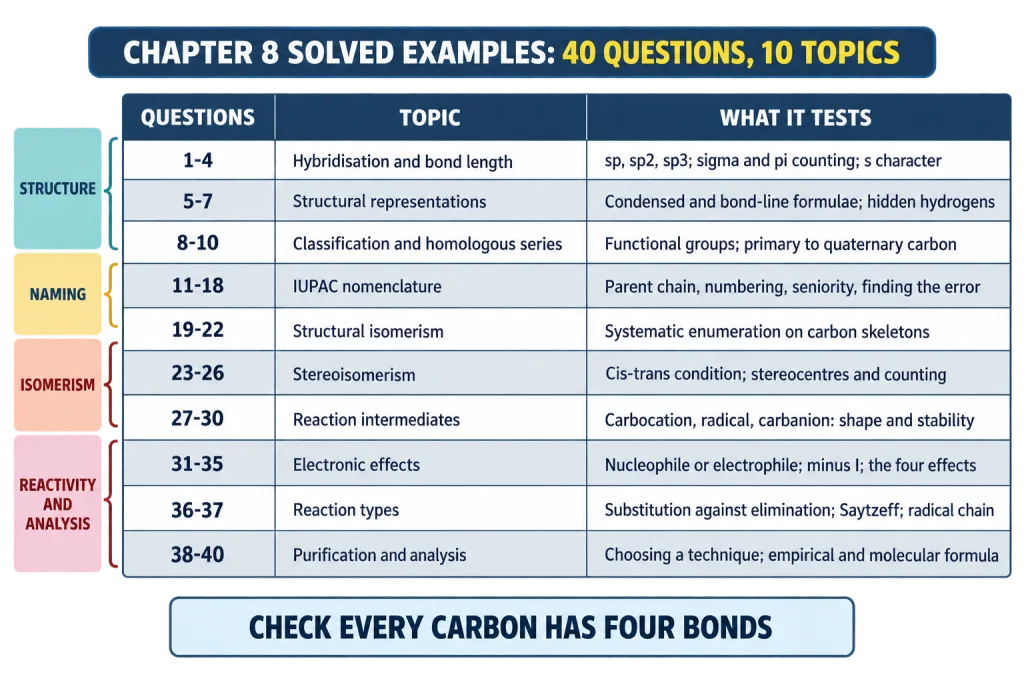
Roadmap
| Questions | Topic | What it tests |
|---|---|---|
| 1-4 | Hybridisation, shape, bond length, sigma and pi | Assigning , and ; counting sigma and pi bonds; reading bond length and acidity off character |
| 5-7 | Structural representations | Moving between complete, condensed and bond-line formulae without losing a hydrogen |
| 8-10 | Classification and homologous series | Naming the functional group and its class; spotting a homologue; labelling carbons as primary to quaternary |
| 11-18 | IUPAC nomenclature | Choosing and numbering the parent chain, seniority, alphabetical citation, name to structure, and finding the error |
| 19-22 | Structural isomerism | Systematic enumeration on skeletons; chain, position, functional group and metamerism |
| 23-26 | Stereoisomerism | The cis-trans condition applied per carbon; stereocentres, enantiomers and counting |
| 27-30 | Reaction intermediates | Which intermediate forms, why, and its shape, hybridisation and electron count |
| 31-35 | Nucleophiles, electrophiles, electronic effects | Locating reactive centres; ranking with ; naming which of the four effects is at work |
| 36-37 | Reaction types and the major product | Substitution against elimination, Saytzeff, and free radical chain reactions |
| 38-40 | Purification and analysis | Choosing a technique; full percentage, empirical and molecular formula determinations |
Anything you get wrong here points at one theory section. Go back to that section, not to the whole chapter.
Hybridisation, shapes, bond lengths and the sigma-pi distinction
Question 1: Every carbon in but-1-en-3-yne
But-1-en-3-yne is . Give the hybridisation of each carbon, the bond angle around each, and the number of sigma and pi bonds in the molecule.
Answer:
I number the carbons left to right, C1 to C4.
C1 is the carbon. It has one double bond and two single bonds, so three sigma bonds in all and no lone pair: . Same for C2, which has a double bond, a hydrogen and a single bond to C3: three sigma bonds, .
C3 is in the triple bond and also joined to C2, so only two sigma bonds: . C4 is in the triple bond and holds one hydrogen, so two sigma bonds: .
Now the angles. Around an carbon the three sigma bonds spread to 120 degrees, so C1 and C2 sit at 120 degrees. Around an carbon the two sigma bonds are opposite, so C3 and C4 sit at 180 degrees.
For the bond count I write every bond out. Four bonds, all sigma. C1C2 is one sigma and one pi. C2C3 is one sigma. C3C4 is one sigma and two pi.
The molecule is , eight atoms, and it has no ring, so the sigma count must be . It is.
Ans: C1 and C2 are at 120 degrees; C3 and C4 are at 180 degrees; 7 sigma bonds and 3 pi bonds
Watch out: A double bond is one sigma plus one pi, and a triple bond is one sigma plus two pi. Counting the lines in the drawn structure as sigma bonds gives 10 and is the commonest slip here.
Question 2: Benzoic acid, bond by bond
For benzoic acid, , give the hybridisation of every carbon, the total number of sigma and pi bonds, and the length of the carbon-carbon bonds in the ring.
Answer:
Every ring carbon is part of the aromatic system, so all six are . The carboxyl carbon has a double bond to one oxygen, a single bond to the other and a single bond to the ring — three sigma bonds, so it is as well. All seven carbons are .
Counting sigma bonds:
- six bonds round the ring: 6
- five bonds on the ring: 5
- the ring-to-carboxyl bond: 1
- the sigma: 1
- the single bond: 1
- the bond: 1
That is 15 sigma bonds. Pi bonds: three in the ring plus one in the carbonyl, so 4.
A check. The formula is , which is 15 atoms, and there is one ring, so sigma bonds . It agrees.
The ring bonds are all equivalent because of resonance, so they take the benzene value, 139 pm — between a single bond at 154 pm and a double bond at 134 pm.
Ans: all seven carbons ; 15 sigma bonds and 4 pi bonds; ring bonds all 139 pm
Question 3: The shortest single bond
In ethane, propene and propyne, compare the carbon-carbon single bond. Which is shortest, and why?
Answer:
I look at what each end of the single bond is.
In ethane, , both carbons are , so 25% character on each side. This is the reference single bond, 154 pm.
In propene, , the single bond runs from an carbon to an carbon: 25% on one side, 33.3% on the other.
In propyne, , it runs from to : 25% on one side, 50% on the other.
More character means the electron pair sits closer to the nuclei, so the bond is shorter and stronger. The total character rises from ethane to propene to propyne, so the bond length falls in the same order.
Ans: propyne has the shortest carbon-carbon single bond; the order of length is ethane propene propyne
Watch out: The bond being compared is the plain single bond in each molecule, not the double or triple bond. All three single bonds are longer than the 134 pm double bond in propene.
Question 4: Why ethyne is the acidic one
Ethyne reacts with sodium metal to give sodium acetylide and hydrogen. Ethene and ethane do not. Explain, and give the order of acidity.
Answer:
The hydrogen that comes off is bonded to carbon in all three, so what differs is the carbon.
In ethyne that carbon is , with 50% character. In ethene it is , 33.3%. In ethane it is , 25%. More character means the orbital is held closer to the nucleus, and a carbon with more character is more electronegative. The canon order is .
So the carbon of ethyne pulls the bonding pair towards itself hardest. When the hydrogen leaves as , the lone pair left behind sits in an orbital, close to the nucleus, and that anion is the best stabilised of the three. The easier the anion is to make, the stronger the acid.
Ans: ethyne ethene ethane in acidity, because the electronegativity of carbon follows
Watch out: "Acidic" here is relative. Ethyne is still an extremely weak acid — far weaker than water — and it reacts with sodium metal or sodamide, not with sodium hydroxide. [JEE Main]
Structural representations and converting between them
Question 5: A bracketed condensed formula
For , write the molecular formula, describe the bond-line drawing, and give the IUPAC name.
Answer:
I unpack the brackets left to right and count as I go.
is three carbons and seven hydrogens. adds one carbon, two hydrogens. adds two carbons and four hydrogens. adds one carbon, two hydrogens on carbon, one hydrogen on oxygen and one oxygen.
So . A saturated open-chain alcohol fits , and , so the count is consistent.
The bond-line drawing is a five-vertex zig-zag. The is written at one end, a short line for a methyl comes off the second vertex, and another short line for a methyl comes off the fourth vertex. Nothing else is drawn; every carbon hydrogen is left out and the hydrogen on oxygen is written in.
For the name, the longest chain that carries the runs from the carbon through to a methyl of the isopropyl end: five carbons, so pentan-ol. The takes C-1. Methyls then fall on C-2 and C-4.
Ans: ; 2,4-dimethylpentan-1-ol
Watch out: The hydrogen on oxygen is always written in a bond-line formula. Leaving it out turns an alcohol into something that does not exist.
Question 6: Reading a ring off the page
A bond-line drawing shows a plain six-membered ring. At one vertex is written; at the vertex directly across the ring a short line sticks out. Write the condensed formula, the molecular formula and the number of hydrogens the drawing leaves out.
Answer:
Every vertex of the ring is a carbon, so the ring is six carbons. The short line ends in a carbon too, making seven. The vertex directly across a six-ring from C-1 is C-4.
Now the hydrogens, filling each carbon up to four bonds.
- The carbon holding has two ring bonds and the , so 1 hydrogen.
- The four plain ring carbons have two ring bonds each, so 2 hydrogens each: 8.
- The carbon holding the methyl has two ring bonds and the methyl, so 1 hydrogen.
- The methyl carbon has one bond, so 3 hydrogens.
Hydrogens on carbon . Add the hydrogen on oxygen and the molecule has 14.
A cyclic alcohol with no double bond fits , and , which checks.
The condensed form is a ring, so I write it as the ring name plus its substituents rather than as a chain.
Ans: 4-methylcyclohexan-1-ol, ; the drawing hides 13 hydrogens, all of them on carbon
Question 7: From bond-line to condensed
A bond-line drawing is a zig-zag of six vertices. A double line joins the second and third vertices, and is written at the first vertex. Write the condensed formula, the molecular formula and the IUPAC name.
Answer:
Six vertices means six carbons in a row, with a double bond between C-2 and C-3 and a bromine on C-1.
Filling the hydrogens: C-1 carries and one chain bond, so 2 hydrogens. C-2 and C-3 are in the double bond and each has one chain neighbour, so 1 hydrogen each. C-4 and C-5 have two chain bonds each, so 2 hydrogens each. C-6 is terminal, so 3.
Hydrogens: . Molecular formula .
Degree of unsaturation, counting the halogen as a hydrogen:
One degree, and the drawing shows one double bond and no ring. Consistent.
For the name, bromine is always a prefix, so nothing competes with the double bond for the lowest locant. Numbering from the bromine end puts the double bond at 2; from the other end it would be at 4.
Ans: , , 1-bromohex-2-ene
Classification, functional groups and homologous series
Question 8: Six compounds, six families
Name the functional group and the class of each, then arrange the four suffixable groups among them in order of seniority.
(a) (b) (c) (d) (e) (f)
Answer:
I look for the atom that is not carbon or hydrogen and see what is attached to it.
(a) A carbonyl carrying a chlorine, . Acid chloride: propanoyl chloride.
(b) A carbonyl carrying . Amide: ethanamide.
(c) A carbonyl carrying . Ester: methyl propanoate.
(d) A carbon triple bonded to nitrogen, . Nitrile: butanenitrile, counting the nitrile carbon as C-1, which makes four carbons.
(e) on a ring. Nitro compound: nitrobenzene.
(f) An oxygen with an alkyl group on each side. Ether: ethoxyethane.
Nitro and ether have no suffix form at all — they are always prefixes, whatever else is in the molecule. That leaves four to rank, and the seniority list gives ester above acid halide, acid halide above amide, and amide above nitrile.
Ans: acid chloride, amide, ester, nitrile, nitro compound and ether; seniority runs ester acid chloride amide nitrile, while nitro and ether are never suffixes
Watch out: In a nitrile the triple-bonded carbon is part of the chain and takes C-1. Naming as propanenitrile drops that carbon and is wrong by one.
Question 9: Sorting a list into series
Which of these belong to one homologous series: methanol, ethanol, methoxymethane, propan-1-ol, phenol? Give the general formula of that series and the mass difference between neighbours.
Answer:
A homologous series needs the same functional group, the same general formula and a gap of one between neighbours.
Methanol is , . Ethanol is . Propan-1-ol is . All three are alcohols on an open saturated chain, and they fit at . They form a series.
Methoxymethane is also , but its oxygen sits between two alkyl groups, so it is an ether. Same formula as ethanol means it is an isomer of ethanol, not a homologue of anything in this list.
Phenol is . The alcohol series at would need , so phenol does not fit; its is on a benzene ring, which is a different family altogether.
Molar masses of the three alcohols: 32, 46, 60. The gap is 14 both times, which is the mass of .
Ans: methanol, ethanol and propan-1-ol form one series, , with successive members differing by 14 g/mol
Watch out: Same molecular formula never makes two compounds homologues. Ethanol and methoxymethane are isomers, and the whole point of a homologous series is that neighbours differ by .
Question 10: Primary to quaternary
In 2,3,3-trimethylpentane, , count the primary, secondary, tertiary and quaternary carbons. Then classify and .
Answer:
The label on a carbon says how many other carbons are bonded to it. I go through the eight carbons one at a time.
- The end on the left: one carbon neighbour. Primary.
- The : two carbon neighbours. Secondary.
- The carbon: the on one side, the on the other, plus two methyls. Four carbon neighbours. Quaternary.
- Each of its two methyls: one neighbour each. Two primary carbons.
- The carbon: the quaternary carbon, its own methyl and the end methyl. Three neighbours. Tertiary.
- Its methyl and the end methyl beyond it: one neighbour each. Two more primary carbons.
Totals: 5 primary, 1 secondary, 1 tertiary, 1 quaternary — eight carbons, which matches .
For the two named compounds the label goes on the functional group, decided by the carbon that carries it.
In the sits on a carbon with three other carbons, so it is a tertiary alcohol.
In the sits on a carbon with two other carbons — but an amine is classified by how many carbon groups are on the nitrogen, and here there is only one. It is a primary amine.
Ans: 5 primary, 1 secondary, 1 tertiary and 1 quaternary carbon; is a tertiary alcohol and is a primary amine
Watch out: Alcohols and haloalkanes are classified by the carbon; amines are classified by the nitrogen. has a secondary carbon and a primary amine group, and calling it a secondary amine is the standard trap.
IUPAC naming, error hunting and name to structure
Question 11: A chain that hides its length
Name .
Answer:
First I count everything: seven carbons written in a row, plus a methyl and an ethyl hanging off. Ten carbons, .
Now the parent chain. Walking the written row end to end gives seven carbons. Starting instead at the far end of the ethyl group and turning into the row gives six one way and five the other. Starting at the methyl gives six. So the longest chain is the seven-carbon row: heptane.
Substituents on it: a methyl on the third carbon from the left and an ethyl on the fourth.
Numbering from the left: . Numbering from the right the ethyl carbon becomes 4 and the methyl carbon 5: . First point of difference — 3 beats 4 — so I number from the left.
Cite alphabetically: ethyl before methyl.
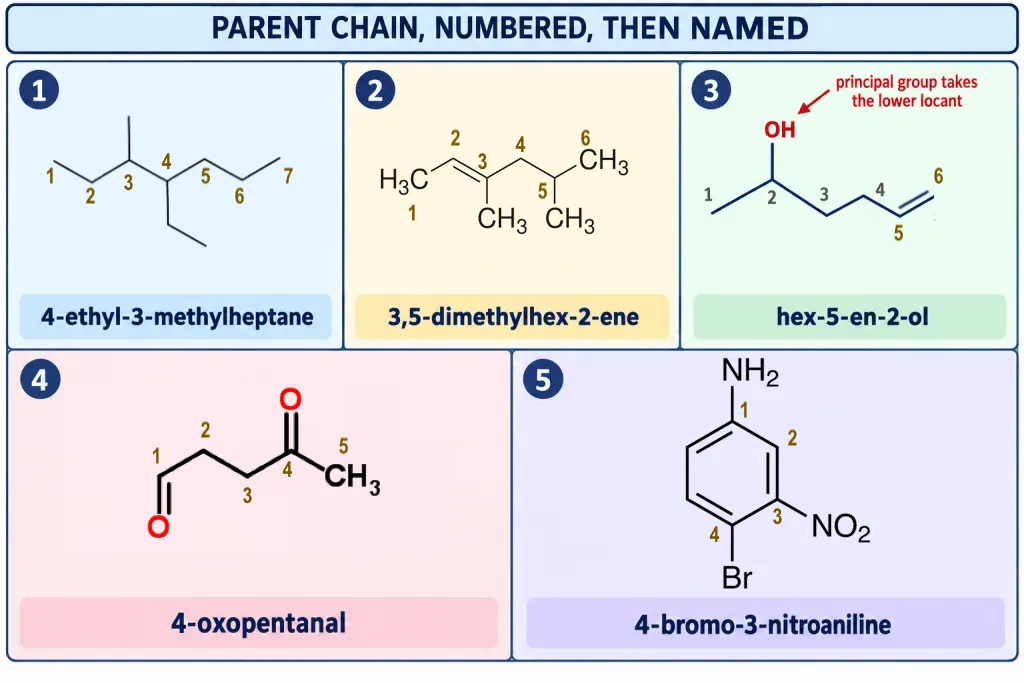
Ans: 4-ethyl-3-methylheptane
Question 12: An alkene with two branches
Name .
Answer:
Six carbons in the written row and two methyls off it, so .
The parent chain must contain the double bond. The written row is six carbons and contains it. There is a second six-carbon route: from the methyl on the fifth carbon, into that carbon, then along the row to the left end. That route also contains the double bond, so the two tie at six. When chains tie, the one with more substituents wins — but both carry two methyls, so it makes no difference and either gives the same name.
Numbering. Nothing here is suffixable except the double bond, so the double bond takes the lowest locant it can. From the left the double bond starts at C-2; from the right it starts at C-4. So I number from the left, and the double bond is 2-ene.
The methyls then sit on C-3 and C-5.
Ans: 3,5-dimethylhex-2-ene
Watch out: The double bond locant is the lower of its two carbons. Numbering from the left, the bond spans C-2 and C-3, and the name uses 2.
Question 13: When the alcohol outranks the double bond
Name .
Answer:
Six carbons in one chain, and the chain holds both the and the double bond. So the parent is a hexenol.
Numbering is the whole question. The alcohol is the principal characteristic group, so it takes the suffix, and rule 2 says the principal group gets the lowest locant — ahead of the double bond, ahead of everything.
From the end: C-1 is the methyl, C-2 carries the , and the double bond spans C-5 and C-6, so it is 5-ene.
From the end: the double bond would be 1-ene but the would sit on C-5.
The at 2 beats the at 5, so the first numbering wins even though it hands the double bond a high locant. The terminal -e of hexane goes because -ol begins with a vowel.
Ans: hex-5-en-2-ol
Watch out: The double bond never overrules the principal group. Numbering to get "hex-1-en-5-ol" is the most common wrong answer to this exact shape of molecule.
Question 14: An aldehyde and a ketone in one chain
Name .
Answer:
Five carbons: the carbon, two groups, the ketone carbon and a methyl. So .
Two carbonyl groups compete for the suffix. The seniority list puts aldehyde above ketone, so -al is the suffix and the ketone drops to the prefix oxo.
An aldehyde carbon is always C-1, so the numbering is forced. C-1 is , C-2 and C-3 are the two groups, C-4 is the ketone carbon and C-5 is the methyl.
Ans: 4-oxopentanal
Watch out: The oxo carbon is inside the chain count, not a substituent hanging off it. Naming this "butanal with an acetyl group" loses a carbon from the root.
Question 15: A benzene ring with two prefixes
A benzene ring carries . A nitro group sits meta to it and a bromine sits para to it. Give the IUPAC name and the molecular formula.
Answer:
The amine is the only suffixable group here — nitro and bromo are always prefixes — so the ring carbon holding is C-1 and the parent is aniline.
Para to C-1 is C-4, so the bromine is at 4 whichever way I go round. Meta to C-1 is C-3 in one direction and C-5 in the other. So the two locant sets are and . First point of difference: 3 beats 4, so the nitro is at 3.
Cited alphabetically, bromo comes before nitro.
For the formula I start from aniline, , take away two ring hydrogens and add and : six carbons, three ring hydrogens plus two on nitrogen, two nitrogens, two oxygens, one bromine.
Ans: 4-bromo-3-nitroaniline,
Question 16: Name to structure, with seniority to check
Write the structure of 5-hydroxy-4-methylhexan-2-one and confirm the name is the correct one for it.
Answer:
I read the name from the back. Hexan-2-one means six carbons in a chain with a on C-2. 4-methyl puts a methyl on C-4. 5-hydroxy puts an on C-5, written as a prefix because the ketone has already claimed the suffix.
Building it carbon by carbon: C-1 is , C-2 is , C-3 is , C-4 is with a methyl, C-5 is with the , C-6 is .
Valency check: C-2 has two chain bonds and a double bond to oxygen, four in total. C-4 has two chain bonds, the methyl and one hydrogen, four. C-5 has two chain bonds, the oxygen and one hydrogen, four. Good.
Formula: seven carbons, and hydrogens with one of those on the oxygen. So .
Now confirming the numbering. Ketone outranks alcohol, so the ketone must take the lower locant. Numbering from the other end would give the 2 and the ketone 5, which puts the senior group higher. The name as written is right.
Ans: ,
Question 17: Find the error — the wrong group took the suffix
A student names as 3-carboxypropan-1-ol. What is wrong, and what is the correct name?
Answer:
The student's structure is right — propan-1-ol with a carboxy group on C-3 does give four carbons with at one end and at the other. The mistake is which group was chosen for the suffix.
Carboxylic acid is at the very top of the seniority list, above alcohol. So must supply the suffix -oic acid, and the alcohol drops to the prefix hydroxy.
Once the acid is the parent group, its carbon is C-1 and the chain is counted from there: C-1 is , C-2 and C-3 are , C-4 is . Four carbons, so butanoic acid, with the hydroxy on C-4.
Ans: the acid, not the alcohol, must take the suffix; the correct name is 4-hydroxybutanoic acid
Watch out: "Carboxy" as a prefix is legal, but only when something even more senior is present — inside a ring name, for instance. It is never used to demote an acid below an alcohol.
Question 18: Find the error — numbering from the wrong end
A student names as 2,2-dimethylbutan-4-ol. Find the mistake and give the correct name.
Answer:
The chain and the substituents are right. The longest chain holding the runs from the carbon through the quaternary carbon and the to the end methyl: four carbons, butane, with two methyls on the carbon next to the .
The mistake is the direction of numbering. The alcohol is the principal group, so it must get the lowest locant available. Numbering from the end puts the on C-1 and the two methyls on C-2. Numbering from the far end puts the on C-4, which is what the student did, and then the methyls come out at 3.
There is a quicker way to spot it. On a four-carbon chain, C-4 is C-1 read backwards, so "butan-4-ol" can never be a correct name — a principal group on the last carbon of a chain always renumbers to the first.
Ans: the chain was numbered from the wrong end; the correct name is 2,2-dimethylbutan-1-ol
Watch out: The student's own locants give it away: for the methyls with the at 4 is not even the lower locant set. Whenever your principal group ends up on the highest-numbered carbon, turn the chain round. [Board]
Structural isomerism and enumeration
Question 19: Every chloride of formula
How many structural isomers has ? Name them all.
Answer:
First the degree of unsaturation, counting the chlorine as a hydrogen:
Zero, so every isomer is a saturated open chain. That means I work skeleton by skeleton: the three pentane skeletons, and on each of them every distinct place the chlorine can sit.
Pentane, . Distinct carbons are C-1, C-2 and C-3 only, because C-4 is C-2 read backwards and C-5 is C-1 read backwards. Three isomers: 1-chloropentane, 2-chloropentane, 3-chloropentane.
2-Methylbutane, . Here C-1 and the methyl branch are the same carbon by symmetry, but C-4 is a genuinely different methyl. So the distinct sites are C-1, C-2, C-3 and C-4. Four isomers: 1-chloro-2-methylbutane, 2-chloro-2-methylbutane, 2-chloro-3-methylbutane and 1-chloro-3-methylbutane.
2,2-Dimethylpropane, . All four methyls are identical and the central carbon has no hydrogen at all. One isomer: 1-chloro-2,2-dimethylpropane.
Ans: 8 structural isomers
Watch out: Putting the chlorine on C-3 of the 2-methylbutane skeleton and calling the product 3-chloro-2-methylbutane gives a ninth name but not a ninth compound. Renumber from the nearer end and it is 2-chloro-3-methylbutane, already counted.
Question 20: The amines of formula
Write every isomer of , classify each as a primary, secondary or tertiary amine, and name the kinds of isomerism present.
Answer:
An amine is classified by how many carbon groups sit on the nitrogen. So I sort by that, then place the carbons.
One group on nitrogen — primary. Three carbons in a chain with on it. The chain gives two distinct positions: propan-1-amine, , and propan-2-amine, .
Two groups on nitrogen — secondary. Three carbons split between two groups, so it must be 2 and 1: -methylethanamine, .
Three groups on nitrogen — tertiary. Three carbons split three ways, so all three are methyls: -dimethylmethanamine, .
Four in all. Every one of them checks out at : nitrogen keeps three bonds throughout, and has nine hydrogens with no left.
The relationships: the two primary amines have the same group in different places, so that pair is position isomerism. A primary amine against the secondary or the tertiary is a change of functional group, so those pairs are functional group isomerism.
Ans: 4 isomers — propan-1-amine and propan-2-amine (primary), -methylethanamine (secondary), -dimethylmethanamine (tertiary); position and functional group isomerism
Watch out: Nitrogen takes three bonds, never four. Writing a fifth isomer with four groups on nitrogen produces an ammonium ion, not an amine.
Question 21: Aromatic hydrocarbons of formula
How many hydrocarbons of formula contain a benzene ring? Name them.
Answer:
A benzene ring uses six of the eight carbons, so two carbons are left for the side chains, and the ring keeps whatever hydrogens are not displaced.
Two carbons can be arranged in exactly two ways: as one two-carbon group, or as two one-carbon groups.
One ethyl group. There is only one place to put a single substituent on a ring, so this gives one compound: ethylbenzene, .
Two methyl groups. Two substituents on a ring can be 1,2 (ortho), 1,3 (meta) or 1,4 (para). That is three compounds: 1,2-dimethylbenzene, 1,3-dimethylbenzene and 1,4-dimethylbenzene, the three xylenes.
Checking one formula to be sure: ethylbenzene has five ring hydrogens plus two plus three on the chain, so ten hydrogens and eight carbons. Correct.
Ans: 4 — ethylbenzene, 1,2-dimethylbenzene, 1,3-dimethylbenzene and 1,4-dimethylbenzene
Watch out: 1,5-dimethylbenzene is not a fifth isomer. Going round the ring the other way makes it 1,3, so it is the meta compound already counted. On a six-ring only 1,2, 1,3 and 1,4 exist.
Question 22: The alkenes of formula
Write every open-chain alkene of formula , name each, and say how many distinct alkenes there are once cis and trans forms are counted.
Answer:
has one degree of unsaturation, so an open chain must hold exactly one double bond.
I take the carbon skeletons in turn and move the double bond about on each.
Five in a row. The double bond can sit between C-1 and C-2, or between C-2 and C-3. Between C-3 and C-4 is the same as C-2 to C-3 read backwards. Two alkenes: pent-1-ene, , and pent-2-ene, .
Four in a row with a methyl branch. The branch is on C-2 of butane. The double bond can go C-1 to C-2, giving 2-methylbut-1-ene, ; or C-2 to C-3, giving 2-methylbut-2-ene, ; or C-3 to C-4, which renumbers to 3-methylbut-1-ene, . Three alkenes.
Three in a row with two branches. That skeleton is , whose central carbon has no hydrogen and no room for a double bond that keeps five carbons. Nothing new.
Now cis and trans. I test each doubly bonded carbon for two different groups. Only pent-2-ene passes on both carbons: one carries methyl and hydrogen, the other ethyl and hydrogen. In 2-methylbut-1-ene and 3-methylbut-1-ene the terminal carbon has two hydrogens; in 2-methylbut-2-ene one carbon has two methyls; pent-1-ene fails the same way as the other terminal alkenes.
So one of the five splits into two, giving six.
Ans: 5 structural isomers, and 6 distinct alkenes once the cis and trans forms of pent-2-ene are counted
Watch out: The question says open-chain. Cyclopentane, methylcyclobutane and the cyclopropanes are also , and they belong to the count only if rings are asked for.
Stereoisomerism, cis-trans and chirality
Question 23: Applying the cis-trans condition four times
Which of these show geometrical isomerism? (a) hex-2-ene (b) hex-3-ene (c) 2-methylbut-1-ene (d) 2,3-dimethylbut-2-ene
Answer:
The test is applied to each doubly bonded carbon on its own: that carbon must carry two different groups. If either carbon fails, there are no cis and trans forms.
(a) Hex-2-ene is . C-2 carries a methyl and a hydrogen — different. C-3 carries a propyl and a hydrogen — different. Both pass, so it shows the isomerism.
(b) Hex-3-ene is . C-3 carries an ethyl and a hydrogen — different. C-4 carries an ethyl and a hydrogen — also different. Both pass. The two carbons happen to bear the same pair of groups as each other, but that does not matter; the test is per carbon.
(c) 2-Methylbut-1-ene is . C-1 carries two hydrogens. It fails immediately, so no.
(d) 2,3-Dimethylbut-2-ene is . Each carbon carries two methyls. Both fail, so no.
Ans: hex-2-ene and hex-3-ene show geometrical isomerism; 2-methylbut-1-ene and 2,3-dimethylbut-2-ene do not
Watch out: Identical groups on opposite ends of the double bond are fine — that is exactly what but-2-ene and hex-3-ene have. What kills the isomerism is identical groups on the same carbon.
Question 24: Two stereocentres, no meso form
How many stereoisomers has 2,3-dichloropentane, ? Describe the relationships.
Answer:
First I find the stereocentres by checking each carbon for four different groups.
C-2 carries a methyl, a hydrogen, a chlorine and the rest of the molecule, . Four different groups, so it is a stereocentre.
C-3 carries a chlorine, a hydrogen, an ethyl and . Four different groups again, so it is a second stereocentre.
Two stereocentres normally give stereoisomers. The only thing that cuts the count is an internal mirror plane, which needs the two halves of the molecule to be identical. Here one half ends in a methyl and the other in an ethyl, so the halves are not identical and there is no meso form.
That leaves four, and they pair up as two sets of mirror images.
Ans: 4 stereoisomers, forming 2 pairs of enantiomers; there is no meso form
Watch out: 2,3-dichlorobutane, which looks almost the same, has methyl on both ends and therefore does have a meso form, giving only 3 stereoisomers. Check the two ends before you divide.
Question 25: Which of these are chiral
Say which of these are chiral, and for each give the reason: (a) 3-chloropentane (b) 2-chloropentane (c) 2-methylpropan-2-ol (d) 2-bromopropanoic acid
Answer:
A molecule with one carbon bearing four different groups is chiral. I look for that carbon.
(a) 3-Chloropentane is . The chlorine-bearing carbon has a chlorine, a hydrogen and two ethyl groups. Two of the four are identical, so it is not a stereocentre. Achiral.
(b) 2-Chloropentane is . That carbon has a methyl, a hydrogen, a chlorine and a propyl. Four different. Chiral.
(c) 2-Methylpropan-2-ol is . The central carbon has three methyls and an . Three identical groups. Achiral.
(d) 2-Bromopropanoic acid is . That carbon has a methyl, a hydrogen, a bromine and a carboxyl. Four different. Chiral.
Ans: 2-chloropentane and 2-bromopropanoic acid are chiral; 3-chloropentane and 2-methylpropan-2-ol are not
Watch out: A carbon with a halogen on it is not automatically a stereocentre. In 3-chloropentane the halogen is there but the two ethyl groups are identical, which is enough to kill the chirality.
Question 26: A diene with two double bonds to set
How many geometrical isomers has hexa-2,4-diene, ?
Answer:
I test each double bond. The C-2 to C-3 bond: C-2 carries a methyl and a hydrogen, C-3 carries a hydrogen and the rest of the chain. Different on both, so this bond can be cis or trans. The C-4 to C-5 bond is the mirror of it and can also be cis or trans.
Two independent choices would give . But this molecule has identical ends — a methyl on each — so I check whether any two of the four are actually the same compound.
- cis at both bonds: one compound.
- trans at both bonds: one compound.
- cis at the first and trans at the second: one compound.
- trans at the first and cis at the second: turn the molecule end for end and this becomes the previous one. Same compound.
So the last two collapse into one, and the count is three.
Ans: 3 geometrical isomers — cis-cis, trans-trans and cis-trans
Watch out: The rule is an upper limit, not an answer. Whenever the two ends of the molecule are the same, check for a form that repeats when the molecule is turned round. [JEE Main]
Intermediates and their stability orders
Question 27: Which bromoalkane ionises fastest
Arrange bromomethane, 1-bromobutane, 2-bromobutane and 2-bromo-2-methylpropane in order of the ease with which the carbon-bromine bond ionises to give a carbocation. Give the alpha hydrogen count for each cation.
Answer:
When the bond breaks heterolytically, bromide takes the pair and the carbon is left positive. So the order of ease is just the order of stability of the four cations produced.
- Bromomethane gives , the methyl cation. The positive carbon has no carbon neighbour, so 0 alpha hydrogens.
- 1-Bromobutane gives , primary. Its only carbon neighbour is a , so 2 alpha hydrogens.
- 2-Bromobutane gives , secondary. Neighbours are a and a , so 5 alpha hydrogens.
- 2-Bromo-2-methylpropane gives , tertiary. Three methyl neighbours, so 9 alpha hydrogens.
More alpha hydrogens means more hyperconjugative structures, and the alkyl groups also push electron density in by towards a carbon that is short of electrons. Both effects run the same way, so stability rises with substitution: tertiary secondary primary methyl.
Ans: 2-bromo-2-methylpropane 2-bromobutane 1-bromobutane bromomethane, with alpha hydrogen counts 9, 5, 2 and 0
Question 28: Which radical the bromination goes through
Propane is treated with bromine in the presence of light. Which radical forms preferentially, and what is the major product?
Answer:
A bromine atom pulls a hydrogen off the propane. There are two kinds of hydrogen to choose from: six on the two end carbons and two on the middle carbon.
Taking an end hydrogen gives , a primary radical with one carbon neighbour and 2 alpha hydrogens. Taking a middle hydrogen gives , a secondary radical with two carbon neighbours and 6 alpha hydrogens.
Radicals follow the same order as carbocations: tertiary secondary primary methyl. So the secondary radical is the more stable of the two, it needs less energy to form, and it is the one the reaction goes through.
That radical then grabs a bromine atom from at the middle carbon.
Ans: the secondary radical forms preferentially, and the major product is 2-bromopropane
Watch out: Statistics favour the end hydrogens six to two, so the answer rests on stability beating numbers. Bromine is selective enough for stability to win; chlorine is far less selective and gives much more of the primary product.
Question 29: Carbanions, and the order that reverses
(i) Arrange , , and in order of stability. (ii) Arrange , , and , and explain why this order runs opposite to the carbocation order.
Answer:
A carbanion has a lone pair on carbon and a negative charge. Anything that pulls electron density away from that carbon spreads the charge and helps; anything that pushes density in makes things worse.
(i) All three substituted anions carry an electron-withdrawing group, so all three beat the bare methyl anion. Among them I use the series, in which is the strongest withdrawer, then , then .
(ii) Alkyl groups are : they release electron density. Pushing more density onto a carbon that already carries a lone pair and a negative charge is destabilising, so every alkyl group added makes the carbanion worse.
The carbocation order is tertiary secondary primary methyl because there the central carbon is short of electrons, so a group is exactly what it wants. Same groups, opposite need, opposite order.
Ans: (i) ; (ii) , the reverse of the carbocation order
Watch out: Hyperconjugation is not the argument for carbanions. There is no empty or half-filled p orbital for the alpha electrons to feed; the deciding factor is the inductive effect working the wrong way.
Question 30: The same skeleton, three intermediates
For , and , give the hybridisation and shape of the central carbon, the number of valence electrons on it and the charge. Then say for each whether it beats or loses to its methyl analogue.
Answer:
I count what is attached to the central carbon in each case, then decide the hybrid state.
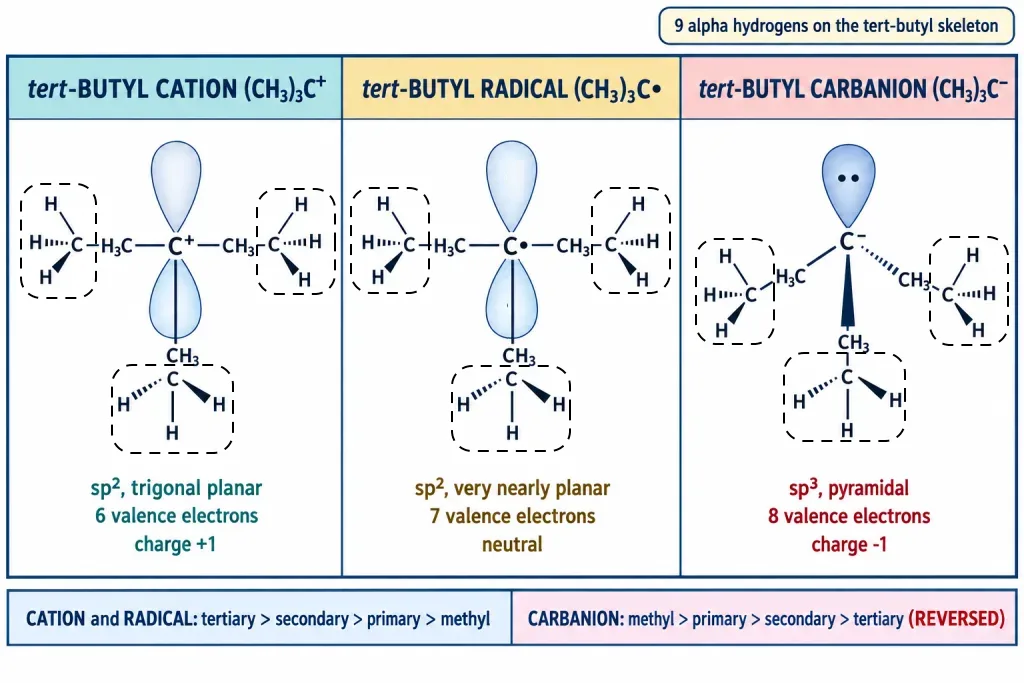
The cation. Three sigma bonds to methyls, nothing else. Three groups means , trigonal planar, with the leftover p orbital empty. Three bonding pairs is 6 valence electrons on that carbon. Charge .
The radical. Three sigma bonds plus one unpaired electron. It is and very nearly planar, with the single electron in the p orbital. Three bonding pairs plus one electron is 7 valence electrons. Neutral.
The anion. Three sigma bonds plus a lone pair — four electron groups, so and pyramidal, the lone pair sitting in an orbital. Three bonding pairs plus a lone pair is 8 valence electrons. Charge .
Against methyl: the cation beats , because the three methyls supply and 9 alpha hydrogens to a carbon short of electrons. The radical beats for the same reasons, less strongly. The anion loses to , because the same push is now unwelcome.
Ans: cation trigonal planar, 6 electrons, ; radical and nearly planar, 7 electrons, neutral; anion pyramidal, 8 electrons, . Tertiary beats methyl for the cation and the radical, and loses to it for the anion
Watch out: The electron count is on the central carbon only, and a lone pair counts two. The cation is the only one of the three with an incomplete octet.
Nucleophiles, electrophiles and the electronic effects
Question 31: Finding the reactive centre
For each species, name the electrophilic centre, the nucleophilic centre, or both: (a) (b) (c) (d) (e)
Answer:
I ask two things of every atom: is it short of electron density, and does it have a pair to give?
(a) . Bromine is more electronegative than carbon, so the bond is polarised . The carbon is the electrophilic centre. Bromine does have lone pairs, but while it is bonded here it acts as the leaving group rather than as a nucleophile.
(b) . The carbonyl is polarised . The carbonyl carbon is electrophilic and the oxygen, with two lone pairs, is nucleophilic. This species has both.
(c) . Boron has only six electrons round it and an empty orbital, so it is an electron-pair acceptor: purely electrophilic, and a Lewis acid.
(d) . Nitrogen has a lone pair and no electron deficiency anywhere: purely nucleophilic, and a Lewis base.
(e) . Nitrogen is more electronegative, so the nitrile carbon is and electrophilic, while the nitrogen lone pair makes that end nucleophilic. Both again.
Ans: carbon in and boron in are electrophilic; nitrogen in is nucleophilic; and carry an electrophilic carbon and a nucleophilic heteroatom
Watch out: A neutral molecule can be a perfectly good nucleophile or electrophile. Charge is not the test — having a pair to give, or a gap to fill, is.
Question 32: Five acids in one line
Arrange in order of decreasing acid strength: acetic acid, fluoroacetic acid, chloroacetic acid, bromoacetic acid and iodoacetic acid.
Answer:
All five give a carboxylate anion when the proton leaves. The more the negative charge on that anion is pulled away from the oxygens and spread out, the more stable the anion and the stronger the acid.
Acetic acid, , has a methyl next to the carboxyl. A methyl is — it pushes density towards the anion, which is the wrong direction. So acetic acid is the weakest of the five.
The other four have a halogen in place of one hydrogen, and every halogen is . The strength of the pull follows electronegativity, and the canon order is
so the acid strengths follow the same order.
Ans: fluoroacetic acid chloroacetic acid bromoacetic acid iodoacetic acid acetic acid
Watch out: Do not rank by bond strength or by size. The carbon-halogen bond gets weaker down the group, which would give the opposite answer; what decides the pull is electronegativity, and fluorine wins that.
Question 33: Name the effect behind each observation
For each observation, say which of the four electronic effects is responsible: inductive, electromeric, resonance or hyperconjugation.
(a) The bond in chlorobenzene is shorter than in chloromethane. (b) Trichloroacetic acid is a far stronger acid than acetic acid. (c) Ethene decolourises bromine water the instant they meet. (d) 2-Methylbut-2-ene is more stable than but-1-ene. (e) The two carbon-oxygen bonds in the acetate ion are equal in length.
Answer:
(a) A chlorine lone pair is fed into the ring, which puts partial double bond character into the bond and shortens it. That needs a pi system and a lone pair, and it is permanent: resonance, the effect of chlorine. The same chlorine is as well, but the shortening is the resonance part.
(b) Three chlorines pull density along the sigma bonds, away from the , stabilising the anion. Permanent, through sigma bonds: inductive, the effect.
(c) The pi pair of the double bond shifts completely to one carbon as the bromine molecule approaches, and it shifts back if the reagent goes away. Temporary, needs an attacking reagent, works on pi electrons: electromeric, the form.
(d) 2-Methylbut-2-ene has three alkyl groups on the double bond and 9 alpha hydrogens; but-1-ene has one alkyl group and 2. Sigma electrons of the alpha bonds delocalise into the pi system: hyperconjugation.
(e) The negative charge is shared equally over both oxygens through two equivalent contributing structures, so both bonds come out the same. Permanent, through a pi system: resonance.
Ans: (a) resonance (b) inductive (c) electromeric (d) hyperconjugation (e) resonance
Watch out: Inductive works through sigma bonds and is permanent. Electromeric works on pi electrons and lasts only while the reagent is there. Mixing those two up is the single most costly confusion in this part of the chapter.
Question 34: The alkene stability ladder
Count the alpha hydrogens in ethene, propene, but-2-ene, 2-methylbut-2-ene and 2,3-dimethylbut-2-ene, and arrange them in order of stability.
Answer:
An alpha hydrogen here is one on a carbon next to a doubly bonded carbon. I take each alkene and look at the neighbours of the double bond.
- Ethene, : no carbon neighbours at all. 0.
- Propene, : one methyl neighbour. 3.
- But-2-ene, : a methyl on each side. 6.
- 2-Methylbut-2-ene, : two methyls on one carbon, one on the other. 9.
- 2,3-Dimethylbut-2-ene, : two methyls on each carbon. 12.
More alpha hydrogens means more hyperconjugative structures and more delocalisation of the sigma electrons into the pi system, so stability rises with the count. The count also tracks how many alkyl groups sit on the double bond, which is why the order matches the substitution order: tetrasubstituted trisubstituted disubstituted monosubstituted ethene.
Ans: 2,3-dimethylbut-2-ene (12) 2-methylbut-2-ene (9) but-2-ene (6) propene (3) ethene (0)
Watch out: Hydrogens on the doubly bonded carbons are not alpha hydrogens. Ethene has four hydrogens and an alpha count of zero, which is the whole reason it sits at the bottom.
Question 35: Acetic acid against ethanol
Both and lose a proton from an . Explain why acetic acid is enormously the stronger acid.
Answer:
I compare the two anions left behind, because whichever anion is better stabilised belongs to the stronger acid.
Ethanol gives the ethoxide ion, . The negative charge sits on one oxygen and stays there — there is no pi system next door to spread it into. Worse, the ethyl group is and pushes a little more density onto an oxygen that already has too much.
Acetic acid gives the acetate ion, . Here the charge does not stay put. Two equivalent contributing structures can be written, one with the double bond to each oxygen and the negative charge on the other. The real ion is a single hybrid of the two, with half a negative charge on each oxygen and both carbon-oxygen bonds the same length. Equivalent contributors give the largest stabilisation there is. On top of that, the carbonyl carbon is electron withdrawing, which helps by as well.
A charge spread over two electronegative atoms is far better off than the same charge parked on one.
Ans: the acetate ion is resonance stabilised over two equivalent structures, with the charge shared by both oxygens, while ethoxide has the charge localised on one oxygen; acetic acid is therefore much the stronger acid
Watch out: The two structures of acetate are not two ions in equilibrium. There is one ion, a hybrid, with two identical carbon-oxygen bonds — which is exactly the experimental evidence for the resonance.
Reaction types, mechanisms and the major product
Question 36: Same substrate, two different reagents
2-Bromobutane is treated with (i) aqueous potassium hydroxide and (ii) alcoholic potassium hydroxide, hot. Give the major product in each case, name the reaction type, and say which alkene predominates and why.
Answer:
The substrate is . The hydroxide ion can attack in two quite different ways, and the solvent decides which.
(i) Aqueous potassium hydroxide. In water the hydroxide behaves mainly as a nucleophile. It attacks the carbon carrying the bromine, bromide leaves with the electron pair, and the takes its place. One group has been swapped for another and the carbon skeleton is untouched, so this is nucleophilic substitution. The product is butan-2-ol.
(ii) Alcoholic potassium hydroxide, hot. In alcohol the hydroxide acts mainly as a base. It removes a hydrogen from a carbon next to the one holding the bromine, bromide leaves from the other side, and a double bond forms between the two carbons. Two groups leave from adjacent carbons, so this is elimination, specifically dehydrohalogenation.
There are two neighbours to choose from. Taking a hydrogen from C-1 gives but-1-ene, which has one alkyl group on the double bond. Taking one from C-3 gives but-2-ene, which has two. By Saytzeff the more substituted alkene is the major product, because more alkyl groups on the double bond means more alpha hydrogens and more hyperconjugative stabilisation — but-2-ene has 6 alpha hydrogens against 2 for but-1-ene.
But-2-ene also has two different groups on each doubly bonded carbon, so it exists as cis and trans forms, and the trans form dominates.
Ans: aqueous KOH gives butan-2-ol by nucleophilic substitution; alcoholic KOH gives but-2-ene as the major alkene by elimination, with but-1-ene minor
Watch out: The reagent is the same ion in both flasks. Only the solvent changes, and with it whether the hydroxide behaves as a nucleophile or as a base.
Question 37: Chlorinating 2-methylpropane
2-Methylpropane is treated with chlorine in sunlight. Name the products of monochlorination, classify the reaction, and say which product is favoured per hydrogen.
Answer:
2-Methylpropane is . It has two kinds of hydrogen: nine on the three methyls, all primary, and one on the central carbon, tertiary.
Replacing a primary hydrogen gives , which is 1-chloro-2-methylpropane. Replacing the tertiary hydrogen gives , which is 2-chloro-2-methylpropane. Two products, and no more, because all nine primary hydrogens are equivalent.
The reaction goes by a free radical chain, so it is free radical substitution. Light splits the chlorine molecule homolytically into two chlorine atoms, that is initiation. A chlorine atom then abstracts a hydrogen to give an alkyl radical and , and the alkyl radical takes a chlorine atom from to give the chloride and a fresh chlorine atom — those two steps are propagation, and they keep the chain running. Two radicals combining ends it.
Per hydrogen, the tertiary one wins. Pulling it off gives the tertiary radical , which has 9 alpha hydrogens and three methyl groups, while the primary route gives with only 2 alpha hydrogens. The more stable radical forms more easily.
Ans: 1-chloro-2-methylpropane and 2-chloro-2-methylpropane, by free radical substitution; per hydrogen the tertiary position reacts faster, giving 2-chloro-2-methylpropane
Watch out: Faster per hydrogen does not mean more product overall. There are nine primary hydrogens against one tertiary, and chlorine is a poor discriminator, so the primary chloride is still formed in quantity. Bromine, which is much more selective, would favour the tertiary product heavily.
Purification, qualitative and quantitative analysis
Question 38: Choosing the technique
Name the method of purification or separation you would use in each case, with one reason:
(a) camphor contaminated with sodium chloride (b) aniline in a mixture with non-volatile tarry impurities (c) glycerol, which decomposes at its normal boiling point (d) a mixture of acetone (boiling point ) and methanol (boiling point ) (e) an organic acid dissolved in water, which is far more soluble in ether than in water
Also say which of column chromatography and paper chromatography works by adsorption and which by partition.
Answer:
Each answer follows from one property that the two components do not share.
(a) Camphor passes straight from solid to vapour on heating, and sodium chloride does not. Sublimation — the camphor vaporises, and I collect it as a solid on a cold funnel while the salt stays behind.
(b) Aniline is volatile in steam and does not mix with water, while tarry impurities are not volatile at all. Steam distillation — and it comes over below , because the vapour pressures of the aniline and the water add together to reach atmospheric pressure early.
(c) The problem is the compound, not the impurity. Distillation under reduced pressure — lowering the pressure lowers the boiling point, so the glycerol distils below the temperature at which it would break up.
(d) Nine degrees apart is close. Fractional distillation — the fractionating column gives the vapour many chances to condense and re-evaporate, and each cycle enriches it in the lower boiling acetone.
(e) The acid partitions between the two liquids and prefers the ether. Differential extraction in a separating funnel — shake, let the layers settle, run off the lower aqueous layer, and repeat with fresh small portions of ether rather than one large one.
Column chromatography packs a solid stationary phase, usually silica gel or alumina, so it separates by adsorption. Paper chromatography relies on the water held on the cellulose fibres as a liquid stationary phase, so it separates by partition.
Ans: (a) sublimation (b) steam distillation (c) distillation under reduced pressure (d) fractional distillation (e) differential extraction; column chromatography is adsorption and paper chromatography is partition
Watch out: Paper looks like a solid, which is why it is so often called adsorption chromatography. The stationary phase is the water held in the paper, so it is partition.
Question 39: Carbon, hydrogen, chlorine and oxygen by difference
On complete combustion, 0.189 g of an organic compound gave 0.176 g of carbon dioxide and 0.054 g of water. In a separate Carius determination, 0.189 g of the same compound gave 0.287 g of silver chloride. The molar mass is 94.5 g/mol. Find the empirical and molecular formulae and name the compound.
Answer:
Carbon first. Out of every 44 g of , 12 g is carbon.
Hydrogen next, with the factor because water carries two hydrogens.
Chlorine from the silver chloride, using and .
Those three add to , so oxygen by difference is .
Now moles, dividing each percentage by the atomic mass:
Dividing all four by the smallest, 1.058:
Empirical formula , whose mass is . Then
so the molecular formula is the empirical formula itself. Two carbons, three hydrogens, a chlorine and two oxygens, with one carbon carrying and the other a chlorine and two hydrogens.
Ans: empirical and molecular formula both ; the compound is chloroethanoic acid, , also written chloroacetic acid
Watch out: Oxygen is found by difference here, so every earlier percentage feeds into it. A slip in the chlorine factor moves the oxygen figure by the same amount and can wreck the whole ratio.
Question 40: A full determination, Kjeldahl included
0.59 g of an organic compound on combustion gave 0.88 g of carbon dioxide and 0.45 g of water. A Kjeldahl determination on another 0.59 g liberated ammonia that neutralised exactly 20.0 mL of 0.5 M hydrochloric acid. The vapour density of the compound is 29.5. Find the molecular formula and identify the compound.
Answer:
For nitrogen I use the Kjeldahl formula, with the molarity of the acid and in millilitres.
Those three come to , so oxygen by difference is .
Moles:
Dividing by 1.695 gives C 2.00, H 5.00, N 1.00, O 1.00, so the empirical formula is with a mass of .
Molar mass from vapour density is twice the vapour density:
So the molecular formula is . Two carbons, one nitrogen and one oxygen, with the nitrogen released as ammonia by Kjeldahl digestion — which tells me the nitrogen is in a straightforward amide or amine link, not in a ring and not in a nitro group. The compound is ethanamide.
Ans: ; the compound is ethanamide, , commonly called acetamide
Watch out: Kjeldahl succeeding is itself a clue. The method fails for nitrogen held in a ring and for nitro and azo compounds, so a clean Kjeldahl result rules those structures out. [NEET]