
Carbon earns a subject of its own
Every element has a chemistry. Only one has a whole branch of the syllabus named after its compounds.
More compounds of carbon are known than of all the other elements put together: more than a hundred million are on record, and the count keeps rising. No other element comes within a factor of a hundred of that.
Then look at where those compounds turn up. The proteins that run every cell, the DNA that stores the instructions for building them, the carbohydrates and fats that carry the energy — all compounds of carbon. So are petrol, diesel, LPG and coal tar. So is almost every drug in a chemist shop. So is every plastic, every synthetic fibre, every rubber, every dye and every detergent. Organic chemistry is the chemistry of fuel, food, medicine and material.
The vital force idea, and how it died
For a long time chemists believed that compounds obtained from living things could only be made by living things, through some "vital force" present in a plant or animal. Compounds from minerals were inorganic; compounds from organisms were organic, and the boundary was thought to be uncrossable.
That belief broke in 1828, when Wohler heated ammonium cyanate — an ordinary inorganic salt — and got urea, a substance until then obtained only from urine.
Ammonium cyanate and urea have the same molecular formula; heating simply rearranged the atoms. Once that was clear the vital force had nothing left to explain, and "organic" stopped meaning "from a living thing" and started meaning what it means now: containing carbon.
Key Point (Definition): Organic chemistry is the chemistry of carbon compounds and their derivatives. The name is historical; the definition is structural.
Two questions run through the whole of organic chemistry: what is the structure, and where will the electrons move. This section answers the one both depend on — what shape the molecule has, and why that shape and no other. Bond angles, lengths and strengths decide which reactions are possible, which isomers exist, and which of two compounds is the stronger acid.
Tetravalence: four bonds, never more
Carbon is element 6. Its ground-state configuration is , so the second shell holds four electrons and needs four more for the octet. Carbon gets them by sharing, four times over.
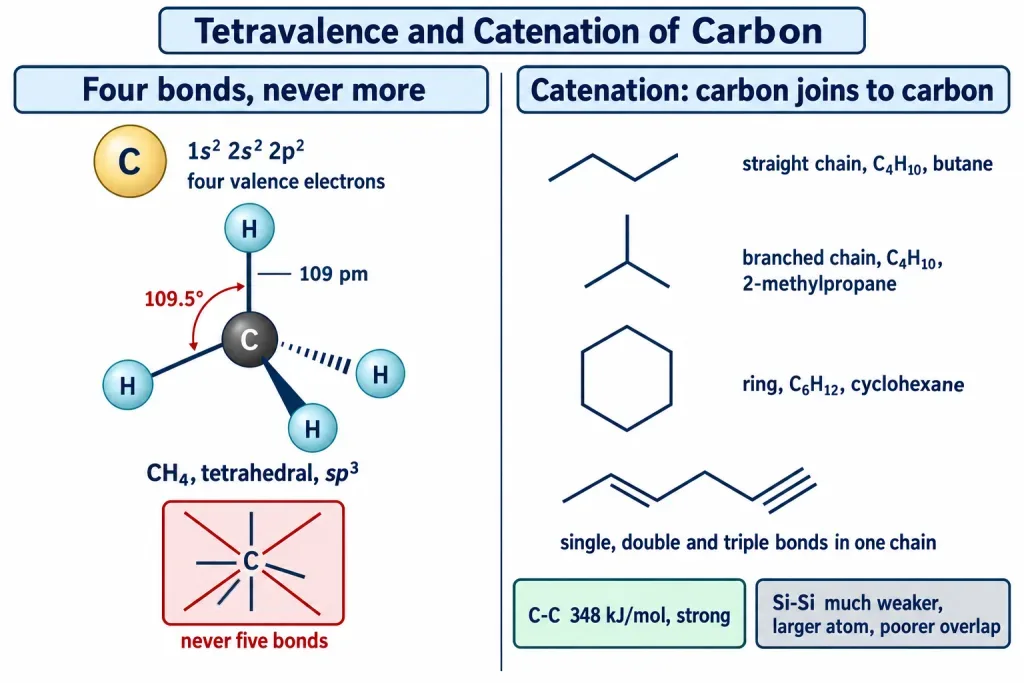
Four properties of the carbon atom force this behaviour.
Four valence electrons. Carbon sits in the middle of the second period, exactly half way to a filled shell, so neither losing nor gaining four electrons is a realistic option.
High ionisation enthalpy. Stripping four electrons off carbon to give would cost far more energy than any lattice could return. Carbon does not form simple positive ions of that kind.
Not electronegative enough for . Adding four electrons to one small atom piles too much negative charge on too little volume. Carbides such as exist, but the simple ion is not the normal state of carbon.
So carbon shares. Four shared pairs give a complete octet and leave the atom neutral. That is tetravalence.
No d orbitals in the valence shell. The second shell has only 2s and 2p subshells; there is no 2d. Carbon therefore has four orbitals available for bonding and not one more, so its maximum covalency is four. A hard limit, not a tendency.
Key Point: Carbon is tetravalent because it has four valence electrons and no way to reach the octet except by sharing; its covalency cannot exceed four because the second shell has no d orbitals.
Where the contrast with silicon starts
Silicon is directly below carbon and also has four valence electrons, but silicon is in the third period and the third shell does have 3d orbitals. Silicon can therefore expand its covalency past four — the hexafluoridosilicate ion, , has six bonds to one silicon atom. There is no matching .
That difference explains a fact worth carrying: is not attacked by water, while hydrolyses the moment it meets moisture. Water attacks by donating a lone pair to the central atom. Silicon accepts it into a d orbital and expands to five bonds on the way to products. Carbon cannot accept it at all, because accepting it would mean five bonds to carbon.
[JEE Main] A carbon written with five bonds is wrong, always, with no exception and no intermediate. When a mechanism seems to need one, the step is wrong.
Carbon is also a small atom, so its compact bonding orbitals overlap closely with those of hydrogen, oxygen, nitrogen, sulphur, the halogens and above all other carbon atoms. Close overlap means strong bonds. Small size plus four bonds plus strong bonds is the whole recipe.
Catenation: carbon bonded to carbon, without limit
The number of carbon compounds is large for one reason above all others. Carbon bonds to itself.
Key Point (Definition): Catenation is the ability of an element to form bonds between its own atoms, giving chains and rings. Carbon shows catenation to an extent no other element approaches.
Two carbons give ethane, three give propane, and there is no natural stopping point: straight chains, branched chains, rings of three, five, six or thirty carbons, rings fused to rings, rings hung off chains. The same carbons can be joined by single, double or triple bonds, and one molecule can carry all three. Every different way of joining the same atoms is a different compound, which is why a single formula such as already covers 18 distinct structures. Add carbon's willingness to bond strongly to hydrogen, oxygen, nitrogen, sulphur, phosphorus and the halogens, and the number of possible molecules stops being surprising.
Why the C-C bond can carry a chain
The C-C single bond enthalpy is 348 kJ/mol, a strong bond by any standard, and the reason is the small size of the carbon atom: the two bonding orbitals overlap deeply and the shared pair sits close to both nuclei.
Carbon also makes strong multiple bonds to itself — C=C at 681 kJ/mol and the triple bond at 823 kJ/mol. Stable double and triple bonds between like atoms are rare, and carbon has both. The 681 kJ/mol of the double bond is itself a sigma part of about 397 kJ/mol plus a pi part of about 284 kJ/mol.
Silicon tries and fails
Silicon catenates a little. The silanes , and are known, and a handful of longer ones, but the series runs out at around six or seven silicon atoms and even the short ones are reactive and easily destroyed. Alkanes of thirty carbons sit in a bottle indefinitely. Two reasons, and they are really one reason twice.
The Si-Si bond is much weaker. Its bond enthalpy is roughly two-thirds of the C-C value, so a silicon chain has far less to lose by breaking up. And Si-O is stronger than Si-Si, so a silicon chain exposed to air or water prefers to become silica or a silicate — which is why silicon in nature occurs as and silicates, never as long chains.
The silicon atom is larger. Bigger atoms hold their bonding electrons further out, the orbitals overlap less deeply, and the bond comes out longer and weaker. The same size effect kills silicon's multiple bonds: an bond needs two large, diffuse p orbitals to overlap sideways, and they do not reach each other well enough. Ethene is a bulk industrial chemical; ordinary compounds are not part of everyday chemistry.
[NEET] Explaining carbon's catenation with "carbon is tetravalent" earns nothing. Silicon is tetravalent too. The marks are in the strength of the C-C bond and the small size of the carbon atom.
Three hybrid states, three shapes
A ground-state carbon atom has two unpaired 2p electrons, which predicts two bonds. Carbon makes four, and the four bonds in methane are identical, which two 2p and one 2s orbital could never produce on their own.
Hybridisation resolves both problems. Orbitals of similar energy on the same atom mix to give a new set of equivalent orbitals — equal in number to those mixed, identical in shape and energy, pointing in the directions that keep them furthest apart. Carbon uses exactly three hybrid states.
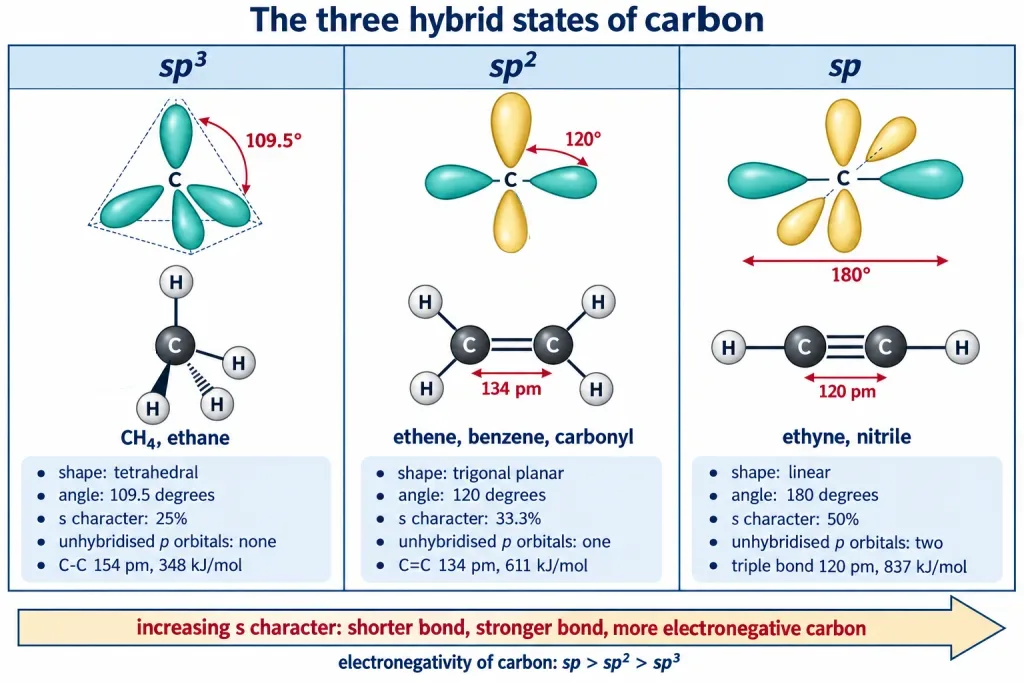
One 2s orbital mixes with all three 2p orbitals, giving four equivalent orbitals, each one part s and three parts p, so each carries 25% s character.
Four orbitals repelling each other as much as possible point to the corners of a regular tetrahedron, at 109.5 degrees. Every carbon in an alkane is , and so is the carbon of an alcohol, a haloalkane or an amine.
One 2s orbital mixes with two of the 2p orbitals, giving three equivalent orbitals of 33.3% s character and leaving one 2p orbital untouched.
Three orbitals spread as widely as possible in a plane lie at 120 degrees to one another — trigonal planar. The leftover 2p orbital stands perpendicular to that plane, one lobe above and one below, and it is this spare p orbital that makes a pi bond. Every doubly bonded carbon in an alkene, every carbon of a benzene ring and every carbonyl carbon is .
One 2s orbital mixes with one 2p orbital, giving two equivalent orbitals of 50% s character and leaving two 2p orbitals untouched.
Two orbitals as far apart as possible point in opposite directions: linear, angle 180 degrees. The two remaining 2p orbitals are perpendicular to each other and both perpendicular to the molecular axis, and they form the two pi bonds of a triple bond. Every triply bonded carbon, and the central carbon of an allene or of carbon dioxide, is .
The table to memorise
| Hybrid state | Orbitals mixed | s character | Shape | Bond angle | Unhybridised p | Typical bond and length |
|---|---|---|---|---|---|---|
| one s, three p | 25% | tetrahedral | 109.5 degrees | none | C-C single, 154 pm | |
| one s, two p | 33.3% | trigonal planar | 120 degrees | one | C=C double, 134 pm | |
| one s, one p | 50% | linear | 180 degrees | two | triple bond, 120 pm |
To assign the hybrid state of any carbon in a structure, count the sigma bonds on it. Four sigma means ; three sigma and one pi means ; two sigma and two pi means . Counting attached atoms works just as well — four attached atoms, ; three, ; two, .
[Board] Ethane's C-H bond length is 109 pm and its C-C bond length is 154 pm. Benzene is the one to keep separate: all six of its C-C bonds are equal at 139 pm, between the single-bond and double-bond values, with every angle 120 degrees.
Methane, ethene and ethyne, worked through
Everything later in the chapter is built on these three.
Methane,
The carbon is . Its four hybrid orbitals point to the corners of a tetrahedron, each overlapping end-on with the 1s orbital of a hydrogen atom, giving four identical C-H sigma bonds.
Shape: tetrahedral, all six H-C-H angles 109.5 degrees, all four C-H bonds 109 pm. No pi bond anywhere in the molecule and no unhybridised p orbital left on carbon.
Methane is not flat and the four bonds are not at 90 degrees. Drawing it as a cross on paper is a writing convention, not a shape.
Ethene,
Each carbon is , so each has three hybrid orbitals in a plane at 120 degrees and one 2p orbital perpendicular to that plane.
Building the molecule:
- one orbital of each carbon overlaps end-on with the other, giving the C-C sigma bond;
- the remaining two orbitals on each carbon overlap with hydrogen 1s orbitals, giving four C-H sigma bonds;
- the two leftover 2p orbitals, parallel to each other and both perpendicular to the plane, overlap sideways to give one pi bond.
Total: five sigma bonds and one pi bond. The double bond is one sigma plus one pi, not two of the same thing.
Shape: planar. All six atoms lie in one plane and all the angles at carbon are close to 120 degrees. The C=C bond length is 134 pm, shorter than the 154 pm of a C-C single bond, because the pi overlap pulls the two carbons together.
Ethyne,
Each carbon is : two hybrid orbitals pointing in opposite directions along one axis, and two 2p orbitals perpendicular to the axis and to each other.
- one orbital from each carbon overlaps end-on, giving the C-C sigma bond;
- the other orbital on each carbon overlaps with a hydrogen 1s orbital, giving two C-H sigma bonds;
- the two pairs of parallel 2p orbitals overlap sideways in two perpendicular planes, giving two pi bonds.
Total: three sigma bonds and two pi bonds. The triple bond is one sigma plus two pi.
Shape: linear. All four atoms lie on a straight line, H-C-C angle 180 degrees. The triple bond is 120 pm long, the shortest of the three.
The two pi bonds together wrap the sigma bond in a cylinder of electron density, and that cylinder is what an attacking electrophile meets first.
Question 1: Hybridisation of every carbon
Give the hybrid state of each carbon atom in (a) , (b) , (c) , (d) , (e) .
Answer:
I count sigma bonds on each carbon. Four sigma means , three sigma plus a pi means , two sigma plus two pi means .
(a) The single carbon carries three H and one Cl — four sigma bonds. .
(b) Propanone. Each methyl carbon has four sigma bonds, so ; the middle carbon is bonded to two methyls and doubly bonded to oxygen, three sigma and one pi, so .
(c) The methyl carbon has four sigma bonds, . The nitrile carbon has one sigma to carbon, one sigma to nitrogen and two pi to nitrogen, so .
(d) Methanamide. The only carbon holds one H, one N and a double bond to O: three sigma and one pi. .
(e) Left to right: the methyl carbon is , both doubly bonded carbons are , the nitrile carbon is .
Ans: (a) ; (b) ; (c) ; (d) ; (e) Watch out: The nitrogen of a nitrile is as well, but the question asks only about carbon. Do not let the lone pair on nitrogen tempt you into calling that carbon .
Question 2: Shape from hybrid state
Write the hybrid state of carbon and the shape of each molecule: (a) , (b) , (c) .
Answer:
(a) Methanal. The carbon has two sigma bonds to H, one sigma to O and one pi to O. Three sigma, so , and means trigonal planar with angles near 120 degrees.
(b) Fluoromethane. Three H and one F, all sigma. , tetrahedral, 109.5 degrees.
(c) Hydrogen cyanide. The carbon has one sigma to H, one sigma to N and two pi to N. Two sigma, so , and means linear at 180 degrees.
Ans: (a) , trigonal planar; (b) , tetrahedral; (c) , linear
Question 3: Counting sigma and pi bonds
How many sigma and how many pi bonds are there in ?
Answer:
I count every bond once. A single bond is one sigma. A double bond is one sigma and one pi. A triple bond is one sigma and two pi.
Skeleton bonds, left to right: C-C single (1 sigma), C=C (1 sigma, 1 pi), C-C single (1 sigma), C triple bond C (1 sigma, 2 pi). That is 4 sigma and 3 pi.
Hydrogens: the formula is , so 6 C-H sigma bonds — three on the methyl, one on each of the two doubly bonded carbons, one on the terminal alkyne carbon.
Total sigma . Total pi .
Ans: 10 sigma bonds and 3 pi bonds Watch out: Do not count the double bond as two pi. It is one sigma and one pi; only the triple bond has two pi.
Question 4: A double bond is not two single bonds
The C-C bond enthalpy is 348 kJ/mol and the C=C bond enthalpy is 681 kJ/mol. Estimate the strength of the pi bond, and say what the numbers tell you.
Answer:
The double bond is one sigma plus one pi. If I take the sigma part of the double bond to be about the same as an ordinary single bond, then
That is only a rough estimate. The measured split of the double bond is about 397 kJ/mol for the sigma part and about 284 kJ/mol for the pi part, and . The subtraction overestimates the pi bond because the sigma bond inside a double bond is not an ordinary single bond: it is shorter, 134 pm against 154 pm, and a shorter bond is a stronger one, so its true share is well above 348 kJ/mol. Taking too small a sigma value leaves too large a pi value.
Twice the single bond would be kJ/mol, and the real double bond is 681 kJ/mol, short of that. So a double bond is still not two single bonds, and the pi bond is worth clearly less than the sigma bond it accompanies.
The reason is the overlap. A sigma bond is made by orbitals meeting end-on along the line joining the nuclei, which is the most efficient overlap available. A pi bond is made by parallel p orbitals brushing past each other sideways, which is weaker overlap and puts the electron density off the internuclear axis.
Ans: About 284 kJ/mol on the measured sigma-pi split, or roughly 333 kJ/mol by the crude subtraction ; either way a double bond is less than twice a single bond, because pi overlap is weaker than sigma overlap Watch out: This is also why alkenes and alkynes react by addition. The pi bond is the cheap bond to break.
Sigma and pi: two bonds, two kinds of overlap
Every bond drawn in this chapter is one of two types, and the difference is entirely in how the orbitals meet.
The sigma bond
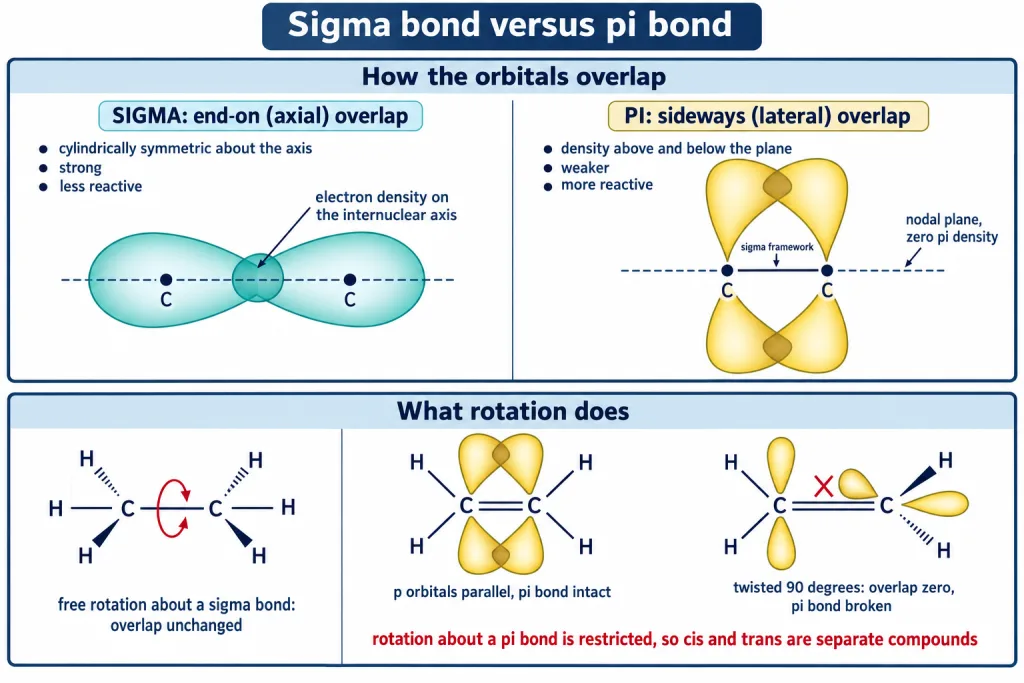
A sigma bond forms when two orbitals overlap end-on, along the straight line joining the two nuclei. The orbitals can be s with s, s with a hybrid, hybrid with hybrid, or two p orbitals pointing at each other; the pattern of overlap is what matters, not the labels.
Two consequences follow. The electron density is concentrated on the internuclear axis, between the two nuclei where both attract it — the most efficient overlap two orbitals can achieve, so a sigma bond is a strong bond. And the charge cloud is cylindrically symmetric about the axis, so spinning one atom about the bond axis does not change the overlap at all.
Key Point: Rotation about a sigma bond is essentially free. The overlap, and therefore the energy, does not change as the two ends turn.
That is why ethane has no isomers arising from the position of its hydrogens: the two methyl groups spin relative to each other billions of times a second, and every arrangement converts freely into every other. The same holds for every single bond in a chain, which is why a long alkane is floppy rather than rigid.
The pi bond
A pi bond forms when two parallel p orbitals, standing perpendicular to the plane of the sigma framework, overlap sideways. Its geometry is the opposite of a sigma bond's in every respect that matters.
The electron density sits in two clouds, one above the plane and one below it, with a nodal plane through both nuclei where the pi density is zero. None of it lies on the internuclear axis. The overlap is less efficient, because the lobes meet at their sides rather than head-on, so a pi bond is weaker than the sigma bond of the same pair of atoms.
And the overlap depends completely on the two p orbitals staying parallel. Twist one carbon of ethene by 90 degrees relative to the other and the p orbitals become perpendicular, the sideways overlap falls to zero and the pi bond is destroyed. Breaking a bond costs energy, so the twist does not happen at ordinary temperatures.
Key Point: Rotation about a pi bond is restricted. Turning either end would break the parallel p-p overlap, so the two ends of a double bond are locked in one plane.
That single fact is the whole basis of geometrical isomerism, taken up in section 8. Two groups on the same side of a C=C stay on the same side, so the cis and trans arrangements are separate, bottleable compounds. Try the same on a C-C single bond and there are no separate compounds, because rotation scrambles them instantly.
Why the pi bond is the reactive one
Three properties of the pi cloud make it the point of attack in an alkene or alkyne. It lies away from the internuclear axis, above and below the plane, not tucked between the two nuclei the way sigma density is, so it is held less tightly — further from both positive centres and higher in energy. It is exposed on the outside of the molecule, so a reagent approaching an alkene meets it first while the sigma framework stays buried underneath. And it is weaker, so less energy is needed to break it.
A pi bond is therefore a loosely held, exposed, comparatively weak pair of electrons sitting on the surface of the molecule, and anything short of electrons — an electrophile — goes for it. This is why alkenes and alkynes undergo addition while alkanes, which have only sigma bonds, are so unreactive that they were once called paraffins, meaning "little affinity". Every electrophilic addition later in organic chemistry begins with a reagent reaching for a pi cloud.
[JEE/NEET] A sigma bond is stronger but less reactive; a pi bond is weaker and more reactive. Both halves of that sentence are examined, and the first half is the one students forget.
s character: the thread that ties bond length, strength and acidity together
A 2s orbital is spherical and holds its electron closer to the nucleus than a 2p orbital, which is directional and reaches further out. A hybrid orbital inherits that in proportion: an orbital is half s and holds its electrons closest to the carbon nucleus, an orbital is one third s, and an orbital is only one quarter s and reaches furthest out.
Key Point: More s character means the hybrid orbital is more compact and closer to the nucleus. The bonds it makes are shorter and stronger, and the carbon carrying it is more electronegative.
Bond length falls as s character rises
Read the three carbon-carbon bond lengths in that order.
| Bond | Carbons | s character of each carbon | Length | Bond enthalpy |
|---|---|---|---|---|
| C-C | - | 25% | 154 pm | 348 kJ/mol |
| C=C | - | 33.3% | 134 pm | 681 kJ/mol |
| triple C-C | - | 50% | 120 pm | 823 kJ/mol |
Two things shorten the bond at once: more s character pulls the bonding orbitals in, and each extra pi bond pulls the nuclei together. Both run the same way, which is why the trend is so steep — 154, 134, 120 pm.
The C-H bonds follow the same rule. Ethane's C-H bond, from an carbon, is 109 pm; the C-H bond of ethene is shorter and that of ethyne shorter still, because the carbon orbital doing the bonding has more s character each time.
[Board] The C-H bond enthalpy is 414 kJ/mol and the C-C bond enthalpy is 348 kJ/mol, so a C-H bond is the stronger of the two — not what most students assume.
Electronegativity follows s character
An orbital that keeps its electrons closer to the nucleus pulls harder on a shared pair, so the same element, carbon, is more electronegative in one hybrid state than another.
An carbon is the most electronegative carbon there is, an carbon the least. Nothing about the nucleus has changed — only the orbital holding the electrons.
The acidity of ethyne
Alkanes are not acids in any useful sense. Ethyne is, weakly but measurably, and the reason is entirely s character.
In ethyne the C-H bond runs from an carbon to hydrogen. That carbon is the most electronegative kind of carbon, so it holds the shared pair tightly and leaves the hydrogen with a distinct . When the proton goes, the pair it leaves behind sits in an orbital — 50% s character, held close to the carbon nucleus and comparatively comfortable there. A stabilised anion means an easier proton loss. Run the same argument on ethene and the lone pair lands in an orbital (33.3% s), on ethane in an orbital (25% s), each less able to hold the charge than the one before.
Sodium metal converts ethyne to sodium acetylide; ammoniacal silver nitrate gives a white precipitate of silver acetylide and ammoniacal cuprous chloride a red one of copper acetylide. Those tests work only on a terminal alkyne, one with a hydrogen on the triply bonded carbon. But-2-yne, , has no such hydrogen and gives no precipitate.
Key Point: The acidity of a terminal alkyne, its short strong bonds and the electronegativity order are three faces of one fact — the s character of the hybrid orbital.
The one exception to keep straight
Benzene does not fit the 154-134 pattern. All six of its C-C bonds are identical at 139 pm, between the single-bond and double-bond lengths, with every ring angle 120 degrees and every carbon . There are no alternating long and short bonds. The reason is resonance, worth 150 kJ/mol of extra stability, and section 12 deals with it.
Question 5: Bond lengths in order
Arrange these bonds in increasing order of length and justify the order: the C-C bond of ethane, the C-C bond of benzene, the C=C bond of ethene, the carbon-carbon bond of ethyne.
Answer:
I use two ideas. More bonds between the same two carbons pulls them closer, and more s character on the carbons pulls the bond in as well.
Ethyne: -, triple bond, 50% s character. Shortest, 120 pm.
Ethene: -, double bond, 33.3% s. Next, 134 pm.
Benzene: -, but the bond order is between one and two because of resonance, so it lands between the double and single values, 139 pm.
Ethane: -, single bond, only 25% s. Longest, 154 pm.
Ans: ethyne (120 pm) < ethene (134 pm) < benzene (139 pm) < ethane (154 pm) Watch out: Benzene goes between ethene and ethane, not equal to either. Writing benzene's bonds as alternately 134 and 154 pm is wrong — all six are 139 pm.
Question 6: All the bond angles in propene
Predict every bond angle at carbon in .
Answer:
I assign hybrid states first. The methyl carbon has four sigma bonds, so . Both of the doubly bonded carbons have three sigma bonds each, so both are .
At the methyl carbon: tetrahedral, so H-C-H and H-C-C angles are all about 109.5 degrees.
At each carbon: trigonal planar, so C-C=C, C=C-H and H-C-H angles are all about 120 degrees.
The three carbons and the three hydrogens on the carbons all lie in one plane; only the methyl hydrogens come out of it.
Ans: about 109.5 degrees at the methyl carbon, about 120 degrees at both carbons Watch out: A molecule can have two different sets of bond angles. Quoting a single angle for the whole of propene is a lost mark.
Question 7: Rotation, and which bond allows it
Explain why but-2-ene exists as two separable compounds but butane does not.
Answer:
The bond between carbon 2 and carbon 3 is the deciding one.
In butane it is a C-C single bond, so a sigma bond. Sigma electron density is cylindrically symmetric about the bond axis, so turning one end relative to the other does not change the overlap and costs essentially no energy. Rotation is free, every arrangement flips into every other continuously, and no two of them can be separated.
In but-2-ene that bond is a double bond, so a sigma plus a pi. The pi bond exists only while the two p orbitals stay parallel. Twisting either carbon destroys the sideways overlap, which means breaking a bond, and there is not enough energy around to do it. The two ends are locked. A methyl group on one carbon stays permanently on the same side as, or permanently opposite to, the methyl on the other — giving cis-but-2-ene and trans-but-2-ene as two distinct, bottleable compounds.
Ans: Free rotation about the sigma bond in butane scrambles all arrangements; restricted rotation about the pi bond in but-2-ene freezes the two arrangements into separate cis and trans compounds
Question 8: Allene
Give the hybrid state of each carbon in and describe the shape.
Answer:
The two end carbons each have two sigma bonds to hydrogen and one sigma bond to the central carbon — three sigma bonds each, so both are , trigonal planar.
The central carbon has only two sigma bonds, one to each end carbon, plus two pi bonds. Two sigma means , so the three carbons lie on a straight line.
The central carbon has two unhybridised p orbitals, and they are perpendicular to each other. One of them makes the pi bond to the left-hand carbon; the other makes the pi bond to the right-hand carbon. Each end carbon's p orbital must line up with the one it bonds to. So the plane at the left end is perpendicular to the plane at the right end.
Ans: end carbons , central carbon ; the carbon skeleton is linear and the two planes are perpendicular to one another Watch out: Allene is not planar. Calling it planar because both ends are misses that the central carbon has two mutually perpendicular p orbitals.