
Five ways of writing one molecule
A molecular formula counts atoms and stops. says four carbons, ten hydrogens, one oxygen, and nothing about which atom joins which — it covers seven compounds, four alcohols and three ethers.
What organic chemistry needs is the connectivity: the exact set of bonds. Five ways of writing one molecule are set out below — the molecular formula, which records the atom count and no connectivity at all; three standard ways of putting the connectivity on paper; and a fifth for shape in three dimensions.
| Level | What it records |
|---|---|
| Molecular formula | how many atoms of each element |
| Complete structural formula | every atom and every bond, drawn out |
| Condensed formula | the same connectivity compressed into one line of text |
| Bond-line (skeletal) formula | the carbon skeleton as a zig-zag of lines |
| Three-dimensional (wedge-dash) formula | which bonds point towards you and which point away |
All describe the same molecule. Pick one according to what you want to show, and move between them without losing an atom; questions are usually set in one representation and answered in another.
Key Point: Two structures are the same compound only if every atom has the same neighbours. Changing the representation never changes the compound. If a conversion appears to change the molecular formula, the conversion is wrong.
The complete structural formula
Here every atom is written as its symbol and every covalent bond as a line.
Ethane, , written out: two carbon symbols joined by a line; the left carbon carries three separate lines to three H symbols, the right carbon three more. Eight atoms, seven lines, four lines at each carbon. That check, four lines at every carbon, is the one to run on every structure in this chapter.
Ethene is the same except that the carbons are joined by a double line and each then carries two hydrogens; ethyne has a triple line and one hydrogen on each carbon. A double line counts as two bonds and a triple as three, so the total at each carbon is still four.
Where the complete formula is worth the effort
- Showing that carbon really has four bonds and oxygen two.
- Separating the two isomers of , where the whole difference is whether the fourth carbon sits at a chain end or on the middle carbon.
- Writing the two isomers of — ethanol with a backbone, dimethyl ether with a backbone.
- Any structure where you suspect a valency error.
Where it collapses
Glucose, , has twenty-four atoms in the open-chain form; drawn completely it becomes a thicket of H symbols in which the six-carbon backbone disappears. Cholesterol has 74 atoms, and unreadable means uncheckable — you cannot see at a glance whether a carbon has picked up a fifth bond.
Hydrogens are the trouble. Roughly two-thirds of the atoms in a hydrocarbon are hydrogen, and they carry almost no information, because a hydrogen on carbon is simply what is left over once the skeleton is settled. Every representation below is an attempt to stop writing them.
[Board] "Write the structural formula" accepts a condensed formula for a small molecule, but "complete structural formula" or "showing all bonds" means draw every bond.
The condensed formula
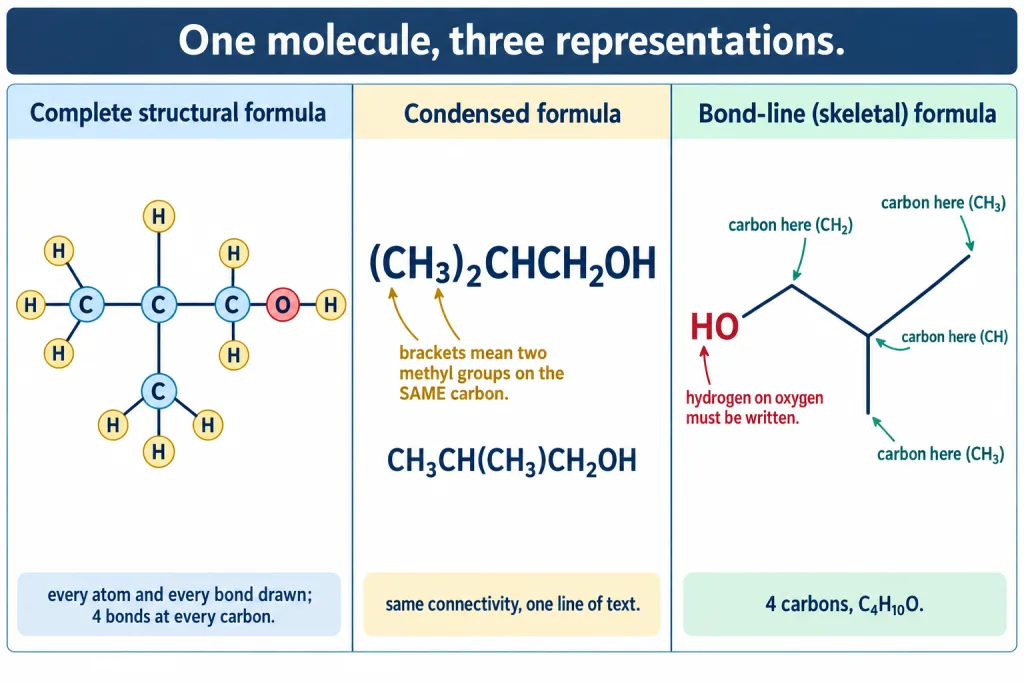
A condensed formula keeps the connectivity but writes it as one line of text. Three moves do the compressing.
Move 1: group each carbon with its own hydrogens. Put the hydrogen count as a subscript: , , , or a carbon with no hydrogen at all. Ethane becomes and propane .
Move 2: drop the single bonds you can do without. A chain read left to right is bonded in that order, so butane is . Double and triple bonds are never dropped: propene is and propyne is . Keep a dash wherever it stops a misreading.
Move 3: bracket what repeats. This is the move that gets misread, so learn the two cases separately.
Case A, a group repeated on the same atom. Two methyls on one carbon are written . So 2-methylpropan-1-ol is Read it as a carbon carrying two methyls, one hydrogen and a group — four bonds. The same compound is also , with the branch bracketed straight after the carbon it hangs from.
Case B, a unit repeated along the chain. Four groups in a row are written , so hexane is Methyl, then four links joined one after another, then methyl. Six carbons, not three.
Telling Case A from Case B
Look at the valency of the unit inside the bracket.
- has one bond spare. It cannot be a chain link, so it must be a pendant group on the neighbouring atom. , and are Case A.
- has two bonds spare, one at each side, so it has to be a link. is always a run of chain: and are Case B.
Test it the wrong way round and the absurdity shows: four groups on one carbon would give it eight bonds.
Key Point (Definition): A condensed formula records connectivity in one line, each carbon written with its own hydrogens as a subscript, single bonds usually omitted, multiple bonds always shown, and brackets compressing either a group repeated on one atom or a unit repeated along the chain.
Reading the functional group clusters
| Written as | Means |
|---|---|
| oxygen singly bonded to carbon and to one hydrogen | |
| carbon with one H and a double bond to O (aldehyde) | |
| carbon double bonded to O, with carbon on both sides (ketone) | |
| carbon double bonded to one O and single bonded to | |
| ester: plus to an alkyl group | |
| nitrogen with two hydrogens and one bond to carbon | |
| carbon triple bonded to nitrogen | |
| nitrogen bonded to carbon and to two oxygens |
is butan-2-one: the second carbon carries a double bonded oxygen and no hydrogen. Read that as a single and it becomes an ether with a different molecular formula.
[JEE Main] and are both , and the difference is entirely in how the cluster is read — ethanoic acid against methyl formate. Read clusters atom by atom, never by shape.
Converting in both directions
Condensed to complete
1. . Three carbons in a row. Left: three H plus a bond to the middle. Middle: two H plus bonds to both ends. Right: three H plus a bond to the middle. Propane, .
2. . The bracket sits after the second carbon, so that carbon carries a methyl branch: a central carbon with three methyls and one hydrogen. 2-Methylpropane, , also written .
3. . is a carbon with two methyls and one hydrogen, one bond free. That bond goes to , which has two hydrogens and one bond left, and that goes to , which carries the . Carbons ; hydrogens . , 2-methylpropan-1-ol.
4. . Write the bracket out: . Six carbons, unbranched. , hexane.
5. . The carbon written as plain has no hydrogen — three bonds to methyls and one to the already fill it. Carbons ; hydrogens . , 2,2-dimethylbutane, an isomer of hexane.
6. . Carbon 1 methyl; carbon 2 one H and a methyl branch; carbon 3 one H and an ; carbon 4 methyl. Carbons 5; hydrogens . , 3-methylbutan-2-ol.
7. . The bracketed unit is an ethyl group with one spare bond, so both ethyls hang on the nitrogen, which then has two ethyls and one hydrogen — three bonds, correct for nitrogen. , diethylamine.
8. . Methyl; a ketone carbon with a double bonded oxygen and no hydrogen; two groups; then the acid carbon, double bonded to one oxygen and single bonded to . Carbons 5; hydrogens ; oxygens 3. .
Complete to condensed
Run the process backwards: walk along the skeleton writing each atom with its own hydrogens, then look for repeats to bracket.
9. Five carbons unbranched. Walking gives , , , , , so , or bracketed, .
10. A central carbon with one hydrogen and three methyls: the central carbon is and the methyls repeat on it, so .
11. Four carbons in a row with a methyl on the second and a methyl on the third. Each of those is a carrying a methyl, and carbon 1 together with the branch on carbon 2 is itself a unit, as is the other end. Compress to : , 2,3-dimethylbutane.
12. Eight carbons unbranched with on the first: . Seven groups in a row give , or from the other end . , octan-1-ol.
One trap. A bracket must sit next to the atom that actually carries the group. looks like a tidy compression of 2,3-dimethylbutane, but each of those carbons would have two methyls, two hydrogens and one carbon — five bonds. A bracket that produces a five-bonded carbon is a wrong compression.
The bond-line or skeletal formula
This one keeps only the shape of the carbon skeleton. It is what practising chemists draw, and from the isomerism section onwards it is what this chapter draws too.
The three conventions
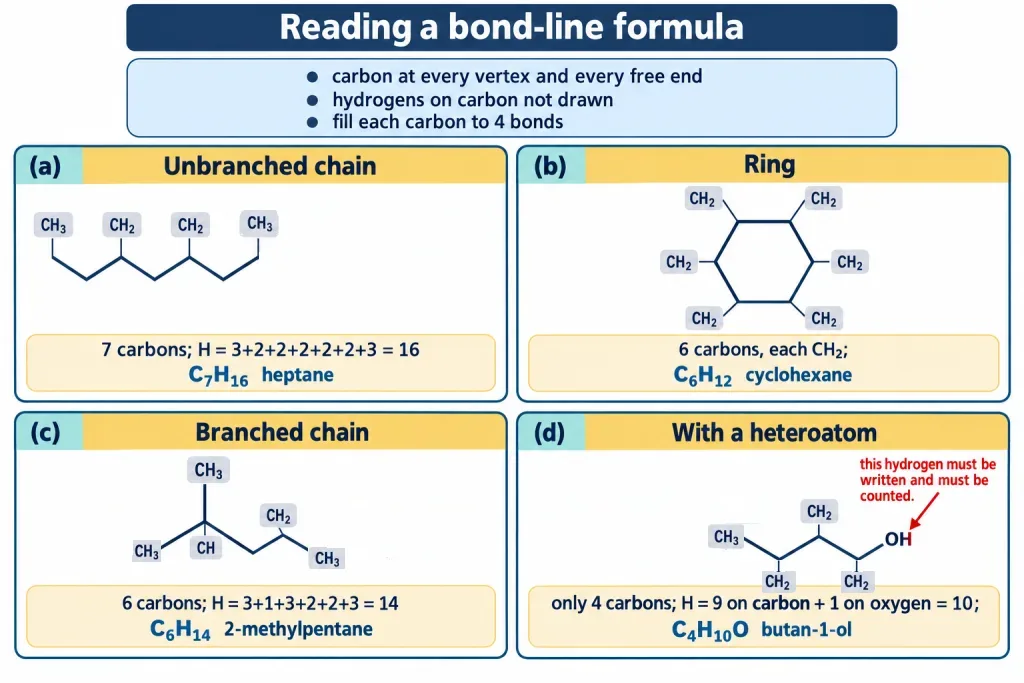
- Carbon sits at every vertex and at every free end of a line. No is written. A vertex is any point where two lines meet; a free end is any point where a line simply stops.
- Hydrogens on carbon are not written at all. Each carbon takes exactly as many as it needs to reach four bonds.
- Hydrogens on nitrogen, oxygen and sulphur are always written. , , and keep their hydrogens on the page.
Rule 3 is not decoration. Write only at the end of a line and you have drawn an oxygen with one bond, which is not a stable neutral species; and nothing then distinguishes an alcohol from an ether oxygen or a carbonyl . Carbon can be left bare because the four-bond rule forces its hydrogen count. A heteroatom's count is not forced — a nitrogen with one bond to carbon could carry two hydrogens, or one, or none.
Why the lines are drawn at an angle
A vertex has to be visible to be counted. Drawn as one straight horizontal line, four collinear carbons would look exactly like two; the zig-zag makes every carbon a countable corner.
The angle stands for the real geometry. An carbon is tetrahedral with bond angles of , so a carbon chain is not straight in the molecule either. The paper angle, drawn at roughly , keeps the drawing legible while reminding you that the chain is bent. The molecular angle is , and the bonds it joins are 154 pm long.
Rings and multiple bonds
A ring is a closed polygon: a plain hexagon is cyclohexane, , a plain pentagon cyclopentane, , a plain triangle cyclopropane, .
Double bonds are two parallel lines between vertices, triple bonds three. Benzene is a hexagon with three alternating double bonds, or a hexagon with a circle inside it — the circle is shorthand for the six delocalised pi electrons. Either drawing means , in which all six ring bonds are equal at 139 pm.
A heteroatom is written in at the position it occupies: a hexagon with one corner labelled and three ring double bonds is pyridine.
Key Point: In a bond-line formula there is a carbon at every vertex and at every free line end; hydrogens on carbon are omitted and filled in mentally to four bonds; hydrogens on N, O and S are written out. A labelled heteroatom occupies its vertex, so that vertex is not a carbon.
The commonest mistakes
- Counting one carbon per line instead of per vertex. Six segments in an unbranched chain give seven carbons.
- Forgetting that a labelled heteroatom takes over its position. In butan-1-ol the takes the last position, so there are four carbons, not five.
- Adding hydrogens to a carbon that already has four bonds. Four lines means no hydrogen; three lines, one; two lines, two; one line, three.
- Leaving the hydrogen off an or . It changes the molecular formula, and it is the error the convention exists to prevent.
Reading a bond-line formula back into a molecular formula
Four steps, used every time.
- Count the carbons. One at every vertex and every free end, skipping any position that carries a heteroatom label.
- Count the bonds at each carbon, a double line as two and a triple as three, including the bond to a heteroatom.
- Fill hydrogens to four at each carbon: minus the bonds already drawn.
- Add the hydrogens written on the heteroatoms and total up.
Six drawings, described in words because the count is the whole point.
(a) An unbranched zig-zag of six line segments, nothing marked. Six segments meet at five internal vertices and stop at two free ends: carbons. The two end carbons have one bond each, so three hydrogens each; the five internal carbons have two bonds each, so two hydrogens each. Hydrogens . , heptane, condensed .
(b) A plain hexagon. Six corners, six carbons, no free ends, two bonds and two hydrogens at each: . , cyclohexane. A ring has two hydrogens fewer than the alkane of the same carbon count, because closing it uses one bond at each of two carbons.
(c) A zig-zag of four segments, with a short line running up from the first vertex from the left to a free end. Main chain carbons; the branch adds one free end, so 6. The two chain ends and the branch end have one bond each, three hydrogens each. The branched carbon has three bonds drawn, one hydrogen. The other two chain carbons have two bonds each, two hydrogens each. Hydrogens . , 2-methylpentane, condensed .
(d) A zig-zag of four segments with written at the right-hand end. This is the one that catches people. The occupies the last position, so it is not a carbon; the carbons are one free end on the left plus three vertices, four in all. The left end carbon has one bond, three hydrogens; the next two have two bonds each, two hydrogens each; the carbon attached to the oxygen has two bonds drawn, one to the previous carbon and one to the oxygen, so two hydrogens. Hydrogens on carbon , plus the one on the oxygen: 10. , butan-1-ol, .
Take the hydrogen off that oxygen and the formula reads , a radical rather than a stable molecule. That is exactly why hydrogens on oxygen are written.
(e) A plain hexagon with at one corner. Six ring carbons. Five have two ring bonds and two hydrogens each: 10. The sixth has two ring bonds plus the bond to oxygen, so one hydrogen: 11 on carbon. Add the oxygen's hydrogen: 12. , cyclohexanol.
(f) A hexagon with three alternating double bonds and on one corner. Six carbons again, but each now has three bonds from the ring alone. Five take one hydrogen each: 5. The carbon bearing the oxygen already has four bonds and takes none. Plus the oxygen's hydrogen: 6. , phenol.
Compare (e) and (f): same carbon count, same one oxygen, twelve hydrogens against six. Three double bonds, two hydrogens each, account for the whole difference. That arithmetic is what a degree of unsaturation is.
A check to run on any answer
For an acyclic compound with only single bonds, hydrogens , and an oxygen inserted into the chain makes no difference to that count. Each ring closure and each double bond removes two hydrogens; each triple bond removes four. Heptane: . Cyclohexane: . Butan-1-ol: . Phenol: . All four match.
[NEET] Bond-line questions are usually pure counting. Count the vertices first and write the number down before starting on the hydrogens; the mistake is nearly always in the carbon count.
Three-dimensional representation: the wedge-and-dash convention
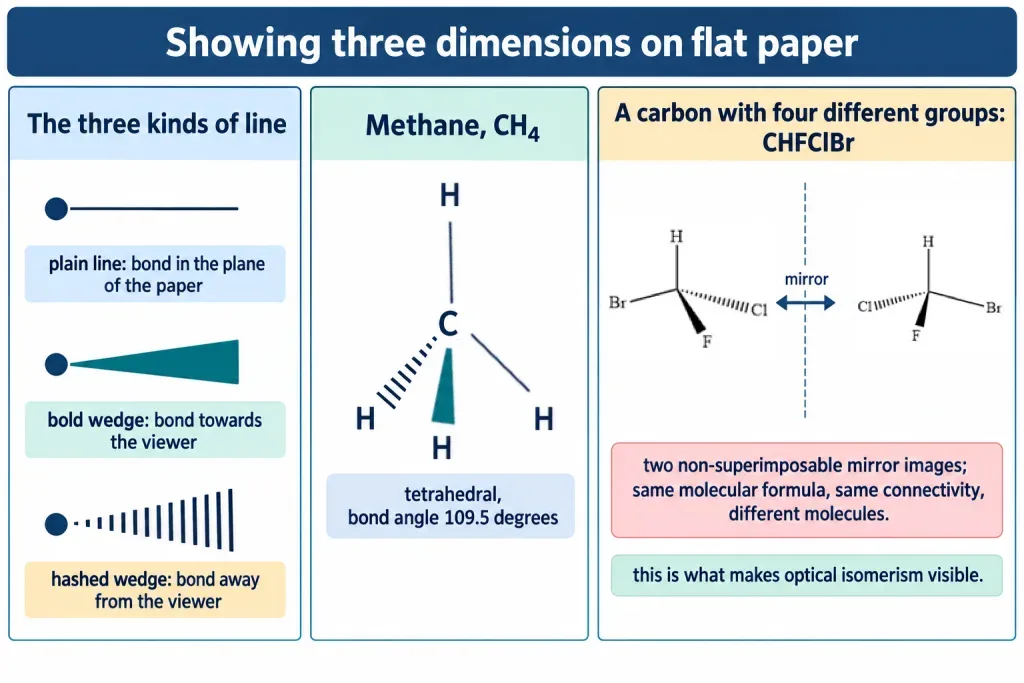
Everything above is flat, and a molecule is not. An carbon points its four bonds at the corners of a tetrahedron at , which no arrangement of lines in the plane of the paper can show. The wedge-and-dash convention fixes that with three kinds of line.
| Line drawn | Meaning |
|---|---|
| Plain thin line | the bond lies in the plane of the paper |
| Bold solid wedge, narrow at the atom and widening outwards | the bond comes towards the viewer, out of the plane |
| Hashed or broken wedge (short parallel strokes, or a dashed line) | the bond goes away from the viewer, behind the plane |
The wedge widens as it comes towards you for the same reason a nearer object looks bigger: the thick end is closer to your eye.
Methane
Put the carbon in the middle. Two bonds are plain lines in the plane of the paper, forming a wide V. The third is a bold wedge, pointing towards you. The fourth is a hashed wedge, pointing behind the paper. Two in the plane, one in front, one behind — the standard picture of a tetrahedral carbon.
A substituted carbon
Take bromochlorofluoromethane, : one carbon carrying four different atoms. Put the carbon at the centre; a plain line left to and a plain line right to , both in the plane; a bold wedge down and forward to ; a hashed wedge up and back to . Four bonds, four different groups, and the drawing now says which of the two possible spatial arrangements this molecule has.
Swap the and the and you have drawn a different molecule. It has the same molecular formula, the same condensed formula, the same bond-line skeleton and the same connectivity, so every representation before this one is blind to the difference. The two drawings are mirror images, and no amount of turning will make one sit on top of the other.
Key Point: The wedge-and-dash formula is the only representation that records the arrangement of groups in space around a carbon. A carbon carrying four different groups can be drawn in two non-superimposable ways, and those two are separate compounds. This is optical isomerism, taken up in the stereoisomerism section, and it cannot even be stated without wedge-and-dash drawings.
Where wedges are used and where they are dropped
Wedges are drawn only where the three-dimensional information is the point: at a carbon with four different groups, to fix which isomer is meant; on a ring, to show whether two substituents sit on the same face or opposite faces; and in sugars and amino acids.
They are dropped everywhere else, because a molecule drawn entirely in wedges is unreadable. A long-chain hydrocarbon has nothing to say in three dimensions — rotation about its single bonds interconverts the shapes freely — so it is drawn as a flat zig-zag.
Molecular models
For shape work three kinds of physical model are used. Framework models show only the bonds, as sticks joined at the correct angles. Ball-and-stick models use balls for atoms and sticks for bonds, with holes drilled at the right angles, so they show the angles and which atom is which. Space-filling models make each atom a sphere of its correct relative size and show no sticks, which gives the best idea of the bulk of a molecule and of the room around a reacting centre, but hides the bonds. The trade-off is the same as on paper: the more accurately a model shows the real molecule, the less clearly it shows the bonding.
Which representation to use, and what each one hides
| Representation | Shows | Hides | Use it when |
|---|---|---|---|
| Molecular formula | how many of each atom | all connectivity, so every isomer looks identical | combustion arithmetic, empirical formulae, unsaturation |
| Complete structural formula | every atom, every bond | all three-dimensional information | the bonding is the point, or the molecule is small |
| Condensed formula | full connectivity, in one line of text | the visual shape; careless brackets hide branching | typing, tables, nomenclature |
| Bond-line formula | the carbon skeleton and ring shape at a glance | hydrogens on carbon, which must be inferred | rings, long chains, isomer counting, mechanisms |
| Wedge-and-dash formula | the arrangement of groups in space at a centre | nothing about geometry, but it clutters a large molecule | stereochemistry, chirality, cis and trans on a ring |
| Ball-and-stick or space-filling model | real angles and real relative sizes | not portable; space-filling hides the bonds | studying shape and steric crowding |
Every representation is a deliberate trade: it drops something to make something else visible. A bond-line formula is not a lazier complete formula; it is a drawing that has decided the hydrogens on carbon carry no information — right for a steroid, wrong for teaching valency.
One molecule, four ways: a reference table
| Compound | Molecular formula | Condensed formula | Bond-line description |
|---|---|---|---|
| butane | unbranched zig-zag of three segments; two free ends, two vertices | ||
| 2-methylpropane | one central vertex with three lines radiating to three free ends | ||
| hexane | unbranched zig-zag of five segments; six carbons | ||
| 2-methylpropan-1-ol | HO at one line end, then a vertex, then a vertex bearing two lines to two free ends | ||
| cyclohexane | closed into a ring | a plain hexagon, nothing marked | |
| cyclohexanol | a plain hexagon with at one corner | ||
| benzene | a hexagon with three alternating double bonds, or with a circle inside | ||
| pentan-3-one | zig-zag of four segments with a double bond from the middle vertex up to O | ||
| octan-1-ol | unbranched zig-zag of eight segments with HO at the right-hand end |
Butane and 2-methylpropane have the same molecular formula and completely different bond-line skeletons — one a line, the other a three-pointed star. That is chain isomerism, and the molecular formula cannot see it. Cyclohexane and hexane differ by exactly two hydrogens, and the ring closure is the whole reason.
Key Point: Convert into the representation the question is easiest to answer in. Isomer counting is easiest in bond-line, naming in condensed, valency checking in complete structural. Stereochemistry is impossible without wedges.
Worked conversions
Question 1: Expanding a bracketed condensed formula
Write the complete structural formula of in words, atom by atom, and give its molecular formula.
Answer:
The unit inside the bracket is , which has only one bond spare, so it must be a group hanging on the atom next to it, the .
So the carries two methyl groups, one hydrogen, and one bond left over. That bond goes to the , which has two hydrogens and one bond left, and that goes to the oxygen, which carries one hydrogen.
Valency check. The carbon: two methyls, one H, one — four. Each methyl carbon: three H and one C — four. The carbon: two H, one C, one O — four. Oxygen: one C, one H — two.
Counting: carbons ; hydrogens ; oxygen 1.
Ans: A central carbon bearing one hydrogen and two methyls, its fourth bond going to a bonded to . , 2-methylpropan-1-ol.
Watch out: Reading the bracket as one methyl gives , propan-1-ol, a different compound.
Question 2: Bond-line to molecular formula, branched chain
A bond-line formula is a zig-zag of four line segments. From the first vertex counting from the left, a short line runs up to a free end. Give the molecular formula.
Answer:
I count carbons first. The main zig-zag has four segments, so three internal vertices plus two free ends: five carbons. The branch adds one more free end: six.
Now the bonds drawn at each of the six, filling hydrogens up to four. Left-hand chain end, one bond, 3 H. The branched vertex, three bonds drawn, 1 H. Branch free end, one bond, 3 H. The next chain vertex, two bonds, 2 H. The next, two bonds, 2 H. Right-hand chain end, one bond, 3 H.
Hydrogens . Cross-check with : six carbons, no ring, no double bond, so . Agrees.
Ans: , 2-methylpentane, condensed .
Watch out: Counting one carbon per line segment gives five carbons and the wrong answer. It is vertices and free ends, never segments.
Question 3: Why the hydrogen on oxygen must be shown
A bond-line formula is a zig-zag of four segments with at the right-hand end. Give the molecular formula, and say what goes wrong if the hydrogen on the oxygen is left off.
Answer:
The right-hand end is labelled, so it is an oxygen. The remaining positions are the left free end and three vertices: four carbons.
Hydrogens on carbon: the left end has one bond, 3 H; the next two vertices have two bonds each, 2 H each; the carbon joined to the oxygen has one bond to the previous carbon and one to the oxygen, so 2 H. That is . Add the hydrogen on the oxygen: 10.
Leave that hydrogen off and the drawing shows an oxygen with a single bond, and the formula reads — a radical with a monovalent oxygen, not butanol.
Ans: , butan-1-ol, . Omitting the O-H hydrogen gives the impossible with a monovalent oxygen.
Question 4: Condensing a long chain
Write in the shortest correct condensed form, give its molecular formula, and describe its bond-line drawing.
Answer:
After the there are seven groups and one , so eight carbons.
The seven groups are in an unbroken run, so they bracket to , giving , or from the other end .
Hydrogens: 1 on the oxygen, on the groups, 3 on the methyl. Total 18.
Ans: , , octan-1-ol. Bond-line: an unbranched zig-zag of eight line segments with at one end; the eight carbons are the seven vertices and the one free end at the far side.
Watch out: Do not write by sweeping the methyl into the bracket. The last carbon has three hydrogens, not two.
Question 5: A condensed formula with a valency error
One of these is impossible. Find it and say why: , , , .
Answer:
I take each central atom in turn and count its bonds.
: three methyls plus one hydrogen. Four bonds. Fine, this is 2-methylpropane.
: four methyls plus one hydrogen. That is five bonds on a carbon. Impossible.
: the plain has four methyls and no hydrogen at all, which is why it is written and not . Four bonds. Fine, this is 2,2-dimethylpropane, .
: an unbranched four-carbon chain. Fine, butane.
Ans: is impossible; its central carbon would carry five bonds.
Watch out: The clue is in the letters. If a carbon in a condensed formula already has four groups written on it, it must be written , never .
Question 6: A three-dimensional drawing
Describe the wedge-and-dash drawing of , and say how many distinct arrangements of the four atoms round the carbon are possible.
Answer:
I put the carbon in the middle and give it four bonds using the three line types. Two are plain lines in the plane of the paper, one going left to and one right to . One is a bold wedge coming towards me, carrying . The last is a hashed wedge going behind the paper, carrying .
How many different molecules can that describe? If I swap the and the , the connectivity has not changed but the spatial arrangement has. Turning the paper or rotating the whole molecule will not bring one onto the other; they are mirror images. So there are two, and every representation before this one gives the same answer for both.
Ans: Two plain bonds in the plane, one bold wedge forwards, one hashed wedge backwards; two distinct non-superimposable arrangements exist, and this is optical isomerism.
Question 7: Reading a double bracket
Give the molecular formula and the name of , and describe its bond-line drawing.
Answer:
Both brackets hold , so both are groups on the carbon next to them. The first carries two methyls, one hydrogen and one bond to the second ; the second carries two methyls, one hydrogen and the bond back.
Carbons . Hydrogens . The longest chain runs methyl, , , methyl, with a methyl on the second and a methyl on the third.
Ans: , 2,3-dimethylbutane. Bond-line: a zig-zag of three segments, with a short line running off the second vertex and another off the third, each ending free.
Watch out: Compressing this as is wrong. Those carbons would each have two methyls, two hydrogens and one carbon — five bonds.