
Three measurements that no single Lewis structure explains
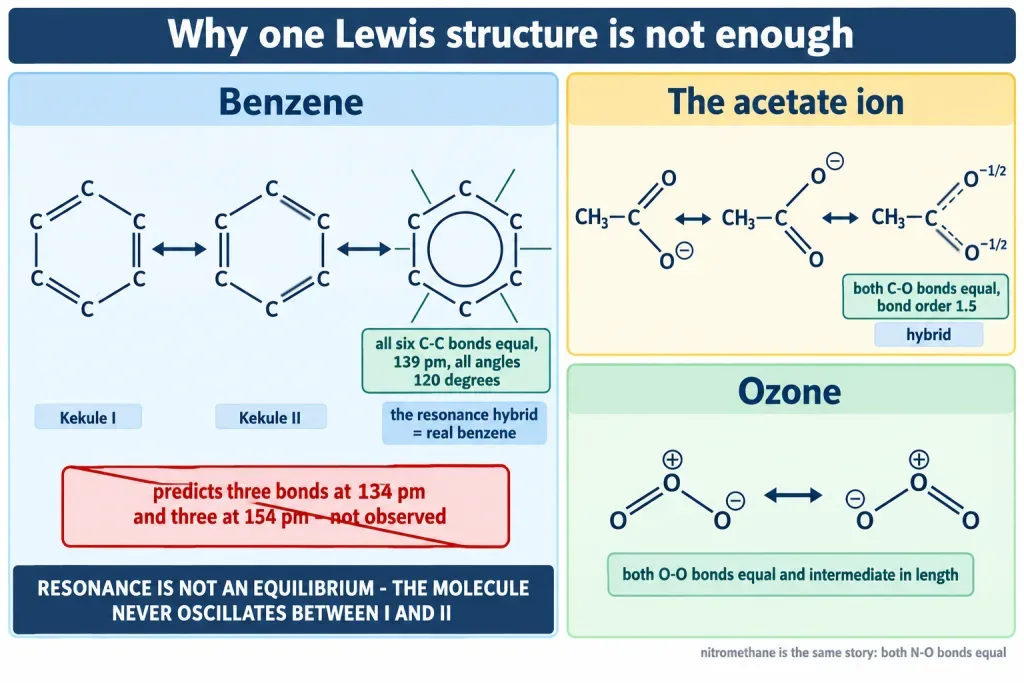
Benzene, , is the standard case. Kekule wrote it as a six-membered ring with three double bonds alternating with three single bonds. That gets the formula right and gives every carbon four bonds, then makes three predictions, all wrong.
Two different bond lengths. A bond is 134 pm and a bond is 154 pm, so the ring should be a lopsided hexagon with three short sides and three long ones. All six carbon-carbon bonds in benzene measure 139 pm — identical, and squarely between the single and double values. The ring is a regular planar hexagon, every angle 120 degrees.
Alkene behaviour. Three double bonds should decolourise bromine water in the cold and add hydrogen easily. Benzene does neither, preferring substitution, which keeps the ring system intact.
Two ortho isomers. With the bonds fixed, 1,2-dibromobenzene would exist in two versions, one with a double bond joining the substituted carbons and one with a single bond. Only one has ever been isolated.
The same trouble in three smaller species
The carboxylate ion. A single Lewis structure for gives one and one , so one bond should be short, the other long, and the charge should sit on one named oxygen. Both carbon-oxygen bonds are exactly equal and intermediate in length, and no experiment can tell the two oxygens apart.
Nitromethane, . The two nitrogen-oxygen bonds are of the same length, again between the and values.
Ozone, . A bent molecule with two equal oxygen-oxygen bonds, again intermediate, where a single Lewis structure demands one double and one single.
Four molecules, one repeated failure. The notation, not the chemistry, is at fault.
Key Point: A Lewis structure parks every electron pair between two named atoms. When a set of electrons is spread over three or more atoms — delocalised — no single Lewis structure can say so, and any one you draw predicts differences that do not exist.
Contributing structures, the hybrid and the energy you get for free
Key Point (Definition): When one Lewis structure will not do, the molecule is described by two or more resonance structures (canonical or contributing structures), joined by a double-headed arrow . The real molecule is one species, the resonance hybrid, which is none of the contributors and is not a mixture of them.
Benzene is Kekule structure I Kekule structure II. Neither structure is benzene. Benzene is what both are groping towards: six pi electrons spread evenly round the ring, six identical 139 pm bonds.
Resonance is not an equilibrium
The molecule does not flip between structure I and structure II, and does not spend half its time as one and half as the other. There is no equilibrium, no equilibrium constant, no rate of interconversion, and no instant — not even for s — at which benzene has three short bonds and three long ones. All six bonds are 139 pm all the time.
A mule is not an animal that oscillates between being a horse and a donkey. It is one animal, permanently, described by pointing at two we already have names for. Benzene is the mule; the Kekule structures are the horse and the donkey, and neither is ever in the room.
Two habits follow. Never write between resonance structures — only . And never say the molecule oscillates, alternates or flickers between them.
Resonance against tautomerism
Section 7 dealt with tautomerism, which looks similar and is entirely different.
| Resonance | Tautomerism | |
|---|---|---|
| What exists | one molecule, the hybrid | two different molecules |
| What moves | electrons only — pi pairs and lone pairs | a hydrogen atom, so nuclei move |
| Arrow used | ||
| Equilibrium constant | none, there is no equilibrium | yes, and measurable |
| Can a form be isolated | never, the forms do not exist | yes, in favourable cases |
| Typical case | benzene, the acetate ion | keto and enol forms of acetone |
Acetone and its enol, , are two real substances in a real equilibrium, a hydrogen having physically moved from carbon to oxygen. The two Kekule structures are two drawings of one substance, and nothing has moved. [JEE/NEET]
Resonance stabilisation energy
Key Point (Definition): The resonance energy is the energy difference between the real hybrid and the most stable single contributing structure. The hybrid is always the lower — delocalisation always stabilises.
For benzene it is 150 kJ/mol, and hydrogenation measures it. Cyclohexene gives out about 120 kJ/mol on hydrogenation, so a hypothetical cyclohexatriene with three isolated double bonds should give out about 360 kJ/mol. Benzene, hydrogenated to the same cyclohexane, gives out only about 208 kJ/mol — about 150 kJ/mol less, because it started about 150 kJ/mol lower down.
That number is why benzene behaves as it does. Adding bromine across a ring bond would break up the delocalised system and hand back the 150 kJ/mol, so benzene refuses and substitutes instead.
Two rules of thumb follow. More contributing structures generally means more stabilisation, and equivalent contributors stabilise far more than unequal ones — which is why the acetate ion is helped so much more than a phenoxide ion.
The rules for writing an acceptable contributing structure
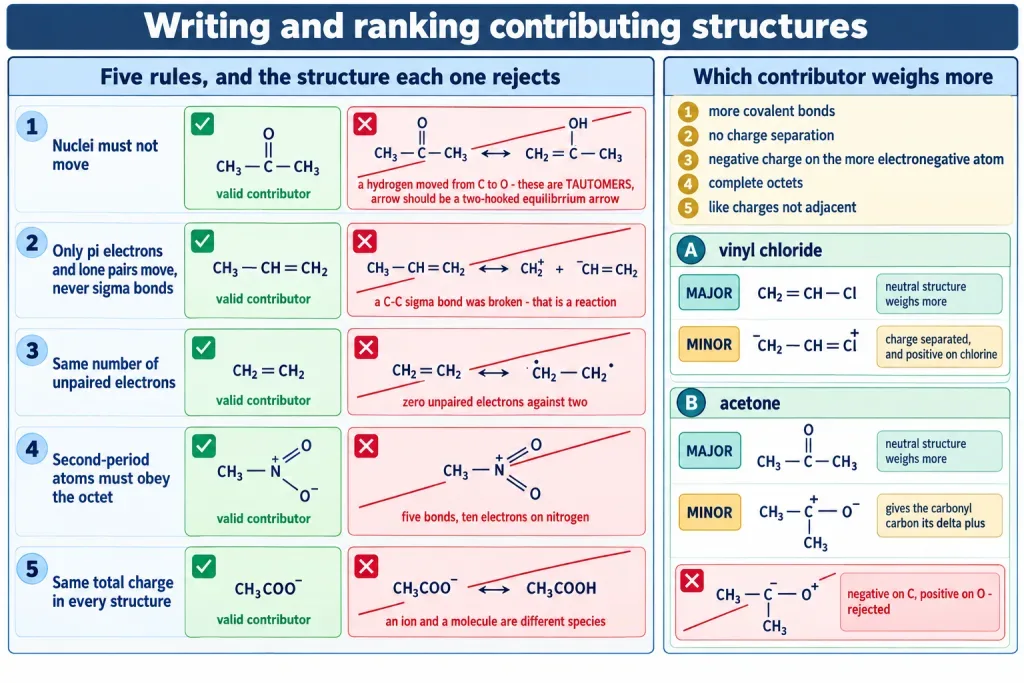
Five conditions must hold, and each has a standard violating structure.
Rule 1 — every nucleus stays exactly where it was. Contributors differ only in where the electrons are drawn.
Violation: and joined by a double-headed arrow. A hydrogen has travelled from carbon to oxygen, so a nucleus has moved. These are tautomers in a genuine equilibrium.
Rule 2 — only pi electrons and lone pairs may move; sigma bonds never do. The sigma framework is the skeleton, and the skeleton is fixed.
Violation: plus . A carbon-carbon sigma bond has been torn open, which is a reaction. The same rule shows that alkanes such as ethane have no resonance structures: no pi electrons, no lone pairs.
Rule 3 — every contributor has the same number of unpaired electrons.
Violation: a structure with a single carbon-carbon bond and one unpaired electron on each carbon. Zero unpaired electrons against two means two different electronic states.
Rule 4 — every second-period atom obeys the octet rule. Carbon, nitrogen and oxygen have no d orbitals. Carbon never shows five bonds, nitrogen never four without a positive charge, oxygen never three without one.
Violation: the nitro group drawn with two double bonds and a neutral nitrogen — five bonds, ten electrons. The acceptable structures keep nitrogen at four bonds with a charge, one and one . Fewer than eight electrons is allowed (a carbocation contributor has six on carbon); more than eight never is.
Rule 5 — every contributor carries the same total charge and the same number of electrons, because the hybrid is one species. is meaningless: that is an ion and a molecule.
Two practical requirements
The system must be conjugated. Delocalisation needs an unbroken run of parallel p orbitals. In buta-1,3-diene, , the four p orbitals are continuous. In penta-1,4-diene, , an carbon sits between the double bonds and the two alkene units are independent.
The delocalised part must lie flat, since p orbitals overlap only when parallel. A group twisted out of the plane of its ring loses its resonance interaction entirely.
Question 1: Resonance or tautomerism
Are and resonance structures of one another?
Answer:
On the right the oxygen carries an and a carbon-carbon double bond has appeared, so a hydrogen has shifted from carbon to oxygen. A nucleus has moved, and Rule 1 forbids that. These are the keto and enol forms — two real substances, both detectable, in a genuine equilibrium.
Ans: They are tautomers, not resonance structures. The arrow is , never .
Watch out: The test is mechanical. If a hydrogen sits on a different atom in the two drawings, it is tautomerism every time.
Question 2: The nitrate ion
Write the resonance description of and give the charge on each oxygen and the bond order.
Answer:
Nitrogen sits in the middle with three oxygens in a plane. One and two gives nitrogen four bonds, so it carries , and the ion is . Correct.
The double bond can go to any of the three oxygens, so there are three contributors, all identical in energy. One negative charge over three oxygens is each; four bonding pairs over three positions is a bond order of .
Ans: Three equivalent contributors; on each oxygen; every bond of order and equal in length.
Watch out: Nitrogen keeps its in every contributor and in the hybrid; a neutral nitrogen here would need five bonds.
Question 3: The pentavalent nitrogen trap
A student writes the nitro group of nitromethane with two nitrogen-oxygen double bonds and no charges. What is wrong?
Answer:
I count nitrogen's bonds: one to carbon, two to each oxygen. Five bonds means ten electrons, and nitrogen has only 2s and 2p orbitals, so eight is its ceiling. Rule 4 rejects the structure.
The acceptable pair keeps nitrogen at four bonds: , one and one , with and one . The second contributor is the mirror image.
Ans: The drawing gives nitrogen ten valence electrons, which no second-period atom can hold.
Watch out: Fewer than eight electrons is legal; more than eight on a second-period atom never is.
Ranking the contributors
Contributors are not equal partners. Each has a weight, and the hybrid resembles the heaviest. Five tests settle it.
- More covalent bonds is better.
- No charge separation beats charge separation.
- If charges are separated, the negative charge sits on the more electronegative atom and the positive on the less electronegative one. The reverse is a very poor contributor.
- Complete octets beat incomplete ones.
- Like charges on adjacent atoms is very bad, and opposite charges far apart is bad, because separating charge costs energy.
Alongside these, equivalent contributors have equal weight, and such a set gives the greatest stabilisation of all.
Worked ranking A — vinyl chloride
Contributor I is , neutral throughout. Contributor II is , made by pushing a chlorine lone pair into the bond and shunting the pi pair onto the terminal carbon.
Both have the same number of bonds, so test 2 decides for I, and test 3 punishes II further for putting the positive charge on the most electronegative atom present.
I is much the more important. II is minor but not zero: it is why the bond in vinyl chloride is shorter and stronger than in chloroethane.
Worked ranking B — the carbonyl group of acetone
Contributor I, , is neutral with a full octet everywhere. Contributor II is , the pi pair having moved onto oxygen. A third arrangement would put the negative charge on carbon and the positive on oxygen.
I wins on tests 2 and 4. II is a genuine minor contributor: it separates charge and leaves carbon with six electrons, but obeys test 3 by putting the negative charge on oxygen. The third arrangement fails test 3 outright. II is exactly what gives the carbonyl carbon its and sends nucleophiles there.
The same reasoning ranks an amide. For acetamide, neutral leads on test 2, but is unusually important for a charge-separated structure because it satisfies tests 3 and 4 perfectly: negative on oxygen, positive on nitrogen, full octets throughout. That weight is the whole chemistry of the amide group. [JEE Main]
Twelve resonance sets worth knowing cold
Each entry gives the contributors, then where the charge sits in the hybrid.
1. Benzene, . Two equivalent Kekule structures, differing in which three ring bonds carry the double bonds. In the hybrid: no charge anywhere, six pi electrons spread evenly over six carbons, every bond 139 pm at order 1.5.
2. The carboxylate ion, . Two equivalent contributors: the moves from one oxygen to the other while the negative charge moves back. In the hybrid: each oxygen carries , both carbon-oxygen bonds have order 1.5 and equal length, and the carbon is uncharged.
3. The nitro group, in nitromethane . Two equivalent contributors, one and one in each, swapped between the oxygens. In the hybrid: nitrogen carries a full , each oxygen , and the two bonds are equal. A permanently positive nitrogen beside two partly negative oxygens is why is the strongest group and a strong group too.
4. The carbonate ion, . Three equivalent contributors, the double bond taking each oxygen in turn. In the hybrid: each oxygen carries , all three bonds are equal at order , and the ion is planar.
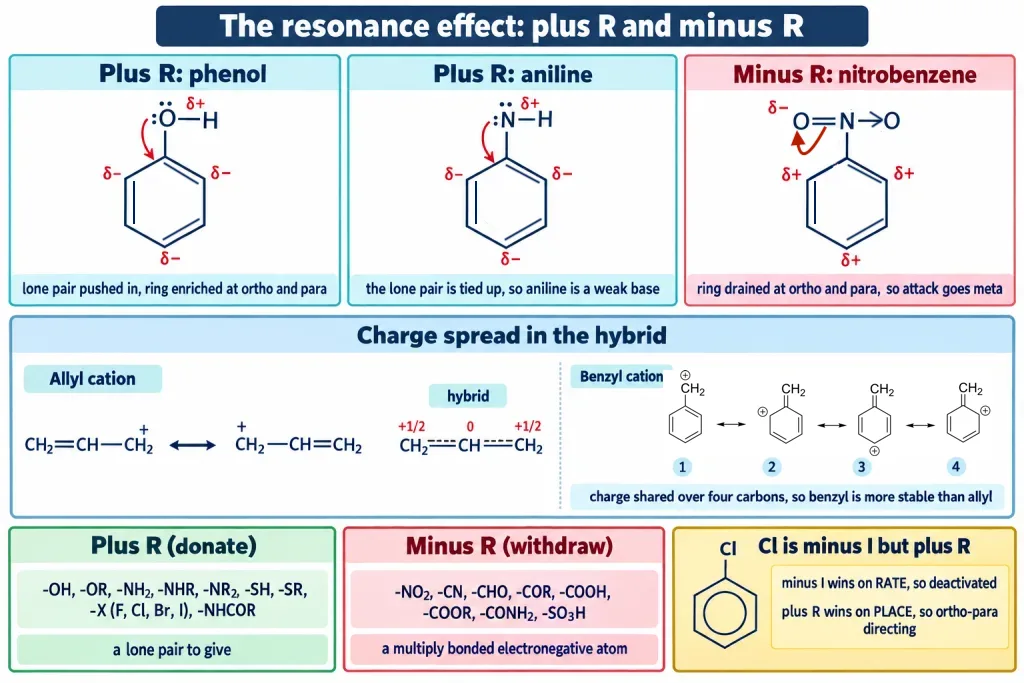
5. Phenol, . Five contributors: the two Kekule forms plus three charge-separated ones in which an oxygen lone pair has entered the ring. In the hybrid: oxygen is , negative charge appears at the two ortho carbons and the para carbon, and the bond has partial double-bond character. The ring is electron-rich, activated and ortho-para directing.
6. Aniline, . The same five-structure pattern with nitrogen in place of oxygen. In the hybrid: nitrogen is and the ortho and para carbons are , and the lone pair is partly committed to the ring.
7. Nitrobenzene, . Two Kekule forms plus three charge-separated ones in which ring pi electrons are pulled towards the nitro group; in each of those, nitrogen keeps its , both oxygens carry a negative charge, and a positive charge appears on a ring carbon. In the hybrid: the ring is electron-poor everywhere and specifically depleted at ortho and para, so it is strongly deactivated and electrophiles are pushed meta.
8. The allyl cation, . Two equivalent contributors, the pi pair and the empty p orbital exchanging ends. In the hybrid: each terminal carbon carries , the central carbon none, and both carbon-carbon bonds are equal at order 1.5.
9. The allyl anion, . Two equivalent contributors, the lone pair and the pi pair exchanging ends. In the hybrid: each terminal carbon carries , the central carbon none.
10. The benzyl cation, . Four contributors: the positive charge sits on the exocyclic in one, and on an ortho, the para and the other ortho carbon in the rest. In the hybrid: the charge is spread over four carbons, the largest share on the exocyclic one. Four positions beat allyl's two, which is why the order runs benzyl > allyl > tertiary.
11. An amide, acetamide . The neutral contributor and . In the hybrid: oxygen is , nitrogen , and the bond has substantial double-bond character, so rotation about it is restricted and the group is planar.
12. Vinyl chloride, . The neutral major contributor and the minor . In the hybrid: the terminal is slightly negative and the bond is shorter than in chloroethane. Chlorine is still the negative end, because its effect outweighs this small donation.
Benzene, the carboxylate ion and the carbonate ion are the sets with fully equivalent contributors, and are correspondingly the most stabilised. [Board]
Question 4: Bond order and charge in the carbonate ion
Give the number of equivalent contributors of , the charge on each oxygen and the carbon-oxygen bond order.
Answer:
One structure has one and two , and the double bond can go on any of the three oxygens, so there are three identical structures. Charge: over three oxygens is each. Bond order: four bonding pairs over three positions is .
Ans: Three equivalent contributors; on each oxygen; bond order on each of three equal bonds.
Watch out: Acetate has two oxygens and a charge, so its figures are and 1.5. Do not import them here.
Question 5: Resonance energy from hydrogenation data
Hydrogenating cyclohexene gives out about 120 kJ/mol; hydrogenating benzene gives out about 208 kJ/mol. Find benzene's resonance energy.
Answer:
If benzene were cyclohexatriene it would hold three independent double bonds like cyclohexene's, so hydrogenation should release about kJ/mol. The measured value is about 208 kJ/mol, so the shortfall is about 150 kJ/mol.
Both routes end at the same cyclohexane, so a smaller release means benzene started lower down.
Ans: About 150 kJ/mol, which is why benzene resists addition.
Watch out: 208 kJ/mol is the heat of hydrogenation, not the resonance energy. The resonance energy is the difference.
Question 6: Where the charge sits in the phenoxide ion
Describe the resonance set of and say which atoms carry the negative charge.
Answer:
The oxygen starts with a full negative charge, and one of its lone pairs can move into the ring, forming a and pushing the charge onto a ring carbon.
Doing that in every allowed way gives four contributors that matter: charge on oxygen, and charge on each of the two ortho carbons and the para carbon. The meta carbons are never reached. They are not equivalent — the one with the charge on oxygen is much the best, since oxygen is far more electronegative than carbon.
Ans: The charge is spread over the oxygen and the two ortho and one para carbons, with the largest share on oxygen. The meta carbons carry none.
Watch out: Resonance delivers charge to ortho and para only. Anything happening at meta is inductive.
Question 7: Why benzyl beats allyl
Order the benzyl, allyl and tert-butyl cations and justify the first two from their resonance sets.
Answer:
The allyl cation has two contributors and shares its positive charge between two carbons. The benzyl cation has four: the charge sits on the exocyclic in one, and on an ortho, the para and the other ortho carbon in the rest.
Spreading a charge over more atoms lowers the energy, so benzyl leads. The tert-butyl cation has no resonance at all and relies on the effect of three methyl groups and hyperconjugation from nine alpha hydrogens.
Ans: benzyl > allyl > tertiary
Watch out: This order sits above the tertiary-secondary-primary-methyl sequence rather than replacing it.
The resonance effect, and the two lists
Key Point (Definition): The resonance effect, also called the mesomeric effect and written , is the permanent polarisation set up in a conjugated system when a substituent either donates a lone pair into the pi system or pulls pi electrons out.
Three properties define it, each separating it from another effect in this chapter.
- Permanent. It is present in the molecule as it stands, reagent or no reagent. The electromeric effect of section 11 is temporary and appears only while an attacking reagent is present.
- Transmitted through the pi system. The inductive effect travels along sigma bonds and dies beyond the third atom. Resonance runs the length of the conjugated chain and delivers charge to specific positions — the ortho and para carbons of a ring, never the meta.
- Requires conjugation. The group must be attached directly to a doubly bonded carbon or an aromatic ring, its lone pair or pi bond parallel to the ring p orbitals. Break the conjugation and the effect vanishes.
Positive resonance effect,
A group donates electrons into the conjugated system. The requirement is a lone pair on the atom joined to the pi system.
Oxygen, nitrogen, sulphur and the halogens all carry lone pairs on the attached atom. Pushing one in raises the electron density at ortho and para, so a group makes a ring more nucleophilic and directs electrophiles ortho and para.
Negative resonance effect,
A group withdraws electrons from the conjugated system. The requirement is the mirror image: a multiply bonded electronegative atom at or next to the point of attachment, giving the pi electrons somewhere to slide onto.
Every one has a , a , an or an . Pulling ring electrons towards it leaves a positive charge at ortho and para, so a group makes a ring electron-poor, deactivates it, and sends the electrophile meta.
The halogens: but
Halogens are the standard trap, because they do both things at once, in opposite directions. A halogen is strongly electronegative and withdraws density along the sigma bond — a effect felt at every ring carbon — while its lone pairs can be pushed into the ring, a effect that delivers density to the ortho and para carbons only.
In chlorobenzene the two resolve like this. Over the whole ring the effect wins: chlorobenzene has less electron density than benzene and is deactivated, reacting with electrophiles more slowly. The effect decides where reaction happens, being the only one of the two that discriminates between positions: the density it supplies goes to ortho and para only, so those carbons stay the richest points in a poor ring and chlorobenzene is ortho and para directing.
Key Point: Chlorobenzene is deactivated yet ortho-para directing. Rate is set by the effect, orientation by the effect. Whenever a group is both, answer the rate question and the orientation question separately.
Two more consequences: chlorobenzene has a smaller dipole moment than chloromethane, the donation opposing the withdrawal, and its bond is short and very resistant to nucleophilic substitution.
What the resonance effect explains
Phenol is a far stronger acid than an alcohol
Ethanol has about 16; phenol about 10, roughly a million times the stronger acid, though both simply lose an proton.
The difference is in the anions. Ethoxide has its charge stranded on one oxygen, and the effect of the ethyl group pushes still more density onto that already negative atom. Phenoxide spreads its charge over the oxygen and the two ortho and one para carbons, and a spread-out charge is a stable charge.
Phenol itself gains some resonance stabilisation too, but the ion gains much more, and it is the difference that sets the acidity.
A carboxylic acid is stronger still
Acetic acid has about 4.8, about five units below phenol, and both anions are delocalised — so the comparison is between two delocalisations.
In acetate the two contributors are exactly equivalent and the charge is shared by two oxygen atoms, which is maximum stabilisation. In phenoxide they are not equivalent: three of the four push the charge onto ring carbons, far less electronegative, and break up the even aromatic arrangement while they hold it.
Ordering: carboxylic acid > phenol > alcohol. [JEE/NEET]
Aniline is a weaker base than an aliphatic amine
Basicity here is the availability of the nitrogen lone pair. In ethylamine that pair sits on nitrogen doing nothing else, and the effect of the ethyl group makes it more available still.
In aniline the pair is delocalised into the ring, spread over the nitrogen and the ortho and para carbons, and a lone pair busy holding a ring system together is not free to attack a proton. The nitrogen is also bonded to an carbon, which pulls the same way.
Protonation destroys the delocalisation completely, since the anilinium nitrogen has no lone pair left, and that lost stabilisation is what keeps aniline weakly basic.
Nitrophenols beat phenol, and the meta isomer lags
Phenol has about 10; the nitrophenols come in at about 7.2 (ortho), 8.4 (meta) and 7.1 (para) — all stronger acids than phenol, with meta clearly the weakest of the three.
is both and , and both drain density away from the phenoxide oxygen and stabilise the anion, in all three isomers.
The path separates them. From para, the ring charge can be delocalised right onto an oxygen of the nitro group, giving a contributor with the charge on the most electronegative atom available. The same works from ortho, which is closest and so gets the largest help. From meta there is no such path at all — resonance reaches ortho and para and nowhere else — so only the effect operates, over a greater distance.
Ordering: p-nitrophenol and o-nitrophenol > m-nitrophenol > phenol. With three nitro groups, 2,4,6-trinitrophenol (picric acid) is a genuinely strong acid.
The benzyl and allyl systems
Section 9 fixed the carbocation order as tertiary > secondary > primary > methyl, with benzyl and allyl standing apart and benzyl > allyl > tertiary as the order to quote when the three are compared. Resonance is the reason: an allyl cation shares its charge over two carbons, a benzyl cation over four, a far bigger stabilisation than or hyperconjugation can supply, and it is why allylic and benzylic halides ionise so readily. The same delocalisation stabilises the allyl and benzyl radicals and anions — spreading lowers the energy whatever the sign of the charge.
Question 8: Phenol against ethanol
Explain why phenol turns blue litmus red and dissolves in sodium hydroxide, while ethanol does neither.
Answer:
Both have an bond, so both could lose a proton, and the anion left behind decides the outcome. Ethoxide keeps its whole charge on one oxygen, and the effect of the ethyl group pushes still more density onto it. Phenoxide spreads its charge over the oxygen and the two ortho and one para carbons, and a charge shared over four atoms is far less demanding than a charge on one.
Ans: The phenoxide ion is resonance stabilised by delocalisation into the ring; the ethoxide ion is not, so phenol is about a million times the stronger acid.
Watch out: The answer is about the anion. Saying phenol is stabilised by resonance is not enough, since stabilising the acid alone would make it weaker, not stronger.
Question 9: Acetic acid against phenol
Both anions are delocalised. Why is acetic acid still the stronger acid?
Answer:
I compare the two delocalisations rather than asking whether each exists. Acetate has two exactly equivalent contributors and shares its charge between two oxygens, which is the largest stabilisation available. Phenoxide has four contributors far from equivalent: three put the charge on ring carbons, much less electronegative and much less willing, and also disturb the even aromatic arrangement.
Ans: Acetate shares its charge over two electronegative oxygens in two equivalent structures; phenoxide pushes most of its charge onto ring carbons in non-equivalent ones. Acidity runs carboxylic acid > phenol > alcohol.
Question 10: Aniline against ethylamine
Why is aniline the weaker base, and what happens to the resonance on protonation?
Answer:
In ethylamine the lone pair is localised on nitrogen and the effect of the ethyl group makes it very available. In aniline it is delocalised into the ring by the effect, and the nitrogen is also bonded to an carbon, which pulls density away.
On protonation the lone pair is consumed in a new bond and the delocalisation is destroyed, so the anilinium ion loses all the stabilisation the free base had.
Ans: The aniline lone pair is delocalised and much less available, and protonation costs that delocalisation. Ethylamine has a free, -enriched lone pair.
Question 11: The three nitrophenols
Order phenol, o-, m- and p-nitrophenol by acid strength and explain the position of the meta isomer.
Answer:
Every nitrophenol beats phenol, because is both and and both drain the ring and stabilise the anion. For ortho and para the path reaches through: the ring charge can be pushed onto an oxygen of the nitro group, putting it on the most electronegative atom in the molecule. Meta cannot be reached by resonance at all, so only the effect helps there, over a longer path.
Ans: p-nitrophenol and o-nitrophenol > m-nitrophenol > phenol.
Watch out: The meta isomer is still stronger than phenol. Losing the resonance path does not remove the inductive one.
Question 12: Chlorobenzene
Chlorobenzene nitrates more slowly than benzene, yet gives mainly ortho and para product. Reconcile the two facts.
Answer:
Chlorine has two effects pointing opposite ways. Its effect withdraws density along the sigma bond at every ring carbon, so the whole ring is poorer than benzene and reacts more slowly. Its effect pushes a lone pair into the ring, putting that extra density at the two ortho carbons and the para carbon only.
The overall electron count is set by the larger effect; the distribution by the effect, the only one that distinguishes positions.
Ans: dominates the total density and deactivates the ring; concentrates what remains at ortho and para, so chlorobenzene is deactivated but ortho-para directing.
Watch out: Halogens are the only common substituents that deactivate and yet direct ortho and para.
Question 13: The amide bond
Why is the bond in acetamide short, why is rotation about it restricted, and why are amides very weak bases?
Answer:
The nitrogen lone pair sits next to a , so the system is conjugated. Pushing the pair in makes while the carbonyl pi pair goes out onto oxygen, giving — unusually good for a charge-separated structure: negative on oxygen, positive on nitrogen, full octets throughout.
Carrying that much weight, it gives the hybrid bond partial double-bond character — shorter, and not free to rotate, so the whole unit is planar and stiff. The same delocalisation ties up the lone pair, leaving it unavailable to a proton.
Ans: Delocalisation of the nitrogen lone pair onto the carbonyl oxygen gives the bond partial double-bond character and removes the lone pair from service.
Question 14: Sorting groups into the two lists
Classify , , , and as or .
Answer:
One test decides each. A lone pair on the attached atom means donation; a multiply bonded electronegative atom in the group means withdrawal.
: oxygen attached, lone pairs available, . : a triple bond to an electronegative nitrogen, . : a halogen with lone pairs, — and also , which is the trap. : attached through a carbonyl carbon, . : attached through nitrogen, which still has a lone pair for the ring, .
Ans: : , , . : , .
Watch out: Read the attachment atom, not the whole group. joins through nitrogen and donates although it contains a carbonyl; joins through carbon and withdraws although it contains a nitrogen.