
Two chains of the same length — the tie-break nobody applies
The parent chain is chosen by two tests in strict order: longest chain containing the principal functional group, then, if two chains tie in length, the one carrying more substituents. Most students stop at the first test.
Take , a .
Along the drawn backbone: six carbons. Starting instead at the terminal of the ethyl branch and running right: six again. Two hexane chains, tied. The drawn one carries a methyl and an ethyl; the other carries one isopropyl.
The drawn chain wins. Numbering from the methyl end gives locants 2 and 3, and e precedes m, so the name is 3-ethyl-2-methylhexane. The name 3-isopropylhexane is built from a legitimate hexane chain and still scores zero.
The tie-breaks, in the order you apply them
- Longest chain containing the principal characteristic group.
- Of the equally long chains, the one with more substituents.
- Lowest locant to the principal functional group, then to a multiple bond, then to substituents.
- Lowest locant set by first point of difference.
- If even that ties, the lower locant goes to the substituent cited first alphabetically.
Rule 5 decides names like . The longest chain is octane, with a methyl and a propyl on adjacent carbons, and from either end the locant set is , so first point of difference settles nothing. Methyl precedes propyl, so methyl takes the 4: 4-methyl-5-propyloctane.
Key Point: A tie in chain length is broken by substituent count; a tie in the locant set is broken by alphabetical order.
[JEE Main] Count the carbons in every path from one chain end to another, not just the row you were given. Half of all nomenclature errors are chains that were never traced.
Ring or chain, and the two ring systems named in brackets
When a ring and a chain are both present, the parent is whichever one carries the principal characteristic group. Chain length enters only if neither does.
| Compound | Parent | Name |
|---|---|---|
| ring (holds the ) | cyclohexanol | |
| chain (holds the ) | cyclohexylmethanol | |
| chain | 3-cyclohexylpropanoic acid | |
| chain | phenylmethanol | |
| ring (equal or larger) | propylcyclohexane |
Bicyclic compounds, in outline
Two rings sharing two atoms make a bicyclic system. The shared atoms are the bridgeheads, joined by three bridges.
- Name after the alkane with the total number of ring atoms, and insert bicyclo.
- Bridge sizes go in brackets, largest first, separated by full stops. They count only bridge carbons, so their sum plus the two bridgeheads gives the parent count.
- Number from one bridgehead, round the largest bridge to the second bridgehead, back along the middle bridge, then the smallest bridge last.
The first is norbornane, the second decalin.
Spiro compounds, in outline
Two rings sharing one atom make a spiro system, and the shared atom is the spiro atom.
- Name after the alkane with the total number of ring atoms, and insert spiro.
- Ring sizes go in brackets, smallest first, counting the atoms of each ring other than the spiro atom. The two numbers plus one spiro atom give the parent count.
- Number from the atom next to the spiro atom in the smaller ring, round that ring, through the spiro atom, then round the larger ring.
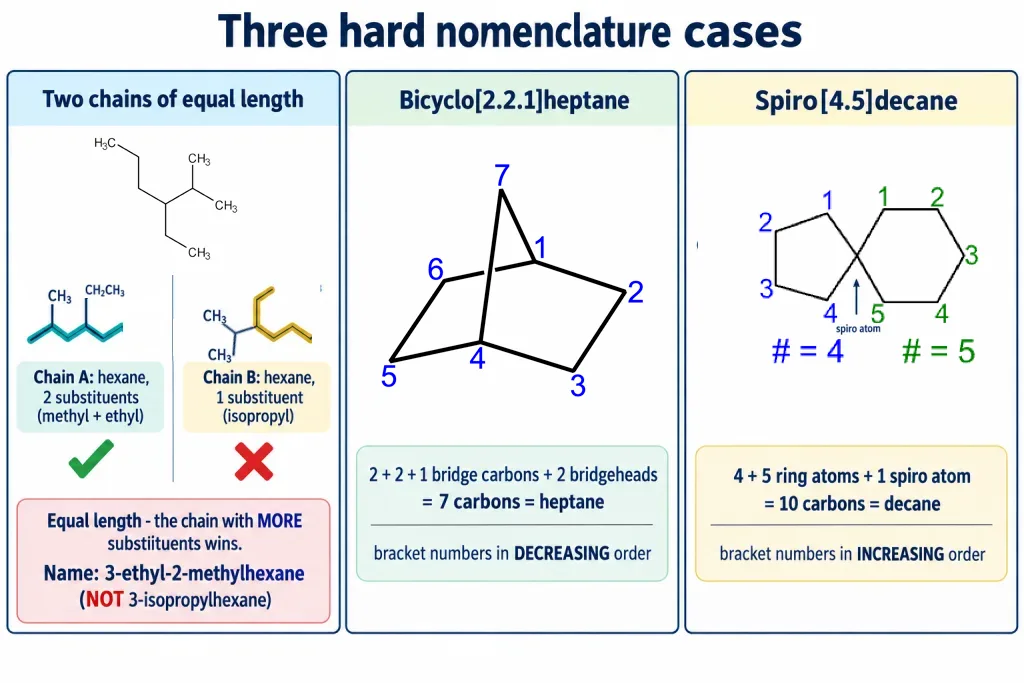
Key Point: Bicyclo brackets run in decreasing order and add two bridgehead atoms; spiro brackets run in increasing order and add one spiro atom.
Bracketed substituents, alphabetisation edge cases, competing seniority
A branched substituent with no accepted short name is named as a chain in its own right and wrapped in brackets, its attached carbon always C-1, with no choice of direction.
Alphabetising is where marks disappear. Multiplying prefixes di, tri, tetra are not counted; iso, neo and cyclo are counted; sec- and tert- are not.
| Prefix as written | Alphabetised at | Files under |
|---|---|---|
| dimethyl | methyl | m |
| isopropyl | isopropyl | i |
| neopentyl | neopentyl | n |
| cyclohexyl | cyclohexyl | c |
| sec-butyl, tert-butyl | butyl | b |
| (1-methylethyl) | methylethyl | m |
| (2,2-dimethylpropyl) | dimethylpropyl | d |
The last two rows are the edge case. A simple substituent cited twice picks up a multiplying prefix that is ignored, but the di inside the bracketed name of a complex substituent belongs to that substituent's own complete name and counts, so (2,2-dimethylpropyl) files under d. The same group written as isopropyl files under i and as (1-methylethyl) under m; both are acceptable, but never mixed inside one name.
When two senior groups sit in the same molecule
Only one group becomes the suffix, and seniority decides which. Everything below it turns into a prefix, even a group you have only met as a suffix.
| Compound | Suffix | Demoted group | Name |
|---|---|---|---|
| acid | ketone as oxo | 4-oxopentanoic acid | |
| aldehyde | alcohol as hydroxy | 3-hydroxybutanal | |
| acid | amide as carbamoyl | 3-carbamoylpropanoic acid | |
| acid | nitrile as cyano | 3-cyanopropanoic acid | |
| acid | alcohol as hydroxy | 5-hydroxypent-2-enoic acid | |
| ester | ketone as oxo | methyl 3-oxobutanoate | |
| alcohol | amine as amino | 2-aminoethan-1-ol |
A nitrile or amide carbon cited as cyano or carbamoyl sits outside the parent chain; an aldehyde or ketone cited as oxo keeps its carbon inside it. Count root carbons after choosing the prefixes.
[JEE/NEET] A double bond never beats a functional group for the lowest locant, but it does beat a substituent: in 5-hydroxypent-2-enoic acid the acid takes C-1, the double bond the lower number then available, and hydroxy what is left.
Question 1: A tie in chain length
Name .
Answer:
Along the drawn backbone I count six carbons, and starting at the far end of the ethyl branch and running right I count six again, so there is a tie.
The drawn chain carries a methyl and an ethyl; the chain through the ethyl carries one isopropyl. Numbering from the methyl end gives instead of , and ethyl is cited first.
Ans: 3-Ethyl-2-methylhexane
Watch out: 3-Isopropylhexane comes from a real hexane chain and still scores zero, because a tie in length is broken by substituent count.
Question 2: A branch as long as the tail
Name .
Answer:
The drawn backbone is seven carbons. Coming in from the left and turning out along the branch also gives seven: four along the backbone, three through the branch.
The drawn chain has one substituent; the chain through the branch has two, a propyl where I left the backbone and a methyl on the first branch carbon. Numbering from the branch end puts methyl at 3 and propyl at 4, beating .
Ans: 3-Methyl-4-propylheptane
Watch out: 4-sec-Butylheptane names a genuine seven-carbon chain, but the wrong one.
Question 3: A bicyclic skeleton
A saturated bicyclic hydrocarbon has two bridgehead carbons joined by bridges of three, two and one carbon atoms. Name it, and say where C-1 goes.
Answer:
Bracket numbers count only bridge carbons, so the system holds bridge carbons plus two bridgeheads, eight in all, making the parent octane, with bridges cited in decreasing order.
C-1 is a bridgehead. Numbering runs round the three-carbon bridge to the second bridgehead at C-5, back along the two-carbon bridge as C-6 and C-7, and finishes on the lone bridging carbon, C-8.
Ans: Bicyclo[3.2.1]octane
Watch out: Bicyclo[3.2.1]hexane is what you get by counting the bridge carbons alone. The bridgeheads are ring atoms too.
Question 4: A spiro skeleton
How many carbons does spiro[4.5]decane contain, which ring is numbered first, and what is the spiro hydrocarbon built from two three-membered rings?
Answer:
Spiro brackets count the atoms of each ring apart from the shared one, so the total is , matching decane. Numbering begins in the smaller ring at the atom next to the spiro atom, so the spiro atom is number 5 and the larger ring follows.
Two three-membered rings sharing one carbon leave two carbons in each ring outside the shared atom: .
Ans: Ten carbons, the smaller ring first, and spiro[2.2]pentane
Watch out: Spiro numbers go up, bicyclo numbers go down. Spiro[5.4]decane reverses the name's only ordering convention.
Question 5: Citation order with three kinds of branch
A nonane chain carries a methyl on C-2, an ethyl on C-4 and a tert-butyl on C-5. Write the name.
Answer:
Going out through the tert-butyl gives at most seven carbons and through the ethyl at most eight, so nonane survives, with locants against from the other end.
For citation order, tert- is not counted, so the group alphabetises as butyl, under b, ahead of ethyl and methyl.
Ans: 5-tert-Butyl-4-ethyl-2-methylnonane
Watch out: Had the branch been isobutyl, iso would count and it would file under i, after ethyl.
Question 6: Three compounds, one suffix
Name , and .
Answer:
All three contain a carboxylic acid, the most senior group in the list, so all three end in -oic acid and the acid carbon is C-1 every time.
In the first the ketone becomes an oxo prefix and keeps its carbon inside the chain: five carbons, carbonyl on C-4. In the second the amide becomes a carbamoyl prefix and its carbon leaves the chain, so what remains is a three-carbon acid with carbamoyl on C-3. In the third the acid fixes C-1, the double bond takes the lower locant available to it, and hydroxy accepts C-5.
Ans: 4-Oxopentanoic acid, 3-carbamoylpropanoic acid and 5-hydroxypent-2-enoic acid
Watch out: The chain shortens by one when an amide or nitrile is demoted, because carbamoyl and cyano carry their own carbon. Demoting a carbonyl to oxo shortens nothing.
Degrees of unsaturation, and counting without missing anything
Before enumerating anything, work out how much unsaturation the formula allows.
Key Point (Definition): For , the degree of unsaturation is Oxygen and divalent sulphur do not appear. Each unit is one ring or one double bond; a triple bond is two units; a benzene ring is four.
A fractional or negative answer means the formula was copied wrongly, and DoU 0 means saturated and acyclic, so no alkene, ring or carbonyl can be drawn.
| Formula | DoU | What it can be |
|---|---|---|
| 1 | one or one ring | |
| 1 | one , one , or one ring | |
| 5 | benzene ring (4) plus the of the nitro group | |
| 3 | a ring plus two double bonds, as in pyrrole |
Structural counts, enumerated
Alkanes. gives 2, 3, 5, 9, 18. The nine heptanes: heptane; 2-methylhexane and 3-methylhexane; 3-ethylpentane; 2,2-, 2,3-, 2,4- and 3,3-dimethylpentane; 2,2,3-trimethylbutane.
Alkyl halides. gives 4: 1- and 2-bromobutane, 1-bromo-2-methylpropane and 2-bromo-2-methylpropane. gives 8: three from pentane, four from 2-methylbutane, one from 2,2-dimethylpropane.
Alcohols and ethers. gives 2, ethanol and dimethyl ether. gives 3, two alcohols and one ether. gives 7, four alcohols and three ethers. gives 14: eight alcohols on the same eight positions as the bromides above, plus six ethers, methyl with each of the four butyl groups and ethyl with each of the two propyl groups.
Aldehydes and ketones. gives 7: four aldehydes, since can sit on any of the four butyl groups, and three ketones, pentan-2-one, pentan-3-one and 3-methylbutan-2-one.
Acids and esters. gives 6: butanoic and 2-methylpropanoic acid, plus methyl propanoate, ethyl ethanoate, propyl methanoate and 1-methylethyl methanoate.
From structural isomers to a full stereoisomer count
Geometrical isomers. Add one extra isomer for every double bond carrying two different groups on each of its carbons. has 3 structural alkenes: but-1-ene, but-2-ene and 2-methylprop-1-ene. Only but-2-ene passes, so counting cis and trans gives 4 distinct alkenes. Allowing rings adds cyclobutane and methylcyclopropane, taking the structural total for to five.
has five structural alkenes, of which only pent-2-ene qualifies, so six exist as distinct compounds.
Optical isomers. Add these with the rule.
Key Point: A molecule with unlike chiral carbons has at most optical isomers, in enantiomeric pairs. If the stereocentres carry the same four kinds of group, one of the has an internal plane of symmetry, is identical to its own mirror image, and is a single achiral meso form, so the true count falls below .
- 2,3-Dichlorobutane. Both stereocentres carry , , and the rest of the molecule, and the halves are identical. predicted, one is meso, so 3 stereoisomers exist: a and a enantiomer plus one optically inactive meso form. Tartaric acid behaves the same way.
- 2,3-Dichloropentane. C-2 carries a methyl, C-3 an ethyl, so the centres are unlike and no symmetry plane can be drawn. All 4 are real, as two enantiomeric pairs.
For there are four structural isomers, and only 2-bromobutane has a stereocentre, its C-2 carrying , , and . Splitting that one gives isomers in total. A racemic mixture is not an extra isomer, only a 50:50 mixture of two already counted.
Question 7: Eight bromides, and how many are chiral
How many structural isomers has , and what is the total when optical isomerism is included?
Answer:
The degree of unsaturation is zero, so every isomer is an open-chain saturated bromide, and I take the three skeletons in turn.
From pentane the bromine goes on C-1, C-2 or C-3. From 2-methylbutane there are four distinct carbons: 1-bromo-2-methylbutane, 2-bromo-2-methylbutane, 2-bromo-3-methylbutane and 1-bromo-3-methylbutane. From 2,2-dimethylpropane every hydrogen is equivalent, so one. That is .
Three of the eight are chiral: 2-bromopentane (, , , propyl on C-2), 1-bromo-2-methylbutane (, , ethyl, on C-2) and 2-bromo-3-methylbutane (, , , isopropyl on C-2). Each splits into a pair.
Ans: 8 structural isomers, and isomers in total
Watch out: 3-Bromopentane looks like a stereocentre until you list the four groups. Two identical ethyls kill it, and so do the two methyls of 2-bromo-2-methylbutane.
Aromaticity and Huckel's rule
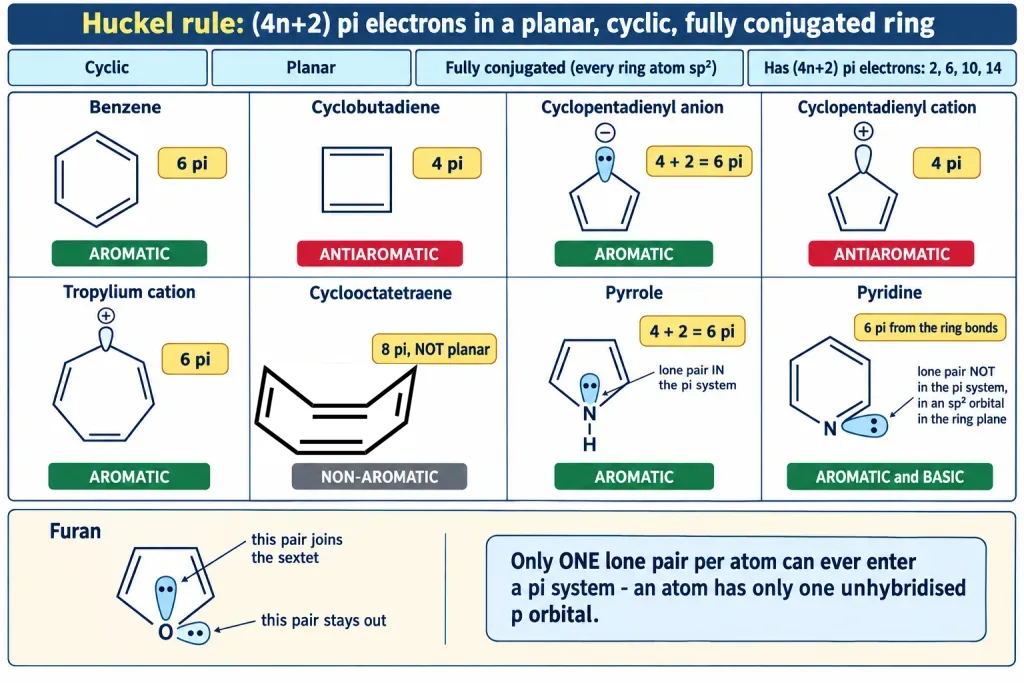
Four conditions must hold together. Drop one and the compound is not aromatic.
- Cyclic — the delocalised system closes on itself.
- Planar — every ring atom in one plane, so the orbitals are parallel.
- Fully conjugated — every ring atom with an unhybridised orbital; one atom breaks the loop.
- electrons in that loop, with , so 2, 6, 10 or 14.
Key Point (Definition): A ring meeting all four conditions is aromatic and unusually stable. One that is planar, cyclic and conjugated but holds electrons is antiaromatic, less stable than the open-chain compound with the same double bonds. One failing the planarity or conjugation test is non-aromatic and behaves like an ordinary alkene.
| Species | Contributions to the loop | electrons | Verdict |
|---|---|---|---|
| Benzene | three | 6 | aromatic, |
| Cyclobutadiene | two | 4 | antiaromatic |
| Cyclopentadienyl anion | two plus the carbanion lone pair in a orbital | 6 | aromatic |
| Cyclopentadienyl cation | two , empty on the third carbon | 4 | antiaromatic |
| Tropylium cation | three , empty on the seventh carbon | 6 | aromatic |
| Cyclooctatetraene | four , but the ring is tub-shaped | 8 | non-aromatic |
| Pyrrole | two plus the nitrogen lone pair from a orbital | 6 | aromatic |
| Pyridine | two plus one ring | 6 | aromatic |
| Furan | two plus one oxygen lone pair | 6 | aromatic |
| Cyclopropenyl cation | one , empty on the third carbon | 2 | aromatic, |
The lone pairs that count and the lone pairs that do not
Pyrrole. The nitrogen is with three sigma bonds in the ring plane, two to carbon and one to hydrogen. Its lone pair has nowhere to go but the remaining unhybridised orbital, parallel to the four carbon orbitals, so it joins the loop: . Committed to the sextet, that pair leaves pyrrole an exceptionally weak base — protonating the nitrogen would cost the aromaticity.
Pyridine. The nitrogen is with only two sigma bonds plus one bond to a ring carbon, and the ring already has its six electrons from those three multiple bonds. Its third orbital holds the lone pair, lying in the ring plane and pointing outwards, at right angles to the cloud. Pyridine is a genuine base, its conjugate acid has a near 5.2, and protonation leaves the sextet untouched.
Furan. Oxygen has two lone pairs. One sits in a orbital and enters the loop, giving 6; the other stays in an orbital in the plane. Only one lone pair per atom can ever join a system, since an atom has one unhybridised orbital to offer. Thiophene is the same picture with sulphur.
Cyclooctatetraene. A molecule distorts rather than pay the antiaromatic penalty of eight electrons. The ring folds into a tub, the orbitals stop being parallel, and it adds bromine like any alkene. Its dianion , with 10 electrons, flattens out and is aromatic.
[JEE Main] Cyclopentadiene, near 16, is about as acidic as ethanol because losing that proton gives the aromatic cyclopentadienyl anion.
Question 8: Sort a set by aromaticity
Classify benzene, cyclobutadiene, the cyclopentadienyl anion, the cyclopentadienyl cation, the tropylium cation and cyclooctatetraene.
Answer:
Benzene is planar and conjugated with 6 electrons, for : aromatic. Cyclobutadiene is conjugated with 4, a count: antiaromatic, and so unstable it survives only at very low temperature.
The cyclopentadienyl anion puts its carbanion lone pair in a orbital, joining the two double bonds for : aromatic. The cyclopentadienyl cation is the same ring with an empty orbital, so only 4: antiaromatic.
The tropylium cation has three double bonds and an empty orbital on its seventh carbon, so 6 over a planar ring: aromatic, which is why its salts are ionic solids. Cyclooctatetraene would have 8, so it buckles into a tub and the conjugation breaks: non-aromatic.
Ans: Aromatic — benzene, cyclopentadienyl anion, tropylium cation. Antiaromatic — cyclobutadiene, cyclopentadienyl cation. Non-aromatic — cyclooctatetraene.
Watch out: A cation is not automatically worse off than the anion: on a five-membered ring the anion wins, on a seven-membered ring the cation. The electron count decides, not the charge.
Ranking acidity and basicity from the electronic effects
An acid is stronger when its conjugate base is more stable; a base is stronger when its lone pair is more available. Every ranking below applies one of those two sentences.
Substituted benzoic acids
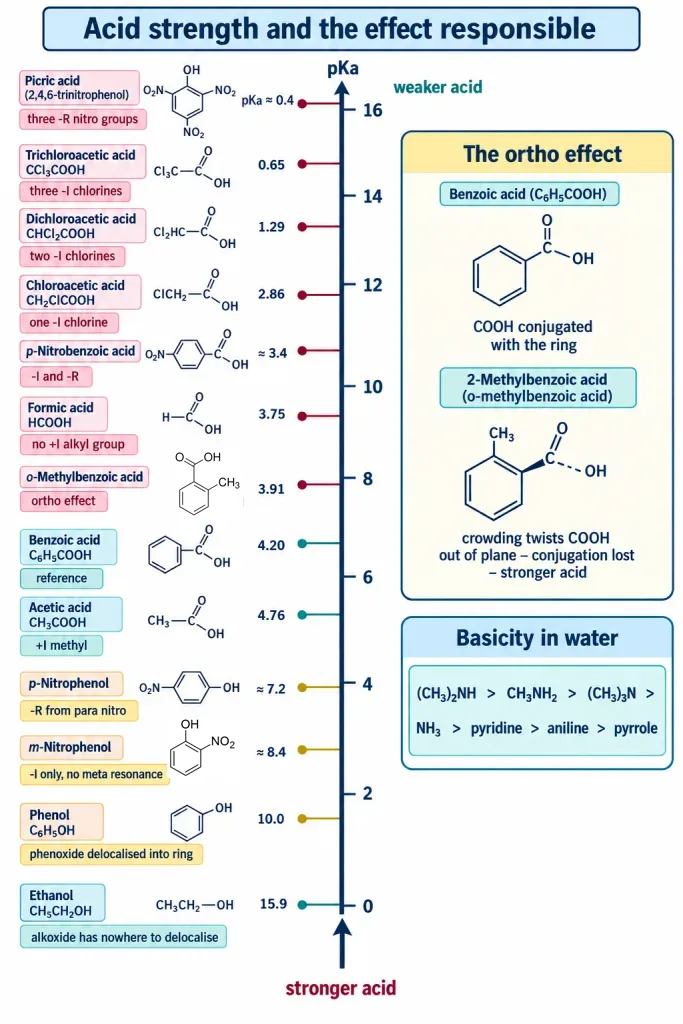
Benzoic acid has 4.20. A group is and together, spreading the carboxylate charge, and p-nitrobenzoic acid drops to about 3.4. Chlorine is the split case, but , and across four bonds the wins on balance. Methyl is only, pushing density towards an already negative centre, so p-methylbenzoic acid is weaker at about 4.4, and methoxy, but strongly from para, leaves p-methoxybenzoic acid weakest at about 4.5.
The ortho effect
Every ortho-substituted benzoic acid is stronger than benzoic acid itself, whether the substituent releases or withdraws electrons. 2-Methylbenzoic acid has 3.91 against 4.37 for the para isomer, and 2-nitrobenzoic acid falls to about 2.2. The cause is steric inhibition of resonance: a group in the ortho position crowds the and twists it out of the ring plane, so ring and carboxyl can no longer conjugate. Without that conjugation the acid behaves more like an aliphatic acid, which is stronger, and the strain in the crowded neutral acid is partly relieved when the flatter carboxylate forms. The electronic character of the ortho group barely enters it.
Phenols
Phenol has 10.0 against 15.9 for ethanol, because the phenoxide charge is delocalised into the ring while an alkoxide has nowhere to put it. A nitro group ortho or para accepts that charge onto its own oxygens through , so p-nitrophenol falls to about 7.1 (o-nitrophenol 7.2); from meta no resonance path reaches the oxygen, only survives, and m-nitrophenol lags at about 8.4. Three nitro groups take picric acid near 0.4, while a methyl makes p-cresol slightly weaker than phenol.
Amines
In water the methylamines run : raises the density on nitrogen, while crowding and the poorer hydration of a heavily substituted cation work against the tertiary amine, so the secondary amine gets the best of both. Aniline is far weaker, its lone pair delocalised into the ring and about 9.4 against 3.4 for methylamine.
Ring substituents follow the same logic: p-toluidine is stronger than aniline (), p-chloroaniline weaker ( beating ), and p-nitroaniline weaker still, since drags the lone pair onto the nitro oxygens. Among the nitroanilines, meta > para > ortho.
Carboxylic acids
With values 0.65, 1.29, 2.86, 3.75, 4.76 and about 4.9, each added chlorine deepens the pull and stabilises the carboxylate further, and formic acid beats acetic for carrying no alkyl group at all. Two refinements: the halogen order follows the series, fluoroacetic beating chloroacetic, then bromoacetic and iodoacetic; and because induction dies beyond the third carbon, 2-chlorobutanoic acid is far stronger than the 3-chloro isomer, which barely differs from the 4-chloro one.
Resonance energy, and the effects that pull in opposite directions
Hydrogenating cyclohexene releases about 120 kJ/mol, so a hypothetical cyclohexatriene with three isolated double bonds should release about 360 kJ/mol. Benzene releases 208 kJ/mol. The shortfall is energy benzene never had to give up, because it already lay lower than the localised picture: the resonance energy of benzene, 150 kJ/mol. Every bond in it is 139 pm, between the 154 pm of a single bond and the 134 pm of a double bond.
Conjugated against isolated
Buta-1,3-diene is more stable than penta-1,4-diene by roughly 15 kJ/mol, and its central bond is 148 pm, distinctly shorter than an ordinary single bond. Three rules of thumb follow:
- More contributing structures of comparable energy means more stabilisation, and equivalent contributors stabilise far more than inequivalent ones. The carboxylate ion, with two identical structures, is why a carboxylic acid is a far stronger acid than an alcohol.
- Aromatic stabilisation is not proportional to size: benzene has 150 kJ/mol for one ring, naphthalene about 255 kJ/mol for two, less per ring, and naphthalene is correspondingly more reactive.
When inductive and resonance oppose
Section 13 settled the intermediates where the effects agree. These are the cases where they fight.
| Situation | says | says | Winner |
|---|---|---|---|
| Stability of | less stable than ethyl cation | more stable, a lone pair fills the empty orbital | , the cation is more stable |
| Acidity of p-chlorophenol | stronger than phenol | weaker than phenol | , it is the stronger acid |
| Basicity of p-chloroaniline | weaker than aniline | stronger than aniline | , it is the weaker base |
| Chlorobenzene in electrophilic substitution | slows the ring down | directs to ortho and para | sets the rate, the position |
| Acidity of p-hydroxybenzoic acid | stronger than benzoic | weaker than benzoic | , it is the weaker acid |
| Acidity of m-hydroxybenzoic acid | stronger than benzoic | no meta resonance path exists | alone, slightly stronger acid |
The pattern: resonance wins where it can put or remove a whole electron pair at the atom that needs it, and induction wins where resonance is blocked by geometry or can only act at a distance. Memorise the chlorobenzene row, where the two effects answer two different questions and both answers are right.
Key Point: but is not a contradiction to settle once and for all. Fix where the charge ends up, then ask which effect reaches it.
Question 9: Five benzoic acids in order
Arrange benzoic acid, p-nitrobenzoic acid, p-methoxybenzoic acid, p-chlorobenzoic acid and o-methylbenzoic acid in decreasing order of acid strength.
Answer:
I judge each by how well it stabilises the carboxylate left behind. The nitro group is and together, the strongest withdrawal in the set, so p-nitrobenzoic acid comes first.
o-Methylbenzoic acid is next, for a reason nothing to do with the methyl being electron-releasing: the ortho substituent twists the out of the ring plane and cuts off its conjugation, so the acid behaves like an aliphatic one, 3.91 against 4.20.
Chlorine is but , and from para the still edges it. Methoxy is also but strongly , and that pushes density onto the carboxylate.
Ans: p-nitro > o-methyl > p-chloro > benzoic > p-methoxy
Watch out: The para methyl isomer sits below benzoic acid, weakened by ; move the same methyl to ortho and the acid gets stronger. The position does the work, not the group.
Question 10: Six bases in order
Arrange ammonia, methylamine, dimethylamine, trimethylamine, aniline and pyrrole in decreasing order of basic strength in aqueous solution.
Answer:
Pyrrole is bottom by a distance: its lone pair is inside the aromatic sextet and protonation would destroy the aromaticity. Aniline is next, its lone pair delocalised over the ortho and para carbons so only partly available, about 9.4.
The methylamines all sit above ammonia because raises the density on nitrogen. Among them the aqueous order is not simply one, two, three methyls: the trisubstituted amine is crowded and its cation poorly hydrated, so dimethylamine balances best.
Ans: aniline > pyrrole
Watch out: In the gas phase, with no solvent, the order becomes tertiary > secondary > primary > ammonia, purely inductive. A question that says "in aqueous solution" wants the other order.
The analysis numericals, at the level they are actually set
Three question shapes recur, none harder than the arithmetic once a plan is written down.
Shape 1: back-calculation. The formula or the percentage composition is given and a product mass is wanted. Run the standard formula backwards.
The same inversion works with for , for , for , for , for and for .
Shape 2: empirical formula with oxygen by difference. Combustion gives carbon and hydrogen; a separate determination gives nitrogen, sulphur or halogen; oxygen is whatever is left.
Oxygen by difference carries every error made in the other determinations, so do it last and do not round the others first. Then divide each percentage by the atomic mass, divide by the smallest result, and multiply up to whole numbers.
Shape 3: Kjeldahl back-titration. The ammonia is driven into a known excess of standard acid and the leftover acid is titrated back with standard alkali. Only the acid the ammonia consumed counts.
is the molarity common to the sulphuric acid and the alkali, the volume of acid taken in mL, the volume of alkali needed in mL, the mass in grams. The factor 2 and the halving of both come from sulphuric acid supplying two protons per molecule. Reasoning in moles works as well: moles of nitrogen equals moles of taken minus moles of alkali used.
Kjeldahl gives no answer at all for nitrogen held in a ring, as in pyridine, or in a nitro or azo group, because those nitrogens are never converted to ammonium sulphate during the digestion.
Question 11: Working backwards to the products
0.50 g of a compound of molecular formula is burned completely. Calculate the masses of carbon dioxide and water formed.
Answer:
The molar mass is , so
Carbon in the sample is g, and 12 g of carbon gives 44 g of carbon dioxide:
Hydrogen is g, and 2 g of hydrogen gives 18 g of water:
Ans: 1.00 g of carbon dioxide and 0.409 g of water
Watch out: The oxygen already in the compound plays no part; only its carbon becomes carbon dioxide and only its hydrogen becomes water.
Question 12: From combustion straight to a molecular formula
0.39 g of a hydrocarbon on complete combustion gave 1.32 g of carbon dioxide and 0.27 g of water. Its molar mass is 78 g/mol. Find the molecular formula.
Answer:
The two add to 100.0, so there is no oxygen. Dividing by atomic masses gives 7.69 and 7.69, so the empirical formula is , of mass 13, and .
Ans:
Watch out: A DoU check confirms it: , exactly the ring and three double bonds of benzene.
Question 13: Oxygen by difference
0.75 g of an organic compound gave 0.88 g of carbon dioxide and 0.45 g of water on combustion. A separate 0.75 g portion gave 112 mL of nitrogen at STP. The molar mass is 75 g/mol. Find the molecular formula.
Answer:
Oxygen by difference, last of all:
Dividing by atomic masses gives 2.667, 6.67, 1.333 and 2.666, and dividing all four by 1.333 gives 2, 5, 1 and 2. The empirical formula has mass 75, so .
Ans: , which is glycine
Watch out: Oxygen is never measured here, only inferred. A wrong nitrogen figure would be absorbed entirely by the oxygen, and the formula would still look tidy.
Question 14: A Kjeldahl back-titration
1.0 g of an organic compound was digested by Kjeldahl's method and the ammonia liberated was absorbed in 30 mL of 0.5 M sulphuric acid. The unreacted acid required 40 mL of 0.5 M sodium hydroxide. Calculate the percentage of nitrogen.
Answer:
Working in moles of protons is safest. Sulphuric acid gives two protons per molecule, so the acid supplies mol of , and the alkali neutralises mol of that.
The ammonia therefore consumed mol of protons, one per molecule, so 0.010 mol of nitrogen, or 0.14 g.
The standard formula agrees: .
Ans: 14.0 %
Watch out: Treating 0.5 M sulphuric acid as supplying 0.5 mol of protons per litre halves the acid and gives a negative answer. Convert to protons before subtracting.