
Two kinds of attacking reagent
Almost every organic reaction is written the same way. One partner is the substrate — the organic molecule whose bonds are going to change. The other is the reagent — the species that comes in and attacks it. Which bond breaks, and where the new bond forms, is decided by what the reagent is short of.
There are only two possibilities. Either the reagent has a pair of electrons it is willing to give away, or it is short of a pair and wants one. That single split runs through the whole of organic chemistry.
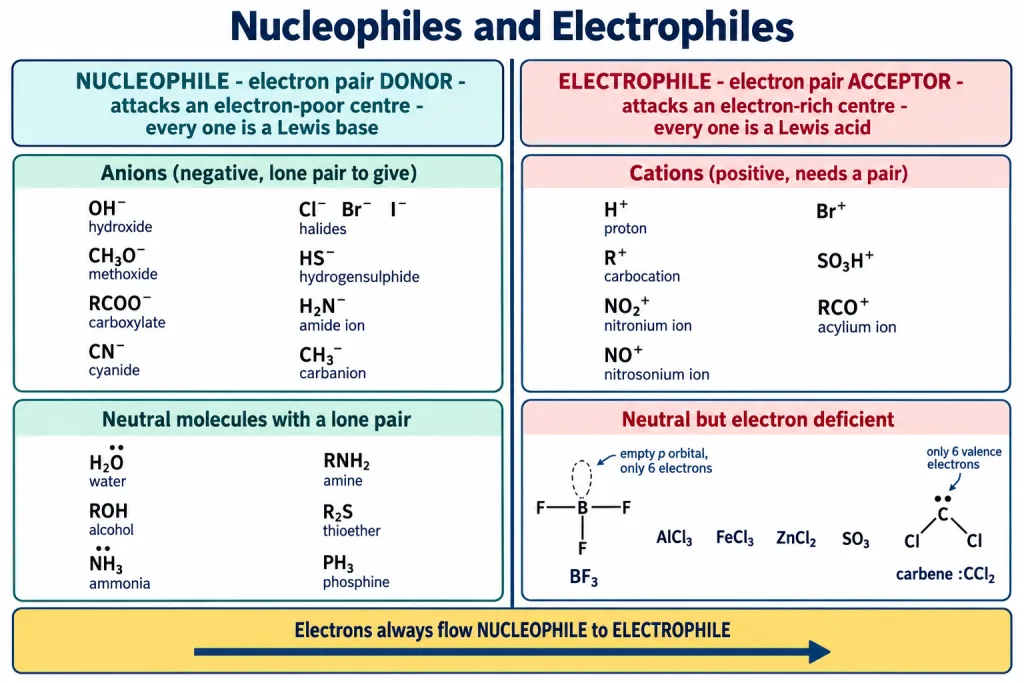
Key Point (Definition): A nucleophile is a reagent that brings an electron pair and donates it to an electron-deficient centre. An electrophile is a reagent that is short of electrons and accepts an electron pair from an electron-rich centre.
The names say what each one hunts for. Nucleophile is "nucleus loving", from the Greek philos, loving: a species carrying spare electrons is drawn to a positively charged, electron-poor nucleus. Electrophile is "electron loving": a species short of electrons goes looking for a region rich in them.
A nucleophile is usually written or , with the two dots standing for the pair it is about to hand over. An electrophile is written or simply .
The two always work as a pair
A nucleophile cannot react on its own, and neither can an electrophile. Every polar organic reaction is one electron pair moving from a donor to an acceptor, and both roles must be filled. When hydroxide attacks bromomethane,
hydroxide is the nucleophile and the carbon of is the electrophilic centre, because bromine has pulled electron density away from it and left it . Bromide leaves with the pair it took from carbon.
Two habits of language matter here.
A reaction is named after the reagent, not the substrate. Hydroxide replacing bromide is a nucleophilic substitution; a nitronium ion attacking benzene is an electrophilic substitution — even though benzene is the electron donor in the second case.
A centre, not a whole molecule, carries the label. In only the carbon bonded to bromine is electrophilic; the hydrogens are not. Learn to point at the atom.
Key Point: Electrons move from the nucleophile to the electrophile. Never the other way. Fix the direction now and half the mechanism marks in Class 12 are already safe.
Nucleophiles: what they look like
A nucleophile needs one thing only — an available pair of electrons. That pair can be a lone pair on a heteroatom, a lone pair on a carbon (a carbanion), or the electron pair of a bond. Two structural families cover almost everything you will meet.
Family 1 — anions
A negative charge means a surplus of electrons, so most anions are nucleophiles.
| Nucleophile | Name | Donor atom |
|---|---|---|
| hydroxide | oxygen | |
| , | methoxide, ethoxide | oxygen |
| carboxylate | oxygen | |
| cyanide | carbon (or nitrogen) | |
| , , | halide | halogen |
| , | hydrogensulphide, thiolate | sulphur |
| amide ion | nitrogen | |
| , | carbanions | carbon |
Carbon is not an electronegative element, so a carbanion holds its negative charge badly and gives the pair away eagerly. That makes carbanions among the most reactive nucleophiles in organic chemistry.
Family 2 — neutral molecules carrying a lone pair
No charge is needed. A neutral molecule whose central atom keeps a lone pair can donate it.
| Nucleophile | Name | Donor atom |
|---|---|---|
| water | oxygen (2 lone pairs) | |
| alcohol | oxygen (2 lone pairs) | |
| ether | oxygen (2 lone pairs) | |
| ammonia | nitrogen (1 lone pair) | |
| , , | amines | nitrogen (1 lone pair) |
| thioether | sulphur (2 lone pairs) | |
| , | phosphine | phosphorus (1 lone pair) |
A bond also counts. The two electrons above and below the plane of are loosely held and stick out into space, so an alkene attacks electrophiles readily — that is the whole basis of electrophilic addition.
Charged beats neutral
Compare a species with its own conjugate acid and the anion always wins as a nucleophile:
Adding a proton locks one lone pair into a bond and puts a positive charge on the donor atom, which grips the remaining electrons far more tightly.
[JEE Main] Down a group in the periodic table, nucleophilicity in water rises even though basicity falls: as nucleophiles towards carbon, the exact reverse of their basicity order. The large, soft, poorly solvated iodide reaches carbon fastest.
Electrophiles: what they look like
An electrophile is short of an electron pair. That shortage comes about in one of two ways — a full positive charge, or an incomplete octet on a neutral atom.
Family 1 — cations
| Electrophile | Name | Accepting atom |
|---|---|---|
| proton | hydrogen (empty 1s) | |
| , e.g. | carbocation | carbon (empty p) |
| nitronium ion | nitrogen | |
| nitrosonium ion | nitrogen | |
| , | halogen cations | halogen |
| protonated sulphur trioxide | sulphur | |
| , written | acylium ion | carbonyl carbon |
A carbocation is the model case. Its carbon is hybridised and trigonal planar, with an empty p orbital perpendicular to the plane and only six valence electrons. That empty orbital is precisely the hole a nucleophile fills. The acylium ion, , carries its positive charge on the carbon bearing the oxygen.
Family 2 — neutral, electron-deficient molecules
| Electrophile | Why it is electron deficient |
|---|---|
| boron has only 6 valence electrons — an incomplete octet, one empty p orbital | |
| aluminium has only 6 valence electrons, same sextet | |
| iron accepts a pair into a vacant d orbital | |
| zinc accepts a pair into a vacant orbital | |
| sulphur bears a large ; all three oxygens pull from it | |
| carbene, or | divalent carbon with only 6 valence electrons and a vacant orbital |
, , and are the four you meet again and again as "catalysts". Each one grabs a lone pair or an anion from the reagent and thereby manufactures a stronger electrophile — that is the whole of the catalysis.
A carbene deserves a warning label. Its carbon carries two bonds, one lone pair and no charge, so it is one of the very few carbon species in this chapter that does not have four bonds. Six valence electrons make it hungry, and dichlorocarbene, , attacks electron-rich centres hard.
The carbonyl carbon: a neutral atom that is still electrophilic
The most important electrophilic centre in all of organic chemistry carries no charge at all. In a carbonyl group,
oxygen is far more electronegative than carbon and it pulls the electron pair towards itself. Carbon is left with a real, permanent . Every aldehyde, ketone, acid, ester, amide and acid chloride is attacked by nucleophiles at exactly that carbon.
The same argument makes the carbon of a nitrile : in nitrogen drains the triple bond. In it is iodine drawing the pair that leaves the methyl carbon .
Key Point: An electrophilic centre is any atom with a full positive charge, an incomplete octet, or a substantial produced by a more electronegative neighbour. The third case is the one students miss.
The link to Lewis acids and bases
The two definitions you learnt in the bonding chapter are the same two definitions again.
Key Point: A Lewis base donates an electron pair; a Lewis acid accepts one. So every nucleophile is a Lewis base, and every electrophile is a Lewis acid.
Run the lists side by side and they match item for item. , , and appear on both the nucleophile list and the Lewis base list. , , and appear on both the electrophile list and the Lewis acid list.
Two sets of words, two different questions
Nucleophilicity and electrophilicity are kinetic terms. They measure a rate — how fast the species attacks, and in practice how fast it attacks a carbon atom. Basicity and acidity are equilibrium terms. They measure the position of an equilibrium, specifically how far the species goes in binding a proton, which is what and report.
The two usually run in the same direction, but not always: iodide is a much weaker base than fluoride, yet in water it is by far the better nucleophile towards carbon. Keeping the one-line difference in your head — rate versus equilibrium — is enough for this chapter.
[NEET] A statement such as "every nucleophile is a Lewis base" is true. Its converse, "every Lewis base is a good nucleophile", is not automatically true, because nucleophilicity depends on how fast the pair reaches carbon and that depends on size, solvation and steric bulk as well as on charge.
Species that play both roles
Nothing forces a molecule to be only one thing. Whether it behaves as a donor or an acceptor depends on which of its atoms the other reagent meets, and on what it is reacting with.
Water, ammonia and alcohols — and their conjugate acids
, and are all nucleophiles: each has a lone pair to donate. Their conjugate acids are not.
- has no lone pair left at all. All four pairs on nitrogen are tied up in bonds, so it cannot donate anything. It is attacked by bases at hydrogen, which makes it an electrophile, not a nucleophile.
- and do keep a lone pair, but the positive charge on oxygen holds it so tightly that they behave as proton donors — as acids and hence electrophiles — rather than as nucleophiles.
The general rule: protonating a nucleophile destroys its nucleophilicity.
One molecule, two sites
Sulphur dioxide. In the sulphur is and accepts an electron pair from a nucleophile; the oxygens carry lone pairs and a , so they can donate to an electrophile. is therefore both an electrophile and a nucleophile, depending on which end is approached.
The carbonyl group — the case to memorise. Take propanone, . Its bond is strongly polarised, because oxygen is much more electronegative than carbon and drags the pair towards itself:
- The carbon is and electrophilic. Nucleophiles — , , , a carbanion — attack here.
- The oxygen is , carries two lone pairs, and is nucleophilic. Electrophiles — a proton, a Lewis acid — attach here.
Both happen in the same flask during acid-catalysed addition: the acid protonates the oxygen first, which pulls even more electron density off the carbon and makes it a better electrophile, and only then does the nucleophile attack the carbon.
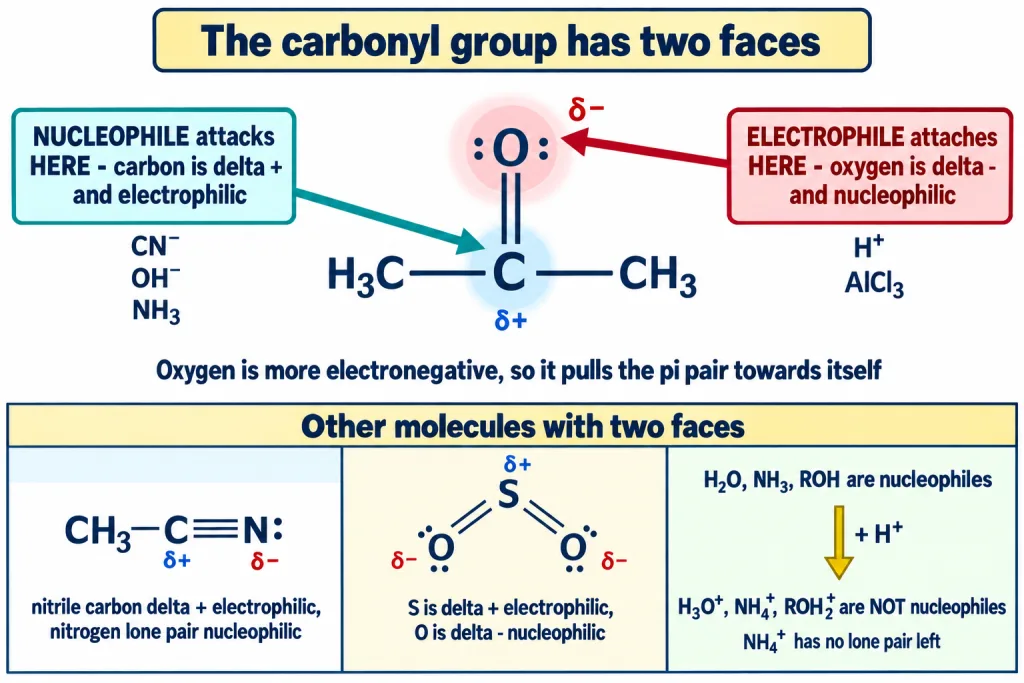
The nitrile group behaves the same way: in the carbon is electrophilic and the nitrogen, with its lone pair, is nucleophilic.
Ambident nucleophiles
A few nucleophiles have two different donor atoms and can attack through either of them. They are called ambident ("two teeth") nucleophiles, and the product depends on which atom does the attacking.
Cyanide, , has a lone pair on carbon and a lone pair on nitrogen, with the negative charge delocalised over both. Ionic potassium cyanide lets the carbon attack, giving an alkyl cyanide ; largely covalent silver cyanide leaves only the nitrogen free, giving the isomeric alkyl isocyanide .
Nitrite, , has lone pairs on nitrogen and on both oxygens. Potassium nitrite gives attack through oxygen and an alkyl nitrite ; silver nitrite gives attack through nitrogen and a nitroalkane . In each case the two products are functional group isomers.
Electron movement and the curved arrow
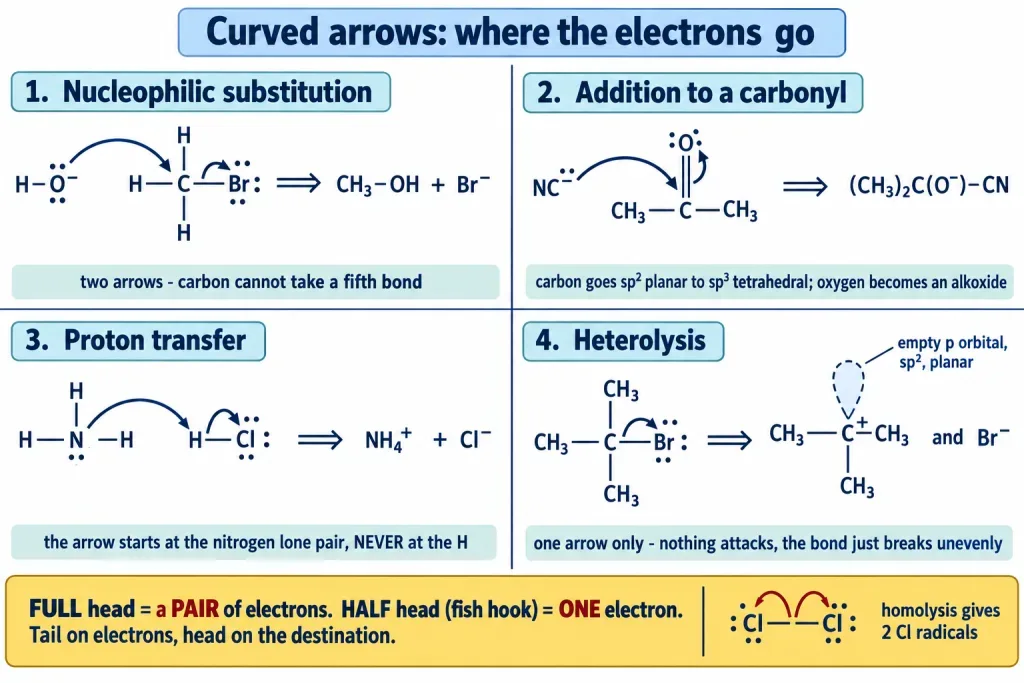
A mechanism is a record of where every electron pair went. The convention for writing it down is the curved arrow, and it has exactly two forms.
Key Point (Definition): A full-headed curved arrow shows the movement of a pair of electrons. A half-headed curved arrow (a "fish hook") shows the movement of a single electron.
Full arrows appear in every polar reaction — every nucleophile-electrophile step, every heterolysis. Fish hooks appear only in radical chemistry, one for each single electron that moves.
The rules the tail and the head must obey
- The tail always sits on electrons. It starts either at a lone pair or in the middle of a bond. Those are the only two legal starting points.
- The tail never starts at an atom, and never at a positive charge. An arrow drawn out of or out of a carbocation is wrong, because there are no electrons there to move. The arrow goes towards the positive centre.
- The head shows the destination. Pointing at an atom means the pair becomes a lone pair on that atom. Pointing between two atoms means the pair becomes a new bond there.
- The octet is never exceeded. If a new bond forms at a second-period atom that already has eight electrons, an old bond at that atom must break in the same step — which needs a second arrow.
- Charge is conserved. Add up the charges on both sides of the arrow; the totals must match.
- Arrows run nucleophile to electrophile, never in reverse.
Six mechanisms, described in words
Curved arrows are drawings, so read each description below against the figure and make sure you could draw it yourself.
1. Nucleophilic substitution — hydroxide on bromomethane.
Two arrows, both in the same step. One lone pair on the hydroxide oxygen moves out and becomes the new oxygen-carbon bond; at the same moment the carbon-bromine bonding pair moves off the bond and onto bromine, where it becomes a fourth lone pair and gives bromide its negative charge. The second arrow is compulsory: carbon already has a full octet, so it cannot take a new bond without giving one up. Charge check: on the left, on the right.
2. Addition to a carbonyl — cyanide on propanone.
The lone pair on the cyanide carbon moves out and becomes a bond to the carbonyl carbon; at the same time the bonding pair of the moves up onto oxygen and becomes a lone pair there. The carbon changes from and planar to and tetrahedral, and the oxygen ends up negative — an alkoxide, which then picks up a proton to give the cyanohydrin.
3. Proton transfer — ammonia and hydrogen chloride.
The lone pair on nitrogen moves out and becomes the new nitrogen-hydrogen bond; at the same instant the hydrogen-chlorine bonding pair moves entirely onto chlorine. Nitrogen loses its lone pair and becomes positive; chlorine gains a fourth lone pair and becomes negative. The arrow starts at the nitrogen lone pair, never at the hydrogen and never at a .
4. Heterolysis — ionisation of 2-bromo-2-methylpropane.
A single arrow. The carbon-bromine bonding pair moves off the bond and onto bromine. Both electrons go to the more electronegative atom, leaving a tertiary carbocation and a bromide ion. Nothing attacks anything here; the bond simply breaks unevenly.
5. Electrophilic addition — hydrogen bromide on ethene.
The bonding pair of the double bond moves out and becomes a bond to the hydrogen of ; simultaneously the hydrogen-bromine bonding pair moves onto bromine. Here the alkene is the nucleophile — the arrow starts in the bond, which is what makes an alkene attack rather than be attacked. The carbocation formed is then captured: a lone pair on bromide moves out to the positive carbon and becomes the carbon-bromine bond.
6. Homolysis — chlorine in light.
Two fish hooks, drawn from the middle of the bond, one curving to each chlorine. Each atom takes one electron and leaves as a neutral radical. A full arrow here would give both electrons to one atom and produce ions, which is not what happens.
The curved-arrow mistakes that lose marks
Every one of these appears in scripts every year.
- Starting the arrow at a positive charge. An arrow drawn from to a lone pair, or from a carbocation to a nucleophile, is backwards. A positive centre has no electrons to send.
- Starting the arrow at an atom instead of at its electrons. The tail belongs on the lone pair or on the bond, not on the letter.
- Drawing one arrow where two are needed. Making a bond to an atom that already has a full octet, without breaking one of its existing bonds, gives carbon five bonds — the worst error in the chapter.
- Using a full arrow for a radical step, or a fish hook for a polar one. One head means one electron; two heads mean two.
- Moving atoms instead of electrons. The arrow tracks electrons only. Nuclei stay where they are except where a bond to them is explicitly broken or made.
- Losing charge across the arrow. If the left side totals and the right side totals , something has been dropped.
- Moving bonds in a resonance scheme. Between resonance contributors only electrons and lone pairs move; atoms and bonds never do.
- Drawing the arrow to the wrong atom of an ambident nucleophile without saying which reagent decides it.
Key Point: Before you accept a mechanism, run three checks — every arrow starts on electrons, no second-period atom exceeds an octet, and the total charge is the same on both sides.
Question 1: Sorting twenty-two reagents
Classify each of the following as a nucleophile, an electrophile, or both, and give the reason in one line: , , , , , , , , , , , , , , , , , , , , , .
Answer:
For each one I check whether it has a spare pair to give or a hole to fill. A few have both.
| Species | Class | Reason |
|---|---|---|
| nucleophile | negative oxygen with three lone pairs to donate | |
| electrophile | boron has only 6 valence electrons and one empty p orbital | |
| nucleophile | neutral, but nitrogen carries a lone pair | |
| electrophile | full positive charge on nitrogen, the nitration reagent | |
| nucleophile | oxygen has two lone pairs | |
| nucleophile | negative and ambident, donating from carbon or from nitrogen | |
| electrophile | aluminium sextet, accepts a pair into its empty orbital | |
| electrophile | carbocation with an empty p orbital and 6 valence electrons | |
| nucleophile | carbanion, a lone pair on a weakly electronegative carbon | |
| electrophile | bare proton, empty 1s orbital, no electrons at all | |
| electrophile | sulphur pulled hard by three oxygens carries a large | |
| both | carbonyl carbon is , carbonyl oxygen has lone pairs | |
| electrophile | no lone pair remains on nitrogen, so it can only accept | |
| nucleophile | alkoxide, negative oxygen | |
| nucleophile | halide anion with four lone pairs | |
| electrophile | iron accepts a pair into a vacant d orbital | |
| nucleophile | tertiary amine, lone pair on nitrogen | |
| nucleophile | negative, polarisable sulphur | |
| electrophile | acylium ion, positive carbon | |
| both | sulphur is and electrophilic, the oxygens are and nucleophilic | |
| both | nitrile carbon is , nitrogen keeps a lone pair | |
| nucleophile | the loosely held pair is donated to electrophiles |
Ans: Nucleophiles — , , , , , , , , , . Electrophiles — , , , , , , , , . Both — , , .
Watch out: is a nucleophile but is not, and the reason is not simply "it is positive" — it is that nitrogen has no lone pair left.
Question 2: Heterolysis and which fragment keeps the pair
Show, in words, the reactive intermediates formed when the bonds in , and undergo heterolytic cleavage.
Answer:
In heterolysis the shared pair goes entirely to one atom, and it is always the more electronegative partner that keeps it. So I compare carbon with the atom on the other side of the bond each time.
In the bond breaks between the methyl carbon and sulphur. Sulphur takes the pair, so the arrow runs from the carbon-sulphur bond onto sulphur, giving and .
In the bond that breaks is the one between the methyl carbon and the nitrile carbon. The cyanide fragment is far better at holding a negative charge, because the charge is spread over carbon and nitrogen. The pair goes to it, giving and .
In the partner is copper, a metal, which is much less electronegative than carbon. Carbon takes the pair this time, giving and .
Ans: ; ; .
Watch out: The carbon-metal bond is the one that reverses. Writing and for methylcopper is the standard slip.
Question 3: Locating the electrophilic centre
Identify the electrophilic centre in , and .
Answer:
An electrophilic centre is an atom left short of electrons by a more electronegative neighbour, so I look for the most polarised bond in each molecule.
In ethanal, , the bond is heavily polarised towards oxygen. The carbonyl carbon is and is where nucleophiles attack. The oxygen is , so it is the nucleophilic end, not the electrophilic one.
In ethanenitrile, , nitrogen drains the triple bond. The nitrile carbon is .
In iodomethane, , iodine pulls the bonding pair towards itself, so the carbon bonded to iodine is .
Ans: the carbonyl carbon of ; the nitrile carbon of ; the carbon carrying iodine in .
Watch out: In all three the electrophilic atom is neutral. A missing charge does not mean a missing electrophile.
Question 4: Arrows for a nucleophilic substitution
Describe, arrow by arrow, the electron movement in , and state how many arrows are needed.
Answer:
Cyanide is the nucleophile and the methyl carbon is the electrophilic centre, because bromine has left it .
First arrow: the lone pair on the carbon of cyanide moves out and becomes the new carbon-carbon bond to the methyl carbon.
Second arrow: at the same time the carbon-bromine bonding pair moves out of that bond and onto bromine, where it becomes an extra lone pair and gives bromide its negative charge.
Two arrows are needed, not one. The attacked carbon already has four bonds and a full octet, so a bond must leave for every bond that arrives — otherwise the drawing shows carbon with five bonds.
Charge check: before, after.
Ans: Two full-headed arrows — cyanide lone pair to carbon, and the bonding pair onto bromine.
Watch out: Do not start the first arrow at the negative sign on . It starts at the lone pair on carbon, which is where the electrons actually are.
Question 5: Arrows for addition to a carbonyl
Describe the electron movement when adds to ethanal in the presence of a trace of base, to give the cyanohydrin .
Answer:
The base first removes the proton from : a lone pair on the base moves to the hydrogen, and the bonding pair moves onto carbon, releasing . The real nucleophile is the cyanide ion.
Addition step, two arrows together. The lone pair on the cyanide carbon moves out and becomes a bond to the carbonyl carbon of ethanal. At the same moment the bonding pair of the moves up onto oxygen and becomes a lone pair there. The carbon changes from and trigonal planar to and tetrahedral, and the product of this step is the alkoxide .
Protonation step, two arrows. A lone pair on the alkoxide oxygen moves out to a hydrogen of (or of water), and the bonding pair of that bond moves away onto carbon, regenerating .
Ans: Cyanide lone pair to the carbonyl carbon, the pair onto oxygen, then the alkoxide lone pair to a proton.
Watch out: The second arrow of the addition step is not optional. Carbon already has a complete octet in the carbonyl, so the pair must be pushed onto oxygen for the new bond to form.
Question 6: Arrows for a proton transfer
Describe the electron movement in .
Answer:
Hydroxide is the nucleophile. It attacks the hydrogen of the group, which is the most electron-poor site in the acid.
First arrow: a lone pair on the hydroxide oxygen moves out and becomes the new bond to that hydrogen.
Second arrow: the bonding pair of the acid's bond moves off the bond and onto its oxygen, which becomes the negative acetate oxygen.
Hydroxide ends up neutral as water; the acid ends up negative as acetate. Total charge on each side.
Ans: Hydroxide lone pair to the acidic hydrogen, and the bonding pair onto the carboxyl oxygen.
Watch out: No arrow is ever drawn starting at the hydrogen. A proton transfer looks like an moving, but what actually moves in the drawing is two electron pairs.
Question 7: Arrows for electrophilic addition
Describe the electron movement when adds to propene, .
Answer:
Here the alkene is the nucleophile and supplies the electrophile.
Step 1, two arrows. The bonding pair of the double bond moves out and becomes a bond to the hydrogen of ; at the same instant the bonding pair moves onto bromine. The hydrogen adds to the terminal , which leaves the positive charge on the middle carbon and gives the secondary cation , more stable than the primary alternative.
Step 2, one arrow. A lone pair on bromide moves out to the positive carbon and becomes the carbon-bromine bond, giving 2-bromopropane.
Ans: pair to hydrogen and pair onto bromine, then a bromide lone pair to the carbocation; the product is .
Watch out: The first arrow starts in the bond, not at a carbon atom, and it points at the hydrogen of , not at the bromine.
Question 8: An ambident nucleophile, two products
Bromoethane with gives one product and with gives its isomer. Name both and explain.
Answer:
Cyanide is ambident: it has a lone pair on carbon and a lone pair on nitrogen, and the negative charge is shared between them.
Potassium cyanide is ionic in solution, so free is present and the more nucleophilic carbon end attacks. The lone pair on carbon moves to the ethyl carbon while the carbon-bromine pair moves onto bromine. The product is propanenitrile, .
Silver cyanide is largely covalent, so free cyanide is scarce and the silver holds the carbon end. Only the nitrogen lone pair is available to attack, and the product is the isocyanide , ethyl isocyanide.
Ans: gives propanenitrile (attack through carbon); gives ethyl isocyanide (attack through nitrogen). They are functional group isomers.
Watch out: The two products have the same molecular formula. The examiner is testing whether you know that the reagent, not the halide, decides which atom of the ambident nucleophile attacks.
Question 9: Find the mistake in a proposed mechanism
A student writes the reaction of with ethene by drawing an arrow from the positive charge on to the middle of the bond. What is wrong, and what is the correct arrow?
Answer:
The tail is in the wrong place. is a bare proton with no electrons at all, so nothing can flow out of it. An arrow tail must sit on a lone pair or on a bond.
The electrons here belong to the alkene. The correct single arrow starts in the bond of and points at the hydrogen of . That pair becomes the new carbon-hydrogen bond, and the carbon that did not get the hydrogen is left with an empty p orbital as .
Charge check: before, after.
Ans: The arrow must run from the bond to the proton, not from the proton to the bond.
Watch out: The same error in disguise is drawing an arrow out of a carbocation towards an incoming nucleophile. Electrons always leave the nucleophile and arrive at the electrophile.