
What this chapter is examined on, honestly
This chapter is tested by recall speed, not derivation. Almost everything from it can be answered in under forty seconds by a student holding the right lists, and nothing in it rewards long working.
| Item type, most frequent first | What it demands | Fair time |
|---|---|---|
| IUPAC naming, and reading a name back into a structure | the rule order and the two tie-breaks | 30-40 s |
| Functional group recognition | spotting , , , in a condensed formula | 10-15 s |
| Stability orders | four memorised ladders and an alpha-hydrogen count | 15-25 s |
| Isomerism identification | one pair, one label | 20-30 s |
| Electronic effects as a one-line reason | which effect, which direction | 20 s |
| The four reaction types | substitution, addition, elimination, rearrangement | 15 s |
| Laboratory tests and their colours | one colour table | 15 s |
Long analysis numericals are rare. The Dumas, Kjeldahl and Carius calculations deserve one revision pass, but they arrive as a single substitution into a formula — mass of in, percentage of chlorine out. Mechanism drawing is rare too: naming the intermediate is common, drawing every curved arrow is not.
Key Point: Split revision time roughly 40% to nomenclature and functional groups, 25% to the stability orders and electronic effects, 20% to isomerism, 15% to the tests, colours and purification methods.
[NEET] Four traps here are facts you either hold or do not — the locant tie-break, the carbanion reversal, halogens being but , and the blood-red colour meaning two elements. Learn all four as sentences.
Nomenclature at speed — the rule card
Six steps, in this order, never out of it.
- Find the parent chain: the longest chain containing the principal functional group. Two chains tied in length, take the one with more substituents.
- Number for the lowest locant to the principal group. The functional group beats a double or triple bond, which beats a substituent.
- Break a tie by first point of difference in the locant set.
- Cite prefixes alphabetically. di, tri, tetra are not counted; iso, neo, cyclo are; sec- and tert- are not.
- Punctuate: commas between numbers, hyphens between number and letter, no spaces inside the name.
- Locant immediately before the piece it belongs to: pent-2-ene, butan-2-one, hex-4-en-2-one.
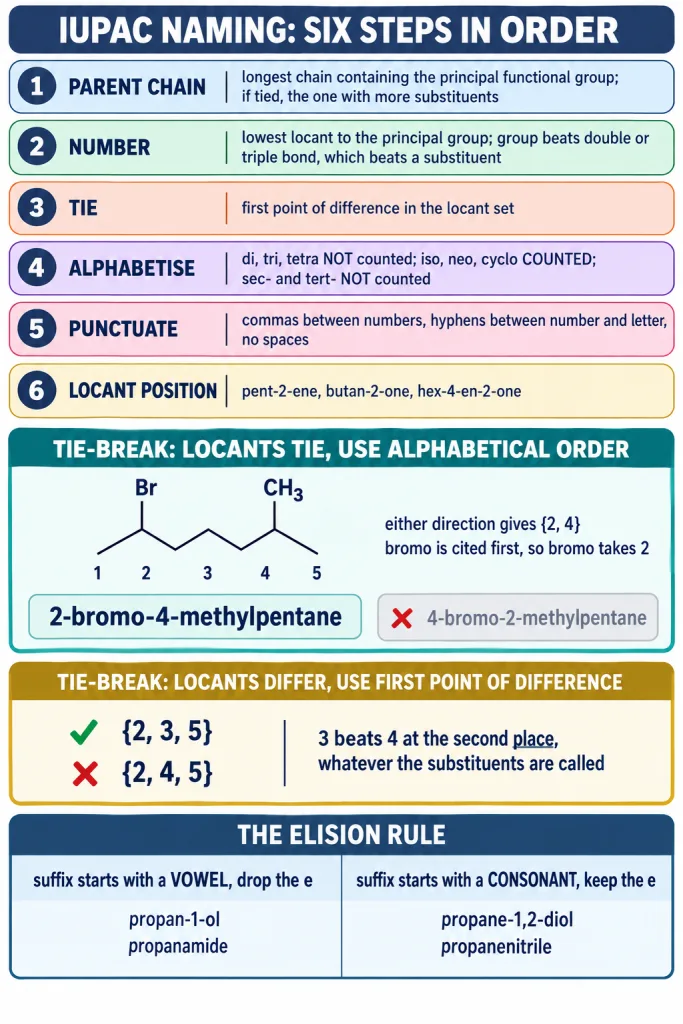
The elision rule. Drop the terminal e of the parent before a suffix beginning with a vowel, keep it before a consonant. So propan-1-ol, propanal, propan-2-one and propanamide, but propanenitrile, propane-1,2-diol and propanedioic acid — the multiplying prefix is what saves the e in the last two.
The two tie-breaks. When the locant sets tie, the prefix cited first alphabetically takes the lower number: in both directions give , so bromo takes 2 and the name is 2-bromo-4-methylpentane. When the sets do not tie, first point of difference decides and alphabetical order never overrides it — beats whatever the substituents are called.
Ring against chain. Whichever has more carbons is the parent, unless the principal group sits on the other one, in which case the group decides. So methylcyclohexane (ring 6 against chain 1) but 1-cyclopropylpentane (chain 5 against ring 3); cyclohexanol and cyclohexanecarbaldehyde with the group on a ring carbon, but phenylmethanol — benzyl alcohol — with it one carbon out.
[NEET] A naming item is marked on the whole string, so right locants with wrong alphabetical order scores nothing. Run all six steps even on a name that looks obvious.
The naming drill
Cover the right-hand columns and work down. Anything missed twice goes on a card.
| Structure | Name | Point |
|---|---|---|
| 2-methylbutane | isopentane | |
| 2,2-dimethylpropane | neopentane | |
| 2-methylpentane | chain is 5 | |
| 3-ethyl-2-methylpentane | ethyl cited first | |
| 3-methylhexane | chain via the propyl | |
| but-1-ene | locant before -ene | |
| but-2-ene | shows cis-trans | |
| buta-1,3-diene | root keeps its a | |
| pent-1-en-4-yne | tie, so -ene takes 1 | |
| 2-bromo-2-methylpropane | tert-butyl bromide | |
| 2-bromo-4-chloropentane | tie, alphabetical | |
| nitroethane | prefix only | |
| propan-2-ol | isopropyl alcohol | |
| 2-methylpropan-2-ol | tert-butyl alcohol | |
| ethane-1,2-diol | e kept | |
| pent-4-en-2-ol | group beats alkene | |
| 1-methoxypropane | ether is alkoxy | |
| propanal | is C-1 | |
| butan-2-one | ketone needs a locant | |
| 3-oxobutanal | ketone demoted to oxo | |
| 4-oxopent-2-enoic acid | acid senior to both | |
| 1-phenylethan-1-one | acetophenone | |
| 2-hydroxypropanoic acid | demoted | |
| ethyl ethanoate | two words | |
| propanamide | e elided | |
| propanenitrile | nitrile carbon counts | |
| propan-1-amine | primary amine | |
| benzyl chloride | not chlorobenzene | |
| 2-phenylethan-1-ol | chain parent | |
| phenol, para | 4-nitrophenol | p-nitrophenol |
Key Point: Four errors produce every wrong name above — a parent chain shorter than the true longest chain, a locant tie broken the wrong way, prefixes out of alphabetical order, and the terminal e wrongly elided or kept.
Question 1: Tied locants, two different prefixes
Name .
Answer:
Parent is pentane, with no functional group — just a bromo and a methyl.
From the bromine end the set is ; from the other end it is again, so first point of difference cannot separate them. The alphabetical rule then applies: bromo comes before methyl, so bromo takes the lower locant.
Ans: 2-bromo-4-methylpentane
Watch out: 4-bromo-2-methylpentane comes from handing the low locant to methyl. The alphabetical rule breaks a tie and never overrides a real first point of difference.
Question 2: The chain is not the way it is drawn
Name , the propyl group being straight.
Answer:
The branch carbon holds a methyl, an ethyl and a propyl. The longest path runs from the propyl end, through that carbon and out along the ethyl: carbons, so hexane with a methyl left over. From the propyl end the methyl lands on C-4, from the ethyl end on C-3.
Ans: 3-methylhexane
Watch out: The longest chain rarely runs left to right in a typed formula. Count every path out of every branch point first.
Question 3: Elision, and two groups competing for a low locant
Name and .
Answer:
The first is a three-carbon diol. -diol begins with a consonant, so the terminal e of propane stays, and the hydroxyls sit on C-1 and C-2.
The second has five carbons, one and one double bond. The alcohol is the principal group and takes the lowest locant open to it, so counting from the methyl end puts on C-2 and the alkene at C-4.
Ans: propane-1,2-diol and pent-4-en-2-ol
Watch out: pent-1-en-4-ol is the standard error, from giving the low locant to the double bond. The functional group outranks a multiple bond, always.
Functional group recognition
| Group | Formula | Class | Suffix when senior | Prefix when demoted |
|---|---|---|---|---|
| carboxyl | carboxylic acid | -oic acid | carboxy | |
| sulphonic | sulphonic acid | -sulphonic acid | sulpho | |
| ester | ester | -yl …oate | alkoxycarbonyl | |
| acid chloride | acid halide | -oyl chloride | halocarbonyl | |
| amide | amide | -amide | carbamoyl | |
| nitrile | nitrile | -nitrile | cyano | |
| aldehyde | aldehyde | -al | oxo (or formyl) | |
| ketone | ketone | -one | oxo | |
| hydroxyl | alcohol or phenol | -ol | hydroxy | |
| amino | amine | -amine | amino | |
| double bond | alkene | -ene | — | |
| triple bond | alkyne | -yne | — | |
| ether | ether | none | alkoxy | |
| halide | haloalkane | none | fluoro, chloro, bromo, iodo | |
| nitro | nitro compound | none | nitro |
Seniority for the suffix, in one string:
Everything below the principal group becomes a prefix, and halo, nitro, nitroso, alkoxy, alkyl and phenyl are never suffixes, however alone they are in the molecule.
The look-alike formulae
| This one | Class | Not this one | Which is |
|---|---|---|---|
| ketone | ester | ||
| carboxylic acid | ester | ||
| aldehyde | ketone | ||
| amide | amine | ||
| nitrile | isocyanide | ||
| nitroalkane | alkyl nitrite | ||
| phenol | benzyl alcohol | ||
| aryl halide | benzyl halide |
Two habits fix nearly all of these. Count the oxygens on the carbonyl carbon: one is an aldehyde or ketone, two an acid or ester. And check whether the group is on a ring carbon or one carbon out: on the ring gives phenol, chlorobenzene, aniline; one out gives benzyl alcohol, benzyl chloride, benzylamine.
[NEET] A match-the-column item on functional groups is pure recall and should take fifteen seconds. Taking longer means the table is not yet memorised.
The stability orders as flashcards
Four ladders, one line of reason each. That line is what a ranking question actually wants.
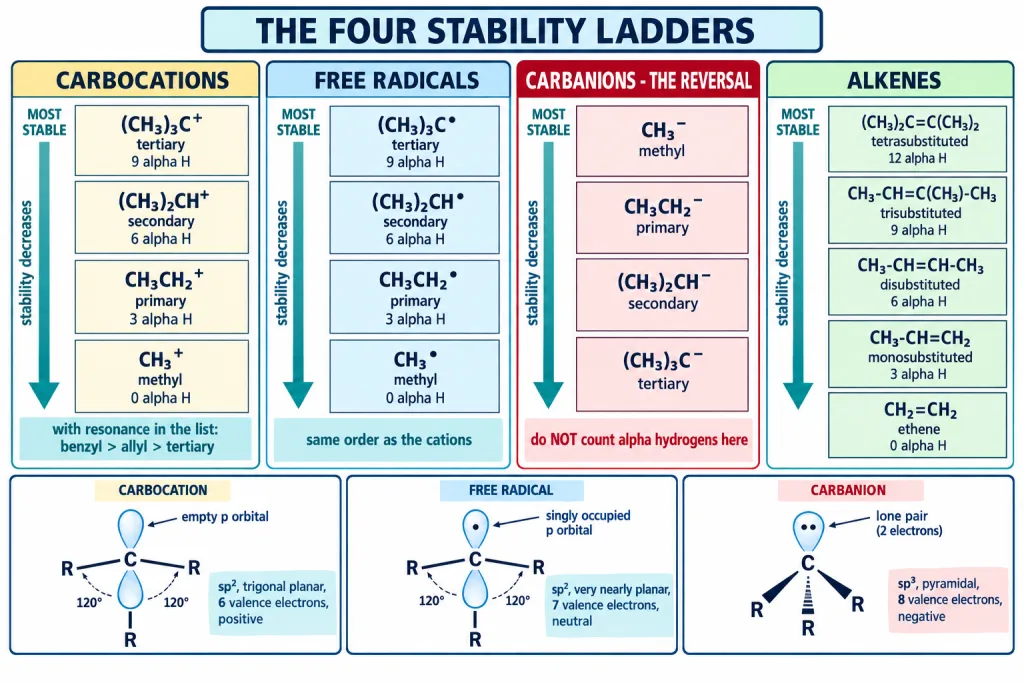
Card 1 — carbocations.
Reason: more alkyl groups means more release and more alpha hydrogens hyperconjugating into the empty orbital. With benzyl and allyl present the ladder becomes
Reason: resonance spreads the charge over four carbons in benzyl and two in allyl, beating any amount of hyperconjugation. Vinyl and phenyl cations sit below methyl, their empty orbital lying in the plane of the pi system where it cannot overlap. A carbocation is , trigonal planar, 6 valence electrons, positive.
Card 2 — free radicals.
Reason: a half-filled orbital accepts delocalised density much as an empty one does, so the same help applies, and benzyl and allyl again lead by resonance. A radical is and very nearly planar, 7 valence electrons, neutral.
Card 3 — carbanions, the reversal.
Reason: the carbon already has a full octet and a negative charge, so an electron-releasing alkyl group makes matters worse. A carbanion is , pyramidal, 8 valence electrons, negative, and a group next door is what stabilises it — far outdoes .
Card 4 — alkenes.
Reason: more alkyl groups on the doubly bonded carbons means more alpha hydrogens and more hyperconjugation.
The alpha-hydrogen counts
An alpha hydrogen sits on the carbon adjacent to the centre, never on the centre itself and never one carbon further out.
| Species | Alpha H |
|---|---|
| tert-butyl | 9 |
| isopropyl | 6 |
| ethyl | 3 |
| methyl | 0 |
| 2,3-dimethylbut-2-ene, tetrasubstituted | 12 |
| 2-methylbut-2-ene, trisubstituted | 9 |
| but-2-ene, disubstituted | 6 |
| propene, monosubstituted | 3 |
| but-1-ene | 2 |
| ethene | 0 |
Radical counts match the cation counts: 9, 6, 3, 0.
Key Point: Count alpha hydrogens only when the centre is short of electrons — a carbocation with 6 valence electrons, a radical with 7, or an alkene pi bond. Never for a carbanion; there is no acceptor orbital and the count predicts the wrong order.
[NEET] But-1-ene against but-2-ene is the counting question most often set: 2 against 6, so but-2-ene wins, the terminal methyl of but-1-ene sitting on a beta carbon.
Question 4: Five carbocations in twenty seconds
Rank , , , and by stability.
Answer:
I sort into two groups. Benzyl and allyl are resonance stabilised and go on top, benzyl above allyl because the ring gives four carbons to spread the charge over against allyl's two. The other three are plain alkyl cations, ranked by alpha hydrogens: tert-butyl 9, isopropyl 6, methyl 0.
Ans:
Watch out: Splitting the list into resonance-stabilised and hyperconjugation-only, then ranking inside each group, is faster than comparing benzyl with tert-butyl directly.
Question 5: Alpha hydrogens in three butenes
Count the alpha hydrogens in but-1-ene, but-2-ene and 2-methylprop-1-ene, and rank them.
Answer:
In but-1-ene, , the only carbon attached to a doubly bonded carbon is the of the ethyl group, so 2; the terminal methyl is beta. But-2-ene, , has a methyl on each doubly bonded carbon: 6. 2-Methylprop-1-ene, , has two methyls on one of them: 6 as well.
Ans: but-2-ene and 2-methylprop-1-ene both count 6 and are comparably stable; but-1-ene counts 2 and is least stable.
Watch out: Hydrogens on a doubly bonded carbon itself are vinylic, not alpha. Counting the terminal turns 6 into 8.
Question 6: A ranking list with a negative species in it
Rank , , and by stability.
Answer:
Every species here is a carbanion, so the order runs opposite to the carbocation order. The carbon is and pyramidal with a complete octet and a full negative charge, and an alkyl group pushing density onto a centre already electron rich raises its energy. Fewer alkyl groups means greater stability.
Ans:
Watch out: Check the charge before ranking anything. Reciting tertiary > secondary > primary > methyl here is exactly the answer the question is built to collect.
The four electronic effects in one table
| Feature | Inductive | Electromeric | Resonance | Hyperconjugation |
|---|---|---|---|---|
| Permanent or temporary | permanent | temporary | permanent | permanent |
| Needs a reagent | no | yes | no | no |
| Electrons that move | a pair, shifted partly | a pair, transferred completely | electrons and lone pairs | electrons of an alpha bond |
| Requires | a bond to an atom unlike hydrogen in electronegativity | a multiple bond and a reagent | a pi system, or a lone pair beside one | an alpha beside an empty , half-filled or |
| Charges produced | partial | full | partial | partial |
| Dies with distance | yes, negligible past the third carbon | not applicable | no | no |
| Sub-types | and | and | and | none |
Working order of strength for the three permanent effects: resonance > hyperconjugation > inductive. The electromeric effect is stronger than all three while a reagent is present and absent otherwise, so it never enters a stability order.
, decreasing strength:
, decreasing strength:
groups have a lone pair to give: , , , , , , , , halogens. groups have a multiply bonded electronegative atom: , , , , , , , .
The five one-line reasons
Phenol is acidic because the phenoxide ion is resonance stabilised, its charge delocalised onto the two ortho carbons and the para carbon. Ethoxide is not, so phenol is about a million times the stronger acid.
Aniline is a weak base because the nitrogen lone pair is delocalised into the ring by and so is not fully available to a proton.
Chloroacetic acid beats acetic acid because chlorine is and disperses the carboxylate charge, while the methyl of acetic acid is and intensifies it. The falls from 4.76 to 2.86.
The tert-butyl cation leads the simple carbocations on 9 alpha hydrogens plus three methyls pushing in by .
Halogens are but because they are more electronegative than carbon and withdraw through the sigma bond, while also holding lone pairs in orbitals that can be donated into an adjacent pi system or empty orbital.
The four reaction types
| Type | Unsaturation | Typical case |
|---|---|---|
| Substitution | unchanged | |
| Addition | falls by one | |
| Elimination | rises by one | |
| Rearrangement | unchanged, atoms move inside |
Alkanes do free radical substitution, arenes electrophilic substitution, alkenes electrophilic addition, carbonyls nucleophilic addition, haloalkanes nucleophilic substitution and elimination.
Isomerism identification at a glance
Two questions settle any pair. Is the molecular formula the same? Is the connectivity the same — different connectivity gives a structural isomer, the same connectivity differently arranged in space a stereoisomer?
Then the sub-type. Skeleton changed with the group intact is chain; the group moved along an unchanged skeleton is position; the group itself changed, and with it the family, is functional group; carbons split differently across a divalent group is metamerism; a hydrogen atom and a double bond both moved is tautomerism. Across a restricted double bond it is geometrical, and for mirror images about a chiral carbon optical.
Twenty quick pairs
| Pair | Formula | Label |
|---|---|---|
| butane and 2-methylpropane | chain | |
| pentane and 2,2-dimethylpropane | chain | |
| butanoic acid and 2-methylpropanoic acid | chain | |
| propan-1-ol and propan-2-ol | position | |
| but-1-ene and but-2-ene | position | |
| 1-bromo-2-methylpropane and 2-bromo-2-methylpropane | position | |
| ethanol and methoxymethane | functional group | |
| propan-2-ol and methoxyethane | functional group | |
| propanal and propanone | functional group | |
| propanoic acid and methyl ethanoate | functional group | |
| propan-1-amine and N-methylethanamine | functional group, primary against secondary amine | |
| but-1-ene and cyclobutane | functional group, ring-chain type | |
| ethoxyethane and 1-methoxypropane | metamerism | |
| N-ethylethanamine and N-propylmethanamine | metamerism | |
| methyl propanoate and ethyl ethanoate | metamerism | |
| pentan-2-one and pentan-3-one | metamerism, methyl propyl ketone against diethyl ketone | |
| propanone and prop-1-en-2-ol | tautomerism | |
| maleic acid and fumaric acid | geometrical | |
| cis- and trans-but-2-ene | geometrical | |
| the two forms of 2-chlorobutane | optical, enantiomers |
The trap. and are 2-methylbutane both times. Name both — two structures with the same IUPAC name are one compound.
The counts to know cold
2, 3, 5, 9, 18, 4, 2, 3, 7 (four alcohols, three ethers). gives 3 structural alkenes, 4 distinct alkenes once cis-trans is counted.
Cis-trans needs two different groups on each of the two doubly bonded carbons, which is why but-2-ene shows it while but-1-ene and do not. Optical activity needs a carbon with four different groups.
[NEET] A "how many isomers" item is answered by enumeration. Write the longest chain first, shorten it by one and place the branch, and stop when a shorter chain repeats something already listed.
Question 7: Four pairs, four labels
Label each pair: (a) and ; (b) and ; (c) and ; (d) and .
Answer:
(a) Both , both alcohols, same skeleton; only the position of differs. (b) Both and both ethers, the four carbons splitting 2 and 2 in one, 1 and 3 in the other. (c) Both , but one a ketone and one an aldehyde — different group, different family. (d) Both , with a hydrogen moved from carbon to oxygen and the double bond shifted from to .
Ans: (a) position; (b) metamerism; (c) functional group; (d) tautomerism.
Watch out: Metamers are always in the same family. If the family changed, the label is functional group isomerism.
Question 8: A pair that is not a pair
Are and chain isomers, position isomers, or something else?
Answer:
I name both instead of staring at them. The first is a four-carbon chain with a methyl on C-2; the second is a four-carbon chain whose methyl also lands on C-2 when numbered from the near end. Two identical names mean one compound written two ways.
Ans: The same compound, 2-methylbutane. Not isomers at all.
Watch out: Reversing the direction of a written formula never produces a new compound.
Question 9: Seven isomers of
Write all the structural isomers of and say how many are alcohols and how many ethers.
Answer:
fits an alcohol and an ether, so I take the families separately.
Alcohols: butan-1-ol and butan-2-ol on the straight skeleton, 2-methylpropan-1-ol and 2-methylpropan-2-ol on the branched one. Four. Ethers split the four carbons across the oxygen — 1 and 3 straight gives 1-methoxypropane, 1 and 3 branched gives 2-methoxypropane, 2 and 2 gives ethoxyethane. Three.
Ans: Seven — four alcohols and three ethers.
Watch out: Missing 2-methoxypropane is the usual route to an answer of six.
The laboratory tests and their colours
Every element must be freed as an ion first. Carbon and hydrogen are found by heating with dry copper(II) oxide; the rest go through the sodium fusion extract, made by fusing the compound with sodium and extracting the fused mass with water.
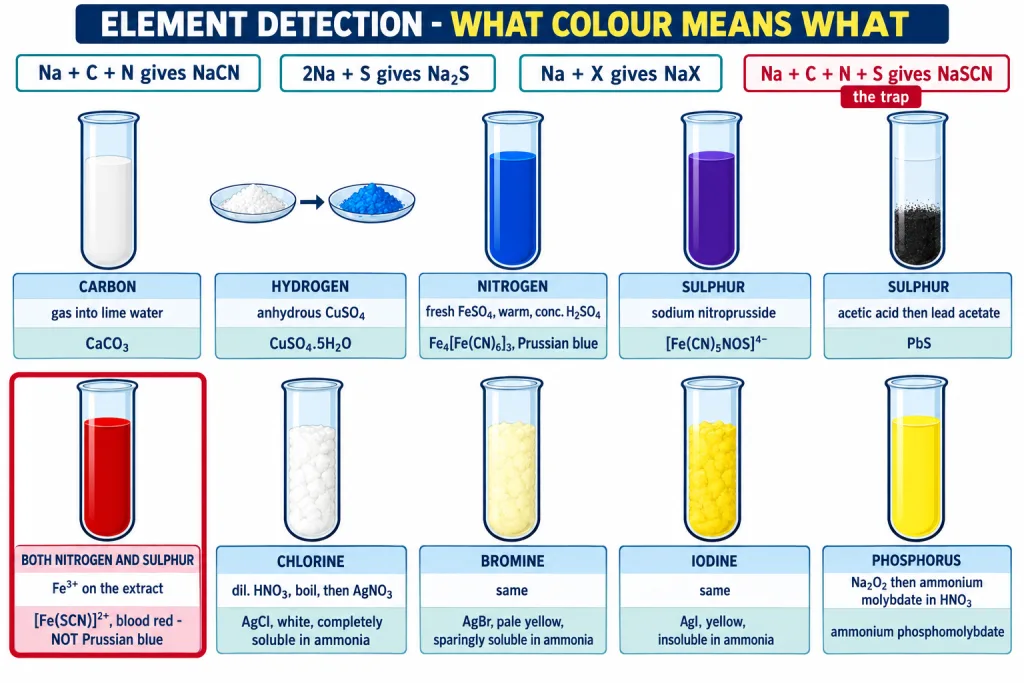
| Element | Reagents, in order | Observation | Species |
|---|---|---|---|
| carbon | dry , gas into lime water | milky | |
| hydrogen | dry , then anhydrous | white turns blue | |
| nitrogen | fresh , warm, conc. | Prussian blue | , iron(III) hexacyanidoferrate(II) |
| sulphur | sodium nitroprusside | violet | |
| sulphur | acetic acid, lead acetate | black precipitate | |
| nitrogen and sulphur | blood red | ||
| chlorine | dil. , boil, | white, completely soluble in ammonia | |
| bromine | same | pale yellow, sparingly soluble | |
| iodine | same | yellow, insoluble | |
| phosphorus | , ammonium molybdate in | yellow precipitate | ammonium phosphomolybdate |
Both the colour and the ammonia behaviour are wanted, since pale yellow and yellow are hard to separate by eye.
The nitrogen-and-sulphur trap
With both present and the sodium not in large excess, the fusion gives sodium thiocyanate instead of separate cyanide and sulphide. The extract then holds and no free , so the iron test gives
a blood-red colour and no Prussian blue at all.
Key Point: Blood red in the iron test is a positive result for two elements at once. It is not a failed nitrogen test, and it says nothing about iron being in the compound; the iron came from the reagent.
The cure is excess sodium, which breaks the thiocyanate down as , restoring Prussian blue for nitrogen and the nitroprusside violet for sulphur independently.
Three details that get asked. The iron(II) sulphate must be freshly prepared, or it has already oxidised and no can form. The iron(III) in Prussian blue is not added — it comes from aerial oxidation of iron(II) in the alkaline extract, and the concentrated acid dissolves the hydroxides so both states meet in solution. The halogen extract must be boiled with dilute nitric acid first, because silver precipitates and too.
On the analysis side, one pass is enough: , Kjeldahl (monobasic acid; double for ), and the molar masses 143.5, 188, 235, 233. Oxygen comes by difference, and Kjeldahl fails for ring nitrogen and for nitro and azo compounds.
The purification decision table
| The situation described | Method |
|---|---|
| solid passes straight to vapour, impurity does not: camphor, naphthalene, anthracene | sublimation |
| solubility differing sharply from the impurity, or with temperature: very soluble hot, almost insoluble cold | crystallisation |
| two solids of different solubility in one solvent, the less soluble coming out first | fractional crystallisation |
| liquids boiling well apart and safely below decomposition: chloroform and aniline | simple distillation |
| boiling points close together: acetone and methanol, apart | fractional distillation |
| liquid decomposes at its normal boiling point: glycerol from spent-lye | distillation under reduced pressure |
| volatile in steam and immiscible with water: aniline, at , the vapour pressures adding | steam distillation |
| solute more soluble in an immiscible organic solvent: a separating funnel and small ether portions | differential extraction |
| several similar substances, milligrams, differing adsorption: bands eluting off silica gel | column chromatography |
| a purity check, or a reaction being monitored: a plate, a spot, an value | thin layer chromatography |
| amino acids, sugars or dyes to be identified: ninhydrin, water held on the cellulose | paper chromatography |
Two distinctions carry marks on their own. Adsorption against partition: column and thin layer chromatography are adsorption methods with a solid stationary phase, while paper chromatography is a partition method whose stationary phase is a liquid, the water held on the cellulose. And the value,
which has no units and always lies between 0 and 1; a more strongly adsorbed component moves less and has the smaller .
[NEET] Purification items are almost always "which method", never "describe the apparatus". Match the phrase in the stem to a row above and move on.
Assertion-reason patterns that recur
The four responses: (a) both true and the reason explains the assertion; (b) both true but the reason does not explain it; (c) assertion true, reason false; (d) assertion false, reason true. Work each item in three moves — judge the assertion alone, judge the reason alone, then ask whether the reason causes the assertion.
1. A: phenol is more acidic than ethanol. R: the phenoxide ion is stabilised by resonance. Both correct, and stabilising the anion is exactly why the proton leaves so readily. (a)
2. A: chlorobenzene is less reactive than benzene towards an electrophile. R: chlorine shows a effect. Both correct — the ring is deactivated and chlorine is . But the deactivation comes from ; the effect works the other way and settles the ortho and para direction, not the slowing down. (b)
3. A: among carbanions the tertiary is the most stable. R: alkyl groups are electron releasing. The reason is correct; the assertion is false. The order is methyl > primary > secondary > tertiary, precisely because alkyl groups push electrons onto a centre already electron rich. (d)
4. A: the methyl cation is planar. R: the carbon of a carbocation is hybridised. The assertion is correct — trigonal planar. The reason is false: that carbon is with an empty orbital perpendicular to the plane. and pyramidal is the carbanion. (c)
5. A: a blood-red colour in the iron test shows nitrogen and sulphur are both present. R: fusion of a compound containing both gives sodium thiocyanate. Both correct, and the thiocyanate is the direct cause of the colour. (a)
6. A: resonance structures are in equilibrium with one another. R: in resonance only pi electrons and lone pairs move, never sigma bonds or atoms. The reason is a correct statement of the rules; the assertion is false. Contributors are not real molecules and there is no equilibrium — the substance is one hybrid, and tautomers are the pair in a genuine equilibrium. (d)
7. A: aniline is purified by steam distillation. R: aniline is volatile in steam and immiscible with water. Both correct, and those two properties are the whole condition for the method. (a)
Key Point: The commonest wrong code is (a) given to a (b) pair. Two true statements standing next to each other are not automatically a cause and an effect.
Always false, whatever they are paired with: resonance contributors are real molecules or in equilibrium; the carbocation is or the carbanion planar; hyperconjugation stabilises a carbanion; the electromeric effect is permanent; Kjeldahl works for pyridine or nitrobenzene; the inductive effect travels undiminished along a long chain; a double bond is twice as strong as a single bond.
Question 10: Two positive tests, two elements
A compound fused with a large excess of sodium gives an extract showing Prussian blue with iron(II) sulphate and concentrated sulphuric acid, and a white precipitate with silver nitrate that dissolves completely in ammonia. Which elements are present, and which are ruled out?
Answer:
Prussian blue needs free , so nitrogen is present. A white silver precipitate completely soluble in ammonia is , so chlorine is present; pale yellow and sparingly soluble would have been bromine, yellow and insoluble iodine.
Sulphur is absent: with sodium in large excess any sulphur would have been free sulphide and would have shown its own violet or black test.
Ans: Nitrogen and chlorine are present; sulphur, bromine and iodine are absent.
Watch out: Prussian blue proves nitrogen, not the absence of sulphur, unless the sodium was in excess.
Question 11: An assertion-reason worked out loud
Assertion: nitrobenzene is far less reactive than benzene towards electrophilic substitution. Reason: the nitro group withdraws electrons by both and . Choose the code.
Answer:
The assertion alone: an electrophile wants an electron-rich ring, and heads the series because its nitrogen carries a formal positive charge, so the ring is poor and slow to react. True.
The reason alone: the nitro group has a multiply bonded electronegative atom, putting it in the list, and it tops the list. True. Withdrawal by two mechanisms at once is exactly why the ring is deprived.
Ans: Both statements are true and the reason correctly explains the assertion.
Watch out: Nitro is and , both pointing the same way, so the reason explains the deactivation. Chlorine is but , so its effect explains the orientation, not the deactivation.
Question 12: Four purifications, four methods
Choose the method for each: (a) camphor contaminated with sand; (b) glycerol, which decomposes near its boiling point of about ; (c) acetone at mixed with methanol at ; (d) benzoic acid dissolved in water.
Answer:
(a) Camphor sublimes on gentle heating and sand does not. (b) The boiling point must be brought below the decomposition temperature, and lowering the pressure does that. (c) Nine kelvin apart is far too close for one vaporisation to give pure vapour. (d) Benzoic acid is far more soluble in ether than in water, and ether does not mix with water.
Ans: (a) sublimation; (b) distillation under reduced pressure; (c) fractional distillation; (d) differential extraction.
Watch out: Several small extractions recover more than one large one using the same total volume of solvent.
Sixty seconds before the paper
The facts that go missing first, in the order they go missing.
- Carbanion is and pyramidal with 8 valence electrons; carbocation planar with 6; radical nearly planar with 7.
- Carbanion stability runs methyl > primary > secondary > tertiary, the reverse of the other two.
- But-1-ene has only 2 alpha hydrogens, not 3, because the terminal methyl is beta.
- Halogens are but : deactivates a ring, decides that it is ortho and para directing.
- The electromeric effect is temporary and needs a reagent; the other three are permanent.
- Tautomers are real and in equilibrium; resonance contributors are neither.
- character 50%, 33.3%, 25%, so electronegativity runs .
- Bond lengths 154 pm, 134 pm, 120 pm, every benzene bond 139 pm; benzene resonance energy 150 kJ/mol.
- The inductive effect is negligible beyond the third carbon.
- iso, neo and cyclo are counted when alphabetising; di, tri, tetra, sec- and tert- are not.
- Elide the terminal e before a vowel, keep it before a consonant: propan-1-ol but propane-1,2-diol.
- A tied locant set breaks alphabetically, so 2-bromo-4-methylpentane.
- Isomer counts: 2, 3, 5, 9, 18, 4, 7.
- Blood red means nitrogen and sulphur, not iron in the compound.
- is pale yellow and only sparingly soluble in ammonia; is yellow and insoluble.
- The iron(II) sulphate must be freshly prepared, and the halogen extract boiled with dilute nitric acid first.
- Kjeldahl fails for ring nitrogen and for nitro and azo compounds.
- has no units and lies between 0 and 1; paper chromatography is partition, not adsorption.
- Glycerol needs reduced pressure; aniline steam distillation at .
- Phenol is acidic because phenoxide is resonance stabilised, not because phenol is.