
Why an ordinary ionic test fails on an organic compound
Sodium chloride gives a white precipitate with silver nitrate the moment you add it. Chloroform, , holds three chlorine atoms per molecule and gives nothing at all.
The difference is the bond. In sodium chloride the chlorine is already a free ion, waiting for . In chloroform the chlorine is held to carbon by a covalent bond, so there is no ion anywhere in the flask. Every test you learnt in inorganic qualitative analysis is a test for an ion, and the elements in an organic compound are not present as ions.
Detection of an element in an organic compound is always a two-step job.
Key Point: Step 1 — break the covalent bonds and convert the element into a simple ionic compound, usually its sodium salt. Step 2 — run the ordinary inorganic test for that ion. No organic compound is tested directly.
Carbon and hydrogen are the exception in method: they are detected by burning the compound rather than fusing it. Nitrogen, sulphur, the halogens and phosphorus all go through the sodium fusion route.
Detection of carbon and hydrogen
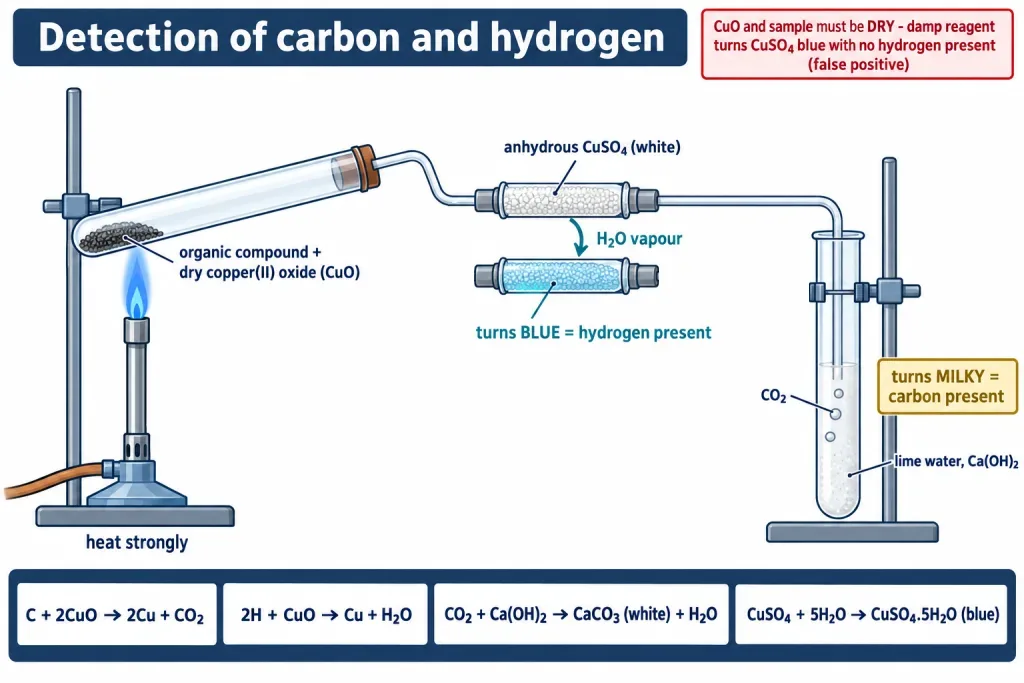
A little of the dry compound is mixed with dry copper(II) oxide, , in a hard-glass test tube and heated strongly. Copper(II) oxide is the oxidising agent: it hands over its oxygen and is itself reduced to copper metal. The carbon of the compound is oxidised to carbon dioxide.
The hydrogen of the compound is oxidised to water.
The gases leaving the tube are then tested one at a time.
Carbon dioxide, passed into lime water. A milky white turbidity of calcium carbonate appears.
Milkiness proves carbon was present in the compound.
Water, collected on anhydrous copper sulphate. The white anhydrous salt turns blue as it takes up water of crystallisation.
White going to blue proves hydrogen was present.
The copper(II) oxide must be freshly ignited and dry, and so must the compound. Moisture in either turns the copper sulphate blue on its own, and hydrogen gets reported in a compound that has none.
Passing the gas into lime water for too long is the other classic slip. Excess carbon dioxide redissolves the precipitate as soluble calcium hydrogencarbonate and the milkiness fades, which reads as a negative for carbon when the carbon was there all along.
[Board] Write both oxidation equations and both test equations, and give the reason copper(II) oxide must be dry.
The sodium fusion extract — Lassaigne's test
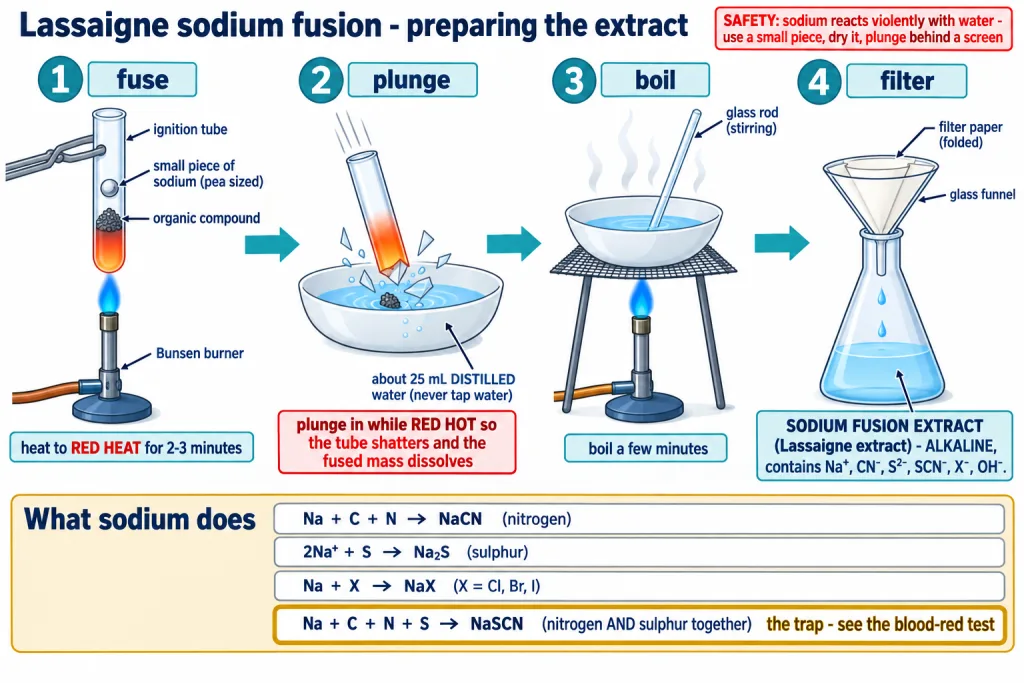
Nitrogen, sulphur, the halogens and phosphorus are all locked into covalent bonds, so all four need the same first step: conversion into a water-soluble sodium salt. That conversion is the sodium fusion, and the solution it produces is the sodium fusion extract, also called Lassaigne's extract.
Why sodium, and nothing else
Sodium is a strongly electropositive metal. It parts with its single valence electron very readily, and at fusion temperature it attacks the covalent bonds of the compound directly, taking the electronegative partner away from carbon and pairing with it as an ion.
Each element of interest therefore ends up as a simple ionic sodium salt, freely soluble in water and available as a free anion for an ordinary inorganic test.
In the halogen equation stands for , or . The fourth equation is the one that trips people up and it gets a section of its own below.
Key Point (Definition): The sodium fusion extract is the alkaline aqueous filtrate obtained by fusing an organic compound with metallic sodium and extracting the fused mass with distilled water. It contains , , and ions according to which elements the compound held.
Sodium has not torn the nitrogen off as a bare nitride; it delivers the carbon-nitrogen pair as cyanide, . This is why the nitrogen test is a cyanide test.
How the fusion is actually done
A pea-sized piece of sodium is cut fresh under kerosene, pressed dry between filter papers and dropped into a clean, dry ignition tube. The tube is warmed until the sodium melts into a shining bead, and only then is a little of the compound added. The tube is heated to red heat for two to three minutes.
While still red hot, the tube is plunged into about 25 mL of distilled water in a china dish. The tube shatters, the fused mass dissolves, and any sodium left over reacts with the water. The contents are stirred, boiled for a few minutes and filtered. The clear filtrate is the extract.
Two details there do real work.
Plunging the tube while red hot shatters it and exposes the whole fused mass at once. Let the tube cool first and the mass stays sealed inside a glass shell, so the extract comes out too dilute and a genuinely present element reads as absent.
Distilled water, never tap water. Tap water carries chloride ions of its own, and the halogen test then gives a white precipitate whatever the compound was made of.
The extract is strongly alkaline, because the excess sodium reacts with water to give sodium hydroxide. That alkalinity matters chemically in the nitrogen test, as the next part shows.
Handling sodium safely
Sodium reacts violently with water and the fusion tube is being deliberately smashed under it.
- Use only a small piece; a large lump gives a dangerous reaction when the tube breaks.
- Cut it under kerosene and blot it dry. A wet piece can ignite in the hand.
- Plunge the tube behind a safety screen, face turned away.
- Never put unused sodium down the sink. The extract is caustic and is handled like dilute alkali.
Question 1: Chloroform and silver nitrate
Chloroform contains 89 per cent chlorine by mass, yet adding silver nitrate to it produces no precipitate at all. Explain, and state what must be done first.
Answer:
Silver nitrate precipitates silver chloride from free ions. In chloroform every chlorine is joined to carbon by a covalent bond, so there are no chloride ions for to meet.
To get a precipitate I must convert that covalent chlorine into ionic chloride. Fusing chloroform with sodium gives , which dissolves as and .
Ans: The chlorine is covalently bound, not ionic; sodium fusion converts it to , and only then does silver nitrate give a white precipitate.
Question 2: What the fusion of 4-chloroaniline produces
4-chloroaniline, , is fused with excess sodium. Name every sodium salt formed and every ion the extract will contain.
Answer:
The detectable elements are chlorine and nitrogen; there is no sulphur and no phosphorus.
Nitrogen goes to sodium cyanide, since sodium carries a carbon along with the nitrogen: . Chlorine goes to sodium chloride: . With sulphur absent, no and no can form.
Ans: and ; the extract contains , , and from the excess sodium.
Question 3: The tube was allowed to cool
A student heats the fusion tube to red heat, sets it down to cool, and only then drops the cold tube into distilled water. The nitrogen test on the extract gives a faint green solution rather than a blue precipitate. What went wrong?
Answer:
Plunging the tube while red hot shatters the glass by thermal shock, releasing the whole fused mass into the water at once.
A cooled tube does not shatter cleanly. Most of the fused sodium cyanide stays sealed inside, so the extract is far too dilute in to build enough . Instead of Prussian blue the student sees only the pale green of unreacted iron(II) sulphate.
Ans: The tube was not plunged in red hot, so the fused mass never fully dissolved and the extract was too dilute; the result is a false negative, not an absence of nitrogen.
Watch out: A faint or absent colour in Lassaigne's test is far more often a fusion failure than a genuine absence. Repeat the fusion before you report an element missing.
Test for nitrogen — Prussian blue
Nitrogen in the extract is present as cyanide ion, . The test builds it into a large, intensely coloured complex.
The procedure
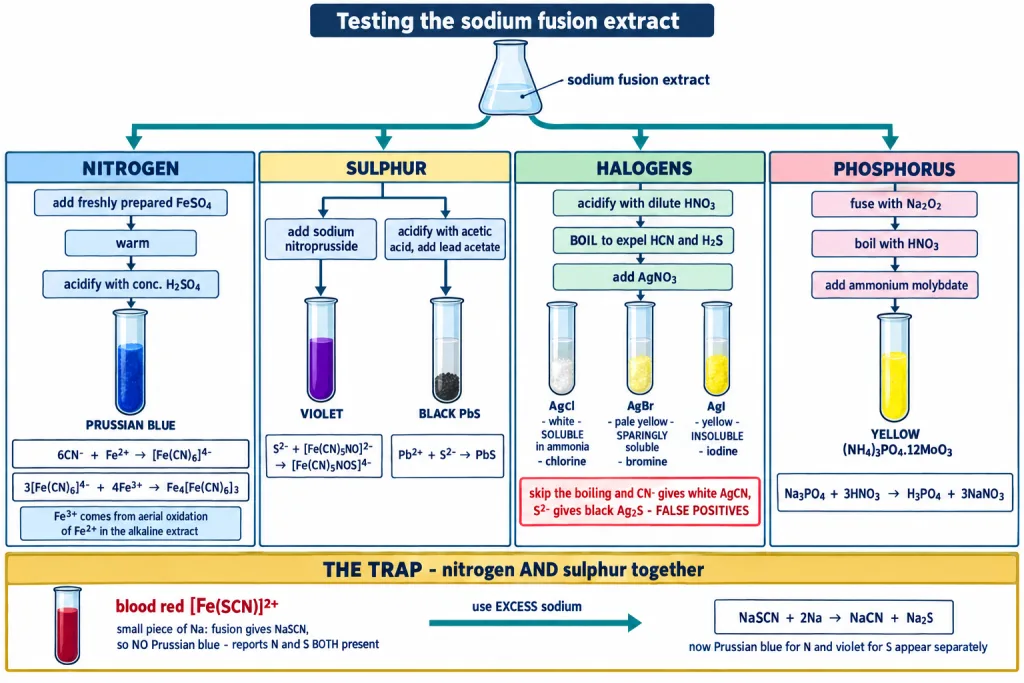
A portion of the sodium fusion extract is taken and freshly prepared iron(II) sulphate solution is added. The mixture is warmed, and then acidified with concentrated sulphuric acid. A Prussian blue colour or precipitate confirms nitrogen.
The chemistry, in two steps
Cyanide ions are strong ligands. Six of them surround an ion to give the hexacyanidoferrate(II) ion.
That complex then combines with to give the pigment.
is iron(III) hexacyanidoferrate(II), the pigment Prussian blue. Its colour comes from electron transfer between iron(II) and iron(III) centres in the same lattice, which is why both oxidation states must be present.
Where the iron(III) comes from
Only iron(II) sulphate was added, so the of the second equation has to be accounted for.
The extract is alkaline. In alkali iron(II) is precipitated as and is oxidised very readily by dissolved and atmospheric oxygen to iron(III). Warming accelerates that aerial oxidation, so by the second step the mixture holds both captured as hexacyanidoferrate(II) and produced by air.
Concentrated sulphuric acid is added for two reasons. It dissolves the iron hydroxides, releasing those ions into solution where they can react. And it destroys the excess alkali, so the blue pigment separates cleanly instead of being masked by a muddy brown-green hydroxide suspension.
Key Point: The iron(III) needed for Prussian blue is not added by the student. It is generated in the tube by aerial oxidation of iron(II) in the alkaline extract, and concentrated sulphuric acid brings it into solution.
Why the iron(II) sulphate must be freshly prepared
An iron(II) sulphate solution left standing oxidises to iron(III) on its own. Use a stale bottle and too little remains to form , so the second step has nothing to work with. The tube goes a dirty yellow-brown and a compound that genuinely contains nitrogen is reported as containing none.
[JEE Main] The two ionic equations, the name iron(III) hexacyanidoferrate(II) and the aerial-oxidation origin of the are the three points this test is examined on.
Test for sulphur
Sulphur in the extract is present as sulphide ion, . Two independent tests are used, and either one confirms sulphur.
Sodium nitroprusside — a violet colour
A portion of the extract is treated with freshly prepared sodium nitroprusside, . A deep violet (purple) colour appears.
The sulphide adds directly to the nitrosyl nitrogen of the complex, and the new ion carries the violet colour. This is a colour test only — nothing precipitates.
Lead acetate — a black precipitate
A second portion of the extract is acidified with acetic acid and lead acetate solution is added. A black precipitate of lead sulphide settles.
Written with the full reagents, the same reaction is
Acetic acid is added first for a specific reason. The extract is alkaline, and lead ions in alkali would come down as white lead hydroxide, which hides the black sulphide and wastes the reagent. Acetic acid neutralises the alkali while staying too weak to drive off hydrogen sulphide the way a strong acid would.
The nitroprusside test is the more sensitive of the two; the lead acetate test gives a precipitate you can filter, so it is the better confirmation.
When nitrogen and sulphur are both present — the standard trap
Read the fourth fusion equation again.
When a compound holds both nitrogen and sulphur and sodium is not in large excess, the fusion does not give separate sodium cyanide and sodium sulphide. Carbon, nitrogen and sulphur come out in one unit as sodium thiocyanate, , so the extract contains and neither nor is free in it.
Run the nitrogen test on that extract and thiocyanate, not cyanide, meets the iron. Thiocyanate is a ligand in its own right and gives the iron(III) thiocyanate complex.
is blood red. There is no Prussian blue, because no was ever formed.
Key Point: A blood-red colour in the iron test means nitrogen and sulphur are both present in the compound. It is a positive result for two elements at once, not a failed nitrogen test.
How to get the two tests back
The cure is excess sodium. With a large enough piece, the sodium thiocyanate formed during fusion is itself attacked and broken down.
Now the extract contains free cyanide and free sulphide again. The iron test gives ordinary Prussian blue for nitrogen and the nitroprusside test gives its violet for sulphur, each independently, and the blood-red colour disappears.
Three outcomes are possible for one compound containing both elements.
| Sodium used in the fusion | Species in the extract | Result of the iron test | What is reported |
|---|---|---|---|
| small piece, not in excess | only | blood red, | nitrogen and sulphur both present |
| large excess | and | Prussian blue | nitrogen present; sulphur shown separately by violet or black |
| compound has N but no S | only | Prussian blue | nitrogen present, sulphur absent |
Two conclusions are worth memorising as sentences.
Blood red never means iron is in the organic compound. The iron came out of the reagent bottle. The colour reports thiocyanate, and thiocyanate reports nitrogen plus sulphur.
No Prussian blue does not by itself mean no nitrogen. Blue means nitrogen without sulphur, blood red means nitrogen with sulphur, and only a colourless or pale green tube after a properly done fusion means nitrogen is genuinely absent.
[JEE/NEET] A question that says "gives a blood-red colour on adding iron(III) chloride to the sodium fusion extract" is asking you to name two elements, not one.
Question 4: A blood-red colour
An organic compound is fused with a small piece of sodium. The extract, treated with iron(III) chloride, gives a blood-red colour. Which elements are present, what species causes the colour, and why is Prussian blue not seen?
Answer:
Blood red with iron(III) is the thiocyanate colour, and thiocyanate can only come from , which needs nitrogen and sulphur in the same compound. The coloured species is , formed as .
Prussian blue is absent because the extract holds no free . All the nitrogen left the fusion tube tied up in , so never formed.
Ans: Nitrogen and sulphur are both present; the colour is ; no free cyanide existed, so no Prussian blue.
Watch out: The blood-red colour says nothing about iron in the compound. The iron came from the reagent.
Question 5: Restoring the two separate tests
The same compound as in the previous item is fused again, this time with a large excess of sodium. Predict the results of the iron test and the sodium nitroprusside test, and give the equation that explains the change.
Answer:
Excess sodium goes on to attack the thiocyanate that formed:
The extract now contains free and free .
The iron test therefore gives Prussian blue, , for nitrogen. The nitroprusside test gives its violet for sulphur. The blood-red colour is gone.
Ans: Prussian blue for nitrogen and violet for sulphur, because excess sodium decomposes into and .
Question 6: Where the iron(III) comes from
Only iron(II) sulphate is added in the nitrogen test, yet the product contains iron in both the +2 and the +3 state. Account for the iron(III).
Answer:
The extract is alkaline because excess sodium made sodium hydroxide with the water. Added is thrown down as in that alkali, and iron(II) hydroxide is oxidised by atmospheric oxygen very rapidly to iron(III). Warming speeds this up.
Concentrated sulphuric acid is then added to dissolve those hydroxides, putting into solution where it can meet the already formed.
Ans: Aerial oxidation of iron(II) in the alkaline extract supplies the ; concentrated sulphuric acid dissolves the hydroxides and releases it.
Question 7: Stale iron(II) sulphate
A student uses iron(II) sulphate solution that has stood open on the bench for a month. Testing the extract of aniline, , the student sees only a brownish solution and reports that aniline contains no nitrogen. Comment.
Answer:
Aniline plainly contains nitrogen, so I look for the reagent fault. An old iron(II) sulphate solution has been oxidised by air to iron(III). With almost no left, barely happens and the second step has nothing to precipitate. The brown colour is just iron(III) in solution.
Ans: A false negative caused by stale reagent; the iron(II) sulphate must be freshly prepared so that enough survives to form .
Question 8: Two sulphur tests on thiourea
Thiourea, , is fused with a large excess of sodium. Write what you would see with sodium nitroprusside, and with lead acetate in acetic acid, giving equations.
Answer:
Excess sodium means the sulphur comes through as free , not . Sodium nitroprusside gives a violet colour:
Lead acetate in acetic acid gives a black precipitate:
Thiourea also contains nitrogen, so with excess sodium the same extract would give Prussian blue in the iron test.
Ans: Violet with sodium nitroprusside and a black precipitate of with lead acetate; sulphur confirmed twice over.
Test for halogens
Halogen in the extract is present as halide ion, . The test is the standard silver nitrate test with a compulsory clean-up step in front of it.
The procedure
The sodium fusion extract is acidified with dilute nitric acid, boiled, and then silver nitrate solution is added.
The precipitate is identified by its colour and by how it behaves with ammonium hydroxide.
| Halogen | Precipitate | Colour | With ammonium hydroxide |
|---|---|---|---|
| chlorine | white | completely soluble | |
| bromine | pale yellow | sparingly soluble | |
| iodine | yellow | insoluble |
The colours run white, pale yellow, yellow in the order Cl, Br, I, and the solubility in ammonia falls the same way, from freely soluble to insoluble. Both observations are needed; colour alone is not enough, because pale yellow and yellow are easy to confuse in a small tube.
Why the boiling with nitric acid is compulsory
If the compound also contained nitrogen or sulphur, the extract holds or , and silver reacts with both.
- — a white precipitate, indistinguishable by eye from silver chloride.
- — a black precipitate.
Either one is a false positive for halogen in a compound that may contain no halogen at all.
Dilute nitric acid converts both offending ions into volatile covalent acids, and boiling drives them out of the solution.
After boiling, the only anion left that can precipitate silver is the halide.
Key Point: Boiling the extract with dilute nitric acid expels and . Skip it and cyanide gives a white precipitate that looks like silver chloride, and sulphide gives a black one — both false positives.
Boiling is done in a fume cupboard, since hydrogen cyanide and hydrogen sulphide are both highly toxic. Acidification does one more job: it stops silver hydroxide precipitating out of the alkaline extract and burying the halide under a brown solid.
[NEET] If a question mentions nitrogen or sulphur anywhere in the compound and then reports a silver nitrate result, check first whether the extract was boiled with nitric acid.
Test for phosphorus
Ordinary sodium fusion does not convert phosphorus into a testable ion, so phosphorus gets its own oxidation.
The compound is heated with the oxidising agent sodium peroxide, , which takes the phosphorus all the way to phosphate, obtained as sodium phosphate. The fused mass is boiled with nitric acid, converting the phosphate to phosphoric acid.
Ammonium molybdate is then added and the mixture warmed. A yellow precipitate of ammonium phosphomolybdate confirms phosphorus.
The yellow solid is the same precipitate used later to estimate phosphorus by mass. The medium must be acidic, and nitric acid is the acid used; in a neutral or alkaline medium the molybdate does not condense onto the phosphate and no yellow solid appears.
Everything in one table
| Element | Form in the extract | Reagent | Observation | Product | Interference to watch |
|---|---|---|---|---|---|
| carbon | not fused; burnt with | lime water | milky white | excess redissolves the milkiness | |
| hydrogen | not fused; burnt with | anhydrous | white turns blue | damp or damp sample gives a false positive | |
| nitrogen | fresh , warm, then conc. | Prussian blue | sulphur present makes ; blood red instead | ||
| sulphur | sodium nitroprusside | violet | with present the violet may fail | ||
| sulphur | lead acetate in acetic acid | black precipitate | alkaline extract gives white | ||
| nitrogen and sulphur | blood red | mistaken for iron in the compound | |||
| chlorine | dil. , boil, | white precipitate, soluble in ammonia | is also white; tap water adds chloride | ||
| bromine | dil. , boil, | pale yellow, sparingly soluble in ammonia | confused with by colour alone | ||
| iodine | dil. , boil, | yellow, insoluble in ammonia | black from an unboiled extract | ||
| phosphorus | phosphate after | ammonium molybdate in | yellow precipitate | neutral or alkaline medium gives no precipitate |
Question 9: Why boil the extract with nitric acid first
Before adding silver nitrate to a sodium fusion extract, the extract is acidified with dilute nitric acid and boiled. State precisely why, with equations.
Answer:
If the compound contained nitrogen or sulphur, the extract holds or , and silver reacts with both to give white and black . A white reads as , so either one is a false positive.
Dilute nitric acid protonates them into volatile weak acids and boiling expels those gases:
Acidification also prevents silver hydroxide separating out of the alkaline extract.
Ans: To destroy and expel cyanide and sulphide as and , so that any precipitate later formed with silver nitrate can only be a silver halide.
Question 10: Identifying the halogen
Three extracts, each acidified and boiled, are treated with silver nitrate. Sample A gives a white precipitate that dissolves completely in ammonium hydroxide. Sample B gives a pale yellow precipitate only slightly soluble in ammonium hydroxide. Sample C gives a yellow precipitate that does not dissolve at all. Name the halogen in each.
Answer:
Colour alone cannot separate pale yellow from yellow reliably, so I use ammonia solubility with it.
White and freely soluble in ammonia is silver chloride, so A contains chlorine. Pale yellow and sparingly soluble is silver bromide, so B contains bromine. Yellow and completely insoluble is silver iodide, so C contains iodine.
Ans: A chlorine, B bromine, C iodine.
Watch out: Solubility in ammonia falls in the order > > , which is the ordering test. Never decide between bromine and iodine on colour alone.
Question 11: A false positive from tap water
A student prepares the fusion extract of pure naphthalene, , using tap water instead of distilled water. Silver nitrate gives a white precipitate soluble in ammonia, and the student reports chlorine. Explain the error.
Answer:
Naphthalene has carbon and hydrogen only, so no halogen can possibly appear in the extract.
The chloride came from the tap water, which routinely carries chloride ions. They precipitate silver chloride exactly as a halogen from the compound would, and dissolves in ammonia, so every observation looks correct. The fix is distilled water, and a blank run with the same water and no compound would have exposed it.
Ans: A false positive; the chloride came from the tap water, not the naphthalene. Distilled water must always be used, and a blank should be run.
Question 12: A false positive from an unboiled extract
A compound is known to contain sulphur. Its extract is treated with silver nitrate without first acidifying and boiling, and a black precipitate appears. The student records iodine. Is that right?
Answer:
No. Silver iodide is yellow, never black, so the colour alone rules it out.
The black solid is , formed as from the sulphide the student already knew was there, and the compound may contain no halogen at all. Acidifying with dilute nitric acid and boiling would have expelled the sulphide as first.
Ans: Wrong; the black precipitate is silver sulphide from unremoved , a false positive caused by skipping the nitric acid and boiling step.
Question 13: A false positive from wet reagents
A student heats a dry sample of graphite with copper(II) oxide taken straight from an unstoppered bottle. The lime water turns milky and the anhydrous copper sulphate turns blue. The student reports carbon and hydrogen. Which conclusion is unsafe?
Answer:
Milky lime water means carbon dioxide, and graphite is carbon, so carbon is genuine.
The blue copper sulphate is the unsafe conclusion. Copper(II) oxide from an open bottle has taken up moisture from the air; that moisture comes over on heating and turns the copper sulphate blue although graphite contains no hydrogen. The test is valid only with copper(II) oxide freshly ignited and cooled in a desiccator.
Ans: Carbon is correctly reported; hydrogen is a false positive caused by moisture in the copper(II) oxide.
Question 14: Full test sequence for phosphorus
An organic compound is suspected to contain phosphorus. Describe how you would confirm it, with equations.
Answer:
Sodium fusion gives no testable phosphorus ion, so I oxidise instead. Heating the compound with sodium peroxide, , oxidises the phosphorus to phosphate, obtained as sodium phosphate. I boil the fused mass with nitric acid:
I add ammonium molybdate and warm. A yellow precipitate of ammonium phosphomolybdate confirms phosphorus:
Ans: Fuse with sodium peroxide, boil with nitric acid, add ammonium molybdate; a yellow precipitate of confirms phosphorus.
Question 15: Reading a full set of observations
An organic compound gives these results. Lime water turns milky and anhydrous copper sulphate turns blue. The extract with iron(II) sulphate, warmed and acidified, gives a blood-red colour. After acidifying with dilute nitric acid and boiling, silver nitrate gives a pale yellow precipitate sparingly soluble in ammonia. After fusion with sodium peroxide and boiling with nitric acid, ammonium molybdate gives no yellow precipitate. List every element present.
Answer:
Milky lime water gives carbon; blue copper sulphate gives hydrogen.
Blood red with iron is , so the fusion made , which needs nitrogen and sulphur together. Both are present.
Pale yellow and sparingly soluble in ammonia is , so bromine is present; the extract was boiled with nitric acid first, so the cyanide and sulphide were expelled and this precipitate is genuine. No yellow precipitate with ammonium molybdate means phosphorus is absent.
Ans: Carbon, hydrogen, nitrogen, sulphur and bromine; phosphorus absent.
Watch out: The blood-red result is doing double duty here. Reading it as a failed nitrogen test would lose both nitrogen and sulphur.
Question 16: Why sodium and not magnesium
Sodium fusion could in principle use another metal. Explain in terms of the property required why sodium is chosen.
Answer:
The metal must break covalent bonds to carbon, take the nitrogen, sulphur or halogen away as an anion, and hold it in a salt that dissolves freely in water.
Sodium is strongly electropositive: it loses its single valence electron very easily, so it cleaves the covalent linkage readily at fusion temperature. Its salts , and are ionic and highly water soluble, which is what the aqueous extract needs. A less electropositive metal attacks the bonds less completely and many of its salts are far less soluble, so the ions would never reach the test tube in useful concentration.
Ans: Sodium is strongly electropositive, so it cleaves the covalent bonds readily, and its cyanide, sulphide and halides are ionic and freely water soluble.