
Why a naming system had to be invented
Early organic compounds were named after where they came from. Formic acid was named after the ant, formica; urea came from urine; citric acid from citrus fruit. These trivial names carry no information about structure, and there are only so many of them.
The problem is arithmetic. There are two alkanes of formula , three of , five of , nine of and eighteen of . By there are 75, and nobody can memorise 75 unrelated names.
The International Union of Pure and Applied Chemistry (IUPAC) settled the matter with rules that build a name out of the structure itself. They run in both directions: given a structure you can write exactly one name, and given the name you can draw exactly one structure. That two-way certainty is why nomenclature is such reliable marks — there is nothing to remember beyond the rules and the roots.
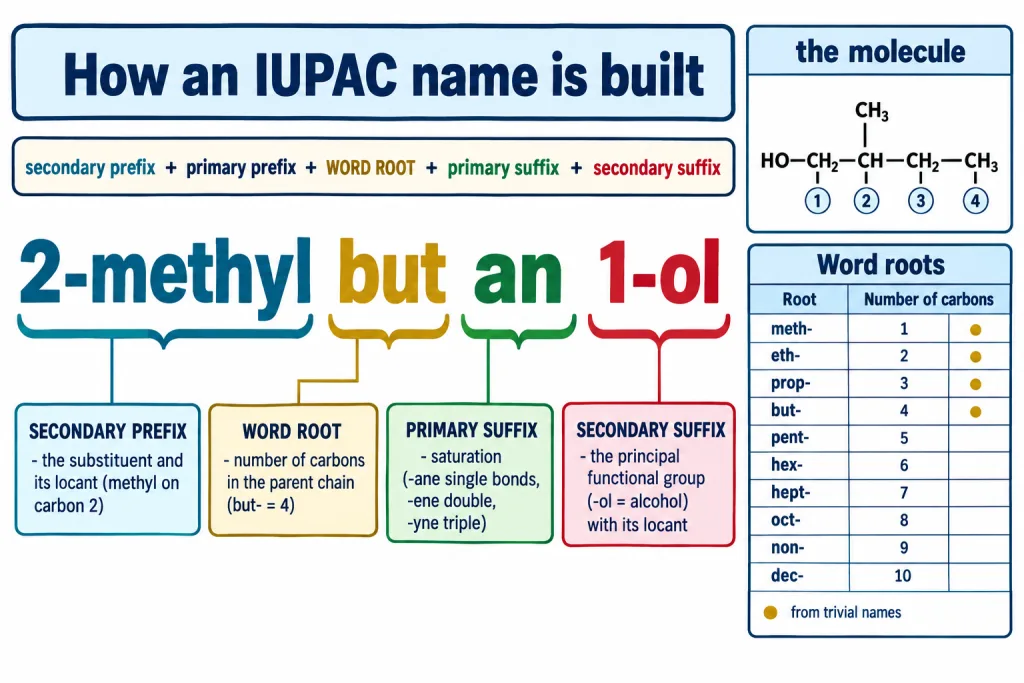
Key Point (Definition): An IUPAC name is assembled from three kinds of part — prefix + word root + suffix. The word root gives the number of carbon atoms in the parent chain, the primary suffix gives the degree of saturation, the secondary suffix gives the principal functional group, and the prefixes give everything hanging off the chain.
The five slots of a name
The order is fixed:
Word root. The number of carbon atoms in the parent chain. Ten roots cover everything in Class 11.
Primary suffix. The saturation of that chain: -ane for single bonds only, -ene for a double bond, -yne for a triple bond. Root plus primary suffix already names a hydrocarbon — hex- + -ane = hexane.
Secondary suffix. The principal functional group: -ol for an alcohol, -al for an aldehyde, -one for a ketone, -oic acid for a carboxylic acid, -amine for an amine. When it begins with a vowel, the terminal e of the primary suffix is dropped — pentane plus -ol gives pentanol, not pentaneol.
Primary prefix. Chain or ring. cyclo- marks a ring; an open chain gets nothing.
Secondary prefixes. Every substituent that is not the principal functional group: alkyl groups, halogens (chloro, bromo), nitro, alkoxy, hydroxy, amino, oxo. These are cited alphabetically.
So 2-methylbutan-1-ol breaks up as prefix 2-methyl + root but- + primary suffix -an- + secondary suffix -1-ol: four carbons, all single bonds, an on the first carbon, a on the second.
This section builds only the hydrocarbon half of the name — root plus -ane, with prefixes. The secondary suffix belongs to the next section, but the machinery for choosing and numbering the parent chain is identical there.
[JEE/NEET] The commonest nomenclature error in a test paper is not a wrong root or a wrong suffix. It is choosing the wrong parent chain, because the student read the straight line printed on the page instead of the molecule.
The word roots
| Carbons | Root | Origin |
|---|---|---|
| 1 | meth- | trivial (methanol) |
| 2 | eth- | trivial (ether) |
| 3 | prop- | trivial (propionic acid) |
| 4 | but- | trivial (butyric acid) |
| 5 | pent- | Greek, five |
| 6 | hex- | Greek, six |
| 7 | hept- | Greek, seven |
| 8 | oct- | Greek, eight |
| 9 | non- | Latin, ninth |
| 10 | dec- | Greek, ten |
Only the first four are irregular. meth-, eth-, prop- and but- are inherited from trivial names already in use before the system existed; from five carbons onwards the root is the Greek or Latin number word, so nothing past but- has to be memorised.
Straight-chain alkanes
A hydrocarbon contains carbon and hydrogen only. It is saturated if it holds nothing but carbon-carbon single bonds, and the IUPAC name of the saturated open-chain family is alkane — the older name was paraffin, from the Latin for little affinity, because these compounds react with almost nothing. A hydrocarbon with at least one carbon-carbon double or triple bond is unsaturated.
Attach -ane to each root and you have the whole straight-chain series, of general formula .
| Formula | IUPAC name | Condensed structure |
|---|---|---|
| Methane | ||
| Ethane | ||
| Propane | ||
| Butane | ||
| Pentane | ||
| Hexane | ||
| Heptane | ||
| Octane | ||
| Nonane | ||
| Decane |
Successive members differ by a single group, which makes this a homologous series: same general formula, same behaviour, a regular gradation of physical properties, and a constant difference of 14 units in molar mass.
The old prefix n- (for normal) is sometimes written before these names — n-butane, n-pentane — to stress that the chain is unbranched. It is not part of the IUPAC name. Plain butane already means the straight-chain compound.
Key Point: The root counts carbons in the parent chain, not carbons in the molecule. has three isomers and only one of them is called pentane.
Alkyl groups
Remove one hydrogen atom from a carbon of a saturated hydrocarbon. What is left is an alkyl group, and the carbon that lost its hydrogen now carries a free valency — a half-bond, drawn as a short line, that will attach to something else.
Key Point (Definition): An alkyl group is an alkane less one hydrogen. Its general formula is , and it is named by replacing the -ane of the parent alkane with -yl.
So methane gives methyl, ethane gives ethyl, propane gives propyl, and so on straight down the table.
| Parent alkane | Group | Name | Short |
|---|---|---|---|
| methane | Methyl | Me | |
| ethane | Ethyl | Et | |
| propane | Propyl | Pr | |
| butane | Butyl | Bu | |
| pentane | Pentyl | — | |
| hexane | Hexyl | — | |
| heptane | Heptyl | — | |
| octane | Octyl | — | |
| nonane | Nonyl | — | |
| decane | Decyl | — |
Me, Et, Pr and Bu are the standard shorthand: for diethyl ether, for methanol. A general, unspecified alkyl group is written R, so stands for any alcohol and for any haloalkane.
Count the hydrogens carefully. Hexane is ; the hexyl group is , one fewer. Writing for the group is the commonest slip, and it leaves a carbon with five bonds once you attach it.
Primary, secondary and tertiary carbon
Classify a carbon by how many other carbon atoms it is bonded to:
- Primary () — bonded to one other carbon (or none, in methane).
- Secondary () — bonded to two other carbons.
- Tertiary () — bonded to three other carbons.
- Quaternary () — bonded to four other carbons, so it carries no hydrogen at all.
An alkyl group is called primary, secondary or tertiary according to the carbon that carries the free valency, not according to anything else in it. That one sentence sorts out the branched groups below.
The branched alkyl groups you must recognise on sight
From propane onwards a hydrogen can be removed from more than one kind of carbon, so one alkane gives more than one alkyl group. These branched groups keep their trivial prefixes in everyday use, and both forms appear in question papers, so learn both.
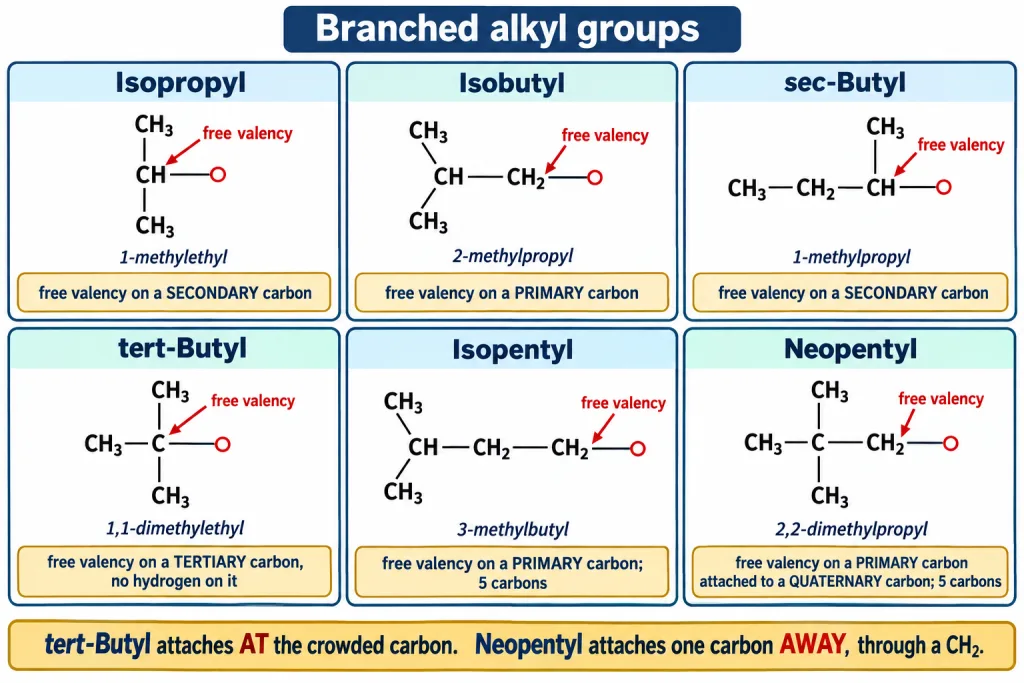
Isopropyl, — three carbons, made by removing a hydrogen from the middle carbon of propane. The free valency sits on a secondary carbon bonded to two methyl groups.
Isobutyl, — four carbons. The free valency sits on a primary , and that is attached to a carbon bearing two methyls.
sec-Butyl, — four carbons, made by removing a hydrogen from C-2 of butane. The free valency sits on a secondary carbon carrying a methyl on one side and an ethyl on the other.
tert-Butyl, — four carbons. The free valency sits on a tertiary carbon bonded to three methyl groups, which therefore carries no hydrogen at all.
Isopentyl (isoamyl), — five carbons. The free valency is on a primary carbon at the end of a two-carbon arm, so numbering from the attachment puts the branch on C-3.
Neopentyl, — five carbons. The free valency is on a primary attached directly to a quaternary carbon.
| Group | Condensed structure | Carbon bearing the free valency | Systematic name |
|---|---|---|---|
| Isopropyl | secondary | 1-methylethyl | |
| Isobutyl | primary | 2-methylpropyl | |
| sec-Butyl | secondary | 1-methylpropyl | |
| tert-Butyl | tertiary | 1,1-dimethylethyl | |
| Isopentyl | primary | 3-methylbutyl | |
| Neopentyl | primary | 2,2-dimethylpropyl |
Three traps live in this table.
Isobutyl versus sec-butyl. Both are . Isobutyl attaches through a (primary); sec-butyl attaches through a that already holds a methyl and an ethyl (secondary). Draw the attachment point first and they never get confused.
tert-Butyl versus neopentyl. tert-Butyl attaches at the crowded carbon; neopentyl attaches one carbon away, through a . Neopentyl is therefore primary despite looking bulky, and it has five carbons, not four.
Isopentyl versus neopentyl. Both are and both attach through a primary carbon, but isopentyl carries its branch two carbons out (3-methylbutyl) and neopentyl on the very next carbon (2,2-dimethylpropyl).
[Board] Asked for "the structure of the neopentyl group", write with the free valency on the . Neopentane, , scores nothing — that is the alkane, not the group.
Naming a branched alkane — the procedure
In a branched-chain alkane, short carbon chains hang off a longer one. The long one is the parent chain and gives the root; the short ones are alkyl substituents and are cited as prefixes. Apply these five steps in this order, every time.
Step 1 — find the longest chain
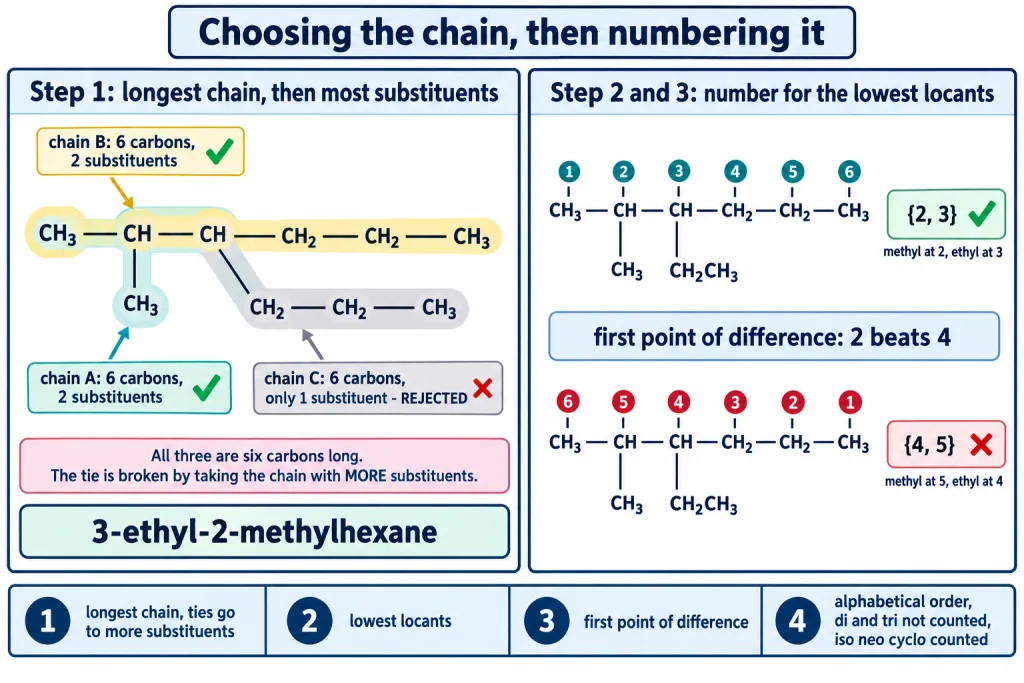
Identify the longest continuous chain of carbon atoms. It supplies the word root. The chain need not be drawn in a straight line; it may turn corners, and it very often does. Count in every possible direction before you commit.
If two or more chains tie in length, choose the one carrying MORE substituents.
Take . Three different six-carbon chains can be traced through it. Two carry two substituents each; one carries a single isopropyl substituent. The chain with two substituents wins, and the name is 3-ethyl-2-methylhexane.
Step 2 — number the chain
Number the parent chain from one end so that the substituents get the lowest possible locants. Number from whichever end reaches a branch sooner.
A strict priority order settles which group claims the low number:
In an alkane there is no functional group and no multiple bond, so the substituents decide by themselves. In the next section the functional group takes over and outranks everything.
Step 3 — apply the first point of difference
When the two directions give different sets of locants, write both sets in increasing order and compare them term by term. At the first place where they differ, the smaller number wins.
Compare with : the first terms tie at 2, and at the second term 3 beats 4. The name is 2,3,5-trimethylhexane. Adding the locants up is not the rule — and both total 10, yet is the lower set at the first point of difference.
Step 4 — cite the prefixes
Write the substituent prefixes in alphabetical order, each with its locant, in front of the root.
- Multiplying prefixes di-, tri-, tetra- are NOT counted. Compare ethyl with methyl, not with dimethyl. So 3-ethyl-2,5-dimethylheptane, ethyl first because e precedes m.
- iso-, neo- and cyclo- ARE counted, being part of the fundamental name of the group. Isopropyl files under i, neopentyl under n, cyclohexyl under c.
- sec- and tert- are NOT counted. sec-Butyl and tert-butyl both file under b.
- Identical groups on the same carbon still get the locant repeated: 2,2-dimethyl, never "2-dimethyl".
- When the two directions give identical locant sets, so the first point of difference cannot decide, the lower number goes to the substituent cited first alphabetically: an ethyl and a methyl competing for 4 and 5 give 4-ethyl-5-methyloctane.
Step 5 — punctuate it
- Commas separate numbers from numbers: 2,3,5.
- Hyphens separate a number from a letter: 2-methyl-, -3-ethyl-.
- No spaces anywhere inside the name. The whole thing is one word: 4-ethyl-2,2-dimethylhexane. (The only space you will ever see is before the separate word acid, as in butanoic acid.) The last prefix runs straight into the root: methyl + butane = methylbutane.
- Locants stand immediately before the part of the name they refer to. For alkanes that means only the prefixes; when a double bond arrives it is written pent-2-ene, not 2-pentene, and that placement is used everywhere in this chapter.
Key Point: Longest chain, then most substituents; lowest locants, then first point of difference; alphabetical citation with di/tri ignored and iso/neo/cyclo counted. In that order. Every branched-alkane name in the syllabus falls out of those three lines.
Complex (branched) substituents
Sometimes the group hanging off the parent chain is itself branched and no simple trivial name covers it. The system names the substituent exactly as it names a chain, then wraps the whole thing in brackets.
The rule for a substituent differs from the rule for a parent in one place: the carbon of the branch attached to the parent chain is always numbered 1. There is no choice of direction — numbering starts at the attachment and runs outwards along the longest chain of the branch. Then:
- Name the branched substituent as a substituted alkyl group.
- Enclose the complete substituent name in brackets.
- Give the bracketed group its locant on the parent chain in the ordinary way.
- Alphabetise it at the first letter of the complete bracketed name. Here a multiplying prefix behaves differently from an ordinary one: because di- sits inside the brackets it is part of the substituent's own name, so it is counted. (1-methylethyl) files under m; (2,2-dimethylpropyl) files under d.
Worked case one. An isopropyl group on C-4 of a heptane chain:
Check the parent first: tracing from one end through C-4 and out along the branch gives only six carbons, so heptane really is the longest chain. Now number the branch from its attachment. The attached carbon is C-1 and carries a methyl; the branch chain runs one more carbon to C-2. So the branch is 1-methylethyl, and the compound is 4-(1-methylethyl)heptane — the older, equally acceptable form being 4-isopropylheptane.
Worked case two. A neopentyl group on C-5 of a decane chain:
Going out from the right-hand end through C-5 and along the branch gives nine carbons against ten for the straight route, so decane stays the parent. Numbering the branch: C-1 is the , C-2 is the quaternary carbon carrying two methyls, C-3 is its last methyl. The branch is a propyl chain with two methyls on C-2, so the compound is 5-(2,2-dimethylpropyl)decane.
Why the brackets matter. Without them, "5-2,2-dimethylpropyldecane" is unreadable, and the locants 2 and 2 would appear to belong to the decane chain. The brackets say plainly: everything inside is numbered on the branch, not on the parent.
[JEE Main] The same group can file in two different places depending on which style of name you use. Written as (1-methylethyl) it alphabetises under m; written as isopropyl it alphabetises under i. Both are acceptable names, but never mix the two styles inside one name, or the citation order stops being reproducible.
Cycloalkanes
Close a chain into a ring and you get a cycloalkane, named after the open-chain alkane with the same number of ring carbons and carrying the primary prefix cyclo-.
| Ring size | Name | Molecular formula |
|---|---|---|
| 3 | Cyclopropane | |
| 4 | Cyclobutane | |
| 5 | Cyclopentane | |
| 6 | Cyclohexane |
The general formula is , two hydrogens fewer than the alkane, because closing the ring uses a bond at each of two carbons. Removing one hydrogen gives a cycloalkyl group — cyclopropyl, cyclobutyl, cyclopentyl, cyclohexyl — of formula .
Numbering a ring
A ring has no ends, so you choose both the starting carbon and the direction.
- With only one substituent, no locant is needed. Methylcyclohexane, not 1-methylcyclohexane.
- With two or more, give C-1 to a substituted carbon and go round in whichever direction gives the lowest set of locants, settling ties by the first point of difference.
- If both directions give the same set, C-1 goes to the substituent cited first alphabetically.
So methyl groups on adjacent ring carbons give 1,2-dimethylcyclohexane, never 1,6-dimethylcyclohexane. An ethyl and a methyl on adjacent carbons give 1-ethyl-2-methylcyclohexane: the set is forced, and ethyl takes C-1 because e precedes m.
Ring or chain — which is the parent
Compare the carbons in the ring with those in the longest chain attached to it.
- Ring has as many carbons as the chain, or more — the ring is the parent and the chain is an alkyl prefix. A cyclohexane ring bearing a propyl group is propylcyclohexane.
- Chain is longer than the ring — the chain is the parent and the ring becomes a cycloalkyl prefix. A cyclobutane ring on C-3 of a hexane chain is 3-cyclobutylhexane.
From Step 4, cyclo- is counted in alphabetising, so in a name containing a cyclopropyl and a methyl group, cyclopropyl is cited first.
Key Point: cyclo- is a primary prefix (it describes the parent), while cyclopropyl, cyclobutyl and cyclohexyl are secondary prefixes (they describe substituents). The same syllable does two jobs, depending on which side of the comparison the ring falls.
Work each of these with a pencil. Redraw the skeleton, mark the chain you have chosen, then number it. Never try to name a molecule by staring at the printed line.
Question 1: The simplest branch
Name .
Answer:
Along the top I count four carbons; turning into the branch gives only three, so the parent is butane. The methyl branch is on the second carbon from the left and the third from the right, and lowest locant wins.
Ans: 2-methylbutane (formerly isopentane) Watch out: 3-methylbutane is the same molecule numbered from the wrong end, and it is wrong.
Question 2: Two identical branches
Name .
Answer:
The longest chain has five carbons, so the root is pent-, with two methyl groups on it. The molecule is symmetrical, so both directions give the set . Two identical groups take the multiplying prefix di-, and both locants are written out.
Ans: 2,4-dimethylpentane Watch out: The locant is repeated even when the numbers are the same, as in 2,2-dimethyl. Never compress it to "2-dimethyl".
Question 3: The chain that turns a corner
Name .
Answer:
The written line gives seven carbons. Going from the left-hand end to the branched carbon and out through the ethyl also gives seven, and that route carries the same two substituents, so either chain will do.
Numbering from the left gives ; from the right it gives . First point of difference: 3 beats 4. Alphabetical citation puts ethyl before methyl.
Ans: 3-ethyl-4-methylheptane Watch out: The formula is — 7 in heptane, 2 in ethyl, 1 in methyl. If your name misses a carbon you have dropped a branch.
Question 4: The tie-break rule
Name .
Answer:
Nine carbons in all, and three different six-carbon chains run through the molecule:
- from the branch methyl, through both central carbons, out along the propyl arm;
- from the left-hand , through both central carbons, out along the propyl arm;
- from the end of the propyl arm, through one central carbon, out along the tail.
None is longer than six, so I apply the tie-break and take the chain with more substituents. The first two carry a methyl and an ethyl; the third carries one isopropyl group. So I take either of the first two.
Numbering from the end nearer the branching gives methyl at 2, ethyl at 3. The far end would give .
Ans: 3-ethyl-2-methylhexane Watch out: 3-isopropylhexane has a six-carbon chain and is still wrong, because that chain carries fewer substituents.
Question 5: First point of difference
Name .
Answer:
Six carbons in the longest chain, with three methyl groups on it. From the left the locants are 2, 3, 5; from the right, 2, 4, 5. Comparing term by term, 2 ties with 2 and then 3 beats 4, so the left-hand numbering wins. Three identical groups take tri-.
Ans: 2,3,5-trimethylhexane Watch out: Do not decide by adding the locants. For against both sums are 10, and only the first point of difference gives the right answer, .
Question 6: Identical locant sets, alphabetical decision
Name .
Answer:
Eight carbons across the molecule and only seven through the ethyl branch, so the root is oct-.
From the left: ethyl at 4, methyl at 5. From the right: methyl at 4, ethyl at 5. The set is either way, so the first point of difference cannot decide, and the tie-breaker is alphabetical — the group cited first takes the lower locant, and ethyl precedes methyl.
Ans: 4-ethyl-5-methyloctane Watch out: 5-ethyl-4-methyloctane uses the same locant set but gives the low number to the wrong group.
Question 7: A quaternary carbon
Name , the compound that defines the octane rating of petrol.
Answer:
The longest chain runs from one methyl of the quaternary carbon, through that carbon, the and the , out to one of its methyls — five carbons, so pent-.
From the quaternary end the locants are ; from the other end . First point of difference: 2 ties, then 2 beats 4.
Ans: 2,2,4-trimethylpentane Watch out: The formula is . The trivial name "isooctane" contains the word octane, but the parent chain is only five carbons long.
Question 8: A complex substituent
Name .
Answer:
The straight route gives seven carbons; turning off at the branched carbon gives six. So heptane is the parent.
The branch is three carbons joined through the middle one. I number it from the point of attachment: C-1 is the attached , which carries a methyl, and the branch chain runs on to C-2. That makes it 1-methylethyl, and it goes in brackets.
The branched carbon is fourth from either end.
Ans: 4-(1-methylethyl)heptane, also written 4-isopropylheptane Watch out: The 1 inside the brackets belongs to the branch, not to the heptane chain.
Question 9: A bigger complex substituent
Name .
Answer:
The straight chain has ten carbons. Going out through the branch from the longer side gives nine, so decane is the parent.
Numbering the branch from its attachment: C-1 is the ; C-2 is the carbon carrying two methyl groups; C-3 continues the chain. The branch is a propyl group with two methyls on C-2 — 2,2-dimethylpropyl, otherwise called neopentyl.
The branched carbon is fifth from the left and sixth from the right.
Ans: 5-(2,2-dimethylpropyl)decane Watch out: The branch has five carbons, not four. Counting only the and three methyls and calling it a tert-butylmethyl group is a real and common error.
Question 10: A ring with two substituents
Name the cyclohexane ring that carries a methyl group on one carbon and an ethyl group on the carbon next to it.
Answer:
Six ring carbons against two in the longest substituent, so the ring is the parent and the root is cyclohexane. The substituted carbons are adjacent, so the locant set is whichever one I call C-1. The first point of difference cannot decide, so C-1 goes to the group cited first alphabetically, which is ethyl.
Ans: 1-ethyl-2-methylcyclohexane Watch out: 1,6- is never a correct pair of adjacent locants on a six-membered ring. Having fixed C-1, go round in the direction that keeps the numbers low.
Question 11: When the ring becomes the substituent
Name (a) a cyclohexane ring carrying a propyl group, and (b) a hexane chain carrying a cyclobutane ring on its third carbon.
Answer:
For (a): six ring carbons against three chain carbons. The ring is bigger, so it is the parent and the chain is a prefix. One substituent only, so no locant is needed.
For (b): four ring carbons against six chain carbons. The chain is bigger, so it is the parent and the ring becomes a cycloalkyl prefix at C-3.
Ans: (a) propylcyclohexane (b) 3-cyclobutylhexane Watch out: In (b) the cyclo counts for alphabetising. If a methyl were also present, cyclobutyl would still be cited first, because c precedes m.
Question 12: Naming all three isomers of one formula
Write the IUPAC names of the three structural isomers of .
Answer:
I build them by shortening the chain one carbon at a time.
Five in a row, : unbranched, so simply pentane.
Four in a row with one methyl, : the methyl must go on C-2, since C-1 or C-4 would only lengthen the chain and C-3 gives the same molecule read backwards.
Three in a row with two methyls, : both methyls on the middle carbon.
There is no fourth arrangement, so the count is three.
Ans: pentane, 2-methylbutane, 2,2-dimethylpropane (formerly n-pentane, isopentane, neopentane) Watch out: "3-methylbutane" and "2-methylbutane" are one molecule, not two. Counting them separately gives four isomers, which is wrong.
Question 13: Reverse — from name to structure
Draw and write the condensed structure of 2,2,3-trimethylpentane.
Answer:
Pent- means five carbons, so I lay down five in a row and number them 1 to 5. Then I hang two methyl groups on C-2 and one on C-3.
C-2 now holds two methyls, C-1 and C-3 — four bonds, no hydrogen left. C-3 holds a methyl, C-2, C-4 and one hydrogen.
Ans: , formula Watch out: Check C-2 before moving on. Writing a hydrogen on it as well as two methyls gives that carbon five bonds.
Question 14: Reverse — a name with two kinds of branch
Draw and write the condensed structure of 4-ethyl-2,2-dimethylhexane.
Answer:
Hex- gives six carbons in a row, numbered 1 to 6. Two methyl groups go on C-2 and an ethyl on C-4. C-2 then carries C-1, C-3 and two methyls, so it has no hydrogen; C-4 carries C-3, C-5, the ethyl and one hydrogen.
Ans: , formula Watch out: Name your drawing back. If it reads 3-ethyl-5,5-dimethylhexane you have numbered from the wrong end.
Question 15: Reverse — three branches
Draw and write the condensed structure of 3-ethyl-2,5-dimethylheptane.
Answer:
Hept- gives seven carbons, numbered 1 to 7, with an ethyl on C-3 and methyls on C-2 and C-5. Now the hydrogens: C-1 and C-7 are ; C-2, C-3 and C-5 each hold one hydrogen beside their branch; C-4 and C-6 are plain .
Ans: , formula Watch out: Numbering from the other end gives methyls at 3 and 6 and an ethyl at 5, the set , which loses to at the first point of difference.
Question 16: Find the error
The name 2-ethyl-3-methylpentane is not acceptable. Find the mistake and give the correct name.
Answer:
First I draw what the name says: , eight carbons in all.
Now I hunt for the longest chain in that drawing. Starting at the far end of the ethyl group, I walk into its , then into C-2, C-3, C-4 and C-5 — six carbons. The name assumed a five-carbon parent, so the parent chain was chosen wrongly.
On the six-carbon chain the two branches are methyls at C-3 and C-4, and the reverse direction gives as well.
Ans: the parent chain was too short; the correct name is 3,4-dimethylhexane Watch out: Any name with an ethyl group on C-2 is automatically suspect — you can always walk out of that ethyl and back down the parent to find a longer chain.
Question 17: Find the error
The name 1,3-dimethylbutane is not acceptable. Find the mistake and give the correct name.
Answer:
Drawing it out gives , six carbons in all.
A substituent on C-1 is a warning sign: a methyl on the first carbon of a chain is not a branch at all, it simply extends the chain by one. Counting again, the longest chain is five carbons, and on it the remaining methyl is second from one end and fourth from the other.
Ans: a methyl on C-1 means the chain was cut short; the correct name is 2-methylpentane Watch out: No correct alkane name ever puts an alkyl substituent at position 1 of an open chain. If yours does, go back to Step 1 and count again.
Question 18: Find the error
The name 3-methyl-4-ethylhexane is not acceptable. Find the mistakes and give the correct name.
Answer:
The structure is , nine carbons. Every route I can trace gives at most six carbons, so hexane is the right parent and the root is not the problem.
Two things are wrong. The prefixes are cited out of order — ethyl must come before methyl, since e precedes m. And numbering from the other end gives ethyl at 3 and methyl at 4, the same set ; because the sets tie, the group cited first alphabetically takes the lower locant, so the ethyl belongs at 3.
Ans: the citation order and the locant assignment are both wrong; the correct name is 3-ethyl-4-methylhexane Watch out: Two names can carry an identical locant set and only one be correct. When the sets tie, alphabetical order decides which group gets which number.