
One molecular formula, several compounds
A molecular formula counts atoms. It says nothing about which atom is joined to which. Join the oxygen of to the end of a two-carbon chain and you get ethanol, boiling at 78 degrees Celsius; put the same oxygen between two methyl groups and you get methoxymethane, a gas boiling at degrees Celsius.
Key Point (Definition): Compounds that have the same molecular formula but different structures are called isomers, and the phenomenon is isomerism. When the difference lies in the order in which the atoms are joined, the compounds are structural isomers (also called constitutional isomers).
Isomerism splits in two at the top level.
- Structural isomerism — the connectivity itself differs. Which atom is bonded to which is not the same in the two molecules.
- Stereoisomerism — the connectivity is identical and only the arrangement in space differs. Geometrical and optical isomerism live here.
This section is entirely about the first branch, which is where nearly all the marks are, and also where students lose marks by writing the same compound twice and counting it as two.
The five kinds
Each one asks a different question about what changed.
| Kind | What is the same | What changed |
|---|---|---|
| Chain (skeletal) | the functional group | the carbon skeleton |
| Position | the skeleton and the group | where the group sits on the skeleton |
| Functional group | nothing but the formula | the functional group itself |
| Metamerism | the functional group, which is divalent | how the carbons are split on either side of it |
| Tautomerism | the formula | a hydrogen atom has moved, and so has a double bond |
Metamerism is a narrower case, and tautomerism a case with a live equilibrium attached. The first three are the workhorses.
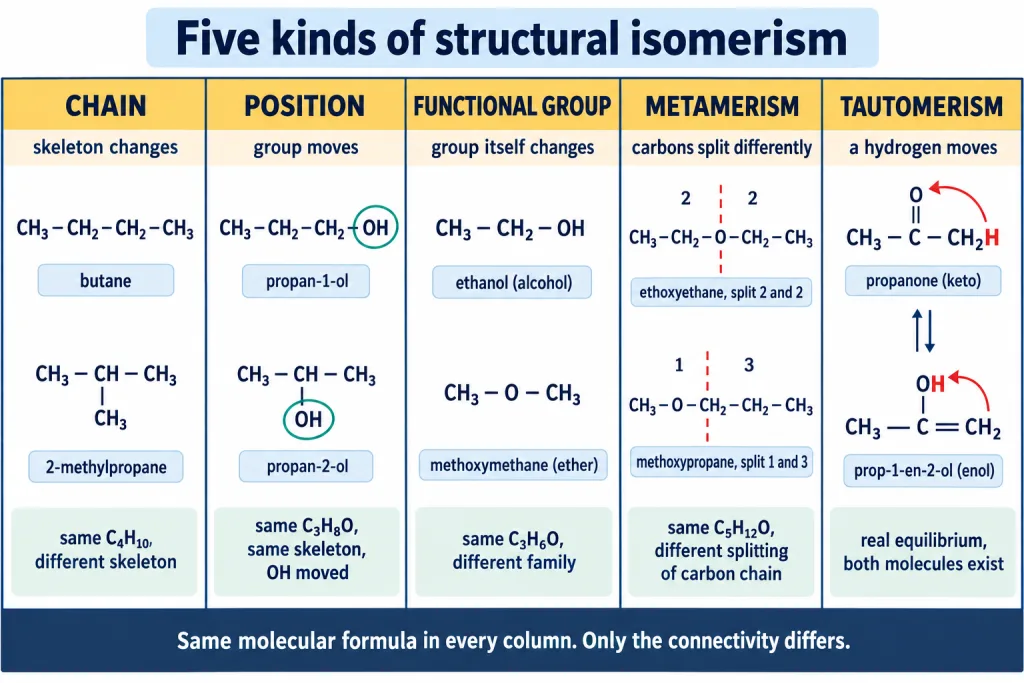
One working rule runs through everything below: a count of isomers is worth writing down only if you have actually drawn every one of them, so every number quoted here comes with the full list beside it.
Chain isomerism
Key Point (Definition): Chain isomers (skeletal isomers) have the same molecular formula and the same functional group, but a different carbon skeleton — one is straight, another is branched, or the branches sit differently.
The condition is simple: at least four carbon atoms. With one, two or three carbons there is only one way to string a skeleton together, so methane, ethane and propane have no isomers at all. Butane is the first alkane that does.
— two isomers
1. — butane.
2. — 2-methylpropane.
There is no third: a methyl on C-1 of propane simply rebuilds butane, and propane has only one middle carbon.
— three isomers
1. — pentane.
2. — 2-methylbutane.
3. — 2,2-dimethylpropane.
— five isomers
1. hexane,
2. 2-methylpentane,
3. 3-methylpentane,
4. 2,2-dimethylbutane,
5. 2,3-dimethylbutane,
Five, and no more.
The shortening method
Guessing produces duplicates. This procedure does not.
Step 1. Draw the longest possible chain. That is isomer one.
Step 2. Shorten the chain by one carbon and attach that carbon as a methyl group to every distinct position on the shortened chain. The two end carbons are never valid — a methyl there just rebuilds the longer chain.
Step 3. Shorten by one more. You now hold two carbons. Place them either as two separate methyls or as one ethyl, on every distinct combination of interior positions. Anything that lengthens the chain is not a new isomer.
Step 4. Repeat until the chain is too short to carry the branches, checking valency each time: a carbon already holding four bonds cannot take another branch.
Applied to :
- Chain of 6: hexane. 1 isomer.
- Chain of 5 plus one methyl: pentane has interior carbons C-2, C-3 and C-4, but C-4 counted from the other end is C-2. Distinct positions: C-2 and C-3. 2 isomers — 2-methylpentane and 3-methylpentane.
- Chain of 4 plus two carbons. Two methyls on butane, whose interior positions are C-2 and C-3: both on C-2 gives 2,2-dimethylbutane, one on each gives 2,3-dimethylbutane, and both on C-3 is 2,2-dimethylbutane again read from the other end. A single ethyl on C-2 or C-3 of butane lengthens the chain to five, so it gives nothing new. 2 isomers.
- Chain of 3 plus three carbons: the middle carbon of propane can carry at most two branches before it runs out of bonds, and two methyls there is only . 0 isomers.
.
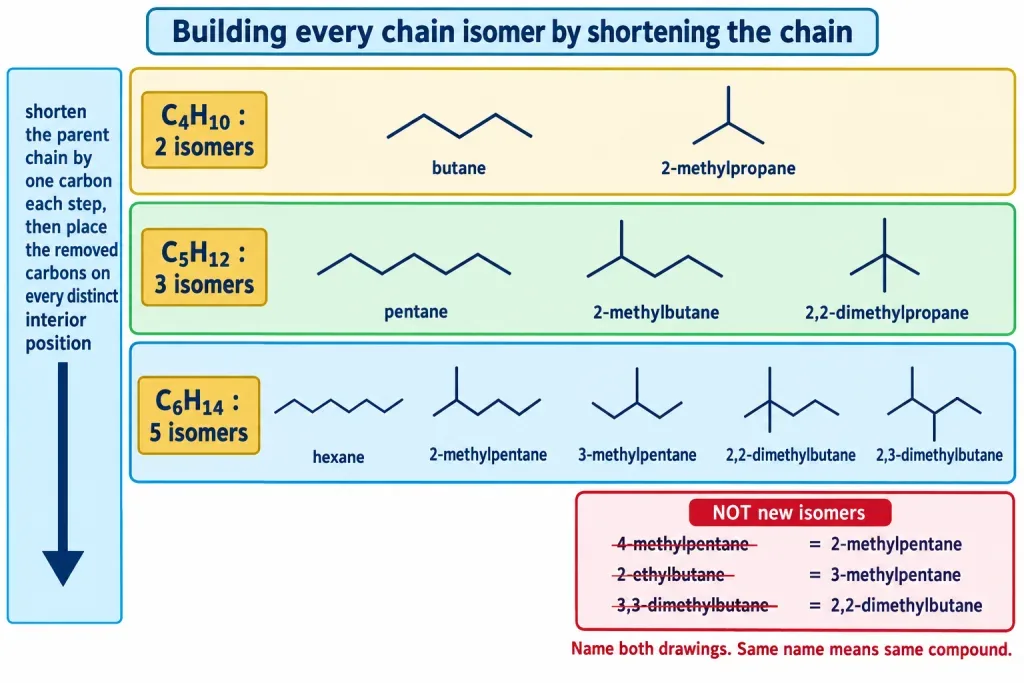
Run the same machine on and it delivers nine: heptane; 2-methylhexane and 3-methylhexane on a six-carbon parent; 2,2-dimethylpentane, 2,3-dimethylpentane, 2,4-dimethylpentane, 3,3-dimethylpentane and 3-ethylpentane on a five-carbon parent; and 2,2,3-trimethylbutane on a four-carbon parent. The count climbs steeply after that, which is why the method matters more than any single answer.
Telling a duplicate from a genuine isomer
This is where over-counting happens. Two drawings that look different on paper are the same compound whenever they give the same IUPAC name.
Key Point: Name both structures by the full rules — longest chain first, then lowest locants. If the two names agree, the two drawings are one compound. A drawing has no memory of how it was drawn; only the name is decisive.
Four duplicates that get counted as new isomers every year, none of which is a compound at all:
- 4-methylpentane — number pentane from the nearer end and the branch is on C-2. It is 2-methylpentane.
- 2-ethylbutane — the longest chain through that structure runs five carbons, not four. It is 3-methylpentane.
- 3-methylbutane — renumbering from the other end gives 2-methylbutane.
- 3,3-dimethylbutane — renumbering gives 2,2-dimethylbutane.
A fast pre-check before you bother naming: write down, for each carbon, how many carbons are attached to it. Different lists mean different compounds; matching lists mean you should name them to be sure.
[JEE Main] Chain isomers of the alkanes differ in boiling point. More branching means a more compact molecule, less surface contact and weaker dispersion forces, so the boiling point falls: pentane boils highest of the three pentanes and 2,2-dimethylpropane lowest.
Question 1: Counting the hexanes
Write all the structural isomers of and name each.
Answer:
I start with the longest chain, six carbons: hexane.
Then I shorten to five and hold one carbon. Pentane has interior carbons at C-2 and C-3 only, because C-4 is C-2 counted from the far end. That gives 2-methylpentane and 3-methylpentane.
Then I shorten to four and hold two carbons. Two methyls both on C-2 of butane gives 2,2-dimethylbutane; one on C-2 and one on C-3 gives 2,3-dimethylbutane. Both on C-3 is the same as both on C-2, read backwards. A single ethyl on C-2 or C-3 makes the longest chain five carbons, so it gives nothing new.
A three-carbon chain cannot take the remaining three carbons without either exceeding four bonds on the middle carbon or lengthening the chain.
Ans: Five — hexane, 2-methylpentane, 3-methylpentane, 2,2-dimethylbutane, 2,3-dimethylbutane. Watch out: 2-ethylbutane and 4-methylpentane are the two fake extras. Both rename to structures already on the list.
Question 2: Is this a new isomer?
A student draws a six-carbon compound and calls it 2-ethylbutane, claiming it as a sixth isomer of . Decide whether it is new.
Answer:
The structure is . I look for the longest chain rather than trusting the name. Starting at the end of the ethyl group and running through the branch point into the right-hand end, I count five carbons, not four.
So the parent is pentane and the leftover branch is a single methyl, sitting on the middle carbon, C-3 from either end. The correct name is 3-methylpentane, already isomer three on the list.
Ans: Not new; it is 3-methylpentane. Watch out: The longest chain must be found first, before any branch is named. A name that puts an ethyl group on a four-carbon parent is almost always a mis-drawn methylpentane.
Position isomerism
Key Point (Definition): Position isomers have the same carbon skeleton and the same functional group, but the group — or the double or triple bond — occupies a different position on that skeleton.
The condition: the skeleton must offer at least two positions that are not equivalent. A two-carbon chain offers only one kind of position, so ethanol has no position isomer; propan-1-ol does.
Alcohols: propan-1-ol and propan-2-ol
Both are , both a propane skeleton with one . In the first the hydroxyl sits on a terminal carbon, making a primary alcohol; in the second it is on the middle carbon, making a secondary alcohol. They oxidise to different products, an acid in one case and a ketone in the other.
Alkenes: but-1-ene and but-2-ene
Both on an unbranched four-carbon chain, with only the location of the double bond differing. Here the thing whose position moves is the unsaturation itself. Contrast 2-methylprop-1-ene, , which has a different skeleton and so is a chain isomer of both.
Haloalkanes: 1-chloropropane and 2-chloropropane
Both on a propane skeleton, with the chlorine terminal in one and central in the other. The first is a primary halide, the second secondary, and that decides which substitution mechanism each prefers in Class 12.
On a ring: the three nitrophenols
With the fixed at C-1, the has exactly three distinguishable homes on the ring, so has three nitrophenols:
1. 2-nitrophenol (ortho), the nitro group on the carbon next to the hydroxyl.
2. 3-nitrophenol (meta), one carbon further round.
3. 4-nitrophenol (para), directly across the ring.
C-5 duplicates C-3 and C-6 duplicates C-2, because the ring can be numbered in either direction. Three, not five. The ortho isomer is the odd one out physically: its and are close enough to hydrogen bond within the same molecule, so it is steam-volatile, while the para isomer hydrogen bonds between molecules and melts far higher.
[NEET] Any disubstituted benzene has exactly three position isomers — ortho, meta and para. That number does not depend on what the two substituents are.
Functional group isomerism
Key Point (Definition): Functional group isomers (functional isomers) share a molecular formula but contain different functional groups, and therefore belong to different families of compounds.
The condition is that the same atom count can be assembled into two different groups. A few general formulae are the classic breeding grounds, worth recognising on sight.
| General formula | Families it can produce |
|---|---|
| alcohol and ether | |
| aldehyde, ketone, unsaturated alcohol, unsaturated ether | |
| carboxylic acid and ester | |
| nitroalkane, alkyl nitrite, amino acid | |
| primary, secondary and tertiary amines |
— two isomers
1. ethanol, , an alcohol.
2. methoxymethane (dimethyl ether), , an ether.
Two, and no more, because two carbons offer only one way of splitting around an oxygen. Every alcohol from upward has at least one ether functional isomer.
— one degree of unsaturation, several families
The formula carries one double bond or one ring. The three open-chain, non-enol structures you are expected to write are:
1. propanal, , an aldehyde.
2. propanone, , a ketone.
3. prop-2-en-1-ol, , an unsaturated alcohol.
A fourth open-chain structure also fits: methoxyethene, , an unsaturated ether. Rings would add more still. The answer to "how many isomers has " therefore depends on what the question permits, and a good answer names the structures rather than announcing a bare number.
— an acid and two esters
1. propanoic acid, .
2. methyl ethanoate, .
3. ethyl methanoate, .
Check each. Propanoic acid: three carbons, six hydrogens, two oxygens. Methyl ethanoate: an ethanoyl group plus . Ethyl methanoate: a methanoyl group plus . All three come to .
The relationships are not all the same, and this is worth being exact about. The acid is a functional group isomer of each ester, since an acid and an ester are different families. The two esters share the same group and differ only in how the three carbons are split around it, two-and-one against one-and-two, but they are not metamers: in ethyl methanoate the acid side of the group is a hydrogen and not an alkyl group, and the definition of metamerism used in this chapter needs an alkyl group on both sides of the divalent group. Ester metamers begin at four carbons.
— three families from one formula
1. nitroethane, , with carbon bonded to nitrogen.
2. ethyl nitrite, , with carbon bonded to oxygen instead.
3. aminoethanoic acid (glycine), , carrying both an amine and an acid.
Nitroethane and ethyl nitrite are the pair to remember: identical atoms, and the whole difference is whether the nitrogen or an oxygen does the joining. Nitroethane is a neutral high-boiling liquid; glycine is a crystalline solid existing as a zwitterion.
Question 3: All the isomers of
Write every structural isomer of , name it, and say which type of isomerism relates each pair.
Answer:
First the degree of unsaturation. For , the maximum hydrogen count for three carbons is , and oxygen does not change that. Eight hydrogens are present, so the degree of unsaturation is zero. Everything is saturated and open-chain.
Now the skeleton. Three carbons give only one skeleton, propane.
Alcohols first. The can go on a terminal carbon or the middle carbon. That is propan-1-ol and propan-2-ol. C-3 is the same as C-1.
Ethers next. Three carbons split around the oxygen as one plus two, and there is only one way to do that: a methyl on one side and an ethyl on the other. That is methoxyethane, .
Relationships: propan-1-ol and propan-2-ol differ only in where the group sits, so they are position isomers. Methoxyethane is an ether, so it is a functional group isomer of both alcohols.
Ans: Three — propan-1-ol, propan-2-ol and methoxyethane; two alcohols and one ether. Watch out: There is no second ether. A split of zero-and-three is not an ether at all, it is propan-1-ol with the oxygen written on the end.
Question 4: The nitrophenol count
How many position isomers has nitrophenol, and which is the most volatile?
Answer:
Fix the at C-1. The nitro group can then be at C-2, C-3 or C-4. Positions C-5 and C-6 are not new, because numbering the ring the other way turns C-5 into C-3 and C-6 into C-2.
So three: 2-nitrophenol, 3-nitrophenol and 4-nitrophenol.
For volatility, 2-nitrophenol has the two groups on adjacent carbons, close enough for the hydroxyl hydrogen to bond to an oxygen of the nitro group inside the same molecule. That intramolecular bond uses up the that would otherwise hold neighbouring molecules together, so 2-nitrophenol has the weakest intermolecular forces of the three.
Ans: Three; 2-nitrophenol is the most volatile, because of intramolecular hydrogen bonding. Watch out: Intramolecular hydrogen bonding lowers the boiling point; intermolecular hydrogen bonding raises it. Getting those two the wrong way round reverses the whole answer.
Metamerism
Metamerism is a narrower idea than the first three, and books do not all draw its boundary in the same place. The definition used throughout this chapter is this one.
Key Point (Definition): Metamers are isomers containing the same functional group, where that group is divalent and sits between two alkyl groups, and the isomers differ in how the carbon atoms are divided between the two sides of that group.
The condition has two parts. First, the group must be divalent, with two bonds going out to carbon: in ethers, in ketones, in secondary amines, in esters, in thioethers. A monovalent group such as or has only one side and can never give metamers. Second, there must be enough carbons for the split to be made in more than one way.
The test: count the carbons on each side of the divalent group. Different splits mean metamers. The same split with one alkyl group branched differently means chain isomers.
Ethers: the set
Three ethers have this formula.
1. methoxypropane, — split one and three.
2. 2-methoxypropane, — split one and three.
3. ethoxyethane (diethyl ether), — split two and two.
Ethoxyethane is a metamer of both of the others, because two-and-two is a different division from one-and-three. Methoxypropane and 2-methoxypropane are not metamers of each other: both divide the carbons one-and-three, and the three-carbon group is merely propyl in one and 1-methylethyl in the other. That is chain isomerism inside an alkyl group.
Four carbons is the minimum for an ether to show metamerism; with three, the only split is one-and-two.
Ketones: the set
1. pentan-2-one, — methyl on one side, propyl on the other, split one and three.
2. pentan-3-one, — ethyl on both sides, split two and two.
3. 3-methylbutan-2-one, — methyl and 1-methylethyl, split one and three.
Under the definition stated above, pentan-2-one and pentan-3-one are metamers: methyl propyl ketone against diethyl ketone, an unequal division against an equal one. Pentan-2-one and 3-methylbutan-2-one divide their carbons identically and so are chain isomers.
Some books instead call these two position isomers, on the ground that the carbonyl has moved along a five-carbon chain. Both readings describe the same molecules and differ only in bookkeeping. The safe move in an examination is to describe the split in words — "one has ethyl on both sides, the other methyl and propyl" — then attach whichever label the definition in front of you demands, never mixing the two systems inside one answer.
Five carbons is the minimum for a ketone; butanone, , has only the one-and-two split available.
Amines and esters
Secondary amines, on : N-methylpropan-1-amine, , split one and three, against N-ethylethanamine, , split two and two. Both , both secondary amines, and metamers.
Esters, on : methyl propanoate, , has three carbons in the acid part and one in the alcohol part; ethyl ethanoate, , has two and two. Both , both esters, and metamers. Four carbons is the minimum here, because any three-carbon pair would have to include a methanoate, whose acid side is a hydrogen rather than an alkyl group.
[JEE/NEET] Every metamer pair is a pair of structural isomers, but the reverse is false. Before writing "metamers", check that the group really is divalent and that the carbon counts on the two sides genuinely differ.
Tautomerism
Key Point (Definition): Tautomers are structural isomers that interconvert so readily that they exist together in a dynamic equilibrium, the change consisting of the migration of a hydrogen atom from one site to another together with the shift of a double bond. The commonest case is the keto-enol equilibrium.
Two things must be said at the start, because both are examined constantly.
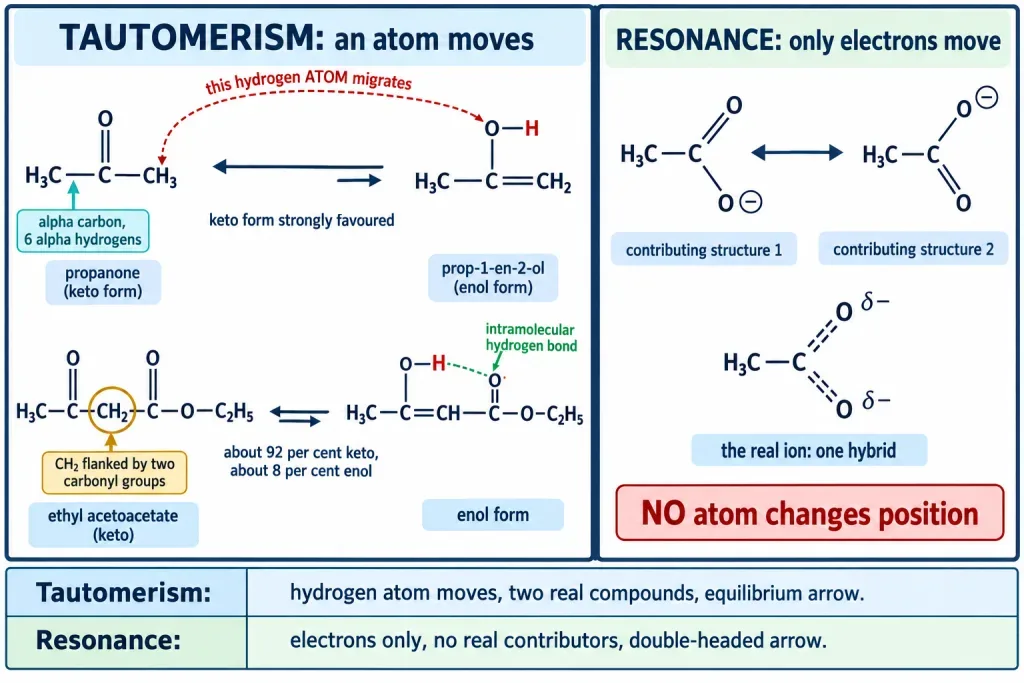
Tautomers are real, separate molecules. Each can in principle be isolated and has its own melting point, spectrum and chemistry. They sit in a genuine two-way equilibrium, written with , with a real rate in each direction and a real equilibrium constant.
Tautomerism is not resonance. In resonance nothing moves except electrons; the contributors are not compounds, cannot be isolated, and the molecule is a single hybrid that is none of them. In tautomerism an atom moves — a hydrogen, complete with its nucleus — so the two structures have their nuclei in different places, which disqualifies them as resonance contributors outright. Resonance takes a double-headed arrow; tautomerism takes an equilibrium arrow.
The keto-enol equilibrium
The keto form has a and a hydrogen on the neighbouring carbon. The enol form has that hydrogen moved to the oxygen, giving , and the double bond moved from to . The name says it: ene plus ol.
Propanone on the left, prop-1-en-2-ol on the right, both . Count the bonds in the enol: the carbon bearing the has one bond to the methyl, one to the oxygen and two to the terminal , which is four; the terminal carbon has two hydrogens and two bonds to its neighbour, also four.
For propanone the equilibrium lies overwhelmingly on the keto side — far less than one molecule in a thousand is enol at any instant, because a bond is much stronger than a plus an . Ethanal is the same, sitting almost entirely as rather than ethenol, .
The requirement: an alpha hydrogen
Key Point: Keto-enol tautomerism needs at least one hydrogen on the carbon alpha to the carbonyl, that is, on the carbon directly attached to the carbon. With no alpha hydrogen there is nothing to move, and no enol form exists.
Propanone has six alpha hydrogens, three on each methyl; ethanal has three. Compounds with none show no keto-enol tautomerism at all: benzaldehyde, , whose alpha carbon is a ring carbon with no hydrogen; methanal, , which has no alpha carbon; 2,2-dimethylpropanal, , whose alpha carbon is fully substituted by methyls; and diphenylmethanone, , with ring carbons on both sides.
Ethyl acetoacetate, the case where the enol is visible
Ethyl 3-oxobutanoate, the keto form, has its central flanked by two carbonyl groups, the ketone on one side and the ester on the other. Those two hydrogens come away far more easily than an ordinary alpha hydrogen, and the resulting enol is stabilised twice over: its is conjugated with the ester carbonyl, and its hydrogen bonds to the ester oxygen inside the same molecule, closing a six-membered ring.
The equilibrium mixture is roughly 8 per cent enol at room temperature — enough that the compound behaves as both. It decolourises bromine water and gives a colour with iron(III) chloride, the tests of an enol, while also giving the reactions of a ketone. That double behaviour is the classic proof that both tautomers are genuinely present.
Reading the two apart in an exam
| Feature | Tautomerism | Resonance |
|---|---|---|
| What moves | a hydrogen atom, plus a double bond | electrons only |
| Positions of nuclei | different in the two forms | identical in all contributors |
| Are the forms real | yes, separate compounds | no, mere contributors |
| Can they be separated | in principle yes | never |
| Arrow used | equilibrium arrow | double-headed arrow |
| The real substance | a mixture of two compounds | one single hybrid |
Enumerating every isomer of a given formula
The recipe below finds every isomer of a formula and repeats none.
Step 1 — find the degree of unsaturation.
Oxygen and sulphur are ignored; halogens count as hydrogens; each nitrogen adds one to the top. A DoU of 0 means everything is saturated and open-chain; 1 means exactly one double bond or one ring; 4 alongside a usually means a benzene ring.
Step 2 — decide the families the formula permits, matching against the general formulae listed earlier: means alcohol or ether, means acid or ester.
Step 3 — draw the carbon skeletons first, ignoring the functional group entirely, by the shortening method. This is the step students skip, and skipping it is what produces duplicates.
Step 4 — on each skeleton, mark the distinct positions, two positions being the same if the skeleton can be flipped or rotated to carry one onto the other. Put the group on each in turn.
Step 5 — name every structure, and delete any two with the same name.
Worked:
DoU : one double bond or one ring. The four-carbon skeletons are the butane chain and the 2-methylpropane skeleton.
1. butane chain, bond between C-1 and C-2: but-1-ene, .
2. butane chain, bond between C-2 and C-3: but-2-ene, . (A bond between C-3 and C-4 is but-1-ene numbered backwards.)
3. branched skeleton: 2-methylprop-1-ene, .
That is 3 structural isomeric alkenes.
Add stereochemistry and but-2-ene splits, since each of its doubly bonded carbons carries a methyl and a hydrogen, making cis and trans distinct. But-1-ene and 2-methylprop-1-ene each have a end with two identical hydrogens, so neither shows it. Counting geometrical isomers gives 4 distinct alkenes.
Rings take up the rest of the formula: cyclobutane and methylcyclopropane. So has five structural isomers, three of them alkenes.
Worked:
DoU : saturated, open-chain, one bromine.
On the butane skeleton the distinct positions are C-1 and C-2 only, since C-4 repeats C-1 and C-3 repeats C-2, giving 1-bromobutane, , and 2-bromobutane, .
On the 2-methylpropane skeleton the distinct positions are one of the three equivalent methyl carbons and the central carbon, giving 1-bromo-2-methylpropane, , and 2-bromo-2-methylpropane, .
Four isomers — two primary, one secondary, one tertiary.
Worked:
DoU : alcohol or ether. On the single propane skeleton the gives propan-1-ol and propan-2-ol. The only split of three carbons across an oxygen is one and two, giving methoxyethane.
Three isomers — two alcohols and one ether.
Worked:
DoU . Alcohol or ether again.
Alcohols. Butane skeleton, distinct positions C-1 and C-2:
1. butan-1-ol,
2. butan-2-ol,
2-methylpropane skeleton, distinct positions a methyl carbon and the central carbon:
3. 2-methylpropan-1-ol,
4. 2-methylpropan-2-ol,
Ethers. Split the four carbons across the oxygen. One and three, with the three-carbon group either straight or branched:
5. methoxypropane,
6. 2-methoxypropane,
Two and two, with only one two-carbon group possible:
7. ethoxyethane,
Seven isomers — four alcohols and three ethers. "Propoxymethane" is methoxypropane written backwards, not an eighth compound.
The five types side by side
| Type | Same in both | Different in both | Condition to be possible | Example pair |
|---|---|---|---|---|
| Chain | molecular formula, functional group | carbon skeleton | at least 4 carbons in the skeleton | butane and 2-methylpropane |
| Position | formula, skeleton, functional group | locant of the group or multiple bond | skeleton must offer two non-equivalent positions | propan-1-ol and propan-2-ol |
| Functional group | molecular formula only | the functional group itself, so the family too | one formula must fit two different groups | ethanol and methoxymethane |
| Metamerism | formula, functional group, family | division of carbons on the two sides of the group | group must be divalent, with carbons to split unequally | ethoxyethane and methoxypropane |
| Tautomerism | molecular formula | position of a hydrogen atom and a double bond | an alpha hydrogen next to the carbonyl | propanone and prop-1-en-2-ol |
[Board] A question that says "identify the type of isomerism" is answered by asking, in order: has the skeleton changed (chain), has the group moved on an unchanged skeleton (position), has the group itself changed (functional), has only the split around a divalent group changed (metamerism), has a hydrogen migrated with a double bond (tautomerism). The first yes is the answer.
Question 5: Classify these four pairs
Name the type of structural isomerism in each: (a) and ; (b) and ; (c) but-1-ene and but-2-ene; (d) pentane and 2,2-dimethylpropane.
Answer:
For (a) both are ethers of formula , the group is the divalent oxygen, and the splits are one-and-three against two-and-two. Metamerism.
For (b) both are , but one is an alcohol and the other an ether. Different functional groups, so functional group isomerism.
For (c) both are on the same unbranched skeleton, and only the double bond has slid along. Position isomerism.
For (d) both are alkanes with no functional group; one is straight and the other is the most branched skeleton possible. Chain isomerism.
Ans: (a) metamerism, (b) functional group, (c) position, (d) chain.
Question 6: Which will not tautomerise
Of propanone, ethanal, benzaldehyde and pentan-3-one, which shows no keto-enol tautomerism, and why?
Answer:
I check each for a hydrogen on the carbon next to the carbonyl.
Propanone, : two methyl groups, six alpha hydrogens.
Ethanal, : one methyl, three alpha hydrogens.
Pentan-3-one, : two groups next to the carbonyl, four alpha hydrogens.
Benzaldehyde, : the carbon attached to the is a ring carbon, and its four bonds are used up by its two ring neighbours, one of them a double bond, plus the bond to the carbonyl carbon. It carries no hydrogen at all.
With no alpha hydrogen there is nothing to migrate to the oxygen, so no enol can form.
Ans: Benzaldehyde, because it has no alpha hydrogen. Watch out: The hydrogen of the group itself is not an alpha hydrogen. It sits on the carbonyl carbon, not on the carbon next to it, and it does not migrate.
Question 7: Tautomers or resonance contributors?
and are drawn on a page joined by an arrow. Which arrow is correct, and what is the relationship?
Answer:
I compare the positions of the nuclei. In the first structure one hydrogen sits on a methyl carbon; in the second that hydrogen sits on the oxygen. A hydrogen nucleus has moved.
Resonance contributors must have every nucleus in the same place, with only electrons redistributed. That test fails here, so these are not resonance contributors.
They are two separate compounds, propanone and prop-1-en-2-ol, both , interconverting in a real equilibrium. The correct arrow is the two-way equilibrium arrow , not the double-headed resonance arrow.
Ans: Tautomers, joined by an equilibrium arrow; the equilibrium lies far towards propanone. Watch out: A double-headed arrow here would claim these are two pictures of one substance, which they are not. They are two substances.