
Two ways to break one bond
A covalent bond is a shared pair of electrons. Breaking it means deciding where that pair ends up, and there are only two possibilities. The two electrons separate, one to each fragment; or they stay together and travel to one fragment. Every organic mechanism you will ever write begins with one of these two choices.
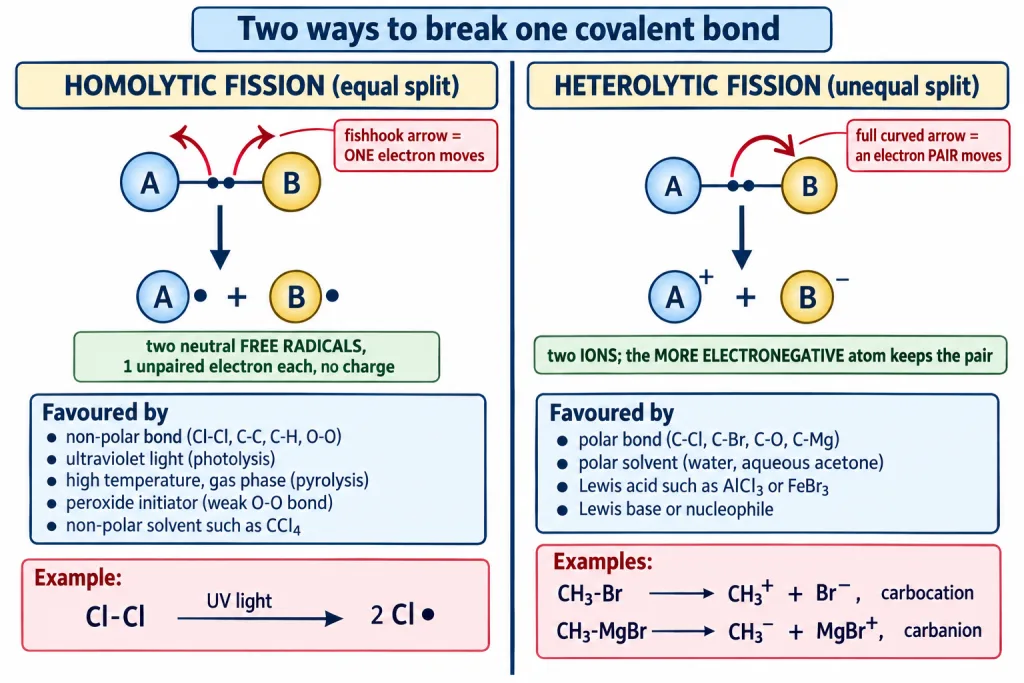
Key Point (Definition): Fission (cleavage) of a covalent bond is the breaking of that bond. In homolytic fission the shared pair divides evenly, one electron to each fragment. In heterolytic fission the shared pair goes intact to one of the two fragments.
The Greek roots do the work for you. Homo means same and lysis means splitting, so homolysis is the equal share; hetero means different, so heterolysis is the unequal one.
Homolytic fission
Each fragment leaves with exactly the one electron it contributed. Nothing has been gained and nothing lost, so both products are electrically neutral, and each carries one unpaired electron. Species of this kind are free radicals, and the dot written next to the symbol is that single electron.
The arrow: a fishhook
A curved arrow in organic chemistry shows where electrons move. For homolysis the moving unit is one electron, not a pair, and that needs its own symbol.
Key Point: A half-headed arrow, drawn with a single barb and always called a fishhook arrow, shows the movement of one electron. Homolysis takes two fishhooks: both start at the middle of the bond, one curling to the left-hand atom and one to the right.
A full double-barbed arrow here would claim a pair moved together, which is the opposite of what homolysis does.
What pushes a bond towards homolysis
- A non-polar or almost non-polar bond. , , and have both ends pulling equally, so there is no reason for either atom to claim both electrons.
- Ultraviolet light. A photon delivers its energy straight into the bond and splits it symmetrically. This is photolysis, and it is why chlorination of alkanes is run in sunlight or under a UV lamp.
- High temperature. Heating in the gas phase, typically several hundred degrees Celsius, breaks bonds thermally with no charge separation to pay for. This is thermolysis or pyrolysis.
- Peroxides. The bond in a peroxide is very weak — far weaker than the bond at 348 kJ/mol — so it snaps homolytically on gentle warming and hands out radicals to everything nearby. A peroxide used this way is called an initiator.
- A non-polar solvent such as or benzene, or no solvent at all. There is nothing present to solvate ions, so the ionic route is shut off.
Three standard examples
In the second of these the bond that breaks is , and the fragment is an alkyl free radical. Homolysis of a bond to carbon is the only way carbon ends up with an odd electron. [JEE Main] Whenever a question mentions peroxide, UV light or a high-temperature gas-phase step, the intended answer is radicals.
Heterolytic fission
The shared pair stays together and goes to one fragment. That fragment ends up with one more electron than it started with, so it becomes negative; the other is left one electron short and becomes positive. Two ions form where one neutral molecule stood.
Which partner keeps the pair is decided by electronegativity: the more electronegative atom takes both electrons.
The arrow: full and curved
Key Point: A full curved arrow, drawn with both barbs on the head, shows the movement of an electron pair. Heterolysis takes exactly one such arrow: it begins on the bond and ends on the atom that keeps the pair.
One full arrow, not two fishhooks — the arrow count alone says which fission you mean.
The two outcomes for carbon
Carbon can end up on either side of the split, and which side it lands on is set by its partner.
Carbon loses the pair. When carbon is bonded to something more electronegative — a halogen, oxygen, nitrogen — the pair goes to that atom and carbon is left positive.
The carbon species is a carbocation (older name: carbonium ion). It carries a full positive charge on carbon.
Carbon keeps the pair. When carbon is bonded to something less electronegative — magnesium, lithium, sodium — carbon is the greedier partner and takes both electrons.
The carbon species is a carbanion. It carries a full negative charge and a lone pair on carbon. The same result follows when a strong base pulls a proton off carbon and leaves the bonding pair behind.
What pushes a bond towards heterolysis
- A polar bond. A large electronegativity difference means the pair is already sitting closer to one atom; the fission only completes a shift that has begun. , , and all qualify.
- A polar solvent. Water, ethanol, acetone and nitromethane surround and solvate the ions the moment they form. Separating opposite charges costs a great deal of energy, and solvation pays most of that bill. In the gas phase, or in a hydrocarbon solvent, heterolysis of the same bond may simply not happen.
- A Lewis acid. , and accept the electron pair from the leaving group and drag it off, forcing the bond to break the ionic way.
- A Lewis base or nucleophile. A base that attacks a hydrogen, or a nucleophile that pushes electron density in at carbon, can drive the pair onto one fragment.
The conditions in the flask choose between the two fissions. Bromine in under UV light gives bromine radicals; the same bromine with gives and .
Both fissions produce species that exist for a very short time and go on to react at once. Anything formed during a reaction and consumed before the reaction ends is a reaction intermediate, and the three that matter in this chapter are the free radical, the carbocation and the carbanion.
Question 1: Chlorine under a lamp
Chlorine gas is irradiated with ultraviolet light. Which fission occurs, and what forms?
Answer:
The bond is , between two identical atoms, so there is no electronegativity difference at all. Neither chlorine can pull both electrons across. On top of that the condition is UV light, which is the standard trigger for homolysis.
So the pair splits one electron each.
Ans: Homolytic fission, giving two neutral chlorine free radicals, each with one unpaired electron.
Question 2: Bromomethane in aqueous acetone
is warmed in aqueous acetone. Which fission occurs, and what fragments form?
Answer:
First I look at the bond. Bromine is much more electronegative than carbon, so is strongly polar and the pair already leans towards bromine.
Then I look at the conditions. Aqueous acetone is a polar solvent, so any ions produced get solvated immediately.
Polar bond plus polar solvent means heterolysis. Bromine is the more electronegative partner, so bromine keeps both electrons.
Ans: Heterolytic fission, giving the methyl carbocation and bromide ion.
Watch out: The same molecule can be made to break the other way. In the gas phase at high temperature gives and . The bond does not decide alone; the conditions decide with it.
Question 3: A peroxide on warming
Benzoyl peroxide, , is warmed gently. Which bond breaks and how?
Answer:
The weakest bond in the molecule is the bond, and it joins two identical oxygen atoms, so it is non-polar. Gentle heat with no polar solvent and no Lewis acid points to homolysis.
Each oxygen keeps one electron, and two benzoyloxy radicals form.
Ans: The bond breaks homolytically, giving two neutral benzoyloxy free radicals. This is exactly what an initiator is for.
Question 4: The carbon-magnesium bond
In , which atom keeps the shared pair when the bond breaks, and what carbon species results?
Answer:
Magnesium is a metal, so it is far less electronegative than carbon. For once carbon is the more electronegative partner in the bond.
Heterolysis puts the pair on the more electronegative atom, which here is carbon. Carbon gains an electron it did not own and becomes negative.
Ans: Carbon keeps the pair, giving the methyl carbanion along with .
Watch out: Students assume that carbon is always the one left positive. It is positive only when its partner is more electronegative. Against a metal the sign flips.
Free radicals
Key Point (Definition): A free radical is a species carrying an odd, unpaired electron. It is produced by homolytic fission and it is electrically neutral.
The electron count
Take the methyl radical, . The central carbon has three bonding pairs to the three hydrogens, contributing electrons to its count, plus one unpaired electron of its own.
Seven is one short of an octet, which is why a radical is so reactive: it will take an electron from almost anything to complete its shell. It is neutral because the carbon still owns four electrons of its own share (three from the three bonds plus the odd one), exactly the four a neutral carbon should have.
Shape and hybridisation
A free radical is hybridised and very nearly planar — pyramidal in some cases. Three orbitals form the three sigma bonds at close to 120 degrees, and the odd electron sits in the unhybridised orbital perpendicular to that plane.
The "very nearly" matters. A carbocation is rigidly planar because its orbital is empty; a radical has one electron there and can pyramidalise cheaply, so is distinctly pyramidal. For alkyl radicals, draw the planar picture.
Stability order
Two effects, both belonging to alkyl groups, produce this order.
Hyperconjugation. The sigma electrons of a bond on the carbon next to the radical centre overlap with the half-filled orbital and spread the odd electron over a larger volume. Only alpha hydrogens count — hydrogens on the carbon adjacent to the radical centre. The tert-butyl radical has 9 alpha hydrogens, isopropyl 6, ethyl 3 and methyl 0. More alpha hydrogens means more hyperconjugative structures and more stability, and the counts run in exactly the order above.
Inductive release. Alkyl groups are : they push electron density through the sigma framework towards the radical centre and help supply the electron it is missing. Three alkyl groups push harder than two, two harder than one.
Resonance, for allyl and benzyl. The allyl radical has its odd electron on a carbon next to a double bond, so the electron is genuinely delocalised over both end carbons — two equivalent contributing structures. The benzyl radical spreads its odd electron into the ring, reaching the two ortho positions and the para position as well. Resonance beats hyperconjugation, so both sit above tertiary, and between the two, benzyl comes above allyl because the ring offers more places for the electron to go.
Reactivity is the mirror image
A stable radical is a radical that is in no hurry. Reactivity therefore runs the other way:
The methyl radical is the least stabilised and so the most aggressive. This inversion applies to the reactivity of the intermediate, one of the few places in this chapter where reversing an order is correct rather than a mistake.
Carbocations
Key Point (Definition): A carbocation is a species in which a carbon atom carries a full positive charge and only six valence electrons. It is produced by heterolytic fission in which carbon loses the bonding pair.
The electron count
In the carbon has three bonds and nothing else: electrons around it, no lone pair, no odd electron.
Being two electrons short makes a carbocation electron deficient, and an electron-deficient centre is by definition an electrophile.
Shape and hybridisation
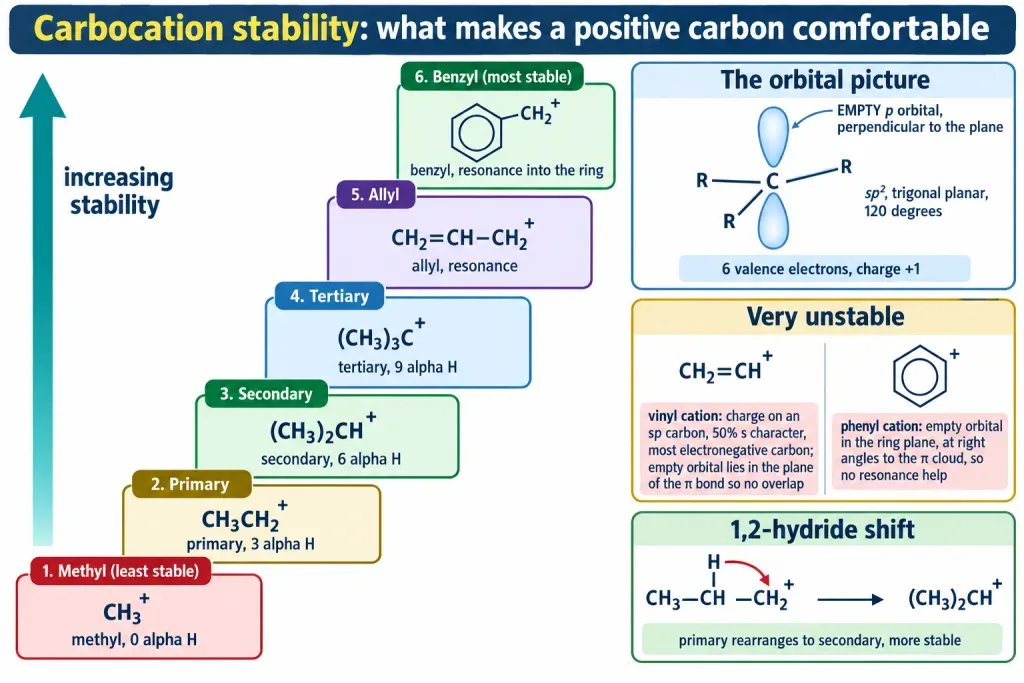
A carbocation is hybridised and trigonal planar. The three sigma bonds lie in one plane at 120 degrees to each other, and the leftover unhybridised orbital stands perpendicular to that plane and is completely empty.
That empty perpendicular orbital is the single most useful fact about carbocations. A nucleophile attacks it from either face, a neighbouring sigma bond overlaps with it in hyperconjugation, and an adjacent pi system delocalises into it.
Stability order
Three reasons, listed here weakest first. In order of strength they run resonance > hyperconjugation > inductive release.
Inductive release. Alkyl groups are and push electron density towards the positive carbon, partly neutralising the charge. Each extra alkyl group helps, which is why tertiary beats secondary beats primary.
Hyperconjugation. Each bond on an alpha carbon donates its sigma pair into the empty orbital. The tert-butyl cation has 9 alpha hydrogens, isopropyl 6, ethyl 3, methyl 0, so the number of hyperconjugative structures falls in the same order as the stability. Hyperconjugation is the larger of the two alkyl effects.
Resonance, for allyl and benzyl. The allyl cation has its empty orbital next to a pi bond, and the two overlap: the positive charge is shared equally by the two terminal carbons, two equivalent structures. The benzyl cation delocalises the charge into the ring, putting it on the two ortho carbons and the para carbon in turn — a far bigger system. Resonance disperses charge much more effectively than hyperconjugation, so both outrank tertiary, and benzyl beats allyl.
The unstable ones: vinyl and phenyl cations
Both are very unstable, and it is worth knowing exactly why, because a question will hide one of them in a ranking list.
- In the vinyl cation the positive carbon is hybridised, with 50% s character. Higher s character makes a carbon more electronegative, and a more electronegative atom is precisely the one that least wants to carry a positive charge.
- In the phenyl cation the positive carbon is , but the empty orbital lies in the plane of the ring, at right angles to the ring pi cloud. Orbitals at right angles do not overlap, so the aromatic sextet cannot help at all. There is a whole pi system next door and none of it is available.
- Hyperconjugation cannot rescue either one. The vinyl cation has no alpha bond at all, because the only carbon attached to it is doubly bonded and the hydrogens on a doubly bonded carbon are vinylic, never alpha. In the phenyl cation the carbons flanking the cationic centre belong to the aromatic ring, so their hydrogens sit on carbons in the ring plane and are not alpha bonds the empty orbital could use — and as the bullet above notes, that orbital is in the wrong plane for the ring system in any case.
Rearrangement, in one line
A less stable carbocation often does not wait to be attacked. A hydrogen with its bonding pair migrates from the neighbouring carbon to the positive carbon — a 1,2-hydride shift — or a methyl group migrates the same way in a 1,2-methyl shift, turning a primary cation into a secondary or tertiary one and giving a product whose skeleton does not match the starting material. Section 14 works through the mechanisms; for now, carbocations rearrange whenever rearrangement buys them stability, and radicals and carbanions do so far less readily.
Question 5: Ranking four simple carbocations
Arrange , , and in decreasing order of stability, and justify with a count.
Answer:
I classify them first: methyl, primary, secondary, tertiary.
Then I count alpha hydrogens, meaning hydrogens on the carbons attached to the positive carbon. The tert-butyl cation has three methyl groups, so . Isopropyl has two methyls, so 6. Ethyl has one methyl, so 3. Methyl cation has no carbon neighbour at all, so 0.
More alpha hydrogens means more hyperconjugative structures, and the same alkyl groups also release electrons inductively.
Ans: , with 9, 6, 3 and 0 alpha hydrogens respectively.
Question 6: Where do benzyl and allyl fit?
Place and into the order of Question 5.
Answer:
Both of these carry the positive charge on a carbon directly attached to a pi system, so both are resonance stabilised, and resonance spreads charge much further than hyperconjugation does.
The allyl cation shares the charge between two carbons. The benzyl cation feeds it into a benzene ring, so the charge visits the two ortho carbons and the para carbon as well.
Both therefore rank above the tertiary cation, and benzyl above allyl.
Ans:
Watch out: A benzyl cation is not a phenyl cation. Benzyl puts the charge on the outside the ring, where resonance can reach it. Phenyl puts it on a ring carbon, where resonance cannot.
Question 7: Why the vinyl cation loses
Explain why is less stable than , even though the vinyl cation has a pi bond right beside the empty orbital.
Answer:
I check the hybridisation of the positive carbon in each. In the ethyl cation it is , 33.3% s character. In the vinyl cation it is , 50% s character.
More s character holds the electrons closer to the nucleus and makes that carbon more electronegative. A more electronegative carbon is the last one that should be asked to carry a positive charge.
The pi bond does not rescue it. The empty orbital of the vinyl cation lies in the same plane as the pi system rather than parallel to it, so the two cannot overlap.
The ethyl cation, meanwhile, has three alpha hydrogens available for hyperconjugation, and the vinyl cation has none at all: the only carbon attached to its positive carbon is doubly bonded, and hydrogens on a doubly bonded carbon are vinylic, never alpha.
Ans: The vinyl cation carries its positive charge on an carbon, the most electronegative kind of carbon, and it gets neither hyperconjugation nor resonance; the ethyl cation gets both an centre and three alpha hydrogens.
Question 8: Ranking four radicals
Arrange , , and in decreasing order of stability.
Answer:
Radicals follow the same reasoning as carbocations, because both have an electron-poor orbital that alkyl groups and pi systems can feed.
Benzyl is resonance stabilised into the ring, so it goes on top. Then tertiary, with 9 alpha hydrogens, then primary with 3, then methyl with 0.
Ans:
Question 9: Reactivity from stability
Of and , which abstracts a hydrogen atom faster?
Answer:
Stability and reactivity of an intermediate run opposite to each other. The tert-butyl radical is heavily stabilised by 9 alpha hydrogens worth of hyperconjugation and by three methyl groups, so it is comparatively content as it is.
The methyl radical has no stabilisation at all and is 7 electrons hunting for an eighth.
Ans: The methyl radical reacts faster; radical reactivity runs methyl > primary > secondary > tertiary, the reverse of the stability order.
Carbanions
Key Point (Definition): A carbanion is a species in which a carbon atom carries a full negative charge and a lone pair, giving it eight valence electrons. It is produced by heterolytic fission in which carbon keeps the bonding pair.
The electron count
In the carbon has three bonds to hydrogen and one lone pair: from the bonds plus 2 from the lone pair.
A carbanion is the only one of the three intermediates with a full octet. It is not electron deficient; it is electron rich, and that is what makes it a nucleophile and a base.
Shape and hybridisation
A carbanion is hybridised and pyramidal. Three of the four orbitals hold the sigma bonds and the fourth holds the lone pair. Counting the lone pair as a fourth electron domain gives four domains around carbon, so the electron geometry is tetrahedral and the shape, which names only the atoms, is pyramidal — the same arrangement as ammonia, and for the same reason.
This is a clean point of contrast. The carbocation and the radical are and flat; the carbanion is and pyramidal.
The stability order is REVERSED
Key Point: For carbanions the order of stability is methyl > primary > secondary > tertiary. This is the exact reverse of the carbocation and free radical orders. It is the most commonly inverted fact in the whole topic.
The reason falls straight out of the electron count. A carbanion carbon already holds a full negative charge and a complete octet — it has more electron density than it can comfortably manage. Alkyl groups are : they push electrons in. Pushing more electron density onto a centre that is already electron rich makes matters worse, not better. Three alkyl groups push hardest, so the tertiary carbanion is the worst off; the methyl carbanion has no alkyl group pushing at all, so it is the best off.
The same release that stabilises an electron-poor cation destabilises an electron-rich anion. One cause, two opposite consequences, and that is the whole of the inversion. [NEET] A ranking question that hands you a carbanion is testing exactly this reversal.
What actually stabilises a carbanion
If pushing electrons in is bad, pulling them out is good.
- An adjacent group. Electron-withdrawing groups such as , , and the halogens drain charge away through the sigma bonds. is far more stable than for this reason alone.
- An adjacent group. A group that withdraws by resonance is better still, because it does not merely thin the charge out, it moves it onto a more electronegative atom. Next to a carbonyl, the lone pair delocalises onto the oxygen; next to a nitro group, onto the nitro oxygens.
A carbanion alpha to a carbonyl group, or alpha to a nitro group, is comparatively stable and can be generated with an ordinary base. The carbanion from acetone is the reason acetone has acidic alpha hydrogens at all, and the ability of nitromethane to lose a proton comes from the same source. Allyl and benzyl carbanions are likewise stabilised by resonance into the neighbouring pi system.
- More s character at the carbanion carbon. A lone pair is held more tightly in an orbital with more s character, so an carbanion beats an one, which beats . This is the opposite of the cation rule, and for the same underlying reason: what suits a negative charge does not suit a positive one.
The three intermediates side by side
| Intermediate | Valence electrons on C | Charge | Hybridisation | Shape | Stability order | Usually generated by |
|---|---|---|---|---|---|---|
| Free radical, | 7 | none, neutral | very nearly planar (pyramidal in some cases) | benzyl > allyl > tertiary > secondary > primary > methyl | homolytic fission: UV light, heat, or a peroxide initiator | |
| Carbocation, | 6 | trigonal planar, empty orbital perpendicular | benzyl > allyl > tertiary > secondary > primary > methyl | heterolytic fission with carbon losing the pair: polar bond, polar solvent, Lewis acid | ||
| Carbanion, | 8 | pyramidal, lone pair in the fourth orbital | methyl > primary > secondary > tertiary (reversed) | heterolytic fission with carbon keeping the pair: bond to a metal, or a base removing an alpha proton |
Three lines of that table do most of the work in an examination.
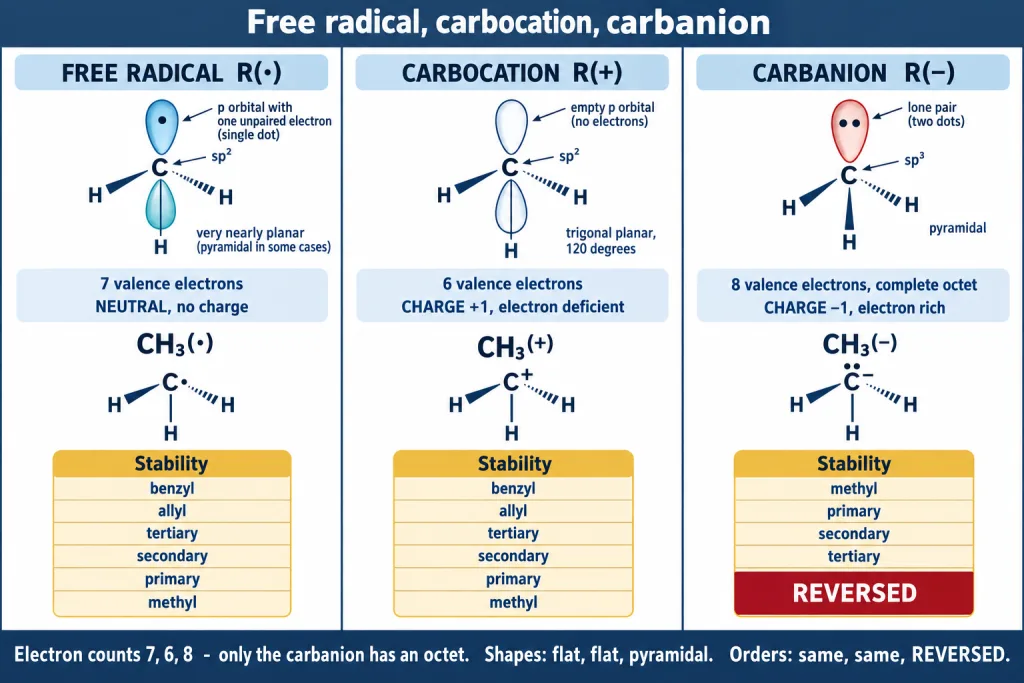
- Electron counts 7, 6, 8, in the order radical, cation, anion. Only the carbanion has an octet.
- Shapes: flat, flat, pyramidal. The two flat ones are ; the pyramidal one is .
- Orders: same, same, reversed. Radicals and cations agree with each other because both are electron poor. The carbanion disagrees with both because it is electron rich.
Reading a reaction backwards
Given an intermediate, you can usually name the fission that made it.
- A neutral species with a dot: homolysis, so look for light, heat or peroxide in the conditions.
- A positive carbon: heterolysis with a more electronegative leaving group departing, so look for a halide, a protonated , or a Lewis acid.
- A negative carbon: heterolysis the other way, so look for a metal attached to carbon, or a base that has just removed a proton.
The prediction runs the other way too. A hydrocarbon plus chlorine plus sunlight makes radicals; an alkyl halide plus water makes a carbocation; an alkyl halide plus magnesium in dry ether makes something that behaves like a carbanion. Naming the intermediate is usually worth more than naming the product, because everything downstream follows from it.
Question 10: Ranking four carbanions
Arrange , , and in decreasing order of stability.
Answer:
This is a carbanion list, so I deliberately flip the reflex that carbocation questions build.
The carbon already carries a negative charge and a complete octet. Alkyl groups are and push still more electron density onto it, which is unwelcome. Fewer alkyl groups therefore means a more stable carbanion.
Methyl has none, ethyl has one, isopropyl two, tert-butyl three.
Ans:
Watch out: Writing tert-butyl first here is the single most common error in this section. Check what the charge is before you rank anything.
Question 11: A carbanion next to a carbonyl
Which is more stable, or ? Give the reason.
Answer:
In the ethyl carbanion the only neighbour is a methyl group, which pushes electrons in and makes the crowding worse.
In the second species the neighbour is a carbonyl group, which is and . The lone pair on the carbanion carbon delocalises into the pi system and the negative charge ends up on the oxygen, a much more electronegative atom that is happy to hold it.
Moving a negative charge onto oxygen is a far bigger stabilisation than any inductive thinning.
Ans: is much more stable, because the adjacent carbonyl delocalises the negative charge onto oxygen.
Question 12: Counting electrons on the central carbon
State the number of valence electrons on the central carbon in , and , and say which is not electron deficient.
Answer:
I count bonding pairs as two electrons each, then add whatever else is on that carbon.
: three bonds, nothing else. .
: three bonds plus one odd electron. .
: three bonds plus one lone pair. .
Ans: 6, 7 and 8 respectively. Only the carbanion has a complete octet, so only the carbanion is not electron deficient.
Question 13: Explaining a given order
A student is told that the order and the order are both correct. Explain how one effect produces two opposite orders.
Answer:
The effect is the same in both: alkyl groups release electron density, by and by hyperconjugation.
A carbocation is short of electrons, so pushing electrons at it helps. More alkyl groups, more help, so tertiary wins.
A carbanion already has a full octet and a negative charge, so pushing more electrons at it hurts. More alkyl groups, more harm, so tertiary loses.
Ans: One cause, opposite consequences. Electron release stabilises an electron-deficient centre and destabilises an electron-rich one, so the carbocation order and the carbanion order must run opposite ways.
Question 14: A cation that will not sit still
is generated in solution. What is likely to happen before a nucleophile reaches it, and what forms?
Answer:
This is a primary carbocation, near the bottom of the stability order, with only 2 alpha hydrogens available.
A hydrogen on the adjacent carbon can migrate to the positive centre together with its bonding pair. That is a 1,2-hydride shift, and it moves the positive charge to the middle carbon.
The middle carbon has two methyl neighbours, giving 6 alpha hydrogens and two groups, so the new ion is a secondary cation and clearly more stable.
Ans: A 1,2-hydride shift converts the primary propyl cation into the secondary isopropyl cation, , and the product comes from the rearranged ion.
Watch out: Rearranged products look like mistakes on a mark scheme until you spot the unstable cation. If a mechanism generates a primary carbocation, check for a hydride or methyl shift before writing the product.
Question 15: Sorting a mixed set
For each of these, name the fission and the carbon intermediate: (a) heated strongly in the gas phase, (b) in aqueous ethanol, (c) , (d) propanone treated with a strong base at the alpha carbon.
Answer:
(a) A non-polar bond, heat, gas phase, no solvent: homolysis, giving .
(b) A polar bond in a polar solvent: heterolysis with chlorine taking the pair, giving the tertiary carbocation , which the order tells me is the most stable of the simple alkyl cations.
(c) Lithium is far less electronegative than carbon, so carbon keeps the pair: heterolysis giving the methyl carbanion .
(d) The base removes an alpha proton and leaves the bonding pair on carbon: heterolysis giving , stabilised by the adjacent carbonyl.
Ans: (a) homolytic, methyl radical; (b) heterolytic, tert-butyl carbocation; (c) heterolytic, methyl carbanion; (d) heterolytic, a resonance-stabilised carbanion.