
One group is the suffix — the rest are prefixes
An alkane name has only a root and prefixes. The moment a functional group appears, a third part joins in: the suffix. A molecule may carry several functional groups, but an IUPAC name allows only one of them to be expressed as the suffix. Every other group drops down to a prefix and is cited in front of the root along with the alkyl and halo substituents.
Key Point (Definition): The principal characteristic group is the senior-most functional group present in the molecule. It alone is named as the suffix, it alone controls the choice of parent chain, and it alone gets first claim on the lowest locant. All remaining groups become prefixes.
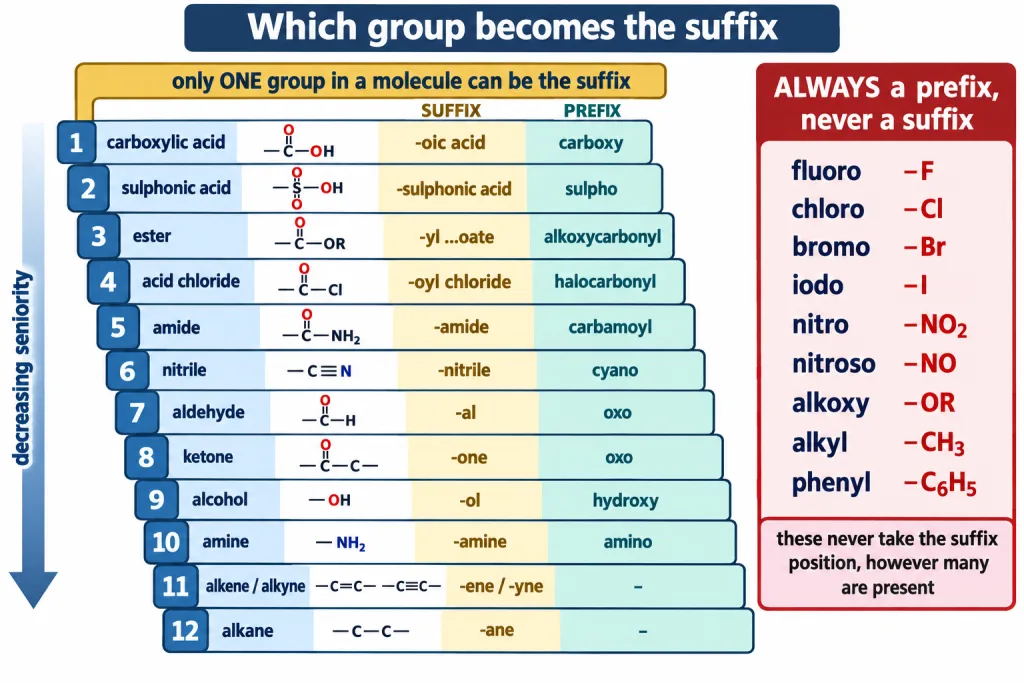
The seniority order is fixed. Learn it top to bottom in this exact sequence:
In words: carboxylic acid > sulphonic acid > ester > acid halide > amide > nitrile > aldehyde > ketone > alcohol > amine > alkene / alkyne > alkane. Acids first, then their derivatives, then the carbonyls, then the and pair, and multiple bonds last.
The groups that can never be a suffix
Some groups have no suffix form at all. However many of them a molecule carries, and however important they look, they are always cited as prefixes:
- halo — fluoro, chloro, bromo, iodo
- nitro () and nitroso ()
- alkoxy (), which is how every ether is named
- alkyl (methyl, ethyl, isopropyl and the rest)
- phenyl ()
A molecule carrying only a chlorine therefore has no suffix beyond the parent alkane ending: is chloroethane, still ending in -ane.
[JEE Main] A common one-mark trap is an option such as "propan-1-nitro" or "ethanochloride". Neither can exist.
Suffix and prefix forms, class by class
| Class | Group | Suffix | Prefix when not senior |
|---|---|---|---|
| carboxylic acid | -oic acid | carboxy | |
| ester | -yl …oate | alkoxycarbonyl | |
| acid chloride | -oyl chloride | halocarbonyl | |
| amide | -amide | carbamoyl | |
| nitrile | -nitrile | cyano | |
| aldehyde | -al | oxo (or formyl) | |
| ketone | -one | oxo | |
| alcohol | -ol | hydroxy | |
| amine | -amine | amino | |
| alkene | -ene | — | |
| alkyne | -yne | — | |
| ether | none | alkoxy | |
| haloalkane | none | halo | |
| nitro compound | none | nitro |
Two rows repay a second look. A ketone and an aldehyde fall back to the same prefix, oxo, because both are a doubly bonded oxygen on a chain carbon. And an alcohol becomes hydroxy, never "hydroxyl-".
Building the name — four mechanical steps
The rules you used for alkanes still apply. Three additions handle the functional group.
Step 1 — the parent chain must contain the principal group. This overrides "longest chain". If a longer chain exists that misses the group, you may not use it. In
the longest chain is five carbons and it does carry the , so the parent is pentane. But if a six-carbon chain avoided the while a four-carbon chain passed through it, the four-carbon chain would win. Length is only the tie-breaker among chains that already contain the group.
Step 2 — number for the lowest locant on the principal group. The priority ladder for numbering is:
The functional group takes the lowest number even if that forces high numbers on everything else. Only when it is equally placed from both ends do you move down to the multiple bond, and only after that to the prefixes.
Step 3 — write the locants in the modern position. The number sits immediately before the piece of the name it belongs to: pent-2-ene, pentan-2-ol, pentan-2-one, but-3-en-2-ol. Not "2-pentanol".
Step 4 — the terminal "-e" rule. This is the one that decides more marks than any other single convention.
Key Point: Drop the terminal -e of the parent hydride when the suffix that follows begins with a vowel. Keep it when the suffix begins with a consonant. A multiplying prefix (di, tri, tetra) placed before the suffix begins with a consonant, so it brings the -e back.
Work through the four cases:
| Parent | Suffix | Begins with | Result |
|---|---|---|---|
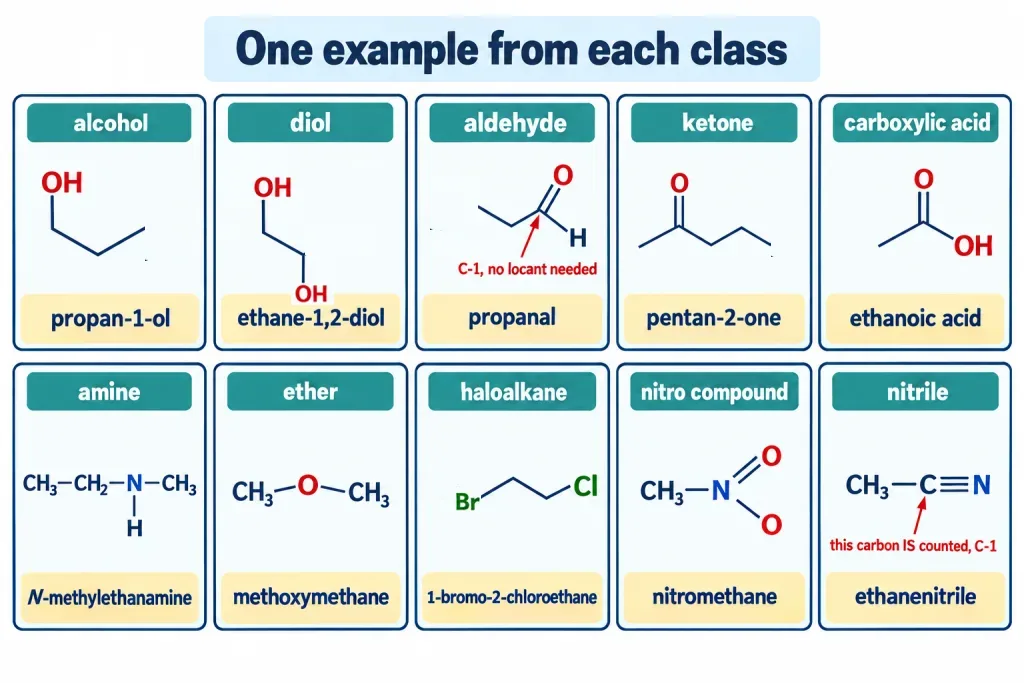
| propane | -ol | vowel o | propan-1-ol (not propane-1-ol) |
| propane | -amine | vowel a | propan-1-amine |
| propane | -nitrile | consonant n | propanenitrile |
| propane | -diol | consonant d | propane-1,2-diol |
The -e vanishes in propan-1-ol and returns in propane-1,2-diol, and it is the letter that starts the suffix, nothing else, that decides. The same rule gives propanal (drop, a is a vowel), propanone (drop, o), propanamide (drop, a), propanoic acid (drop, then -oic), butanedioic acid (keep, d) and butanedinitrile (keep, d).
When may a locant be left out? Only when the position is not in doubt. Methanol, ethanol, propanone and ethanal need no number because there is only one place the group can sit. As soon as a second position becomes possible the number is compulsory: propan-1-ol and propan-2-ol are different compounds, and so are pentan-2-one and pentan-3-one.
Alcohols — the suffix -ol
Replace the terminal -e of the alkane by -ol, and give the carbon bearing the the lowest possible number.
| Compound | Formula | IUPAC name | Common name |
|---|---|---|---|
| 1 carbon | methanol | methyl alcohol | |
| 2 carbons | ethanol | ethyl alcohol | |
| 3 carbons, end | propan-1-ol | n-propyl alcohol | |
| 3 carbons, middle | propan-2-ol | isopropyl alcohol | |
| 4 carbons, branched | 2-methylpropan-2-ol | tert-butyl alcohol |
Take carefully. The longest chain through the carbon is three carbons, propane, with the on C-2 and the third methyl hanging off C-2 as a substituent: 2-methylpropan-2-ol. Counting four carbons is the standard slip — the molecule does contain four, but they do not lie in one chain.
Two and three hydroxyl groups
When the same group appears more than once, use di, tri and so on, cite every locant, and remember that the multiplying prefix restores the -e.
| Formula | IUPAC name | Common name |
|---|---|---|
| ethane-1,2-diol | ethylene glycol | |
| propane-1,2-diol | propylene glycol | |
| propane-1,3-diol | trimethylene glycol | |
| propane-1,2,3-triol | glycerol | |
| butane-2,3-diol | — |
Both hydroxyls have to be numbered; "propanediol" alone does not say whether the second is on C-2 or C-3.
Alcohols with a double bond
The alcohol is senior to the alkene, so the claims the lower number and the double bond takes what is left.
- : numbering from the end puts oxygen on C-1 and the double bond between C-2 and C-3. Name: prop-2-en-1-ol.
- : the is one carbon from the methyl end, so number from there. on C-2, double bond from C-3. Name: but-3-en-2-ol.
Watch the ending: -ol starts with a vowel, so the -e of "ene" is dropped too — prop-2-en-1-ol, never "prop-2-ene-1-ol".
Aldehydes — the suffix -al
Replace the terminal -e of the alkane by -al. The carbon can only ever be at the end of a chain, because that carbon already carries a hydrogen and a doubly bonded oxygen and has just one bond left for carbon.
Key Point: In a chain aldehyde the carbon is always C-1, so no locant is written for the -al. Write butanal, never "butan-1-al".
| Formula | IUPAC name | Common name |
|---|---|---|
| methanal | formaldehyde | |
| ethanal | acetaldehyde | |
| propanal | propionaldehyde | |
| butanal | butyraldehyde | |
| 2-methylpropanal | isobutyraldehyde |
Formaldehyde, acetaldehyde and the rest of that column are common names only — worth knowing because reagent bottles use them, but never the answer when the question asks for the IUPAC name.
Since C-1 is fixed, every substituent number in an aldehyde is measured from the carbon:
- : C-1 is the CHO, C-2 bears the methyl, so 2-methylbutanal.
- : C-1 is the CHO, C-3 bears the , so 3-hydroxybutanal.
When the CHO sits on a ring: -carbaldehyde
A ring carbon cannot become C-1 of a chain, so the is treated as a group attached to the ring and the suffix -carbaldehyde is used. The carbon of the is not counted in the ring name.
| Formula | IUPAC name | Common name |
|---|---|---|
| cyclohexane ring with | cyclohexanecarbaldehyde | — |
| cyclopentane ring with | cyclopentanecarbaldehyde | — |
| benzenecarbaldehyde | benzaldehyde |
Two aldehyde groups on a chain use -dial, with the -e kept: is propanedial.
Ketones — the suffix -one
Replace the terminal -e by -one. Unlike the aldehyde carbon, a ketone carbonyl sits inside the chain, so its position genuinely varies and a locant is required wherever more than one position is possible.
| Formula | IUPAC name | Common name |
|---|---|---|
| propanone | acetone | |
| butan-2-one | ethyl methyl ketone | |
| pentan-2-one | methyl propyl ketone | |
| pentan-3-one | diethyl ketone | |
| cyclohexane ring with | cyclohexanone | — |
Propanone needs no number. A three-carbon ketone can only have its carbonyl on the middle carbon; putting it on C-1 would make an aldehyde instead. Pentan-2-one does need one, because pentan-3-one is a real and different compound.
For the chain through the carbonyl is five carbons. Numbering from the left puts the on C-2; from the right it would land on C-4. Lowest wins, so the methyl branch falls on C-4 and the name is 4-methylpentan-2-one.
Carboxylic acids — the suffix -oic acid
Drop the terminal -e and add -oic acid. Like the aldehyde, the carbon is necessarily terminal and is always C-1, so it carries no locant.
| Formula | IUPAC name | Common name |
|---|---|---|
| methanoic acid | formic acid | |
| ethanoic acid | acetic acid | |
| propanoic acid | propionic acid | |
| butanoic acid | butyric acid | |
| 2-methylpropanoic acid | isobutyric acid |
The carbon of is counted in the chain: ethanoic acid has two carbons, the methyl and the acid carbon.
Two acid groups: -dioic acid
Both carbons are counted, they occupy the two ends of the chain, and the -e is kept because d is a consonant.
| Formula | IUPAC name | Common name |
|---|---|---|
| ethanedioic acid | oxalic acid | |
| propanedioic acid | malonic acid | |
| butanedioic acid | succinic acid |
Oxalic acid is ethanedioic acid, not "methanedioic acid". Two groups joined directly to each other give a chain of two carbons.
Ring acids use -carboxylic acid, for the reason aldehydes use -carbaldehyde: is benzenecarboxylic acid, retained as benzoic acid.
Amines — the suffix -amine
Drop the terminal -e and add -amine. The parent chain is the longest carbon chain attached to the nitrogen.
Amines are classified by how many carbons the nitrogen carries: primary (one carbon on N), secondary (two), tertiary (three).
This counts carbons on the nitrogen, not on the carbon bearing the nitrogen — the opposite of how alcohols and haloalkanes are classified, and mixing the two up is a routine error.
| Formula | IUPAC name | Class |
|---|---|---|
| methanamine | primary | |
| ethanamine | primary | |
| propan-1-amine | primary | |
| propan-2-amine | primary | |
| butane-1,4-diamine | primary (two groups) |
Substituents on the nitrogen: the italic N
For a secondary or tertiary amine, pick the longest chain on nitrogen as the parent. Every other group on the nitrogen is cited as a prefix, and its "locant" is the italic letter N instead of a number, because it sits on nitrogen and not on a numbered carbon.
| Formula | IUPAC name | Class |
|---|---|---|
| N-methylmethanamine | secondary | |
| N-methylethanamine | secondary | |
| N-ethylethanamine | secondary | |
| N,N-dimethylmethanamine | tertiary | |
| N,N-dimethylethanamine | tertiary |
Take . Nitrogen carries a methyl and an ethyl; ethyl is longer, so the parent is ethanamine and the methyl is cited as N-methyl, giving N-methylethanamine. Reversing the choice and writing "N-ethylmethanamine" is wrong — the longer chain must be the parent.
Two identical groups on nitrogen need N repeated once for each: N,N-dimethyl, not "N-dimethyl".
is benzenamine, universally retained as aniline.
Ethers — always an alkoxy prefix
An ether has no suffix of its own. It is named as a hydrocarbon carrying an alkoxy group, exactly like a haloalkane is named as a hydrocarbon carrying a halogen.
Key Point: In , the larger alkyl group becomes the parent chain and the smaller one becomes the prefix: methoxy (), ethoxy (), propoxy ().
| Formula | IUPAC name | Common name |
|---|---|---|
| methoxymethane | dimethyl ether | |
| methoxyethane | ethyl methyl ether | |
| ethoxyethane | diethyl ether | |
| 1-methoxypropane | methyl n-propyl ether | |
| 2-methoxypropane | isopropyl methyl ether | |
| methoxybenzene | anisole |
The last pair is the one to fix in memory. Both and have the formula and both are "methoxypropane", separated only by the locant: 1-methoxypropane has the oxygen on an end carbon, 2-methoxypropane on the middle one. Methoxymethane and methoxyethane carry no locant because their parent chains offer only one position.
Haloalkanes — halo prefix, lowest locant, alphabetical order
Fluoro, chloro, bromo and iodo are prefixes on the alkane root. Nothing else changes: the ending is still -ane.
| Formula | IUPAC name | Common name |
|---|---|---|
| chloromethane | methyl chloride | |
| dichloromethane | methylene chloride | |
| trichloromethane | chloroform | |
| 2-chloropropane | isopropyl chloride | |
| 2-bromo-2-methylpropane | tert-butyl bromide |
Two different halogens are cited in alphabetical order, which runs bromo, chloro, fluoro, iodo — not the order of the group in the periodic table.
: the chain is ethane, and numbering either way gives the locant set , so the sets tie. The tie is broken by giving the lower number to the substituent cited first alphabetically, which is bromo. Name: 1-bromo-2-chloroethane.
: numbering from the end gives ; from the methyl end it gives . The sets do not tie, so first point of difference settles it before alphabetical order is consulted. Name: 2-bromo-1-chloropropane.
[JEE/NEET] Alphabetical order decides only the order of citation and, when locant sets tie, which substituent gets the lower number. It never overrides a genuinely lower locant set.
Nitro compounds — the nitro prefix
has no suffix form at all. It is always nitro-.
| Formula | IUPAC name |
|---|---|
| nitromethane | |
| nitroethane | |
| 1-nitropropane | |
| 2-nitropropane | |
| 2-methyl-1-nitropropane | |
| nitrobenzene |
In 2-methyl-1-nitropropane the chain is three carbons, the nitro sits on C-1 and the methyl on C-2, and m precedes n, so methyl is cited first.
Nitriles — the suffix -nitrile
The carbon of the group is counted as part of the chain, and it is C-1. That single fact produces most of the mistakes in this class.
Key Point: has two carbons in its chain, so it is ethanenitrile, not "methanenitrile". The nitrile carbon is C-1 and the methyl is C-2.
Because -nitrile begins with the consonant n, the terminal -e is kept: ethane + nitrile = ethanenitrile.
| Formula | IUPAC name | Common name |
|---|---|---|
| ethanenitrile | methyl cyanide, acetonitrile | |
| propanenitrile | ethyl cyanide | |
| butanenitrile | n-propyl cyanide | |
| 3-methylbutanenitrile | isobutyl cyanide | |
| butanedinitrile | succinonitrile |
Check 3-methylbutanenitrile atom by atom: C-1 is the nitrile carbon, C-2 is the , C-3 is the carrying the methyl branch, C-4 is the terminal . Four carbons in the chain, methyl on C-3.
On a ring the same problem arises as with , and the same solution is used: the suffix -carbonitrile, with the nitrile carbon outside the ring count. A cyclohexane ring bearing is cyclohexanecarbonitrile, and is benzenecarbonitrile, retained as benzonitrile. When a nitrile is not the senior group it becomes the prefix cyano.
Esters, acid chlorides and amides — in outline
These three are all derivatives of a carboxylic acid, and all three outrank the aldehyde and the ketone.
Esters, . The name comes in two words. The alkyl group attached to oxygen is named first as a separate word; the acid part loses "-ic acid" and takes -oate.
| Formula | IUPAC name | Common name |
|---|---|---|
| methyl methanoate | methyl formate | |
| methyl ethanoate | methyl acetate | |
| ethyl ethanoate | ethyl acetate | |
| methyl propanoate | methyl propionate |
In the ethyl sits on oxygen, so ethyl is the first word, and the two-carbon acid part gives ethanoate.
Acid chlorides, . Replace "-oic acid" of the parent acid by -oyl chloride.
| Formula | IUPAC name | Common name |
|---|---|---|
| ethanoyl chloride | acetyl chloride | |
| propanoyl chloride | propionyl chloride | |
| benzenecarbonyl chloride | benzoyl chloride |
Amides, . Replace the terminal -e by -amide; the a is a vowel so the -e goes.
| Formula | IUPAC name | Common name |
|---|---|---|
| methanamide | formamide | |
| ethanamide | acetamide | |
| propanamide | propionamide | |
| N-methylethanamide | N-methylacetamide |
Substituents on the amide nitrogen use the italic N as in amines.
Which group wins — a decision table
Every row below is a compound carrying two functional groups. Read across: the senior one becomes the suffix, the junior one becomes the prefix from the table in the first block.
| Compound | Groups present | Senior group | Junior becomes | IUPAC name |
|---|---|---|---|---|
| alcohol, aldehyde | aldehyde | hydroxy | 3-hydroxypropanal | |
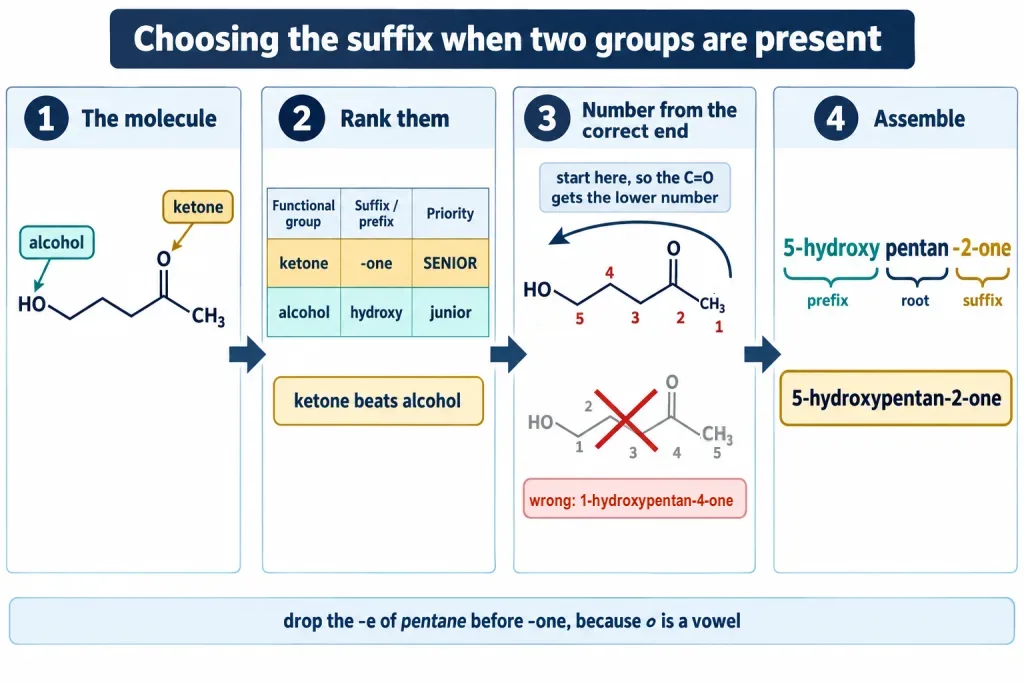
| alcohol, ketone | ketone | hydroxy | 5-hydroxypentan-2-one | |
| alcohol, acid | acid | hydroxy | 3-hydroxypropanoic acid | |
| ketone, acid | acid | oxo | 3-oxobutanoic acid | |
| aldehyde, acid | acid | oxo | 5-oxopentanoic acid | |
| amine, alcohol | alcohol | amino | 2-aminoethan-1-ol | |
| amine, aldehyde | aldehyde | amino | 3-aminopropanal | |
| nitrile, aldehyde | nitrile | oxo | 4-oxobutanenitrile | |
| ketone, amide | amide | oxo | 3-oxobutanamide | |
| alkene, alcohol | alcohol | (stays a suffix) | prop-2-en-1-ol | |
| halogen, alcohol | alcohol | chloro | 3-chloropropan-1-ol | |
| nitro, acid | acid | nitro | 3-nitropropanoic acid | |
| ether, aldehyde | aldehyde | methoxy | 3-methoxypropanal |
Three habits fall out of this table.
One. A halogen, a nitro group or an alkoxy group never enters the seniority contest at all. In 3-chloropropan-1-ol the alcohol is the only candidate for the suffix even though chlorine looks the more reactive group.
Two. An aldehyde or ketone demoted to a prefix becomes oxo, and the oxo carbon is still counted in the chain. In 5-oxopentanoic acid C-1 is the carbon and C-5 is the carbon.
Three. The senior group also decides the direction of numbering. In the ketone must get the lower number, so numbering starts from the methyl end: C-2 the carbonyl, C-5 the . Numbering from the alcohol end instead puts C-1 on the and the carbonyl on C-4, giving "1-hydroxypentan-4-one" — the right suffix on the wrong locants. Reverse the seniority as well and the result is "4-oxopentan-1-ol". Both are wrong.
A checklist to run on every name
- List every functional group present.
- Rank them; the senior one is the suffix, all others are prefixes.
- Choose the longest chain that contains the senior group.
- Number so the senior group gets the lowest locant; break remaining ties with the multiple bond, then first point of difference, then alphabetical order.
- Assemble: prefixes in alphabetical order, then root, then the multiple-bond suffix, then the functional-group suffix.
- Apply the -e rule, and use commas between numbers and hyphens between numbers and letters, with no spaces except in "…oic acid", "…oyl chloride" and the two-word ester name.
Worked problems
Question 1: A branched alcohol where the chain is shorter than the carbon count
Give the IUPAC name of .
Answer:
The molecule has five carbons in total, so my first instinct is "pentan-". I check whether five carbons actually lie in one chain. The central carbon carries two methyls, one and one ethyl. Any chain through it can pick up only one of the two methyls, so the longest chain is methyl + central carbon + + , which is four carbons. Root: but-.
The is on the second carbon of that chain from the methyl end, so it is C-2. The leftover methyl is also on C-2.
Ans: 2-methylbutan-2-ol
Watch out: Total carbon count is not chain length. Counting five here and writing "pentan-2-ol" is the commonest version of this error.
Question 2: An aldehyde with a branch
Give the IUPAC name of .
Answer:
The carbon has to be C-1, so I have no choice about direction. Counting from it: C-1 is the CHO, C-2 is the carrying the methyl, C-3 is the , C-4 is the terminal . Four carbons: root but-.
Suffix -al, no locant needed for it. Methyl prefix on C-2.
Ans: 2-methylbutanal
Watch out: Never write "butan-1-al". A chain aldehyde carries no locant on the -al.
Question 3: A secondary amine
Give the IUPAC name of .
Answer:
Nitrogen carries two carbon groups, a methyl and an ethyl, so this is a secondary amine.
The parent must be the longer chain on nitrogen: ethyl, giving ethanamine. The methyl is left over and sits on nitrogen, so it is cited as N-methyl.
Ans: N-methylethanamine
Watch out: "N-ethylmethanamine" uses the shorter chain as parent and is wrong. The N is a locant, not a substituent name, so it stays italic and is never replaced by a number.
Question 4: A branched ether
Give the IUPAC name of .
Answer:
An ether has no suffix. The larger group becomes the parent chain and the smaller becomes alkoxy.
The larger group is the three-carbon isopropyl, so the parent is propane. The smaller group is , methoxy.
The oxygen is attached to the middle carbon of the propane chain, C-2.
Ans: 2-methoxypropane
Watch out: "Methoxypropane" without a number does not distinguish this from 1-methoxypropane, . Both are .
Question 5: Two different halogens
Give the IUPAC name of .
Answer:
No functional group has a suffix here, so the ending is plain -ane. Three carbons: propane.
Numbering from the end: chloro on C-1, bromo on C-2, set . From the methyl end: bromo on C-2, chloro on C-3, set . First point of difference is 1 against 2, so wins.
Citation is alphabetical, so bromo before chloro.
Ans: 2-bromo-1-chloropropane
Watch out: Alphabetical order fixes the order of writing, not the numbering. Here chloro genuinely has the lower locant even though bromo is written first.
Question 6: A nitrile
Give the IUPAC name of .
Answer:
The nitrile carbon counts as part of the chain and is C-1. From it: C-2 is the , C-3 is the with the methyl, C-4 is a . Four chain carbons, root but-.
The suffix -nitrile starts with n, a consonant, so butane keeps its -e: butanenitrile. Methyl prefix on C-3.
Ans: 3-methylbutanenitrile
Watch out: Forgetting to count the nitrile carbon gives "2-methylpropanenitrile", which is a different compound altogether.
Question 7: An alcohol and a ketone together
Give the IUPAC name of .
Answer:
Two groups: an alcohol and a ketone. The ketone is senior, so -one is the suffix and the alcohol drops to the prefix hydroxy.
The chain has five carbons and contains both groups, so the root is pent-.
The ketone must get the lowest locant. Numbering from the methyl end puts the carbonyl on C-2; from the end it would be C-4. So I number from the methyl: C-1 methyl, C-2 carbonyl, C-3, C-4, C-5 the .
Pentane loses its -e before -one.
Ans: 5-hydroxypentan-2-one
Watch out: "2-oxopentan-5-ol" gets the seniority backwards: it keeps the correct numbering but names the ketone as a prefix and the alcohol as the suffix. The alcohol never beats the ketone.
Question 8: An aldehyde and an acid together
Give the IUPAC name of .
Answer:
Carboxylic acid is the most senior group of all, so it takes the suffix and the aldehyde becomes the prefix oxo.
The carbon is C-1. Counting on: C-2, C-3 and C-4 are the three groups and C-5 is the carbon. Five carbons, so pentanoic acid with an oxo on C-5.
Ans: 5-oxopentanoic acid
Watch out: The oxo carbon is inside the chain count. Writing "4-oxopentanoic acid" or "pentanedial" both lose the acid.
Question 9: Name to structure
Write the structure of 3-methylbutan-2-ol.
Answer:
"butan" tells me four carbons in a row. "-2-ol" puts an on C-2. "3-methyl" puts a on C-3.
So: C-1 is ; C-2 is with the ; C-3 is with the methyl branch; C-4 is .
I check valencies. C-2 has bonds to C-1, C-3, the and one H: four. C-3 has bonds to C-2, C-4, the methyl and one H: four. Good.
Ans:
Question 10: Name to structure with two prefixes
Write the structure of 2-chloro-3-methylbutanal.
Answer:
"butanal" means a four-carbon chain with the as C-1, and no locant is written for the -al because C-1 is forced.
"2-chloro" puts on C-2. "3-methyl" puts on C-3. C-4 is the last .
Valency check on C-2: bonds to C-1, C-3, and one H, four in all.
Ans:
Question 11: Name to structure with an N locant
Write the structure of N,N-dimethylethanamine.
Answer:
"ethanamine" means the parent chain on nitrogen is an ethyl group, .
"N,N-dimethyl" puts two methyl groups on the nitrogen, not on any carbon. That uses up the nitrogen's remaining two bonds, so no hydrogen is left on N.
Nitrogen now holds three carbons, so this is a tertiary amine, and nitrogen has exactly three bonds as it must.
Ans:
Watch out: Each group on nitrogen needs its own N. "N-dimethylethanamine" with a single N is wrong, and "2,2-dimethylethanamine" would put both methyls on carbon, which describes — a completely different amine.
Question 12: Find the error
A student writes propane-2-ol for . What is wrong, and what is the correct name?
Answer:
The chain and the locant are both right: three carbons with the on the middle one.
The mistake is the -e. The suffix -ol begins with the vowel o, so the terminal -e of propane must be dropped.
Ans: propan-2-ol
Question 13: Find the error
A student writes 2-hydroxybutan-4-al for . Find every mistake.
Answer:
There are two mistakes.
The first is the locant on the aldehyde. The carbon must be C-1, so it can never be numbered 4, and it never carries a locant at all.
The second follows from fixing the first. Once the carbon is C-1, I count on: C-2 is the , C-3 is the carrying the , C-4 is the . So the hydroxy is on C-3, not C-2.
Aldehyde beats alcohol in seniority, so -al stays the suffix and hydroxy stays the prefix; that part the student had right.
Ans: 3-hydroxybutanal
Question 14: Find the error
A student writes 1-hydroxy-4-chlorobutane for . Find every mistake.
Answer:
Three mistakes here.
First, an alcohol has a suffix, so must be expressed as -ol and not as the prefix hydroxy. Chlorine has no suffix form, so it is the only prefix.
Second, the citation order. Prefixes are always cited in alphabetical order, so chloro must be written before hydroxy. The locants themselves are the only part the student got right: the is the principal group, so it does take C-1, and the chlorine does fall on C-4.
Third, the ending. With -ol as the suffix, butane drops its terminal -e.
Ans: 4-chlorobutan-1-ol
Watch out: "Hydroxy" is only used when something senior to the alcohol is already claiming the suffix. A halogen is never senior to anything, because it has no suffix at all.