
What "pure" means in an organic laboratory
An organic compound never comes out of a reaction flask clean. Alongside the product sit unreacted starting material, solvent, side products, inorganic salts from the work-up and coloured tarry matter. Every physical constant and every analysis in the next two sections assumes the sample is pure, so purification is not a tidying-up step at the end — it is the step that makes all the later numbers mean anything.
Every method here works the same way: find a physical property in which the compound and the impurity differ, then exploit the difference. Sublimation uses the tendency to pass directly to vapour, crystallisation uses solubility, the distillations use boiling point or volatility in steam, differential extraction uses relative solubility in two immiscible liquids, and chromatography uses adsorption on a solid or partition between two liquids.
How purity is judged
A pure organic solid melts sharply: it stays solid right up to its melting point and then collapses to a liquid over half a degree to one degree. A pure liquid boils sharply — once boiling starts, the thermometer in the vapour holds steady until the flask is nearly dry.
An impurity spoils both. A soluble impurity lowers the melting point and broadens the range. Impure benzoic acid that should melt at might soften at and not be fully liquid until : the value dropped and the sharp point became a smear.
Key Point (Definition): A pure solid has a sharp melting point and a pure liquid a sharp boiling point. An impurity depresses the melting point and widens the melting range. Depression plus broadening together is the standard test for impurity.
The range is the more sensitive test, because it needs no knowledge of the true value. A sample melting over five degrees is impure whatever the numbers are.
Mixed melting point — a test of identity
Melting point depression also settles a different question, whether an unknown white solid really is the compound it is believed to be. Mix the unknown thoroughly with an authentic sample of the suspected compound and melt the mixture.
- Same compound: the mixture is still one pure substance and melts at the same temperature, just as sharply. No depression.
- Different compounds: each acts as an impurity in the other, so the mixture melts lower and over a wider range than either alone.
Key Point: In a mixed melting point test, no depression means the two samples are the same compound; a depressed, broadened melt means they are different. Two unrelated compounds can share a melting point by coincidence, so matching values alone prove nothing.
[Board] Urea and cinnamic acid both melt near , and a mixture of the two melts far below that — the standard reason why a matching melting point is not proof of identity.
A pure liquid gives the parallel test. Distil it and watch the thermometer: a constant reading throughout means pure, a climbing reading means a mixture.
Sublimation
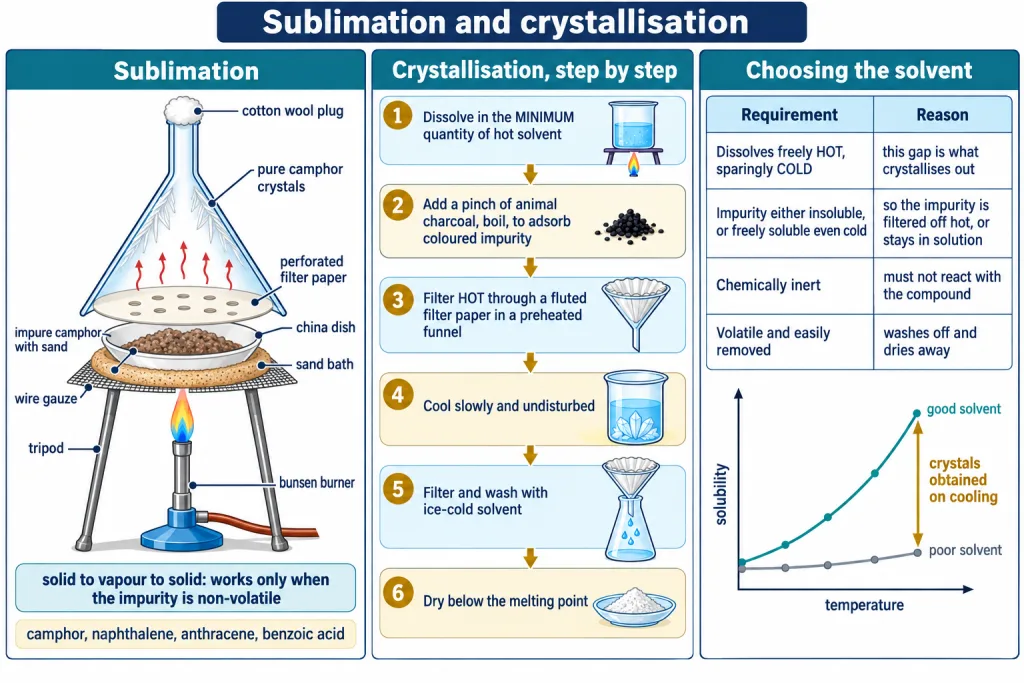
Some solids pass straight from solid to vapour on heating, and the vapour condenses straight back to solid on a cold surface. Such solids sublime.
Key Point (Definition): Sublimation is the direct conversion of a solid to vapour on heating and back to solid on cooling, without a liquid stage. It purifies a volatile solid that sublimes when the impurities present are non-volatile.
Procedure. Put the impure solid in a china dish, cover it with a perforated filter paper, and invert a glass funnel over it with its stem plugged loosely by cotton wool. Heat gently on a sand bath. The compound sublimes, the vapour rises through the perforations and deposits as pure crystals on the cool inner wall of the funnel, and the non-volatile impurity stays in the dish. The perforated paper lets vapour through but stops purified crystals falling back into the dirty residue.
Where it is used. Camphor, naphthalene, anthracene, benzoic acid, iodine and ammonium chloride all sublime readily; crude camphor contaminated with sand or sodium chloride is the standard case. The method fails the moment the impurity also sublimes — camphor and naphthalene cannot be separated this way, because both leave the dish together.
Crystallisation
Crystallisation is the workhorse method for an organic solid.
Key Point (Definition): Crystallisation separates a solid from its impurities using the difference in their solubility in a suitable solvent. The compound is dissolved in the minimum quantity of hot solvent; on cooling, the solution becomes supersaturated in the compound and it crystallises out, while the impurity stays behind in the mother liquor.
Choosing the solvent
The method stands or falls on the solvent, which must satisfy four conditions.
- It dissolves the compound freely when hot and only sparingly when cold. That steep temperature dependence forces the crystals out; a solvent dissolving it equally well at both temperatures gives no crystals at all.
- It handles the impurity in one of two opposite ways: either it does not dissolve the impurity, so the impurity is filtered off hot, or it dissolves the impurity freely even when cold, so the impurity stays in solution while the compound crystallises.
- It is chemically inert towards the compound.
- It is volatile and easily removed, and cheap and safe enough to use in quantity.
Water, ethanol, methanol, acetone, chloroform, benzene and diethyl ether are the usual choices. Benzoic acid is crystallised from hot water: very soluble near , almost insoluble cold.
The procedure
- Dissolve. Heat with solvent added in small portions until the solid just dissolves. Use the minimum quantity of hot solvent — every extra millilitre is product lost in the mother liquor.
- Decolourise, if needed. Boil a solution coloured by resinous matter for a few minutes with a pinch of animal charcoal, whose enormous surface area adsorbs the colour. A pinch only; excess charcoal adsorbs the product too.
- Filter hot through a fluted filter paper in a preheated funnel, removing the insoluble impurity and the charcoal. A cold funnel makes the compound crystallise in the paper.
- Cool slowly and undisturbed. Slow cooling gives large, well-formed, pure crystals; fast cooling gives fine crystals that trap mother liquor and impurity inside them.
- Filter and wash the crystals, preferably under suction, with a little ice-cold solvent.
- Dry between filter paper and in an oven or desiccator, well below the melting point.
If crystals refuse to appear, scratch the flask with a glass rod or add a seed crystal.
Fractional crystallisation
Key Point: In fractional crystallisation a hot saturated solution of two compounds of different solubility is cooled. The less soluble component saturates first and crystallises first. Its crystals are filtered off, the mother liquor is concentrated and cooled again, and the more soluble component comes out in the second crop. Repeating the cycle sharpens the separation.
Each crop is recrystallised on its own until its melting point is sharp and stops changing across successive crops. That constancy is how you know to stop.
Question 1: Reading a melting point range
A sample of benzoic acid melts from to . Pure benzoic acid melts at . What does that tell me, and what next?
Answer:
Two things went wrong at once. The value is low, and instead of a point I got a range. That pair is the signature of a soluble impurity.
Benzoic acid dissolves well in hot water and hardly at all in cold, so I recrystallise from the minimum quantity of boiling water, filter hot, cool slowly, and take the melting point again. A sharp means pure.
Ans: The sample is impure. Recrystallise from hot water and recheck the melting point.
Watch out: The broadening is the better clue. A single low value could be a bad thermometer; a six-degree range cannot.
Question 2: Choosing a solvent from solubility data
Solubility of a solid, in grams per :
| Solvent | at | at |
|---|---|---|
| P | 0.4 | 12.0 |
| Q | 9.5 | 11.0 |
| R | 0.2 | 0.5 |
Which solvent should I crystallise from?
Answer:
I want a big gap between the cold and the hot figure, because that gap is what crystallises out.
Q dissolves the compound almost as well cold as hot, so cooling gives almost nothing. R barely dissolves it even hot, so I would need litres and still recover little. P gives of crystals from every of saturated hot solution.
Ans: Solvent P, because solubility rises steeply with temperature and per crystallises on cooling.
Watch out: A very poor solvent like R looks attractive because so little stays dissolved cold, but you cannot get the compound into solution without an absurd volume.
Question 3: How much benzoic acid comes back
I crystallise of benzoic acid from water. Its solubility is per at and per at . Find the mass recovered.
Answer:
Minimum volume of hot water: .
On cooling to that volume still holds , so
Ans: About , a recovery of roughly .
Watch out: The left behind scales with solvent volume. Using would leave and drop the recovery to — the whole point of "minimum quantity of hot solvent".
Distillation
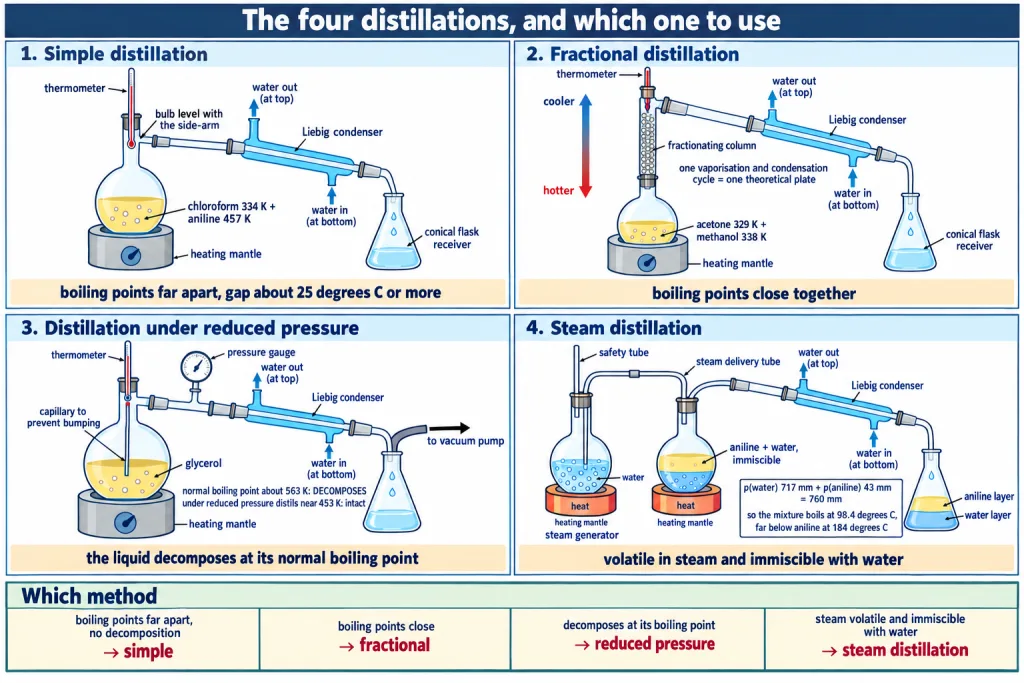
Distillation separates liquids by boiling point. The liquid is boiled, the vapour is led through a condenser, and the condensate — the distillate — is collected, the more volatile component going over first. The apparatus is a flask with a side-arm, a thermometer whose bulb sits level with the side-arm so it reads the vapour temperature and not the liquid temperature, a water condenser and a receiver.
Two facts decide which of the four methods to use: how far apart the boiling points are, and whether the compound survives being heated to its boiling point at all.
Key Point: The decision runs like this.
- Boiling points far apart, no decomposition on heating: simple distillation.
- Boiling points close together: fractional distillation.
- The liquid decomposes at its normal boiling point: distillation under reduced pressure.
- The substance is volatile in steam and immiscible with water, with a non-volatile impurity: steam distillation.
Simple distillation
Simple distillation works when the components boil well apart — a gap of about suffices — and neither decomposes at its boiling point. The vapour above the boiling mixture is then so rich in the more volatile component that one pass separates them.
The standard case is chloroform (, that is ) mixed with aniline (, that is ): chloroform distils at a steady while aniline stays in the flask, and when the thermometer starts climbing the chloroform is finished. This is also the routine way to strip a solvent off a high-boiling product, or a liquid off a dissolved salt.
Fractional distillation
When the boiling points are close, one vaporisation does not enrich the vapour enough, so the vaporisation and condensation are repeated many times over inside a single column.
A fractionating column sits between the flask and the condenser: a long tube packed with glass beads or fitted with bubble-cap plates, giving a large surface and a temperature that falls steadily from bottom to top. Vapour rising up it meets condensed liquid running back down, and at every contact the less volatile part of the vapour condenses while the more volatile part of the liquid is re-vaporised, so the vapour gets purer at each stage. The height of column achieving one complete vaporisation-and-condensation cycle is a theoretical plate; more plates means purer vapour at the top and closer boiling points the column can handle.
Key Point: Fractional distillation separates liquids whose boiling points are close together, by carrying out a large number of successive vaporisation and condensation cycles in a fractionating column. Each cycle enriches the vapour a little further in the more volatile component.
Acetone (, that is ) and methanol (, that is ) are only apart and need a column.
The industrial case is the fractional distillation of crude oil in the petroleum industry, where hundreds of hydrocarbons have boiling points running continuously from below room temperature to well above . Vaporised at the base of a tall trayed tower, refinery gas and petrol come off at the cool top, then naphtha, kerosene, diesel and lubricating oil lower down, with bitumen left at the bottom. Each stream is a fraction — a band of boiling points, not a single compound.
Distillation under reduced pressure
A liquid boils when its vapour pressure equals the external pressure, so lowering the external pressure lowers the boiling point. That is the escape route for a compound that would decompose before reaching its normal boiling point.
Key Point: Distillation under reduced pressure (vacuum distillation) is used for a liquid that decomposes at or below its normal boiling point. Reducing the pressure over the liquid lowers its boiling point enough for it to distil unchanged.
Glycerol is the standard example. Its normal boiling point is about () and it decomposes before it gets there; under a few millimetres of mercury it distils near () intact. This is how glycerol is recovered from spent-lye in the soap industry. The set-up is a closed assembly of thick-walled glassware on a vacuum pump, with a capillary or magnetic stirrer to stop bumping, since boiling chips do not work under vacuum.
Steam distillation
Steam distillation brings a high-boiling compound over below , by exploiting the fact that two immiscible liquids do not dilute each other's vapour pressure.
Conditions. The substance must be volatile in steam (an appreciable vapour pressure near ), immiscible with water and unaffected by boiling water, and accompanied by impurities non-volatile in steam.
Apparatus. Steam from a separate generator is bubbled through the impure liquid in a gently heated flask; the mixed vapour passes to a condenser and the distillate collects as two layers, separated afterwards in a separating funnel.
Why it distils below . Two immiscible liquids each exert their full vapour pressure, independent of the other, so the total pressure above the mixture is the sum:
Boiling begins when reaches atmospheric pressure. Since supplies part of it, need only supply the rest, and water alone reaches that lower value below its own boiling point. The mixture therefore boils below — below the boiling point of either liquid on its own.
Key Point: In steam distillation the mixture boils when . Because the two vapour pressures add, the mixture distils below and far below the compound's own boiling point.
Aniline is the standard example. On its own it boils at () and darkens by oxidation if held there; steam-distilled, it comes over at as a milky distillate that separates into an aniline layer and a water layer. Nitrobenzene, bromobenzene and essential oils such as eugenol from clove are obtained the same way.
Question 4: Simple or fractional
Which method separates each pair, and why?
(a) Chloroform, , and aniline, . (b) Acetone, , and methanol, .
Answer:
I work out the gap in each case.
(a) . The vapour above the boiling mixture is essentially pure chloroform, so one vaporisation does the whole job. Simple distillation, chloroform over first at .
(b) . A single vaporisation enriches the vapour only slightly in acetone, so I need a fractionating column to repeat that enrichment on the way up.
Ans: (a) simple distillation; (b) fractional distillation.
Watch out: The more volatile component distils first in both cases. What changes is not the order but the number of cycles needed.
Question 5: The temperature of a steam distillation
Aniline is steam distilled. At the vapour pressure of water is and that of aniline . Show that the mixture boils at this temperature, and find the mass percentage of aniline in the distillate. Take , .
Answer:
Aniline and water are immiscible, so neither dilutes the other and each exerts its full vapour pressure:
That equals atmospheric pressure, so the mixture boils at — below water's boiling point, and far below aniline's .
The vapour-phase mole ratio equals the ratio of partial pressures, so
Per gram of water there is of aniline, so the mass percentage of aniline is
Ans: It boils at because ; the distillate is about aniline by mass.
Watch out: Aniline is only of the vapour by moles but nearly a quarter by mass, because an aniline molecule is five times heavier than a water molecule. Quoting the mole fraction as the mass percentage is the standard slip.
Differential extraction
Distillation and crystallisation both work on a compound you can isolate as a solid or a liquid. Differential extraction handles the very common case where the compound is dissolved in water — the aqueous layer left after a reaction work-up.
Key Point (Definition): Differential extraction removes a dissolved organic compound from an aqueous solution by shaking it with an immiscible organic solvent in which the compound is far more soluble. The compound distributes itself between the two layers and is then recovered from the organic layer.
A solute shaken with two immiscible liquids distributes between them until the ratio of its concentrations reaches a constant value at a given temperature — the partition coefficient, :
A large means the solvent pulls the compound out of the water efficiently. Benzoic acid, phenol and most neutral organic compounds have well above one for ether or benzene against water, because an organic solute prefers an organic solvent to strongly hydrogen-bonded water.
The procedure
- Pour the aqueous solution into a separating funnel and add a portion of organic solvent — usually diethyl ether, benzene or chloroform.
- Stopper, invert and shake, releasing the pressure through the tap from time to time, so the liquids come into intimate contact and equilibrium is reached quickly.
- Clamp the funnel and let the layers settle sharply. Ether is less dense than water and sits on top, chloroform is denser and sits below, so identify the layers before running anything off. Run off the lower layer through the tap and pour the upper layer out of the top.
- Repeat on the aqueous layer with two or three fresh small portions and combine all the organic extracts.
- Dry the combined extract over an anhydrous drying agent — sodium sulphate, magnesium sulphate or calcium chloride — filter it off, then recover the compound by distilling off the volatile solvent.
Several small extractions beat one large one
For a fixed total volume of solvent, splitting it into several portions always removes more than using it all at once. Each extraction leaves behind a fixed fraction of whatever was in the water, and applying that fraction repeatedly compounds it downwards. If one extraction leaves a fraction , then extractions leave : two extractions each leaving one third behind leave , against the left by one portion of the same total volume.
For a compound too poorly soluble in the organic solvent for batch extraction, a continuous extraction apparatus boils the solvent, condenses it, passes it through the aqueous layer and returns it to the boiler over and over, so a small volume does the work of a very large one.
[JEE Main] Extraction questions come as the arithmetic of repeated extraction, so learn the fraction-remaining method rather than solving each stage from scratch.
Question 6: One big extraction against two small ones
of water contains of an organic compound whose partition coefficient between ether and water is . Compare extracting once with of ether against twice with each.
Answer:
One extraction with . Let grams pass into the ether:
so is left in the water.
Two extractions with each. For the first,
leaving . Every portion leaves one third behind, so after the second remains and has been extracted.
Ans: One extraction gives ; two half-sized ones give .
Watch out: The gain comes from applying the fraction twice — two portions leave , against the left by one portion.
Question 7: Four portions instead of two
With the same figures, what fraction remains after four extractions with of ether each?
Answer:
If a fraction stays in the water and goes into of ether,
Each small portion leaves half behind, so four portions leave , an extraction of — against with two portions and with one.
Ans: , that is , remains, so is extracted.
Watch out: Each single extraction is worse than a one, taking only half rather than four fifths. Repeating a weaker step still wins, because the fractions multiply.
Chromatography
Chromatography separates the components of a mixture even when they are chemically very similar, works on milligrams, and separates and identifies at the same time. The name comes from the Greek chroma, colour, because the first separations were of coloured plant pigments, but the method has nothing to do with colour and is used on colourless compounds every day.
The general idea
Every chromatographic method has a stationary phase held fixed in place — a solid, or a liquid supported on a solid — and a mobile phase, a liquid or gas moving steadily over or through it. The mixture is placed on the stationary phase and the mobile phase is allowed to flow. Each component is pulled forward by the mobile phase and held back by the stationary phase, and settles at its own compromise speed: strong interaction with the stationary phase means lagging behind, a preference for the mobile phase means running ahead. After a while the components occupy separate positions. That is differential movement, and it is the whole of chromatography.
Key Point (Definition):
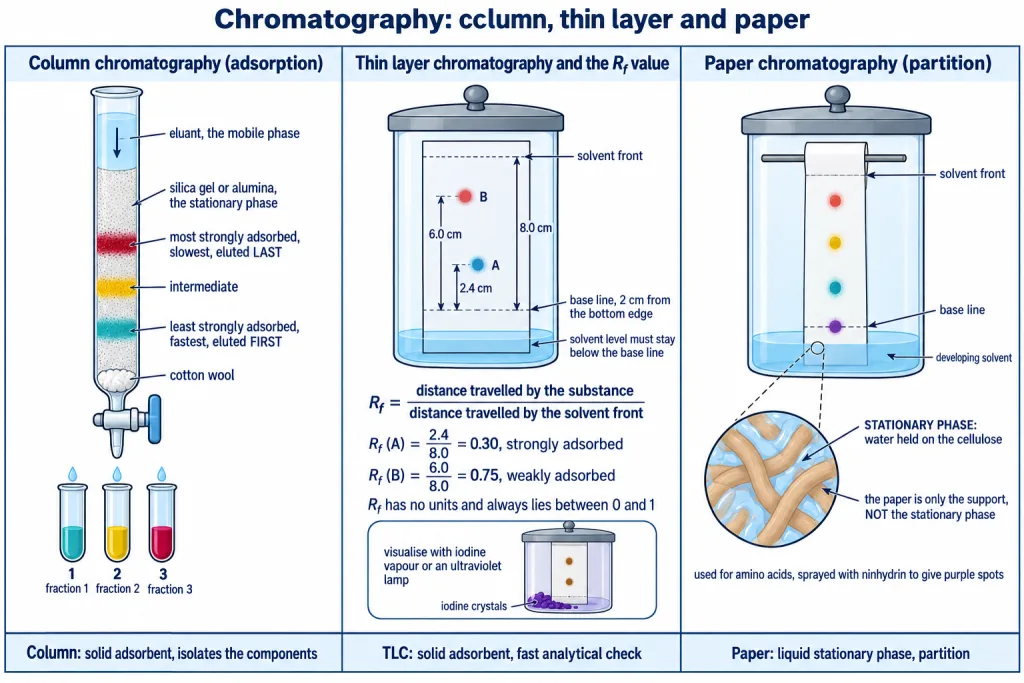
- Adsorption chromatography uses a solid stationary phase — usually silica gel or alumina — and separates components by how strongly each is adsorbed on that solid. Column chromatography and thin layer chromatography belong here.
- Partition chromatography uses a liquid stationary phase and separates components by how each partitions between two liquids. Paper chromatography belongs here.
Adsorption chromatography
The solid stationary phase is the adsorbent. Silica gel and alumina are the standard ones, and both are polar, so a polar component sticks harder and moves more slowly than a non-polar one. The mobile phase is a liquid solvent or solvent mixture, the eluant.
Column chromatography
The adsorbent is packed into a vertical glass column with a tap at the bottom.
Packing. Pour in a slurry of adsorbent in solvent so it settles as an even bed with no air bubbles and no cracks. A channel through the bed ruins the separation, because part of the mixture bypasses the adsorbent, and a column that runs dry cracks, so keep the bed covered with solvent.
Loading. Dissolve the mixture in the smallest possible volume of solvent and run it onto the top of the bed as a narrow, level band; a thick or uneven starting band gives overlapping products at the bottom.
Eluting. Pour eluant on top and let it flow down. The components separate into distinct bands, one below the other. Raising the polarity of the eluant as the run proceeds pushes the tightly held bands down as well — gradient elution.
Collecting. Collect the liquid leaving the tap in small numbered flasks, the fractions. Each band, as it reaches the bottom, appears in its own group of fractions; evaporate the solvent from each and the separated components are in hand.
Key Point: In column chromatography the least strongly adsorbed component moves fastest and is eluted first. The most strongly adsorbed component moves slowest and comes off last, or stays at the top until a more polar eluant is used.
Column chromatography is the standard method for separating plant pigments, dye mixtures and the products of a reaction that gives more than one compound, on any scale from milligrams to hundreds of grams.
Thin layer chromatography (TLC)
TLC applies the same adsorption principle on a flat plate, and takes minutes rather than hours.
The plate. A uniform layer of adsorbent about thick — usually silica gel with a little calcium sulphate as binder — is spread on a glass, plastic or aluminium sheet and dried. This is the chromaplate.
The spot. Draw a faint pencil base line about from the bottom edge and touch a fine capillary charged with a solution of the mixture to it, leaving a small, concentrated spot. A large spot spreads into a streak and the separation is lost.
Developing. Stand the plate in a closed jar holding a shallow depth of mobile phase, with the solvent level below the base line — if the solvent touches the spot, the mixture washes off into the tank instead of climbing the plate. The solvent rises through the layer by capillary action, carrying the components at different speeds. When it has climbed most of the way, take the plate out, immediately mark the solvent front in pencil, and dry the plate.
Visualising. Coloured components are already visible. Colourless ones show up on standing the dry plate in a closed jar with a few iodine crystals, whose vapour is adsorbed by most organic compounds to give brown spots; or under an ultraviolet lamp, where a plate made with a fluorescent indicator shows the spots as dark patches on a bright background; or on spraying a specific reagent such as ninhydrin for amino acids.
TLC is used constantly to monitor a reaction: run the starting material, the reaction mixture and the product side by side on one plate, and the disappearance of the starting material spot says the reaction is done. It is also the fast purity check — one spot means one component.
The value
Absolute distances on a plate depend on how long the plate stayed in the jar, so they cannot be quoted. The ratio can.
Key Point (Definition): The retardation factor or value is Both distances are measured from the base line, to the centre of the spot. is a ratio of two lengths, so it has no units, and since a substance cannot overtake the solvent carrying it, always lies between 0 and 1.
Reading the value:
- A low (near 0) means the component is strongly adsorbed and hardly moved. Polar compounds on silica behave this way.
- A high (near 1) means the component is weakly adsorbed, prefers the mobile phase and travelled nearly as far as the solvent front. Non-polar compounds on silica behave this way.
- Two components with the same under the same conditions may be the same compound; change the solvent and look again before concluding anything.
is reproducible only if the adsorbent, solvent, temperature and plate are the same, so an value is always quoted together with the system used to measure it.
Question 8: A single value
On a TLC plate a compound travels from the base line while the solvent front travels . Find .
Answer:
Both distances are measured from the base line, so they go straight into the ratio.
Ans: , dimensionless — the compound moved exactly half as far as the solvent.
Watch out: Measure from the pencil base line, not the bottom edge of the plate. With the base line up, measuring from the edge would give , which is wrong.
Question 9: Two components on one plate
A two-component mixture is run on silica gel. The solvent front reaches from the base line; spot A is centred up and spot B up. Find both values and say which is more strongly adsorbed.
Answer:
A moved less, so A spent more of its time held on the silica; B preferred the moving solvent.
Ans: , . A is more strongly adsorbed, and since silica gel is polar, A is the more polar component.
Watch out: A low means strongly adsorbed, not "less soluble". The spot that barely moves is gripped hardest by the stationary phase.
Question 10: Working backwards from
A compound has in a particular solvent system. On a plate developed until the solvent front reached , where should its spot appear?
Answer:
Rearranging the definition,
Ans: above the base line.
Watch out: A reported above 1 is impossible, since the substance is carried by the solvent and cannot overtake the front. Such a value means the two distances were measured from different starting lines, or the front was marked after the plate had dried out.
Partition chromatography
In partition chromatography the stationary phase is a liquid, and separation depends on how each component distributes between two liquids — the partition principle behind differential extraction, repeated continuously along a strip instead of once in a funnel.
Paper chromatography
Paper chromatography is the standard case, and it carries the trap examiners keep returning to.
Key Point: In paper chromatography the stationary phase is the water held on the surface of the cellulose fibres of the paper. The paper is only the support for that water — it is not itself the stationary phase. The mobile phase is the developing solvent rising through the paper.
Procedure. Draw a pencil base line near one end of a strip of chromatography paper, apply the mixture as a small spot on it and dry. Suspend the strip in a closed jar so the lower edge dips into the developing solvent while the base line stays clear of it. The solvent rises by capillary action, each component partitions repeatedly between the moving solvent and the stationary water, and each moves at its own rate. Take the strip out when the solvent is near the top, mark the solvent front, dry, and develop the spots with a reagent if they are colourless. The finished strip is a chromatogram, and values are calculated and read exactly as on a TLC plate.
Where it is used. Separating and identifying amino acids in a protein hydrolysate — sprayed with ninhydrin, each gives a purple spot at its own characteristic . Also sugars, the dyes in an ink, and ions in forensic work. It needs nothing but paper, solvent and a jar.
The techniques side by side
| Technique | Stationary phase | Mobile phase | Separates by | Typical use |
|---|---|---|---|---|
| Column chromatography | solid: silica gel or alumina in a column | liquid eluant flowing down | differing adsorption | separating and isolating components, milligrams to hundreds of grams |
| Thin layer chromatography | solid: thin layer of silica gel on a plate | liquid rising by capillary action | differing adsorption | purity checks, monitoring a reaction, identification |
| Paper chromatography | liquid: water held on the cellulose | liquid rising by capillary action | differing partition | identifying amino acids, sugars and dyes |
Column chromatography is the only one of the three that returns a usable quantity of each component. TLC and paper chromatography are analytical: they say what is there and how many things are there, on a scale far too small to isolate.
Choosing the method
Everything in this section reduces to one question: given a described impure sample, which technique applies. The reason column is what earns the mark.
| Impure sample | Method | Why |
|---|---|---|
| Crude camphor mixed with sand and sodium chloride | sublimation | camphor sublimes on gentle heating; sand and salt are non-volatile and stay in the dish |
| Benzoic acid coloured brown by resinous impurity | crystallisation from hot water with animal charcoal | very soluble hot, almost insoluble cold; the charcoal adsorbs the colour and is filtered off hot |
| Two solids soluble in one solvent to appreciably different extents | fractional crystallisation | the less soluble one saturates and crystallises first; the mother liquor gives the second crop |
| Chloroform, , mixed with aniline, | simple distillation | a gap makes the vapour essentially pure chloroform, so one vaporisation suffices |
| Acetone, , mixed with methanol, | fractional distillation | only apart, so many vaporisation and condensation cycles in a column are needed |
| Glycerol in spent-lye from the soap industry | distillation under reduced pressure | glycerol decomposes at its normal boiling point of about ; at a few millimetres of mercury it distils intact near |
| Aniline mixed with water and a non-volatile impurity | steam distillation | volatile in steam and immiscible with water, so the vapour pressures add to atmospheric and it distils at ; the impurity is not steam-volatile |
| Benzoic acid dissolved in water | differential extraction with ether | far more soluble in ether than in water; several small extractions, then dry and distil off the solvent |
| A few milligrams of leaf extract holding several similar pigments | column chromatography on silica gel or alumina | the pigments differ in strength of adsorption, so they separate into bands and elute in order, the least adsorbed first |
| A mixture of amino acids from a protein hydrolysate | paper chromatography | the amino acids partition differently between the solvent and the water held on the cellulose; ninhydrin gives a purple spot at each characteristic |
Three warnings cover most of the marks lost:
- Sublimation needs a non-volatile impurity. Camphor and naphthalene both sublime, so they cannot be separated from each other this way.
- Reduced pressure is for thermal instability, not close boiling points. Two liquids nine degrees apart still need a column.
- Steam distillation needs immiscibility as well as steam volatility. Ethanol is volatile but miscible, so it is out.
Question 11: Reading a TLC plate of a reaction
Three lanes are run on one plate: starting material alone, reaction mixture, product alone. The starting material lane shows one spot at ; the mixture lane shows spots at and ; the product lane shows one spot at . What is happening, and what next?
Answer:
The starting material is at and the product at . The middle lane still shows both, so some starting material is unreacted and the reaction is incomplete.
The product moved less far, so it is more strongly adsorbed on the silica and therefore the more polar of the two — consistent with a reaction that introduced a polar group.
Next, keep the reaction running and re-run the plate. Once the spot has gone from the mixture lane, work up and purify by column chromatography on silica gel, where the less polar impurity comes off first.
Ans: The reaction is incomplete, since the mixture lane still carries the starting material spot at . The product at is the more polar. Continue, re-run the plate, then purify on a silica column.
Watch out: In column chromatography the higher component elutes first, because weak adsorption is exactly what makes it fast on the plate and fast down the column. Assuming the product comes off first because it is the one you want is the common error.
Question 12: Which method, and one reason each
Name the method and give one reason.
(a) Aniline from the reduction of nitrobenzene, present in water with tarry residue. (b) A dilute aqueous solution of phenol. (c) A mixture of camphor and naphthalene.
Answer:
(a) Aniline is volatile in steam and immiscible with water, and the tar is not steam-volatile. Steam distillation, and it comes over at instead of , so it is not oxidised.
(b) The phenol is present as a dilute aqueous solution, so distilling it off would mean boiling away a large excess of water to recover a little phenol. Shake with ether in a separating funnel, since phenol is far more soluble in ether. Repeat with fresh small portions, dry the combined extract over anhydrous sodium sulphate, and distil off the ether.
(c) Sublimation is out, because both camphor and naphthalene sublime and would leave the dish together. They differ in solubility and in polarity, so fractional crystallisation from ethanol works, and column chromatography on silica gel works for a small sample.
Ans: (a) steam distillation; (b) differential extraction with ether; (c) fractional crystallisation, or column chromatography for a small sample.
Watch out: In (c), the condition for sublimation is a statement about the impurity, not only about the compound. Both components subliming kills the method.