
One molecule, many groups — but still only one suffix
Real molecules rarely carry one functional group. Lactic acid has an and a ; glucose has five groups and a . The IUPAC answer never changes: the name gets exactly one suffix, and everything else is pushed into the prefix.
Key Point (Definition): The principal characteristic group is the senior-most functional group present. It alone becomes the suffix and it alone controls the numbering; every other functional group is demoted to a prefix.
The seniority order
Read it left to right and stop at the first group your molecule contains. That group is the suffix.
Some groups never win, because they have no suffix form at all. Halo (fluoro, chloro, bromo, iodo), nitro, nitroso, alkoxy, alkyl and phenyl are always prefixes, whatever else is present.
The suffix and the prefix form of each class
| Class | Group | Suffix when senior | Prefix when demoted |
|---|---|---|---|
| carboxylic acid | -oic acid | carboxy | |
| ester | -yl …oate | alkoxycarbonyl | |
| acid chloride | -oyl chloride | halocarbonyl | |
| amide | -amide | carbamoyl | |
| nitrile | -nitrile | cyano | |
| aldehyde | -al | oxo (or formyl) | |
| ketone | -one | oxo | |
| alcohol | -ol | hydroxy | |
| amine | -amine | amino | |
| ether | none | alkoxy | |
| haloalkane | none | halo | |
| nitro | none | nitro |
One row loses more marks than the rest put together. A ketone demoted to a prefix becomes oxo. An aldehyde demoted to a prefix is also oxo when its carbon is counted in the parent chain, and formyl when it cannot be — which happens whenever the hangs off a ring.
The procedure, in the order you must apply it
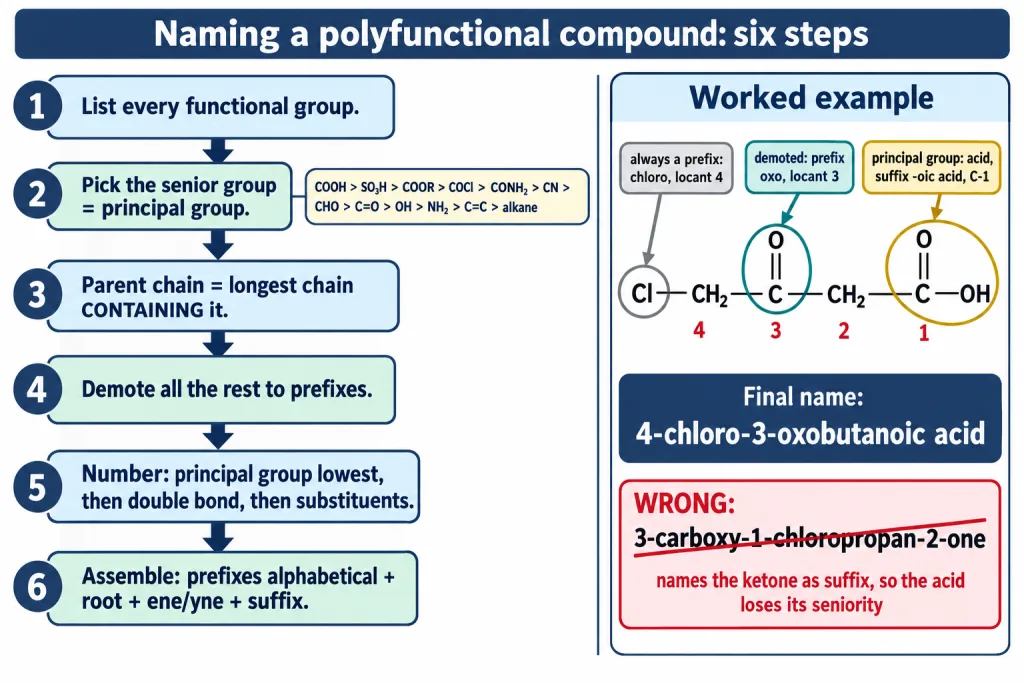
Step 1 — inventory. Write down every functional group. Do not skip the double bonds.
Step 2 — pick the principal group. Run down the seniority list; the first hit wins.
Step 3 — choose the parent chain. The longest chain that contains the principal group. A longer chain that misses it is not a candidate at all; if two equal-length chains both contain it, take the one with more substituents.
Step 4 — demote. Every remaining functional group, alkyl branch and halogen becomes a prefix.
Step 5 — number. From the end giving the principal group the lowest locant. Only if that leaves a choice does the multiple bond decide, and only if that ties too do the substituents decide, by first point of difference.
Step 6 — assemble. Prefixes alphabetically (di, tri, tetra ignored when alphabetising), then the root, the unsaturation ending, and the suffix with its locant.
Key Point: The priority for numbering is principal group first, then multiple bond, then substituents. Numbering for the substituent because it "looks lower" loses the mark every time.
Nothing in that procedure lets a demoted group fight back. Once a carboxylic acid wins seniority over a ketone, the ketone is oxo for good, and no amount of convenient numbering restores it. [JEE Main]
Question 1: An acid and a ketone in the same chain
Name .
Answer:
One ketone, one carboxylic acid. The acid is higher in the seniority list, so it is the principal group and the suffix is -oic acid.
The parent chain must contain the carbon. From the acid carbon straight through to the terminal methyl gives five carbons, and there is no longer chain, so the root is pent-. The ketone is demoted to oxo.
Numbering is forced, because a carboxyl carbon is always C-1. C-2 and C-3 are the two groups, C-4 is the carbonyl, C-5 the methyl. The oxo locant is 4.
Ans: 4-oxopentanoic acid
Watch out: "4-carboxypentan-2-one" treats the ketone as the suffix and the acid as a prefix, reversing the seniority order.
Question 2: An alcohol and an aldehyde
Name .
Answer:
Aldehyde beats alcohol, so the suffix is -al and the alcohol drops to the prefix hydroxy. The chain must include the carbon, which gives four carbons: butanal.
An aldehyde carbon can only sit at the end of a chain, so it takes C-1 automatically. C-2 and C-3 are and C-4 carries the .
Ans: 4-hydroxybutanal
Watch out: Do not write "1-hydroxybutan-4-al". Numbering is set by the principal group, and here that is the aldehyde.
Question 3: An amine and an acid
Name .
Answer:
The acid sits at the top of the whole list, so it wins outright over the amine. Suffix -oic acid, and the becomes the prefix amino.
Four carbons in the chain containing the acid, so butanoic acid. C-1 is the acid carbon, and the nitrogen is on C-4.
Ans: 4-aminobutanoic acid
Watch out: Amines take the suffix -amine only when nothing senior is present, so "4-carboxybutan-1-amine" fails on the suffix.
Question 4: An alcohol and a ketone
Name .
Answer:
The ketone is senior, so the suffix is -one and the becomes hydroxy. Four carbons in the chain, so a butanone.
Numbering from the methyl end: C-1 methyl, C-2 carbonyl, C-3 the , C-4 the carbon bearing the . Numbering from the other end would put the carbonyl at C-3. The principal group takes the lower number, so the carbonyl is 2 and the hydroxyl is 4.
Ans: 4-hydroxybutan-2-one
Watch out: "1-hydroxybutan-3-one" keeps the right suffix but numbers from the alcohol end. A demoted group has no say in the numbering, even when its own locant would drop.
Question 5: Acid, ketone and a halogen together
Name .
Answer:
Chlorine is a permanent prefix, so it is out of the running immediately. Between the ketone and the acid, the acid is senior, so the suffix is -oic acid.
The chain containing has four carbons: butanoic acid. C-1 is the acid carbon, C-2 is , C-3 is the carbonyl, C-4 carries the chlorine.
Prefixes: chloro on C-4, oxo on C-3, cited alphabetically with chloro first.
Ans: 4-chloro-3-oxobutanoic acid
Watch out: Alphabetical order decides the order of citation only. It never changes which locant a group has.
Question 6: When the longest chain is the wrong chain
Name .
Answer:
The longest continuous chain runs from the end of the butyl group, through the central carbon, and out along the ethyl group: four plus one plus two, seven carbons. But that chain does not contain the carboxyl carbon, and step 3 disqualifies it.
The chains that do contain are acid carbon central carbon butyl, six carbons, and acid carbon central carbon ethyl, four. The longer wins: hexanoic acid.
C-1 is the acid carbon, C-2 the central carbon, C-3 to C-6 the butyl carbons, and the ethyl hangs off C-2.
Ans: 2-ethylhexanoic acid
Watch out: The rule is never just "longest chain". It is "longest chain that contains the principal group", and dropping those five words is the commonest source of a wrong root.
A double bond plus a functional group — two endings in one name
An alkene or alkyne sits just above "alkane", so it almost never becomes the suffix — and it does not vanish either. Unsaturation is carried as an infix: -ene or -yne sits between the root and the principal suffix, each with its own locant.
So in the alcohol is senior, C-1 is the carbon bearing the oxygen and the double bond starts at C-3: but-3-en-1-ol. Numbered from the other end you get "but-1-en-4-ol" — the alkene looks better placed, but the hydroxyl has slipped to 4, and the principal group outranks it. That name is wrong.
The elision rules
The parent hydride name ends in -e: butane, pentane, hexane. Whether that -e survives depends on the letter after it.
- Drop it before a suffix beginning with a vowel. butane -ol butan-1-ol; hexane -one hexan-2-one; pentane -al pentanal.
- Keep it before a suffix beginning with a consonant. butane -nitrile butanenitrile; propane -diol propane-1,2-diol, because the multiplying prefix di starts with a consonant.
- -ene and -yne behave the same way. butene -ol gives but-3-en-1-ol; butene -diol gives but-3-ene-1,2-diol.
- Before a multiplying prefix the root takes its full -a form. buta-1,3-diene, hexa-2,4-dien-1-ol. Never "but-1,3-diene".
Worked endings
| Structure | Name | Why |
|---|---|---|
| prop-2-en-1-ol | takes C-1, alkene starts at C-2 | |
| but-3-en-1-ol | at 1 beats a lower alkene locant | |
| hex-4-en-2-one | ketone gets 2, so the alkene is 4 | |
| pent-4-enoic acid | carbon is C-1 by definition | |
| 4-oxopent-2-enoic acid | acid senior, ketone demoted to oxo | |
| 3-methylbut-2-en-1-ol | methyl on the alkene carbon C-3 | |
| but-3-yn-1-ol | alkyne uses -yn- in exactly the same slot | |
| hexa-2,4-dien-1-ol | two alkenes, so the root is hexa- |
Key Point: In hex-4-en-2-one the two numbers are not interchangeable. The one immediately before -en- is the double bond; the one immediately before -one is the carbonyl. Swapping them describes a different molecule.
With both an alkene and an alkyne present and neither senior, give the lower locant set to the pair together; if they tie, the double bond takes the lower number, as in hept-1-en-6-yne. [JEE/NEET]
Question 7: Alkene plus ketone
Name .
Answer:
The ketone is senior, so the suffix is -one and the alkene rides along as -en-. Six carbons, so the root is hex-.
Taking the next to the as C-1, the carbonyl is C-2, the is C-3, and the double bond runs C-4 to C-5, with C-6 the last methyl. From the other end the carbonyl would be C-5. Since the ketone is the principal group, 2 beats 5. The alkene locant is the first of its two carbons, so 4.
Ans: hex-4-en-2-one
Watch out: "hex-2-en-5-one" comes from numbering to favour the double bond, which never outranks the principal group.
Question 8: Find the error
A student names as but-1-en-4-ol. What is wrong, and what is the correct name?
Answer:
The suffix is -ol, so the alcohol is the principal group and the numbering must make the locant as small as possible.
The student numbered from the alkene end: ene 1, ol 4. Numbering from the end gives ol 1, ene 3. The principal group is at 4 in the first and 1 in the second, and step 5 settles it before the double bond is even considered.
Ans: but-3-en-1-ol
Watch out: The correct numbering also happens to give the lower locant set, but that is a coincidence. Even if the alkene numbering had given a lower set, the alcohol would still take priority.
Question 9: Acid, ketone and a double bond
Name .
Answer:
The acid is senior, so suffix -oic acid, the ketone becomes oxo and the double bond an -en- infix. All five carbons are in the chain, so pent-.
C-1 is the acid carbon; the double bond joins C-2 and C-3, so its locant is 2; the carbonyl is C-4, so oxo takes 4; C-5 is the methyl. The -e of ene is dropped before the vowel of -oic.
Ans: 4-oxopent-2-enoic acid
Question 10: Reverse — from the name to the structure
Draw hexa-2,4-dien-1-ol.
Answer:
I read the name backwards. The suffix -ol at locant 1 puts an on C-1; hexa- gives six carbons; 2,4-dien gives double bonds starting at C-2 and C-4, and the -a- is there only because di follows.
Valency check: C-1 has two H, one OH and one C. C-2 to C-5 each have one H, one double bond and one single bond. C-6 has three H and one C. Four bonds everywhere.
Ans:
Watch out: The name does not say hex-2,4-dien-1-ol. When a multiplying prefix follows the root, the root keeps its full -a form.
Benzene as the parent
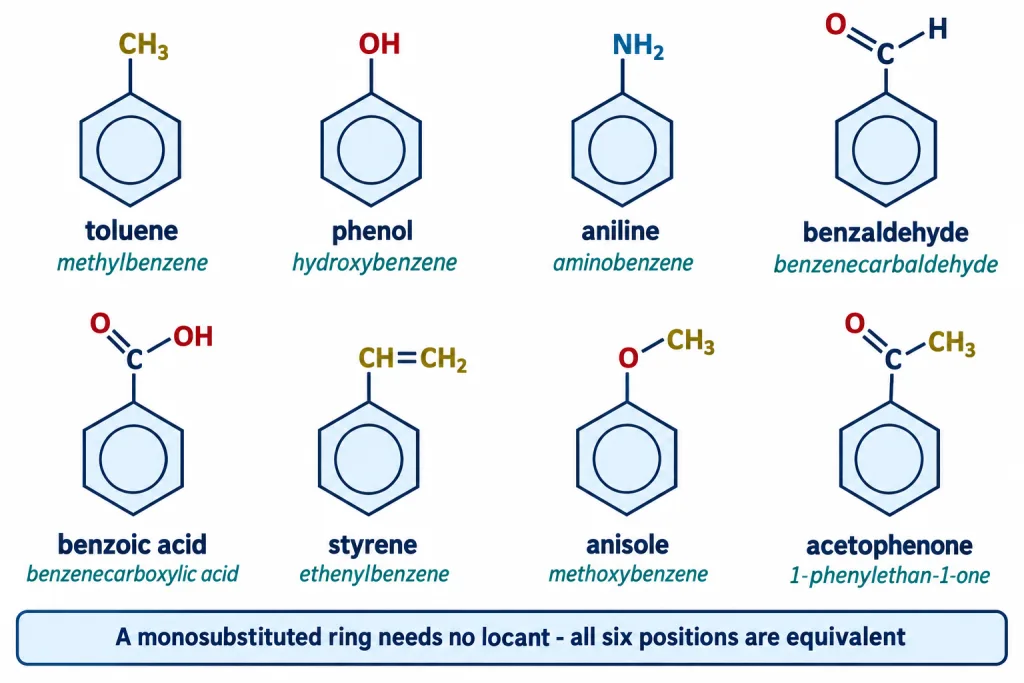
Benzene is : a flat ring with all six carbons equivalent, all six bonds equal at 139 pm and every ring angle 120 degrees. Because the positions are identical, a monosubstituted benzene needs no locant at all — you write the substituent prefix, then the word benzene.
Some rings cannot be named that way, because their functional group carbon sits outside the ring. A , or on a ring gives benzenecarbaldehyde, benzenecarboxylic acid and benzenecarbonitrile — names nobody writes, because IUPAC has retained the older ones.
The retained trivial names
These are not slang. IUPAC formally retains them, and you must recognise both forms.
| Retained name | Structure | Systematic name |
|---|---|---|
| toluene | methylbenzene | |
| phenol | hydroxybenzene (benzenol) | |
| aniline | aminobenzene (benzenamine) | |
| benzaldehyde | benzenecarbaldehyde | |
| benzoic acid | benzenecarboxylic acid | |
| styrene | ethenylbenzene (vinylbenzene) | |
| anisole | methoxybenzene | |
| acetophenone | 1-phenylethan-1-one | |
| benzonitrile | benzenecarbonitrile | |
| cumene | (1-methylethyl)benzene |
Which name to use, and when
Use the retained name as a parent for toluene, phenol, aniline, benzaldehyde and benzoic acid. These five behave like ordinary parent hydrides: number the ring, hang prefixes on it, and the defining group stays locked at C-1. So 2-nitrotoluene, 4-chlorophenol, 3-bromoaniline and 2-hydroxybenzoic acid are all acceptable.
Anisole, styrene and acetophenone are safer left alone. They are retained for the parent compound, but a substituted derivative is best written systematically: 1-methoxy-2-nitrobenzene can never be marked wrong.
Key Point: Phenol is not an alcohol. Its is bonded straight to an ring carbon, which changes its acidity and its whole chemistry; an alcohol has on an carbon. is a phenol, an alcohol. [NEET]
Two substituents on the ring — ortho, meta and para
Once two groups sit on a ring, their relative positions matter, and there are exactly three.
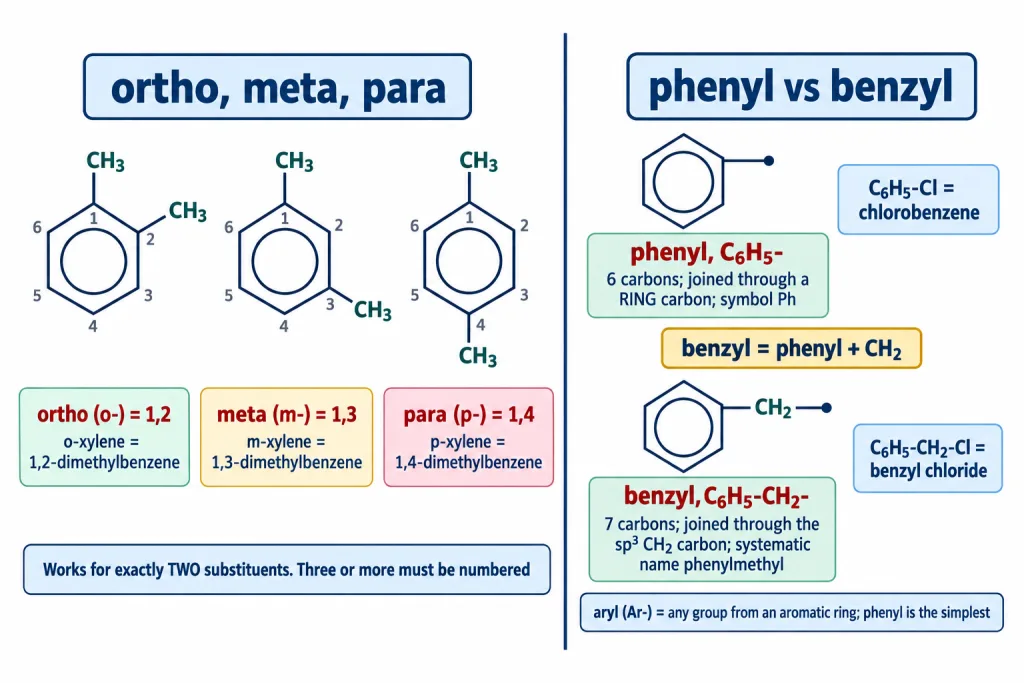
Key Point (Definition): Two substituents on adjacent ring carbons are ortho (1,2). Separated by one carbon they are meta (1,3). Directly opposite, across the ring, they are para (1,4).
The prefixes are written o-, m- and p-, italic and hyphenated. Any other pairing reduces to one of these three — 1,5 is 1,3 counted the other way, 1,6 is 1,2 — which is why there are three disubstituted isomers, never six.
How to number a disubstituted ring
- Two identical groups. Either can be C-1; pick the direction that makes the second locant smaller.
- Two different groups, one suffixable. The principal group takes C-1. In 4-nitrophenol the is C-1, because the hydroxyl is suffixable while nitro is a permanent prefix, so no seniority comparison arises.
- Neither suffixable. Number for the lowest locant set; if that ties, the lower locant goes to the substituent cited first alphabetically.
The standard sets
The three xylenes, — both groups are methyl, so either takes C-1.
| Common name | IUPAC name |
|---|---|
| -xylene | 1,2-dimethylbenzene |
| -xylene | 1,3-dimethylbenzene |
| -xylene | 1,4-dimethylbenzene |
The three nitrophenols — the takes C-1, since nitro is always a prefix.
| Common name | IUPAC name | Fully systematic |
|---|---|---|
| -nitrophenol | 2-nitrophenol | 1-hydroxy-2-nitrobenzene |
| -nitrophenol | 3-nitrophenol | 1-hydroxy-3-nitrobenzene |
| -nitrophenol | 4-nitrophenol | 1-hydroxy-4-nitrobenzene |
The three dibromobenzenes — : 1,2-dibromobenzene (), 1,3-dibromobenzene (), 1,4-dibromobenzene ().
The three toluidines — the aminotoluenes. Methyl is an alkyl group and always a prefix, so the amine wins and takes C-1, which makes aniline the parent.
| Common name | IUPAC name |
|---|---|
| -toluidine | 2-methylaniline |
| -toluidine | 3-methylaniline |
| -toluidine | 4-methylaniline |
The parent switches under you: the trivial name is built on toluene, the systematic name on aniline, because outranks .
The three benzenediols — the common names are still in daily use.
| Common name | IUPAC name | Relationship |
|---|---|---|
| catechol (pyrocatechol) | benzene-1,2-diol | ortho |
| resorcinol | benzene-1,3-diol | meta |
| quinol (hydroquinone) | benzene-1,4-diol | para |
Three more to memorise: the cresols are the methylphenols, so -cresol is 2-methylphenol; salicylic acid is 2-hydroxybenzoic acid; anthranilic acid is 2-aminobenzoic acid. In the last two the takes C-1, because it outranks and .
Key Point: The -, -, - system works for exactly two substituents. With three or more it cannot describe the arrangement, and numbering becomes compulsory.
Question 11: Phenol with two prefixes
A benzene ring carries , and a on a carbon next to it, and a on the carbon opposite the . Name it.
Answer:
Methyl and nitro are permanent prefixes, so the is the principal group, the parent is phenol, and the is locked at C-1.
The methyl is adjacent to it, so C-2 or C-6; the nitro is opposite it, so C-4 either way. One direction gives {2,4}, the other {4,6}, and the first point of difference, 2 against 4, settles on {2,4}. Hydroxy is already in the parent name, so I alphabetise only methyl and nitro.
Ans: 2-methyl-4-nitrophenol
Question 12: Which group becomes the parent
A benzene ring carries an and a on adjacent carbons. Name it.
Answer:
Carboxylic acid sits above alcohol, so the acid is the principal group and the parent is benzoic acid, with the attached at C-1. The is adjacent, so it is C-2, demoted to the prefix hydroxy.
Ans: 2-hydroxybenzoic acid (this is salicylic acid)
Watch out: "2-carboxyphenol" makes phenol the parent and demotes the acid. The senior group is never the prefix.
Question 13: An alphabetical tie-break
A benzene ring carries a bromine and a chlorine on adjacent carbons. Name it.
Answer:
Neither halogen has a suffix form, so benzene itself is the parent. The two positions are adjacent, so whichever I choose as C-1, the other is C-2: the set is {1,2} both ways, a genuine tie.
The tie-break then applies — the lower locant goes to the substituent cited first alphabetically. Bromo comes before chloro, so bromine takes C-1.
Ans: 1-bromo-2-chlorobenzene (also written -bromochlorobenzene)
Watch out: "1-chloro-2-bromobenzene" has the same locant set but breaks the tie the wrong way, and cites the prefixes out of order too.
Three or more substituents — numbering becomes compulsory
With three groups the // system collapses: a 1,2,4-pattern has an ortho pair and a para pair, so no single prefix describes it. From three substituents onwards you must number, and the decisions come in a fixed order.
- A suffixable principal group gets locant 1. No exceptions, and no comparison of locant sets first.
- A retained parent name locks its defining group at C-1. Toluene fixes methyl at 1, phenol hydroxy at 1, aniline amino at 1, benzoic acid the carboxyl at 1.
- With no principal group and no retained parent, number for the lowest locant set by first point of difference.
- If the sets still tie, the lower locant goes to the prefix cited first alphabetically.
- Cite all prefixes alphabetically, whatever their numbers.
Picric acid
Picric acid is a ring with one and three groups, the nitro groups ortho, para and ortho to the hydroxyl. Nitro is a permanent prefix, so the is the principal group and the parent is phenol with hydroxy at C-1. The nitro groups fall at C-2, C-4 and C-6, and the ring is symmetrical about the axis, so {2,4,6} comes out the same either way.
Picric acid 2,4,6-trinitrophenol, systematically 1-hydroxy-2,4,6-trinitrobenzene. The set {1,2,4,6} is not the lowest available one. It does not matter: the principal-group rule outranks the lowest-locant rule.
TNT — where the choice of parent changes the numbers
TNT is the same ring with in place of . Here nothing is suffixable — methyl and nitro are both permanent prefixes — so there are two legitimate routes.
Route 1 — toluene as the retained parent. The name toluene locks the methyl at C-1, so the nitro groups are 2, 4 and 6: 2,4,6-trinitrotoluene, which is where the abbreviation comes from.
Route 2 — benzene as the parent. Nothing is locked, so I hunt for the lowest locant set. Label the ring A to F, with methyl at A and nitro at B, D and F. Starting at A towards B gives {1,2,4,6}; starting at B towards A makes that nitro 1, the methyl 2, the nitro at F 3 and the nitro at D 5, giving {1,2,3,5}.
First point of difference: 1 = 1, 2 = 2, then 3 against 4, so {1,2,3,5} is lower. The methyl is C-2 and the nitro groups are 1, 3 and 5, cited alphabetically with methyl first:
TNT 2-methyl-1,3,5-trinitrobenzene, and equally correctly 2,4,6-trinitrotoluene.
Key Point: Two numberings of TNT are both right because the parent differs. Say "toluene" and the methyl is C-1, so you give up the freedom to hunt for lower locants; say "benzene" and the lowest-locant rule takes over. Never mix them: "2,4,6-trinitrobenzene" and "1,3,5-trinitrotoluene" are both meaningless. [JEE Main]
Mesitylene, and a ring with a suffix group
Mesitylene has three methyl groups, each meta to the other two. Whichever I call C-1, the others are C-3 and C-5, so there is nothing to choose: 1,3,5-trimethylbenzene.
Now a benzoic acid with a nitro ortho to the and a chlorine para to it. Carboxyl is senior, so it is C-1; the nitro is C-2 or C-6 and the chlorine C-4 either way, so {2,4} beats {4,6}. Cited alphabetically: 4-chloro-2-nitrobenzoic acid.
One more trap: a ring with and para to each other. The acid outranks the aldehyde, so the parent is benzoic acid, and because the aldehyde carbon is outside the ring the prefix is formyl, not oxo: 4-formylbenzoic acid.
Phenyl, benzyl and aryl
Three group names are constantly confused, and the confusion changes the formula.
Key Point (Definition): Phenyl, , is benzene minus one hydrogen. It attaches through a ring carbon and has six carbons. Symbol Ph.
Benzyl, , is toluene minus one hydrogen from the methyl group. It attaches through the carbon and has seven carbons. Systematic name phenylmethyl.
Aryl, written Ar, is the general term for any group left when an aromatic ring loses a hydrogen. Phenyl is the simplest; tolyl and naphthyl are others. Aryl is a category, not a specific group.
In one line: phenyl is the ring, benzyl is the ring plus a .
| Formula | Correct name | The wrong name people write |
|---|---|---|
| chlorobenzene (phenyl chloride) | benzyl chloride | |
| benzyl chloride, (chloromethyl)benzene | chlorobenzene | |
| phenol | benzyl alcohol | |
| benzyl alcohol, phenylmethanol | phenol | |
| aniline (phenylamine) | benzylamine | |
| benzylamine | aniline |
Phenol is acidic enough to dissolve in sodium hydroxide; benzyl alcohol is an ordinary primary alcohol.
When benzene is the substituent, not the parent
One rule decides whether the ring is parent or substituent: the parent must contain the principal characteristic group.
- Group on the ring: the ring is the parent, so is phenol.
- Group on a side chain: the chain is the parent and the ring is cited as phenyl, so is phenylmethanol.
| Structure | Name | Reasoning |
|---|---|---|
| 2-phenylethan-1-ol | two-carbon chain, on C-1, phenyl on C-2 | |
| diphenylmethane | one-carbon parent, two phenyl groups on it | |
| 1-phenylethan-1-one | ethanone chain; the carbonyl C-1 carries the ring (acetophenone) | |
| 3-phenylpropanoic acid | acid carbon is C-1, ring on C-3 | |
| 2-phenylpropan-2-ol | propane chain, and phenyl both on C-2 | |
| triphenylmethane | methane parent bearing three phenyls | |
| phenoxybenzene (diphenyl ether) | an ether, so one ring becomes phenoxy |
Two rings joined directly, , is biphenyl, which has its own retained name.
Key Point: In 2-phenylethan-1-ol the parent is the two-carbon chain, not the ring, because the is on the chain. Counting the ring carbons into the chain and calling it "octanol" is a connectivity error — ring carbons are not part of any open chain. [JEE/NEET]
Question 14: Picric acid from scratch
Derive the IUPAC name of picric acid: a ring bearing one hydroxyl and three nitro groups, two ortho to the hydroxyl and one para to it.
Answer:
Nitro has no suffix form, so the hydroxyl is the principal group by default: parent phenol, hydroxyl at C-1.
Two nitro groups are ortho, so C-2 and C-6, and one is para, so C-4. Going round the other way swaps C-2 and C-6 and leaves {2,4,6} unchanged, so there is nothing to choose. Three identical prefixes, so tri.
Ans: 2,4,6-trinitrophenol
Watch out: The set {1,2,4,6} is not the lowest available for those positions, and that is fine. The principal-group rule is applied first, so the hydroxyl keeps C-1.
Question 15: TNT, two parents, two sets of numbers
Name 2,4,6-trinitrotoluene using benzene as the parent, and explain why the numbers change.
Answer:
Methyl and nitro are both permanent prefixes, so there is no principal characteristic group at all.
With toluene as the parent, the name itself fixes the methyl at C-1, and the nitro groups are 2, 4 and 6.
With benzene as the parent nothing is fixed, so I find the lowest locant set. Start at a nitro next to the methyl and number towards the methyl: that nitro is 1, the methyl 2, the nitro on the far side 3, the para nitro 5. Compare {1,2,4,6} with {1,2,3,5} — the third entry decides, 4 against 3 — so {1,2,3,5} wins. Prefixes cited alphabetically: methyl, then nitro.
Ans: 2-methyl-1,3,5-trinitrobenzene
Watch out: "1,3,5-trinitrotoluene" contradicts the fixed C-1 of toluene, and "2,4,6-trinitrobenzene" describes a ring with no methyl at all.
Question 16: A three-substituent alphabetical tie
A benzene ring carries , and , each meta to the other two. Name it.
Answer:
None of the three has a suffix form, so benzene is the parent and nothing is locked. All three are mutually meta, so they occupy alternate ring carbons: whichever I call C-1, the other two are C-3 and C-5, and every numbering gives {1,3,5}.
The alphabetical tie-break takes over. Alphabetical order is bromo, chloro, methyl, so bromo is C-1. Two directions remain, and chloro precedes methyl, so chloro takes 3 and methyl 5.
Ans: 1-bromo-3-chloro-5-methylbenzene
Question 17: Reverse — draw the molecule
Draw the structure of 4-hydroxy-3-methoxybenzaldehyde, and check the numbering is the lowest possible.
Answer:
The parent is benzaldehyde, so the ring carbon holding the is C-1. The goes on C-4, para to the aldehyde, and the on C-3, ortho to the hydroxyl.
Numbering check: with at C-1, one direction puts the substituents at 3 and 4, the other at 4 and 5, and {3,4} wins. Alphabetical check: hydroxy before methoxy.
Ans: A benzene ring with at C-1, at C-3 and at C-4. This is vanillin.
Question 18: Find the error — citation order
A student writes 3-methyl-4-hydroxybenzoic acid. Is the name acceptable?
Answer:
The locants are fine: the carboxyl is C-1, and methyl at 3 with hydroxy at 4 gives {3,4}, lower than the {4,5} from numbering the other way. The fault is the citation order — prefixes are written alphabetically, not in locant order, and hydroxy precedes methyl.
Ans: The correct name is 4-hydroxy-3-methylbenzoic acid. The locants are unchanged; only the citation order was wrong.
Watch out: Alphabetising never renumbers anything. Swapping the numbers along with the words gives "3-hydroxy-4-methylbenzoic acid", a different molecule.
Question 19: Find the error — phenyl or benzyl
A student says is chlorobenzene and is benzyl chloride. Correct both.
Answer:
Count the carbons. has seven: six in the ring plus the . The chlorine sits on the side-chain carbon, so the group is benzyl: benzyl chloride, systematically (chloromethyl)benzene.
has six carbons and the chlorine bonded straight to a ring carbon. With no it cannot be a benzyl compound at all: chlorobenzene, or phenyl chloride.
Ans: is benzyl chloride; is chlorobenzene. The two have been swapped.
Watch out: The same swap turns phenol into benzyl alcohol. Check the carbon count: phenyl six, benzyl seven.
Question 20: Benzene as a substituent
Name and .
Answer:
For the first: the sits on a side-chain carbon, not on the ring, and the parent must contain the principal group. So the parent is the two-carbon chain and the ring is a phenyl substituent. The takes C-1, so the phenyl carbon is C-2, and the -e of ethane drops before the vowel of -ol.
For the second there is no functional group at all. The only non-ring carbon is the central , so the parent hydride is methane with two phenyls on it.
Ans: 2-phenylethan-1-ol and diphenylmethane
Watch out: "1-phenylethan-2-ol" numbers for the substituent instead of the principal group. The must be as low as possible.
Question 21: A capstone with three features
Name .
Answer:
A phenyl ring, an and a . Phenyl is a permanent prefix, and between the alcohol and the acid the acid is senior, so the suffix is -oic acid.
The parent chain must contain the carboxyl carbon and stay out of the ring: carboxyl carbon, , — three carbons, so propanoic acid. A carboxyl carbon is always C-1, so the is on C-2 and the phenyl on C-3, with hydroxy cited before phenyl.
Valency check: C-1 has a doubly bonded O, the acid OH and one C. C-2 has H, OH, C-1 and C-3. C-3 has two H, C-2 and the ring carbon. Four bonds each.
Ans: 2-hydroxy-3-phenylpropanoic acid
Watch out: Counting the ring into the chain to make a nine-carbon acid is wrong. Ring carbons already use their four bonds inside the ring.