
Same atoms, same connections, a different arrangement in space
Structural isomerism, covered in section 7, always changes which atom is joined to which. Butan-1-ol and butan-2-ol differ because the sits on a different carbon. Diethyl ether and butan-1-ol differ because one has an oxygen inside the chain and the other has it at the end.
Stereoisomerism changes nothing about the connections. Every atom is bonded to exactly the same neighbours in both isomers. What differs is where those neighbours sit in three-dimensional space.
Key Point (Definition): Stereoisomers have the same molecular formula and the same sequence of bonded atoms, and differ only in the arrangement of those atoms in space. Structural isomers differ in the sequence of bonded atoms itself.
A quick way to tell the two apart
Write the condensed formula of both compounds, atom by atom, left to right.
- If the two condensed formulae come out different, the connectivity differs and the pair is structural.
- If the two condensed formulae come out identical and yet the compounds are different substances with different boiling points, the difference must be spatial, and the pair is stereoisomeric.
and are structural isomers: the double bond has moved. But describes two real, separable compounds that boil at different temperatures. The flat condensed formula cannot tell them apart, which is exactly what makes them stereoisomers.
The two kinds
| Kind | What is fixed in space | Origin |
|---|---|---|
| Geometrical (cis-trans) | the two ends of a rigid double bond or a ring | restricted rotation |
| Optical | the four groups round a carbon that has no mirror symmetry | handedness of the molecule |
Geometrical isomers are ordinary different compounds — different melting points, different boiling points, different dipole moments, separable by distillation. Optical isomers of the simplest kind are far more alike: they match in almost every measurable property and betray themselves only in how they turn a beam of polarised light.
[JEE/NEET] A question that says "the compounds have the same connectivity" is telling you the answer is stereoisomerism, not chain, position or functional isomerism.
Geometrical isomerism: the cause and the condition
Why a double bond freezes the arrangement
A bond is one sigma bond plus one pi bond. The sigma bond comes from head-on overlap along the internuclear axis, and rotation about it costs almost nothing. The pi bond comes from sideways overlap of two unhybridised p orbitals, one above and one below the plane of the two carbons, as set out in section 1.
Twisting one end of the double bond relative to the other would swing those p orbitals out of alignment and destroy the sideways overlap. That means breaking the pi bond. The size of the bill is the gap between the bond enthalpy of and the value of — a few hundred kilojoules per mole, far more than the thermal energy available at room temperature.
The two ends of the double bond are therefore locked in one plane. Whatever is on the same side stays on the same side, permanently.
Key Point: Restricted rotation about the bond is what makes geometrical isomerism possible. Free rotation about a single bond is what destroys it, which is why butane has no cis and trans forms.
The condition, and the test
Restricted rotation alone is not enough. Ethene, , has a locked double bond and still exists as one compound only, because swapping the two hydrogens on a carbon changes nothing.
Key Point (Definition): A compound shows geometrical isomerism when it has restricted rotation about a double bond and each of the two doubly bonded carbons carries two different groups.
Apply it as a two-step test, one carbon at a time.
Step 1. Cover the right-hand carbon. List the two other groups on the left-hand carbon. If they are the same, stop — no geometrical isomerism.
Step 2. Cover the left-hand carbon. List the two other groups on the right-hand carbon. If they are the same, stop.
Only if both carbons pass does the compound exist as cis and trans. One failure is enough to kill it, and a terminal group fails instantly because it carries two hydrogens.
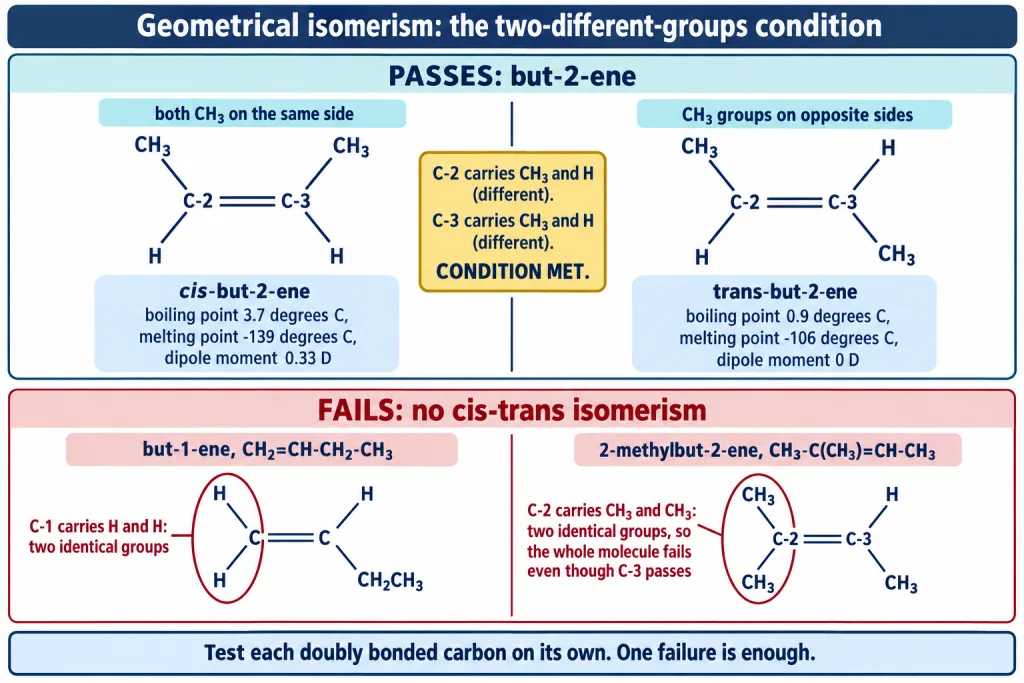
But-2-ene passes
. The double bond runs from C-2 to C-3.
- C-2 carries and — different.
- C-3 carries and — different.
Both pass, so two compounds exist. In cis-but-2-ene the two methyl groups are on the same side of the double bond; in trans-but-2-ene they are on opposite sides. Cis is Latin for "on this side", trans for "across".
But-1-ene fails
. C-1 carries and . The test stops at step 1. Swapping those two hydrogens gives back the identical molecule, so there is nothing to swap and only one but-1-ene exists.
2-Methylbut-2-ene fails as well
, that is . This one is worth going slowly.
- C-2 carries and — the same. Failed.
- C-3 carries and — different, so this carbon passes.
One carbon passing does not rescue the molecule. Because C-2 carries two identical methyls, flipping the molecule over gives the same compound back. 2-Methylbut-2-ene does not show geometrical isomerism. Students lose the mark here by counting the four groups round the double bond, seeing three different kinds, and answering yes; the rule is about the two groups on each carbon separately, never about the four taken together.
Question 1: Two butenes side by side
Say which of but-1-ene and but-2-ene shows geometrical isomerism, and why.
Answer:
I take the double bond in each and look at one carbon at a time.
But-1-ene is . C-1 has two hydrogens on it. Two identical groups, so the test fails right there.
But-2-ene is . C-2 has a methyl and a hydrogen, C-3 has a methyl and a hydrogen. Both carbons carry two different groups.
Ans: But-2-ene shows cis-trans isomerism; but-1-ene does not, because its terminal carbon carries two hydrogens
Question 2: 2-Methylbut-2-ene
Does exist as cis and trans forms?
Answer:
The double bond joins C-2 and C-3.
On C-2 I find two methyl groups. They are identical, so the arrangement cannot be changed by moving them — I get the same molecule back either way.
I do not even need C-3, but for completeness it carries a hydrogen and a methyl, which are different.
Ans: No. C-2 carries two identical methyl groups, so 2-methylbut-2-ene has no geometrical isomers
Watch out: Three different kinds of group appear round this double bond, which tempts people into saying yes. The condition is applied to each doubly bonded carbon on its own.
Question 3: The two dichloroethenes
Which of and shows geometrical isomerism?
Answer:
In 1,2-dichloroethene, , each carbon carries one chlorine and one hydrogen. Different on both carbons, so it passes. The two chlorines can sit on the same side (cis) or on opposite sides (trans).
In 1,1-dichloroethene, , one carbon carries two chlorines and the other two hydrogens. Both carbons fail.
Ans: 1,2-Dichloroethene shows cis and trans forms; 1,1-dichloroethene does not
Question 4: Counting the butenes
How many distinct alkenes have the formula ?
Answer:
First the structural skeletons. But-1-ene, . But-2-ene, . 2-Methylprop-1-ene, . That is 3 structural isomers.
Now I run the test on each. But-1-ene fails, one compound. 2-Methylprop-1-ene has at one end and two methyls at the other, so it fails on both carbons, one compound. But-2-ene passes, giving cis and trans, two compounds.
.
Ans: 3 structural isomers, but 4 distinct alkenes once cis-trans forms are counted
Question 5: A longer chain
Does pent-2-ene show geometrical isomerism? Does 3-methylpent-2-ene?
Answer:
Pent-2-ene is . C-2 carries methyl and hydrogen; C-3 carries ethyl and hydrogen. Both different, so yes.
3-Methylpent-2-ene is . C-2 carries methyl and hydrogen — different. C-3 carries methyl and ethyl — also different. Both pass, so yes again.
Ans: Both show geometrical isomerism
Watch out: Swap that C-3 methyl for a chlorine and the matching pair really does disappear. In 3-chloropent-2-ene, , C-2 carries a methyl and a hydrogen while C-3 carries a chlorine and an ethyl, so all four groups differ and there is no pair of identical groups spanning the double bond; calling one form cis and the other trans is then arbitrary. This is precisely the case the E-Z system was invented for.
Cis-trans beyond the simple alkene
Rings
A ring does the same job as a double bond. The carbons of a small ring cannot rotate freely about their bonds without pulling the ring apart, so a substituent stays permanently on one face of the ring.
1,2-Dimethylcyclopropane is the standard example. Three ring carbons; C-1 and C-2 each carry a methyl and a hydrogen. In the cis isomer both methyls stick out from the same face of the ring; in the trans isomer one points up and the other down. The two are separate compounds with different melting points.
The same condition applies: each of the two substituted ring carbons must carry two different groups. 1,1-Dimethylcyclopropane has both methyls on one carbon and shows no such isomerism.
The carbon-nitrogen double bond in oximes
An oxime is formed when an aldehyde or a ketone reacts with hydroxylamine, giving a unit. Rotation about is restricted for the same reason as rotation about , and the nitrogen carries a lone pair on one side and the on the other, so nitrogen counts as carrying two different things.
Acetaldoxime, , exists in two forms. When the hydrogen on carbon and the on nitrogen lie on the same side the isomer is called syn; when they lie on opposite sides it is anti. The words syn and anti are used in place of cis and trans whenever the double bond involves nitrogen.
Azo compounds, , behave the same way and also come in cis and trans forms.
Key Point: Geometrical isomerism needs a rigid unit — , , or a ring — plus two different groups at each end of it.
Where it can never appear
A group cannot show it, because the oxygen has nothing else attached to it besides its lone pairs. A triple bond cannot show it either: an sp carbon is linear, so its one other group lies straight along the axis and there is no "side" to be on. Neither can any freely rotating single bond.
E and Z: the modern replacement for cis and trans
Cis and trans work only when you can point to a matching pair of groups, one at each end of the double bond, and say "same side" or "opposite sides". In there is no such pair. Every one of the four groups is different, so which two do you compare?
The E-Z system removes the ambiguity by ranking, rather than matching.
Key Point (Definition): On each doubly bonded carbon, rank its two groups by priority. If the two higher-priority groups lie on the same side, the isomer is Z (German zusammen, together). If they lie on opposite sides, it is E (entgegen, opposite).
Priority is settled by the Cahn-Ingold-Prelog rules. In outline: compare the atomic numbers of the atoms directly attached to the doubly bonded carbon, and the higher atomic number wins. If those first atoms tie, move outwards to the next set of atoms and use the first point of difference. So beats beats beats , and beats because at the first carbon out the ethyl offers against the methyl's . The full set of rules, including how to handle double bonds and isotopes, belongs to Class 12; for now the atomic-number idea is enough.
For but-2-ene the two systems agree. On each carbon the choice is between and , and carbon outranks hydrogen, so the higher-priority groups are the two methyls. cis-But-2-ene is (Z)-but-2-ene and trans-but-2-ene is (E)-but-2-ene.
Z does not always mean cis
Take 2-chlorobut-2-ene, , drawn with the two methyl groups on the same side. By the loose methyl-to-methyl reading that arrangement looks cis.
Now rank. On C-2 the two groups are and ; chlorine has the higher atomic number, so chlorine wins. On C-3 the two groups are and ; the methyl wins. Since the C-2 methyl is on the same side as the C-3 methyl, the chlorine must be on the opposite side from the C-3 methyl. The two winners are on opposite sides, so this is the E isomer.
[JEE Main] The mismatch between "looks cis" and "is E" is the standard trap. Rank first, then decide; never translate cis to Z by reflex.
How the two geometrical isomers actually differ
Because the groups sit differently in space, the two isomers have genuinely different bulk properties. Three of them are asked about constantly.
Dipole moment
Bond dipoles add as vectors. In a cis isomer the two polar groups point partly in the same direction, so their dipoles reinforce and the molecule has the larger resultant. In a trans isomer they point in opposite directions and cancel — completely, if the two groups are identical.
| Compound | cis | trans |
|---|---|---|
| 1,2-dichloroethene | ||
| but-2-ene |
trans-1,2-Dichloroethene has two strongly polar bonds and a dipole moment of exactly zero, because the two vectors are equal and opposite.
Boiling point
A larger dipole means stronger dipole-dipole attraction between molecules, so more energy is needed to pull them into the vapour. The cis isomer usually boils higher. cis-1,2-Dichloroethene boils at against for the trans; cis-but-2-ene boils at against .
Melting point
Melting is about how well molecules stack in a crystal, not about how strongly a pair of them attracts. The trans isomer is the more symmetrical and flatter of the two, so it packs into a tighter, better-ordered lattice, and more energy is needed to break that lattice down. The trans isomer usually melts higher. trans-But-2-ene melts at against for the cis.
Key Point: cis wins on dipole moment and boiling point; trans wins on melting point. The reasons are different — attraction between molecules for boiling, packing in the lattice for melting.
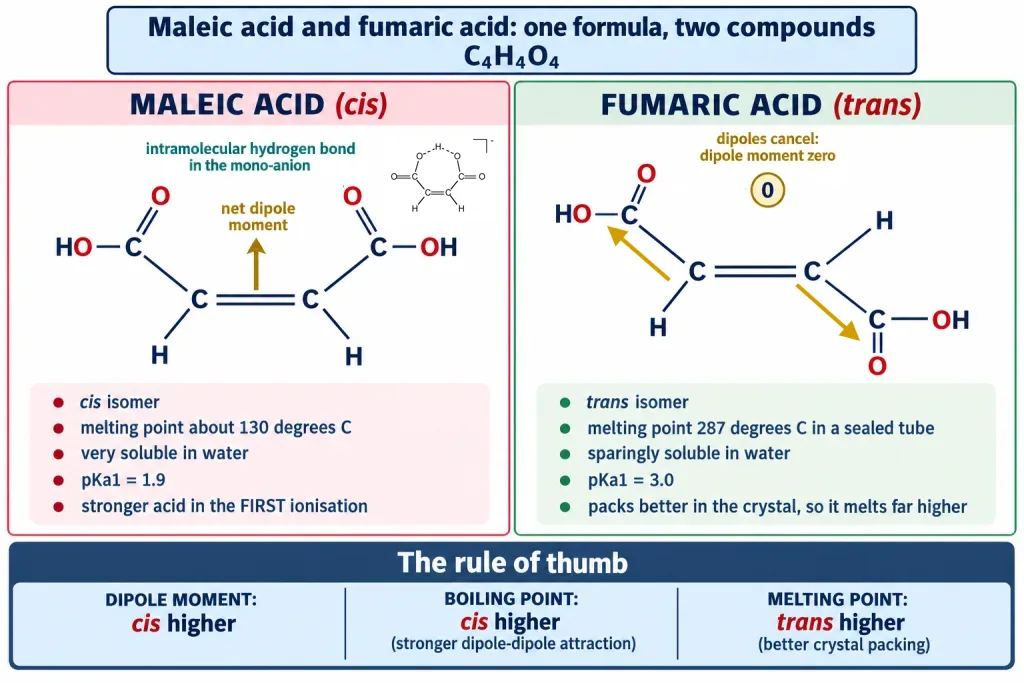
Maleic and fumaric acid
Both are butenedioic acid, . Each doubly bonded carbon carries and , so both carbons pass the test.
- Maleic acid is the cis isomer. The two groups sit on the same side. It has a net dipole moment, melts at about , and is very soluble in water.
- Fumaric acid is the trans isomer. The two groups sit across the double bond from each other, the dipoles cancel to zero, it melts at in a sealed tube, and it is only sparingly soluble in water.
The huge melting-point gap is the packing argument in its most extreme form: the flat, symmetrical trans molecule stacks into a tight lattice while the bent cis one cannot.
Which is the stronger acid
Maleic acid is the stronger acid in its first ionisation — the standard figures are for maleic against for fumaric.
The reason is the cis geometry. Once maleic acid loses its first proton, the resulting sits right next to the intact on the same side of the double bond, close enough for a strong intramolecular hydrogen bond to form between them. That hydrogen bond stabilises the mono-anion, and a more stable anion means the first proton comes off more readily. In fumaric acid the two groups are on opposite sides and far apart, so no such bond can form.
The same hydrogen bond then grips the second proton tightly, so maleic acid is the weaker acid in its second ionisation ( against for fumaric).
[JEE Main] Quote the mechanism, not the memory: the cis mono-anion is stabilised by an internal hydrogen bond.
Optical isomerism: light as the detector
Plane-polarised light
An ordinary light wave vibrates in every plane at right angles to its direction of travel. Pass it through a Nicol prism or a sheet of Polaroid and only the vibration in one plane gets through. What emerges is plane-polarised light, vibrating in a single plane.
Most substances leave that plane exactly where it was. A few rotate it through a measurable angle. Those are called optically active.
Key Point (Definition): A substance is optically active if it rotates the plane of plane-polarised light. The angle of rotation is , measured in degrees.
The polarimeter
The instrument is a straight line of five parts.
- A monochromatic source, almost always a sodium lamp working at the D line, .
- A polariser, a fixed Nicol prism, which produces the plane-polarised beam.
- The sample tube, of known length, holding the pure liquid or a solution of known concentration.
- An analyser, a second Nicol prism that can be rotated by hand.
- A circular scale graduated in degrees, reading off how far the analyser had to be turned.
With no sample in the tube the analyser is set so that the field is dark. Putting an optically active sample in rotates the plane, light leaks through, and the analyser must be turned to restore darkness. The angle it is turned through is .
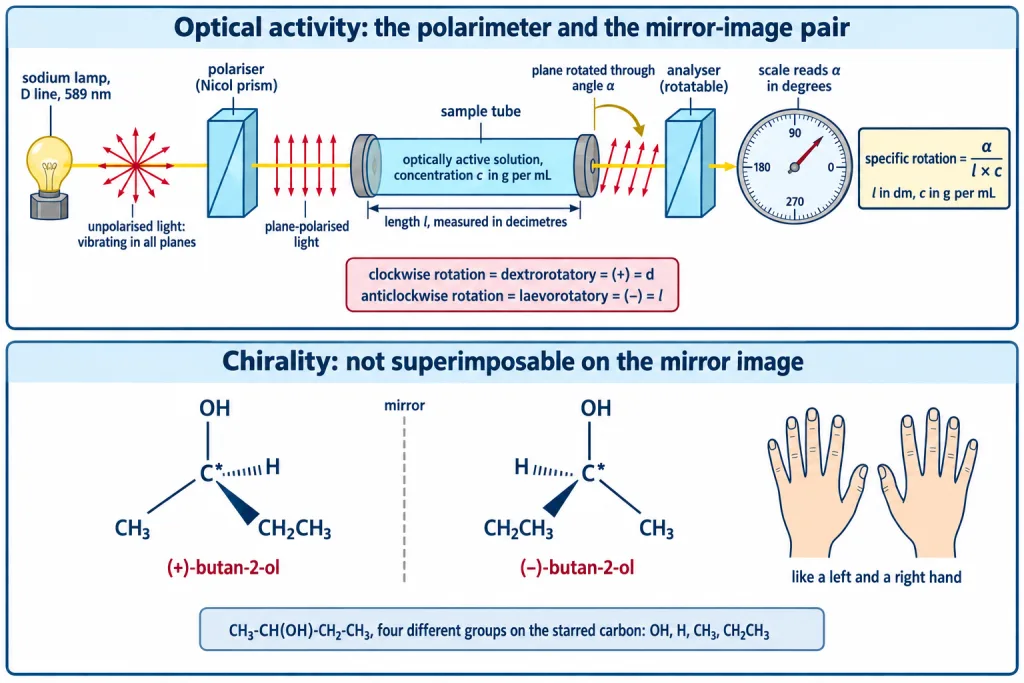
The two directions
Key Point (Definition): A compound that rotates the plane clockwise, to the right as the observer faces the oncoming beam, is dextrorotatory, written (+) or d. One that rotates it anticlockwise, to the left, is laevorotatory, written (-) or l.
The sign is a measured fact about a particular compound. It cannot be predicted by looking at the structure, and it has nothing to do with the D and L labels of sugars or the R and S labels of the modern system.
Specific rotation
The observed angle depends on how much substance the light passed through, so it is normalised.
- is the observed rotation in degrees.
- is the length of the sample tube in decimetres (a tube is ).
- is the concentration in . For a pure liquid, use its density.
- The subscript D records the sodium D line and the superscript the temperature in degrees Celsius.
Specific rotation is a physical constant of a compound, listed in tables the way a melting point is. The two commonest slips are leaving the tube length in centimetres and putting the mass of solute in place of the concentration.
Chirality, the asymmetric carbon and enantiomers
Handedness
Hold your two hands palm down side by side. Each is the mirror image of the other, yet no amount of sliding or turning lays one exactly on top of the other with every finger matching. Objects with that property are called chiral, from the Greek cheir, a hand.
Key Point (Definition): A molecule is chiral if it is not superimposable on its mirror image. A molecule that can be superimposed on its mirror image is achiral.
Chirality is the whole cause of optical activity. A chiral molecule rotates the plane of polarised light; an achiral one does not.
The asymmetric carbon
The commonest source of chirality in the compounds you will meet is a single carbon atom.
Key Point (Definition): An asymmetric carbon, also called a chiral carbon or a stereocentre, is an carbon bonded to four different groups. It is marked with an asterisk, .
Butan-2-ol, , has one. Its starred carbon carries , , and : four groups, all different. Swap any two of them and you get a molecule you cannot superimpose on the first.
A molecule with exactly one asymmetric carbon is always chiral. With more than one, it may or may not be, for a reason taken up below.
Enantiomers
Key Point (Definition): Enantiomers are a pair of stereoisomers that are non-superimposable mirror images of each other.
They are the closest two different compounds ever get.
| Property | The two enantiomers |
|---|---|
| melting point, boiling point, density | identical |
| refractive index, solubility in an ordinary solvent | identical |
| infrared and NMR spectra in an ordinary solvent | identical |
| magnitude of the rotation | identical |
| sign of the rotation | equal and opposite |
| reaction with an achiral reagent | identical rate, identical products |
| reaction with a chiral reagent | different rates, different products |
The last row is why chirality matters outside the examination hall. Enzymes are chiral, so a living cell handles the two enantiomers of a drug quite differently: one may cure and the other do nothing at all.
The racemic mixture
Key Point (Definition): A racemic mixture is an equimolar, 50:50 mixture of the two enantiomers. It is optically inactive, because the rotation produced by every molecule is cancelled by an equal and opposite rotation from a molecule. This cancelling between separate molecules is called external compensation. A racemic mixture is written or and its specific rotation is zero.
Splitting a racemic mixture into its two pure enantiomers is called resolution.
When stereocentres do not make a chiral molecule
Any molecule with a plane of symmetry is superimposable on its mirror image, and is therefore achiral, no matter how many stereocentres it contains. In such a molecule one half rotates the plane of polarised light exactly as much as the other half rotates it back, within the same molecule; this is internal compensation, and the optically inactive stereoisomer it produces is called a meso form. meso-Tartaric acid is the standard example.
Counting the isomers: the rule
Key Point: A molecule with unlike chiral carbons has at most optical isomers, arranged in pairs of enantiomers.
One stereocentre gives ; two unlike stereocentres give ; three give .
The exception comes when the molecule is symmetric, so that the stereocentres are alike. Tartaric acid, , has two stereocentres and the two halves of the molecule are identical. The rule predicts 4, but one of the four turns out to have a plane of symmetry and is identical to its own mirror image. Tartaric acid therefore has 3 stereoisomers: a and a enantiomer, plus one optically inactive meso form.
[NEET] Apply first, then check for a symmetric molecule and subtract the duplicated meso forms.
Question 6: Butan-2-ol
Find the chiral carbon in .
Answer:
I number the chain and take each carbon in turn, listing all four things attached to it.
C-1: three hydrogens and the rest of the chain. Three identical groups, so no.
C-2: , , (looking towards C-1) and (looking towards C-3 and C-4). Four different groups.
C-3: two hydrogens. No.
C-4: three hydrogens. No.
Ans: C-2 is the chiral carbon, so butan-2-ol exists as a pair of enantiomers
Question 7: Propan-2-ol
Does have a chiral carbon?
Answer:
C-2 is the only candidate. It carries , , and .
The last two are both methyl groups. Two of the four are the same, so the condition fails.
Ans: No chiral carbon. Propan-2-ol is achiral and optically inactive
Watch out: Butan-2-ol and propan-2-ol look alike on paper. The difference is one , and that single group is what makes one side ethyl and the other methyl.
Question 8: Lactic acid
Find the chiral carbon in .
Answer:
Three carbons. The carbon has two bonds to one oxygen and one to another, so it is not and cannot be a stereocentre. The carbon has three hydrogens.
The middle carbon carries , , and . All four different.
Ans: C-2, the carbon between the methyl and the carboxyl group
Question 9: Glyceraldehyde
Find the chiral carbon in .
Answer:
C-1 is the carbon, doubly bonded to oxygen, so it is out. C-3 carries two hydrogens as well as the , so it is out.
C-2 carries , , and . The and the both contain a carbon and an oxygen, but they are different groups, so the carbon qualifies.
Ans: C-2. Glyceraldehyde is the simplest chiral sugar and exists as and forms
Watch out: Two groups that share the same atoms are not the same group. and differ in how those atoms are joined.
Question 10: Alanine
Is chiral?
Answer:
The middle carbon carries , , and . Four different groups.
Ans: Yes, alanine has one chiral carbon and exists as a pair of enantiomers
Question 11: 3-Methylhexane
A hydrocarbon with no functional group at all. Is chiral?
Answer:
Only C-3 carries four separate things, so that is the one to examine.
Attached to C-3: a hydrogen; a methyl branch; then the chain going left, which is , an ethyl group; and the chain going right, which is , a propyl group.
Hydrogen, methyl, ethyl, propyl. Four different groups.
Ans: Yes. C-3 of 3-methylhexane is a chiral carbon, so the compound is optically active
Watch out: A chiral carbon needs no oxygen, nitrogen or halogen. Four different alkyl chains do the job by themselves, which is why you must always follow the chain out in both directions before deciding.
Question 12: 2-Chlorobutane and 2-chloropropane
Compare with .
Answer:
In 2-chlorobutane, C-2 carries , , and . Four different, so it is chiral.
In 2-chloropropane, C-2 carries , , and . The two methyls make it achiral, and a plane of symmetry runs through the , the and C-2.
Ans: 2-Chlorobutane is chiral; 2-chloropropane has no chiral carbon
Question 13: Butan-1-ol
Does show optical isomerism?
Answer:
C-1 carries the and two hydrogens. C-2 and C-3 each carry two hydrogens. C-4 carries three.
Every carbon in the chain has at least two identical groups on it.
Ans: No chiral carbon, so butan-1-ol is optically inactive
Watch out: Having an group does not make a molecule optically active. The question is always about the four groups on one carbon, never about which functional group is present.
Question 14: How many optical isomers
A compound has three chiral carbons and no plane of symmetry. How many optical isomers does it have, and how many enantiomeric pairs?
Answer:
The rule is with the number of unlike chiral carbons. Here , so optical isomers.
They come in mirror-image pairs, so the number of pairs is .
Ans: 8 optical isomers, forming 4 pairs of enantiomers
Watch out: , never . Three stereocentres give 8, not 6.
Question 15: Tartaric acid
has two chiral carbons. Why does it have three stereoisomers rather than four?
Answer:
The rule predicts . But the two halves of this molecule are identical: each stereocentre carries , , and the other half of the molecule.
One of the four arrangements has an internal plane of symmetry cutting the molecule between the two stereocentres. The upper half rotates the plane of polarised light one way and the lower half rotates it back by exactly the same amount, so the molecule is optically inactive by internal compensation. That arrangement is the meso form, and it is identical to its own mirror image, so what would have been two isomers is only one.
Ans: 3 stereoisomers — a and a enantiomer plus one optically inactive meso form
Watch out: A meso compound is one substance with a symmetry plane inside it, inactive by internal compensation. A racemic mixture is two substances in equal amounts, inactive by external compensation. Do not swap the two words.
Question 16: A specific rotation calculation
of a compound is dissolved to give of solution. In a tube the observed rotation is . Find the specific rotation.
Answer:
First the concentration in the units the formula wants, grams per millilitre.
The tube length is already in decimetres, .
Ans: , and the compound is dextrorotatory
Watch out: Dividing by the mass instead of the concentration gives , and forgetting the tube length gives . Both are common.
Question 17: A racemic sample
Equal numbers of moles of -butan-2-ol and -butan-2-ol are mixed. What rotation does a polarimeter read, and is the mixture chiral?
Answer:
Each molecule turns the plane one way and each molecule turns it back by exactly the same angle. With equal numbers of each, the two effects cancel completely.
The individual molecules are still chiral — nothing about them has changed. The mixture is optically inactive, by external compensation.
Ans: The reading is zero. The mixture is optically inactive, written -butan-2-ol, although every molecule in it is chiral
Question 18: Naming the relationship
State how each pair is related: (i) but-1-ene and cis-but-2-ene; (ii) cis-but-2-ene and trans-but-2-ene; (iii) -lactic acid and -lactic acid.
Answer:
(i) The double bond has moved from C-1 to C-2, so the connectivity is different. These are position isomers, a kind of structural isomerism.
(ii) The connectivity is identical and only the spatial arrangement across the locked double bond differs. Geometrical isomers.
(iii) Same connectivity, non-superimposable mirror images, equal and opposite rotations. Enantiomers, which are optical isomers.
Ans: (i) position (structural) isomers; (ii) geometrical isomers; (iii) enantiomers