
An equation is not a mechanism
A balanced equation names the starting materials and the products and says nothing about the route. Two reactions with identical equations can travel completely different paths, give different by-products and respond differently to a change of solvent.
Key Point (Definition): A reaction mechanism is the step-by-step account of a reaction: the order in which bonds break and form, the movement of electrons in each step, every intermediate produced along the way, and the transition state through which each step must pass.
Six words to use precisely
Substrate. The organic compound being attacked — the one whose carbon skeleton reappears in the product. In , bromoethane is the substrate.
Reagent. The attacking species — here the hydroxide ion. A reagent is one of three things at this level: a nucleophile (electron-pair donor), an electrophile (electron-pair acceptor) or a free radical. The potassium ion is a spectator; the bromide ion is the leaving group, the piece that departs with the bonding pair.
Elementary step. One bond-breaking or bond-making event, or a concerted set of them, with nothing isolable in the middle. A mechanism is a list of these.
Reaction intermediate. A real species, made in one step and consumed in a later one, with complete bonds, a definite geometry and a short but finite lifetime. On an energy diagram it sits in a well, a minimum, which is what makes it real: it is stable against small disturbances. In principle it is isolable; in practice it is detected spectroscopically or trapped. The carbocation, carbanion and free radical of section 9 are the intermediates you will meet.
Transition state (activated complex). The highest-energy arrangement on the way through one step, and not a species at all. Its bonds are partial — one half made, another half broken — and it has no lifetime, because it sits at a maximum, so any nudge in either direction sends it downhill. It is never isolable, and it is written in square brackets with a double dagger.
Rate-determining step. The slowest elementary step. Its activation energy fixes the rate of the whole reaction, so speeding up the other steps changes nothing.
| Feature | Reaction intermediate | Transition state |
|---|---|---|
| Position on the profile | in a well (minimum) | at a hump (maximum) |
| Bonds | complete, ordinary bonds | partial, part-made and part-broken |
| Lifetime | short but finite | none |
| Isolable in principle | yes | never |
| Example | the flattened carbon of a half-made bond |
The trap is one sentence wide: a carbocation is an intermediate, never a transition state. [JEE Main]
Reading an energy profile
An energy profile plots the potential energy of the reacting system against the reaction coordinate, which is not time and not distance but simply progress, running from reactants on the left to products on the right.
A one-step reaction gives one hump. The left-hand plateau is the reactant level, the right-hand plateau the product level, and between them a single maximum. The rise from the reactant level to the top of that hump is the activation energy, . The gap between the plateaux is the enthalpy change: products lower means exothermic, higher means endothermic. No well means no intermediate, and one hump is the signature of a concerted reaction.
A two-step reaction gives two humps and a well between them. The floor of the well is the intermediate. A reaction of steps gives humps and wells, so counting humps counts steps and counting wells counts intermediates.
Measure each barrier from the well immediately to its left: the barrier of step 1 is the height of the first hump above the reactant level, and the barrier of step 2 is the height of the second hump above the floor of the well. The step with the larger barrier is the rate-determining step, and in nearly every profile you will be shown that is also the taller hump on the page. The overall reaction can never go faster than that step.
A deep well does not make a step fast: well depth is thermodynamics, hump height is kinetics, and the two are independent. A catalyst offers a lower transition state, so it lowers while leaving both plateaux where they were.
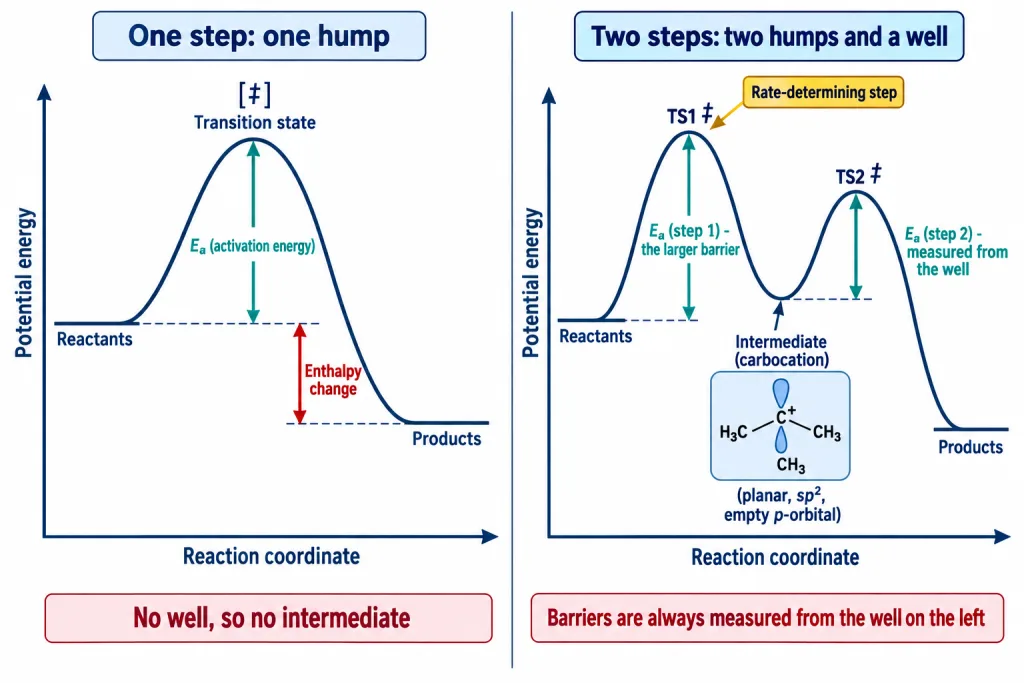
The picture in words. For one step: a flat reactant line, a smooth rise to a single rounded peak marked with a double dagger, then a fall to a lower product line, with a vertical arrow from reactant line to peak labelled . For two steps: the same reactant line, a rise to a first peak, a fall into a shallow valley labelled intermediate, a second rise to a peak drawn lower than the first, then a fall to the product line. The taller first hump makes step 1 rate-determining.
Question 1: Intermediate, transition state or neither
In the two-step hydrolysis of 2-bromo-2-methylpropane, classify (a) the ion, (b) the arrangement in which the bond is half broken and no new bond has formed, (c) the bromide ion.
Answer:
I ask one question about each: well or hump?
(a) The tert-butyl cation is made in step one, used up in step two, has three complete bonds and a real lifetime, and sits at the bottom of the well. Intermediate.
(b) A half-broken bond is a partial bond, and this is the top of the first hump. Transition state.
(c) Bromide is formed in step one and stays to the end: it is the leaving group and finishes as a product.
Ans: (a) intermediate, (b) transition state, (c) leaving group and final product Watch out: A carbocation is never a transition state. Well against hump is the test, not how short-lived the species is.
Question 2: Naming the parts
In , name the substrate, the reagent, the leaving group and the type of reagent.
Answer:
The product skeleton comes from bromoethane, so that is the substrate. The cyanide ion attacks, offering a lone pair on carbon, so it is the reagent and a nucleophile. Bromide leaves with the pair that held it to carbon, so it is the leaving group, and potassium sits out the reaction.
Ans: substrate bromoethane; reagent the cyanide ion, a nucleophile; leaving group bromide Watch out: The substrate is not always the bigger molecule; it is the one whose skeleton you can find in the product.
Question 3: Rate-determining step from a profile
A two-step profile has its first maximum 92 kJ/mol above the reactant level, the well 30 kJ/mol above it, and the second maximum 48 kJ/mol above it. Which step is rate-determining, what is its activation energy, and how many intermediates are there?
Answer:
Two humps means two steps and one well, so one intermediate.
Step 1 starts at the reactant level: barrier kJ/mol. Step 2 starts from the intermediate at the bottom of the well, not from the reactants: barrier kJ/mol.
92 beats 18, so step 1 is rate-determining, and it is the taller hump.
Ans: step 1, kJ/mol, one intermediate Watch out: Do not read the second barrier as 48 kJ/mol off the reactant line. Every barrier is measured from the valley on its own left.
The four broad classes
Almost every organic reaction in Class 11 and Class 12 belongs to one of four families, and the cleanest test is what happened to the degree of unsaturation, the number of double-bond equivalents, which is for a hydrocarbon and counts a ring or a double bond as one and a triple bond as two. Substitution leaves the count alone; addition lowers it by one; elimination raises it by one; rearrangement changes neither the formula nor the count.
Substitution
Key Point (Definition): In a substitution reaction an atom or group in the substrate is replaced by another, by the scheme . Carbon skeleton and degree of unsaturation both survive intact.
Nucleophilic substitution: hydroxide on bromoethane
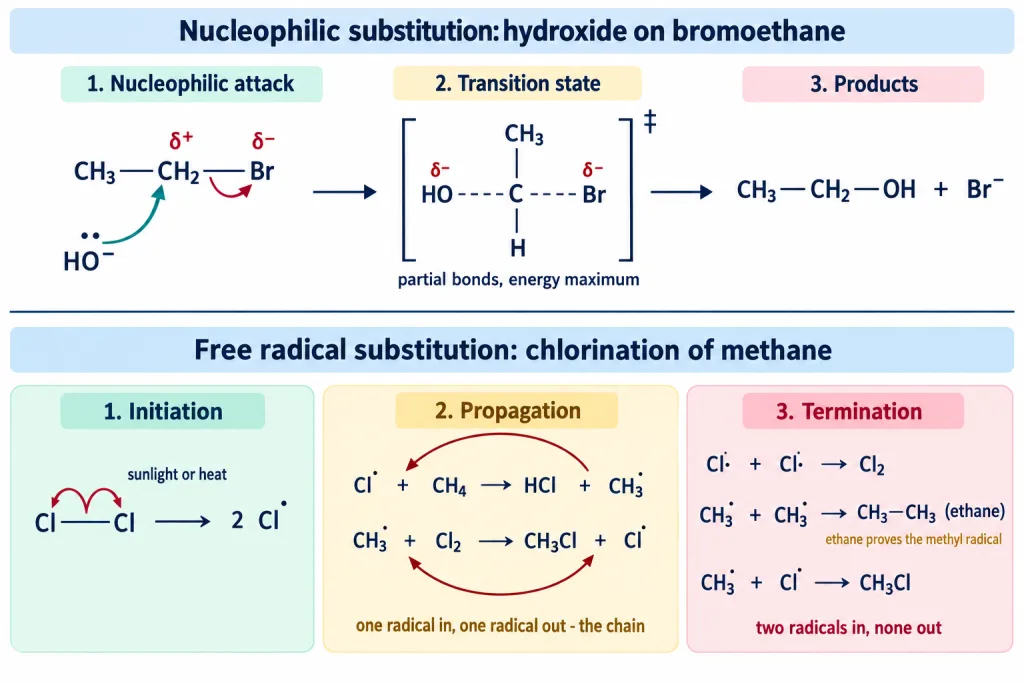
Bromine is more electronegative than carbon, so the bond carries on carbon, and that carbon is the target. Hydroxide brings a lone pair on oxygen and reaches for it along the line directly opposite the bromine, the only approach clear of the departing group. As the new bond forms, the pair holding the bond folds back onto bromine, which leaves as bromide — both in the same step.
The transition state therefore has a half-made bond, a half-broken bond, the attacked carbon flattened with its three retained groups almost in a plane, and the charge shared between incoming oxygen and outgoing bromine. One hump, no intermediate, and the rate depends on both concentrations.
A tertiary halide changes the mechanism. ionises first, unaided, to the tert-butyl cation, the most stable by the order tertiary > secondary > primary > methyl. That cation is a genuine intermediate in a well, and hydroxide attacks it in a second step: two humps, with the ionisation rate-determining. Same equation, two mechanisms, decided by carbocation stability.
Free radical substitution: chlorination of methane
Methane and chlorine are inert in the dark. In diffused sunlight or ultraviolet light, or at 520-670 K, they react at once, because light or heat splits the weak bond homolytically. The reaction is a chain, and a chain has three kinds of step. [Board]
Initiation — radicals appear where there were none:
Propagation — each step uses one radical and makes another:
The chlorine atom abstracts a whole hydrogen atom, electron included, which is why the product is a methyl radical and not a carbanion. The second step hands back a chlorine atom, so one initiation event turns over thousands of methane molecules, and that regeneration makes the reaction a chain.
Termination — two radicals pair their odd electrons and the chain dies:
The trace of ethane always found in the product has no other possible source, so it is the proof that methyl radicals exist. Chlorine atoms attack chloromethane as readily as methane, so substitution runs on to , and unless a large excess of methane is used.
Electrophilic substitution: nitration of benzene
The aromatic case runs the other way, because the ring is electron-rich. Benzene with concentrated nitric and sulphuric acids at 323-333 K gives nitrobenzene, : the sulphuric acid generates the electrophile , the ring gives it an electron pair, and the ring then loses a proton and substitutes rather than adds, since only substitution restores the 150 kJ/mol of resonance energy.
Question 4: Classify five reactions
Classify each: (a) , (b) , (c) , (d) , (e) .
Answer:
I check the degree of unsaturation each time.
(a) Ethanol has no pi bond, ethene has one, and water left. Unsaturation up: elimination.
(b) Ethene has one pi bond, the dibromide none, and two bromines joined on: addition.
(c) A ring hydrogen swapped for chlorine, ring untouched, unsaturation unchanged: substitution.
(d) Bromine swapped for , unsaturation unchanged: substitution.
(e) Both sides are ; nothing joined, nothing left, a hydrogen moved one carbon along: rearrangement.
Ans: (a) elimination, (b) addition, (c) substitution, (d) substitution, (e) rearrangement Watch out: For a rearrangement the molecular formula is identical on both sides. If it is not identical, it is not a rearrangement.
Question 5: The chlorination of methane in full
Write the initiation, propagation and termination steps for the chlorination of methane, and say what the trace of ethane proves.
Answer:
Initiation, homolysis of the weakest bond present:
Propagation, one radical in and one out each time:
Termination, two radicals in and none out:
Ethane has two carbons, and neither reactant supplies two carbons in one piece, so two carbon-bearing fragments joined. The only such fragment in the scheme is the methyl radical.
Ans: as written above; the ethane is the evidence for the methyl radical Watch out: Never write or in this mechanism. Light causes homolysis, so every intermediate is neutral with one unpaired electron.
Question 6: A nonpolar electrophile
Ethene and bromine give 1,2-dibromoethane. Bromine is nonpolar, so identify the electrophile and explain how a nonpolar reagent manages the job.
Answer:
The pi cloud of ethene is loosely held and sticks out above and below the molecular plane, so it is a region of high electron density. As a bromine molecule approaches, that cloud repels the electrons towards the far bromine: the near bromine becomes , the far one .
The near, bromine is now the electrophile. The pi pair attacks it, the pair leaves with the far bromine as bromide, and bromide then attacks the carbon from the opposite face.
Ans: the induced end of the bromine molecule is the electrophile Watch out: Nonpolar does not mean incapable of being an electrophile. An induced dipole is enough.
Addition
Key Point (Definition): In an addition reaction two species combine across a multiple bond and nothing leaves the substrate. One pi bond is consumed per addition, so the degree of unsaturation falls by one. The scheme is .
Which end of the reagent moves first depends entirely on how the pi bond is polarised.
Electrophilic addition: HBr and propene
An alkene pi bond joins two carbons of equal electronegativity, so it is not polarised — merely electron-rich, with a loosely held pair exposed on both faces. Electron-rich attracts electrophiles.
Propene is ; numbered as prop-1-ene, C1 is the end, C2 the middle carbon, C3 the methyl.
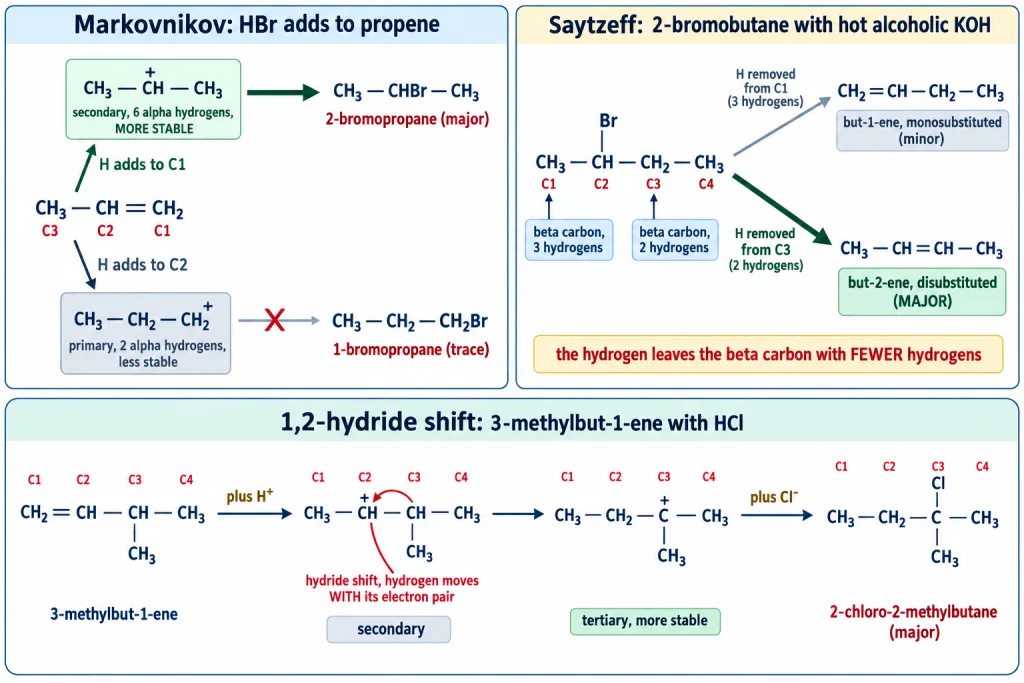
Step 1. Hydrogen bromide is polar, with on hydrogen. The pi pair reaches out and captures that hydrogen; the pair folds onto bromine, which leaves as bromide. This makes a carbocation, in one of two ways:
- hydrogen on C1 puts the charge on C2 — a secondary cation, , 6 alpha hydrogens;
- hydrogen on C2 puts the charge on C1 — a primary cation, , 2 alpha hydrogens.
Section 9 fixed the order tertiary > secondary > primary > methyl and section 13 gave the reason: more alkyl groups on the cationic carbon means more alpha bonds overlapping the empty p orbital, so more hyperconjugative delocalisation, plus more push. Six alpha hydrogens beat two, so the secondary cation lies much lower and forms far faster.
Step 2. Bromide brings a lone pair to the positive carbon and the addition is complete.
The product is 2-bromopropane, with only traces of 1-bromopropane, and step 1 is rate-determining.
Key Point: Markovnikov's rule. When an unsymmetrical alkene or alkyne adds a polar reagent , the negative part of the reagent attaches to the carbon carrying the smaller number of hydrogen atoms. Equivalently, and more usefully: the addition proceeds through whichever carbocation is more stable.
The second form is the whole point. Markovnikov's rule is the carbocation stability order applied to the first step of an addition, so everything in sections 9 and 13 — tertiary beating secondary beating primary, counting alpha hydrogens, groups pushing charge away — is cashed in here as one line of prediction. [JEE/NEET]
An alkyne adds twice, obeying the rule each time: propyne, , with two moles of HBr gives , 2,2-dibromopropane.
Nucleophilic addition: attacking a carbonyl
A carbonyl has the same kind of pi bond and the opposite reactivity. Oxygen is far more electronegative, so the pi electrons are already dragged towards it, leaving on carbon, and an electron-poor carbon attracts nucleophiles. Same pi bond, opposite reagent; polarisation is the entire difference.
HCN and propanone. Cyanide offers a lone pair on its carbon and attacks the carbonyl carbon. As that bond forms, the pi pair moves wholly onto oxygen, which becomes an alkoxide with a full negative charge, and the attacked carbon goes from sp2 trigonal planar to sp3 tetrahedral, its angles closing from 120 degrees to 109.5 degrees. The alkoxide then takes a proton from HCN or from water:
giving the cyanohydrin, 2-hydroxy-2-methylpropanenitrile.
A Grignard reagent and ethanal. In the carbon-magnesium bond is polarised the other way, on carbon, so the methyl group behaves as a carbanion. It attacks the carbonyl carbon of , the pi pair goes to oxygen, and hydrolysis with dilute acid delivers the alcohol:
Ethanal has one degree of unsaturation and propan-2-ol none — the fingerprint of an addition.
Elimination
Key Point (Definition): In an elimination reaction a small molecule — HX, water, — is removed from the substrate and a multiple bond appears where the two departing pieces were attached. The degree of unsaturation rises by one.
Elimination is the formal reverse of addition and competes with substitution for the same substrates. Almost all eliminations at this level are 1,2-eliminations (beta-eliminations): the leaving group departs from the alpha carbon and the hydrogen from an adjacent beta carbon.
Dehydrohalogenation
The base takes a hydrogen from a beta carbon. The pair that held that bond swings inwards, between the beta and alpha carbons, and becomes the new pi bond, while the pair leaves with bromine as bromide. Three bond changes, one transition state, one hump.
The reagent decides which way the substrate goes, and this is a favourite trap. Hot alcoholic KOH gives elimination and propene; aqueous KOH gives nucleophilic substitution and propan-2-ol. The substrate is identical. [Board]
Dehydration of an alcohol
Hydroxide is a hopeless leaving group, so the acid converts it into a good one. Three steps: the acid protonates the oxygen to give ; water departs with its pair, leaving a carbocation; a base removes a beta hydrogen and that pair becomes the pi bond. Three humps and two wells, with the ionisation carrying the largest barrier — which is why ease of dehydration runs tertiary, then secondary, then primary, tracking carbocation stability exactly.
Saytzeff's rule
When beta hydrogens sit on more than one beta carbon, more than one alkene is possible.
Key Point: Saytzeff's rule. In a beta-elimination the major product is the more highly substituted, and so the more stable, alkene. Equivalently, the hydrogen is preferentially removed from the beta carbon carrying the fewer hydrogens.
The justification is the alkene stability order from section 13: tetrasubstituted > trisubstituted > disubstituted > monosubstituted > ethene, because each extra alkyl group on a doubly bonded carbon brings more alpha hydrogens into hyperconjugation with the pi system.
Take 2-bromobutane, , with hot alcoholic KOH. The alpha carbon is C2, so the beta carbons are C1 and C3. A hydrogen from C1 (a , three hydrogens) puts the double bond between C1 and C2: but-1-ene, monosubstituted. A hydrogen from C3 (a , two hydrogens) puts it between C2 and C3: but-2-ene, disubstituted.
But-2-ene is the more stable alkene and the major product, and it also comes from the beta carbon with fewer hydrogens, so both statements of the rule agree, as they always do. Of its two geometrical forms, trans is the larger share, being less crowded.
Question 7: Markovnikov on 2-methylpropene
Predict the major product of and justify it by counting alpha hydrogens.
Answer:
The proton goes on first, and there are two choices.
On the carbon: the charge lands on the carbon bearing two methyls, giving , tertiary, with three methyl groups on the cationic carbon and so alpha hydrogens.
On the other carbon: the charge lands on the terminal carbon, giving , primary, whose only neighbour is a , so 1 alpha hydrogen.
Nine beats one by a wide margin, so the tertiary cation forms and chloride attacks it.
Ans: 2-chloro-2-methylpropane, Watch out: Count hydrogens on the carbons next to the positive carbon, never on the positive carbon itself. In that carbon has no hydrogen at all.
Question 8: Nucleophilic addition to propanone
Give the product of propanone with HCN, name it, and state which atom the cyanide attacks and where the pi electrons go.
Answer:
The bond is polarised with on carbon, so cyanide attacks the carbonyl carbon, using the lone pair on its own carbon. The pi pair shifts completely onto oxygen, which becomes an alkoxide, and the attacked carbon changes from sp2 to sp3. The alkoxide then takes a proton from HCN, so the becomes an : the product is , with an and a methyl on C2 counting from the nitrile carbon.
Ans: , 2-hydroxy-2-methylpropanenitrile Watch out: The nucleophile goes to carbon, never to oxygen. Oxygen already has the electron density; the carbon is the one that is short.
Question 9: Saytzeff on 2-bromo-2-methylbutane
2-Bromo-2-methylbutane is heated with alcoholic KOH. Name the two possible alkenes and say which is major, and why.
Answer:
The substrate is , so the alpha carbon is C2 and its beta carbons are C1 (a , three hydrogens), the branch methyl on C2 (equivalent to C1) and C3 (a , two hydrogens).
A hydrogen from C1 or the branch methyl puts the double bond between C1 and C2: 2-methylbut-1-ene, two alkyl groups on the doubly bonded carbons, disubstituted. A hydrogen from C3 puts it between C2 and C3: 2-methylbut-2-ene, three alkyl groups, trisubstituted.
Trisubstituted beats disubstituted, and C3 is also the beta carbon with fewer hydrogens, so both forms of Saytzeff's rule agree.
Ans: 2-methylbut-2-ene major, 2-methylbut-1-ene minor Watch out: Judge substitution by counting alkyl groups on the two doubly bonded carbons, not carbons in the molecule. Both alkenes here are .
Rearrangement
Key Point (Definition): In a rearrangement the atoms or groups of a molecule migrate from one position to another within the same molecule. Nothing joins and nothing leaves, so the molecular formula is unchanged: a rearrangement is an isomerisation, and the degree of unsaturation is unchanged too.
The 1,2-shift in a carbocation
An atom or group on the carbon next door to a carbocation centre moves across to that centre, taking its bonding pair with it, so the positive charge is left behind on the carbon it vacated. The group moves only to the adjacent carbon, and only if the new cation is more stable. A migrating hydrogen is a hydride shift; a migrating methyl is a methyl shift.
A hydride shift. 3-Methylbut-1-ene, , with HCl. The proton adds to C1, giving a secondary cation at C2. C3 next door carries a hydrogen and already has two alkyl groups, so shifting that hydrogen with its pair to C2 leaves the charge on C3, which now bears three carbon groups — secondary has become tertiary:
Chloride attacks the tertiary cation, so the major product is 2-chloro-2-methylbutane, with some 2-chloro-3-methylbutane from cations captured before they rearrange. Applying Markovnikov and stopping gives only that minor product.
A methyl shift. 3,3-Dimethylbut-1-ene, , with HBr gives a secondary cation . C3 carries no hydrogen, so a methyl migrates instead, C3 becomes the tertiary cation , and bromide gives 2-bromo-2,3-dimethylbutane — a skeleton different from the alkene, the tell-tale sign of a rearrangement.
Tautomeric rearrangement. In keto-enol tautomerism a hydrogen atom migrates from the alpha carbon to the carbonyl oxygen while the double bond slides from to , so and interconvert as two real compounds in a genuine equilibrium — unlike resonance, whose contributors are not molecules at all.
Homolytic against heterolytic
The four classes describe what happens to the atoms. Cutting the same reactions by how the bond breaks describes what happens to the electrons, and settles which intermediate appears.
Homolytic fission. The bonding pair splits evenly, one electron each, giving free radicals — 7 valence electrons, neutral, sp2 and very nearly planar, order tertiary > secondary > primary > methyl. Favoured by a bond between atoms of similar electronegativity such as ; the vapour phase or a nonpolar solvent such as , where ions have nothing to stabilise them; high temperature; ultraviolet light; and radical initiators, above all peroxides. Its signature on paper is the three-part chain.
Heterolytic fission. The pair goes entirely to the more electronegative atom, giving ions — a carbocation (sp2, trigonal planar, 6 valence electrons, empty p orbital, tertiary > secondary > primary > methyl) or a carbanion (sp3, pyramidal, 8 valence electrons, reverse order, methyl > primary > secondary > tertiary). Favoured by an already polar bond such as ; a polar ionising solvent such as water or ethanol, which solvates the separated ions; an acid, base or Lewis acid catalyst; and moderate temperatures in the dark. Its signature is electrophile-and-nucleophile language.
One substrate can be pushed either way. Propene and HBr in the dark in a polar solvent break the bond heterolytically, run through a carbocation and obey Markovnikov to give 2-bromopropane; with a trace of peroxide they break homolytically, run through a radical, and give 1-bromopropane.
The classes side by side
| Reaction type | Degree of unsaturation | Typical reagent | Typical substrate | Example |
|---|---|---|---|---|
| Nucleophilic substitution | unchanged | nucleophile: , , | haloalkane, alcohol | |
| Free radical substitution | unchanged | halogen with light or heat | alkane | |
| Electrophilic substitution | unchanged | electrophile: , | arene | |
| Electrophilic addition | falls by one | polar or polarisable: HX, | alkene, alkyne | |
| Nucleophilic addition | falls by one | nucleophile: , | aldehyde, ketone | |
| Elimination | rises by one | hot alcoholic KOH, or hot conc. | haloalkane, alcohol | |
| Rearrangement | unchanged | no external reagent joins; acid or heat | carbocation, keto or enol form |
Question 10: Predicting a rearranged product
Give the major product of 3-methylbut-1-ene with HCl, and identify each intermediate.
Answer:
The alkene is . The proton adds to C1, which puts the charge on C2 and gives a secondary cation rather than a primary one. First intermediate: .
C3 carries a hydrogen and already has two alkyl groups, so moving that hydrogen with its pair to C2 puts the charge on C3, which then has three carbon groups. Second intermediate: , tertiary. That is a real gain, so the shift happens and chloride attacks the tertiary carbon.
Ans: 2-chloro-2-methylbutane, via a secondary carbocation that undergoes a 1,2-hydride shift to a tertiary one Watch out: Applying Markovnikov and stopping gives 2-chloro-3-methylbutane, the minor product. Whenever your cation is secondary and a tertiary one is one shift away, check for the shift.
Question 11: Which fission mode, from the conditions alone
Predict homolytic or heterolytic fission and name the intermediate: (a) heated to 800 K in the vapour phase, (b) stirred in aqueous ethanol at 300 K, (c) with in ultraviolet light.
Answer:
(a) A nonpolar bond, no solvent to stabilise ions, very high temperature. Nothing pays for charge separation: homolytic, giving two methyl radicals.
(b) A polar bond, a solvent that will solvate both ions, and a tertiary substrate: heterolytic, giving the tert-butyl carbocation and bromide.
(c) Ultraviolet light splits evenly and a radical chain follows: homolytic, giving chlorine atoms and then propyl radicals.
Ans: (a) homolytic, methyl radicals; (b) heterolytic, tert-butyl carbocation; (c) homolytic, chlorine atoms then propyl radicals Watch out: The solvent is as much part of the answer as the substrate. The same tertiary bromide in dry under ultraviolet light does not ionise at all.
Question 12: Reading a three-step profile
The dehydration of ethanol has a profile with three humps at 20, 105 and 70 kJ/mol above the reactant level, and two wells at 5 and 45 kJ/mol above it. How many intermediates are there, which step is rate-determining, and what is that step chemically?
Answer:
Three humps means three steps and two wells, so two intermediates. Each barrier is measured from the well on its own left: step 1 gives kJ/mol, step 2 gives kJ/mol, step 3 gives kJ/mol.
100 kJ/mol is much the largest, so step 2 is rate-determining. Reading the mechanism across, step 1 is protonation of the , step 2 the loss of water to give the carbocation, step 3 the removal of the beta hydrogen.
Ans: two intermediates; step 2, loss of water to form the carbocation, with kJ/mol Watch out: The third hump stands higher on the page than the first, but its barrier is only 25 kJ/mol, because it starts from a well already 45 kJ/mol up. Always subtract the well.