
The fourth effect, and the one built differently
The inductive effect needs a sigma bond to an atom that pulls or pushes harder than hydrogen. The electromeric effect needs a multiple bond and a reagent walking up to it. Resonance needs conjugation. All three leave one question open: what does a plain saturated alkyl group do when there is no polar bond worth speaking of and no pi system to join?
A methyl group has no lone pair, no pi bond and only a feeble electronegativity difference with the carbon it holds. Yet three methyls turn the least stable carbocation into the most stable simple one, and four make the most stable alkene of a set of isomers — differences too large for the inductive effect to carry.
Key Point (Definition): Hyperconjugation is the permanent delocalisation of the electrons of a bond on the carbon adjacent to an empty orbital, a partly filled orbital or a bond. It needs no attacking reagent, and the electrons it moves are electrons — which is exactly what separates it from the other three.
The adjacent carbon is the alpha carbon and its hydrogens the alpha hydrogens. Everything practical here comes from counting them.
What the effect requires
- An electron-poor or pi-bearing centre: an carbon with an empty orbital (a carbocation), one with a half-filled orbital (a free radical), or a bond (an alkene).
- At least one bond on a carbon directly attached to that centre, the hydrogen being on the neighbour and not on the centre itself.
- Overlap must be geometrically possible. The bond has to line up roughly parallel to the orbital. Alkyl groups rotate freely, so at any instant one of each methyl is well placed; a hydrogen locked at right angles contributes nothing.
Fail one condition and there is no hyperconjugation: the methyl cation fails the second, the phenyl cation the third.
The orbital picture
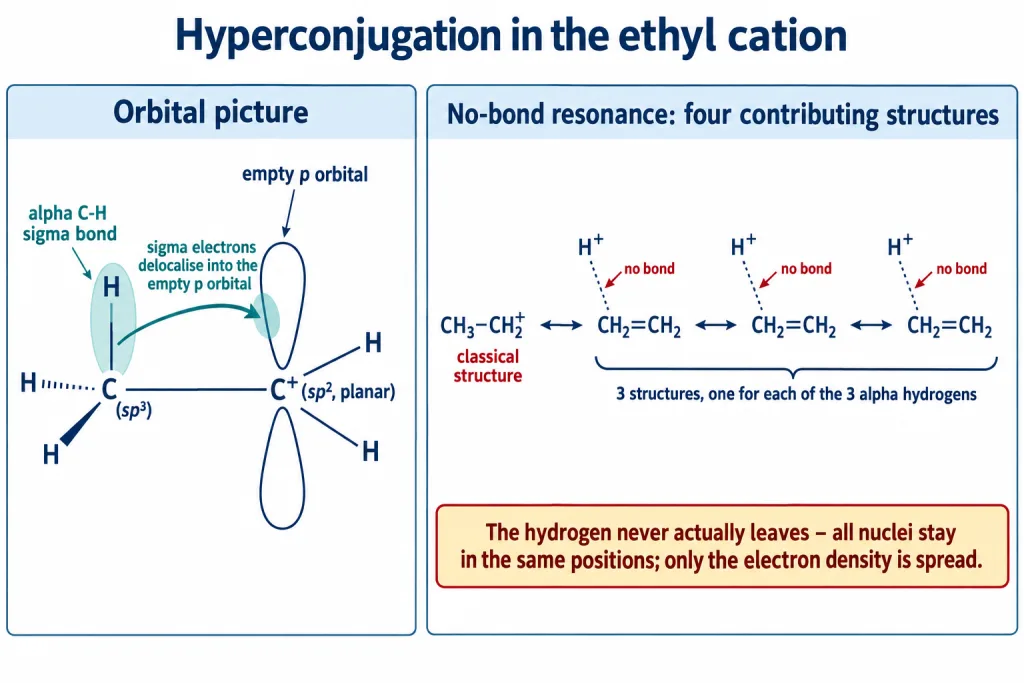
In the ethyl cation, , the positive carbon is and flat with an empty orbital perpendicular to its three bonds. The methyl carbon next door is , and one of its bonds points along the same axis as that empty orbital.
A filled orbital beside an empty one of matching direction is an invitation. The sigma pair spreads out of its own bond into the empty orbital and is shared over three centres — the hydrogen, the methyl carbon and the cationic carbon. Charge concentrated on one carbon is smeared over a larger volume, and spreading charge lowers energy.
None of this needs a reagent; it is a property of the ion standing alone, and the displacement is partial, so it gives partial charges, never full ones.
Three other names appear in problems: - conjugation, which fits the alkene case, no-bond resonance, from how the structures are drawn, and the Baker-Nathan effect.
No-bond resonance, and why the hydrogen stays put
Start from the ordinary structure of the ethyl cation, , and pick one bond on the methyl group. Move that bonding pair into the space between the two carbons, so a bond joins them and the cationic carbon reaches a complete octet. The hydrogen has handed over the pair it was sharing, so it is left with the positive charge and, on paper, no bond at all to its carbon.
That methyl has three alpha hydrogens, so there are three such structures and four contributors in all.
Key Point: The name no-bond resonance is used because in every hyperconjugative contributor the alpha bond is drawn broken, with the hydrogen carrying the positive charge and no bond between that hydrogen and its carbon.
The hydrogen does not leave
The contributor looks like a free proton beside a molecule of ethene. It is not.
A set of contributors is not a set of real molecules and not an equilibrium; the real species is one hybrid, and the positions of all the nuclei are identical in every contributor. Only the drawn electron density differs, and the hybrid keeps that density partly in the bond and partly between the carbons. If the hydrogen genuinely left, the products would be ethene and a proton — two separate species and a finished reaction, not a description of one ion.
In the hybrid the alpha bonds are slightly longer and weaker than ordinary ones, since part of their density has drifted away; the bond gains partial double-bond character and shortens; and a small share of the positive charge sits on each alpha hydrogen.
The same thing in a neutral molecule
In propene, , the single bond between the methyl carbon and the carbon measures about 150 pm against the 154 pm of an ordinary bond — partly the higher character of an carbon, partly the partial double-bond character - conjugation gives it.
The contributors are drawn the same way, except that the pair leaving the alpha pushes the electrons on to the far carbon:
Three alpha hydrogens, three such structures. Each separates charge, so each is a minor contributor — but three minor contributors are still three routes for spreading density, and the molecule is lower in energy for having them.
[JEE Main] The standard demand is to explain an order by hyperconjugation and then say what is delocalised. The answer never changes: the electrons of an alpha bond, into the adjacent empty orbital, half-filled orbital or bond.
Question 1: Which species can hyperconjugate
Which of , , and can be stabilised by hyperconjugation?
Answer:
I run the three conditions on each.
has an empty orbital but no carbon neighbour at all, so no alpha hydrogen. Condition 2 fails.
has an empty orbital and a methyl next to it with three hydrogens, one of which rotates into alignment. All three met.
carries its charge on an carbon, and the only carbon attached to it is the doubly bonded , whose hydrogens are vinylic — hydrogens on a doubly bonded carbon are never alpha hydrogens — so the ion has no alpha bond at all. Condition 2 fails.
has its empty orbital in the ring plane, where the ring hydrogens also lie, so nothing is aligned and there is no near.
Ans: Only .
Watch out: Having a pi system nearby is not the same as being able to use it. Vinyl and phenyl both sit next to plenty of electrons and reach none, because the orbitals are at right angles.
Question 2: Counting alpha hydrogens in two propyl cations
Count the alpha hydrogens in and in , and say which is more stable.
Answer:
In the n-propyl cation the positive carbon is the end , and only the middle is attached to it, carrying two hydrogens. The far methyl is on a beta carbon, one bond too far out.
In the isopropyl cation the positive carbon has two methyls attached: . The hydrogen on the positive carbon itself is not alpha — an alpha hydrogen is on the neighbour.
Ans: n-propyl 2, isopropyl 6, so isopropyl is much the more stable. It is also secondary against primary, and the two arguments agree.
Watch out: Two errors give the wrong count here. One counts the hydrogen on the cationic carbon and gets 7; the other mistakes isopropyl for tert-butyl and gets 9.
Question 3: Contributors for isobutene
How many hyperconjugative structures does 2-methylprop-1-ene, , have?
Answer:
The doubly bonded carbons are the one carrying the two methyls and the terminal , and the only carbons attached to either are the two methyls.
Each methyl carries three hydrogens, so alpha hydrogens and six structures. In each, a pair from an alpha makes a second double bond, the original pair moves out to the terminal carbon, and the hydrogen is drawn positive with no bond to carbon.
Ans: Six, one for each alpha hydrogen.
Watch out: The two hydrogens on the terminal are vinylic — attached to a doubly bonded carbon itself. They are never alpha hydrogens.
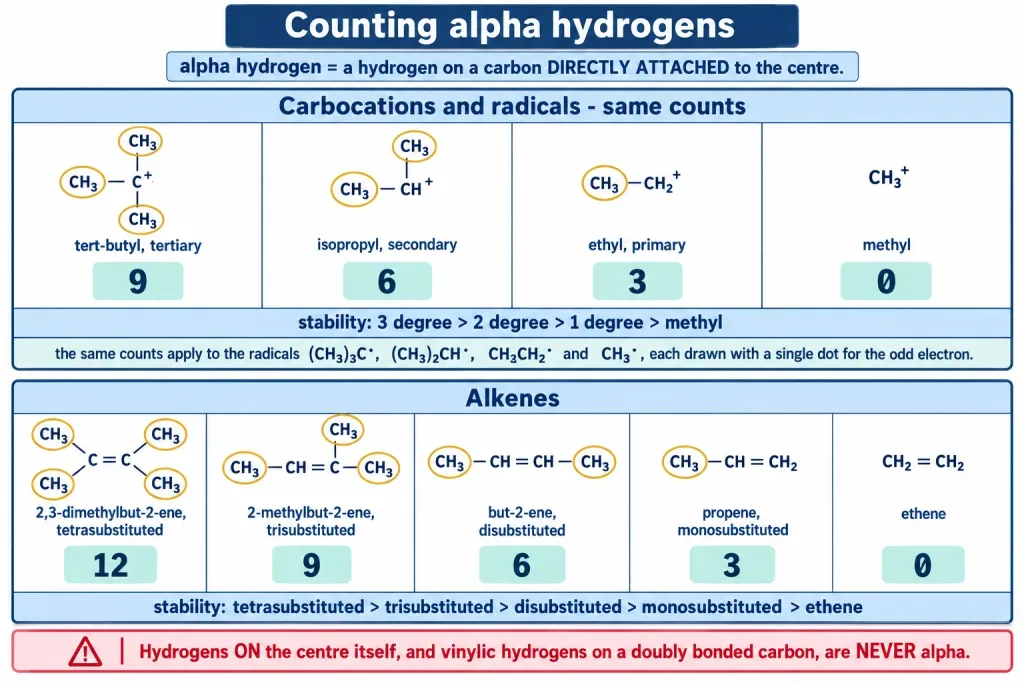
Alpha-hydrogen counting
The effect reduces to one number, in three steps.
- Find the centre: the positive carbon, the radical carbon, or the two carbons of the double bond.
- List the carbons directly attached to it — for an alkene, those attached to either doubly bonded carbon.
- Count the hydrogens on those listed carbons only. Hydrogens on the centre itself never count; nor do beta hydrogens, one carbon further out.
Key Point: The number of hyperconjugative (no-bond resonance) structures equals the number of alpha hydrogens. More alpha hydrogens means more structures, wider delocalisation and greater stability.
Carbocations
| Cation | Class | Alpha carbons | Alpha H |
|---|---|---|---|
| tertiary | three methyls | 9 | |
| secondary | two methyls | 6 | |
| primary | one methyl | 3 | |
| methyl | none | 0 |
Nine, six, three, zero — the counts fall in exactly the order of stability, which makes this the fastest tool in the topic. The same methyls are also donors, so the two effects reinforce each other.
Free radicals
A radical centre has a half-filled orbital, which accepts delocalised density much as an empty one does, so the counts are identical: tert-butyl 9, isopropyl 6, ethyl 3, methyl 0, giving tertiary > secondary > primary > methyl. Identical counts are why the two stability orders are identical: both species are electron poor, so both welcome density from a neighbour.
Alkenes
The acceptor is the bond, and both of its carbons can carry alkyl neighbours, so counts run higher.
| Alkene | Substitution | Alpha H |
|---|---|---|
| , 2,3-dimethylbut-2-ene | tetrasubstituted | 12 |
| , 2-methylbut-2-ene | trisubstituted | 9 |
| , but-2-ene | disubstituted | 6 |
| , propene | monosubstituted | 3 |
| , ethene | unsubstituted | 0 |
Twelve, nine, six, three, zero. The rule in words — more alkyl groups on the double bond means a more stable alkene — and the rule as a count are the same rule. 2-Methylprop-1-ene, , is disubstituted and also has 6, so it sits alongside but-2-ene.
The counting trap: but-1-ene against but-2-ene
In the doubly bonded carbons are C1 and C2, and only the of the ethyl group is attached to either: 2 alpha hydrogens, the terminal methyl being a beta carbon. In each doubly bonded carbon carries a methyl: 6. But-2-ene wins six to two, which is why acid moves a terminal double bond inwards.
Two familiar facts are hyperconjugation in disguise. Methylbenzene is more reactive than benzene and directs to ortho and para, because the methyl feeds sigma density from its three alpha hydrogens into the ring. Propene has a dipole moment and ethene has none, because the methyl pushes density towards the double bond by and hyperconjugation together.
Question 4: Ranking five alkenes by count
Arrange , , , and in decreasing order of stability, with counts.
Answer:
I count the hydrogens on carbons attached to either doubly bonded carbon.
2,3-Dimethylbut-2-ene has four methyls on the double bond: . In 2-methylbut-2-ene two methyls sit on C2 and one on C3, so . But-2-ene has two methyls: 6. Propene has one: 3. Ethene has no carbon attached to the double bond: 0.
Ans: , with 12, 9, 6, 3 and 0 alpha hydrogens — tetrasubstituted > trisubstituted > disubstituted > monosubstituted > ethene.
Question 5: A radical set
Arrange , , and in decreasing order of stability, and say what accepts the delocalised electrons.
Answer:
A radical carbon is with a half-filled orbital, which still has room, so it accepts delocalisation from alpha bonds as an empty orbital would. Counting gives tert-butyl 9, isopropyl 6, ethyl 3, methyl 0, and the three methyls of tert-butyl are also the strongest set of the four.
Ans: — tertiary > secondary > primary > methyl, the same as for carbocations, with the half-filled orbital as acceptor.
Question 6: Naming the effect behind each order
Name the effect that decides each comparison: (a) over ; (b) over ; (c) over ; (d) but-2-ene over but-1-ene.
Answer:
(a) Two saturated alkyl cations with no pi system: 9 alpha hydrogens against 3, plus a stronger push. Hyperconjugation reinforced by induction.
(b) tert-Butyl already has the maximum alkyl help a simple cation can get, and benzyl still beats it, because benzyl has a ring to spread the charge into. Resonance.
(c) A carbanion is electron rich, and three chlorines drain density through the sigma bonds. The effect.
(d) Two alkene isomers, 6 alpha hydrogens against 2. Hyperconjugation.
Ans: (a) hyperconjugation with ; (b) resonance; (c) ; (d) hyperconjugation.
Why a carbanion gets nothing out of it
Section 9 fixed the carbanion order as the reverse of the other two:
Hyperconjugation is why that inversion is not an arbitrary fact to memorise. Two things go wrong when an alkyl group meets a carbanion, and either would settle it alone.
There is no acceptor orbital. A carbanion carbon is and pyramidal with eight valence electrons: three orbitals hold the sigma bonds and the fourth holds the lone pair, so every orbital on that carbon is full. Hyperconjugation needs an empty orbital, a half-filled orbital or a bond to receive the sigma density, and a carbanion offers none of the three. Condition 1 fails outright.
Pushing density in would be unwelcome anyway. Even if the geometry allowed it, that carbon already carries a full negative charge and a complete octet — more electron density than it can comfortably manage. Adding to it raises the energy. Delocalisation helps only when it disperses charge; here it would concentrate it.
Key Point: Count alpha hydrogens only when the centre is short of electrons. A carbocation (6 electrons) and a free radical (7) are short, and both release and hyperconjugation stabilise them. A carbanion (8 electrons, full octet, negative) is not short, and the same two influences destabilise it.
That sentence produces the inversion: one cause, the electron-releasing character of an alkyl group, with opposite consequences depending on the sign of the charge beside it.
What does stabilise a carbanion
- An adjacent group drains negative charge along the sigma bonds: is far more stable than .
- An adjacent group is better still, since it moves the charge on to a more electronegative atom — on to oxygen next to a carbonyl, on to the nitro oxygens next to . This is why the alpha hydrogens of acetone and nitromethane are acidic enough for an ordinary base.
- Resonance into a neighbouring pi system, as in the allyl and benzyl carbanions. Spreading a charge lowers energy whatever its sign, so resonance helps all three intermediates.
[NEET] A ranking list that quietly contains a carbanion is testing this reversal and nothing else. Check the charge before counting anything.
The four orders, and which effects fix each
Carbocations
| Cation | Class | from alkyl | Alpha H | Resonance | Place |
|---|---|---|---|---|---|
| benzyl | none | none usable | charge over 4 carbons | first | |
| allyl | none | none usable | charge over 2 carbons | second | |
| tertiary | three methyls | 9 | none | third | |
| secondary | two methyls | 6 | none | fourth | |
| primary | one methyl | 3 | none | fifth | |
| methyl | none | 0 | none | sixth | |
| vinyl | none | none | none usable | very unstable | |
| phenyl | none | none | none usable | very unstable |
Step one, the alkyl series. For the four simple cations the only effects available are release and hyperconjugation; both scale with the number of methyls, hyperconjugation being the larger: tertiary > secondary > primary > methyl.
Step two, resonance lifts benzyl and allyl above all of them. Allyl shares its charge over two carbons, benzyl over four. Resonance disperses charge far more effectively than hyperconjugation, so both outrank tertiary, and benzyl outranks allyl because the ring offers more places to go.
The two very unstable ones. The vinyl cation carries its charge on an carbon with 50% character, and high character makes a carbon more electronegative — the last kind of atom that should hold a positive charge. Its own bond cannot help, because the empty orbital lies in the plane of the system rather than parallel to it, and it has no alpha at all, since the hydrogens on its doubly bonded carbon are vinylic. The phenyl cation has its empty orbital in the plane of the ring, at right angles to the aromatic cloud, and orbitals at right angles do not overlap — a whole aromatic sextet next door, none of it available. Both go below the methyl cation in any ranking.
Free radicals
| Radical | Alpha H | Resonance |
|---|---|---|
| none usable | odd electron over 4 carbons | |
| none usable | odd electron over 2 carbons | |
| 9 | none | |
| 6 | none | |
| 3 | none | |
| 0 | none |
The same order for the same two reasons — release plus hyperconjugation from the alkyls, resonance for benzyl and allyl — because a half-filled orbital behaves like an empty one towards an approaching pair. The one difference from the cations is size, not direction: a radical is neutral, so there is no full charge to disperse and the gaps are smaller.
Carbanions
| Carbanion | , here destabilising | Hyperconjugation | Place |
|---|---|---|---|
| none | no acceptor orbital | first | |
| one methyl | no acceptor orbital | second | |
| two methyls | no acceptor orbital | third | |
| three methyls | no acceptor orbital | fourth |
One effect absent and the other harmful is the whole story. Replace the alkyls by withdrawing groups and the order inverts again — . Resonance still helps, so allyl and benzyl carbanions stand above the simple ones.
Alkenes
| Alkene | Substitution | Alpha H | Effects at work |
|---|---|---|---|
| tetrasubstituted | 12 | hyperconjugation, | |
| trisubstituted | 9 | both, one step weaker | |
| disubstituted | 6 | both, weaker again | |
| monosubstituted | 3 | both, weakest | |
| unsubstituted | 0 | neither |
A conjugated diene beats an isolated one. In penta-1,4-diene, , an carbon separates the two double bonds, their orbitals cannot overlap and the molecule behaves as two independent alkenes. In penta-1,3-diene, , the four orbitals form one continuous parallel set and the four electrons are delocalised over all four carbons. That is ordinary resonance, not hyperconjugation, and it lowers the energy of the conjugated diene by roughly 15 kJ/mol, seen as a smaller heat of hydrogenation.
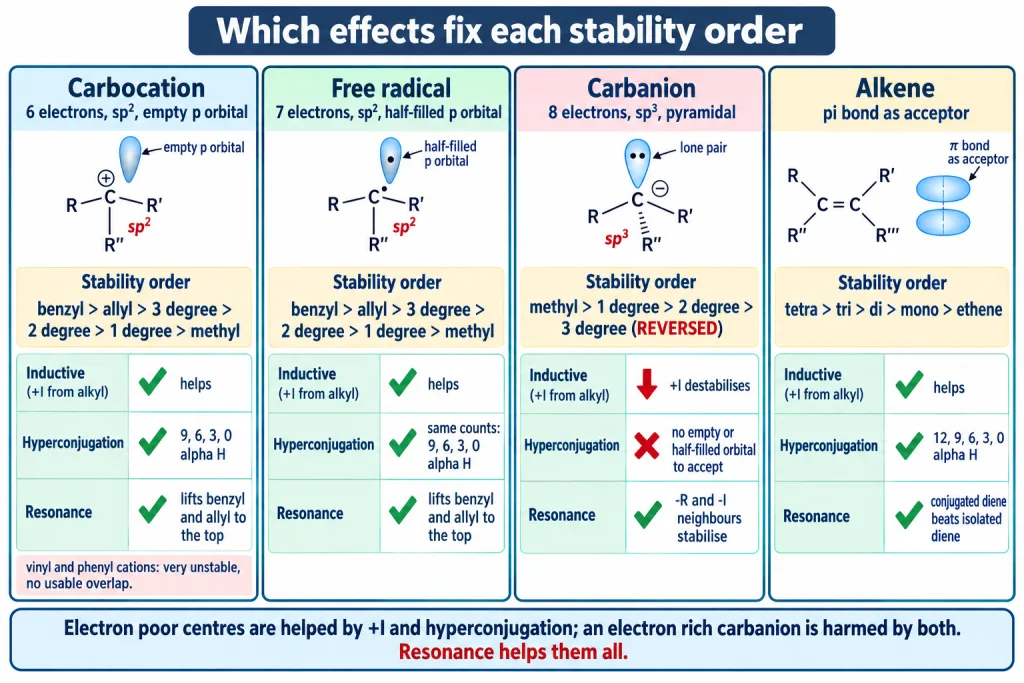
Three sentences carry all four orders. Cations and radicals are electron poor, so and hyperconjugation stabilise them, both scaling with the number of alkyl groups. Carbanions are electron rich, so the same two destabilise them and the order inverts, with and groups taking over. Resonance helps every one of them, whatever the sign of the charge.
Question 7: A full carbocation ranking
Arrange , , , , and in decreasing order of stability.
Answer:
Benzyl spreads its charge over four carbons and allyl over two, so benzyl leads, allyl follows, and both beat any simple alkyl cation. Among those, tert-butyl has 9 alpha hydrogens and three methyls, ethyl 3 and one, methyl 0 and none.
The phenyl cation has its empty orbital in the ring plane, so the aromatic cloud cannot reach it and no alpha is aligned. It ends up below even the methyl cation.
Ans:
Watch out: Benzyl and phenyl sit at opposite ends of that list. Benzyl puts the charge on a outside the ring, where the pi system reaches it; phenyl puts it on a ring carbon, where it cannot.
Question 8: Hyperconjugation against resonance
The tert-butyl cation has 9 alpha hydrogens and the allyl cation has almost none available. Why is the allyl cation still the more stable?
Answer:
In the help is nine hyperconjugative structures plus the push of three methyls, both partial displacements of density towards the positive carbon.
In the only carbon attached to the positive centre is the of the double bond, whose single hydrogen lies in the plane of the pi system rather than along the empty orbital, so hyperconjugation contributes nothing worth counting. What allyl has instead is a bond parallel to the empty orbital; the two overlap and the charge is shared equally by two carbons, two equivalent contributors that beat nine minor ones.
Ans: The allyl cation wins; resonance is the stronger effect here and decides the comparison even though tert-butyl has by far the larger alpha-hydrogen count.
Watch out: A large alpha-hydrogen count decides a comparison only against another cation that also depends on hyperconjugation. Against a resonance-stabilised one, stop counting and look at the delocalisation.
Question 9: Two effects of one chlorine
Which is more stable, or ? Chlorine is , which should make the second worse.
Answer:
The standard warning about halogens applies: chlorine is but .
By alone it drains density from a carbon already two electrons short, and the chloro cation should lose. But chlorine also carries lone pairs, and one of them sits in a orbital parallel to the empty orbital on the adjacent positive carbon. Donated into that orbital, it gives a contributor with a double bond in which carbon has a complete octet and the charge has moved on to chlorine.
A whole lone pair delivered into the orbital that needs it outweighs a partial withdrawal along a sigma bond. Section 11 records the consequence: adds to to give , the cation forming on the carbon that already carries the halogen.
Ans: is the more stable, because the lone-pair donation beats the withdrawal.
Watch out: The same halogen loses the argument in chlorobenzene, where decides the overall ring density and only decides which positions react. Which effect wins depends on what is being compared.
Question 10: A carbanion hidden in a list
Arrange , , and in decreasing order of stability, and say why alpha-hydrogen counting is useless here.
Answer:
The charge is negative, so I stop counting before I start.
A carbanion carbon is and pyramidal with a full octet — three bonding pairs and a lone pair, every orbital occupied — so there is no empty or half-filled orbital for a sigma pair to enter.
What remains is the effect of the alkyl groups, harmful at an already electron-rich centre. Methyl has none, ethyl one, isopropyl two, tert-butyl three.
Ans: . Counting is useless because there is no acceptor orbital, and because extra density is unwelcome at a centre with a complete octet and a full negative charge.
Watch out: Putting tert-butyl first is the commonest single error in the topic. It comes from carrying the carbocation reflex across without checking the sign.
Which effect wins when they compete
All four effects can operate in one molecule, and they do not always point the same way. A working hierarchy helps, provided its limits come with it.
Resonance generally beats the inductive effect. It moves a whole pi pair or lone pair across a delocalised system, while induction only leans a sigma pair towards one end of a bond and dies out beyond the third carbon. That is why phenol is about a million times more acidic than ethanol, and why benzyl and allyl cations sit above every alkyl cation.
"Generally" is doing real work there. The rule is a tendency, not a law, and the counterexample is in section 12: in chlorobenzene the chlorine is and at once, and the two settle different questions. wins on total electron density, so the ring is deactivated; decides where reaction happens, so the compound is ortho and para directing. Ask which property is being compared before deciding which effect governs it.
Hyperconjugation is comparable to, or a little weaker than, resonance. Its contributors all separate charge and break a bond, which makes each of them minor, and head to head — allyl with two equivalent contributors against tert-butyl with nine minor ones — resonance takes it. But hyperconjugation operates where resonance cannot: a saturated alkyl group has no lone pair and no pi bond, so hyperconjugation is the only delocalisation on offer. Every alkene order and every alkyl carbocation order in this chapter rests on it.
Hyperconjugation is the larger of the two alkyl effects. Beside an electron-poor centre, release and hyperconjugation point the same way and are hard to separate experimentally. The position used throughout this chapter is that hyperconjugation is the bigger, since the gaps between methyl, ethyl, isopropyl and tert-butyl track the alpha-hydrogen counts more closely than anything induction predicts alone.
The electromeric effect is not in this comparison at all. It is the strongest displacement while it lasts, transferring a complete pi pair and producing full charges, and section 11 gives it the verdict whenever it opposes induction. But it exists only while an attacking reagent is present, and stability comparisons of isolated ions, radicals or alkenes are questions about ground states.
Key Point: For the permanent effects the working order of strength is resonance, then hyperconjugation, then inductive — with the reminder that a strong group can still control a total-density comparison. The electromeric effect is stronger than any of them while a reagent is present and absent otherwise, so it never enters a stability order.
The four effects side by side
| Feature | Inductive | Electromeric | Resonance | Hyperconjugation |
|---|---|---|---|---|
| Permanent or temporary | permanent | temporary | permanent | permanent |
| Electrons that move | pair, shifted partly | pair, transferred completely | electrons and lone pairs | electrons of a bond next to an empty orbital, a half-filled orbital or a bond |
| Attacking reagent needed | no | yes | no | no |
| Structural requirement | a bond to a group attracting or releasing electrons more strongly than hydrogen | a multiple bond, and a reagent attacking it | conjugation: the group bonded directly to a doubly bonded carbon or an aromatic ring, its lone pair or bond parallel to the orbitals | an alpha bond next to an empty orbital, a half-filled orbital or a bond, aligned for overlap |
| Charge produced | partial, and | full and | partial, on the atoms of the system | partial |
| Sub-types | and | and | and | none |
| Worked example | of chlorine makes chloroacetic acid much stronger than acetic acid | shift in ethene as a proton approaches, giving | phenoxide delocalisation makes phenol far more acidic than ethanol | the 9 alpha hydrogens of make it the most stable simple carbocation |
A reading order for any stability question
- Read the charge. Positive, or a radical dot, means electron poor, so releasing groups help; negative means electron rich, so withdrawing groups help.
- Look for conjugation first, checking that the orbitals are parallel — the phenyl cation is the reminder that a pi system in the wrong plane is no help.
- With no conjugation, count alpha hydrogens, which mean nothing for a carbanion.
- Use induction to break ties, remembering that it fades past the third carbon, and check hybridisation last: a positive charge is worst on an carbon, a lone pair best on one.
Question 11: Effects pulling opposite ways
In methylbenzene the methyl group is and hyperconjugating, raising the ring density; in nitrobenzene the nitro group is and , lowering it. What happens in 4-nitrotoluene, and which side wins?
Answer:
The methyl releases density into the ring by and by hyperconjugation from its three alpha hydrogens — a partial sigma displacement and three minor contributors, both modest.
The nitro group withdraws by and by . Its nitrogen carries a formal positive charge, which is why heads the series, and its effect pulls pi density right out of the ring on to the nitro oxygens. A strong withdrawer using both mechanisms against a weak releaser using two weak ones is not close.
Ans: The nitro group wins comfortably. The ring of 4-nitrotoluene is poorer in electrons than methylbenzene and poorer than benzene, so it is deactivated towards electrophiles — though less so than nitrobenzene, since the methyl offsets a little of the withdrawal.
Watch out: Which effect is stronger is decided by the groups, not the labels. A nitro group beats a hyperconjugating methyl; a lone pair on chlorine beats that same chlorine's effect on an adjacent cation.
Question 12: Two dienes and the right name for the effect
Which is more stable, penta-1,3-diene or penta-1,4-diene, and is the reason hyperconjugation?
Answer:
Penta-1,3-diene is and penta-1,4-diene is .
In the 1,4-isomer an carbon stands between the two double bonds and breaks the chain of parallel orbitals, so the two pi bonds are independent.
In the 1,3-isomer the four orbitals form one continuous parallel set and the four pi electrons are delocalised over all four carbons. A pi system conjugating with another is plain resonance; hyperconjugation would need a sigma bond delocalising into the pi system. The measurable sign is the heat of hydrogenation, lower for the conjugated diene by roughly 15 kJ/mol.
Ans: Penta-1,3-diene, by conjugation of the two pi bonds — a resonance effect. Hyperconjugation is a separate, smaller contribution from the terminal methyl and its 3 alpha hydrogens.
Watch out: Both dienes have alpha hydrogens, so counting settles nothing. The question is whether the two pi bonds can reach each other, and that depends on whether an carbon stands between them.