
Card 1 — Carbon: tetravalence, catenation and the three hybrid states
Carbon is tetravalent: four valence electrons, no route to the octet except sharing, and no d orbitals in the second shell, so its covalency cannot exceed four.
Key Point (Definition): Catenation is the ability of an element to form bonds between its own atoms, giving chains and rings. Carbon catenates as no other element does, its C-C bond being short and strong.
| Hybrid state | s character | Shape | Bond angle | Typical bond | Length | Bond enthalpy |
|---|---|---|---|---|---|---|
| 25% | tetrahedral | 109.5 degrees | C-C single | 154 pm | 348 kJ/mol | |
| 33.3% | trigonal planar | 120 degrees | C=C double | 134 pm | 681 kJ/mol | |
| 50% | linear | 180 degrees | carbon-carbon triple | 120 pm | 823 kJ/mol |
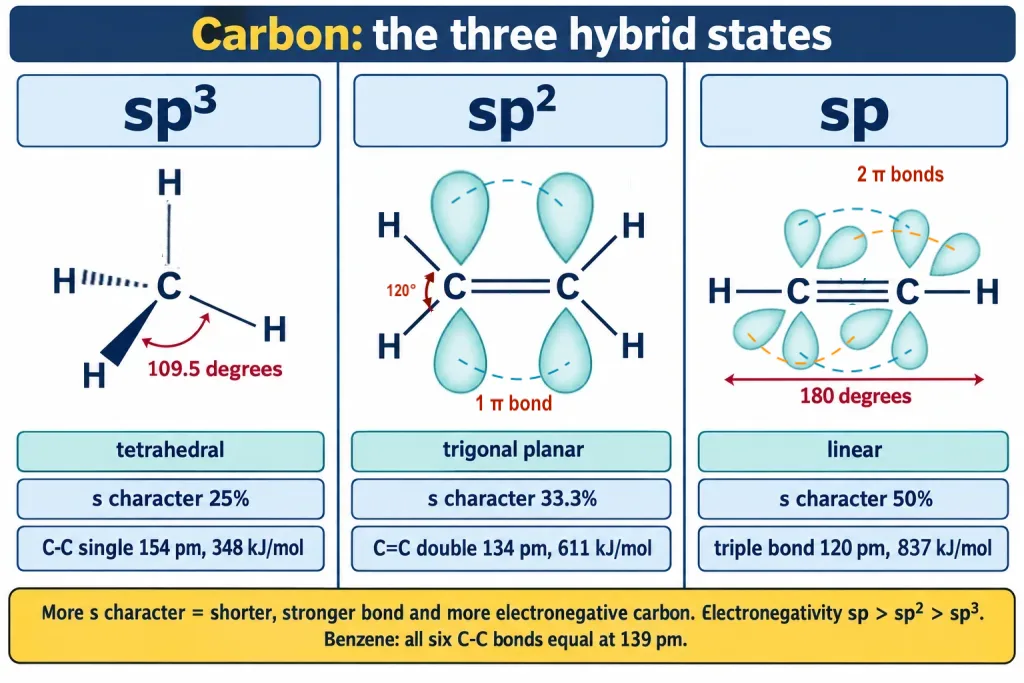
Assign the hybrid state by counting sigma bonds: four means , three , two .
More s character means a shorter, stronger bond and a more electronegative carbon, so electronegativity runs and acidity ethyne > ethene > ethane.
Outside the pattern: ethane's C-H at 109 pm; the C-H bond enthalpy of 414 kJ/mol, larger than C-C at 348; benzene's six equal C-C bonds at 139 pm with all ring angles 120 degrees; benzene's resonance energy of 150 kJ/mol. A double bond is not twice a single bond: 681 is short of .
Card 2 — Sigma against pi: rotation, and why pi is the reactive one
| Sigma | Pi | |
|---|---|---|
| Overlap | head-on, axial | sideways, parallel p orbitals |
| Cloud | on the internuclear axis | above and below the plane |
| Rotation | free | restricted |
| Strength | stronger | weaker |
| Exists alone | yes | never, only with a sigma |
A single bond is one sigma, a double bond one sigma and one pi, a triple bond one sigma and two pi. The first bond is always sigma.
Key Point: Rotation about a sigma bond is essentially free. The overlap, and therefore the energy, does not change as the two ends turn.
Key Point: Rotation about a pi bond is restricted. Turning either end would break the parallel p-p overlap, so the two ends of a double bond are locked in one plane.
Free rotation about C-C is why butane has no cis and trans forms; restricted rotation about C=C makes geometrical isomerism possible.
Why pi is the reactive bond. Sideways overlap is poorer, so a pi bond is weaker than its sigma partner, and its electrons lie further from both nuclei, exposed and loosely held. An electrophile meets them first, so alkenes and alkynes react by addition: the pi bond is cheap to break and the sigma framework survives.
Card 3 — The representations, and what each one hides
| Representation | Shows | Hides |
|---|---|---|
| Complete structural | every atom and every bond | all three-dimensional information |
| Condensed | full connectivity in one line | shape; careless brackets hide branching |
| Bond-line (skeletal) | the carbon skeleton and ring shape | hydrogens on carbon, which must be inferred |
| Wedge-and-dash | the arrangement of groups in space | nothing, but it clutters a large molecule |
Changing the representation never changes the compound: if a conversion appears to change the molecular formula, the conversion is wrong.
Reading a bond-line formula — the three rules.
- Carbon sits at every vertex and at every free end of a line. No C is written.
- Hydrogens on carbon are not written at all. Each carbon takes as many as it needs to reach four bonds: four lines means no hydrogen, three lines one, two lines two, one line three.
- Hydrogens on nitrogen, oxygen and sulphur are always written. A labelled heteroatom occupies its vertex, so that vertex is not a carbon.
Four errors lose nearly all the marks: counting one carbon per line segment, forgetting that a labelled heteroatom takes over its position, adding hydrogens to a carbon that already has four bonds, and leaving the hydrogen off an or .
Card 4 — Classification of organic compounds: the whole tree
- Acyclic (open chain, aliphatic): propane
- Cyclic
- Alicyclic (carbocyclic, non-aromatic): cyclohexane
- Aromatic
- Benzenoid (has a benzene ring): toluene
- Non-benzenoid (aromatic, no benzene ring): tropolone
- Heterocyclic (heteroatom in the ring)
- Aromatic heterocyclic: pyridine
- Alicyclic heterocyclic: tetrahydrofuran
Three checks place any compound. Is there a ring? No means acyclic. Is every ring atom carbon? No means heterocyclic. Is the ring aromatic — planar, cyclic, fully conjugated, pi electrons? No means alicyclic; yes means aromatic, and a benzene hexagon then decides benzenoid against non-benzenoid.
Key Point (Definition): Alicyclic = carbocyclic and non-aromatic. Unsaturation alone does not make a ring aromatic; the ring must also be planar, fully conjugated and carry pi electrons.
Aromatic is the bigger box; benzenoid is one compartment inside it.
The commonest misfiling puts a substituted benzene such as phenol or aniline into the heterocyclic box. Ask where the heteroatom sits — in the ring, or on it. Aniline carries off the ring, so it is benzenoid; piperidine has nitrogen in a saturated ring, so it is alicyclic heterocyclic.
Card 5 — Functional groups: class, formula, suffix, prefix
Key Point (Definition): A functional group is the atom or group of atoms bonded to the carbon skeleton that gives the molecule its characteristic chemical properties. It is the seat of reactivity.
| Class | Formula | Suffix | Prefix when not senior |
|---|---|---|---|
| carboxylic acid | -oic acid | carboxy | |
| ester | -yl …oate | alkoxycarbonyl | |
| acid chloride | -oyl chloride | halocarbonyl | |
| amide | -amide | carbamoyl | |
| nitrile | -nitrile | cyano | |
| aldehyde | -al | oxo (or formyl) | |
| ketone | -one | oxo | |
| alcohol | -ol | hydroxy | |
| amine | -amine | amino | |
| alkene | -ene | - | |
| alkyne | -yne | - | |
| ether | - | alkoxy | |
| haloalkane | - | halo | |
| nitro | - | nitro |
Two-carbon examples fix the table: ethanol , ethanal , ethanoic acid , ethanenitrile , ethanamine , propanone .
In an aldehyde the carbonyl carbon carries a hydrogen, in a ketone two carbons. Amino is basic and donates by resonance; nitro heads the series. Skeleton for physical properties, functional group for chemical properties.
Card 6 — Homologous series, general formulae, homologue against isomer
Key Point (Definition): A homologous series is a family of organic compounds in which successive members differ by one unit, all members contain the same functional group, all members fit one general formula, and the physical properties show a regular gradation with increasing molar mass. Individual members are homologues.
| General formula | Series sharing it |
|---|---|
| alkanes | |
| alkenes, cycloalkanes | |
| alkynes | |
| arenes | |
| alcohols, ethers | |
| aldehydes, ketones | |
| carboxylic acids, esters | |
| primary amines | |
| haloalkanes | |
| nitriles |
Every row naming two series is a functional-isomer pair, and a shared formula does not mean a shared series: cyclobutane and but-1-ene are both , in different families. Ethanol and propan-1-ol are homologues; ethanol and methoxymethane are isomers.
Key Point: Two compounds can never be homologues and isomers at the same time. Homologues have different molecular formulae by definition; isomers have the same molecular formula by definition. The two relationships are mutually exclusive.
Card 7 — IUPAC nomenclature: the rule order as a checklist
A name is prefix + word root + primary suffix + secondary suffix; the root counts carbons in the parent chain, not in the molecule.
- Pick the longest chain containing the principal functional group. A longer chain that misses it is not a candidate. On a tie in length, take the one with more substituents.
- Number from the end giving the lowest locant to the principal functional group. The functional group beats a double or triple bond, which beats a substituent.
- When a choice remains, apply the first point of difference: compare the two increasing locant sets term by term, and the smaller number wins where they first differ. Adding locants up is not the rule — and both total 10, and is lower.
- Cite prefixes alphabetically. Multiplying prefixes di, tri and tetra are not counted; iso, neo and cyclo are; sec- and tert- are not. On identical locant sets the lower number goes to the substituent cited first alphabetically.
- Punctuate. Commas between numbers, hyphens between a number and a letter, no space inside the name, a repeated locant written out: 2,2-dimethyl, never "2-dimethyl".
- Place every locant immediately before the part of the name it refers to — pent-2-ene, not 2-pentene.
Elision. Drop the terminal -e of the parent hydride before a vowel (butan-1-ol), keep it before a consonant (butanenitrile, propane-1,2-diol), and take the full -a form before a multiplying prefix (buta-1,3-diene). A chain aldehyde carbon is always C-1, so write butanal, never "butan-1-al".
Card 8 — Seniority: which group becomes the suffix
Key Point (Definition): The principal characteristic group is the senior-most functional group present. It alone becomes the suffix, it alone controls the choice of parent chain, and it alone gets first claim on the lowest locant. Every other group is demoted to a prefix.
Read left to right and stop at the first group your molecule contains; that group is the suffix.
Always prefixes, never suffixes: halo (fluoro, chloro, bromo, iodo), nitro, nitroso, alkoxy, alkyl, phenyl.
Key Point: The priority for numbering is principal group first, then multiple bond, then substituents. Numbering for the substituent because it "looks lower" loses the mark every time.
A demoted ketone becomes oxo; a demoted aldehyde is oxo when its carbon is in the parent chain and formyl when it cannot be, as when the hangs off a ring. So is 4-oxopentanoic acid.
Unsaturation is an infix between root and suffix, each part with its own locant. is but-3-en-1-ol: the hydroxyl claims C-1 even though the other numbering would give the alkene a lower locant. In hex-4-en-2-one the numbers are not interchangeable — the one before -en- is the double bond, the one before -one the carbonyl.
Card 9 — Substituted benzenes: o, m, p, trivial names, phenyl against benzyl
Key Point (Definition): Two substituents on adjacent ring carbons are ortho (1,2). Separated by one carbon they are meta (1,3). Directly opposite, across the ring, they are para (1,4).
Any other pairing reduces to one of these three — 1,5 is 1,3 the other way, 1,6 is 1,2 — so there are three disubstituted isomers, never six. The system works for exactly two substituents; with three or more, numbering becomes compulsory.
When one of the two groups can be a suffix it takes C-1, as the does in 4-nitrophenol.
| Retained name | Structure | Systematic name |
|---|---|---|
| toluene | methylbenzene | |
| phenol | hydroxybenzene | |
| aniline | aminobenzene | |
| benzaldehyde | benzenecarbaldehyde | |
| benzoic acid | benzenecarboxylic acid | |
| styrene | ethenylbenzene | |
| anisole | methoxybenzene | |
| acetophenone | 1-phenylethan-1-one | |
| cumene | (1-methylethyl)benzene |
Use the first five as parents; write anisole, styrene and acetophenone derivatives systematically.
Key Point (Definition): Phenyl, , is benzene minus one hydrogen, attaching through a ring carbon, six carbons. Benzyl, , is toluene minus one hydrogen from the methyl, attaching through an carbon, seven carbons.
So is chlorobenzene and benzyl chloride; is phenol and benzyl alcohol. Phenol is not an alcohol: its sits on an ring carbon.
Card 10 — Structural isomerism: the five types
Key Point (Definition): Compounds with the same molecular formula but different structures are isomers. When the difference lies in the order in which the atoms are joined, they are structural isomers.
| Type | Criterion | Example pair |
|---|---|---|
| Chain | same formula and group, different carbon skeleton; needs at least 4 carbons | butane and 2-methylpropane |
| Position | same skeleton and group, different locant for the group or multiple bond | propan-1-ol and propan-2-ol |
| Functional group | same formula only, different functional group and family | ethanol and methoxymethane |
| Metamerism | same divalent group, carbons split differently on its two sides | ethoxyethane and methoxypropane |
| Tautomerism | a hydrogen atom has migrated and a double bond has shifted; a real equilibrium | propanone and prop-1-en-2-ol |
Ask in that order and the first yes is the answer: skeleton changed, group moved on an unchanged skeleton, group itself changed, split around a divalent group changed, hydrogen migrated with a double bond.
Never quote an isomer count you have not enumerated; the fixed ones are gathered on Card 22. Keto-enol tautomerism needs at least one hydrogen on the carbon alpha to the carbonyl.
If the two names agree, the two drawings are one compound — "3-methylbutane" is 2-methylbutane numbered from the wrong end.
Card 11 — Stereoisomerism: cis-trans, chirality, enantiomers, the rule
Key Point (Definition): Stereoisomers have the same molecular formula and the same sequence of bonded atoms, and differ only in the arrangement of those atoms in space.
Geometrical isomerism — the two conditions. Restricted rotation about a rigid unit (, , or a ring), and two different groups on each doubly bonded carbon. But-2-ene passes; but-1-ene fails, its terminal carbon carrying two hydrogens.
E and Z. Higher-priority groups on the same side is Z, on opposite sides E. Z does not always mean cis.
cis wins on dipole moment and boiling point; trans on melting point.
Key Point (Definition): A molecule is chiral if it is not superimposable on its mirror image. An asymmetric carbon (chiral carbon, stereocentre) is an carbon bonded to four different groups, marked . Enantiomers are a pair of stereoisomers that are non-superimposable mirror images.
Enantiomers differ in exactly two ways: in the sign, never the magnitude, of the optical rotation — dextrorotatory or d clockwise, laevorotatory or l anticlockwise — and in their behaviour towards a chiral reagent, enzymes included, where the two give different rates and different products. Every scalar property — melting point, boiling point, density, refractive index, solubility in an achiral solvent — is identical.
Key Point (Definition): A racemic mixture is an equimolar, 50:50 mixture of the two enantiomers. It is optically inactive by external compensation, is written or , and has specific rotation zero. Separating it is resolution.
Key Point: A molecule with unlike chiral carbons has at most optical isomers, in pairs of enantiomers.
A molecule with a plane of symmetry is achiral however many stereocentres it has: internal compensation, giving a meso form. Tartaric acid has two stereocentres, so predicts 4, but one is meso, leaving 3.
Card 12 — Resonance against tautomerism
One question settles it: did a nucleus move?
| Resonance | Tautomerism | |
|---|---|---|
| What exists | one molecule, the hybrid | two different molecules |
| What moves | electrons only, pi pairs and lone pairs | a hydrogen atom, so nuclei move |
| Arrow used | ||
| Equilibrium constant | none, there is no equilibrium | yes, and measurable |
| Can a form be isolated | never, the forms do not exist | yes, in favourable cases |
| Typical case | benzene, the acetate ion | keto and enol forms of acetone |
Benzene does not flip between the two Kekule structures. There is no equilibrium, no rate of interconversion, and no instant at which benzene has three short bonds and three long ones — all six are 139 pm all the time. Never write between resonance structures, and never say a molecule oscillates or flickers between them. Acetone and its enol, by contrast, are two real substances in a real equilibrium, a hydrogen having moved from carbon to oxygen.
A legal contributing structure keeps every nucleus in place, moves only pi electrons and lone pairs, and obeys the octet rule.
Key Point (Definition): The resonance energy is the energy difference between the real hybrid and the most stable single contributing structure. The hybrid is always the lower. For benzene it is 150 kJ/mol.
Card 13 — Bond fission and the three intermediates
Key Point (Definition): In homolytic fission the shared pair divides evenly, one electron to each fragment, giving free radicals. In heterolytic fission the shared pair goes intact to one fragment, giving ions.
Homolysis takes two fishhook (half-headed) arrows and needs ultraviolet light, heat or a peroxide on a weak, non-polar bond. Heterolysis takes one full curved arrow to the atom that keeps the pair, and needs a polar bond, a polar solvent or a Lewis acid.
| Intermediate | Electrons on C | Charge | Hybridisation | Shape | Stability order |
|---|---|---|---|---|---|
| Free radical | 7 | neutral | very nearly planar (pyramidal in some cases) | benzyl > allyl > tertiary > secondary > primary > methyl | |
| Carbocation | 6 | trigonal planar, empty orbital perpendicular | benzyl > allyl > tertiary > secondary > primary > methyl | ||
| Carbanion | 8 | pyramidal, lone pair in the fourth orbital | methyl > primary > secondary > tertiary (reversed) |
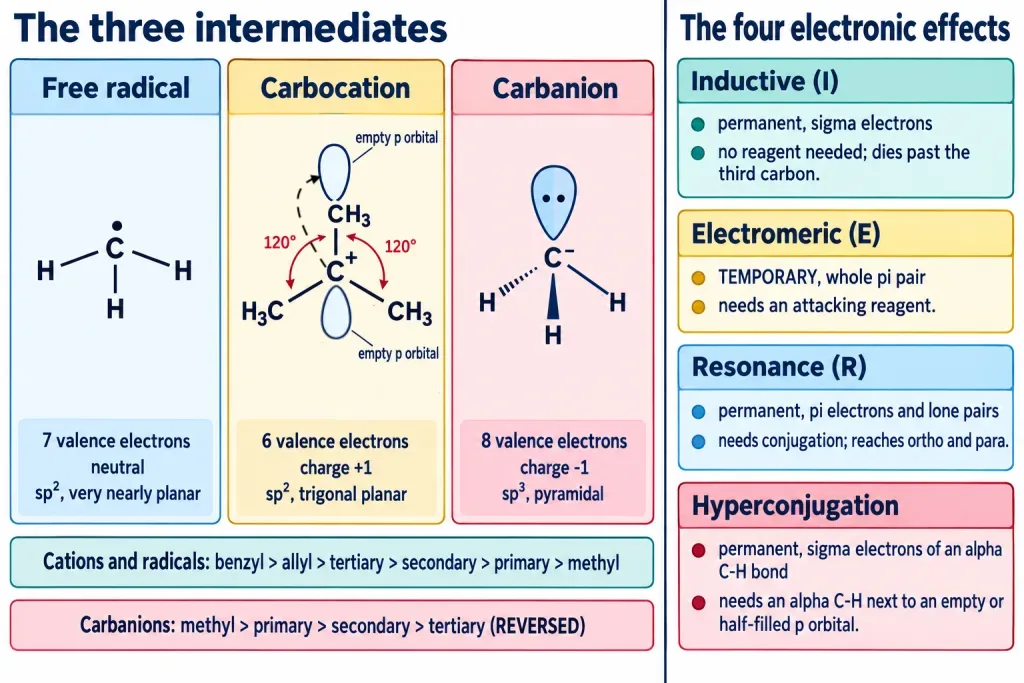
Three lines carry the table. Electron counts 7, 6, 8 for radical, cation, anion. Shapes flat, flat, pyramidal. Orders same, same, reversed — radicals and cations are both electron poor, the carbanion is electron rich. Vinyl and phenyl cations sit below the methyl cation.
Card 14 — The four electronic effects in one table
| Feature | Inductive | Electromeric | Resonance | Hyperconjugation |
|---|---|---|---|---|
| Permanence | permanent | temporary | permanent | permanent |
| Electrons that move | pair, shifted partly | pair, transferred completely | electrons and lone pairs | electrons of an alpha bond |
| Reagent needed | no | yes | no | no |
| Structural requirement | a bond to a group more withdrawing or releasing than hydrogen | a multiple bond and a reagent attacking it | conjugation: the group joined directly to a or an aromatic ring | an alpha next to an empty or half-filled orbital, or a bond |
| Charge produced | partial, and | full and | partial, across the system | partial |
| Sub-types | , | , | , | none |
| Example | of chlorine makes chloroacetic acid much stronger than acetic acid | shift in ethene as a proton approaches | phenoxide delocalisation makes phenol far more acidic than ethanol | the 9 alpha hydrogens of |
Hydrogen is the zero of the inductive scale. The inductive effect is negligible beyond the third carbon, the displacement falling as , , — smaller each step, not larger. Resonance delivers charge to the ortho and para carbons of a ring, never the meta.
Key Point: For the permanent effects the working order of strength is resonance, then hyperconjugation, then inductive — with the reminder that a strong group can still control a total-density comparison. The electromeric effect is stronger than any of them while a reagent is present and absent otherwise, so it never enters a stability order.
Card 15 — The four series, and the halogen anomaly
Minus-I, electron withdrawing, decreasing strength:
Charge first, electronegativity second: the formal on the nitrogen of heads the list, and the halogens rank by electronegativity, not by size.
Plus-I, electron releasing, decreasing strength:
and donate more strongly than any alkyl group.
Plus-R (a lone pair on the attached atom, donated into the pi system): , , , , , , , (F, Cl, Br, I), .
Minus-R (a multiply bonded electronegative atom, pulling pi electrons out): , , , , , , , .
Read the attachment atom, not the whole group: donates through nitrogen despite its carbonyl, withdraws through carbon despite its nitrogen.
The halogen anomaly. Halogens are but . In chlorobenzene wins over the whole ring, so the compound is deactivated, while alone discriminates between positions, so it is ortho and para directing.
Key Point: Rate is set by the effect, orientation by the effect. Whenever a group is both, answer the two questions separately.
Card 16 — Hyperconjugation, alpha hydrogens, and all four stability orders
Key Point (Definition): Hyperconjugation is the permanent delocalisation of the electrons of a bond on the carbon adjacent to an empty orbital, a partly filled orbital or a bond. It needs no attacking reagent, and the electrons it moves are electrons.
It is called no-bond resonance because every contributor draws the alpha bond broken, the hydrogen carrying the positive charge. The hydrogen does not actually leave.
Key Point: The number of hyperconjugative structures equals the number of alpha hydrogens — hydrogens on the carbon adjacent to the cation centre, radical centre or doubly bonded carbon, never on the centre itself.
has 9, 6, 3, 0. Hydrogens on a doubly bonded carbon itself are vinylic, never alpha.
Carbocations, and free radicals in the same order, a half-filled orbital acting like an empty one:
Carbanions, the exact reverse:
A carbanion has a full octet, so release and hyperconjugation both destabilise it; count alpha hydrogens only when the centre is short of electrons. What helps it is and groups and s character.
Alkenes:
with 12, 9, 6, 3 and 0 alpha hydrogens; count alkyl groups on the two doubly bonded carbons, not in the molecule. Resonance helps every one of these species, whatever the sign of the charge.
Card 17 — The four reaction types, plus Markovnikov and Saytzeff
| Type | Degree of unsaturation | Typical reagent | Example |
|---|---|---|---|
| Substitution | unchanged | nucleophile, electrophile, or a halogen with light | |
| Addition | falls by one | HX or across ; a nucleophile at | |
| Elimination | rises by one | hot alcoholic KOH, or hot conc. | |
| Rearrangement | unchanged | no external reagent joins; acid or heat |
For a rearrangement the molecular formula is identical on both sides.
Substitution has three flavours: nucleophilic on a haloalkane, free radical on an alkane with light or heat, electrophilic on an arene. Addition has two: electrophilic across an alkene, nucleophilic at a carbonyl carbon, where the nucleophile goes to carbon and never to oxygen.
Key Point: Markovnikov's rule. When an unsymmetrical alkene or alkyne adds a polar reagent , the negative part of the reagent attaches to the carbon carrying the smaller number of hydrogen atoms. Equivalently, and more usefully: the addition proceeds through whichever carbocation is more stable.
Key Point: Saytzeff's rule. In a beta-elimination the major product is the more highly substituted, and so the more stable, alkene. Equivalently, the hydrogen is preferentially removed from the beta carbon carrying the fewer hydrogens.
Markovnikov follows from cation stability, so check for a 1,2-shift whenever your cation is secondary and a tertiary one is one shift away.
Card 18 — Purification: the decision table and
An impurity depresses the melting point and widens the melting range; depression plus broadening is the test.
| Situation | Method |
|---|---|
| Volatile solid, non-volatile impurity | sublimation (camphor, naphthalene, anthracene) |
| Solubility differs sharply from the impurity or with temperature | crystallisation from the minimum hot solvent |
| Two solids of different solubility in one solvent | fractional crystallisation, less soluble first |
| Boiling points far apart, no decomposition | simple distillation (chloroform 334 K from aniline 457 K) |
| Boiling points close together | fractional distillation (acetone 329 K from methanol 338 K) |
| Liquid decomposes at its normal boiling point | distillation under reduced pressure (glycerol) |
| Volatile in steam and immiscible with water | steam distillation (aniline, at ) |
| Solute more soluble in an immiscible organic solvent | differential extraction |
| Several similar components, milligram quantities | chromatography |
Steam distillation works because two immiscible liquids each exert their full vapour pressure, so the mixture boils when — the pressures add, and it distils below .
Adsorption chromatography (column, thin layer) uses a solid stationary phase, silica gel or alumina. Partition chromatography (paper) uses a liquid one, the water held on the cellulose, for which the paper is only the support.
Key Point (Definition): = (distance travelled by the substance) / (distance travelled by the solvent front), both measured from the base line to the centre of the spot. It has no units and always lies between 0 and 1.
A low means strongly adsorbed; in a column the least strongly adsorbed component moves fastest and is eluted first.
Card 19 — Qualitative analysis: element, reagent, observation
Covalent compounds give no ions in solution, so every element is first converted to a sodium salt by fusion with sodium metal, and the fused mass extracted with water to give Lassaigne's sodium fusion extract.
| Element | Reagent | Observation | Product |
|---|---|---|---|
| carbon | dry CuO, into lime water | milky white | |
| hydrogen | dry CuO, anhydrous | white turns blue | |
| nitrogen | fresh , warm, then conc. | Prussian blue | |
| sulphur | sodium nitroprusside | violet | |
| sulphur | lead acetate in acetic acid | black precipitate | |
| nitrogen and sulphur | blood red | ||
| halogen | dil. , boil, | white and ammonia-soluble; pale yellow and sparingly soluble; yellow and insoluble | ; ; |
| phosphorus | , then ammonium molybdate in | yellow precipitate | ammonium phosphomolybdate |
The iron(III) that Prussian blue needs is not added; it comes from aerial oxidation of iron(II) in the alkaline extract.
Key Point: A blood-red colour means nitrogen and sulphur are both present, because the fusion gave rather than . It is a positive result for two elements at once, not a failed nitrogen test, and it says nothing about iron in the compound. With sodium in large excess the thiocyanate is broken down, , and the two elements then give their own separate tests.
Boiling with dilute nitric acid before adding silver nitrate is compulsory: it expels and , which otherwise give white and black .
Card 20 — Quantitative analysis: every formula in one place
With the mass of compound taken and the mass of the product weighed:
| Element | Method, and what is measured | Formula |
|---|---|---|
| Carbon | combustion; mass of | |
| Hydrogen | combustion; mass of | |
| Nitrogen | Dumas; volume of at STP, mL | |
| Nitrogen | Kjeldahl; volume of standard acid (monobasic acid; double for ) | |
| Halogen | Carius; mass of | |
| Sulphur | Carius; mass of | |
| Phosphorus | magnesia mixture; mass of | |
| Phosphorus | ammonium molybdate; mass of the yellow salt | |
| Oxygen | direct; mass of from the coke | |
| Oxygen | by difference |
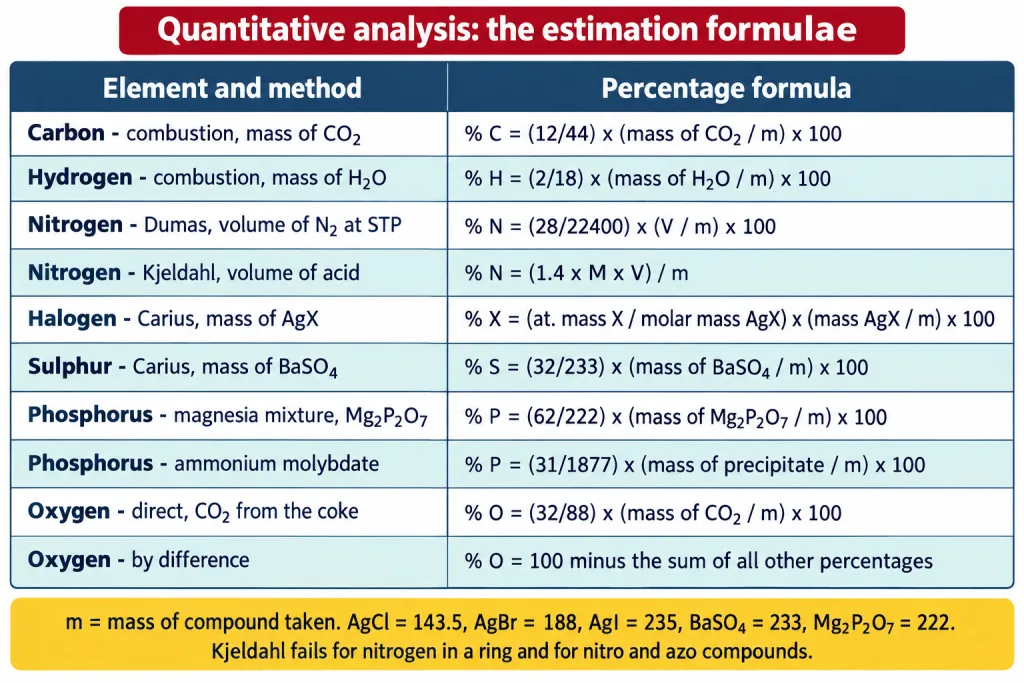
Molar masses: , , , , ; , , .
For Dumas, first correct the volume to 273 K and 760 mm with , subtracting the aqueous tension. The back-titration Kjeldahl form is . Kjeldahl fails for nitrogen in a ring and for nitro and azo compounds.
Empirical to molecular. Divide each percentage by the atomic mass, divide all by the smallest, multiply up to whole numbers. Then molar mass / empirical formula mass, the molecular formula being the empirical formula times . Double the vapour density first.
Card 21 — Twenty mistakes that cost marks in this chapter
- Drawing benzene's ring bonds as 134 and 154 pm alternately, when all six are 139 pm.
- Calling a double bond two pi bonds; it is one sigma and one pi.
- Assuming a double bond is twice a single bond, when 681 kJ/mol is short of .
- Counting one carbon per line segment, not one per vertex and free end.
- Leaving the hydrogen off an or in a bond-line drawing.
- Filing phenol or aniline as heterocyclic, when the heteroatom is on the ring, not in it.
- Alphabetising under the multiplying prefix, giving "2,5-dimethyl-3-ethylheptane".
- Choosing the parent chain by length when it does not hold the principal group.
- Numbering for a substituent or a double bond ahead of the principal group.
- Adding locants up instead of applying the first point of difference.
- Writing "butan-1-al", when a chain aldehyde carbon is C-1 and takes no locant.
- Counting "3-methylbutane" separately, and reporting four isomers of .
- Calling benzyl chloride chlorobenzene; benzyl is the ring plus a .
- Using between resonance structures, or saying the molecule flickers.
- Answering 4 for tartaric acid without subtracting the meso form to get 3.
- Copying the carbocation order onto carbanions, which run methyl first.
- Counting hydrogens on the cationic carbon as alpha, giving 7 for .
- Ranking halogens by size in the series, which follows electronegativity.
- Reading a blood-red Lassaigne result as a failed nitrogen test.
- Using 108 for silver in place of 143.5, the molar mass of , in the Carius formula.
Card 22 — The last sixty seconds: numbers and one-liners
Lengths (pm). C-C 154, C=C 134, triple 120, benzene 139, C-H 109.
Enthalpies (kJ/mol). C-C 348, C=C 681, triple 823, C-H 414; benzene resonance energy 150.
Angles 109.5, 120, 180. s character 25%, 33.3%, 50%. Electronegativity .
Isomers. 2, 3, 5, 9, 18, 4, 2, 3, 7; 3 structural alkenes, 4 with cis-trans. Tartaric acid 3.
Alpha hydrogens. tert-butyl 9, isopropyl 6, ethyl 3, methyl 0.
Intermediates. radical 7 electrons, , flat; cation 6, , flat; carbanion 8, , pyramidal.
Seniority. acid, sulphonic acid, ester, acid halide, amide, nitrile, aldehyde, ketone, alcohol, amine, alkene or alkyne, alkane. Always prefixes: halo, nitro, nitroso, alkoxy, alkyl, phenyl.
Effects. Inductive dies beyond the third carbon; resonance reaches ortho and para only; electromeric needs a reagent; hyperconjugation counts alpha hydrogens. Halogens are but , deactivating yet ortho-para directing.
Orders. Cations and radicals benzyl > allyl > tertiary > secondary > primary > methyl; carbanions methyl > primary > secondary > tertiary; alkenes tetra > tri > di > mono > ethene.
Markovnikov puts the negative part on the carbon with fewer hydrogens, via the more stable cation. Saytzeff gives the more substituted alkene. has no units, 0 to 1.
Colours. Prussian blue, nitrogen; violet or black, sulphur; blood red, both; white , pale yellow , yellow ; yellow phosphomolybdate.
Factors. C 12/44, H 2/18, N 28/22400, S 32/233, P 62/222 or 31/1877, O 32/88; 143.5, 188, 235.
Card 23 — One question per topic: a five-minute self-check
Question 1: A bond length
Which carbon-carbon bond is 139 pm, and why does it fit nowhere in the 154-134-120 sequence?
Answer:
Delocalisation makes all six ring bonds equal, at a bond order between one and two.
Ans: Every C-C bond in benzene
Question 2: Sigma and pi count
How many sigma and how many pi bonds has propyne, ?
Answer:
Four C-H bonds, two C-C sigma bonds, two pi from the triple bond.
Ans: 6 sigma and 2 pi
Question 3: Reading a skeleton
An unbranched zig-zag of five segments carries HO at the right-hand end. What is it?
Answer:
Six positions, the last one oxygen, so five carbons remain.
Ans: Pentan-1-ol,
Question 4: Placing a ring
Classify tetrahydrofuran.
Answer:
A ring, one ring atom oxygen, fully saturated.
Ans: Alicyclic heterocyclic
Question 5: Prefix form
A molecule has both and a chain ketone. What happens to the ketone?
Answer:
The acid is senior, so the ketone is demoted, and a demoted ketone is oxo.
Ans: It becomes the prefix oxo, as in 4-oxopentanoic acid
Question 6: Homologue or isomer
Are ethanol and methoxymethane homologues or isomers?
Answer:
Both are , so the formulae are identical and the groups differ.
Ans: Functional group isomers, never homologues
Question 7: Alphabetical order
Which is cited first, an ethyl group or two methyl groups?
Answer:
Di is ignored, so ethyl is compared with methyl.
Ans: Ethyl, as in 3-ethyl-2,5-dimethylheptane
Question 8: Cis-trans possible or not
Does but-1-ene show geometrical isomerism?
Answer:
C-1 carries two hydrogens, failing the two-different-groups condition.
Ans: No
Question 9: Resonance or tautomerism
Acetone and prop-1-en-2-ol are joined by which arrow?
Answer:
A hydrogen has physically moved, so two real molecules are in equilibrium.
Ans: , this being tautomerism
Question 10: Intermediate shape
Give the hybridisation and shape of a carbanion.
Answer:
Three bonds plus a lone pair make four electron domains.
Ans: and pyramidal, 8 valence electrons on carbon
Question 11: Counting alpha hydrogens
How many alpha hydrogens has the isopropyl cation?
Answer:
The hydrogen on the positive carbon does not count; two methyls carry three each.
Ans: 6
Question 12: An analysis factor
Write the Carius expression for the percentage of chlorine.
Answer:
The factor uses the molar mass of silver chloride, never the mass of silver.
Ans: