
What quantitative analysis is for
Qualitative analysis answers "which elements are here". Quantitative analysis answers "how much of each", and it is the step that turns a purified unknown into a formula. The logic is the same in every method:
- Weigh out an accurately known mass of the pure, dry compound.
- Convert the element you want into one single, definite substance — a gas whose volume you can read, or a solid you can filter, dry and weigh.
- From the mass or volume of that substance, work back to the mass of the element.
- Express that mass as a percentage of .
Every formula in this section is steps 3 and 4 rolled together, and the fraction in front is always the mass of the element divided by the molar mass of the thing you measured.
Key Point: Nothing here works on an impure sample. Purification comes first, and the compound must be dry — trapped solvent adds to and pushes every percentage down.
Carbon and hydrogen together, by combustion
Principle. Burn the compound completely in a current of pure, dry oxygen. Every carbon atom leaves as and every hydrogen atom leaves as . Trap the two products separately, weigh each, and the carbon and hydrogen contents follow.
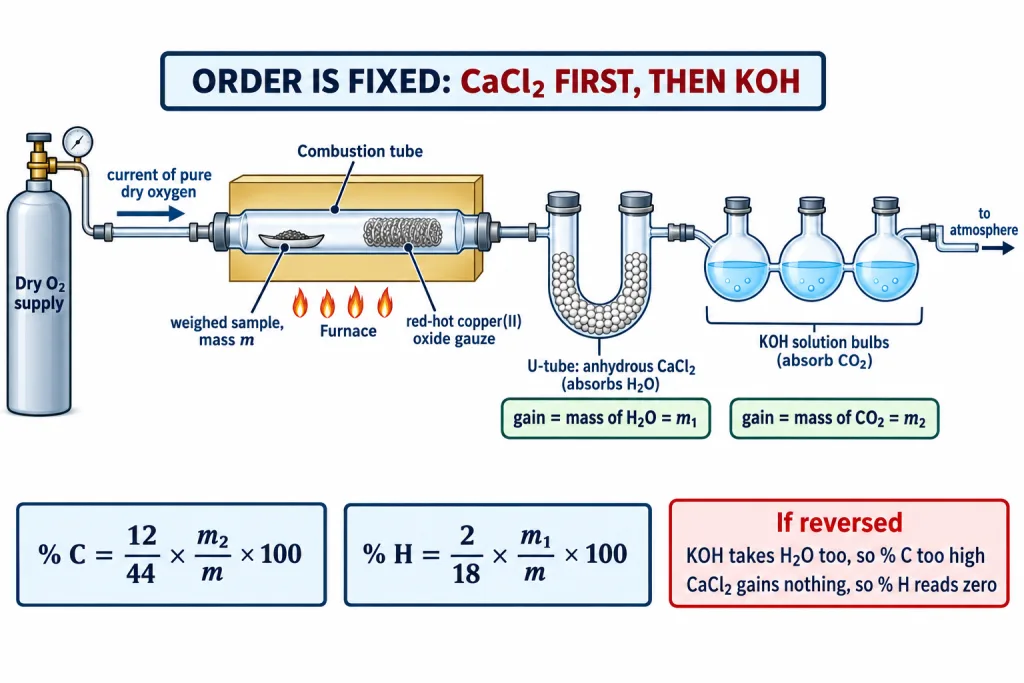
The apparatus, in words. A weighed boat carrying the sample sits in a hard-glass combustion tube. Dry oxygen enters at one end and sweeps the products forward. The middle of the tube holds oxidised copper gauze, kept red hot, which burns any carbon monoxide or unburnt carbon right through to carbon dioxide. The gas stream then leaves the furnace and passes through two absorption units, in this fixed order:
- First a U-tube packed with anhydrous calcium chloride, which takes the water.
- Then a set of bulbs containing concentrated potassium hydroxide solution, which takes the carbon dioxide.
Both units are weighed before the run and again after. The gain of the calcium chloride tube is the mass of water, ; the gain of the potassium hydroxide bulbs is the mass of carbon dioxide, .
The two formulae
44 g of carries 12 g of carbon, and 18 g of carries 2 g of hydrogen. That gives, with the mass of compound taken:
The 2 in the hydrogen factor is where marks go. One water molecule holds two hydrogen atoms, so the factor is , not .
Why calcium chloride must come first
Potassium hydroxide solution is aqueous and alkaline. It absorbs carbon dioxide, which is what it is there for, but it absorbs water vapour just as greedily — and, being a solution, it also adds fresh water vapour to any gas leaving it. Anhydrous calcium chloride is selective: it takes water and leaves carbon dioxide untouched.
Put the calcium chloride first and each unit gets exactly one product. Reverse them and two things go wrong at once: the alkali bulbs take the water along with the carbon dioxide, so their gain is and the carbon comes out far too high, while the calcium chloride tube, now fed an already-stripped stream, gains almost nothing and the hydrogen reads near zero. One swapped joint destroys both results.
[JEE Main] The order of absorbents, and the reason for it, is asked far more often than the arithmetic.
Question 1: Carbon and hydrogen from a single combustion
On complete combustion, 0.246 g of an organic compound gave 0.198 g of carbon dioxide and 0.1014 g of water. Find the percentages of carbon and hydrogen.
Answer:
The carbon dioxide came from the potassium hydroxide bulbs and the water from the calcium chloride tube, so g and g, with g.
Carbon first. Out of every 44 g of , 12 g is carbon.
Now hydrogen, with the factor because water has two hydrogens.
Ans: C = 21.95%, H = 4.58% Watch out: The two percentages add to 26.53%, nowhere near 100, so this compound holds a great deal of something else — oxygen, a halogen, nitrogen or sulphur. A low total is information, not an error.
Question 2: Deciding whether the compound holds oxygen
0.276 g of a compound on combustion gave 0.924 g of carbon dioxide and 0.216 g of water. Find the percentages of carbon and hydrogen, and say whether the compound can contain oxygen.
Answer:
Adding, . Carbon and hydrogen already account for the whole sample, so there is no room for any third element.
Ans: C = 91.30%, H = 8.70%; the compound is a hydrocarbon and contains no oxygen Watch out: A sum of 99.8% or 100.2% still means "hydrocarbon" — weighings carry a little error. A sum of 88% does not.
Question 3: What one swapped absorbent costs you
A compound of mass 0.30 g, correctly analysed, would give 0.440 g of carbon dioxide and 0.154 g of water. A student assembles the train with the potassium hydroxide bulbs before the calcium chloride tube, then reports the whole gain of the bulbs as carbon dioxide. What percentage of carbon does the student report, and what are the true values?
Answer:
With the alkali first, the bulbs take both products, so their gain is g, and the calcium chloride tube gains nothing, making the student's hydrogen figure zero. Treating all 0.594 g as carbon dioxide,
The true values use the two masses separately.
Ans: The student reports C = 54.0% and H = 0%; the true figures are C = 40.0% and H = 5.70% Watch out: 54% carbon is a perfectly believable answer, so the arithmetic gives no warning. Only the impossible zero for hydrogen exposes the mistake.
Nitrogen by the Dumas method
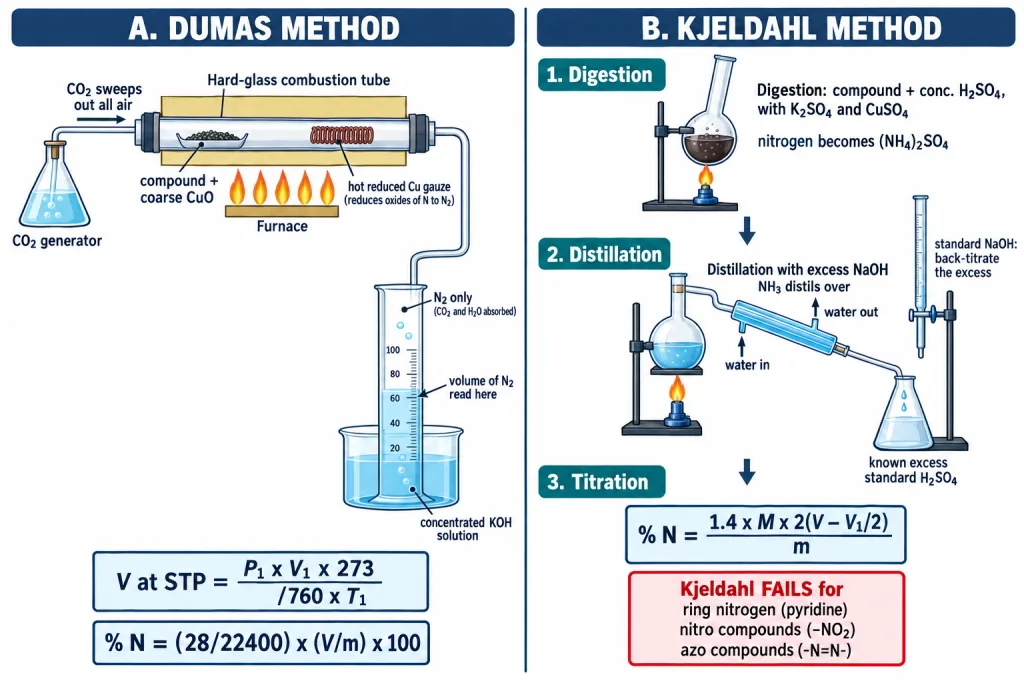
Principle. Heat the compound with a large excess of copper(II) oxide in an atmosphere of carbon dioxide. The copper(II) oxide oxidises carbon to and hydrogen to , while the nitrogen is set free as . Collect the gases over potassium hydroxide solution: the alkali dissolves all the carbon dioxide and holds back the water, so what stands above the liquid is nitrogen and nothing else. Read its volume, correct it to standard conditions, and convert.
The apparatus, in words. Carbon dioxide from a side flask is swept through the whole train first, driving out every trace of air. That flush is the step the method rests on: air is four-fifths nitrogen, and any left behind is counted as the compound's own. The sample, mixed with coarse copper oxide, sits in a combustion tube heated in a furnace. Beyond it the tube carries a plug of hot reduced copper gauze, which reduces any oxides of nitrogen back to . The exit gases bubble into a graduated tube standing over concentrated potassium hydroxide solution. Carbon dioxide and water vanish into the alkali; the nitrogen collects, and its volume is read off against the levelled liquid.
Correcting the volume to STP
The nitrogen is measured at laboratory temperature and pressure, standing over a solution, so it is saturated with water vapour. Two corrections are needed.
Aqueous tension. Subtract the vapour pressure of water at that temperature from the observed total pressure; what is left is the pressure of the dry nitrogen alone.
The gas law. Then take the dry gas from to standard conditions, mm and K:
with the volume at STP in mL.
From volume to percentage
At STP one mole of nitrogen, 28 g, occupies 22400 mL. So mL weighs g, and
Key Point (Definition): In the Dumas method nitrogen is the one element in this whole section that is measured as a volume of gas rather than weighed as a solid. Every other determination ends on a balance.
Nitrogen by Kjeldahl's method
Principle. Instead of setting the nitrogen free as a gas, drive it into ammonia and titrate the ammonia. Three stages, in order.
Digestion. Heat the compound with concentrated sulphuric acid, plus a little potassium sulphate to raise the boiling point and a trace of copper sulphate as catalyst, until the black liquid clears. All the nitrogen ends up as ammonium sulphate.
Distillation with alkali. Dilute the digest, add excess sodium hydroxide, and boil. Ammonia is liberated and distils over.
Absorption and back-titration. Lead the ammonia into a known excess of standard sulphuric acid, where it is fixed as ammonium sulphate.
Titrate the leftover acid against standard alkali. The acid consumed by the ammonia is the difference, and from it the nitrogen follows.
The two formulae
Where the ammonia has neutralised the acid outright and you know how much acid it took, with the molarity of the acid and its volume in mL,
The 1.4 is — the atomic mass of nitrogen, the percentage factor and the mL-to-litre conversion in one number. This form assumes each mole of acid fixes one mole of ammonia, true for a monobasic acid such as . Sulphuric acid is dibasic: one mole of fixes two moles of , and that factor of 2 appears in the back-titration form.
For the back-titration, let be the volume in mL of standard acid taken and the volume in mL of standard alkali needed for the excess, both of the same molarity :
The bracket is the volume of acid actually used up by the ammonia; the alkali volume is halved because two moles of a monobasic alkali neutralise one mole of the dibasic acid.
Where Kjeldahl fails, and why
The method rests on the digestion converting all the nitrogen into ammonium ion. Three classes of compound refuse, and for them the result is meaningless — usually far too low.
- Nitrogen in a ring. In pyridine, quinoline or pyrrole the nitrogen is part of an aromatic ring and shares its lone pair with the ring pi system. The ring survives boiling concentrated sulphuric acid, so the nitrogen is never reduced to ammonium and escapes the count. Pyridine, , truly holds 17.72% nitrogen; a Kjeldahl run returns almost nothing.
- Nitro compounds, . The nitrogen is already at a high oxidation state, and sulphuric acid is an oxidising medium, not a reducing one, so it cannot bring down to . Part of the nitrogen leaves as oxides.
- Azo compounds, . The azo linkage is likewise not reduced; the nitrogen comes off as or as oxides and is lost.
Key Point: Kjeldahl works for amines, amides and proteins, where nitrogen sits on a chain. It fails for nitrogen in a ring, and for nitro and azo compounds, because the digestion cannot convert that nitrogen to ammonium. For those, use Dumas, which burns everything and so has no such restriction.
[NEET] The Dumas-versus-Kjeldahl choice for a named compound is a standing single-mark question. If the structure shows a ring nitrogen, an or an , the answer is Dumas.
Question 4: Dumas, with the aqueous tension correction
During an estimation by the Dumas method, 0.3 g of an organic compound gave 50 mL of nitrogen collected at 300 K and 715 mm pressure. The aqueous tension at 300 K is 15 mm. Find the percentage of nitrogen.
Answer:
The gas stood over potassium hydroxide solution, so the 715 mm includes water vapour. I strip that out first.
Now I take the dry nitrogen to STP with , so .
At STP, 22400 mL of nitrogen weighs 28 g, so 41.9 mL weighs g. As a percentage of 0.3 g,
Ans: 17.46% Watch out: Forgetting the aqueous tension and using 715 mm gives 42.81 mL and 17.84% — a small, believable, wrong answer. If the question quotes an aqueous tension, it must be subtracted.
Question 5: Dumas with dry nitrogen
0.35 g of a compound gave 60 mL of dry nitrogen measured at 300 K and 745 mm. Find the percentage of nitrogen.
Answer:
The gas is stated to be dry, so no tension correction applies and mm.
Ans: 19.12%
Question 6: Kjeldahl, straight neutralisation
The ammonia evolved from 0.5 g of a compound in a Kjeldahl estimation neutralised 10 mL of 1 M sulphuric acid. Find the percentage of nitrogen.
Answer:
Sulphuric acid is dibasic, so one mole fixes two moles of ammonia, and each mole of ammonia carries one mole of nitrogen. 1000 mL of 1 M therefore corresponds to 2 mol of nitrogen, that is 28 g. So 10 mL of 1 M acid corresponds to
writing the 20 as "20 mL of acid on a one-hydrogen basis". As a percentage of 0.5 g,
The canonical form gives the same thing: with , , , so .
Ans: 56.0% Watch out: Dropping the factor 2 for the dibasic acid halves the answer to 28.0%. This single slip is the commonest error in Kjeldahl arithmetic.
Question 7: Kjeldahl by back-titration
0.7 g of a compound was digested and the ammonia distilled into 50 mL of 0.5 M sulphuric acid. The excess acid needed 60 mL of 0.5 M sodium hydroxide. Find the percentage of nitrogen.
Answer:
Here , mL of acid taken, mL of alkali used on the excess.
Checking it in moles, because the bracket is easy to mis-set. Acid taken mol, which is 0.05 mol of replaceable hydrogen. Alkali used mol, so 0.030 mol of hydrogen was still free. The ammonia therefore took mol of hydrogen, so 0.02 mol of , so 0.02 mol of nitrogen g. That is .
Ans: 40.0% Watch out: is halved, not doubled. The alkali is monobasic and the acid dibasic, so 60 mL of alkali is worth only 30 mL of the acid.
Question 8: Choosing the method
Which method would you use to estimate nitrogen in each of pyridine, nitrobenzene, azobenzene and acetamide, and why?
Answer:
Kjeldahl needs the digestion to turn every nitrogen into ammonium ion. Pyridine has ring nitrogen, which survives boiling concentrated sulphuric acid. Nitrobenzene carries , already highly oxidised, which the acid cannot reduce. Azobenzene has , likewise left alone. All three go to Dumas, where the copper oxide burns the molecule outright and the nitrogen comes off as whatever it was bonded to.
Acetamide, , has amide nitrogen, which digests cleanly to ammonium sulphate, so Kjeldahl serves and is quicker.
Ans: Dumas for pyridine, nitrobenzene and azobenzene; Kjeldahl (or Dumas) for acetamide Watch out: Dumas has no exceptions among these classes; Kjeldahl has three.
Halogens by the Carius method
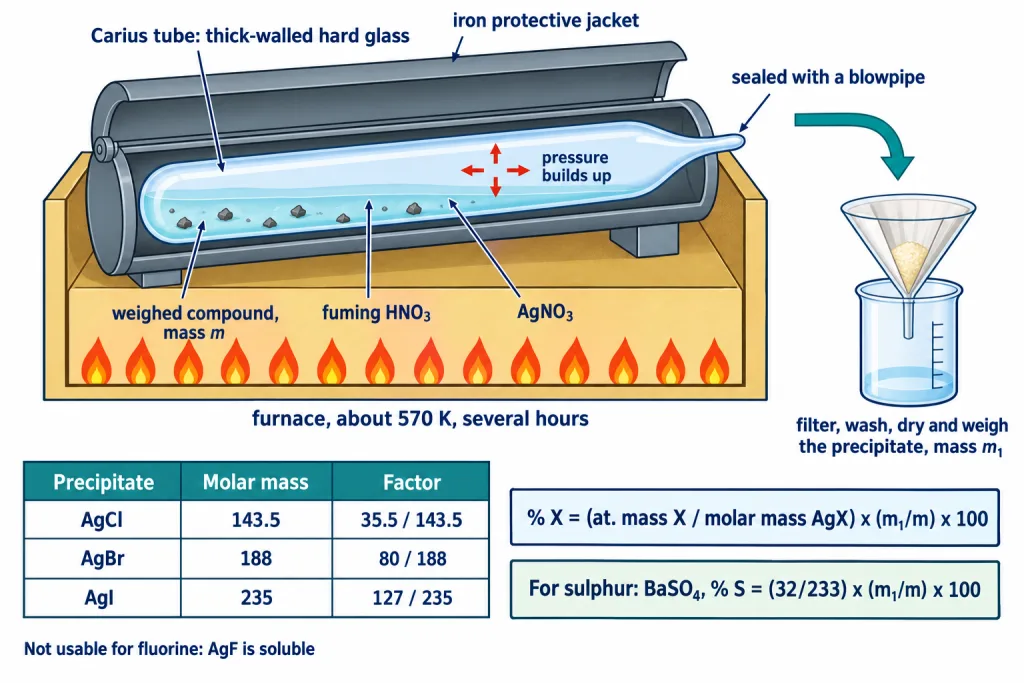
Principle. Heat a weighed amount of the compound with fuming nitric acid in the presence of silver nitrate. The nitric acid destroys the organic skeleton; the halogen is set free as halide ion and caught at once by silver ion as an insoluble silver halide, which is filtered, washed, dried and weighed.
The apparatus, in words. The reagents go into a thick-walled hard-glass Carius tube, sealed at the neck with a blowpipe. The sealed tube sits inside an iron jacket, for safety, and is heated in a furnace at about 570 K for several hours; pressure builds up, which is why the tube must be strong and jacketed. After cooling, the tube is opened, the contents washed out, and the silver halide collected on a weighed filter.
The formula and the three molar masses
Let be the mass of compound and the mass of silver halide:
| Halide weighed | Molar mass of | Atomic mass of | Factor to use |
|---|---|---|---|
| 143.5 | Cl = 35.5 | 35.5 / 143.5 | |
| 188 | Br = 80 | 80 / 188 | |
| 235 | I = 127 | 127 / 235 |
Fluorine has no place in this table. Silver fluoride is soluble, so the Carius method cannot be used for fluorine at all.
Sulphur
Principle. Heat the compound with fuming nitric acid in a Carius tube, exactly as for the halogens. Every sulphur atom is oxidised through to sulphuric acid. Precipitate the sulphate with barium chloride solution, and weigh the barium sulphate.
Barium sulphate is ideal for gravimetry: dense, almost insoluble, easy to filter and stable to drying. Its molar mass is 233, of which 32 is sulphur. With the mass of barium sulphate,
Phosphorus
Principle. Heat the compound with fuming nitric acid, which oxidises the phosphorus to phosphoric acid. From that point there are two standard finishes, and the formula depends on which precipitate you weigh.
As magnesium pyrophosphate. Add ammonia and magnesium chloride — "magnesia mixture" — which throws down magnesium ammonium phosphate. Ignite that, and it loses ammonia and water to leave magnesium pyrophosphate.
has molar mass 222 and contains two phosphorus atoms, 62 units in all:
As ammonium phosphomolybdate. Add ammonium molybdate in nitric acid and a yellow precipitate of ammonium phosphomolybdate, , comes down. Its molar mass is 1877 and it holds a single phosphorus atom:
The molybdate route weighs an enormous precipitate for a tiny amount of phosphorus, which is its merit: a small error on the balance becomes a very small error in the answer.
Oxygen
Oxygen is the awkward one. There is no reagent that pulls oxygen out of an organic molecule as a weighable solid, so it is nearly always obtained by difference:
This carries the accumulated error of every other determination, which makes the oxygen figure the least reliable number in an analysis.
The direct method, in outline. A known mass is decomposed by heating in a stream of nitrogen, and the gaseous products are swept over red-hot coke at 1373 K, where all the oxygen ends up as carbon monoxide.
The carbon monoxide is passed over warm iodine pentoxide, which oxidises it to carbon dioxide, and that carbon dioxide is absorbed and weighed.
Following the atoms through, 32 g of oxygen ends up as 2 mol of , that is 88 g. So with the mass of carbon dioxide finally weighed,
Key Point: The carbon dioxide in the oxygen determination is not the carbon dioxide of the combustion analysis. It comes from the coke, and its oxygen came from the compound. The two must never be mixed up in one calculation.
Question 9: Bromine by Carius
In a Carius estimation, 0.15 g of an organic compound gave 0.12 g of silver bromide. Find the percentage of bromine.
Answer:
Silver bromide has molar mass 188, of which 80 is bromine. The mass of bromine in 0.12 g of is
and as a percentage of 0.15 g,
Ans: 34.04%
Question 10: Chlorine by Carius
0.24 g of a compound gave 0.287 g of silver chloride. Find the percentage of chlorine.
Answer:
For chlorine the factor is .
Ans: 29.58% Watch out: 143.5 is the molar mass of , not of silver. Using 108 or 35.5 in the denominator is the standard slip.
Question 11: Iodine by Carius
0.40 g of a compound gave 0.235 g of silver iodide. Find the percentage of iodine.
Answer:
Ans: 31.75%
Question 12: Sulphur as barium sulphate
0.157 g of an organic compound gave 0.4813 g of barium sulphate in a Carius sulphur estimation. Find the percentage of sulphur.
Answer:
Barium sulphate is 233 per mole and holds 32 of sulphur, so the sulphur in the precipitate is g.
Ans: 42.10% Watch out: The precipitate here outweighs the sample three times over. That is normal in gravimetry and not a sign of an error.
Question 13: Phosphorus as magnesium pyrophosphate
0.25 g of a compound gave 0.444 g of magnesium pyrophosphate. Find the percentage of phosphorus.
Answer:
is 222 per mole and contains two phosphorus atoms, .
Ans: 49.60% Watch out: 62, not 31. There are two phosphorus atoms in the pyrophosphate. Using 31 halves the answer to 24.80%.
Question 14: Phosphorus as ammonium phosphomolybdate
0.20 g of a compound gave 1.877 g of ammonium phosphomolybdate. Find the percentage of phosphorus.
Answer:
This precipitate is 1877 per mole with just one phosphorus atom, so the factor is .
Ans: 15.50% Watch out: Here the factor is 31 and not 62 — one phosphorus per formula unit, unlike the pyrophosphate.
Question 15: Oxygen by difference
0.44 g of a compound containing only carbon, hydrogen and oxygen gave 0.88 g of carbon dioxide and 0.36 g of water. Find the percentage of each element.
Answer:
Oxygen is what is left when the others are taken from 100.
Ans: C = 54.55%, H = 9.09%, O = 36.36% Watch out: Oxygen by difference is only valid once you are sure no other element is present. If the compound also held nitrogen and you never estimated it, that nitrogen would be counted as oxygen.
From percentages to a formula
Percentage composition gives the mass ratio of the elements. A formula needs the atom ratio, and the bridge between them is the atomic mass.
The procedure
- Write down the percentage of every element. If oxygen was not determined, get it by difference. Work with 100 g of compound, so each percentage is a mass in grams.
- Divide each percentage by the atomic mass of that element. This gives the relative number of moles, which is the relative number of atoms.
- Divide every quotient by the smallest of them. The smallest becomes 1 and the rest come out as ratios relative to it.
- Multiply the whole set by a small integer if needed to clear a fraction. A value near needs , near or needs , near or needs . Then round to whole numbers.
- What you now have is the empirical formula — the simplest whole-number atom ratio.
- Find from the molar mass:
- The molecular formula is the empirical formula with every subscript multiplied by .
Key Point (Definition): The empirical formula gives the simplest whole-number ratio of atoms. The molecular formula gives the actual number of atoms in one molecule. They coincide only when .
The molar mass must come from outside the combustion data — a vapour density, a freezing-point depression, a mass spectrum. Where a vapour density is given, molar mass vapour density, because vapour density is measured against , of molar mass 2.
Where the marks go
Rounding too early. is and needs doubling; round it to 2 at step 3 and the empirical formula is wrong beyond rescue. Carry three figures until step 4 is done.
Rounding too late. is 2. Weighings are not exact, and is . Multiplying by 50 to clear the produces nonsense.
Dividing by the wrong quotient at step 3. Divide by the smallest, not by the first and not by the carbon one.
Using percentages instead of moles. Percentages are masses; dividing 40% by 6.67% says nothing about atoms.
Summary of every determination
| Element | Method | Chemistry | What is weighed or measured | Formula |
|---|---|---|---|---|
| Carbon | combustion in oxygen | C burnt to , absorbed in | mass of | |
| Hydrogen | combustion in oxygen | H burnt to , absorbed in anhydrous | mass of | |
| Nitrogen | Dumas | heated with in ; over solution | volume of at STP | |
| Nitrogen | Kjeldahl | digested to , into standard acid | volume of acid used | |
| Halogen | Carius | fuming and , sealed tube | mass of | |
| Sulphur | Carius | oxidised to , precipitated with | mass of | |
| Phosphorus | oxidation, then magnesia mixture | to , then ignited | mass of | |
| Phosphorus | oxidation, then ammonium molybdate | to , then the yellow molybdate salt | mass of | |
| Oxygen | by difference | not determined | nothing | |
| Oxygen | direct | over coke at 1373 K to , then to | mass of |
Halogen molar masses to memorise: , , .
[Board] One mark for the method, one for the reaction, one for the formula, one for the arithmetic. Writing the formula down before touching the numbers protects three of those four.
Question 16: A hydrocarbon of vapour density 39
0.2 g of a hydrocarbon on complete combustion gave 0.677 g of carbon dioxide and 0.1385 g of water. Its vapour density is 39. Find the empirical and molecular formulae.
Answer:
Percentages first.
The two add to 100.01, so nothing else is present.
Now moles. Carbon: . Hydrogen: .
Dividing both by the smaller, 7.69, gives C and H . The empirical formula is , of formula mass .
Molar mass vapour density , so
Ans: Empirical formula ; molecular formula (benzene) Watch out: Vapour density is not molar mass. Doubling it is not optional.
Question 17: A ratio that will not come out whole
0.29 g of a gaseous hydrocarbon gave 0.88 g of carbon dioxide and 0.45 g of water on combustion. Its molar mass is 58 g/mol. Find the empirical and molecular formulae.
Answer:
They sum to exactly 100, so it is a hydrocarbon.
Moles: C ; H .
Dividing by the smaller, 6.897:
2.50 is not a whole number and it is not close to one either, so I multiply both by 2:
The empirical formula is , formula mass .
Ans: Empirical formula ; molecular formula (butane) Watch out: is a legitimate empirical formula even though no molecule exists. The empirical formula is a ratio, not a species. Rounding 2.50 down to 2 would have given and then , which is wrong by two hydrogens.
Question 18: Oxygen by difference
0.30 g of a compound containing carbon, hydrogen and oxygen gave 0.44 g of carbon dioxide and 0.18 g of water. Its molar mass is 60 g/mol. Find the molecular formula.
Answer:
Moles, dividing each percentage by its atomic mass:
- C:
- H:
- O:
The smallest is 3.333, and dividing through by it gives C , H , O . Empirical formula , formula mass .
Ans: (ethanoic acid) Watch out: Divide oxygen by 16, the atomic mass, never by 32. The molecule contains oxygen atoms, not units.
Question 19: Combustion plus a Carius determination
Combustion of 0.40 g of a compound gave 0.3556 g of carbon dioxide and 0.1455 g of water. A separate 0.30 g portion, treated by the Carius method, gave 0.8697 g of silver chloride. The molar mass is 99 g/mol. Find the molecular formula.
Answer:
The two runs used different masses, so I must use the right in each formula.
From the combustion, with g:
From the Carius run, with g and :
The three add to 100.01, so there is no oxygen.
Moles:
- C:
- H:
- Cl:
Smallest is 2.020. Dividing: C , H , Cl . Empirical formula , formula mass .
Ans: (1,2-dichloroethane or 1,1-dichloroethane) Watch out: Do not divide the silver chloride mass by 0.40 g. Each determination is normalised by the mass of compound used in that determination.
Question 20: Combustion plus Dumas, with oxygen by difference
0.30 g of a compound on combustion gave 0.352 g of carbon dioxide and 0.18 g of water. A separate 0.30 g portion by the Dumas method gave 44.8 mL of nitrogen measured at STP. The molar mass is 75 g/mol. Find the empirical and molecular formulae.
Answer:
Those three come to 57.34, so the rest is oxygen:
Moles:
- C:
- H:
- N:
- O:
The smallest is 1.333. Dividing every quotient by it:
- C:
- H:
- N:
- O:
Empirical formula , formula mass .
Ans: Empirical formula ; molecular formula (glycine) Watch out: is a real answer, not a sign of a mistake. Whenever the molar mass equals the empirical formula mass, the two formulae are identical.