
A shared pair that is not shared equally
In ethane the two carbons are identical, so the bond pair sits midway and neither carbon carries a charge. In chloromethane the two ends of the bond are not identical. Chlorine is more electronegative and holds the shared pair closer, so the bond is polarised: chlorine gets a small excess of electron density, carbon a small deficiency.
The straight arrow on the bond points towards the atom that pulls harder. The symbols and mean partial charges — a fraction of one electronic charge, not a whole one. The molecule stays neutral overall; the charge has only been redistributed inside it.
A reagent approaching a molecule sees this map of electron density and nothing else. A nucleophile goes to the site short of electrons — the carbon. An electrophile goes to the site with electrons to spare — a atom, a lone pair, or the loose cloud of a bond.
Key Point: Predicting an organic reaction is almost always the job of working out the and map of the molecule. Every electronic effect in this chapter is a rule for building that map.
The four effects, and where each one is dealt with
Four separate mechanisms redistribute electron density in an organic molecule, and they are constantly confused with one another. Fix the distinctions now.
| Effect | Permanent or temporary | Electrons that move | Attacking reagent needed | Covered in |
|---|---|---|---|---|
| Inductive | permanent | pair, shifted partly | no | this section |
| Electromeric | temporary | pair, transferred completely | yes | this section |
| Resonance | permanent | electrons and lone pairs | no | section 12 |
| Hyperconjugation | permanent | electrons of a bond next to an empty orbital, a half-filled orbital or a bond | no | section 13 |
The inductive effect and hyperconjugation are partial displacements: the pair leans towards one atom, both keep a share, and the result is and . The electromeric effect is a complete transfer: the pair goes entirely to one atom, giving full charges.
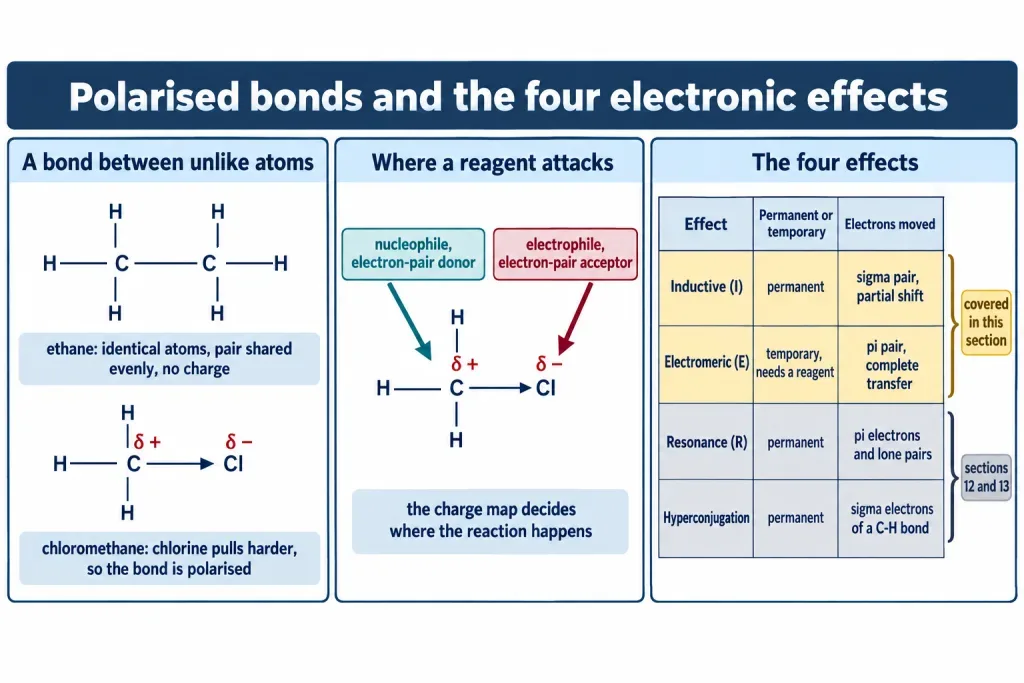
Read the inductive effect as the background polarisation that is always there, and the electromeric effect as what happens the instant a reagent arrives.
The inductive effect
Key Point (Definition): The inductive effect is the permanent displacement of bond electrons along a chain of atoms, caused by an atom or group that attracts or releases electrons more strongly than hydrogen does. It is transmitted from bond to bond by successive displacement and weakens rapidly with distance.
Three words carry the weight. Permanent — a property of the molecule sitting alone in a bottle, measurable as a dipole moment. Sigma — it travels through single bonds, not a system. Successive — each bond passes on only a fraction of what it received, which is why the effect dies.
Working through 1-chlorobutane, atom by atom
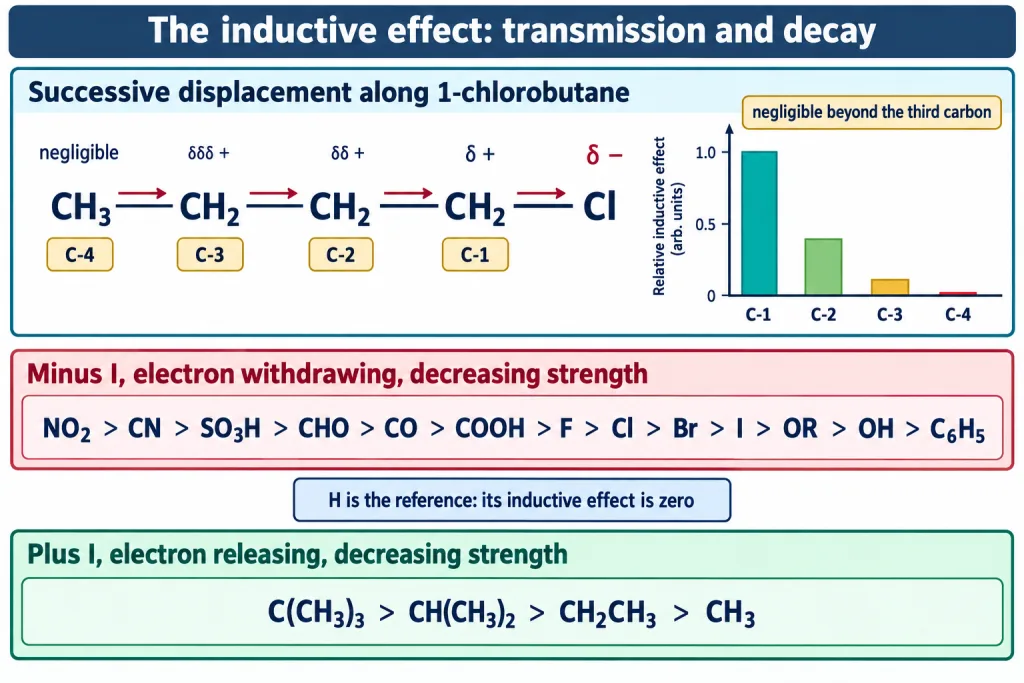
Take and number from the chlorine end, so C-1 carries the chlorine and C-4 is the terminal methyl.
At C-1. Chlorine draws the pair towards itself. Chlorine becomes , C-1 becomes .
At C-2. C-1, being short of density, pulls on the pair in turn. But C-1 is only , not a full cation, so its pull is far feebler than chlorine's and the charge on C-2 is much smaller. It is written .
At C-3. The relay repeats, and C-3 picks up a still smaller deficiency, .
At C-4. The displacement is too diluted to write down; this methyl behaves like the methyl of butane.
Read right to left: , C-1, C-2, C-3, then the C-4 methyl.
The magnitudes fall steeply: .
Key Point: The inductive effect is negligible beyond the third carbon from the substituent. Each transmission passes on only a small fraction of the displacement it received, so after three bonds there is almost nothing left. [JEE Main]
Draw the transmission with a straight arrow along each bond, all pointing the same way. A curved arrow would mean a complete pair moving, which is not what happens here.
Hydrogen is the zero of the scale
An inductive effect is never measured in the abstract. It is always measured against hydrogen, whose inductive effect is defined as zero. A group that pulls electrons away from carbon more strongly than hydrogen does is electron withdrawing and shows the effect; one that releases them more strongly than hydrogen does is electron releasing and shows the effect. That is why every acidity and basicity argument below compares a substituted compound with the parent that carries a hydrogen at that position.
The series
The ordering follows charge first and electronegativity second.
Charge first. A formal positive charge on the atom joined to carbon makes the most powerful withdrawer of all. The nitrogen of carries a formal , which is why nitro tops the list, and a charged group such as is stronger still: a positively charged nitrogen outpulls a neutral fluorine.
Then the multiply bonded, electron-poor groups, , , , and , which hang electronegative atoms off a carbon that is already electron-poor. Then the halogens, in order of electronegativity, — not size, not polarisability. Then and , weaker because the oxygen already has a hydrogen or alkyl group partly satisfying it. Weakest, , whose ring carbon is only slightly more electronegative than the carbon it joins.
The halogens are but : they withdraw through the framework while donating a lone pair into a system. Whenever a halogen is ranked, say which of the two effects the question is about.
The series
Alkyl groups release electron density towards the carbon they are attached to, and the reason is branching. Every extra methyl brings another set of and bonding electrons into the group, and a bigger, more polarisable cloud is easier to push. Tertiary butyl has three methyls feeding it, isopropyl two, ethyl one, methyl none. Groups carrying a negative charge, such as and , are stronger donors than any alkyl group — charge dominates on both sides of the scale.
Question 1: Mapping the partial charges along a chain
Mark the inductive polarisation on every carbon of 1-chloropentane, .
Answer:
I number from the chlorine end, so C-1 carries the . Chlorine pulls the pair, so is and C-1 is . C-1, being electron-poor, pulls on the pair, so C-2 becomes , much smaller. The relay runs once more and C-3 becomes , smaller again. C-4 and C-5 are past the third carbon, so I write nothing on them.
Ans: is ; C-1 is , C-2 is , C-3 is ; C-4 and C-5 essentially neutral.
Watch out: The charge gets smaller away from the halogen. Reading as twice as much charge inverts the whole idea.
Question 2: Ranking four withdrawing groups
Arrange , , and in decreasing order of effect.
Answer:
I read straight off the series. Nitro comes first because its nitrogen carries a formal positive charge, cyano next, then bromine from the halogen block. Hydroxyl sits near the bottom, below all four halogens.
Ans:
Watch out: Oxygen is more electronegative than bromine, which tempts you to put above . The measured order puts below all four halogens.
Question 3: Inductive strength is not bond strength
Fluorine has a much stronger effect than iodine, yet a bond breaks far more easily than a bond. Why is there no contradiction?
Answer:
The effect is about how hard the halogen pulls the shared pair towards itself while the bond is intact, which follows electronegativity. Bond strength is the energy needed to break the bond, which follows orbital overlap, and iodine's large diffuse orbital overlaps poorly with carbon.
Ans: follows electronegativity ( strongest); bond strength follows orbital overlap ( weakest). The two are independent.
Consequence one: the acidity of carboxylic acids
A carboxylic acid ionises:
Its strength depends on how comfortable the carboxylate anion is. That anion carries a full negative charge spread over two oxygens, and anything that spreads it further stabilises it and pushes the equilibrium right.
- An electron-withdrawing group () pulls negative charge away from the oxygens and out along the chain: charge dispersed, anion stabilised, acid stronger. It also polarises the bond, making the proton easier to release.
- An electron-releasing group () pushes density onto an already negative centre: charge concentrated, anion destabilised, acid weaker.
Key Point: Stabilise the conjugate base and you strengthen the acid. Every acidity comparison in this chapter reduces to that one sentence.
One chlorine changes everything
In acetic acid, , the group next to the carboxyl is a methyl, which is and makes the anion worse off. In chloroacetic acid, , one methyl hydrogen has been replaced by chlorine, which is ; chlorine drags density out of the group, which drags it out of the carboxylate in turn, and the charge is spread over a larger volume.
| Acid | Approximate |
|---|---|
| acetic acid, | 4.76 |
| chloroacetic acid, | 2.86 |
| dichloroacetic acid, | 1.29 |
| trichloroacetic acid, | 0.65 |
A lower means a stronger acid, so chloroacetic acid is about a hundred times stronger than acetic acid.
The effects of several groups add up
Each extra chlorine pulls on the same carboxylate, and the effects are roughly additive:
Swapping the halogen follows the order exactly: , with near 2.59, 2.86, 2.90 and 3.18.
The effect falls off along the chain
Move the same chlorine further from the carboxyl group and it stops mattering. In butanoic acid the carboxyl carbon is C-1.
| Acid | Bonds from to | Approximate |
|---|---|---|
| 2-chlorobutanoic acid | one | 2.9 |
| 3-chlorobutanoic acid | two | 4.1 |
| 4-chlorobutanoic acid | three | 4.5 |
| butanoic acid | no chlorine | 4.8 |
The chlorine on C-2 shifts the by nearly two units, on C-3 by less than one, and on C-4 by a few tenths. That is the "negligible beyond the third carbon" rule made quantitative. [JEE/NEET]
Formic acid against acetic acid
Formic acid is ; acetic acid is . Where formic acid has a hydrogen on the carboxyl carbon, acetic acid has a methyl.
Hydrogen is the zero of the inductive scale, so it neither pushes nor pulls. Methyl is , so it pushes density onto the carboxylate, intensifying the negative charge and destabilising the anion. Formate is therefore the more comfortable anion, and formic acid ( 3.75) is the stronger acid ( 4.76 for acetic acid).
Ethyl is a better donor than methyl, so propanoic acid is very slightly weaker again: . Beyond that the differences are too small to rank.
Benzoic acid, , checks the bottom of the series. Phenyl withdraws rather than releases, though weakly, so benzoic acid ( 4.20) is stronger than acetic acid and much weaker than chloroacetic acid.
Question 4: The chloroacetic acid ladder
Arrange acetic acid, chloroacetic acid, dichloroacetic acid and trichloroacetic acid in decreasing order of acid strength, and justify the order.
Answer:
I compare the four conjugate bases. Trichloroacetate has three chlorines pulling the negative charge away from the two oxygens and spreading it over the whole group, so it is the most stable. Dichloroacetate has two chlorines doing the same job, chloroacetate one. Acetate has none, and worse, a methyl group whose effect pushes density back onto an already negative centre.
More stable anion means stronger acid, so the order follows the chlorine count.
Ans:
Watch out: The values fall from 4.76 to 0.65 down this list. A falling means a rising acid strength.
Question 5: Same chlorine, three different places
Arrange butanoic acid, 2-chlorobutanoic acid, 3-chlorobutanoic acid and 4-chlorobutanoic acid in decreasing order of acidity.
Answer:
All three chloro acids have one chlorine; the only variable is how far it sits from the carboxyl group. In 2-chlorobutanoic acid it is on the carbon next to the carboxyl, so its withdrawal reaches the carboxylate almost undiminished. In 3-chlorobutanoic acid it passes through one extra bond and only a fraction survives; in 4-chlorobutanoic acid, through two, and almost nothing survives. Butanoic acid has no chlorine at all.
Ans: 2-chlorobutanoic acid 3-chlorobutanoic acid 4-chlorobutanoic acid butanoic acid
Watch out: 4-chlorobutanoic acid and butanoic acid have very similar values, near 4.5 and 4.8. That closeness is the point of the question.
Question 6: Formic against acetic, and where propanoic sits
Which is the stronger acid, or ? Predict where falls.
Answer:
In acetic acid a methyl group is attached to the carboxyl carbon. Methyl is , so it feeds density into the carboxylate, concentrating the negative charge. In formic acid that position carries a hydrogen, which has no inductive effect at all, so nothing pushes density onto the formate anion. Formate is the more stable, and formic acid the stronger acid. Propanoic acid has an ethyl group, a stronger donor than methyl, so it destabilises its anion a little more.
Ans:
Watch out: Do not push this trend far up the series. From propanoic acid onwards the differences are hundredths of a unit and not reliably monotonic.
Question 7: Mixing the withdrawing groups
Arrange , , and in decreasing order of acidity.
Answer:
Each of the last three has one withdrawing group next to the carboxyl, so I only need the order of , and : cyano sits above all the halogens, and fluorine above iodine. Acetic acid has a methyl instead and comes last.
Ans:
Watch out: Iodine is the biggest and most polarisable halogen, which tempts you to rank it first. Inductive strength tracks electronegativity, and iodine is the least electronegative of the four.
Consequence two: the basicity of aliphatic amines
An amine acts as a base by offering the lone pair on its nitrogen to a proton:
Two things help: higher electron density on nitrogen makes the lone pair easier to donate, and a more stable pulls the equilibrium right.
Alkyl groups are , so replacing a hydrogen of ammonia by an alkyl group helps on both counts. On the inductive effect alone, more alkyl groups should mean a stronger base:
In the gas phase this is exactly the order found, and it is the one to quote when a question asks for the order "on the basis of the inductive effect".
The anomaly in water
In aqueous solution the observed order is different. For the methylamines the measured values are 3.27 for dimethylamine, 3.38 for methylamine, 4.22 for trimethylamine and 4.75 for ammonia. A lower means a stronger base, so:
The tertiary amine has dropped below the primary. For the ethylamines the anomaly lands differently, , but in both series the secondary amine comes out on top and the tertiary amine underperforms.
The reason is solvation. The cation is stabilised in water by hydrogen bonds from its hydrogens, and a primary ammonium ion has three such hydrogens, a secondary two, a tertiary only one. Every alkyl group added helps through and hurts through lost hydrogen bonding, with crowding round the nitrogen making matters worse. The secondary amine is the best compromise. That argument belongs to Class 12 amines; here it is enough to know it exists and that it breaks the simple order.
Key Point: On inductive grounds alone, and in the gas phase, aliphatic amine basicity runs . In aqueous solution solvation intervenes and the secondary amine becomes the strongest base. Say which situation you are answering for. [NEET]
Consequence three: the stability of the reaction intermediates
Carbocations
A carbocation has a full positive charge and only six valence electrons on the positive carbon, so anything pushing density towards it stabilises it. Alkyl groups are , and the more of them, the more the charge is spread out:
which is the tertiary secondary primary methyl order fixed in section 9. Hyperconjugation reinforces the same order (section 13), which is why it is so reliable. Withdrawing groups do the opposite: is far less stable than .
Carbanions
A carbanion has a full negative charge and a lone pair on the negative carbon. It has too many electrons, not too few, so the requirement is the exact opposite: it is stabilised by groups that take density away. Alkyl groups, being , push density onto an already negative centre, so the order reverses:
methyl primary secondary tertiary, exactly as fixed in section 9.
Withdrawing groups stabilise carbanions strongly: is far more stable than — the same fact as the strength of trichloroacetic acid, seen from the other side. Free radicals are neutral, and their order matches the carbocations.
Key Point: groups stabilise a positive centre and destabilise a negative one, so carbocation and carbanion stability orders are mirror images. Getting one of them backwards is the commonest error in this part of the chapter.
Question 8: Ranking four carbocations
Arrange , , and in decreasing order of stability.
Answer:
Each cation has a carbon short of electrons and carrying a full positive charge, so whatever pushes density in will help. I count the alkyl groups on the positive carbon: tertiary butyl three methyls, isopropyl two, ethyl one, methyl none. Alkyl groups are , so more of them means more of the charge spread out.
Ans:
Question 9: The same four skeletons, as carbanions
Arrange , , and in decreasing order of stability.
Answer:
The charge is now negative, so the requirement flips: the carbon already has a lone pair and a full negative charge, and pushing more density onto it makes matters worse. Alkyl groups are , so every one on the negative carbon is a liability. Tertiary butyl anion has three and is worst off; methyl anion has none and is best off.
Ans:
Watch out: This is the reverse of the carbocation order, and of the free radical order. Copying the tertiary-first order across is the standard trap.
Question 10: Two different answers for amine basicity
Arrange , , and in decreasing order of basicity (a) on the inductive effect alone and (b) as measured in aqueous solution.
Answer:
(a) Methyl is , so each one added to nitrogen raises the electron density there and helps spread the conjugate acid's positive charge. Counting methyls gives trimethylamine three, dimethylamine two, methylamine one, ammonia none, and the prediction runs in that order — which is what the gas phase shows.
(b) In water the measured values are 3.27, 3.38, 4.22 and 4.75 for dimethylamine, methylamine, trimethylamine and ammonia. Lower is a stronger base, so dimethylamine leads and trimethylamine falls below methylamine, whose cation has more hydrogens for hydrogen bonding to water.
Ans: (a) ; (b)
Watch out: Read the question for the word "aqueous". Both orders are correct answers to different questions.
The electromeric effect
Key Point (Definition): The electromeric effect is the complete transfer of a shared electron pair to one of the two atoms joined by a multiple bond. It takes place only in the presence of an attacking reagent and it is temporary — take the reagent away and the electrons return.
Three features separate it sharply from the inductive effect.
It is complete, not partial. The pair does not lean towards one atom; it goes there entirely. The result is not and but a full positive charge on one atom and a full negative charge on the other.
It needs a reagent. An isolated alkene shows no electromeric effect. Bring an electrophile near and it appears; take the electrophile away before anything has bonded and it vanishes.
It involves electrons. A saturated molecule cannot show it; there has to be a double or triple bond, whose loosely held cloud is easy to move. Draw the movement as a curved arrow from the middle of the bond to the atom that takes the pair.
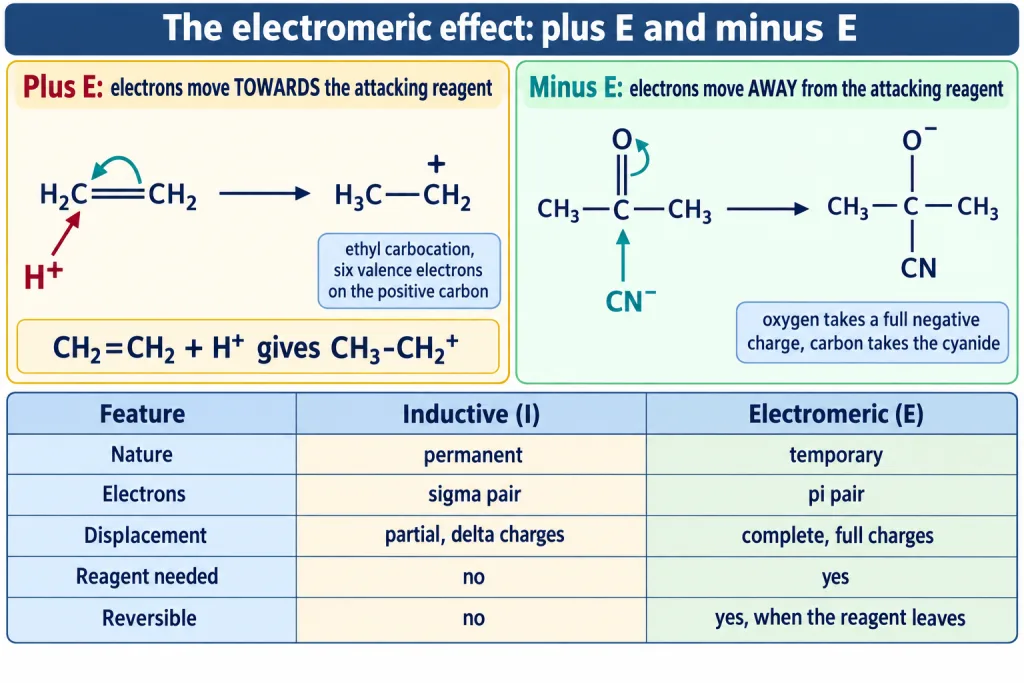
The effect: electrons move towards the attacking reagent
In the effect, the electrons are transferred to the atom to which the attacking reagent becomes attached.
Take ethene, , and bring up a proton. The cloud is the most exposed electron density in the molecule, so heads for it. The pair then shifts entirely to the nearer carbon, which uses it to bond to the hydrogen, leaving the other carbon with six valence electrons and a full positive charge.
The electrons moved towards the carbon the reagent joined, so this is . The ethyl carbocation then combines with whatever anion is available. This is the first step of every electrophilic addition.
The effect: electrons move away from the attacking reagent
In the effect, the electrons are transferred to the atom further from the attacking reagent — away from the site of attack.
Take propanone, , and bring up a cyanide ion. A nucleophile needs an electron-poor site, and it finds one at the carbonyl carbon. As approaches, the pair of the bond is pushed right onto the oxygen, which takes a full negative charge and a complete octet; the carbon becomes positive and accepts the cyanide.
The alkoxide oxygen then takes a proton from the medium, giving the cyanohydrin . The electrons moved away from the site of attack, so this is , the first step of every nucleophilic addition to a carbonyl.
A carbonyl shows both effects side by side. With no reagent near, oxygen's electronegativity polarises the group inductively, leaving the carbon and the oxygen , and that is what tells the nucleophile where to go. The electromeric shift is the complete version of the same displacement.
Inductive against electromeric, side by side
| Feature | Inductive effect | Electromeric effect |
|---|---|---|
| Permanent or temporary | permanent; a ground-state property | temporary; lasts only while the reagent is present |
| Electrons displaced | bond pair | bond pair |
| Extent, and charge produced | partial; and | complete; full and |
| Attacking reagent needed | no | yes |
| Reversible | no | yes, the instant the reagent is removed |
| Transmission | relayed along a chain, negligible past the third carbon | confined to the two atoms of the multiple bond |
| Sub-types | and | and |
When the two effects disagree
Both effects can operate in one molecule at once, and they do not always point the same way. The general rule is that the electromeric effect is the stronger whenever it can operate, because it is a complete transfer of a pair while the inductive effect is only a partial displacement. Against that, it exists only while a reagent is present, whereas the inductive effect is on all the time. In an isolated molecule the inductive effect decides everything; during an attack the electromeric shift usually decides the outcome, but the inductive effect settles which of the two carbons of an unsymmetrical multiple bond takes the pair.
Both effects agreeing — propene and . In the methyl group is and pushes density into the bond, building it up at the terminal . The proton goes there, the pair moves to that carbon, and the positive charge lands on the middle carbon as a secondary cation. Bromide adds, giving 2-bromopropane — the Markovnikov product, with and reinforcing each other.
The inductive effect overriding — 3,3,3-trifluoroprop-1-ene. In the group has an enormous effect, and a cation on the carbon next to it would be crippled. The proton therefore adds to the middle carbon, putting the charge one bond further from the fluorines, and the product is , 3-bromo-1,1,1-trifluoropropane — the opposite regiochemistry to propene's.
A withdrawing group losing to lone-pair donation — bromoethene. adds to to give 1,1-dibromoethane, : the cation forms on the carbon that already carries the bromine, against what its effect alone would predict, because a lone pair on that bromine stabilises it. That is a effect, taken up in section 12.
Key Point: When the two effects oppose each other, the electromeric effect normally wins, because it moves a whole pair rather than a fraction of one. A very strong group such as or can still control the outcome, by deciding which way the electromeric shift is allowed to go. [JEE Main]
Question 11: Name the effect in each case
Identify the electronic effect responsible for each of the following.
(a) The carbon of chloromethane carries a partial positive charge even in the pure liquid. (b) The bond of ethene opens completely when a proton comes close. (c) Trichloroacetic acid is a far stronger acid than acetic acid. (d) The pair of an aldehyde moves entirely onto oxygen when a nucleophile attacks the carbon.
Answer:
(a) No reagent, partial displacement, bond: inductive, the effect of chlorine.
(b) Reagent present, complete displacement, electrons: electromeric, with the electrons moving towards the carbon the proton joins, so .
(c) A permanent property of the isolated molecule, transmitted along bonds from three chlorines to the carboxylate: inductive, .
(d) Electromeric, with the electrons moving away from the carbon under attack, so .
Ans: (a) ; (b) ; (c) ; (d)
Watch out: The test is mechanical. Reagent plus means electromeric; no reagent plus means inductive.
Question 12: or for hydrogen cyanide and propanone
adds across the carbonyl group of propanone. Which form of the electromeric effect operates in the first step, and what is the intermediate?
Answer:
supplies , a nucleophile, which attacks the electron-poor atom — in a carbonyl group, the carbon. As the cyanide reaches it, the pair of is transferred completely to the oxygen, away from the site of attack. Oxygen takes a full negative charge and a complete octet; the carbon takes the cyanide.
Ans: The effect. The intermediate is the alkoxide , protonated to give the cyanohydrin .
Watch out: Do not decide the sign from the charge on the reagent. It depends only on the direction the electrons move relative to the site of attack.
Question 13: Where does the proton go in propene
An electrophile attacks propene, . Which carbon does it bond to, and which cation forms?
Answer:
I build the charge map with the inductive effect first. The methyl group is , so it pushes density into the double bond and the density piles up at the far end, the terminal .
An electrophile goes where the electrons are, so bonds there. The pair moves to that carbon to make the new bond, leaving the middle carbon positive with a methyl on each side — a secondary cation.
Ans: The proton bonds to the terminal carbon, giving the secondary cation .
Watch out: Protonating the middle carbon instead would give a primary cation, far less stable, which is why that route is not taken.
Question 14: Predicting an anti-Markovnikov product from the inductive effect
adds to 3,3,3-trifluoroprop-1-ene, . Which product forms?
Answer:
Two cations are possible. Protonating the terminal puts the charge on the middle carbon, directly attached to ; protonating the middle carbon puts it on the terminal carbon, one bond further away.
The group has a very large effect, and a positive centre right next to it is drained of what little density it has. Moving the charge one bond away is worth more than the usual secondary-over-primary preference, so the proton adds to the middle carbon.
Ans: , 3-bromo-1,1,1-trifluoropropane — the anti-Markovnikov product.
Watch out: Markovnikov addition is a consequence of cation stability, not a law in itself. A strong enough group changes which cation is more stable, and the regiochemistry follows.