
Alkanes do not react with acids, bases, oxidising agents or reducing agents under ordinary conditions. The one reaction that defines them is substitution — an atom or group bonded to carbon is replaced by another. When the incoming atom is a halogen, the reaction is halogenation.
Key Point (Definition): In a substitution reaction an atom or group already bonded to carbon is replaced by a different atom or group. In halogenation, a hydrogen of the alkane is replaced by a halogen atom, and the displaced hydrogen leaves as a molecule of hydrogen halide.
The conditions
Halogenation goes only in diffused sunlight, in ultraviolet light, or at 573-773 K. All three supply the energy needed to split a halogen molecule into two halogen atoms. A mixture of methane and chlorine kept in a dark bottle at room temperature can be stored indefinitely; open it to sunlight and the reaction starts at once. That observation is the first clue to the mechanism.
Chlorination of methane, one step at a time
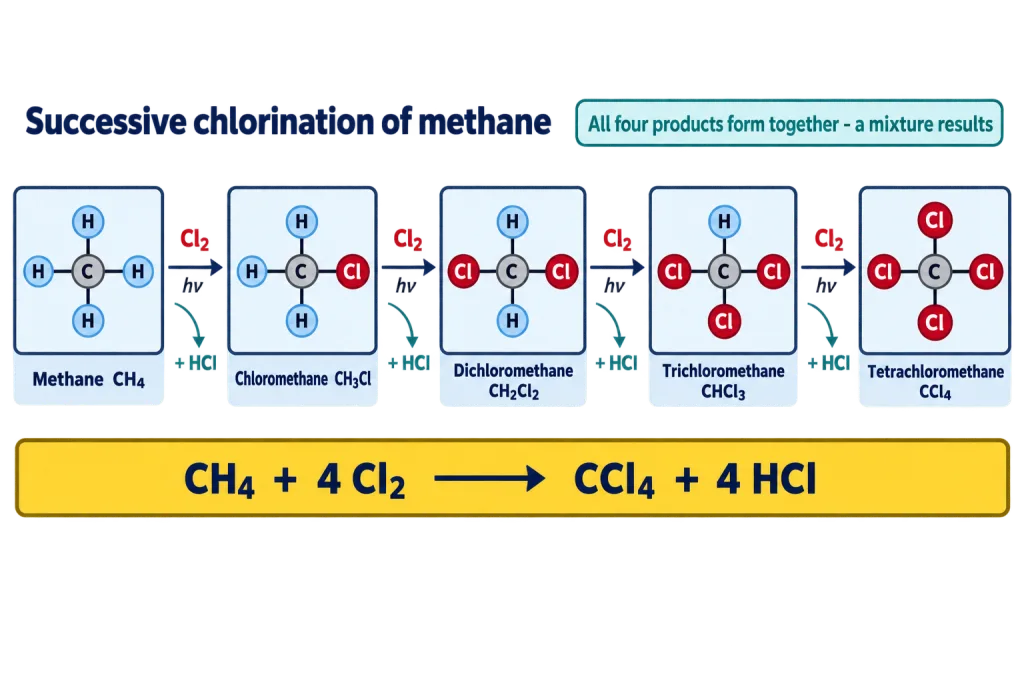
Every one of methane's four hydrogens can be replaced, so chlorine attacks in four successive stages, each releasing one molecule of hydrogen chloride.
Adding the four gives the overall equation:
Check it. Left: 1 C, 4 H, 8 Cl. Right: 1 C, 4 H in , and 4 + 4 = 8 Cl. Every step balances the same way — one hydrogen leaves the carbon, one chlorine atom joins it, and the second chlorine atom carries the hydrogen away.
Ethane behaves the same way, giving chloroethane at the first stage:
Why a mixture always results
The species that attacks methane is a chlorine atom, and it has no way of telling one C-H bond from another. The first molecule of formed still carries three perfectly good hydrogens, and a chlorine atom that collides with it attacks it as readily as it attacks methane. The second, third and fourth substitutions therefore begin long before the first is complete.
The product is a mixture of all four chloromethanes together with hydrogen chloride and leftover methane, separated afterwards by fractional distillation. Only the reactant ratio gives any control: a large excess of methane makes chloromethane the main product, because a chlorine atom is then far more likely to meet methane than chloromethane, while a large excess of chlorine drives the reaction through to tetrachloromethane.
Key Point: Free-radical halogenation is not selective. Every hydrogen in the flask — in the starting alkane and in every product made from it — is a target, so mono-, di-, tri- and tetra-substituted products all form together.
[Board] "Why is a mixture of products obtained in the chlorination of methane?" answers in two sentences: the chlorine radical cannot distinguish between hydrogens, and the mono-substituted product still has hydrogens left to lose.
How the four halogens compare
All four halogens can in principle substitute a hydrogen of an alkane, but they differ enormously in how fast and how usefully they do it.
Key Point: The rate of reaction of alkanes with halogens falls in the order
Chlorination and bromination are the two actually used; fluorination and iodination both fail, for opposite reasons.
Fluorination — too fast to control
Fluorine reacts with an alkane with explosive violence. The F-F bond is very weak, so fluorine atoms form far too easily, and the H-F and C-F bonds produced are very strong, so every step releases a large amount of energy that accelerates the next until the reaction runs away. It does not stop at substitution: carbon-carbon bonds break too, and the alkane is torn down to carbon and hydrogen fluoride. Direct fluorination is manageable only if both reactants are heavily diluted with an inert gas such as nitrogen, so collisions become rare and the heat can be carried away.
Iodination — reversible, and how the reversibility is beaten
Iodine is the opposite extreme. Iodination is extremely slow, and worse, it is reversible:
The reverse reaction is the problem: hydrogen iodide is a powerful reducing agent and reduces iodomethane straight back to methane as fast as it forms.
Both equations carry 1 C, 4 H and 2 I on each side. The equilibrium lies well to the left, so a flask of methane and iodine in sunlight yields almost no product.
The way round it is to destroy the hydrogen iodide as it forms. Any oxidising agent that attacks HI but leaves the iodoalkane alone will serve, and the two used are iodic acid, , and nitric acid, .
Atom count: left has H = 1 + 5 = 6, I = 1 + 5 = 6, O = 3; right has 6 I, 6 H and 3 O. Removing HI pulls the equilibrium to the right by Le Chatelier's principle, and the iodine regenerated goes back into the reaction, so nothing is wasted.
There is a second reason for the slowness, which belongs with the mechanism below. The step in which an iodine atom pulls a hydrogen off the alkane forms a weak H-I bond while breaking a C-H bond, which at is a strong one. That step is strongly endothermic, and an endothermic step in a chain is a slow one. A chlorine atom has no such difficulty, because the H-Cl bond it forms is far stronger.
Key Point: Fluorination fails because it is uncontrollably fast and must be diluted with an inert gas; iodination fails because it is slow and reversible, and needs an oxidising agent such as or to destroy the HI formed.
[JEE/NEET] "Why is iodination of alkanes carried out in the presence of an oxidising agent?" answers in one line: the reaction is reversible, the HI produced reduces the alkyl iodide back to the alkane, and the oxidising agent removes the HI.
Not all hydrogens are equal
Methane has four identical hydrogens, so the question of which one is replaced does not arise. In any larger alkane it does. Hydrogens are classed by the carbon carrying them: a hydrogen on a carbon joined to one other carbon is primary, on a carbon joined to two others secondary, and on a carbon joined to three others tertiary.
Key Point: The ease with which a hydrogen of an alkane is replaced by a halogen falls in the order
Why tertiary is easiest
The reason has nothing to do with the hydrogen itself, and everything to do with what is left behind when it is taken away.
Removing a hydrogen atom leaves a free radical — a carbon with three bonds and one unpaired electron. A tertiary hydrogen leaves a tertiary radical, a secondary hydrogen a secondary radical, and so on. The stability order of alkyl radicals from Chapter 8 is
because each alkyl group on the radical carbon pushes electron density in by the effect and, more importantly, its C-H bonds overlap with the half-filled orbital and spread the odd electron out by hyperconjugation. A more stable radical is reached through a lower-energy transition state, so it forms faster, and the tertiary hydrogen comes off most easily because the radical it leaves behind is the easiest one to make.
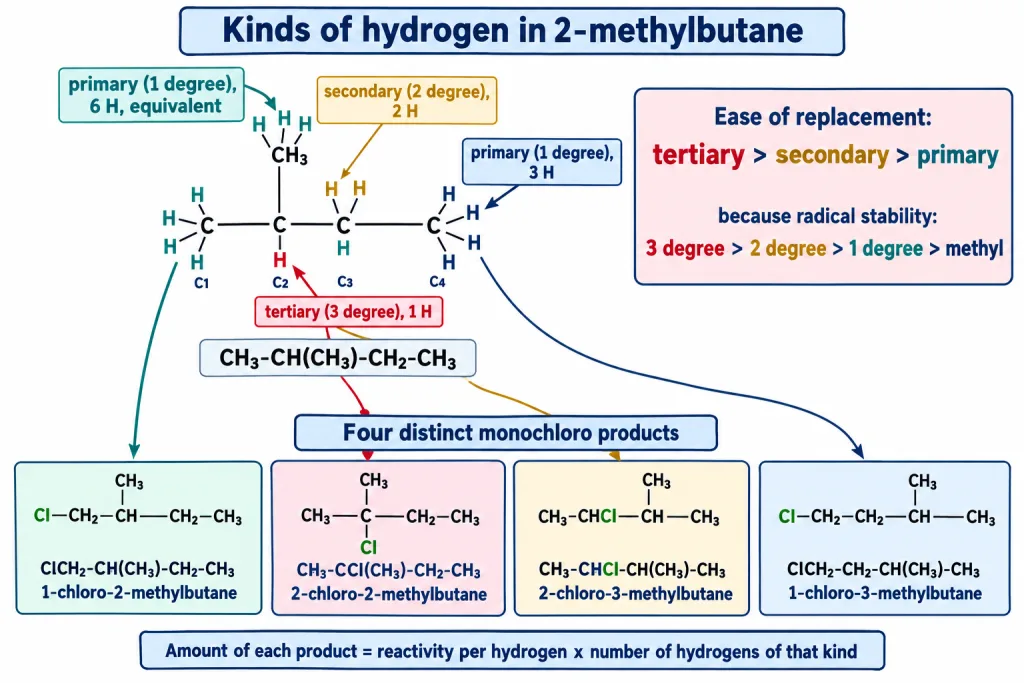
A molecule with all three kinds of hydrogen
Take 2-methylbutane, , with the main chain numbered C1 to C4 and a methyl branch on C2.
| Position | Kind of hydrogen | Number of such H |
|---|---|---|
| C1 and the 2-methyl group | primary | 6 |
| C2 | tertiary | 1 |
| C3 | secondary | 2 |
| C4 | primary | 3 |
C1 and the branch are two methyl groups on the same carbon, so they are equivalent and give the same product, leaving four distinct positions and four monochlorination products:
- 1-chloro-2-methylbutane, , from either of the equivalent methyls on C2
- 2-chloro-2-methylbutane, , from the tertiary hydrogen
- 2-chloro-3-methylbutane, , from the secondary hydrogens on C3
- 1-chloro-3-methylbutane, , from the methyl at C4
Predicting the mixture
Two factors decide how much of each product forms, and they pull against each other. Reactivity per hydrogen favours the tertiary position, then the secondary, then the primary. The number of hydrogens of each kind favours the primary positions, because there are nine primary hydrogens here and only one tertiary.
Multiplying the two for each position, all four products form in comparable amounts and none overwhelms the rest: the six primary hydrogens on the two methyls attached to C2 and the two secondary hydrogens at C3 give the largest shares, the single tertiary hydrogen a substantial one, and the lone methyl at C4 the least.
Key Point: The amount of each product is set by the product of two factors — how reactive that kind of hydrogen is () and how many hydrogens of that kind the molecule has. The tertiary hydrogen is the most reactive but is usually outnumbered.
[JEE Main] Counting the distinct monochlorination products of an alkane is a standard one-mark item, and the method is mechanical: find every set of equivalent hydrogens and count the sets, since each set gives exactly one product.
Halogenation of an alkane proceeds by a free-radical chain mechanism in three parts: initiation, propagation and termination. Every step below is numbered, because examination questions ask you to classify a step by name.
One piece of notation first. In heterolysis both bonding electrons go to one atom and ions result; in homolysis they separate, one to each atom, and neutral radicals result. The movement of a single electron is shown by a half-headed arrow with one barb, a fishhook arrow, as against the full double-barbed arrow for a moving electron pair. Fishhooks cannot be typed, so they are drawn in the figure; in words, one fishhook starts at the middle of the bond and points at one atom while a second points at the other.
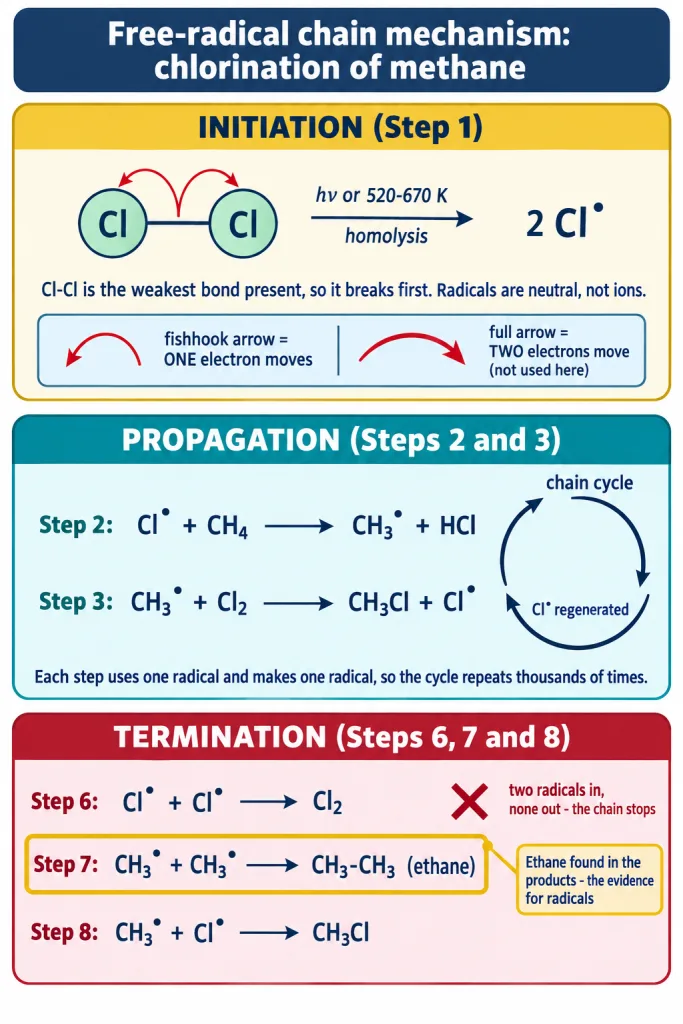
(i) Initiation
Step 1.
Light of the right energy, or heating to 573-773 K, breaks the chlorine molecule homolytically into two chlorine free radicals. Two fishhook arrows leave the Cl-Cl bond, one to each chlorine atom, showing the bonding pair parting company. The Cl-Cl bond breaks rather than a C-H or C-C bond because it is the weakest bond in the mixture — its bond enthalpy is lower than the C-H value of and the C-C value of . Bond strength, not bond polarity, decides what homolyses.
Electron bookkeeping: the Cl-Cl bond holds two electrons, one from each atom. After homolysis each chlorine has its own seven valence electrons, one of them now unpaired, and a charge of zero. A radical is neutral, not an ion, and that is the most useful single fact about this mechanism. Initiation is the only step that needs the light; it makes radicals where there were none.
(ii) Propagation
Step 2.
The chlorine radical attacks methane and pulls a hydrogen atom off it. Only the hydrogen atom moves — the proton plus one electron; the other electron of the broken C-H bond stays on carbon and becomes the odd electron of the methyl radical. In fishhook terms, one arrow runs from the C-H bond to the hydrogen and one runs back onto the carbon. Atoms: left 1 C, 4 H, 1 Cl; right 1 C and 3 H in plus 1 H and 1 Cl in HCl. Charge: neutral throughout — no ions anywhere.
Step 3.
The methyl radical attacks a fresh chlorine molecule, takes one chlorine atom to complete its octet, and leaves the other as a new radical. Atoms: left 1 C, 3 H, 2 Cl; right 1 C, 3 H and 1 Cl in plus 1 Cl as the radical. Balanced.
The feature that makes it a chain
Count the radicals across the two propagation steps. Step 2 consumes one and produces one ; Step 3 consumes one and produces one . One radical in, one radical out, both times.
Neither step changes the number of radicals present. The chlorine radical regenerated at the end of Step 3 is identical to the one that began Step 2, so it goes back into Step 2 with a fresh methane molecule and the pair runs round and round, making one molecule of product on every turn.
Key Point (Definition): A chain reaction is one in which a reactive intermediate consumed in one step is regenerated in a later step, so a single initiation event causes a long, self-sustaining sequence of reactions. The species that carry the chain forward — here and — are the chain carriers.
The carrier that closes the loop is the chlorine radical: made by initiation, consumed at the start of every cycle and handed back at the end of it. The methyl radical is the other carrier, but it exists only for the half-cycle between Step 2 and Step 3.
Because nothing is lost on a turn of the cycle, one absorbed photon can lead to thousands of molecules of chloromethane before the chain breaks. That is why a little light produces a great deal of product.
The propagation steps that give the higher products
The same pair of steps repeats on the products themselves, which is exactly why the mixture forms.
Step 4.
Step 5.
The dot before the formula in marks the carbon as the atom carrying the odd electron. Step 4 has 1 C, 3 H and 2 Cl on each side; Step 5 has 1 C, 2 H and 3 Cl. Two more pairs of the same shape take to through , then to through .
(iii) Termination
The chain can stop only if the radicals are removed, and the only way to remove one is to pair its odd electron with another odd electron. Two radicals must meet, and three combinations are possible.
Step 6.
Step 7.
Step 8.
Each of these consumes two radicals and produces none. That is the definition of a termination step, and the test to apply whenever a question asks you to classify one: count the radicals on each side.
Step 8 catches students out, because the molecule it makes, chloromethane, is the one Step 3 makes as well. Two steps can give the same product and still belong to different classes — Step 3 is propagation because it hands back a radical, Step 8 is termination because it destroys both radicals it starts with. Radicals are present in tiny concentrations, so two of them meeting is rare, which is why the cycle turns so many times before termination catches it.
Key Point: Initiation makes radicals from none. Propagation keeps the radical count constant while making product. Termination destroys radicals two at a time and hands back no carrier, so the chain stops.
Ethane in the flask — the evidence for the mechanism
The mechanism was not guessed. One experimental observation fixes it, and the argument is short and airtight.
When methane is chlorinated, a small quantity of ethane, , is found among the products.
Ethane has a carbon-carbon bond. What went into the flask was methane, with one carbon and no C-C bond, and chlorine, with no carbon at all. Nothing in the mixture contains a C-C bond, so somewhere in the reaction two carbons have been joined.
The only step in the whole scheme that joins two carbons is Step 7:
For that step to happen at all, free methyl radicals must be present as real, separately existing intermediates, not a bookkeeping device on paper.
The alternatives all fail. An ionic route through cannot work, because two positive ions repel rather than combine, and the same objection applies to two ions. A concerted one-step displacement of hydrogen by chlorine has no route to a C-C bond at all. Only neutral methyl radicals account for ethane, and the small amounts of chloroethane also found, from chlorination of that ethane, fit the same picture.
Key Point: The formation of ethane during the chlorination of methane is the experimental evidence for the free-radical mechanism. Ethane contains a C-C bond that neither reactant possesses, and it can only arise from two methyl radicals combining in a termination step.
[Board] This is set as "Explain why ethane is obtained as a by-product in the chlorination of methane". Three sentences answer it: ethane has a C-C bond, neither nor has one, so two methyl radicals must have combined.
Chlorination in the dark, and the effect of an inhibitor
Two further observations pin the mechanism down, and both follow from its three-part structure.
No light, no reaction. A mixture of methane and chlorine in the dark at room temperature does not react at any measurable rate. Nothing in it has enough energy to homolyse the Cl-Cl bond, so Step 1 never happens, no chlorine radicals appear, and the cycle has nothing to start it — Step 2 needs a chlorine radical that only initiation can supply. The reaction is not slow in the dark; no path is open to it. Supply the energy as sunlight, ultraviolet light or heat at 573-773 K and it begins at once, and a chemical initiator that falls apart into radicals on gentle warming, such as an organic peroxide, does the same job.
A trace of an inhibitor stops it. Add a small amount of a radical trap — molecular oxygen is the common example — and the reaction stops, or shows a clear induction period during which nothing appears to happen. Oxygen intercepts the methyl radical and turns it into a sluggish peroxy radical that cannot carry the chain; once the inhibitor is used up, the reaction resumes at its normal rate. How little is needed is the striking part, because each radical removed cancels a whole chain of thousands of cycles rather than one molecule of product. An ordinary reaction is not switched off by a trace impurity, so inhibition by oxygen is a diagnostic test for a radical chain.
Set against the mechanisms of Chapter 8
Chapter 8 introduced two mechanistic families. This one belongs to neither.
| Feature | Electrophilic or nucleophilic | Free-radical halogenation |
|---|---|---|
| How the bond breaks | heterolysis | homolysis |
| Arrow used | full curved arrow, two barbs | fishhook, one barb |
| Intermediates | carbocations, carbanions — charged | free radicals — neutral |
| What starts it | a polar reagent or a catalyst | light or heat |
| Effect of a polar solvent | speeds it up, stabilising the ions | little effect |
| Effect of a trace of oxygen | none worth mentioning | stops the reaction |
The difference in one sentence: an electrophilic or nucleophilic reaction moves electron pairs and passes through ions, while free-radical halogenation moves single electrons and passes through neutral species, so there are no ions in it at all. That is why polar solvents do not help it and why it works perfectly well in the gas phase. It also explains the lack of selectivity: with uncharged intermediates the attraction of opposite charges, the usual driver of selectivity in polar reactions, is missing — which brings the argument back to the mixture of products this section opened with.
Question 1: The four chlorinations of methane
Write the four successive steps in the chlorination of methane, name each organic product, and write the overall equation.
Answer:
Each step swaps one hydrogen for one chlorine and throws out one molecule of HCl.
The products in order are chloromethane, dichloromethane, trichloromethane (chloroform) and tetrachloromethane (carbon tetrachloride). Adding the four steps, four go in and four HCl come out.
Balance: 1 C and 4 H on both sides, 8 Cl on the left and 4 + 4 = 8 on the right.
Ans: The four steps above; overall . Watch out: The fourth step is not . The hydrogen always leaves as HCl.
Question 2: Getting one product instead of four
Explain why chlorination of methane gives a mixture, and say how chloromethane can be made the main product.
Answer:
The attacking species is a chlorine radical, and it cannot tell one C-H bond from another. As soon as chloromethane forms it sits beside leftover methane with three hydrogens still on it, and a chlorine radical that hits it substitutes another hydrogen just as readily, so all four substitutions run together.
To favour chloromethane I use a large excess of methane. On numbers alone a chlorine radical is then far more likely to collide with methane than with chloromethane, so the second substitution becomes rare. The mixture is separated afterwards by fractional distillation.
Ans: Because every hydrogen present, in the alkane and in each product, is an equally good target; a large excess of methane makes chloromethane the major product.
Question 3: Iodination of methane
Why is the iodination of methane carried out in the presence of iodic acid or nitric acid? Write the equations.
Answer:
Iodination is reversible, and the HI it makes is a reducing agent strong enough to send the product straight back:
So the equilibrium sits far to the left and hardly any product accumulates. An oxidising agent removes the HI as it forms:
Left: 6 H, 6 I, 3 O. Right: 6 I, 6 H, 3 O. Taking HI out shifts the equilibrium right by Le Chatelier's principle, and the iodine regenerated goes back into the reaction. Concentrated nitric acid does the same job.
Ans: Because the reaction is reversible and the HI formed reduces back to ; the oxidising agent destroys the HI and pulls the equilibrium forward. Watch out: The oxidising agent is not a catalyst and it does not touch the iodomethane. It removes one product only.
Question 4: Counting monochloro products of 2-methylbutane
How many distinct monochloro products can 2-methylbutane give? Name them, and say which forms in the smallest amount.
Answer:
The skeleton is , with C1 to C4 along the chain and a methyl branch on C2. I group the hydrogens into equivalent sets. C1 and the branch methyl are two methyls on the same carbon, so they are equivalent — one set. C2 has its single tertiary hydrogen — a second. C3 has two secondary hydrogens — a third. C4 is a methyl on C3, in a different environment from the other two methyls — a fourth. Four sets, four products.
- From C1 or the branch methyl: , 1-chloro-2-methylbutane
- From C2: , 2-chloro-2-methylbutane
- From C3: , 2-chloro-3-methylbutane
- From C4: , 1-chloro-3-methylbutane
For the third one the locant set is from either end, so the tie goes to the substituent first in alphabetical order and chloro takes the 2. The smallest share comes from C4 — three hydrogens of the least reactive kind, with no advantage in either reactivity or number.
Ans: Four — 1-chloro-2-methylbutane, 2-chloro-2-methylbutane, 2-chloro-3-methylbutane and 1-chloro-3-methylbutane, the last of these being the smallest fraction. Watch out: The commonest wrong answer is three, from counting only the primary, secondary and tertiary classes. The two primary positions here are in different environments and give different products.
Question 5: Neopentane and pentane
How many distinct monochloro products does each of 2,2-dimethylpropane and pentane give?
Answer:
2,2-dimethylpropane is . The central carbon spends all four bonds on methyl groups, so it has no hydrogen, and the four methyls are equivalent. All twelve hydrogens form one set: one product, 1-chloro-2,2-dimethylpropane.
Pentane is . C1 and C5 are equivalent methyls, C2 and C4 are equivalent, and C3 sits between two groups and is distinct from them. Three sets, three products: 1-chloropentane, 2-chloropentane and 3-chloropentane.
Ans: One from 2,2-dimethylpropane; three from pentane. Watch out: C2, C4 and C3 of pentane are all secondary, yet C3 gives a product different from the one C2 and C4 give. Equivalence is decided by the whole environment, not by the primary-secondary-tertiary label.
Question 6: 2,3-dimethylbutane
How many monochloro products does 2,3-dimethylbutane give? Name them.
Answer:
The structure is , symmetrical about the centre of the C-C bond. All four methyls are equivalent, so twelve primary hydrogens form one set, and the two central carbons are equivalent, so their two tertiary hydrogens form a second. Two products: 1-chloro-2,3-dimethylbutane, , and 2-chloro-2,3-dimethylbutane, .
Ans: Two — 1-chloro-2,3-dimethylbutane and 2-chloro-2,3-dimethylbutane. Watch out: This molecule has no secondary hydrogen at all. Answering three because "there must be a primary, a secondary and a tertiary product" is the trap.
Question 7: Classify the steps
Classify each of these as initiation, propagation or termination, with the reason.
(a) (b) (c) (d)
Answer:
I count radicals on each side of every equation.
(a) Zero radicals in, two out — radicals are created where there were none, so initiation. (b) One radical in, one out, and product is being made, so propagation. (c) Two radicals in, none out — both destroyed, so termination. (d) One radical in, one out, so propagation.
Ans: (a) initiation, (b) propagation, (c) termination, (d) propagation. Watch out: (c) and (d) both give chloromethane, which is why (d) is so often mislabelled termination. The product does not decide the class; the radical count does.
Question 8: The chain carrier
Name the chain carriers in the chlorination of methane, say which one closes the cycle, and say how many product molecules one initiation event can lead to.
Answer:
The carriers are the chlorine radical, , and the methyl radical, . Each appears on the left of one propagation step and the right of the other.
The one that closes the cycle is : made in initiation, consumed when it abstracts hydrogen from methane, and handed back when the methyl radical attacks . Since neither propagation step changes the number of radicals, one chlorine radical can turn the cycle thousands of times before termination catches it, so one photon absorbed leads to thousands of molecules of chloromethane.
Ans: and are the carriers, closes the cycle, and one initiation event can give thousands of product molecules.
Question 9: Ethane as evidence
A small amount of ethane is always found among the products of the chlorination of methane. Why is this decisive evidence for a free-radical mechanism?
Answer:
Ethane contains a carbon-carbon bond. Neither reactant does — methane has a single carbon and chlorine none — so two carbons must have been joined. The only step that joins two carbons is the combination of two methyl radicals:
For two methyl radicals to meet, they must exist in the mixture as real intermediates. An ionic mechanism cannot do it: two methyl cations repel each other, and so do two methyl carbanions, so neither pair would ever combine. A one-step displacement of H by Cl has no route to a C-C bond at all.
Ans: Ethane has a C-C bond that neither nor possesses, so it can only come from two methyl radicals combining, which proves free methyl radicals are real intermediates. Watch out: The answer is not "because ethane is the next alkane in the series". The whole argument turns on the C-C bond.
Question 10: The dark and the inhibitor
(a) Why does a mixture of methane and chlorine not react in the dark at room temperature? (b) What happens if a trace of oxygen is added, and why is the effect so large for so little oxygen?
Answer:
(a) The mechanism cannot start. Nothing in the mixture has enough energy to homolyse the Cl-Cl bond, so no chlorine radicals appear and initiation never occurs. The first propagation step needs a chlorine radical to begin with, so propagation cannot start by itself either. The reaction is not merely slow in the dark; no path is open.
(b) Oxygen is a radical scavenger. It traps the methyl radical as a sluggish peroxy radical that cannot carry the chain, so the reaction stops or shows an induction period until the oxygen is used up, then resumes at its normal rate. The effect is out of proportion to the amount because every radical removed cancels a whole chain, not a single molecule of product.
Ans: (a) No initiation, so no chain carriers and no reaction. (b) Oxygen traps methyl radicals and kills the chains; a trace suffices because each radical removed costs thousands of cycles.
Question 11: Chlorination of ethane
How many monochloro and how many dichloro products can ethane give? Name them.
Answer:
All six hydrogens of are equivalent, so there is only one monochloro product, chloroethane. For the dichloro products I put the second chlorine on chloroethane: on the carbon that already carries chlorine, giving , 1,1-dichloroethane, or on the other carbon, giving , 1,2-dichloroethane. That is all — both chlorines on the far carbon gives , which is 1,1-dichloroethane written backwards.
Ans: One monochloro product (chloroethane) and two dichloro products (1,1-dichloroethane and 1,2-dichloroethane).
Question 12: Propagation steps for the second substitution
Write the propagation steps that convert chloromethane into dichloromethane, and check the balance.
Answer:
The pattern repeats: a chlorine radical abstracts a hydrogen, then the carbon radical takes a chlorine from and hands one back.
First: left 1 C, 3 H, 2 Cl; right 1 C, 2 + 1 = 3 H, 1 + 1 = 2 Cl. Second: left 1 C, 2 H, 1 + 2 = 3 Cl; right 1 C, 2 H, 2 + 1 = 3 Cl. Both balance. The dot before the formula in marks the carbon, not the chlorine, as the atom with the odd electron. The chlorine radical is regenerated, so this is a propagation cycle like the first — which is why the reaction cannot be stopped at chloromethane.
Ans: The two steps above; both balance, and the second regenerates , so the chain continues.