
An alkane has nothing to offer an incoming reagent. Every bond in it is a sigma bond, every electron is tucked between two nuclei, and a molecule approaching it finds only a smooth surface of hydrogen atoms. An alkene is the opposite. Its double bond is one sigma bond and one pi bond, and the pi bond is made by sideways overlap of two orbitals, one on each carbon. The pi electron cloud lies above and below the plane of the molecule, out in the open, where anything drifting past meets it first.
Those pi electrons are also held loosely. The whole C=C bond is worth about kJ/mol, and of that the sigma part is about kJ/mol while the pi part is only about kJ/mol. The pi bond is the weakest bond in the molecule, so it is the bond that gives way.
An electron-poor species is pulled towards an alkene for both reasons. Such a species is called an electrophile, an electron-loving reagent. It takes the pi electrons, the pi bond disappears, and the two carbons end up holding two new groups. Nothing has left the molecule; the reagent has been added across the double bond.
Key Point (Definition): In an electrophilic addition, an electron-seeking reagent attacks the loosely held pi electrons of a multiple bond, and the two fragments of the reagent finish on the two carbons that were doubly bonded. No atom is displaced, and the product is more saturated than the reactant.
The general shape of the mechanism
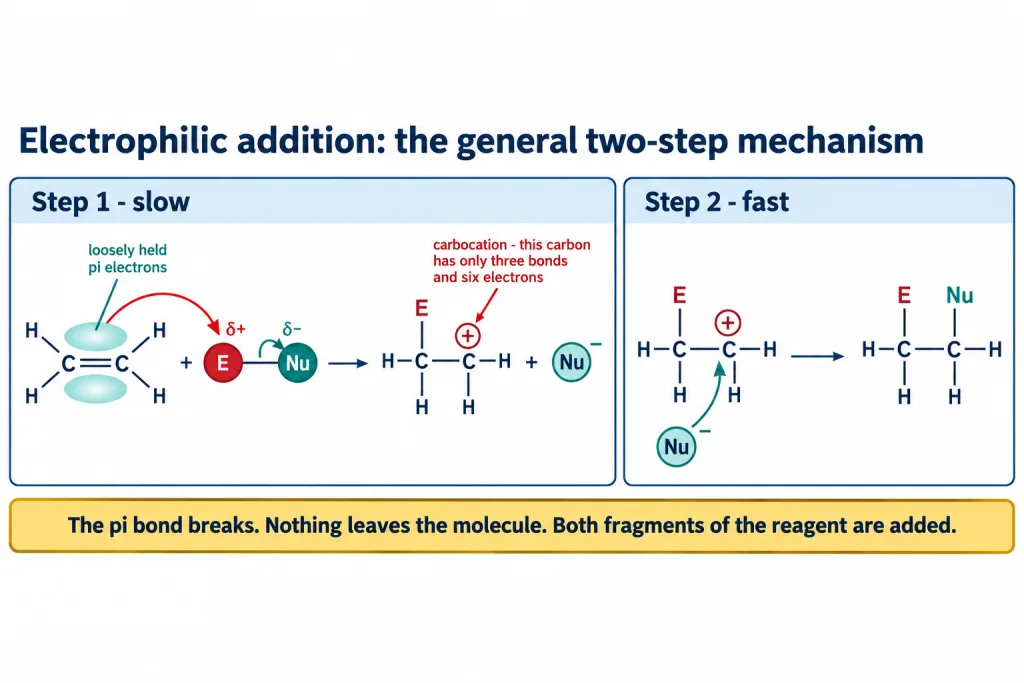
Write the reagent as , where is the electrophilic end and the nucleophilic end. Almost every addition in this chapter runs in the same two steps.
Step 1 — slow. The pi electrons reach out to the electrophilic end and form a new sigma bond from one alkene carbon to . The pi bond is gone. The other carbon has been left holding only three bonds and six electrons, so it carries a positive charge. That species is a carbocation. In some additions the electrophile does not sit on one carbon at all but bridges both, giving a cyclic ion instead; bromine does exactly this, and that case is worked out later in this section.
Step 2 — fast. The nucleophile, negatively charged or at least electron-rich, attacks the positive carbon and gives it the fourth bond it is short of. The addition product is complete.
The first step is the slow one, because it breaks a bond and creates a charge. Whatever makes that carbocation easier to form makes the whole addition faster, and that single idea decides the outcome of every unsymmetrical addition in the next section.
How this differs from what alkanes do
The reaction of section 4 was a free-radical substitution: light or heat split a halogen molecule into two neutral atoms, a chlorine atom pulled a hydrogen off the alkane, the alkyl radical grabbed a chlorine, and a molecule of HCl was thrown out at every stage. Here nothing is thrown out and nothing is neutral in the middle — the intermediates carry charges, the reaction needs no light, and the alkene keeps all its own atoms while gaining both fragments of the reagent.
Three additions are taken in turn below: dihydrogen, the halogens, and the hydrogen halides. Addition of water, oxidation, ozonolysis and polymerisation come later in the chapter.
Alkene plus dihydrogen gives an alkane
An alkene takes up one molecule of dihydrogen in the presence of finely divided nickel, palladium or platinum and becomes the corresponding alkane.
Every one of these balances by inspection: two hydrogens go in, and the carbon count never changes. Ethene, , plus gives ; propene, , gives ; but-2-ene, , gives .
A mixture of ethene and dihydrogen can be kept indefinitely without reacting. The metal is what makes the reaction go. Its surface adsorbs the dihydrogen and stretches the H-H bond almost to breaking, holds the alkene alongside it, and then hands over the two hydrogen atoms to the two carbons. Because both hydrogens are delivered from the metal surface, they arrive on the same face of the double bond. This is a syn addition, and it is the opposite of what bromine does.
The words finely divided are part of the answer, not decoration. A lump of nickel has almost no surface; nickel precipitated as a fine black powder has an enormous one, and the reaction happens entirely on the surface.
The heat given out is a measurement, not a detail
Hydrogenation is exothermic. Two strong C-H sigma bonds are made and only a weak pi bond and one H-H bond are broken, so the products sit lower in energy than the reactants.
Key Point (Definition): The enthalpy of hydrogenation is the enthalpy change when one mole of an unsaturated compound adds dihydrogen and becomes saturated. It is negative, because heat is released. The more heat an alkene gives out, the higher up it started, and the less stable it was.
That last sentence only works when the alkenes being compared all end up at the same place. The three isomers of with a straight chain all give exactly the same product, butane, so any difference in the heat released must come from the alkenes themselves.
| Alkene | Structure | Enthalpy of hydrogenation | Product |
|---|---|---|---|
| But-1-ene | about kJ/mol | butane | |
| cis-But-2-ene | , both methyls on one side | about kJ/mol | butane |
| trans-But-2-ene | , methyls on opposite sides | about kJ/mol | butane |
Read the table from the bottom up. Trans-but-2-ene releases the least, so it began lowest, so it is the most stable of the three. Cis-but-2-ene is next; it has the same two alkyl groups on the double bond but they are crowded together on one side. But-1-ene releases the most and is the least stable, because only one of its doubly bonded carbons carries an alkyl group.
Two conclusions come straight out of the numbers, and both are worth memorising:
- The more alkyl groups on the doubly bonded carbons, the more stable the alkene.
- Between two geometrical isomers, trans is more stable than cis, because the bulky groups are further apart.
Ethene, with no alkyl group at all on the double bond, gives out about kJ per mole on hydrogenation — more than any of the butenes. It cannot be put in the same table, because it gives ethane and not butane, but the pattern it belongs to is the same one.
Why this settles Saytzeff's rule
Section 7 stated that an elimination gives the more substituted alkene as the major product. The enthalpies of hydrogenation are the experiment behind that statement. They show, by direct measurement and without any argument, that the more substituted alkene really is the more stable one — and the transition state leading to it is lower in energy for the same reason, so it forms faster. Saytzeff's rule is a consequence of alkene stability, and alkene stability is something a calorimeter can measure. [JEE Main]
One industrial use
Vegetable oils contain long chains with several double bonds in them; hydrogenating those double bonds with dihydrogen over a nickel catalyst turns the liquid oil into the semi-solid fat sold as vanaspati ghee.
Bromine in carbon tetrachloride
Bromine and chlorine add across a double bond to give a vicinal dihalide, that is, a dihalide with the two halogen atoms on adjacent carbons. The standard laboratory reagent is a solution of bromine in carbon tetrachloride, , which is red-brown.
Count the atoms in the second one: plus gives , and each of the four carbons still has four bonds.
The red-brown colour is discharged. That is the whole observation, and it is the classic test for unsaturation. A few drops of bromine in carbon tetrachloride shaken with an unknown compound at room temperature: if the colour vanishes at once, a carbon-carbon multiple bond is present. Bromine water behaves the same way and is often used instead, because it is safer to handle.
Key Point: Bromine in , red-brown, decolourised at once in the cold and in the dark by an alkene or an alkyne, unchanged by an alkane and by benzene. The disappearance of the colour is what you report.
The test is done in the cold and away from sunlight, because an alkane in bright sunlight will also make bromine fade — by free-radical substitution, which gives off fumes of hydrogen bromide. An addition gives off nothing.
The mechanism, through the cyclic bromonium ion
A bromine molecule is not polar to start with, so at first sight it has no electrophilic end. The alkene creates one.
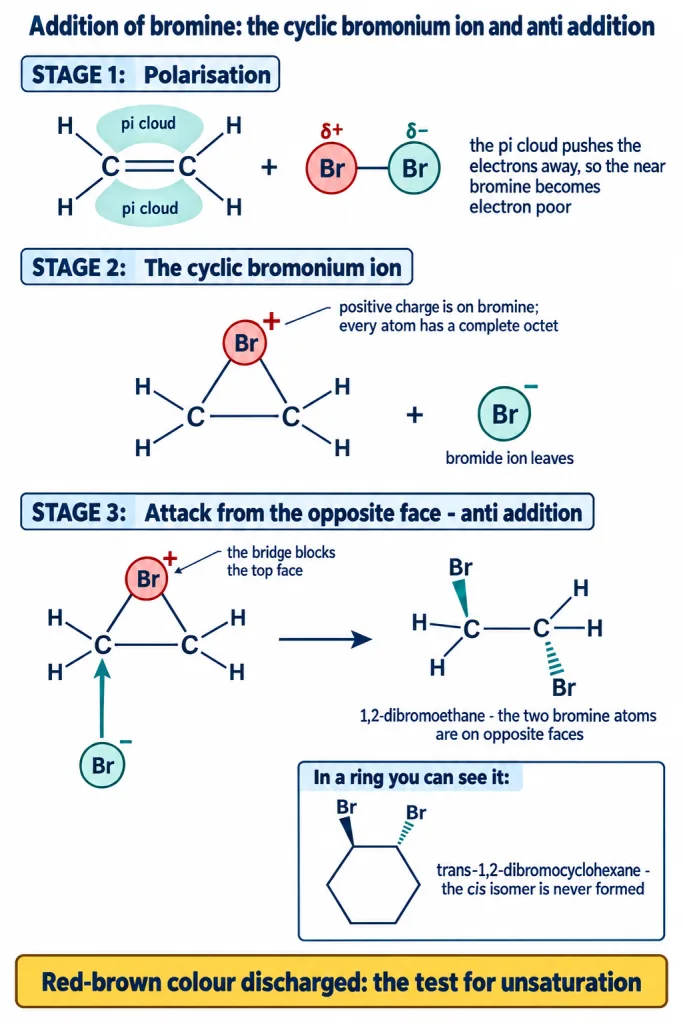
Step 1 — the alkene polarises the bromine. As approaches the electron-rich pi cloud, the cloud repels the electrons of the nearer bromine atom and pushes them along the bond towards the far atom. The molecule becomes polarised, , and the near atom is now an electrophile.
Step 2 — the bromonium ion forms. The pi electrons attack that bromine and the Br-Br bond breaks heterolytically. Bromide ion, , leaves with both bonding electrons. The bromine that stayed behind does not sit on one carbon: it uses one of its own lone pairs to bond to the second carbon as well, so it bridges both carbons in a three-membered ring. The positive charge sits on the bromine. This species is the cyclic bromonium ion.
The bridge is preferred over an open carbocation because bromine has lone pairs to spare, and sharing one of them gives every atom in the ion a complete octet. An open primary carbocation would leave a carbon with only six electrons.
Step 3 — the bromide comes back, from the other side. The bromide ion released in step 2 attacks one of the two ring carbons. It cannot approach from the side the bridge is on, because the bulky positive bromine is sitting there and blocking it. So it attacks from the face opposite the bridge, the C-Br bond of the ring breaks, and the second bromine ends up on the far side from the first.
Key Point: The two bromine atoms arrive on opposite faces of what was the double bond. Addition of a halogen to an alkene is therefore an anti addition.
What anti addition looks like in a ring
For an open-chain alkene the two ends can rotate afterwards, so the anti relationship is easy to miss. In a ring it cannot rotate away, and the result is visible in the product's name.
Cyclohexene, , with bromine in carbon tetrachloride gives trans-1,2-dibromocyclohexane and none of the cis compound.
One bromine points up from the ring and the other points down. If the two bromines had been delivered together from the same face, as the hydrogens are in catalytic hydrogenation, the cis product would be the only one formed. It is not formed at all. Since the bromide ion can open the bridge at either of the two carbons, and the two choices give mirror-image products, the trans product is obtained as an equal mixture of the two mirror-image forms.
A second piece of evidence points the same way. Carrying out the addition in the presence of added chloride ion — in water rather than in carbon tetrachloride, so that the salt actually dissolves — gives a good deal of the 1-bromo-2-chloro compound alongside the dibromide. A chloride ion can only get into the product if there is a positively charged intermediate sitting there waiting for a nucleophile from outside — which is exactly what the bromonium ion is.
Chlorine and iodine
Chlorine behaves in the same way and by the same mechanism, through a cyclic chloronium ion, and gives the vicinal dichloride.
Chlorine is the faster of the two, but bromine is what the test uses, because a red-brown colour disappearing is far easier to see than a pale greenish-yellow one.
Iodine does not add to an alkene under ordinary conditions. The addition is too unfavourable to go anywhere; iodine's colour stays exactly where it was. A compound that leaves an iodine solution unchanged has told you nothing about whether it is unsaturated.
The reagents and their order of reactivity
Hydrogen chloride, hydrogen bromide and hydrogen iodide all add across a double bond to give an alkyl halide. The hydrogen goes on one carbon and the halogen on the other.
They do not all react at the same speed. The order is fixed:
Key Point: The reactivity of the hydrogen halides towards an alkene falls in the order .
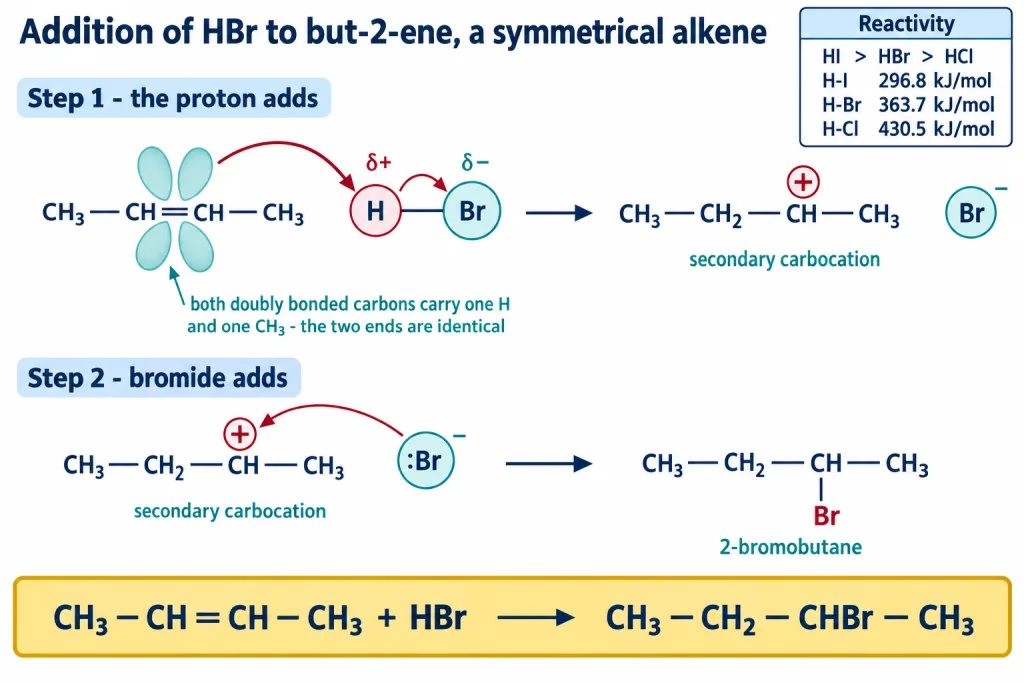
The reason is the bond that has to break. The addition starts by handing a proton to the alkene, so the H-X bond must come apart in the very first and slowest step. The weaker that bond, the easier the step and the faster the reaction. The measured bond enthalpies fall in exactly the order needed: H-Cl about kJ/mol, H-Br about kJ/mol, H-I about kJ/mol. Hydrogen iodide, with the weakest bond, reacts fastest. [NEET]
A common wrong route to this order is to argue from the electronegativity of the halogen — that chlorine is the most electronegative, so H-Cl is the most polarised, so it should give up its proton most readily. Polarity is not the deciding factor here; bond strength is.
Addition to a symmetrical alkene
A symmetrical alkene is one in which the two doubly bonded carbons carry the same set of groups. Ethene, but-2-ene, hex-3-ene and 2,3-dimethylbut-2-ene are all symmetrical in this sense. When the alkene is symmetrical, it makes no difference which carbon the proton lands on, and there is only one possible product.
Ethene and hydrogen bromide. The overall reaction is
Atom check: , and both carbons have four bonds.
The mechanism has the two steps set out at the start of this section.
Step 1 — the electrophile is a proton. Hydrogen bromide is already polar, . The pi electrons of ethene attack the hydrogen and form a C-H sigma bond, and the H-Br bond breaks heterolytically with the bromine taking both electrons. What is left of the alkene is the ethyl carbocation, a primary carbocation.
Step 2 — the nucleophile is bromide. The bromide ion released in the first step attacks the positive carbon and gives it its fourth bond.
Adding the two steps back together returns the overall equation, with the bromide ion cancelling from both sides.
But-2-ene and hydrogen bromide. This one shows why symmetry matters.
Each of the two doubly bonded carbons carries one hydrogen and one methyl group, so the two are indistinguishable. Put the proton on C2 and the positive charge appears on C3; put it on C3 and the charge appears on C2. Either way the intermediate is a secondary carbocation with a methyl on one side and an ethyl on the other — the same ion, drawn from two ends. Bromide then attacks it, and the product is 2-bromobutane whichever route was taken.
Atom check on the overall reaction: .
Two more symmetrical cases, worked the same way:
When there is a choice
The moment the alkene is unsymmetrical and the reagent is unsymmetrical as well, the proton has two different carbons to choose between, and the two choices give two different products. Propene with hydrogen bromide could give 1-bromopropane or 2-bromopropane, and only one of them is actually the major product. Which one, and why, is the whole business of the next section.
The three additions side by side
| Reagent | Conditions | Product | What is observed |
|---|---|---|---|
| finely divided Ni, Pd or Pt | the alkane | the gas is taken up; heat is released | |
| dissolved in , cold, no sunlight | vicinal dibromide | red-brown colour discharged at once, no fumes | |
| in , cold | vicinal dichloride | pale greenish-yellow colour fades | |
| ordinary conditions | no addition | colour unchanged | |
| , , | dry hydrogen halide, no peroxide | the alkyl halide | no colour change; reactivity |
Three facts run right across the table. The pi bond breaks every time, the product always carries two more groups than the alkene did, and nothing is ever expelled.
Reading a positive test honestly
What a discharged bromine colour tells you. The compound has a site of unsaturation that bromine can add across — a carbon-carbon double bond or a carbon-carbon triple bond.
What it does not tell you.
- It does not say alkene or alkyne. Ethene and ethyne both decolourise bromine, and so do all their homologues.
- It does not say how many double bonds there are. One mole of bromine decolourised does not mean one double bond unless the amount of bromine has actually been measured.
- It says nothing about where in the molecule the multiple bond sits.
- It does not identify the compound. Several other electron-rich compounds outside this chapter also take up bromine.
How to settle the alkene-or-alkyne question. Use ammoniacal silver nitrate: a terminal alkyne gives a white precipitate of the silver acetylide, and an alkene gives nothing at all. Ammoniacal cuprous chloride does the same job with a red precipitate. Baeyer's reagent is no help here, because its pink colour is discharged and brown is deposited by an alkene and an alkyne alike.
What a negative result tells you. Bromine in is left unchanged by an alkane, because an alkane has no pi electrons to offer, and by benzene, because benzene's six pi electrons are delocalised over the whole ring and giving them up to an electrophile would destroy that delocalisation. Benzene is unsaturated by formula and still fails the test, and that failure is one of the first pieces of evidence for its special structure.
A last practical warning. If a compound decolourises bromine only in bright sunlight, and the fumes turn moist blue litmus red, the reaction is free-radical substitution and the compound may well be a saturated alkane. Read both the colour and the fumes.
Question 1: Three hydrogenations
Write balanced equations for the catalytic hydrogenation of ethene, propene and 2-methylpropene, and name each product.
Answer:
Each alkene takes exactly one molecule of dihydrogen, and the carbon skeleton is untouched. The catalyst is finely divided nickel, palladium or platinum.
Checking the last one: . The product has a three-carbon chain with a methyl branch on the middle carbon, so it is 2-methylpropane and not butane.
Ans: Ethane, propane and 2-methylpropane. Watch out: Hydrogenation never straightens or rearranges a chain. A branched alkene gives a branched alkane.
Question 2: Ranking three butenes
The enthalpies of hydrogenation of but-1-ene, cis-but-2-ene and trans-but-2-ene are about , and kJ/mol. Arrange the three in order of stability and justify the comparison.
Answer:
All three give the same product, butane. Since the finishing line is common, the only thing that can make the heat released differ is where each alkene started.
But-1-ene gives out the most heat, so it began the highest above butane, so it is the least stable. Trans-but-2-ene gives out the least, so it began lowest and is the most stable. Cis-but-2-ene falls in between.
The chemistry behind the order: but-1-ene has an alkyl group on only one of its two doubly bonded carbons, while both but-2-enes have one on each, and alkyl groups stabilise a double bond. Between the two but-2-enes, the cis isomer has its two methyl groups crowded on the same side, which costs energy, so trans is lower.
Ans: trans-but-2-ene > cis-but-2-ene > but-1-ene in stability. Watch out: This comparison is only legitimate because all three give the same alkane. Ethene releases about kJ/mol, but that does not make it the least stable alkene in existence — it gives ethane, a different product altogether.
Question 3: The bromine mechanism in steps
Set out the mechanism of the addition of bromine to ethene in carbon tetrachloride.
Answer:
First I ask how a non-polar bromine molecule can be an electrophile at all. The alkene makes it one: as comes close to the pi cloud, the cloud pushes the electrons of the near bromine atom away along the bond, so that atom becomes and the far one .
The pi electrons then attack the bromine and the Br-Br bond breaks heterolytically, releasing . The bromine left behind uses a lone pair to bond to the second carbon as well, so it bridges both carbons and carries the positive charge — the cyclic bromonium ion.
Finally the bromide ion attacks a ring carbon from the face opposite the bridge, since the bridging bromine blocks its own side, and the ring opens.
Ans: Polarisation of , then formation of the cyclic bromonium ion with loss of , then attack of from the opposite face to give 1,2-dibromoethane. Watch out: The positive charge in the intermediate is on bromine, not on carbon. Drawing an open carbocation loses the whole reason the addition is anti.
Question 4: Why cyclohexene gives only one of two possible products
Cyclohexene and bromine in give trans-1,2-dibromocyclohexane and no cis isomer. Account for this.
Answer:
The bromonium ion forms on one face of the ring, say the top. The bridging bromine physically covers that face. When the bromide ion comes in, the top is blocked, so it has to attack a ring carbon from the bottom.
The result is one bromine above the ring and one below it — the trans arrangement. A ring cannot rotate about its C-C bonds the way an open chain can, so the two bromines are stuck where they were put and the relationship shows up in the product.
For the cis compound to form, both bromines would have to arrive on the same face, which is what happens in catalytic hydrogenation but not here.
Ans: The bromide can only attack from the face opposite the bromonium bridge, so the addition is anti and only the trans dibromide forms. Watch out: The bromide can open the bridge at either of the two carbons, and the two choices give mirror-image molecules. So the trans product is obtained as an equal mixture of the two mirror-image forms, not as a single one.
Question 5: Products from three symmetrical alkenes
Give the product of each: (a) but-2-ene with in , (b) hex-3-ene with HBr, (c) 2,3-dimethylbut-2-ene with HCl.
Answer:
Every one of these alkenes is symmetrical, so I do not have to decide which carbon gets what. Whichever way round I add the reagent, the same molecule comes out.
(a) Bromine adds one atom to each of C2 and C3. That is 2,3-dibromobutane.
(b) Hex-3-ene is ; each doubly bonded carbon carries one H and one ethyl group. That is 3-bromohexane.
(c) 2,3-Dimethylbut-2-ene is . The proton goes to one of the two identical carbons and chloride to the other. The chain is four carbons long with methyls at C2 and C3 and chlorine at C2, so it is 2-chloro-2,3-dimethylbutane.
Ans: (a) 2,3-dibromobutane, (b) 3-bromohexane, (c) 2-chloro-2,3-dimethylbutane.
Question 6: What makes a bromine test valid
A student adds bromine in to a liquid on a sunny window sill, sees the colour fade over ten minutes, and reports an alkene. What has gone wrong, and how should the test be run?
Answer:
Sunlight is the problem. Light splits bromine into bromine atoms, and those atoms will attack a saturated alkane by free-radical substitution, so the colour fades even when there is no double bond anywhere in the liquid.
The two reactions can still be told apart, because substitution throws out hydrogen bromide and addition throws out nothing. Held over the mouth of the tube, moist blue litmus turns red in the substitution case and stays blue in the addition case.
The other clue is speed. Addition to a genuine alkene is essentially instantaneous in the cold; ten minutes of slow fading is the signature of the radical reaction.
Ans: The test must be run in the cold and away from sunlight, and the absence of acidic fumes checked. Fading in sunlight with HBr fumes is substitution, not addition. Watch out: Never report the disappearance of colour by itself. Report that it disappeared immediately, in the cold, with no fumes.
Question 7: A gas decolourises bromine water
An unknown gas decolourises bromine water immediately. State what this proves, what it does not prove, and one further test that would narrow it down.
Answer:
What it proves: the gas has a carbon-carbon multiple bond that bromine can add across. It is not an alkane, and it is not benzene vapour.
What it does not prove: whether the multiple bond is a double bond or a triple bond, since ethene and ethyne both discharge the colour just as fast. It also says nothing about how many multiple bonds there are, or where they sit in the chain, and it does not name the compound.
The further test: pass the gas into ammoniacal silver nitrate. A terminal alkyne gives a white precipitate of the silver acetylide; an alkene gives no precipitate at all. Ammoniacal cuprous chloride does the same job, giving a red precipitate.
Ans: It proves unsaturation and nothing more. Ammoniacal silver nitrate separates a terminal alkyne, white precipitate, from an alkene, no precipitate. Watch out: Baeyer's reagent will not settle it. Its pink colour is discharged and brown appears with an alkene and with an alkyne alike.
Question 8: The order of reactivity of the hydrogen halides
State the order in which HCl, HBr and HI add to an alkene, and justify it with data.
Answer:
The order is .
The slow step of the addition is the transfer of a proton to the pi bond, and that step requires the H-X bond to break. Whichever H-X bond is weakest breaks most easily, so that reagent is fastest.
The bond enthalpies line up exactly with the order: H-Cl about kJ/mol, H-Br about kJ/mol, H-I about kJ/mol. The H-I bond is the weakest by a wide margin and hydrogen iodide is the most reactive.
Ans: , because the H-X bond strength falls in the order H-Cl > H-Br > H-I and the weakest bond breaks most readily. Watch out: Do not argue from electronegativity. H-Cl is the most polar of the three and still the least reactive, because polarity is not what has to be overcome — a bond is.
Question 9: HBr and but-2-ene, in full
Write the mechanism for the addition of HBr to but-2-ene and name the product.
Answer:
But-2-ene is . Each doubly bonded carbon carries one hydrogen and one methyl group, so the two ends are identical and I do not need to choose between them.
Step 1. Hydrogen bromide is polar, . The pi electrons attack the hydrogen, the H-Br bond breaks heterolytically, and a secondary carbocation is left.
Step 2. The bromide ion attacks the positive carbon.
Adding the steps gives , which balances.
Ans: 2-Bromobutane, through a secondary carbocation. Watch out: Protonating the other carbon looks like a second pathway but it is the same one. Number the chain from the other end and the ion produced is identical.
Question 10: Identify the alkene
An alkene gives butane on catalytic hydrogenation, and with HBr it gives one product only. Identify it.
Answer:
Giving butane rules out any branched skeleton, so the chain is four carbons in a row. That leaves but-1-ene and the two but-2-enes.
But-1-ene is unsymmetrical: one doubly bonded carbon carries two hydrogens and the other carries one hydrogen and one ethyl group. The proton could go to either, so two different bromobutanes are possible from it.
But-2-ene is symmetrical, both ends of the double bond carrying one hydrogen and one methyl, so only 2-bromobutane can form. That matches the clue.
Ans: But-2-ene, either the cis or the trans isomer, since both give butane and both are symmetrical. Watch out: 2-Methylpropene is also and also gives a single product with HBr, but it hydrogenates to 2-methylpropane and not to butane, so the hydrogenation clue eliminates it.
Question 11: Three gases in three jars
Ethane, ethene and ethyne are in three unlabelled jars. Distinguish them.
Answer:
First test, bromine in , in the cold and out of the sun. Ethane leaves the red-brown colour untouched, because it has no pi electrons. Ethene and ethyne both discharge it at once. That identifies the ethane jar and no more.
Second test, on the two remaining jars, ammoniacal silver nitrate. Ethyne is a terminal alkyne and its hydrogen is acidic enough to be replaced by silver, so it gives a white precipitate of silver acetylide. Ethene gives nothing.
Ans: Ethane — no reaction with bromine. Ethene — decolourises bromine, no precipitate with ammoniacal silver nitrate. Ethyne — decolourises bromine and gives a white precipitate with ammoniacal silver nitrate. Watch out: Ammoniacal cuprous chloride works equally well for the second test, but the ethyne precipitate is red, not white. Quote the right colour with the right reagent.
Question 12: Reading two numbers
Cis-but-2-ene and trans-but-2-ene have enthalpies of hydrogenation of about and kJ/mol. Which is more stable, by how much, and why?
Answer:
Both give butane, so the difference in heat released is the difference in the energies of the two alkenes.
Trans-but-2-ene releases kJ per mole and cis releases kJ per mole, so cis had kJ per mole more energy to give away. That puts trans about kJ/mol lower and therefore more stable.
The cause is crowding. In the cis isomer the two methyl groups are on the same side of the double bond and cannot rotate away from each other, because rotation about a C=C bond is restricted. In the trans isomer they are on opposite sides and out of each other's way.
Ans: Trans-but-2-ene is the more stable, by about kJ/mol, because its methyl groups are not crowded together.
Question 13: Syn and anti in the same molecule
Cyclohexene is treated separately with dihydrogen over platinum and with bromine in . Compare the stereochemistry of the two additions.
Answer:
With dihydrogen over platinum, both hydrogen atoms are handed to the ring from the metal surface, which can only touch one face of the molecule at a time. Both arrive on the same face — a syn addition. The product is cyclohexane, in which every carbon is , so nothing about the stereochemistry survives to be seen.
With bromine, the first bromine bridges one face as the bromonium ion and the bromide ion is forced to attack from the other — an anti addition. The product is trans-1,2-dibromocyclohexane, and here the stereochemistry is visible in the name, because two different groups are left on adjacent ring carbons.
Ans: Hydrogenation is syn and gives cyclohexane; bromination is anti and gives trans-1,2-dibromocyclohexane. Watch out: Syn addition of hydrogen is real even though cyclohexane cannot show it. Choose a substituted ring and the difference between the two additions becomes visible.