
Acidic character — the one property that separates an alkyne from every other hydrocarbon
Sodium does nothing to ethane and nothing to ethene. Ethyne passed over sodium in liquid ammonia gives a white solid salt and a stream of hydrogen gas: the hydrocarbon has handed a proton to a base, which is behaviour no alkane and no alkene shows.
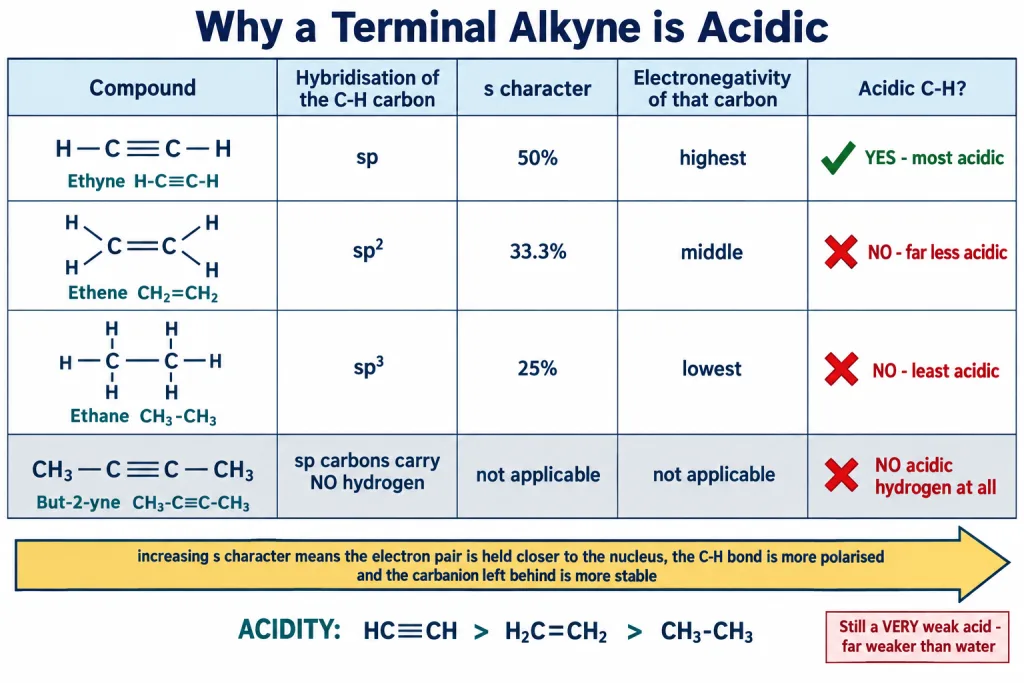
Key Point: The acidic strength of the three two-carbon hydrocarbons runs and the reason is the hybridisation of the carbon that carries the hydrogen, not anything about the pi bonds themselves.
The s character of the carbon orbital settles it
| Hydrocarbon | Hybridisation of carbon | s character | Electronegativity of that carbon | Acidity of its C-H bond |
|---|---|---|---|---|
| Ethyne, | 50% | highest | highest | |
| Ethene, | 33.3% | middle | middle | |
| Ethane, | 25% | lowest | lowest |
An s orbital has its density greatest right at the nucleus; a p orbital has a node there and pushes its density outwards. The more s character a hybrid carries, the closer to the nucleus its electrons sit. An orbital is half s, so its electron pair is held closer in than a pair in , which is held closer than a pair in .
Chapter 8 records the consequence as an electronegativity order for carbon itself:
A more electronegative carbon drags the shared pair of the C-H sigma bond further towards itself. The bond is more polarised, the hydrogen carries a larger , and a base can pull it away as more easily. In ethyne that polarisation is at its largest, so ethyne loses a proton most readily of the three.
The anion left behind is also the most stable one
Removing the proton leaves a carbanion, and the lone pair it inherits has to live somewhere:
In the acetylide ion the lone pair occupies an orbital, close to the nucleus and low in energy. In the vinyl anion it sits in and in the ethyl anion in , each further out and each less comfortable. The most stable anion comes from the strongest acid.
What the acidity is not
The triple bond is not the acidic part. The pi electrons of an alkyne are a source of electron density, not a source of protons. Only the sigma C-H bond on an carbon is acidic, which is why the six hydrogens of but-1-yne are not equivalent: the one on C1 comes off, the ones on C3 and C4 do not.
Keeping the size of the effect honest
Ethyne is acidic compared with other hydrocarbons, and that is the whole of the claim. On the usual scale ethyne comes in at about 25 against about 16 for water, so ethyne is roughly a thousand million times the weaker acid. It will not turn litmus red and it will not liberate carbon dioxide from a bicarbonate. Sodium and sodamide work on it because they are powerful bases.
Key Point: Ethyne is a very weak acid overall — far weaker than water or an alcohol. Never write that ethyne is acidic without saying what it is being compared with. [Board]
Only a terminal alkyne is acidic
The acidic hydrogen has to be sitting on the triply bonded carbon. An alkyne with the triple bond buried in the middle of the chain has hydrogens only on carbons, and those are as unreactive as the hydrogens of an alkane.
Key Point: A terminal alkyne has the group and gives all the acetylide reactions. An internal (non-terminal) alkyne such as but-2-yne, , has no hydrogen on a triply bonded carbon and gives none of them. [JEE/NEET]
The full order the textbook quotes puts the number of acidic hydrogens into it as well:
Ethyne has two acidic hydrogens and so forms a mono- or a di-salt. Propyne has one. But-2-yne has none, and the gap between it and the terminal alkynes is the difference between a reaction and no reaction at all.
Sodium in liquid ammonia
Sodium metal in liquid ammonia at 273 K takes one acidic hydrogen and releases half a mole of dihydrogen for every mole of ethyne:
The product is monosodium acetylide (monosodium ethynide). More sodium takes the second hydrogen as well:
giving disodium acetylide, in which both hydrogens have gone. Counting atoms on the first equation: two carbons, two hydrogens and one sodium go in; the salt takes two carbons, one hydrogen and the sodium, and the remaining hydrogen leaves as .
Propyne stops after one substitution, because it has only one acidic hydrogen:
Sodamide
Sodamide, , is a stronger base than the acetylide ion, so it strips the terminal hydrogen and ends up as ammonia:
Sodamide is a base here and a base in Section 11, where it makes an alkyne from a vinyl halide; the difference is that here it removes a proton from carbon rather than removing HX.
Ammoniacal silver nitrate — a white precipitate
Silver nitrate dissolved in aqueous ammonia gives the diamminesilver(I) ion, the same solution used as Tollens' reagent. A terminal alkyne passed into it throws down silver acetylide as a white precipitate:
Written with the reagents as they are mixed:
Propyne, with one acidic hydrogen, gives the monosilver salt:
Ammoniacal cuprous chloride — a red precipitate
Cuprous chloride dissolved in ammonia gives a red precipitate of copper acetylide with the same alkynes:
Key Point (Definition): A metal acetylide is the salt formed when the acidic hydrogen of a terminal alkyne is replaced by a metal. Ammoniacal silver nitrate gives a white precipitate; ammoniacal cuprous chloride gives a red precipitate. Both are dry-handling hazards — the dry solids are shock-sensitive explosives, so they are destroyed with dilute acid while still wet.
The test for a terminal alkyne, and telling four hydrocarbons apart
Three reagents between them sort out every aliphatic hydrocarbon a Class 11 paper is likely to give you, and the whole skill is knowing which one answers which question.
- Bromine water (or in ) reports whether a pi bond is present at all.
- Baeyer's reagent, cold dilute alkaline , reports the same thing a second way, and its brown deposit makes the result hard to miss.
- Ammoniacal silver nitrate reports something quite different: whether there is a hydrogen on a triply bonded carbon.
The four-way table
| Compound | Bromine water | Baeyer's reagent (cold dilute alkaline ) | Ammoniacal |
|---|---|---|---|
| Ethane, | no change, stays orange | no change, stays pink | no precipitate |
| Ethene, | decolourised | pink discharged, brown appears | no precipitate |
| Ethyne, | decolourised | pink discharged, brown appears | white precipitate |
| But-2-yne, | decolourised | pink discharged, brown appears | no precipitate |
Read the table down the last column and the point of the silver test is clear: it does not detect unsaturation, it detects an acidic hydrogen. But-2-yne is every bit as unsaturated as ethyne and still gives nothing, because there is no hydrogen on either triply bonded carbon. Ammoniacal cuprous chloride can replace the silver reagent throughout, reading red precipitate wherever the table reads white.
Closing the last gap
The table separates ethane from the other three, and ethyne from the other three. It leaves ethene and but-2-yne looking identical, because both decolourise both reagents and neither precipitates. Separating those two needs a measurement rather than an observation:
| Compound | Moles of taken up per mole | Product |
|---|---|---|
| Ethene | 1 | 1,2-dibromoethane |
| But-2-yne | 2 | 2,2,3,3-tetrabromobutane |
An alkene saturates one pi bond and stops; an alkyne has two and keeps going, so it consumes twice as much bromine. Measuring the bromine absorbed is the standard way of counting pi bonds in a sample.
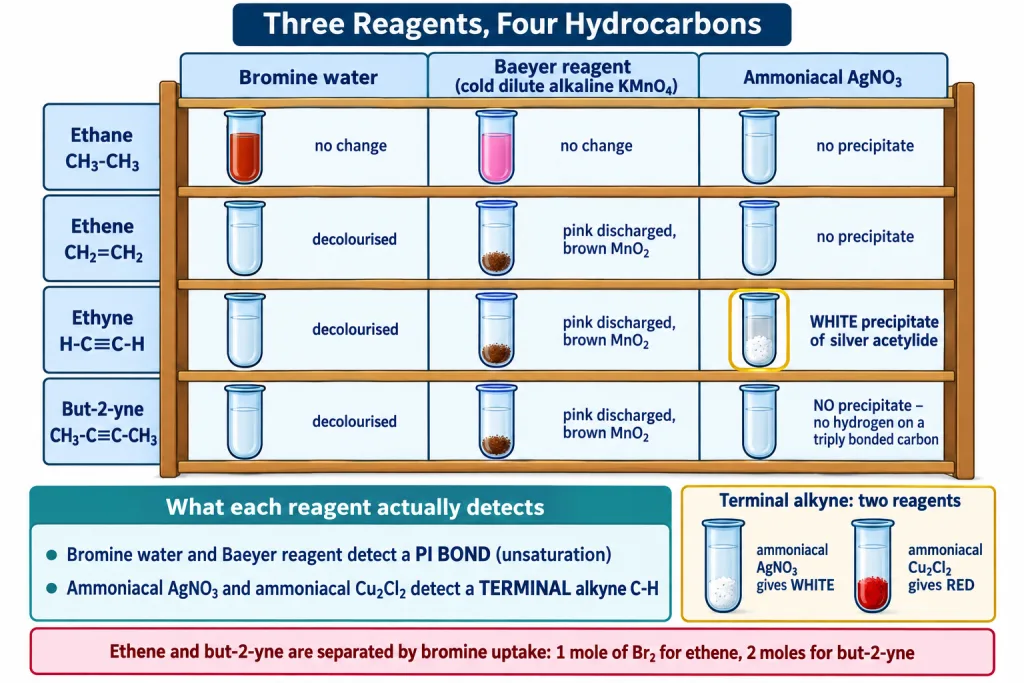
Key Point: Bromine water and Baeyer's reagent test for unsaturation. Ammoniacal silver nitrate and ammoniacal cuprous chloride test for a terminal alkyne. An alkene and an internal alkyne both pass the first pair and both fail the second. [NEET]
Addition reactions — a triple bond adds twice
A triple bond is one sigma bond and two pi bonds. Each pi bond can be broken and replaced by two new sigma bonds, so an alkyne takes up two molecules of a reagent where an alkene takes one. The intermediate after the first addition is an alkene, and it can often be isolated.
Most of these additions are electrophilic additions: the pi cloud attacks an electron-poor species, and the intermediate is a vinylic cation, a positively charged carbon that is part of a double bond. Which of the two possible vinylic cations forms decides the orientation of the product, exactly as carbocation stability decides Markovnikov orientation in an alkene.
Addition of dihydrogen
Hydrogen adds over finely divided nickel, platinum or palladium, and the reaction runs through the alkene to the alkane:
Propyne gives propene and then propane. With an unpoisoned catalyst and excess hydrogen the reduction simply does not stop at the alkene, so the alkene cannot be isolated: the reaction runs on to the alkane and the alkene appears only in square brackets as something passed through.
Stopping at the alkene needs a deliberately weakened catalyst, and the two ways of doing it were set out in Section 7. Lindlar's catalyst — palladium on barium sulphate poisoned with quinoline — gives the cis alkene. Sodium in liquid ammonia at 195 K gives the trans alkene. Those conditions are for partial reduction; ordinary , or takes you all the way to the alkane.
Addition of halogens
Bromine dissolved in carbon tetrachloride adds in two stages:
The first product is 1,2-dibromoethene and the second is 1,1,2,2-tetrabromoethane. Propyne runs the same course:
giving 1,2-dibromopropene and then 1,1,2,2-tetrabromopropane. But-2-yne, having no end carbon involved, gives 2,3-dibromobut-2-ene and then 2,2,3,3-tetrabromobutane.
Key Point: The red-brown colour of bromine in carbon tetrachloride is discharged, and this is the standard test for unsaturation. It is given by alkenes and by alkynes alike, so it proves a pi bond is present and nothing more.
Chlorine behaves the same way and takes ethyne through 1,2-dichloroethene to 1,1,2,2-tetrachloroethane. Making chlorinated solvents from ethyne on this pattern is one reason ethyne was such an important industrial feedstock.
Addition of hydrogen halides — twice over, and both times Markovnikov
Hydrogen chloride, hydrogen bromide and hydrogen iodide each add twice. The first addition gives a vinyl halide, the second gives a geminal dihalide.
Key Point (Definition): A geminal (gem) dihalide carries both halogen atoms on the same carbon. A vicinal (vic) dihalide carries them on adjacent carbons. Two successive additions of HX to an alkyne give the geminal compound. [JEE Main]
Ethyne and hydrogen bromide
The first product is bromoethene (vinyl bromide). Ethyne is symmetrical, so the first step raises no question of orientation. The second step does. In one doubly bonded carbon carries two hydrogens and the other carries one, so Markovnikov's rule sends the bromine to the carbon already holding the bromine. The product is 1,1-dibromoethane — geminal.
Putting the second bromine on the other carbon would give 1,2-dibromoethane, which is the vicinal isomer and is not what forms. The reason is the usual one: adding to the end leaves the positive charge on the carbon bearing bromine, and the bromine's lone pair stabilises that cation by donating into the empty orbital. The other route would leave a primary cation with nothing to stabilise it.
Propyne and hydrogen bromide
In propyne the terminal carbon carries one hydrogen and C2 carries none, so the bromine goes to C2 and the product of the first step is 2-bromopropene. In the second step the bromine again lands on C2, and the final product is 2,2-dibromopropane. Both halogens have arrived on the same carbon, which is the general result.
But-1-yne and hydrogen chloride
The chlorines go to C2 both times, giving 2,2-dichlorobutane. Counting atoms: plus has four carbons, eight hydrogens and two chlorines, and so does .
The order of reactivity, and the peroxide effect
The hydrogen halides add in the order HI > HBr > HCl, the same order as with alkenes and for the same reason: the weakest H-X bond supplies its proton most readily.
The peroxide effect applies to HBr only. In the presence of benzoyl peroxide, HBr adds to a terminal alkyne by a free-radical route and the bromine ends up on the terminal carbon instead, giving the anti-Markovnikov product. HCl and HI show no peroxide effect at all.
Key Point: Remember the pairing by where the reagent starts. A vicinal dihalide is what you get by adding to an alkene; a geminal dihalide is what you get by adding to an alkyne. Section 11 uses both as starting materials for making alkynes back again.
Addition of water — the enol, the tautomer and the one exception
Alkynes are immiscible with water and do nothing with it on their own. Under the right catalyst one molecule of water adds across the triple bond, and the product is not an alcohol but a carbonyl compound.
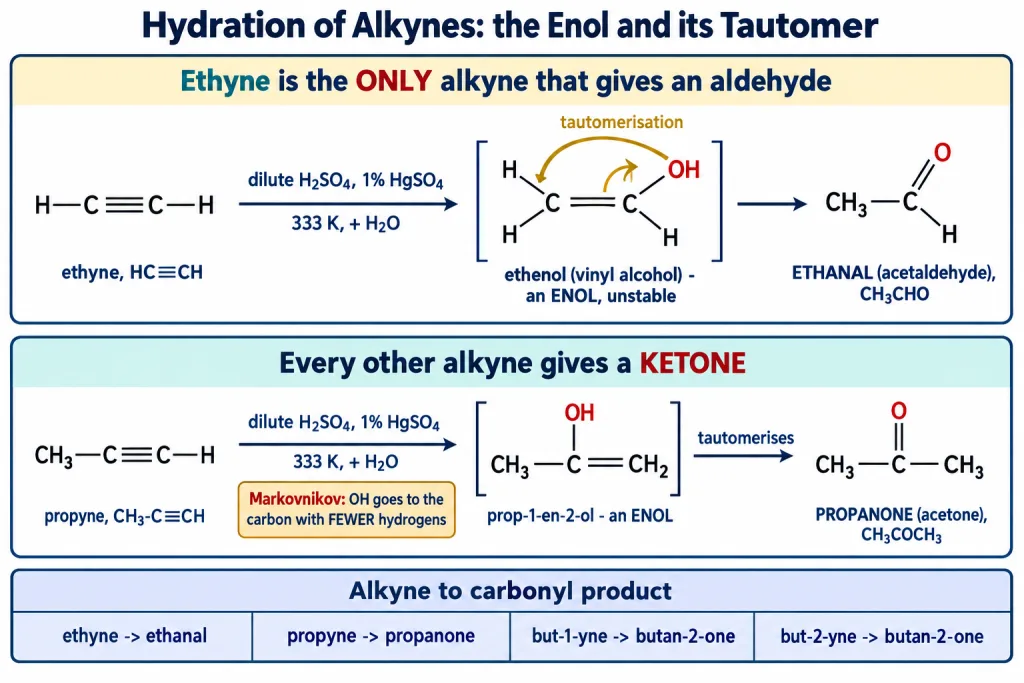
Key Point: An alkyne warmed with dilute sulphuric acid containing 1% mercuric sulphate at 333 K adds one molecule of water with Markovnikov orientation. The immediate product is an unstable enol, which tautomerises to a carbonyl compound. Ethyne gives ethanal; every other alkyne gives a ketone. [JEE/NEET]
Ethyne gives ethanal, and it is the only alkyne that gives an aldehyde
The species in brackets is ethenol (vinyl alcohol), an enol: a hydroxyl group attached directly to a doubly bonded carbon. It cannot be bottled. The hydrogen on the oxygen migrates to the far carbon of the double bond while the pi bond shifts onto the carbon-oxygen pair, leaving ethanal, , also called acetaldehyde. The driving force is bond strength: a carbon-oxygen pi bond is much stronger than a carbon-carbon pi bond, so the keto form sits far lower in energy and the equilibrium lies almost entirely on the carbonyl side.
Key Point (Definition): Tautomers are constitutional isomers that interconvert rapidly by the migration of a hydrogen atom and the shift of a double bond. The keto-enol pair is the standard example, and the keto form is normally the overwhelming majority.
Every other alkyne gives a ketone
Propyne is unsymmetrical, so orientation matters. The goes to C2, the carbon carrying no hydrogen:
The enol is prop-1-en-2-ol and the product is propanone (acetone). Two more:
But-1-yne gives butan-2-one. And an internal alkyne, which still adds water even though it has no acidic hydrogen:
But-2-yne also gives butan-2-one. Two different alkynes converging on one ketone is worth holding on to, because it means the ketone alone does not identify the alkyne it came from.
Why the asymmetry between ethyne and the rest
Markovnikov puts the on the carbon with fewer hydrogens. In every alkyne except ethyne, that carbon carries a carbon substituent, so after tautomerisation the carbonyl carbon has two carbon neighbours and the compound is a ketone. Ethyne is the only alkyne in which both triply bonded carbons carry a hydrogen, so the carbonyl carbon keeps a hydrogen and the product is an aldehyde.
Reading the reaction backwards
Given a ketone, the alkyne that produced it had its triple bond between the carbonyl carbon and one of its neighbours.
| Alkyne | Enol formed | Carbonyl product |
|---|---|---|
| Ethyne | ethenol | ethanal, |
| Propyne | prop-1-en-2-ol | propanone, |
| But-1-yne | but-1-en-2-ol | butan-2-one |
| But-2-yne | but-2-en-2-ol | butan-2-one |
| Pent-1-yne | pent-1-en-2-ol | pentan-2-one |
| Hex-3-yne | hex-3-en-3-ol | hexan-3-one |
A symmetrical internal alkyne such as but-2-yne or hex-3-yne gives a single ketone. An unsymmetrical internal alkyne such as pent-2-yne can add water either way round and gives a mixture of pentan-2-one and pentan-3-one, so the reaction is preparatively useful only for terminal and symmetrical alkynes.
Alkynes are slower than alkenes towards electrophiles
An alkyne carries four pi electrons and an alkene only two, so the expectation is that the alkyne should be the more eager partner for an electrophile. Experiment says the opposite: towards electrophilic addition an alkyne is generally the less reactive of the two.
The reason is where those electrons sit. The pi bonds of an alkyne are built on carbons, which hold their electrons closer to the nuclei than the carbons of an alkene, so the alkyne's pi cloud is more tightly held and less available to an approaching electrophile. The intermediate reinforces the same conclusion: attacking an alkyne generates a vinylic cation, in which the positive carbon is hybridised and much less stable than the ordinary alkyl carbocation an alkene would give.
Key Point: More pi electrons does not mean more reactive. Alkynes undergo electrophilic addition more slowly than alkenes because the carbons hold the pi electrons tightly and the vinylic cation intermediate is unstable. [JEE Main]
The section on one page
| Reagent | Conditions | Immediate product | Final product |
|---|---|---|---|
| liquid , 273 K | monosodium acetylide | disodium acetylide with excess Na | |
| liquid | sodium acetylide | — | |
| ammoniacal | room temperature | white precipitate, silver acetylide | — |
| ammoniacal | room temperature | red precipitate, copper acetylide | — |
| Pt, Pd or Ni | alkene | alkane | |
| in , colour discharged | dibromoalkene | tetrabromoalkane | |
| Markovnikov, twice | vinyl halide | geminal dihalide | |
| dil. , 1% , 333 K | enol | ethanal from ethyne, ketone from all others |
The first four rows need a terminal alkyne. The last four work on any alkyne, terminal or internal.
Three sentences worth memorising
Acidity belongs to the C-H bond on an carbon and runs ethyne above ethene above ethane, because s character rises from 25% to 33.3% to 50%.
The silver and copper precipitates detect a terminal hydrogen rather than unsaturation, so an internal alkyne fails them while still decolourising bromine water.
Two additions of HX give a geminal dihalide, and hydration gives a carbonyl compound through an enol, with ethyne alone giving an aldehyde.
Worked items
Question 1: Why sodium reacts with ethyne but not with ethene
Ethyne liberates hydrogen gas with sodium in liquid ammonia; ethene does not. Account for the difference.
Answer:
The hydrogen that comes off ethyne is on an carbon, 50% s character, the most electronegative kind of carbon. The C-H bond is strongly polarised, the hydrogen carries a large , and a strong base can take it away.
The hydrogens of ethene sit on carbons, only 33.3% s. That bond is far less polarised, and the vinyl anion left behind holds its lone pair in a higher-energy orbital.
Ans: The carbon of ethyne is more electronegative than the carbon of ethene, so its C-H bond is more polarised and the anion left behind is more stable.
Watch out: The reason is the hybridisation of the carbon, not the number of pi bonds. Writing that "the triple bond makes it acidic" gets no marks.
Question 2: Arranging four compounds in order of acidity
Arrange ethane, ethene, ethyne and water in increasing order of acidic strength, and justify the position of water.
Answer:
Among the hydrocarbons the order follows s character: 25% for ethane, 33.3% for ethene, 50% for ethyne. Water sits above all three, because oxygen is far more electronegative than any carbon, so the O-H bond is much more polarised and hydroxide is far more stable than any carbanion.
Ans: .
Watch out: Ethyne being "the most acidic hydrocarbon" does not make it an acid in any everyday sense. Water beats it by something like nine powers of ten.
Question 3: But-1-yne and but-2-yne with ammoniacal silver nitrate
Both compounds have formula . Say what each does with ammoniacal silver nitrate and write the equation for any reaction.
Answer:
But-1-yne is , and its C1 hydrogen sits on a triply bonded carbon, so it is acidic and is replaced by silver:
A white precipitate appears.
But-2-yne is , and both triply bonded carbons carry methyl groups. Its six hydrogens are all on carbons, so none is acidic and there is no reaction.
Ans: But-1-yne gives a white precipitate of silver but-1-ynide; but-2-yne gives no precipitate.
Watch out: But-2-yne still decolourises bromine water. The silver test is not a test for unsaturation.
Question 4: Two gas jars, ethene and ethyne
Describe one test that tells ethene from ethyne, stating what is seen in each jar.
Answer:
Bromine water is useless here, because both gases decolourise it. The test has to pick up the terminal hydrogen, so I pass each gas through ammoniacal silver nitrate. Ethyne throws down a white precipitate of silver acetylide:
Ethene has no acidic hydrogen and the solution stays clear.
Ans: Ammoniacal silver nitrate — white precipitate with ethyne, no change with ethene. Ammoniacal cuprous chloride would do the same job with a red precipitate.
Question 5: Three unlabelled jars
Jars A, B and C contain propane, propene and propyne in some order. Set out a scheme of tests that identifies all three.
Answer:
I shake a portion of each with bromine water first. Propane leaves the orange colour untouched, because it has no pi bond, and that identifies the alkane straight away.
The other two both decolourise it, so I take fresh portions of those into ammoniacal silver nitrate. Propyne, , has a hydrogen on a triply bonded carbon and gives a white precipitate:
Propene gives nothing, so it is identified by elimination.
Ans: No change with bromine water means propane; decolourisation plus a white precipitate with ammoniacal means propyne; decolourisation with no precipitate means propene.
Watch out: Baeyer's reagent can replace bromine water in the first step, but nothing replaces the silver test in the second.
Question 6: Distinguishing an alkene from an internal alkyne
Bromine water and Baeyer's reagent both behave identically with ethene and with but-2-yne, and neither gives a precipitate with ammoniacal silver nitrate. Suggest how the two can still be told apart.
Answer:
Both are unsaturated and neither has an acidic hydrogen, so no observation-only test separates them. What differs is how much reagent each consumes. Ethene has one pi bond and takes up one mole of bromine per mole:
But-2-yne has two pi bonds and takes up two:
Passing a known amount of each into a standard bromine solution and measuring the uptake separates them cleanly.
Ans: Measure the bromine uptake — one mole per mole for ethene, two moles per mole for but-2-yne.
Question 7: Hydrogen liberated by sodium
of ethyne is treated with sodium in liquid ammonia at 273 K to give monosodium acetylide. Find the volume of dihydrogen liberated at STP.
Answer:
The molar mass of ethyne is , so
The equation gives half a mole of hydrogen for each mole of ethyne when only one hydrogen is replaced:
So , and at STP one mole occupies :
Ans: , that is at STP.
Watch out: Taking the reaction all the way to disodium acetylide would double the answer to . Read which salt the question asks for.
Question 8: Hydration of ethyne
Write the reaction of ethyne with water, giving the reagent, the temperature and the intermediate, and name the product.
Answer:
Water adds across one pi bond to give ethenol, an enol with the on a doubly bonded carbon. The enol is unstable: the hydroxyl hydrogen shifts to the other doubly bonded carbon and the double bond moves onto the carbon-oxygen pair. That is keto-enol tautomerism, and the keto form wins because is the stronger pi bond.
Ans: Ethanal (acetaldehyde), , through the enol ethenol; dilute with 1% at 333 K.
Watch out: Ethanol, , is the trap. That would need two molecules of water and a reduction; only one molecule of water adds here.
Question 9: Hydration of propyne
Predict the product when propyne is warmed with dilute sulphuric acid containing 1% mercuric sulphate at 333 K, and explain the orientation.
Answer:
In , C1 carries one hydrogen and C2 carries none, so Markovnikov's rule sends the to C2 and the hydrogen to C1.
The enol prop-1-en-2-ol tautomerises with the hydroxyl hydrogen moving to C1, leaving a carbonyl group on C2 flanked by two carbons.
Ans: Propanone (acetone), .
Watch out: Propanal is the anti-Markovnikov answer. It would need the on the terminal carbon, and nothing in these conditions puts it there.
Question 10: Two alkynes, one ketone
Give the hydration product of but-1-yne and of but-2-yne under the same conditions, and comment.
Answer:
But-1-yne, : the goes to C2, which carries no hydrogen.
But-2-yne is symmetrical, so both ways of adding water give the same enol and the same ketone.
Both products are butan-2-one.
Ans: Both give butan-2-one, .
Watch out: Two different alkynes converging on one ketone means hydration alone cannot identify the starting material. The silver test separates but-1-yne from but-2-yne.
Question 11: Working backwards from a ketone
An alkyne on hydration gives pentan-2-one as the only product. Identify the alkyne and say what it would do with ammoniacal cuprous chloride.
Answer:
Pentan-2-one is , five carbons with the carbonyl on C2, so the triple bond lay between C2 and a neighbour: either C1-C2, giving pent-1-yne, or C2-C3, giving pent-2-yne.
Pent-2-yne is unsymmetrical, so water could add either way round and would give a mixture of pentan-2-one and pentan-3-one. Only one product is formed, so the alkyne is pent-1-yne, , whose Markovnikov hydration can only put the oxygen on C2. Being terminal, it gives a red precipitate with ammoniacal cuprous chloride:
Ans: Pent-1-yne; it gives a red precipitate of copper pent-1-ynide.
Question 12: Which dihalide, geminal or vicinal
Propyne is treated with two moles of hydrogen bromide. Name the product and explain why the other dibromide does not form.
Answer:
In the terminal carbon carries a hydrogen and C2 carries none, so the first addition puts bromine on C2:
In 2-bromopropene the end has two hydrogens and C2 has none, so the second bromine also goes to C2:
Both bromines are on the same carbon, so the product is the geminal dihalide.
Ans: 2,2-Dibromopropane, a geminal dihalide.
Watch out: 1,2-Dibromopropane is the vicinal isomer and comes from adding to propene, not from adding HBr twice to propyne.
Question 13: Bromine on but-2-yne, stage by stage
Write both stages of the reaction of but-2-yne with bromine in carbon tetrachloride and name both products. State what is seen.
Answer:
Checking the second product for valency: each middle carbon carries two bromines, one methyl group and one bond to the other middle carbon — four bonds each. The red-brown colour of the bromine solution is discharged at both stages.
Ans: 2,3-Dibromobut-2-ene, then 2,2,3,3-tetrabromobutane; the bromine colour is decolourised.
Question 14: Identifying a hydrocarbon from three observations
A gaseous hydrocarbon decolourises bromine water, gives a white precipitate with ammoniacal silver nitrate, and on warming with dilute sulphuric acid containing 1% mercuric sulphate at 333 K gives a compound that does not reduce Tollens' reagent. Identify it and name the 333 K product.
Answer:
has two degrees of unsaturation and decolourises bromine water, so it is unsaturated. The white precipitate with ammoniacal silver nitrate means a hydrogen on a triply bonded carbon, so it is a terminal alkyne, and with three carbons the only terminal alkyne is propyne.
Hydration gives propanone, a ketone, and a ketone has no hydrogen on the carbonyl carbon to be oxidised, so it does not reduce Tollens' reagent. Every observation fits.
Ans: Propyne, ; the 333 K product is propanone.
Watch out: Propadiene, , is the other isomer. It decolourises bromine water but gives no silver precipitate, so the white solid rules it out.
Question 15: Hydrogenation stopped and not stopped
Propyne is hydrogenated over nickel. What is obtained, and what would you change to isolate the alkene?
Answer:
Over plain nickel with excess hydrogen the reduction does not stop at the alkene, so nothing accumulates in the middle:
To stop at the alkene the catalyst has to be deliberately weakened. Palladium on barium sulphate poisoned with quinoline — Lindlar's catalyst — gives the cis alkene, and sodium in liquid ammonia at 195 K gives the trans alkene. Propene has no cis-trans isomers, so with propyne both routes give the same product, but on but-2-yne they give cis-but-2-ene and trans-but-2-ene respectively.
Ans: Propane; Lindlar's catalyst or sodium in liquid ammonia at 195 K stops the reduction at the alkene.
Watch out: Sodium in liquid ammonia does two jobs in this chapter. At 273 K with a terminal alkyne it makes the acetylide salt; at 195 K with any alkyne it reduces to the trans alkene.