
What this chapter is actually worth in the paper
Hydrocarbons is a recall chapter. Almost every question on it is one of seven tasks, each answered from a memorised table rather than from reasoning.
- Reagent to product. A reagent with its conditions is given, name the product — or the reverse.
- The named reaction. Wurtz, Kolbe, Sabatier-Senderens, Lindlar, Kharasch, Baeyer, Friedel-Crafts.
- A test and what is seen. Alkene from alkyne, terminal alkyne from internal, benzene from cyclohexene.
- Markovnikov, the peroxide effect, Saytzeff. The major product in one line, no mechanism written.
- IUPAC naming and isomer counting.
- Aromaticity counting. Count the pi electrons, test , classify.
- Directive influence. Classify the group on the ring, read off ortho-para or meta, activating or deactivating.
What the paper does not ask
Full mechanisms are rarely asked in detail. Three steps with curved arrows will not fit a one-minute question and cannot be put in an option list. Mechanism appears instead as a remembered label:
- bromine addition goes through a cyclic bromonium ion, so the addition is anti;
- aromatic substitution goes through the arenium ion, and forming it is the rate-determining step;
- the peroxide route is free-radical, and the radical formed is the more stable one;
- alkyne hydration goes through an enol that tautomerises.
Those four lines cover the mechanistic content this paper wants.
Key Point: A reaction you cannot state with its reagent, its catalyst and its temperature is a reaction you do not know. The condition is the answer more often than the product is.
A hydrocarbon question should take twenty to thirty seconds. Longer means the reagent was not recognised, the substrate was misread, or a rule is being re-derived that should have been recalled.
[NEET] Assertion-reason and match-the-column items fall heavily here because the content is tabular.
The named reactions, on one page
Every row gives the reagent with its condition, because that is the examinable half.
| Name | Reagent and conditions | Substrate | Product | Example |
|---|---|---|---|---|
| Wurtz reaction | in dry ether | alkyl halide | symmetrical alkane | bromoethane butane |
| Kolbe electrolysis | electrolysis of the concentrated aqueous Na or K salt | salt of a carboxylic acid | at the anode | sodium acetate ethane |
| Decarboxylation | soda lime, , heat | sodium salt of an acid | alkane, one carbon fewer | sodium acetate methane |
| Sabatier-Senderens | , finely divided Ni, 573 K | alkene or alkyne | alkane | ethene ethane |
| Lindlar hydrogenation | , poisoned by quinoline | alkyne | cis alkene | but-2-yne cis-but-2-ene |
| Sodium in liquid ammonia | , liquid , 195 K | alkyne | trans alkene | but-2-yne trans-but-2-ene |
| Kharasch peroxide effect | with benzoyl peroxide | unsymmetrical alkene | anti-Markovnikov halide | propene 1-bromopropane |
| Baeyer oxidation | cold dilute alkaline | alkene | vicinal glycol | ethene ethane-1,2-diol |
| Ozonolysis | (i) (ii) , | alkene | aldehydes, ketones | but-2-ene 2 ethanal |
| Friedel-Crafts alkylation | , anhydrous | benzene | alkylbenzene | benzene toluene |
| Friedel-Crafts acylation | or , anhydrous | benzene | aryl ketone | benzene acetophenone |
| Nitration | conc. + conc. , 323-333 K | benzene | nitrobenzene | electrophile |
| Sulphonation | fuming sulphuric acid (oleum), heat | benzene | benzenesulphonic acid | electrophile |
| Ring halogenation | + anhydrous , or | benzene | halobenzene | benzene chlorobenzene |
| Carbide route | calcium carbide | ethyne | the industrial ethyne source | |
| Cyclic polymerisation | red-hot iron tube, 873 K | 3 moles of ethyne | benzene | a benzene route |
| Alkyne hydration | dil. , 1 per cent , 333 K | alkyne | ethanal from ethyne, a ketone from the rest | propyne propanone |
The equations worth writing out once
The carbide route runs in three steps and all three are quoted:
Five traps inside this table
- Wurtz gives only symmetrical alkanes cleanly. No odd-carbon alkane from a single halide, and methane not at all.
- Decarboxylation shortens the chain by one carbon; Kolbe doubles the alkyl group. Sodium propanoate gives ethane by the first, butane by the second.
- Lindlar gives cis; sodium in liquid ammonia gives trans. The most swapped pair in the chapter.
- Alkylation has three faults; acylation has none. Polyalkylation, rearrangement through a carbocation, failure with vinyl or aryl halides. The acylium ion does not rearrange and the ketone is deactivated.
- Sulphonation is reversible. Nitration, halogenation and both Friedel-Crafts reactions are not.
[NEET] Given a product and asked for the route, count carbons backwards. Twice the carbons means Wurtz or Kolbe; one fewer means soda lime.
The test table — the highest-yield table in the chapter
Five hydrocarbons, six reagents. Learn the grid, not the sentences.
| Reagent | Alkane | Alkene | Alkyne (terminal) | Alkyne (internal) | Arene |
|---|---|---|---|---|---|
| Bromine water or in | no change in the dark | colour discharged at once — the orange of bromine water, the red-brown of in | colour discharged | colour discharged | no change |
| Baeyer's reagent (cold dil. alkaline ) | no change | pink discharged, brown appears | pink discharged, brown | pink discharged, brown | no change |
| Ammoniacal | no change | no change | white precipitate of silver acetylide | no change | no change |
| Ammoniacal cuprous chloride | no change | no change | red precipitate of copper acetylide | no change | no change |
| Sodium metal (in liquid , 273 K) | no reaction | no reaction | evolved, sodium acetylide forms | no reaction | no reaction |
| Combustion flame | clean, non-luminous blue flame | luminous yellow flame, slightly smoky | smoky, sooty luminous flame | smoky, sooty luminous flame | strongly sooty luminous flame with black smoke |
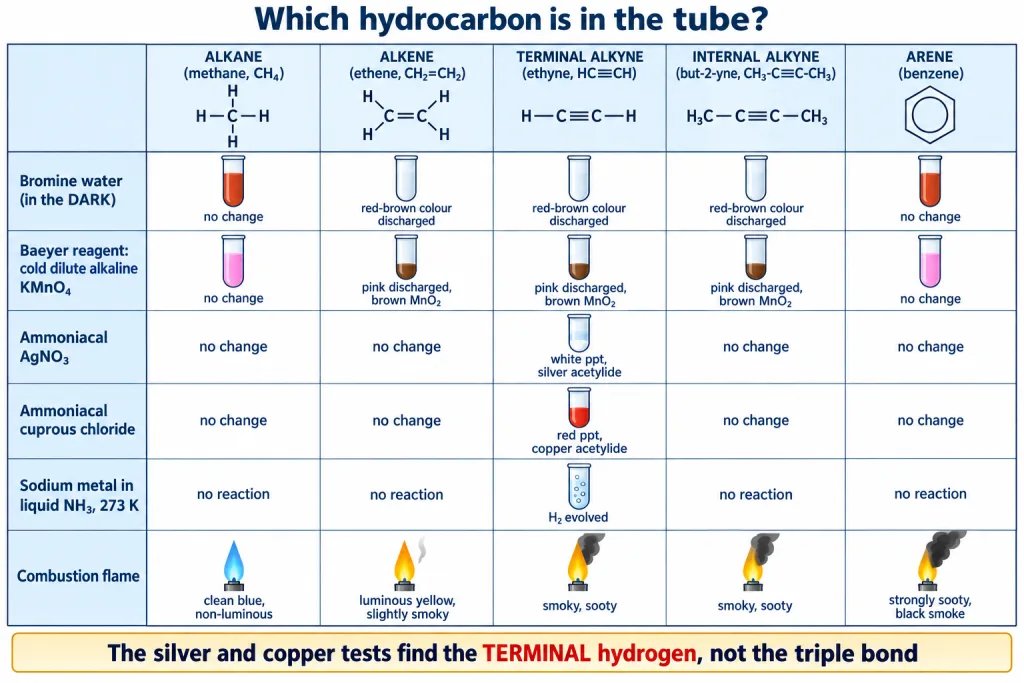
Reading the grid as a decision path
- Ammoniacal silver nitrate. A white precipitate ends the question: terminal alkyne.
- Bromine water in the dark. Decolourised means an alkene or an internal alkyne; unchanged means an alkane or an arene.
- Baeyer's reagent confirms unsaturation but does not separate the alkene from the internal alkyne — nothing here does. Separate them by the fact that an alkyne takes two moles of bromine and an alkene one.
- If nothing decolourised, the flame decides: clean blue is the alkane, heavy black smoke is the arene.
Key Point: Ammoniacal silver nitrate and ammoniacal cuprous chloride test for the acidic terminal hydrogen, not for the triple bond. But-2-yne has a triple bond and gives no precipitate with either.
Two traps inside the bromine test
An alkane does decolourise bromine in sunlight, because free-radical substitution takes place and hydrogen bromide is released — nothing adds. It is slow, and acidic fumes come off which turn moist blue litmus red. The test is always specified in the dark.
Benzene has four degrees of unsaturation and still leaves both reagents untouched, because substitution preserves the delocalised sextet. A negative bromine-water test means not an alkene and not an alkyne, not saturated.
[NEET] Toluene behaves like benzene towards both reagents in the cold. Hot alkaline is a different reagent and cuts the side chain back to , giving benzoic acid.
Markovnikov, the peroxide effect and Saytzeff, on sight
Three one-line rules carry every prediction question in the aliphatic half of the chapter.
Key Point: Markovnikov (addition): the negative part of an unsymmetrical reagent goes to the carbon of the double bond carrying the fewer hydrogen atoms, because the more stable carbocation forms first. Peroxide effect (Kharasch and Mayo): only, with benzoyl peroxide, adds anti-Markovnikov by a free-radical route. Saytzeff (elimination): the more substituted, more stable alkene is the major product.
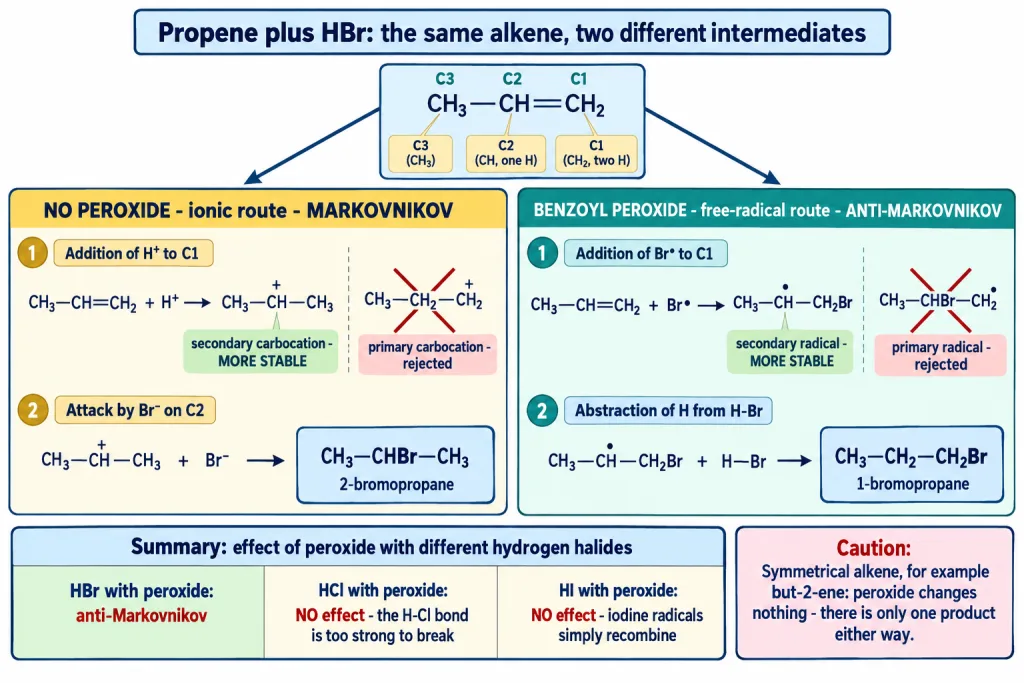
The drill
Each line is a prediction and a one-line reason. Cover the right-hand column and work down.
| # | Substrate and reagent | Major product | Reason in one line |
|---|---|---|---|
| 1 | propene | 2-bromopropane | secondary cation beats primary |
| 2 | propene , benzoyl peroxide | 1-bromopropane | adds first, giving the secondary radical |
| 3 | propene , benzoyl peroxide | 2-chloropropane | no peroxide effect: the bond is too strong to break |
| 4 | propene , benzoyl peroxide | 2-iodopropane | no peroxide effect: iodine radicals simply recombine |
| 5 | 2-methylpropene | 2-bromo-2-methylpropane | tertiary cation, and it is not close |
| 6 | 2-methylpropene , peroxide | 1-bromo-2-methylpropane | radical route, orientation flips |
| 7 | propene , dil. | propan-2-ol | is the negative part, Markovnikov |
| 8 | 2-methylpropene , dil. | 2-methylpropan-2-ol | tertiary alcohol from the tertiary cation |
| 9 | but-1-ene | 2-chlorobutane | C2 carries one hydrogen, C1 carries two |
| 10 | but-2-ene | 2-bromobutane | symmetrical alkene, no orientation question arises |
| 11 | but-2-ene , peroxide | 2-bromobutane | unchanged: with a symmetrical alkene the peroxide changes nothing |
| 12 | cyclohexene | bromocyclohexane | symmetrical, one product either way |
| 13 | 2,3-dimethylbut-2-ene | 2-bromo-2,3-dimethylbutane | symmetrical, one product either way |
| 14 | pent-2-ene | 2- and 3-bromopentane | both carbons carry one hydrogen, so the rule predicts nothing |
| 15 | propyne 1 mol | 2-bromoprop-1-ene | Markovnikov on the triple bond |
| 16 | propyne excess | 2,2-dibromopropane | both halogens on one carbon: a geminal dihalide |
| 17 | propyne , dil. , 1 per cent , 333 K | propanone | enol tautomerises; every alkyne but ethyne gives a ketone |
| 18 | ethyne , same conditions | ethanal | the one alkyne that gives an aldehyde |
| 19 | 2-bromobutane alcoholic | but-2-ene | Saytzeff: disubstituted beats monosubstituted |
| 20 | 2-bromo-2-methylbutane alc. | 2-methylbut-2-ene | Saytzeff: trisubstituted wins |
| 21 | 2-bromopentane alc. | pent-2-ene | Saytzeff, pent-1-ene minor |
| 22 | butan-2-ol conc. , 443 K | but-2-ene | dehydration, Saytzeff again |
The three things that go wrong
Applying Markovnikov to a symmetrical alkene. Lines 10 to 13 look like rule questions and none is. Line 11 above all: a peroxide on a symmetrical alkene changes nothing, because there is no second orientation to switch to.
Extending the peroxide effect past . The bond is too strong for a radical to break; the bond breaks so easily that iodine radicals recombine instead of adding. Bromine sits in the window between.
Mixing Saytzeff with Markovnikov. Alcoholic or hot conc. in the stem means Saytzeff (elimination); or water with dilute acid means Markovnikov (addition).
The supporting orders, asked directly:
- Reactivity of the hydrogen halides in addition: .
- Reactivity of the halide in dehydrohalogenation: .
- Ease of elimination and of dehydration: tertiary > secondary > primary.
- Carbocation stability, which is the reason behind Markovnikov: tertiary > secondary > primary > methyl.
The ozonolysis card
Key Point: Cut at the double bond and put an oxygen on each of the two carbons in place of the bond they shared. A doubly bonded carbon carrying two hydrogens becomes methanal; one hydrogen and one alkyl becomes an aldehyde; two alkyl groups becomes a ketone.
Zinc destroys the hydrogen peroxide that would otherwise oxidise an aldehyde on to the acid. Hot or acidic cleaves the same bond but stops at ketones and carboxylic acids.
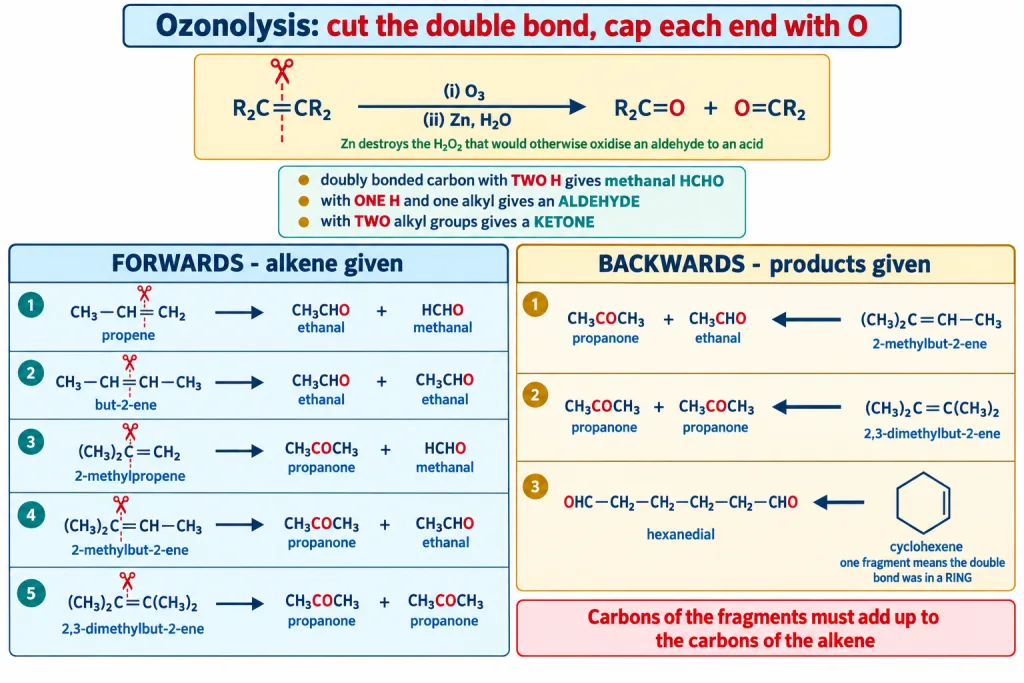
Forwards: the alkene is given
| Alkene | Products |
|---|---|
| propene | ethanal methanal |
| but-2-ene | 2 ethanal, |
| 2-methylpropene | propanone methanal |
| 2-methylbut-2-ene | propanone ethanal |
| 2,3-dimethylbut-2-ene | 2 propanone |
| cyclohexene | one hexanedial, |
Backwards: the products are given
Join the two carbonyl carbons with a double bond, drop both oxygens, and the alkene falls out.
| Products | Alkene |
|---|---|
| 2 ethanal | but-2-ene |
| ethanal methanal | propene |
| propanone methanal | 2-methylpropene |
| propanone ethanal | 2-methylbut-2-ene |
| 2 propanone | 2,3-dimethylbut-2-ene |
| ethanal pentan-3-one | 3-ethylpent-2-ene |
| a single hexanedial | cyclohexene (a ring gives one dicarbonyl, not two fragments) |
Two checks that catch every error
The carbon count. The products' carbons must add to the alkene's. Propanone plus ethanal is , so the alkene is and 2-methylbut-2-ene is the only candidate.
The fragment count. An open-chain alkene gives two fragments. One fragment carrying two carbonyl groups means the double bond was inside a ring. Two identical fragments mean a symmetrical alkene.
[NEET] The backwards question is set far more often than the forwards one.
Aromaticity flashcards
Four conditions, all of which must hold: planar, cyclic, completely conjugated so every ring atom carries an unhybridised p orbital, and pi electrons,
| Species | Pi electrons | Verdict | |
|---|---|---|---|
| benzene | 6 | 1 | aromatic |
| naphthalene | 10 | 2 | aromatic |
| anthracene | 14 | 3 | aromatic |
| cyclopentadienyl anion | 6 | 1 | aromatic |
| tropylium (cycloheptatrienyl) cation | 6 | 1 | aromatic |
| cyclopropenyl cation | 2 | 0 | aromatic |
| pyrrole | 6 | 1 | aromatic |
| furan | 6 | 1 | aromatic |
| thiophene | 6 | 1 | aromatic |
| pyridine | 6 | 1 | aromatic |
| cyclobutadiene | 4 | — | antiaromatic |
| cyclopentadienyl cation | 4 | — | antiaromatic |
| cyclooctatetraene | 8 | — | non-aromatic, because it is tub-shaped, not planar |
| cyclohexane | 0 | — | non-aromatic, not conjugated |
| cyclohexene | 2 | — | non-aromatic, not cyclically conjugated |
How to count without going wrong
Each ring C=C gives two pi electrons. A carbanion lone pair in a p orbital gives two. A carbocation gives zero — its empty p orbital completes the conjugation without adding to the count. A heteroatom lone pair counts only if it sits in a p orbital perpendicular to the ring.
Key Point: Pyrrole's nitrogen lone pair IS part of the sextet; pyridine's is NOT. Pyrrole has two ring double bonds (4 electrons) and the lone pair must join to reach six. Pyridine already has three ring double bonds (6 electrons), so its lone pair stays in an orbital in the ring plane — which is why pyridine is basic and pyrrole is a very weak base.
Three more checks
- Cyclopentadiene loses a proton easily for a hydrocarbon, because the anion left behind is the aromatic six-electron ion; cycloheptatriene loses a hydride to give the tropylium cation. Five wants the anion, seven wants the cation.
- Eight pi electrons in a ring: check planarity before saying antiaromatic. Cyclooctatetraene puckers into a tub and escapes to non-aromatic.
- Any carbon in the ring breaks the conjugation, and a fused system counts the whole system — naphthalene has ten, not two lots of six.
[NEET] The value that costs marks is : with is ten, not eight.
Directive influence, in its compact form
| Group | Class | Direction | Rate |
|---|---|---|---|
| , , , , , and all alkyl, | 1 | ortho, para | activating |
| , , , | 2 | ortho, para | deactivating |
| , , , , , , , | 3 | meta | deactivating |
The halogen anomaly, which is the whole point of the table
Class 1 answers both questions the same way, and so does class 3. The halogens are the only groups that split the two answers. A halogen is and at the same time.
- Its effect pulls electron density out of every ring carbon, so every substitution is slower than on benzene. The halogen is deactivating.
- Its effect delocalises a lone pair into the ring, putting negative charge at the ortho and para carbons only, so whatever attack happens goes there.
Key Point: Induction decides the rate. Resonance decides the orientation. For every group except the halogens the two point the same way, so reading one off the other works. For the halogens it fails, and the question is set on exactly that.
Ask what is on the ring, not what is coming in. Nitration, chlorination and sulphonation of toluene all give ortho and para; the same three on nitrobenzene all give meta.
The arenium ion is the underlying reason. For a donating group, ortho and para attack give a contributor whose positive charge sits on the carbon bearing the donor, so the donor stabilises it. For a group that contributor is the worst of the three, so meta wins by default rather than by being good.
[NEET] A ring carrying a class 3 group does not undergo Friedel-Crafts at all. Nitrobenzene is neither alkylated nor acylated, because the ring is too electron poor to attack the electrophile.
The structure and property numbers that get forgotten
Bond lengths, enthalpies and geometry
| Bond | Length | Bond enthalpy | Hybridisation and shape |
|---|---|---|---|
| 154 pm | 348 kJ/mol | , tetrahedral, | |
| 134 pm | 681 kJ/mol | , trigonal planar, about | |
| 120 pm | 823 kJ/mol | , linear, | |
| benzene | 139 pm | resonance energy 150 kJ/mol | , every angle |
| ethane 109 pm, ethene 108 pm, ethyne 106 pm | 414 kJ/mol | shortens as character rises |
The double bond splits into a sigma part of about 397 kJ/mol and a pi part of about 284 kJ/mol. The pi bond is the weaker half, which is why an alkene adds and an alkane does not. Ethene's angles are not exactly : is about , about .
The s character chain
character: 50 per cent, 33.3 per cent, 25 per cent. Electronegativity of carbon follows it: . That one order explains the bond lengths above and the acidity order below.
Physical properties
- to gases, to liquids, and above solids at room temperature.
- Boiling point rises with chain length — more surface, stronger van der Waals forces.
- Branching lowers the boiling point. Among the pentanes: pentane highest, then 2-methylbutane, then 2,2-dimethylpropane.
- Melting points do not rise smoothly: even-numbered members pack better and melt higher than the trend.
- Alkanes are non-polar, insoluble in water, soluble in non-polar solvents, and they float on water.
The orders asked as one-liners
- Acidity: , and ethyne is still a very weak acid overall, far weaker than water — never drop that clause.
- Carbocation stability: tertiary > secondary > primary > methyl.
- Alkene stability: the more substituted, the more stable — Saytzeff's reason.
- Ease of replacement of hydrogen: tertiary > secondary > primary.
- Halogen reactivity towards an alkane: . Fluorination is explosively violent; iodination is reversible and needs or to remove the .
- Towards an electrophile an alkene reacts faster than an alkyne, despite the alkyne having more pi electrons, because carbons hold them less available.
Two more numbers: ethane's eclipsed-to-staggered difference is 12.5 kJ/mol, small enough that rotation is free for practical purposes and conformers cannot be isolated; benzene's resonance energy is 150 kJ/mol.
[NEET] Free rotation about a single bond makes conformations possible. Restricted rotation about a makes cis-trans isomerism possible. Questions mix the two deliberately.
Assertion-reason patterns that recur
The four-way format is always the same: both true and the reason explains; both true but the reason does not explain; assertion true and reason false; assertion false and reason true. The work is in deciding whether the reason is the cause of the assertion or merely a second true sentence beside it.
1. A: 2,2-dimethylpropane boils lower than pentane. R: Branching makes a molecule more nearly spherical, so less surface touches a neighbour and the van der Waals forces are weaker. Both true, R explains A. The two have the same molar mass, so mass cannot be the cause and surface area is.
2. A: Ethyne reacts with sodium to release hydrogen but ethene does not. R: The carbon has 50 per cent character and holds its electrons more tightly, so the bond is more polarised and the anion is more stable. Both true, R explains A. Tested separately: ethyne is still a far weaker acid than water.
3. A: Hydrogen bromide and propene give 1-bromopropane when benzoyl peroxide is present. R: The peroxide switches the mechanism to a free-radical one in which the bromine radical adds first, to the terminal carbon, because that gives the more stable secondary radical. Both true, R explains A. The trap version replaces R with "the peroxide reverses Markovnikov's rule", which restates the result and explains nothing.
4. A: Hydrogen chloride shows no peroxide effect. R: The bond is too strong to be broken by a free radical. Both true, R explains A. The companion item uses , where R changes completely: the bond breaks so easily that iodine radicals recombine instead of adding.
5. A: Chlorobenzene is nitrated more slowly than benzene, yet gives the ortho and para products. R: Chlorine is and . Both true, R explains A, provided is read onto the rate and onto the orientation. The trap version gives R as "chlorine is electron withdrawing", true but predicting meta.
6. A: Benzene undergoes substitution rather than addition. R: Substitution leaves the delocalised sextet intact; addition would destroy it and cost 150 kJ/mol of resonance energy. Both true, R explains A. The trap version gives R as "benzene has three double bonds", a Kekule statement explaining nothing about the preference.
7. A: Cyclooctatetraene is not aromatic. R: It has eight pi electrons, a count. Both true, but R is not the complete explanation. Cyclooctatetraene escapes being antiaromatic because it is not planar — it puckers into a tub and Huckel's rule no longer applies at all.
8. A: Sulphonation of benzene is reversible. R: The electrophile is , a neutral molecule. Both true, but R does not explain A. A neutral electrophile is a fact about how the reaction starts; reversibility is about how easily the sulphonic group comes off again. Nitration also has a genuine electrophile and is not reversible.
Sixty seconds before the paper
- Wurtz, dry ether, symmetrical alkane, no methane.
- Kolbe, electrolysis of the concentrated aqueous salt, alkyl group doubled, at the anode.
- Soda lime is ; the product has one carbon fewer.
- Sabatier-Senderens: , Ni, 573 K.
- Lindlar is cis. Sodium in liquid ammonia at 195 K is trans.
- Peroxide effect: only, benzoyl peroxide, free radical, anti-Markovnikov.
- Markovnikov: negative part to the carbon with fewer hydrogens, because of the more stable carbocation.
- Saytzeff: alcoholic or conc. at 443 K, more substituted alkene.
- Baeyer's reagent is cold dilute alkaline : pink goes, brown appears, product is a glycol.
- Ozonolysis: then and water; zinc stops the aldehyde being oxidised.
- White precipitate with ammoniacal ; red with ammoniacal cuprous chloride; terminal alkyne only.
- Alkyne hydration: dil. , 1 per cent , 333 K; ethyne alone gives an aldehyde.
- Nitration 323-333 K; sulphonation with oleum and reversible; ring halogenation with anhydrous .
- Friedel-Crafts needs anhydrous ; alkylation has three faults, acylation has none.
- Arenium ion: aromaticity temporarily lost, that step is rate determining.
- Halogens: ortho, para directing but deactivating, because and .
- Benzene: 139 pm, , 150 kJ/mol, six delocalised pi electrons.
- : benzene 6, naphthalene 10, anthracene 14, tropylium cation 6, cyclopentadienyl anion 6.
- Pyrrole's lone pair is in the sextet; pyridine's is not.
- Cyclooctatetraene is non-aromatic because it is tub-shaped, not because of the count alone.
- Bond lengths 154, 134, 120 pm; enthalpies 348, 681, 823 kJ/mol. Branching lowers the boiling point.
- Acidity , all weaker than water.
- Ethane in the chlorination of methane is the evidence for the radical mechanism.
- Sooty flame means arene; clean blue flame means alkane.
- PAHs: more than two fused rings is the warning sign, not a guarantee — anthracene is not a carcinogen; the named ones are the bent four- and five-ring compounds, above all benzo[a]pyrene.
Question 1: Telling propyne from propene in one test
Give one reagent that distinguishes propyne from propene, and say what is seen.
Answer:
Both decolourise bromine water and Baeyer's reagent, so neither separates them. The only difference a reagent can grab is the acidic hydrogen on the carbon of propyne.
Ans: Ammoniacal silver nitrate — propyne gives a white precipitate, propene gives no change. Ammoniacal cuprous chloride works equally well, with a red precipitate. Watch out: But-2-yne would also give nothing, because the test is for the terminal hydrogen, not for the triple bond.
Question 2: Wurtz on a mixture of two halides
Bromomethane and bromoethane are treated together with sodium in dry ether. How many alkanes form?
Answer:
Wurtz couples two alkyl groups, and with two halides present every pairing happens: methyl with methyl gives ethane, ethyl with ethyl gives butane, methyl with ethyl gives propane.
Ans: Three — ethane, propane and butane, as an inseparable mixture. Watch out: This is why Wurtz is stated as a route to symmetrical alkanes only.
Question 3: Kolbe against soda lime on the same salt
Sodium propanoate is treated two ways: electrolysis of its concentrated aqueous solution, and heating with soda lime. Name the hydrocarbon in each case.
Answer:
Kolbe discharges the carboxylate at the anode, loses , and couples the two ethyl groups left behind.
Soda lime couples nothing. It strips the carboxyl group as carbonate, so the chain loses one carbon.
Ans: Kolbe gives butane; soda lime gives ethane. Watch out: Count the carbons of the alkyl group, not of the acid. Propanoate has three carbons but only two in the ethyl group, so Kolbe gives , not .
Question 4: Two catalysts, two geometries
But-2-yne is reduced twice: with hydrogen over palladium on barium sulphate poisoned with quinoline, and with sodium in liquid ammonia at 195 K. Give both products.
Answer:
The first is Lindlar's catalyst: both hydrogens are delivered to the same face, so the methyls end up on the same side. Sodium in liquid ammonia works through a radical anion and puts the hydrogens on opposite faces.
Ans: Lindlar gives cis-but-2-ene; sodium in liquid ammonia gives trans-but-2-ene. Watch out: Neither goes on to butane. Plain with Ni at 573 K would, and that is the unpoisoned-catalyst route.
Question 5: The peroxide pair
Give the major product from propene and hydrogen bromide with no peroxide and with benzoyl peroxide, and say what changes if hydrogen chloride is used.
Answer:
Without peroxide the proton adds first, to the terminal carbon, because that leaves a secondary carbocation rather than a primary one. Bromide attacks that carbon.
With peroxide the bromine radical adds first, again to the terminal carbon, because that leaves the more stable secondary radical.
With hydrogen chloride the radical chain never starts, because the bond is too strong to break.
Ans: 2-bromopropane without peroxide, 1-bromopropane with peroxide, and 2-chloropropane with either way. Watch out: The orientation flips but the reason does not. Both routes put the incoming species where it leaves the more stable intermediate — a cation in one case, a radical in the other.
Question 6: A symmetrical alkene with a peroxide
But-2-ene is treated with hydrogen bromide in the presence of benzoyl peroxide. Give the product.
Answer:
I check the alkene before the reagent. In both carbons of the double bond carry one hydrogen and one methyl, so bromine on either gives the same compound.
Ans: 2-bromobutane, exactly as it would be without the peroxide. Watch out: The word "peroxide" in a stem is not an instruction to flip the answer. If the alkene is symmetrical, the peroxide is a decoy.
Question 7: Saytzeff with three beta positions in play
2-bromo-2-methylbutane is heated with alcoholic potassium hydroxide. Give the major alkene.
Answer:
In carbon 2 has three neighbours carrying hydrogens: the ethyl and two methyls. Eliminating towards the gives a trisubstituted alkene, towards a methyl a disubstituted one. Saytzeff picks the more substituted.
Ans: 2-methylbut-2-ene major, 2-methylbut-1-ene minor. Watch out: Alcoholic eliminates; aqueous substitutes and would give 2-methylbutan-2-ol. The solvent is the whole question.
Question 8: Ozonolysis backwards from two carbonyls
An alkene gives propanone and ethanal on ozonolysis followed by zinc and water. Identify it.
Answer:
Propanone carries three carbons and ethanal two, and matches , so nothing is missing. I join the two carbonyl carbons with a double bond and delete both oxygens.
The longest chain through the double bond is four carbons and a methyl hangs off carbon 2.
Ans: 2-methylbut-2-ene. Watch out: Fragments adding to fewer carbons than the alkene means one has been dropped.
Question 9: A ring in disguise
Ozonolysis of followed by zinc and water gives one compound, . Identify it.
Answer:
One product with two carbonyl groups, not two products with one each. An open-chain alkene always breaks into two pieces, so a single piece means the ends were already joined. Rejoining the two carbonyl carbons closes a six-membered ring.
Ans: Cyclohexene. Watch out: has two degrees of unsaturation, one for the ring and one for the double bond.
Question 10: Two ions of the same ring
Classify the cyclopentadienyl anion and the cyclopentadienyl cation.
Answer:
The ring skeleton carries two carbon-carbon double bonds, which is four pi electrons, and one carbon that is neither.
In the anion that carbon holds a lone pair in a p orbital, so four plus two makes six. with , planar and fully conjugated, so aromatic.
In the cation that carbon has an empty p orbital and contributes nothing. The count stays at four, which is , and the ring is still planar and conjugated — so antiaromatic, not merely non-aromatic.
Ans: The anion is aromatic with six pi electrons; the cation is antiaromatic with four. Watch out: A carbocation carbon on a ring contributes zero pi electrons, not two.
Question 11: Rate one way, orientation the other
Chlorobenzene and nitrobenzene are each nitrated. Give the major product in each case and compare the rates with benzene.
Answer:
Chlorine is and . Induction pulls electron density from the whole ring, so chlorobenzene nitrates more slowly than benzene; resonance donation puts negative charge at the ortho and para carbons, so the electrophile still goes there.
Nitro is and , both withdrawing. Every position is poor but ortho and para are worst, so meta wins by default.
Ans: Chlorobenzene gives ortho and para, slower than benzene; nitrobenzene gives meta, far slower. Watch out: Slower than benzene does not mean meta. Only the halogens answer the two questions differently.
Question 12: Four gases, four test tubes
Methane, ethene, ethyne and benzene vapour are unlabelled. Give the shortest identification scheme.
Answer:
Ammoniacal silver nitrate first: only ethyne gives a white precipitate. Bromine water in the dark on the remaining three: only ethene decolourises it.
The last two are methane and benzene, and neither touches bromine water or Baeyer's reagent. Burning separates them: methane gives a clean non-luminous blue flame, benzene a strongly sooty flame with black smoke, its carbon-to-hydrogen ratio being much higher.
Ans: Silver nitrate finds ethyne, bromine water finds ethene, the flame separates methane from benzene. Watch out: In sunlight methane decolourises bromine water too, by substitution, with acidic fumes.
Question 13: Counting monochlorination products
How many isomeric monochloro products does 2-methylbutane give on chlorination, ignoring stereoisomers?
Answer:
In the hydrogens fall into four equivalent sets: the two methyls on carbon 2 together, the tertiary hydrogen on carbon 2, the two hydrogens on carbon 3, and the methyl at carbon 4.
Ans: Four — 1-chloro-2-methylbutane, 2-chloro-2-methylbutane, 2-chloro-3-methylbutane and 1-chloro-3-methylbutane. Watch out: Treating the two methyls on carbon 2 as different gives five. The terminal methyl is not equivalent to them, because it sits next to a rather than at the branch point; merging it gives three.
Question 14: Alkylation refused
Why does nitrobenzene undergo neither Friedel-Crafts reaction, and why is acylation preferred to alkylation for putting a straight chain on benzene?
Answer:
The nitro group is and and is among the strongest deactivators. Friedel-Crafts needs the ring to attack the electrophile, and a ring that poor in electrons cannot.
Alkylation has three faults: the alkylbenzene formed is more activated and reacts again, the alkyl group travels through a carbocation and rearranges, and vinyl or aryl halides do not react. Acylation escapes all three — the acylium ion does not rearrange and the ketone is deactivated.
Ans: Nitrobenzene is too deactivated for either; acylation is preferred because the acylium ion does not rearrange and the deactivated ketone stops further substitution. Watch out: "Anhydrous" is part of the reagent. Moist aluminium chloride is hydrolysed and the catalyst is dead before the electrophile is generated.