
Six identical positions become three different ones
Benzene has six hydrogens and all six are the same. Replace any one of them and the ring is no longer symmetrical in the same way. Number the ring so that the group sits on carbon 1. Carbons 2 and 6 are next to it and are called ortho. Carbons 3 and 5 are one place further round and are called meta. Carbon 4 sits directly across the ring and is called para.
A second electrophilic substitution therefore has a choice of three kinds of site, not one. A blind choice would follow the head count — two ortho, two meta, one para, so 40 per cent ortho, 40 per cent meta, 20 per cent para. Nothing like that is seen. A monosubstituted benzene gives either a mixture that is almost entirely ortho plus para, with traces of meta, or a product that is almost entirely meta.
Which of the two happens is decided by the group already on the ring. It is not decided by the incoming electrophile. Nitration, chlorination and sulphonation of toluene all give the ortho and para products; the same reactions on nitrobenzene all give the meta product. The electrophile changes, the orientation does not.
Key Point (Definition): The directive influence of a substituent is its power to decide where the next electrophile attacks the ring. It depends on the group already present, not on the entering group. A group is called ortho, para directing or meta directing accordingly.
A second, separate question sits beside where: how fast. Compare each compound with benzene under identical conditions. Some monosubstituted benzenes are nitrated far faster than benzene, and their groups are activating. Others are nitrated far more slowly and need hotter acid or longer times, and their groups are deactivating.
Key Point: Ask two questions of every substituent, separately. Where does it send the next group — ortho and para, or meta? And does it make the ring faster or slower than benzene? Most groups answer both questions the same way. The halogens do not, and that is where marks are lost.
Groups fall into exactly three classes.
[JEE/NEET] Every question on aromatic product prediction reduces to classifying the group on the ring. Learn the three lists, then learn the arenium ion reason behind them, because the reason is what a five-mark answer asks for.
Class 1 — ortho, para directing and activating
These are the electron-donating groups. They push electron density into the ring, the ring becomes richer in pi electrons than benzene, and an electrophile finds it easier to attack.
Key Point: The ortho, para directing and activating groups are , , , , , alkyl groups (, and the rest) and (phenyl).
They donate in one of two ways.
Donation by resonance (). Look at , , , and . In each, the atom joined to the ring carries a lone pair in a p orbital, and that p orbital lies parallel to the ring pi system. The lone pair is delocalised into the ring.
Phenol is the standard case. It is a resonance hybrid of four contributing structures. One is the ordinary neutral structure. In the other three, the oxygen lone pair has moved into the ring: oxygen carries a positive charge, and a negative charge appears on a ring carbon. The three dipolar contributors put that negative charge on carbon 2, carbon 6 and carbon 4 — the two ortho carbons and the para carbon. No contributor puts it on a meta carbon.
That is the whole argument in one line. The donated pair arrives at the ortho and para positions and nowhere else, so those positions become the electron-rich ones, and an electrophile goes where the electrons are.
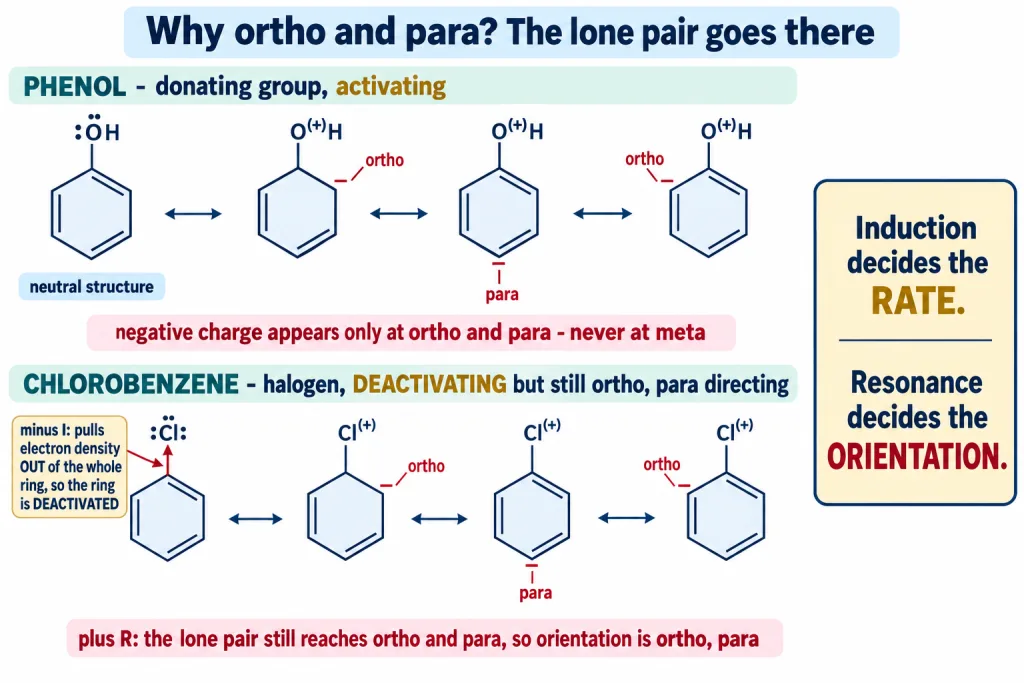
The group also has a effect, because oxygen is more electronegative than carbon and pulls a little density out along the sigma bond. That slightly reduces the density at every position, ortho and para included. For , and the donation is much the larger of the two, so the ring ends up richer overall and the group activates. Phenol is nitrated by dilute nitric acid at room temperature, giving -nitrophenol and -nitrophenol, where benzene needs the concentrated nitric-sulphuric mixture at 323-333 K.
Donation by induction and hyperconjugation (). Alkyl groups have no lone pair to give. They donate in two smaller ways. An alkyl group is electron releasing along the sigma bond, a effect. More importantly, the bonds of the alkyl group overlap with the ring pi system — hyperconjugation — and that delocalisation again feeds density specifically to the ortho and para carbons. Toluene is nitrated appreciably faster than benzene and gives -nitrotoluene and -nitrotoluene with only a trace of the meta isomer.
The phenyl group of biphenyl donates by conjugating its own pi system with the second ring, which again favours the ortho and para positions.
[Board] Acetanilide, , is in the activating list but is much gentler than aniline, because the nitrogen lone pair is shared with the carbonyl group as well as with the ring. That is exactly why aniline is acetylated before it is nitrated.
Class 2 — the halogens: ortho, para directing but deactivating
, , and sit in a class of their own, and they are the single most misread entry in the whole aromatic section.
Key Point: The halogens , , , are ortho, para directing but deactivating. Chlorobenzene is chlorinated and nitrated more slowly than benzene, yet the products are the ortho and para isomers.
Read that twice. A group that slows the ring down still sends the electrophile to ortho and para, which is where the activating groups send it. The combination looks self-contradictory. It is not, once the two questions of the last two pages are kept apart.
A halogen has both effects at once, and they act on different things.
, and it wins on rate. Halogens are strongly electronegative. Each pulls electron density out of the ring along the sigma bond, and this withdrawal reaches every carbon of the ring. The ring as a whole is left poorer in electrons than benzene. A poorer ring is harder for an electrophile to attack, so every position reacts more slowly than the corresponding position of benzene. The halogen deactivates.
, and it wins on orientation. A halogen also has lone pairs, and one of them can be delocalised into the ring exactly as phenol's oxygen lone pair is. Chlorobenzene is a hybrid of the neutral structure and three dipolar ones in which chlorine carries a positive charge and a negative charge sits on a ring carbon — again on carbon 2, carbon 6 and carbon 4, the ortho and para carbons, never on a meta carbon.
The donation is weak here. Chlorine's lone pair sits in a 3p orbital while the ring pi system is built from 2p orbitals, so the sideways overlap is poor, and chlorine is too electronegative to part with its electrons willingly. The donation is nowhere near enough to beat the withdrawal and make the ring richer than benzene. What it is enough for is to make the ortho and para positions less poor than the meta positions.
Key Point: The resolution: induction decides the rate, resonance decides the orientation. The effect lowers the electron density everywhere, so the whole ring is deactivated and reacts more slowly than benzene. The effect returns some of that density to the ortho and para positions only, so among three slow positions, ortho and para are the least slow. The electrophile still has to react somewhere, and it picks the best of a bad set.
The effect answers the question how rich is this ring compared with benzene? — poorer. The effect answers the question within this ring, which carbon is richest? — ortho and para. Two comparisons, two answers, no contradiction.
[JEE Main] A rate ordering that appears again and again: phenol and toluene faster than benzene, benzene faster than chlorobenzene, chlorobenzene faster than nitrobenzene. The orientation ordering cuts across it: phenol, toluene and chlorobenzene are all ortho, para directing, while nitrobenzene is meta directing.
Class 3 — meta directing and deactivating
These are the electron-withdrawing groups. They drain electron density out of the ring, the ring becomes poorer than benzene, substitution slows down, and what substitution does occur happens at the meta position.
Key Point: The meta directing and deactivating groups are , , , , , , and .
Two patterns run through the list.
Withdrawal by resonance (). In , , , , , and , the atom attached to the ring carries a multiple bond to a more electronegative atom. The ring pi electrons are pulled out towards that atom. The direction of the arrow is the opposite of phenol's.
Nitrobenzene is the standard case. Nitrogen in already carries a positive formal charge. Nitrobenzene is a resonance hybrid of a neutral structure and three dipolar ones in which ring pi density has moved onto the nitro group, leaving a positive charge on a ring carbon — and that positive charge appears on carbon 2, carbon 6 and carbon 4, the ortho and para carbons. Once again the meta carbons are left out.
The pattern is the mirror image of phenol. A group delivers negative charge to ortho and para. A group delivers positive charge to ortho and para. Either way the meta carbons are the ones the resonance does not touch.
So in nitrobenzene the ortho and para carbons are the most depleted and the meta carbons are the least depleted. The electrophile avoids the ortho and para carbons and attacks meta. It also attacks slowly, because every carbon in the ring is poorer than a carbon of benzene.
Withdrawal by induction only. is the odd one in the list because it has no pi system and no lone pair to move. Its nitrogen has four bonds and a full positive charge, so all four of its valence pairs are tied up in bonds. It withdraws by a very strong effect alone, driven by the positive charge sitting right next to the ring. Since it cannot donate at all, no position is helped and the ring is uniformly impoverished; attack goes meta for the reason given in the next block, and it goes slowly.
[NEET] is a strong activator, but is a meta directing deactivator, for exactly the reason just given: protonating the nitrogen uses up the lone pair, so donation stops and only withdrawal is left. Aniline in a strongly acidic nitrating mixture is largely present as the anilinium ion, which is why the reaction gives a substantial amount of the meta product.
The real reason — look at the arenium ion
Counting electron density in the starting material gives the right answer. The reason an examiner wants is one step deeper, in the intermediate.
Electrophilic aromatic substitution goes in three steps: the electrophile is generated, it attacks the ring to give the arenium ion, and a proton is then lost to restore aromaticity. The second step is slow and rate-determining. Whatever makes that step easier decides both the rate and the position.
In the arenium ion, the carbon that the electrophile attacked has become and holds both the electrophile and a hydrogen. The remaining four pi electrons and the positive charge are spread over the other five carbons — but not evenly. Drawing the contributing structures shows that the positive charge sits on only three of them: the two carbons next to the carbon and the one across the ring from it.
Now put a substituent on carbon 1 and attack at each of the three kinds of position in turn.
Attack at ortho (carbon 2). Carbon 2 becomes . The positive charge is carried by carbons 1, 3 and 5. Carbon 1 is in the list — the carbon holding the substituent.
Attack at para (carbon 4). Carbon 4 becomes . The positive charge is carried by carbons 3, 5 and 1. Carbon 1 is in the list again.
Attack at meta (carbon 3). Carbon 3 becomes . The positive charge is carried by carbons 2, 4 and 6. Carbon 1 is not in the list.
Key Point: Ortho attack and para attack each give an arenium ion with one contributing structure carrying the positive charge on the carbon that bears the substituent. Meta attack never does. Everything about directive influence follows from that single structural fact.
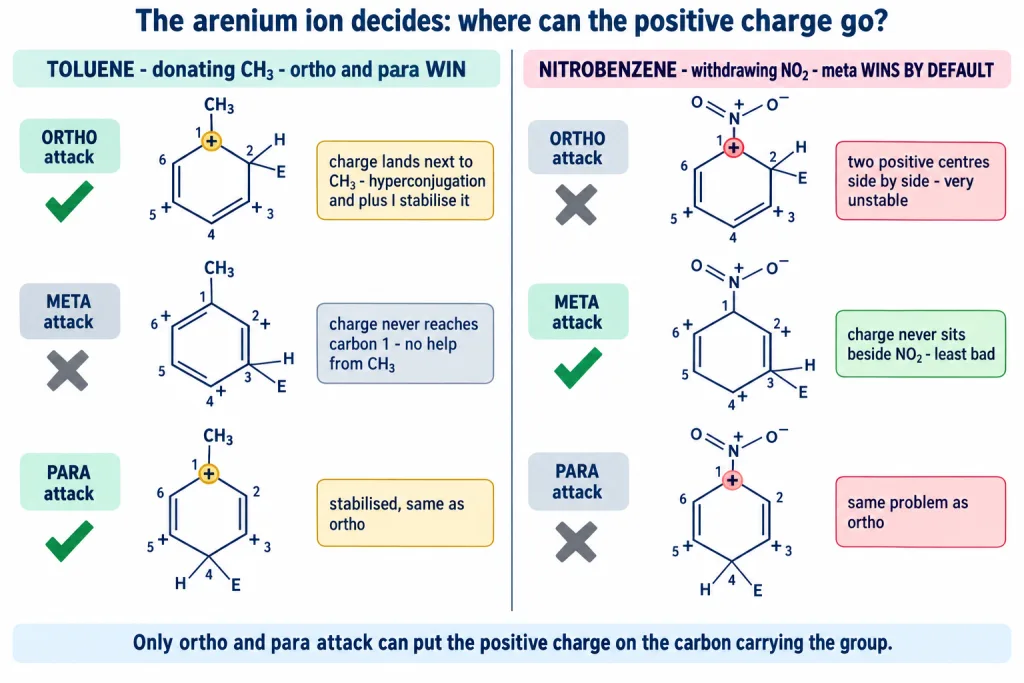
Worked case 1 — phenol, a donor. Attack at the ortho carbon gives an arenium ion with three ordinary contributors, one of which has the positive charge on carbon 1, the carbon bearing . Oxygen sits right there with a lone pair, and it pushes that pair into the bond, producing a fourth contributor in which the charge has moved off carbon and onto oxygen, and every ring carbon now has a complete octet. A contributor with every atom's octet filled and the charge on the electronegative atom that can hold it is a very stable one, and a resonance hybrid is stabilised most by its most stable contributor. Attack at para gives the same extra contributor, for the same reason. Attack at meta cannot — carbon 1 is never positive, so the oxygen lone pair has nothing to stabilise. The ortho and para intermediates are lower in energy, those pathways have lower activation energies, and the ortho and para products form. All three are still easier than attack on benzene itself, which is why phenol is activated.
Worked case 2 — toluene, also a donor. The same three intermediates, but a smaller stabilisation from a different source. With the positive charge on carbon 1, the methyl group next door donates by and by hyperconjugation, its bonds overlapping the empty orbital and spreading the charge. That help is again available only for ortho and para attack.
Worked case 3 — nitrobenzene, a withdrawer. Attack at the ortho carbon again gives a contributor with the positive charge on carbon 1. This time carbon 1 carries , whose nitrogen already bears a full positive charge and is dragging electrons away from that very carbon. A positive charge placed directly beside a positive, electron-hungry group is badly destabilised; that contributor is so poor that it barely counts, and the hybrid loses most of its delocalisation. Para attack suffers identically. Meta attack alone escapes: carbon 1 never becomes positive, so the worst contributor never arises, and all three of its contributors are ordinary ones.
Meta does not win because it is good. It wins because it is the least bad. All three intermediates from nitrobenzene are higher in energy than the arenium ion from benzene, which is why nitrobenzene is deactivated and needs harsher conditions than benzene for the same reaction.
Halogens in the same language. Chlorobenzene's effect raises the energy of all three arenium ions relative to benzene's, so the rate falls. But for ortho and para attack the chlorine lone pair can still step in and give the extra octet-complete contributor, exactly as oxygen does in phenol, and meta attack gets no such help. All three are slow; ortho and para are the least slow.
Why para usually beats ortho
An ortho, para directing group leaves the electrophile two ortho carbons and one para carbon. On counting alone the ortho product should be twice the para product. It very often is not.
The reason is steric. The ortho positions are immediately next to the group already on the ring. An incoming electrophile arriving there has to crowd past that group, and the transition state is strained. The para position is as far away as the ring allows, and nothing is in the way. The bulkier the group already present, or the bulkier the electrophile, the more the balance swings towards para.
Toluene, with a small methyl group, gives a good deal of ortho product alongside the para. tert-Butylbenzene, with a large group, is nitrated almost entirely at the para position, and the ortho isomer is a minor product. Bromination, with a bigger electrophile than nitration uses, tilts further to para than nitration does on the same substrate.
Separating the two is easy. The para isomer is the more symmetrical molecule, packs better and melts higher, so it crystallises out; the ortho isomer, melting and boiling lower, is removed by steam distillation.
[Board] A one-line answer: two ortho positions against one para position favours ortho statistically, but steric crowding next to the existing group works against it, and for anything larger than methyl the steric factor usually wins.
The three classes at a glance
| Group | Class | Effect and how | Effect on rate | Next group goes | Worked example |
|---|---|---|---|---|---|
| , , | 1 | strong (lone pair), weak | strongly activating | ortho, para | phenol dil. , 298 K - and -nitrophenol |
| , | 1 | , moderated | activating | ortho, para | anisole - and -bromoanisole |
| and all alkyl | 1 | and hyperconjugation | activating | ortho, para | toluene conc. / - and -nitrotoluene |
| 1 | conjugation with the second ring | activating | ortho, para | biphenyl nitrated at the 4-position | |
| , , , | 2 | and | deactivating | ortho, para | chlorobenzene /anhyd. - and -dichlorobenzene |
| , , , | 3 | and | strongly deactivating | meta | nitrobenzene conc. / -dinitrobenzene |
| , , | 3 | and | deactivating | meta | benzoic acid nitrated 3-nitrobenzoic acid |
| 3 | only, no lone pair left | strongly deactivating | meta | the charged nitrogen cannot donate at all |
Two rows carry most of the marks. The halogen row is the only place where the rate answer and the orientation answer come from different effects. The row catches anyone who classifies by element rather than by behaviour: nitrogen with a lone pair is an activator, nitrogen with none is a deactivator.
Key Point: Every ortho, para director except the halogens is activating. Every meta director is deactivating. There is no such thing as a meta directing activator.
The remaining reactions of benzene
Substitution is what benzene prefers, because it keeps the delocalised sextet. Under forcing conditions the ring can be made to add, and the sextet is then destroyed.
Addition of hydrogen. Benzene adds dihydrogen over a nickel catalyst at high temperature and pressure. Three molecules of are taken up, one for each formal double bond, and the product is cyclohexane.
Count the atoms: 6 carbons and hydrogens on the left, 6 carbons and 12 hydrogens on the right. One mole of benzene needs three moles of hydrogen, which at STP is litres. The conditions are severe compared with the hydrogenation of an alkene, which runs over nickel, platinum or palladium near room temperature, and that difference is itself evidence for the extra stability of the aromatic ring.
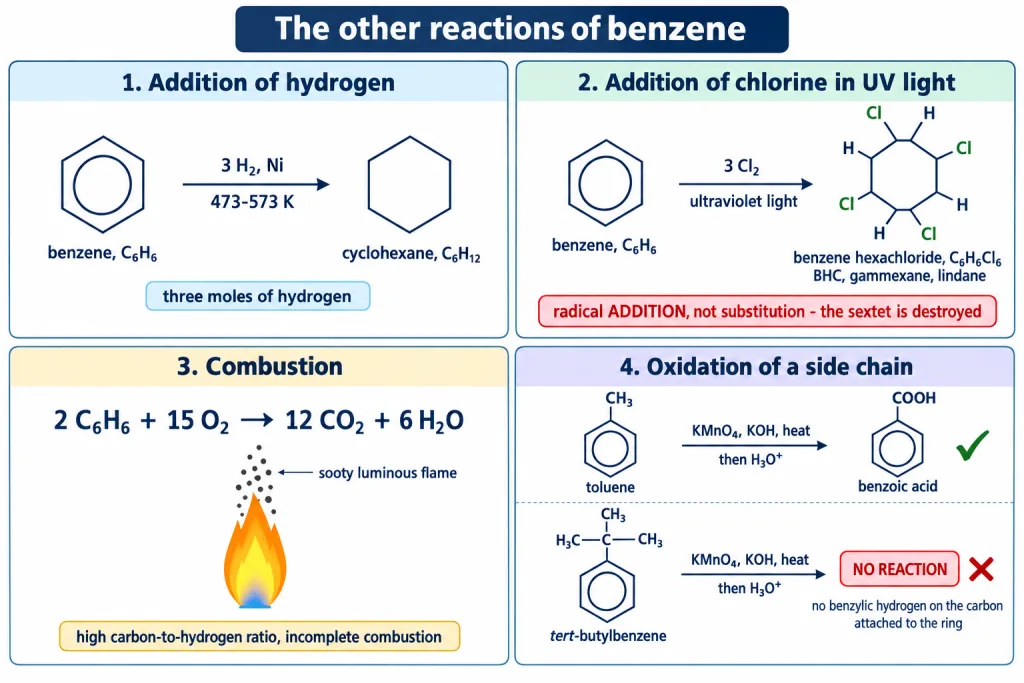
Addition of chlorine in ultraviolet light. Three molecules of chlorine add across the ring to give , benzene hexachloride, also called BHC, gammexane or lindane, once used widely as an insecticide.
The atom count: 6 carbons, 6 hydrogens and 6 chlorines on each side. Every carbon of the product is and carries one hydrogen and one chlorine, so the ring is a saturated cyclohexane ring and the aromatic sextet is gone.
Key Point: Benzene and chlorine give two entirely different products depending on the conditions. With anhydrous or in the dark, the electrophile is generated and the reaction is electrophilic substitution, giving chlorobenzene, . In ultraviolet light with no catalyst, chlorine breaks homolytically into radicals and the reaction is free-radical addition, giving . The conditions decide which.
Combustion. Benzene burns in air to carbon dioxide and water like any hydrocarbon.
Check it: carbon ; hydrogen ; oxygen on the left against on the right. The equation balances.
What is seen is a sooty, luminous flame. The cause is benzene's high carbon-to-hydrogen ratio: has one carbon for every hydrogen, where hexane, , has one for every 2.33. A carbon-rich fuel needs a great deal of oxygen per mole, and an ordinary air supply cannot deliver it, so combustion is incomplete. Unburnt carbon particles glow white-hot in the flame, making it luminous, then escape as soot. That yellow sooty flame is the standard test-tube sign of an aromatic compound.
Oxidation of a side chain. The ring itself is hard to oxidise, but an alkyl group attached to it is not. Toluene heated with alkaline , followed by acidification, gives benzoic acid; chromic acid does the same job.
The ring survives untouched. So does most of the side chain — because whatever its length, the chain is cut back to a single carbon as . Ethylbenzene, , gives benzoic acid. Propylbenzene gives benzoic acid. Isopropylbenzene gives benzoic acid. The extra carbons leave as carbon dioxide.
Key Point: Side-chain oxidation to needs at least one benzylic hydrogen — a hydrogen on the side-chain carbon directly attached to the ring. tert-Butylbenzene, , has none: the benzylic carbon carries three methyl groups and no hydrogen. It resists oxidation and is recovered unchanged.
The reason is that oxidation begins by removing a benzylic hydrogen, which is easy because the radical left behind is delocalised into the ring. With no such hydrogen there is no easy first step, and the strong oxidising agent has nowhere to start.
[JEE Main] Given a mixture of toluene and tert-butylbenzene, alkaline separates them: the toluene becomes benzoic acid, which dissolves in aqueous alkali, and the tert-butylbenzene is untouched and stays in the organic layer.
Worked items
Question 1: Nitration of toluene
Predict the product of treating toluene with concentrated and concentrated at 323-333 K.
Answer:
The group on the ring is , an alkyl group. It donates by and hyperconjugation, so it is activating and ortho, para directing.
Ans: -nitrotoluene and -nitrotoluene, formed faster than benzene is nitrated, with only a trace of the meta isomer.
Question 2: Nitration of nitrobenzene
Where does the second nitro group go, and how do the conditions compare with the first nitration?
Answer:
is and , so it is deactivating and meta directing. The ring is poorer in electrons than benzene, so the second nitration needs a higher temperature and a longer time than the first.
Ans: -dinitrobenzene (1,3-dinitrobenzene), under conditions more vigorous than those used on benzene.
Question 3: Chlorination of chlorobenzene
Chlorobenzene is treated with and anhydrous . Give the products and say whether the reaction is faster or slower than the same reaction on benzene.
Answer:
Chlorine is and . The effect drains the whole ring, so the rate is lower than benzene's. The effect returns density to the ortho and para carbons only, so those are the positions attacked.
Ans: -dichlorobenzene and -dichlorobenzene, formed more slowly than benzene gives chlorobenzene.
Watch out: Slower than benzene but still ortho, para. Writing the meta product because the group deactivates is the commonest error in this chapter.
Question 4: Ranking four rings for rate
Arrange benzene, toluene, chlorobenzene and nitrobenzene in decreasing order of rate of nitration.
Answer:
Toluene has a donating , so it is above benzene. Chlorobenzene is deactivated by , so it is below benzene. Nitrobenzene is strongly deactivated by and , so it is lowest.
Ans: toluene benzene chlorobenzene nitrobenzene.
Question 5: The arenium ion from phenol
Explain, through the intermediate, why phenol is nitrated at the ortho and para positions and not at meta.
Answer:
Ortho attack puts the carbon at position 2, so the positive charge sits on carbons 1, 3 and 5. Carbon 1 holds the , so oxygen pushes a lone pair in and gives an extra contributor with the charge on oxygen and a complete octet on every ring carbon. Para attack, at position 4, gives charge on carbons 3, 5 and 1 and the same extra contributor. Meta attack charges carbons 2, 4 and 6 only, so carbon 1 is never positive and oxygen has nothing to stabilise.
Ans: The ortho and para intermediates gain an extra, octet-complete contributor that the meta intermediate cannot have, so they are lower in energy and their pathways are faster.
Question 6: The arenium ion from nitrobenzene
Why does the same position argument send the electrophile to meta here?
Answer:
Ortho and para attack again produce a contributor with the positive charge on carbon 1, which carries . That nitrogen already has a full positive charge and is pulling electrons off that carbon, so two positive centres end up side by side. The contributor barely counts and the hybrid is poorly stabilised. Meta attack keeps the charge on carbons 2, 4 and 6, away from the nitro group.
Ans: Meta wins by avoiding the worst contributor, not by being favourable; all three intermediates are still higher in energy than benzene's, so nitrobenzene reacts slowly.
Question 7: Aniline against acetanilide
Why is aniline acetylated before it is nitrated?
Answer:
In the strongly acidic nitrating mixture the nitrogen is protonated to . With the lone pair used up the group becomes a strong withdrawer, deactivating and meta directing, so a large amount of -nitroaniline appears. Acetylation gives , far less basic, which stays unprotonated and remains an ortho, para directing activator.
Ans: Acetylation blocks protonation and moderates the nitrogen, so nitration gives mainly -nitroacetanilide, which is then hydrolysed back to -nitroaniline.
Question 8: Order of two steps
Starting from benzene, how would you make -chloronitrobenzene, and how would you make -chloronitrobenzene?
Answer:
For the meta isomer I nitrate first. is meta directing, so chlorination with and anhydrous then puts chlorine at the meta position.
For the para isomer I chlorinate first. is ortho, para directing, so nitration then gives the ortho and para products, and the para isomer is separated by crystallisation.
Ans: Nitration then chlorination gives the meta isomer; chlorination then nitration gives the ortho and para isomers.
Watch out: Same two reactions, opposite order, different product. Always classify the group that will be sitting on the ring when the second step runs.
Question 9: Nitration of benzoic acid
Give the product and name it.
Answer:
has a carbonyl attached to the ring, so it is and , deactivating and meta directing.
Ans: 3-nitrobenzoic acid (-nitrobenzoic acid), formed more slowly than benzene is nitrated.
Question 10: A quaternary nitrogen
activates and directs ortho, para, but deactivates and directs meta. Both have nitrogen joined to the ring. Explain.
Answer:
In the nitrogen has three bonds and one lone pair, and that pair is delocalised into the ring — a strong effect. In the nitrogen has four bonds and a full positive charge, so every valence pair is tied up in a bond and none is left to give. Only remains, and the positive charge makes it very strong.
Ans: The classification follows what the atom can do, not which element it is: donation needs an available lone pair, and the quaternary nitrogen has none.
Question 11: tert-Butylbenzene and permanganate
Toluene with hot alkaline gives benzoic acid. What does tert-butylbenzene give?
Answer:
Side-chain oxidation starts by removing a benzylic hydrogen — a hydrogen on the side-chain carbon joined to the ring. In toluene that carbon has three of them. In tert-butylbenzene the benzylic carbon carries three methyl groups and no hydrogen at all.
Ans: No reaction; tert-butylbenzene is recovered unchanged, while toluene becomes benzoic acid.
Question 12: Two products from chlorine
Benzene and chlorine give chlorobenzene in one experiment and in another. What decides which?
Answer:
With anhydrous or in the dark, the Lewis acid generates and the reaction is electrophilic substitution, keeping the aromatic sextet. In ultraviolet light with no catalyst, chlorine splits homolytically into chlorine atoms and the reaction is free-radical addition, which destroys the sextet.
Ans: The conditions. Catalyst and dark gives by substitution; ultraviolet light gives benzene hexachloride (BHC, gammexane, lindane) by addition.
Question 13: Hydrogen taken up
How many moles of hydrogen does one mole of benzene absorb, under what conditions, and what volume is that at STP?
Answer:
Left side: 6 C and H. Right side: 6 C and 12 H. The equation balances, and three formal double bonds need three molecules of hydrogen.
Ans: Three moles, over nickel at 473-573 K, which is litres at STP; the product is cyclohexane.
Question 14: The sooty flame
Write the balanced combustion equation for benzene and say why the flame is sooty.
Answer:
Carbon: 12 each side. Hydrogen: 12 each side. Oxygen: 30 on the left, on the right.
Benzene has one carbon per hydrogen, against one per 2.33 in hexane. A carbon-rich fuel needs a lot of oxygen, ordinary air cannot supply it fast enough, and unburnt carbon glows in the flame and escapes as soot.
Ans: ; the sooty luminous flame comes from the high carbon-to-hydrogen ratio and incomplete combustion.
Question 15: Ortho against para
Nitration of tert-butylbenzene gives almost entirely one isomer, while nitration of toluene gives a good deal of two. Explain.
Answer:
Both groups are alkyl and ortho, para directing, and both rings offer two ortho positions against one para, which by counting favours ortho. The difference is size: the bulky crowds an electrophile arriving at either ortho carbon, while the para carbon is clear. Methyl is small enough that the crowding is mild.
Ans: Steric hindrance. tert-Butylbenzene gives mainly the para product; toluene gives both ortho and para in useful amounts.
Watch out: The statistical 2:1 advantage of ortho is real, so it is the steric penalty that must be argued, not the direction of the electronic effect.