
Card 1 - Classification, general formulae and the degree of unsaturation
A hydrocarbon contains carbon and hydrogen only. Sorting one takes two questions: chain or ring, and single bonds only or not.
Open chain: alkanes , alkenes , alkynes . Alicyclic, a ring behaving like an open chain: cycloalkanes , cycloalkenes . Aromatic: single-ring benzene homologues , .
Key Point (Definition): The degree of unsaturation is the number of pairs of hydrogen atoms a compound is short of the saturated open-chain compound with the same carbon skeleton. Each unit is one ring or one pi bond.
A halogen counts as a hydrogen and is subtracted, nitrogen adds one, oxygen and sulphur are ignored. One , ring or is worth 1, one 2, one benzene ring 4. Benzene gives 4, toluene 4 as well since an alkyl side chain is invisible to the count, naphthalene 7.
Key Point: belongs to the alkenes and the cycloalkanes, to the alkynes, cycloalkenes and dienes alike, so a molecular formula alone can never fix a structure.
Card 2 - Structure and bonding across the three aliphatic families
- Ethane: , tetrahedral, ; C-C 154 pm, 348 kJ/mol, one sigma; C-H 109 pm; 25% s character.
- Ethene: , trigonal planar, about ; C=C 134 pm, 681 kJ/mol, one sigma and one pi; C-H 108 pm; 33.3% s.
- Ethyne: , linear, ; triple bond 120 pm, 823 kJ/mol, one sigma and two pi; C-H 106 pm; 50% s.
C-H bond enthalpy is 414 kJ/mol throughout, and ethene's angles are not exactly : about , about .
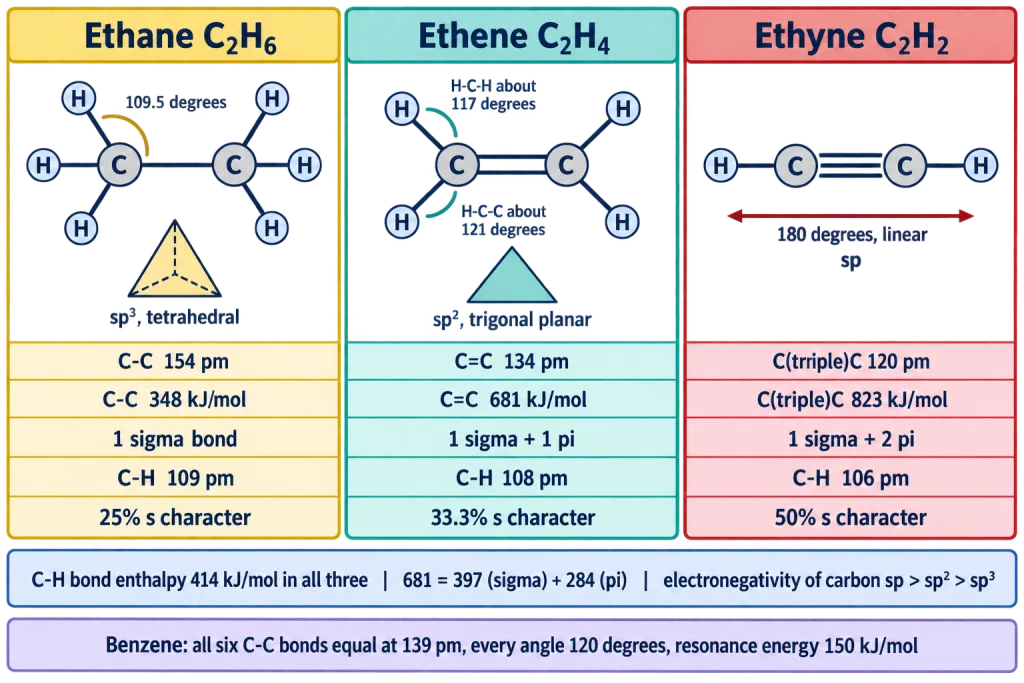
Key Point: The pi part, about 284 kJ/mol, is the weakest figure here, and it is the bond that gives way on addition. Reactivity is set by the pi component and not the total, which is why the strongest carbon-carbon bond sits in a readily attacked, unsaturated molecule.
More s character holds the pair closer in, so carbon's electronegativity runs , the order that makes a terminal alkyne acidic. Benzene is the outlier: all six C-C bonds equal at 139 pm, every angle , resonance energy 150 kJ/mol.
Card 3 - Alkanes: the five preparations
1. Hydrogenation of an alkene or alkyne with Pt, Pd or Ni — with nickel the Sabatier-Senderens reaction at 573 K; an alkyne takes two moles.
2. Wurtz reaction, sodium in dry ether. Only symmetrical alkanes cleanly, so from one halide only an even carbon count, methane not at all, and three alkanes from two different halides.
3. Reduction of an alkyl halide with Zn and dilute HCl, or a zinc-copper couple in ethanol; the skeleton is untouched, so this reaches methane and the odd chains. 4. Decarboxylation: the sodium salt of a carboxylic acid heated with soda lime (), giving an alkane with one carbon fewer.
5. Kolbe electrolysis of a concentrated aqueous solution of the sodium or potassium salt, giving at the anode.
Key Point: Hydrogenation and halide reduction keep the carbon count, decarboxylation drops it by one, Wurtz and Kolbe double it — so neither doubling method gives methane or an odd-carbon alkane from a single starting material.
Card 4 - Alkanes: physical properties
The only force between two alkane molecules is the weak van der Waals (London dispersion) force, and its size depends on how much surface two neighbours can press together.
State at room temperature: to gases, to liquids, and above solids. Boiling point rises with chain length, a longer chain having more surface.
Key Point: Branching lowers the boiling point. The more branched the isomer, the more nearly spherical it is, the smaller its area of contact with a neighbour, the weaker the intermolecular forces, and the lower the boiling point: pentane 309.1 K, 2-methylbutane about 301 K, 2,2-dimethylpropane 282.5 K.
Key Point: Melting depends on packing, so the rise is not smooth: even-numbered members pack better and melt higher than the trend predicts, giving a saw-tooth curve, since their two terminal methyls point in opposite directions and the zig-zag chains nest closely.
A symmetrical branched molecule packs better still, so 2,2-dimethylpropane melts at 256.5 K against pentane at 143.3 K while boiling lowest of the three. Alkanes are non-polar: insoluble in water, freely soluble in benzene and ether, since like dissolves like, and their density of 0.6 to 0.8 g per cubic centimetre puts them above water.
Card 5 - Alkanes: the reactions other than halogenation
Alkanes are paraffins, from parum affinis: strong non-polar bonds, no lone pair, no pi cloud, no partial charge, so neither an electrophile nor a nucleophile has a site to attack. Combustion is strongly exothermic; limited air gives carbon monoxide and a poorer supply carbon black.
Controlled oxidation — the catalyst, not the alkane, picks the product, and permanganate touches an alkane only where there is a tertiary hydrogen:
Pyrolysis (cracking): heat alone at 773 K, by a free-radical route, into lower alkanes, alkenes and dihydrogen. Isomerisation: anhydrous with turns -hexane into 2-methylpentane and 3-methylpentane. Aromatisation, also called reforming or hydroforming, over (or , ) at 773 K and 10-20 atm, needing six or more carbons in the chain. Steam over nickel at 1273 K is the industrial source of dihydrogen.
Key Point: 523 K with copper at 100 atm gives methanol; 773 K alone gives cracking and 773 K with gives benzene; 1273 K with nickel and steam gives dihydrogen.
Card 6 - Free-radical halogenation, in numbered steps
Conditions: diffused sunlight, ultraviolet light, or 573-773 K. In the dark the mixture keeps indefinitely.
Classify by the radical count and never by the product: Steps 3 and 6 both give chloromethane and differ in class. A mixture always results.
Key Point: Halogen reactivity falls as . Fluorination is explosively violent, manageable only with both reactants heavily diluted by an inert gas; iodination is reversible and needs an oxidising agent such as or to destroy the HI formed.
Key Point: Ease of replacement of a hydrogen runs tertiary > secondary > primary, the radical left behind ranking .
Key Point: The formation of ethane during the chlorination of methane is the evidence for the free-radical mechanism: ethane has a C-C bond that neither nor possesses, and only two methyl radicals combining can make it.
Card 7 - Conformations
Rotation about a single bond is essentially free, a sigma cloud being cylindrically symmetrical about the internuclear axis; rotation about a is blocked, costing the pi overlap of about 284 kJ/mol. Free rotation gives conformations; restricted rotation gives cis-trans isomerism.
Key Point (Definition): Conformations are the spatial arrangements produced purely by rotation about a C-C single bond; bond lengths and angles are unchanged throughout.
Eclipsed, bonds in line; staggered, as far apart as the geometry allows; skew, everything between — gauche is reserved for butane's staggered form with the two methyls 60 degrees apart. Rotation is continuous, so ethane has an infinite number of conformations. Sawhorse: the C-C bond a diagonal, the lower-left end the front carbon, three lines from each end. Newman: the front carbon a point with three lines at , the rear carbon a circle with three lines from its circumference; six even spokes staggered, three doubled spokes eclipsed.
Key Point (Definition): Torsional strain is the repulsion between the electron clouds of bonds on adjacent atoms brought into line by rotation. It is greatest eclipsed and least staggered, so the staggered conformation is the more stable. Eclipsed comes at , , and staggered at , , , giving three maxima and three minima in a turn.
Key Point: For ethane the eclipsed-to-staggered difference is 12.5 kJ/mol, small enough for collisions to push every molecule over it continuously, so rotation is free for practical purposes and conformers cannot be isolated — which is why they are not isomers in the sense that cis and trans forms are.
Butane, by the dihedral angle between the methyls on and , adds steric strain:
Card 8 - Alkenes: the four preparations
Three of the four are beta-eliminations, and no beta hydrogen means no elimination.
1. Dehydrohalogenation with alcoholic KOH, heated. Halide reactivity I > Br > Cl; ease of elimination tertiary > secondary > primary.
Key Point: Alcoholic KOH gives elimination to the alkene, the solvent supplying the stronger, bulkier ethoxide ion; aqueous KOH gives substitution to the alcohol, water supplying hydroxide, a good nucleophile.
2. Dehydration of an alcohol: concentrated at 443 K, or at 623 K. Ease tertiary > secondary > primary, the slow step making a carbocation, which can shift a hydride and give a rearranged alkene.
3. Dehalogenation of a vicinal dihalide: zinc dust in methanol, heated. A geminal dihalide gives no alkene this way.
4. Partial hydrogenation of an alkyne — the pair never to swap.
Key Point: with poisoned by quinoline (Lindlar's catalyst) gives the cis alkene, both hydrogens arriving on one face from the metal surface. Na in liquid ammonia at 195 K gives the trans alkene, through a vinyl anion that puts the bulky groups as far apart as possible.
Key Point: Saytzeff's rule — where an elimination can give more than one alkene, the major product is the more substituted alkene, because it is the more stable one.
2-Bromobutane gives but-2-ene as major even though C-1 offers three beta hydrogens against two on C-3: stability overrides statistics. Saytzeff governs elimination, Markovnikov addition.
Card 9 - Alkenes: every addition reaction
The pi cloud lies outside the plane, loosely held, so an electrophile attacks it and both fragments of the reagent finish on the two carbons.
- , finely divided Ni, Pt or Pd — the alkane, syn.
- in , cold, no sunlight — the vicinal dibromide, red-brown colour discharged, no fumes; bromine water discharges its own orange colour, the dichloride, no addition.
- , dry, no peroxide, reactivity — the alkyl halide, Markovnikov.
- with benzoyl peroxide — the anti-Markovnikov bromide, HBr only.
- Cold concentrated — the alkyl hydrogen sulphate, hydrolysed by boiling water to the alcohol.
- with dilute — the alcohol, Markovnikov; industrial ethanol.
- Cold dilute alkaline — the vicinal glycol, pink discharged and brown .
- Acidic or hot — cleavage to acids, ketones and .
- , then — aldehydes and ketones.
- High temperature and pressure with a catalyst — polythene from ethene, polypropene from propene.
The alkene polarises the approaching , and the remaining bromine bridges both carbons as the cyclic bromonium ion, which bromide can open only from the opposite face.
Key Point: Halogen addition is anti — cyclohexene with in gives trans-1,2-dibromocyclohexane and no cis compound — while catalytic hydrogenation delivers both hydrogens to one face and is syn. A discharged colour proves only that a carbon-carbon multiple bond is present: not double or triple, not how many, not where.
Card 10 - Markovnikov's rule and the peroxide effect, side by side
Key Point (Definition): Markovnikov's rule. When an unsymmetrical reagent adds to an unsymmetrical alkene, the negative part of the reagent attaches itself to the carbon atom carrying the fewer hydrogen atoms.
Key Point (Definition): Peroxide effect (Kharasch and Mayo). HBr only, with benzoyl peroxide, adds anti-Markovnikov by a free-radical mechanism.
Both obey one principle: the intermediate that forms is the more stable one. The ionic route sends the proton in first, leaving the more stable carbocation () with bromine beside it; the radical route sends a bromine atom in first, leaving the more stable radical and stranding bromine at the end.
| Feature | No peroxide | With benzoyl peroxide |
|---|---|---|
| Mechanism | electrophilic, ionic | free-radical chain |
| Attacks first | ||
| Intermediate | carbocation | carbon free radical |
| Bromine ends on | carbon with fewer hydrogens | carbon with more hydrogens |
| From 2-methylpropene | 2-bromo-2-methylpropane | 1-bromo-2-methylpropane |
The chain needs both propagation steps, a halogen radical made from H-X and that radical adding to the double bond. HCl fails the first, its bond of about 430.5 kJ/mol being too strong for a radical to break; HI fails the second, its bond of about 296.8 kJ/mol breaking easily but the iodine radicals simply recombining. HBr, about 363.7 kJ/mol, passes both.
Key Point: Three conditions must hold together — HBr, a peroxide, and an unsymmetrical alkene. But-2-ene and cyclohexene give 2-bromobutane and bromocyclohexane with peroxide or without.
Markovnikov's rule is a consequence of carbocation stability, not an independent law: where the first cation can shift a hydride and become tertiary, the count predicts wrongly.
Card 11 - Alkene oxidation and ozonolysis
Key Point (Definition): Baeyer's reagent is a cold, dilute, alkaline solution of potassium permanganate. It converts an alkene into a vicinal glycol, a 1,2-diol, with the skeleton intact.
Key Point: In a positive Baeyer test the pink colour is discharged and a brown precipitate of manganese dioxide appears. Both changes together are the test for unsaturation, and benzene gives neither.
Acidic or hot permanganate cleaves the double bond, each carbon judged by its own hydrogen count; ozonolysis stops one step earlier.
| Carbon in the alkene | Hot or acidic | , then |
|---|---|---|
| methanal, | ||
| a carboxylic acid, | an aldehyde, | |
| a ketone, | a ketone, |
Carbon dioxide among the permanganate products marks a terminal .
Key Point: Zinc is present to destroy the hydrogen peroxide released when the ozonide is hydrolysed; without it the aldehyde would be oxidised on to the acid.
Key Point: To work backwards, erase the two oxygen atoms and join the two carbonyl carbons with a double bond, nothing else moving since ozonolysis with zinc loses no carbon.
Two different products means an unsymmetrical alkene, two moles of one a symmetrical one (two moles of ethanal give but-2-ene), and one product with two carbonyl groups a cyclic alkene (hexanedial gives cyclohexene). The geometry goes with the double bond, so cis- and trans-but-2-ene answer alike.
Card 12 - Alkynes: preparation, acidity and the acetylide tests
From calcium carbide, the industrial route, which gives ethyne only:
From a vicinal or a geminal dihalide: the first HX comes off with alcoholic KOH, the second needs sodamide, , the vinyl halide having a strengthened C-X bond and a tightly held vinylic hydrogen.
Key Point: in acidity, because the carbon holds its electrons most tightly — 50% s character, the most electronegative kind of carbon — so the C-H bond is the most polarised and the anion left behind is the most stable.
Only a terminal alkyne is acidic; but-2-yne has all its hydrogens on carbons and gives none of these reactions.
Key Point: Ammoniacal silver nitrate gives a white precipitate of silver acetylide; ammoniacal cuprous chloride gives a red precipitate of copper acetylide. These are the standard test for a terminal alkyne, separating it from an alkene and from a non-terminal alkyne alike.
Key Point: Ethyne is a very weak acid overall — far weaker than water. Sodium and sodamide work on it only because they are powerful bases.
Card 13 - Alkynes: the addition reactions
A triple bond is one sigma and two pi bonds, so an alkyne takes up two molecules of a reagent where an alkene takes one.
Hydrogen. Over Pd or Ni the reduction runs through the alkene to the alkane; to stop there, Lindlar's catalyst gives the cis alkene and sodium in liquid ammonia at 195 K the trans alkene.
Halogen. in , colour discharged, through the dihalide to the tetrahalide: two moles of bromine per mole against one for an alkene.
Hydrogen halide. Markovnikov both times, and both halogens land on the same carbon.
Key Point (Definition): Two successive additions of HX to an alkyne give the geminal dihalide; adding to an alkene gives the vicinal dihalide. Reactivity is .
Key Point: An alkyne warmed with dilute containing 1% at 333 K adds one molecule of water with Markovnikov orientation, giving an unstable enol which tautomerises. Ethyne gives ethanal; every other alkyne gives a ketone, ethyne alone carrying a hydrogen on both triply bonded carbons.
Polymerisation. Linear gives polyacetylene, conducting when doped; cyclic puts three molecules of ethyne through a red-hot iron tube at 873 K and closes them into benzene. An alkyne adds an electrophile more slowly than an alkene, its carbons holding the pi electrons tightly.
Card 14 - The distinguishing-test table for all four families
| Reagent | Alkane | Alkene | Terminal alkyne | Internal alkyne | Benzene |
|---|---|---|---|---|---|
| in or bromine water | no change in the dark | discharged, 1 mol | discharged, 2 mol | discharged, 2 mol | no change |
| Baeyer's reagent | no change | pink gone, brown | pink gone, brown | pink gone, brown | no change |
| Ammoniacal | no reaction | no reaction | white precipitate | no reaction | no reaction |
| Ammoniacal | no reaction | no reaction | red precipitate | no reaction | no reaction |
| Burning in air | clean, faintly blue | luminous, some soot | sooty, smoky | sooty, smoky | sooty luminous flame |
Sodium in liquid ammonia at 273 K agrees with the silver reagent: dihydrogen from a terminal alkyne, nothing from anything else here.
The order to test in. The silver or copper reagent first, a precipitate meaning a terminal alkyne and finishing the identification; then bromine water or Baeyer's reagent, colour discharged at once meaning an alkene or an internal alkyne; then the bromine taken up, one mole against two, or hydration at 333 K, an alkene giving an alcohol and an internal alkyne a ketone.
Key Point: Bromine water and Baeyer's reagent test for unsaturation. Ammoniacal silver nitrate and ammoniacal cuprous chloride test for a terminal hydrogen. An alkene and an internal alkyne pass the first pair and fail the second, which is why but-2-yne decolourises bromine water and still gives no precipitate.
A negative unsaturation test is the firmer result, and benzene gives one in spite of four degrees of unsaturation. An alkane in sunlight fades bromine slowly by substitution, so a positive test must be immediate, in the cold, with no fumes.
Card 15 - Benzene: the structure argument from Kekule to resonance
Five facts a structure had to satisfy: with four degrees of unsaturation; all six hydrogens equivalent, so one monosubstituted product; exactly three disubstituted isomers, ortho, meta and para; three double bonds, from the triozonide and three moles each of and ; and unusual stability, with substitution in preference to addition.
Kekule, 1865 proposed a closed ring of six carbons with alternating single and double bonds. That clears three of the five and fails at the ortho position: two 1,2-dibromobenzenes are predicted, one with a double bond between carbons 1 and 2 and one with a single bond, and only one has ever been isolated. Kekule's answer was that the double bonds oscillate too fast to be caught — a historical patch, not the modern explanation, and it fixes neither the stability nor the bond lengths, alternating bonds meaning 154 pm next to 134 pm.
Key Point: X-ray diffraction shows all six carbon-carbon bonds equal at 139 pm, every angle , and a planar regular hexagon of carbons, each keeping one unhybridised p orbital perpendicular to the plane, so the six pi electrons are delocalised above and below it.
Key Point: The two Kekule arrangements are contributing structures joined by a double-headed arrow. Benzene is one resonance hybrid — not a mixture, not an equilibrium, and it does not oscillate.
Cyclohexene releases 119.6 kJ/mol on hydrogenation, so three ordinary double bonds should give kJ/mol; benzene reaches the same cyclohexane releasing only 208.4.
Key Point: The resonance energy is about 150 kJ/mol, and it is why benzene substitutes rather than adds: substitution preserves the delocalised sextet, addition destroys it and forfeits the 150 kJ/mol.
Card 16 - Aromaticity and Huckel's rule
Key Point (Definition): A species is aromatic when all four conditions hold: it is cyclic; it is planar; it is completely conjugated, every ring atom carrying an unhybridised p orbital that overlaps both its neighbours; and it holds pi electrons with The last is Huckel's rule.
Take them in order and stop at the first failure. in such a ring is aromatic and more stable than the open-chain analogue — 2, 6, 10, 14, 18; is antiaromatic and less stable than it — 4, 8, 12, 16; failing condition 1, 2 or 3 gives non-aromatic. Count two electrons per double bond inside the ring, and a lone pair only if it occupies an unhybridised p orbital in the cyclic array; a carbanion lone pair counts, and an empty p orbital contributes nothing but keeps the conjugation unbroken.
Aromatic: benzene (6), naphthalene (10), anthracene (14), cyclopentadienyl anion (6), tropylium (cycloheptatrienyl) cation (6), cyclopropenyl cation (2), pyrrole, furan and thiophene (6 each), pyridine (6).
Antiaromatic: cyclobutadiene (4), cyclopentadienyl cation (4).
Non-aromatic: cyclooctatetraene (8 pi electrons but tub-shaped, not planar, so the count is never reached), cyclohexane, cyclohexene, and every open chain.
Key Point: Pyrrole's nitrogen lone pair IS part of the sextet — two ring bonds give 4 and the lone pair in the p orbital the other 2 — so using it on a proton would destroy the aromaticity and pyrrole is a very weak base. Pyridine's lone pair is NOT: three ring double bonds, one , already give 6, and the pair sits in an orbital in the ring plane, free to take a proton, so pyridine is a base. Furan and thiophene put one of their two lone pairs into the p orbital, so both come to 6.
Card 17 - Preparation of benzene, and the electrophilic substitutions
So ethyne through a red-hot iron tube at 873 K, phenol over heated zinc dust, and sodium benzoate with soda lime. Every substitution below runs on , the electrophile generated in the flask.
| Reaction | Reagent and conditions | Electrophile | Product |
|---|---|---|---|
| Nitration | conc. + conc. , 323-333 K | , nitronium ion | nitrobenzene |
| Sulphonation | fuming sulphuric acid (oleum), heat | benzenesulphonic acid | |
| Halogenation | + anhydrous , or | halobenzene | |
| Friedel-Crafts alkylation | + anhydrous | alkylbenzene | |
| Friedel-Crafts acylation | or + anhydrous | acylium, | aryl ketone |
Key Point: Sulphuric acid acts as the acid and nitric acid as the base — supplying the nitro group does not make nitric acid the acid.
Key Point: Sulphonation is reversible; the others are not. Oleum and heat put the group on, superheated steam or dilute acid takes it off, and that is what lets it serve as a blocking group. The Lewis acid must be anhydrous, a damp catalyst giving no reaction at all.
Card 18 - Friedel-Crafts: alkylation, its three limitations, and acylation
Key Point (Definition): Friedel-Crafts alkylation puts an alkyl group on the ring from an alkyl halide with anhydrous ; the electrophile is the carbocation .
1. Polyalkylation. The product is activated relative to the substrate, so toluene is attacked faster than benzene and the xylenes and trimethylbenzenes follow.
2. Rearrangement. A plain carbocation moves to become more stable first: 1-chloropropane gives the primary propyl cation, which shifts a hydride, so the product is isopropylbenzene (cumene), not propylbenzene.
3. Vinyl and aryl halides fail completely, their halogen sitting on an carbon so that the cation would be ruinously unstable. Alongside them, a strongly deactivated ring does not react at all: nitrobenzene undergoes neither alkylation nor acylation.
Key Point (Definition): Friedel-Crafts acylation uses an acyl chloride or an acid anhydride with anhydrous ; the electrophile is the acylium ion and the product an aryl ketone.
Key Point: Acylation avoids all three: the acylium ion is resonance stabilised with a complete octet on carbon and so does not rearrange, and the group of the product is deactivating and meta directing, so the reaction stops at one group. It needs slightly over one mole of , the ketone oxygen binding the catalyst.
A straight chain therefore goes on by acylation then reduction — Zn-Hg with concentrated HCl (Clemmensen) or Wolff-Kishner.
Card 19 - The mechanism of electrophilic aromatic substitution, in three steps
Nitration, sulphonation, halogenation, alkylation and acylation are one reaction in five hats.
(a) Generation of the electrophile from the reagent and the catalyst; sulphonation is the exception, oleum already containing the neutral electrophile .
(b) Attack of the electrophile on the pi cloud, giving the arenium ion.
Key Point: In the arenium ion (sigma complex) the attacked carbon is , holding the incoming group and a hydrogen above and below the ring plane, so it has no p orbital left and aromaticity is temporarily lost. The positive charge is delocalised over the other five carbons, three contributing structures placing it beside the carbon or across the ring from it. This step is SLOW and rate-determining, because forming the ion costs the resonance energy of about 150 kJ/mol.
(c) Loss of a proton from the carbon, taken by the base, restoring aromaticity. Fast.
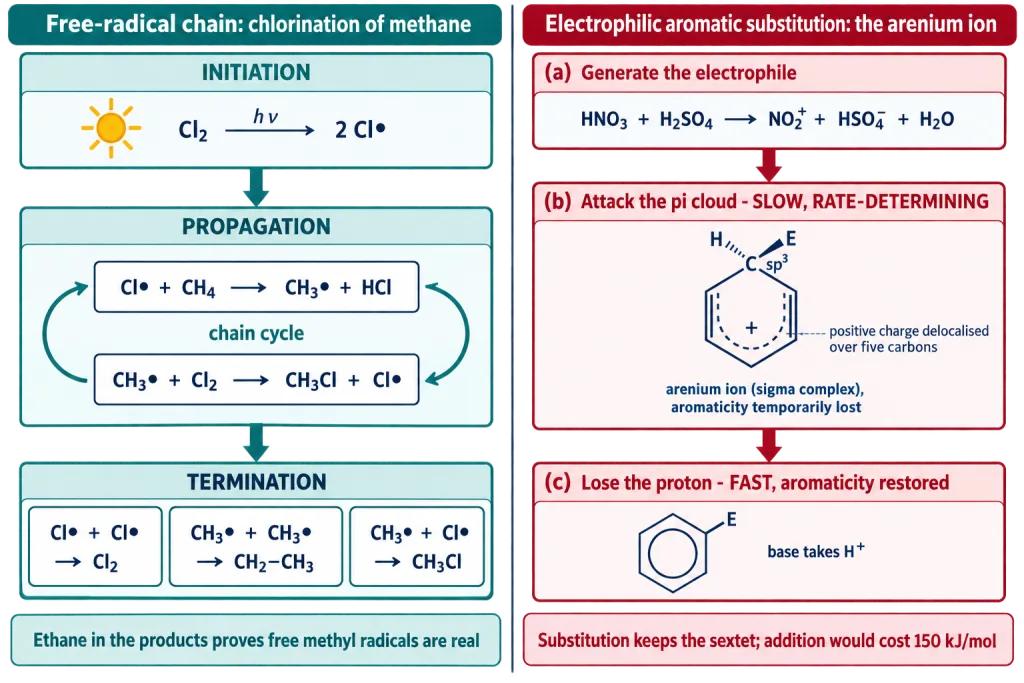
The energy profile has two maxima and one minimum, the first the taller, which says pictorially that step (b) is rate-determining. That nitrates at almost the rate of places the C-H bond breaking after the slow step.
Key Point: Benzene substitutes rather than adds because both paths leave from the same arenium ion: losing a proton restores the sextet and repays the 150 kJ/mol, while capturing a nucleophile would destroy the aromaticity for good.
Card 20 - Directive influence
Ask two questions of every substituent: where does it send the next group, and does it make the ring faster or slower than benzene. Most answer both the same way; the halogens do not.
Key Point: Ortho, para directing AND activating: , , , , , and all alkyl groups, . Meta directing AND deactivating: , , , , , , , . There is no meta directing activator.
Key Point: Ortho, para directing BUT deactivating: the halogens , , , . They are and : induction withdraws and deactivates the whole ring, so chlorobenzene reacts more slowly than benzene, while resonance donates a lone pair to the ortho and para positions and so still directs there. Induction decides the rate, resonance the orientation.
Classify by what the atom can do, not which element it is: activates while and deactivate and direct meta, a four-bonded nitrogen having no lone pair to give. A typical rate order is toluene > benzene > chlorobenzene > nitrobenzene.
The arenium-ion reason. Ortho attack puts the charge on carbons 1, 3 and 5; para attack on 3, 5 and 1; meta attack on 2, 4 and 6.
Key Point: Ortho and para attack each give one contributing structure carrying the positive charge on the carbon bearing the substituent; meta attack never does.
For a donor that contributor is the prize, an oxygen pushing its lone pair in to complete every ring carbon's octet; for a group it is the disaster, a positive charge landing beside a positively charged nitrogen, so meta wins by avoiding the worst contributor rather than by being good. Para usually beats ortho despite the head count, an electrophile arriving ortho having to crowd past the group already there.
Card 21 - The other reactions of benzene
Addition of hydrogen, three moles, under conditions far harsher than an alkene needs — itself evidence for the aromatic stability.
Addition of chlorine in ultraviolet light, a free-radical addition that destroys the sextet, every product carbon being with one hydrogen and one chlorine.
Key Point: Benzene and chlorine give two different products according to the conditions: with anhydrous or in the dark, electrophilic substitution to ; in ultraviolet light with no catalyst, free-radical addition to .
Combustion, with a sooty luminous flame from the high carbon content — one carbon per hydrogen against one per 2.33 in hexane.
Side-chain oxidation. The ring survives and any alkyl side chain is cut back to , whatever its length, so ethylbenzene, propylbenzene and isopropylbenzene all give benzoic acid; chromic acid does the same job.
Key Point: Side-chain oxidation needs at least one benzylic hydrogen, on the side-chain carbon attached directly to the ring. tert-Butylbenzene has none and is recovered unchanged.
On toluene the same split holds: light means side chain, giving benzyl chloride, and a Lewis acid in the dark means ring, giving 2- and 4-chlorotoluene.
Card 22 - Carcinogenicity and toxicity
Key Point (Definition): A polynuclear aromatic hydrocarbon (PAH) is an arene built from benzene rings fused edge to edge. More than two fused benzene rings is the warning sign for toxicity and carcinogenicity.
The ring count is a guide, not a guarantee. Naphthalene, with two fused rings, falls outside the class altogether, and anthracene — three rings fused in a straight line — is not a carcinogen. The three named carcinogens are the bent four- and five-ring compounds: benzo[a]pyrene, the one found in tobacco smoke, 1,2-benzanthracene and dibenzanthracene. PAHs form by the incomplete combustion of organic material — tobacco, coal and petroleum above all, and also charred food.
They enter the body, are converted into products that damage DNA, and cause cancer. The hydrocarbon itself is unreactive; the body's own attempt to dispose of it, by cytochrome P-450 oxidation, makes a strained electrophilic epoxide, guanine attacks it, and the DNA adduct left behind is copied wrongly, so the PAH is a procarcinogen.
Benzene itself is toxic and a known human carcinogen, its target organ the bone marrow: long exposure gives aplastic anaemia and is linked to acute myeloid leukaemia, and it is no longer used as a laboratory solvent for this reason.
The replacement is toluene: the body oxidises a side chain in preference to a ring, the selectivity of cutting toluene back to benzoic acid, so no epoxide forms, while benzene has no side chain and its ring is the only thing available to oxidise.
Carbon monoxide, from incomplete combustion, is colourless and odourless and binds the iron(II) of haemoglobin at the same site as oxygen but about 200 times more strongly.
Card 23 - The twenty mistakes that cost marks in this chapter
- Wurtz and Kolbe both double the carbon count, so neither gives methane or an odd-carbon alkane from one starting material.
- Branching always lowers the boiling point but can raise the melting point where it raises symmetry.
- Copper at 523 K and 100 atm gives methanol while gives methanal.
- A step making chloromethane is propagation if it hands back a radical and termination if it destroys two, so the radical count decides the class.
- Conformers interconvert too fast to be separated, so they are not isomers as cis and trans forms are.
- Saytzeff governs elimination and Markovnikov governs addition.
- Alcoholic KOH eliminates to the alkene, aqueous KOH substitutes to the alcohol.
- Lindlar's catalyst gives the cis alkene, sodium in liquid ammonia at 195 K the trans alkene.
- Markovnikov's rule places the negative part of the reagent, so in iodine monochloride the chlorine goes to the carbon with fewer hydrogens.
- The peroxide effect is HBr only, and it changes nothing for a symmetrical alkene such as but-2-ene.
- Cold, dilute, alkaline permanganate gives the glycol and keeps every carbon; acidic or hot permanganate cleaves the double bond.
- Ozonolysis with zinc stops at the aldehyde, hot acidic permanganate goes on to the acid.
- Two moles of one carbonyl compound means a symmetrical alkene, one compound with two carbonyl groups a cyclic one.
- Bromine on an alkene gives a vicinal dihalide, two moles of HX on an alkyne a geminal one.
- Ethyne is the only alkyne whose hydration gives an aldehyde.
- Ammoniacal silver nitrate detects a terminal hydrogen and not unsaturation, so but-2-yne gives no precipitate yet still decolourises bromine water.
- Benzene is one resonance hybrid on a double-headed arrow, not two Kekule structures in equilibrium, and it does not oscillate.
- Cyclooctatetraene is non-aromatic because it is tub-shaped rather than planar, so its count of 8 is never reached.
- Pyrrole's nitrogen lone pair is inside the sextet and pyridine's is not, which is why pyridine is the base.
- The halogens are ortho, para directing but deactivating, so chlorobenzene reacts more slowly than benzene and still gives ortho and para products.
Card 24 - The reagent-to-product strip, for the last sixty seconds
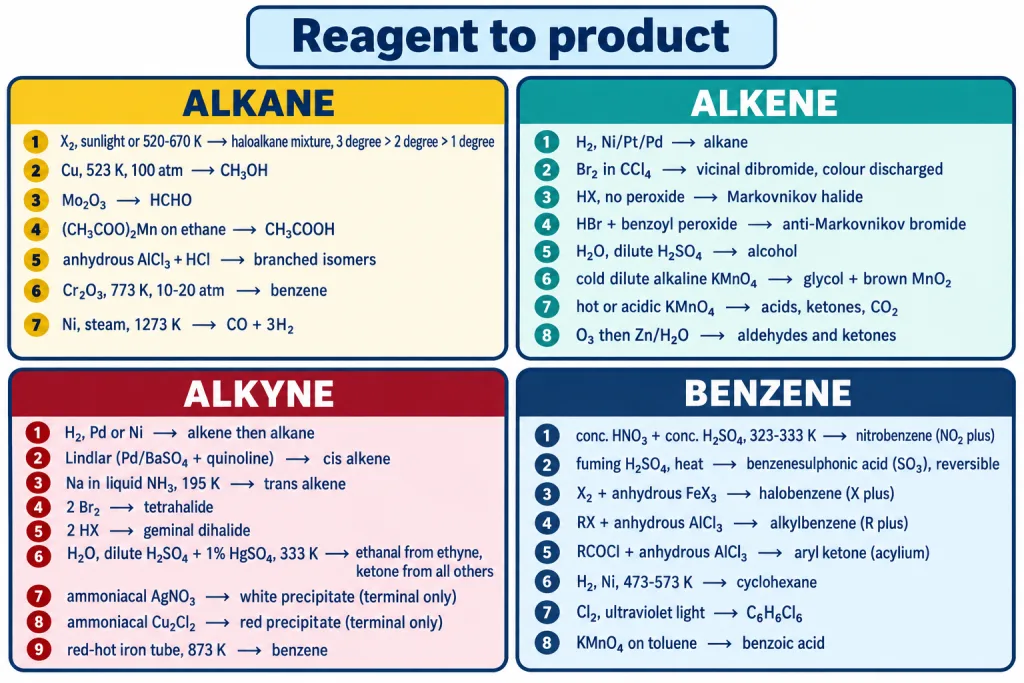
Making things. Alkane: Na in dry ether on , Zn with dilute HCl, soda lime on the carboxylate, or Kolbe electrolysis. Alkene: alcoholic KOH on a halide (Saytzeff), conc. at 443 K on an alcohol, Zn dust in methanol on a vicinal dihalide, or from an alkyne Lindlar for cis and Na in liquid at 195 K for trans. Alkyne: alcoholic KOH then , or with water for ethyne. Benzene: ethyne at 873 K, phenol with zinc dust, or sodium benzoate with soda lime.
Alkane in. in sunlight or at 573-773 K, the haloalkane mixture with ; Cu at 523 K and 100 atm, ; , ; on ethane, ; anhydrous with , branched isomers; at 773 K and 10-20 atm, benzene; nickel with steam at 1273 K, .
Alkene in. over Ni, Pt or Pd, the alkane; in , the vicinal dibromide with the colour discharged, anti; HX without peroxide, the Markovnikov halide, and HBr with benzoyl peroxide the anti-Markovnikov one; water with dilute , the alcohol; cold dilute alkaline , the glycol with brown ; hot or acidic , acids, ketones and ; then , aldehydes and ketones.
Alkyne in. over Pd or Ni, the alkene then the alkane; two moles of , the tetrahalide; two moles of HX, the geminal dihalide; water with dilute and 1% at 333 K, ethanal from ethyne and a ketone from every other alkyne; Na in liquid at 273 K, the acetylide with , and ammoniacal or a white or red precipitate, both terminal only; a red-hot iron tube at 873 K, benzene.
Benzene in. Conc. with conc. at 323-333 K, nitrobenzene via ; fuming with heat, benzenesulphonic acid via , reversibly; with anhydrous , the halobenzene via ; with anhydrous , the alkylbenzene via ; with anhydrous , the aryl ketone via ; over Ni at 473-573 K, cyclohexane; in ultraviolet light, ; on toluene, benzoic acid.
Card 25 - One question per topic: a five-minute self-check
Question 1: Degree of unsaturation
Give the degree of unsaturation of and two hydrocarbons that fit it.
Answer:
, spendable as one triple bond, two double bonds, or a ring and a double bond.
Ans: 2; but-1-yne and buta-1,3-diene.
Question 2: Bond data
Which carbon-carbon bond is the shortest, and which the strongest?
Answer:
Length falls 154, 134, 120 pm as pi bonds are added while enthalpy rises 348, 681, 823 kJ/mol.
Ans: The triple bond of ethyne is both.
Question 3: A preparation
Which alkane forms when sodium propanoate is heated with soda lime?
Answer:
Decarboxylation removes one carbon.
Ans: Ethane.
Question 4: Physical properties
Arrange pentane, 2-methylbutane and 2,2-dimethylpropane in decreasing order of boiling point.
Answer:
Fewest branches boils highest, having the largest contact area.
Ans: pentane > 2-methylbutane > 2,2-dimethylpropane.
Question 5: Alkane reactions
Name the product and the catalyst when methane is oxidised at 523 K and 100 atm.
Answer:
High pressure over a copper tube is the methanol route; gives methanal instead.
Ans: Methanol, over copper.
Question 6: Halogenation
Classify .
Answer:
One radical in and one out, with product made.
Ans: Propagation.
Question 7: Conformations
An ethane molecule sits at a dihedral angle of . Name the conformation.
Answer:
Any multiple of from zero is eclipsed, the form of maximum torsional strain.
Ans: Eclipsed, 12.5 kJ/mol above the staggered form.
Question 8: Alkene preparation
Give the major alkene from 2-bromo-2-methylbutane with alcoholic KOH.
Answer:
Saytzeff picks the more substituted alkene, and a hydrogen from C-3 gives a trisubstituted one.
Ans: 2-Methylbut-2-ene.
Question 9: Markovnikov and the peroxide effect
Give the product of 2-methylpropene with HBr and benzoyl peroxide.
Answer:
The bromine radical adds to the terminal , leaving the more stable tertiary radical.
Ans: 1-Bromo-2-methylpropane.
Question 10: Ozonolysis
An alkene gives methanal and propanone on ozonolysis. Name it.
Answer:
Erase both oxygens and join the carbonyl carbons.
Ans: 2-Methylpropene.
Question 11: Alkyne tests
But-1-yne and but-2-yne both decolourise bromine water. Which reagent separates them?
Answer:
The silver reagent detects a hydrogen on a triply bonded carbon.
Ans: Ammoniacal silver nitrate — a white precipitate with but-1-yne only.
Question 12: Aromatic substitution
Where does a nitro group go on chlorobenzene, and is the reaction faster or slower than on benzene?
Answer:
Chlorine is and : induction deactivates the ring, resonance feeds the ortho and para carbons.
Ans: Ortho and para, and more slowly than benzene.