
Alkylation: hanging an alkyl group on the ring
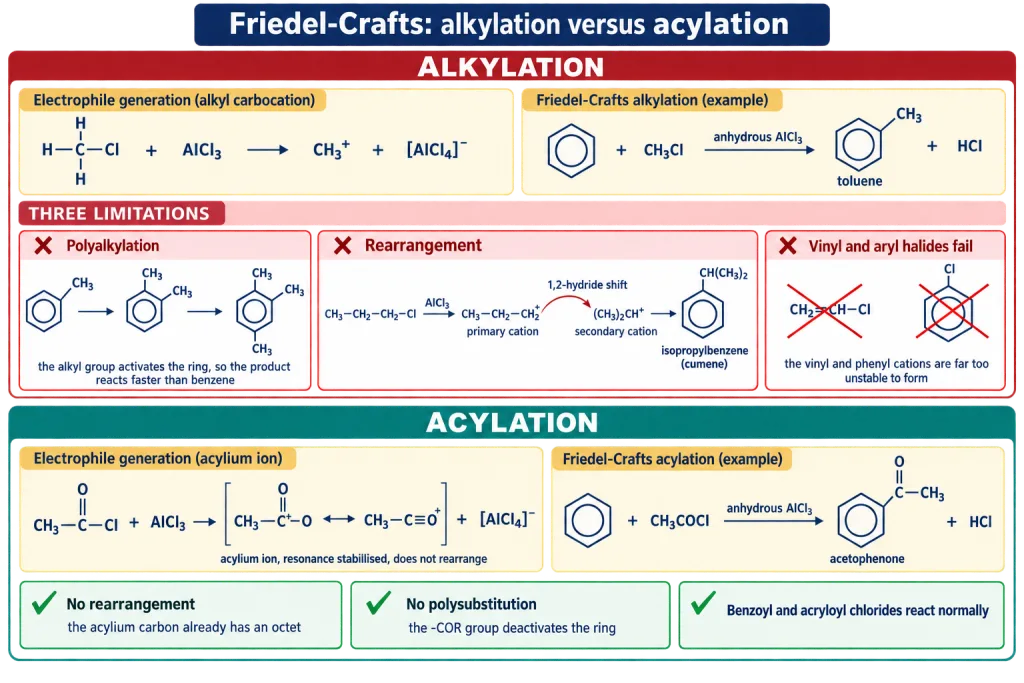
An alkyl halide left alone with benzene does nothing. Add a pinch of anhydrous aluminium chloride and the alkyl group walks straight onto the ring, displacing a hydrogen. Charles Friedel and James Crafts published the trick in 1877, and it is still the shortest route from a ring to an alkylbenzene.
Key Point (Definition): Friedel-Crafts alkylation replaces a ring hydrogen of an arene by an alkyl group, using an alkyl halide with anhydrous aluminium chloride as the catalyst. The electrophile is the carbocation , and the product is an alkylbenzene.
Count the atoms in the first: seven carbons, nine hydrogens and one chlorine on each side.
What the catalyst actually does. Aluminium in has only six electrons in its valence shell and one vacant orbital, which makes it a Lewis acid. It grabs a lone pair from the halogen of the alkyl halide and then leaves with the whole carbon-halogen bonding pair, stripping the carbon of two electrons.
Charge is conserved — nothing on the left, a plus and a minus on the right — and the four chlorines of the tetrachloroaluminate ion are the catalyst's three plus the one taken from the halide.
The carbocation is the electrophile. The ion is not a spectator; it comes back in the last step of the mechanism to take a proton off the ring, and in doing so it hands the back. That is why a small quantity of catalyst turns over a large quantity of substrate.
Why "anhydrous" is part of the answer. Aluminium chloride is hydrolysed by water to aluminium hydroxide and hydrogen chloride, and hydroxide has no vacant orbital to offer. Damp reagents or damp glassware kill the reaction, so writing without the word anhydrous costs marks. Anhydrous , and do the same job; is the one to quote.
One honest qualification. A tertiary halide ionises fully; a primary one does not, and what attacks the ring is better described as a polarised complex carrying a large positive charge on carbon. It behaves like a carbocation, which is what matters for predicting the product.
[JEE Main] The examinable trio for alkylation is: reagent an alkyl halide, catalyst anhydrous , electrophile . Quote all three.
The three limitations of alkylation
Alkylation looks like the perfect way to build an alkylbenzene, and then fails in three separate ways. All three trace back to one source: the electrophile is a plain carbocation, and plain carbocations are badly behaved.
Limitation 1: polyalkylation
The product is more reactive than the starting material. A methyl group pushes electron density into the ring by induction and by hyperconjugation, so toluene is electron richer than benzene and is attacked faster. The moment the first molecule of toluene appears it competes with benzene for the electrophile, and wins.
What comes out of the flask is a mixture of toluene, the three xylenes and the trimethylbenzenes. The methyl group is activating and ortho, para directing, which fixes both that the second substitution happens and where it happens.
The laboratory patch is a large excess of benzene, so that an electrophile is far more likely to meet benzene than the small amount of toluene present. It works, but most of the benzene is recovered unreacted, which makes it a dodge rather than a cure.
Key Point: Polysubstitution happens because the product is activated relative to the substrate. Nitration and sulphonation do not suffer from it: and are deactivating, so the first product is harder to attack than benzene was.
Limitation 2: rearrangement
The electrophile is a carbocation, and a carbocation moves to become more stable before it does anything else. Feed the reaction a primary halide and the ring receives a secondary or tertiary group.
The standard case is 1-chloropropane. The catalyst pulls off the chloride to give the primary propyl cation, the least stable kind there is. Within its lifetime a hydrogen moves with its bonding pair from the middle carbon to the positive carbon — a 1,2-hydride shift — and the charge lands on the middle carbon, which is secondary.
The product is isopropylbenzene, cumene, not propylbenzene. Nine carbons and thirteen hydrogens on each side, with the thirteenth hydrogen ending up in the hydrogen chloride: the equation balances, and the carbon skeleton has quietly changed shape.
1-Chlorobutane behaves the same way and gives mostly sec-butylbenzene. A straight chain of three or more carbons cannot be attached to a ring by alkylation.
Limitation 3: vinyl and aryl halides do not react
Chlorobenzene and chloroethene both carry their chlorine on an carbon, and two things follow. The halogen lone pair is delocalised into the pi system, so the carbon-chlorine bond has partial double bond character and is short and hard to break. And the cation left behind — the vinyl cation or the phenyl cation — is ruinously unstable: in the phenyl cation the empty orbital lies in the plane of the ring, at right angles to the pi cloud, so the six delocalised electrons cannot reach it at all. Aluminium chloride cannot generate a cation that has no way of surviving.
And the ring itself must be able to afford it
Friedel-Crafts reactions need an electron rich ring. A strongly deactivated ring does not react at all: nitrobenzene undergoes neither alkylation nor acylation. The nitro group drains the ring by induction and by resonance, and the carbocation is not a strong enough electrophile to attack what is left. Nitrobenzene is so unreactive that it is used as the solvent for Friedel-Crafts reactions of other compounds.
Aniline fails for a different reason: its nitrogen lone pair binds the aluminium, and the positively charged nitrogen left behind is powerfully deactivating.
Acylation: the reaction that behaves
Change the alkyl halide for an acyl chloride or an acid anhydride and every one of the three problems disappears.
Key Point (Definition): Friedel-Crafts acylation replaces a ring hydrogen by an acyl group , using an acyl chloride or an acid anhydride with anhydrous . The electrophile is the acylium ion , and the product is an aryl ketone.
Both give acetophenone. Check the anhydride equation: ten carbons, twelve hydrogens and three oxygens on each side.
Generating the acylium ion. The aluminium chloride takes the chloride away exactly as before.
The cation left behind is not a bare carbocation. The oxygen next door has lone pairs, and one of them slides into the empty orbital on carbon:
In the left-hand contributor the carbon has three bonds and six electrons. In the right-hand one it has four bonds and a complete octet, the oxygen has three bonds and one lone pair, and the charge has moved to oxygen. That second structure is the major contributor, and the whole unit is linear.
Key Point: The acylium ion is resonance stabilised and does not rearrange. There is nothing to gain: the positive centre already has an octet, so no hydride or alkyl shift can improve it.
Why the reaction stops after one substitution. The product is an aryl ketone, and is deactivating and meta directing. The carbonyl group pulls electron density out of the ring by induction and by resonance, so acetophenone is markedly harder to attack than benzene, and a second acyl group does not go on.
One practical consequence: the ketone oxygen binds the aluminium chloride, so acylation needs slightly more than one mole of per mole of acyl chloride, while alkylation is genuinely catalytic.
Alkylation against acylation
| Point of comparison | Alkylation | Acylation |
|---|---|---|
| Reagent (catalyst anhydrous in both) | alkyl halide | or |
| Electrophile | carbocation | acylium ion |
| Stabilisation of the electrophile | none; a primary is very unstable | resonance stabilised, octet complete |
| Rearrangement | common, by hydride or alkyl shift | never |
| Product | alkylbenzene | aryl ketone |
| Effect of the new group | activating, ortho and para directing | deactivating, meta directing |
| Further substitution | fast, so a mixture forms | slow, so it stops at one group |
| Catalyst quantity | a small catalytic amount | slightly over one mole |
| Vinyl or aryl reagent | fails completely | works; benzoyl chloride reacts normally |
The reliable route to a straight chain
Propylbenzene cannot be made by alkylation, because the propyl cation rearranges. Make the ketone instead, then take the oxygen off.
The acylium ion has no reason to rearrange, so the three-carbon chain arrives intact, and the reduction converts into without touching the skeleton. Zinc amalgam with concentrated hydrochloric acid is the Clemmensen reduction; hydrazine with a strong base is the Wolff-Kishner reduction.
[JEE/NEET] Any question that asks for an unbranched alkyl chain on a ring is asking for acylation followed by reduction. Direct alkylation is the wrong answer by design.
The mechanism, step by step
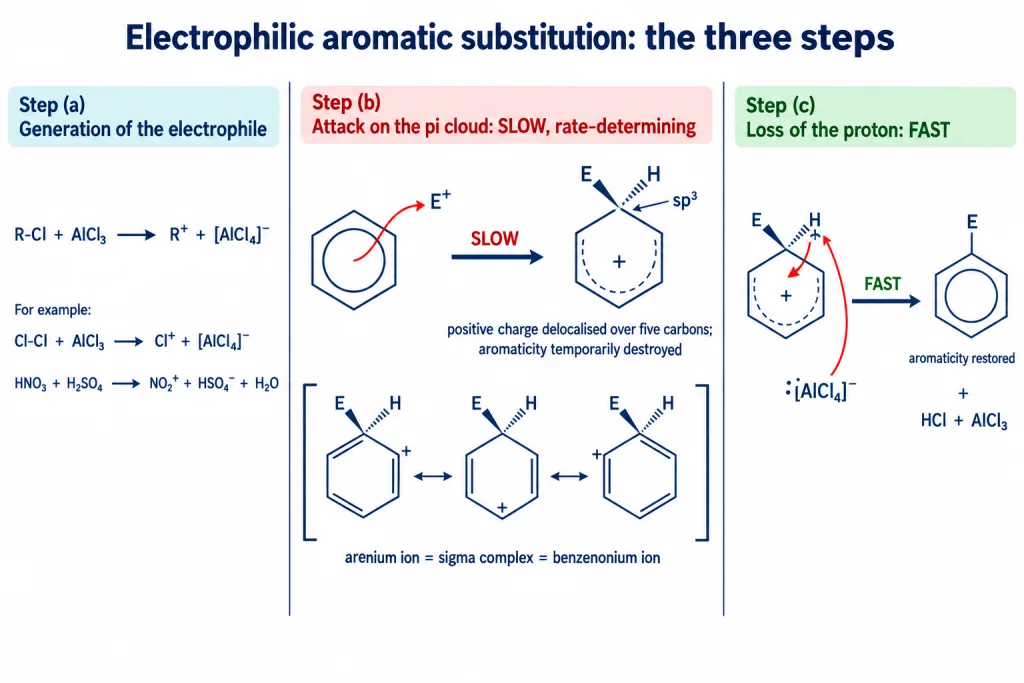
Nitration, sulphonation, halogenation, alkylation and acylation look like five different reactions and are one reaction in five hats. All are electrophilic substitution, written , and all run through the same three steps; only the electrophile changes.
Step (a): generation of the electrophile
Benzene is electron rich but not aggressive. It will not attack a weak electrophile, so every one of these reactions begins by manufacturing a strong one from the reagent and the catalyst.
Sulphonation is the odd one out: oleum already contains , electrophilic at sulphur without any help.
In each line the Lewis acid supplies the vacant orbital and the reagent supplies the electron pair; the electrons end up on the leaving group and the positive charge on the fragment that goes to the ring. Charge balances in every one.
Step (b): attack on the pi cloud, giving the arenium ion
The ring holds six pi electrons in two doughnuts above and below its plane, and they are the most available electrons in the molecule. Two of them leave the delocalised system and form a new sigma bond from one ring carbon to the electrophile. The curved arrow for that movement starts in the pi cloud and points at ; the picture carries it, because it cannot be drawn in a line of text.
What is left is the arenium ion, also called the sigma complex or the benzenonium ion. Four facts define it, and an examiner will ask for all four.
- One carbon is now . The attacked carbon has four sigma bonds: two to its ring neighbours, one to the incoming group , and one to the hydrogen already there. Those last two stick out above and below the ring plane, and the carbon is tetrahedral.
- Aromaticity is temporarily destroyed. The carbon has no unhybridised p orbital left, so the ring of overlapping p orbitals is broken and the delocalisation runs into that carbon and stops. The arenium ion is not aromatic, not antiaromatic, and not a stable molecule.
- The positive charge is delocalised over the remaining five carbons. Four pi electrons are shared by five p orbitals, and the shortfall of one electron is spread out. Three contributing structures can be drawn: the charge sits on either of the two carbons next to the carbon, or on the carbon directly opposite it across the ring. The real ion is the hybrid of the three, with the charge never on the two carbons in between.
- This step is slow, and it is the rate-determining step. Reaching the arenium ion means giving up the aromatic stabilisation of benzene, about . The pentadienyl cation that replaces it has stabilisation of its own, but nothing like as much, so the barrier is large and the overall rate of substitution is the rate at which molecules get over it.
Key Point: Formation of the arenium ion is the slow, rate-determining step of every electrophilic aromatic substitution, because it costs the resonance energy of the ring. Anything that helps the ring carry a positive charge lowers that barrier and speeds the reaction — which is the whole basis of the next section on directing groups.
Step (c), and why arenes substitute instead of adding
Step (c): loss of the proton
A base comes for the hydrogen on the carbon — in halogenation, alkylation and acylation, in nitration. Two arrows move at once: one runs from a lone pair on the base to that hydrogen, and one runs from the carbon-hydrogen bonding pair into the ring. The base leaves with the proton, and the pair of electrons left behind drops into the p orbital that the carbon recovers as it flattens back to .
Six electrons are once again delocalised over six equivalent p orbitals. Aromaticity is restored, the resonance energy is repaid in full, and the step runs strongly downhill. It is fast, and never rate-determining under ordinary conditions.
Add the three steps of alkylation together and the catalyst cancels out:
The aluminium chloride that was consumed in step (a) is handed back in step (c), which is why it is a catalyst and not a reagent.
The reason the ring substitutes
The arenium ion is a carbocation, and the obvious thing for a carbocation to do is capture a nucleophile. If a chloride ion added to the positively charged carbon instead of a proton leaving, the product would be a dichlorocyclohexadiene: two carbons in the ring, four pi electrons in a broken system, no aromatic sextet anywhere. That is the addition product, and the molecule would have paid the full of resonance energy and got nothing back.
Losing a proton costs almost nothing and returns the whole . Both routes start from the same intermediate; one ends far below the other.
Key Point: Benzene substitutes rather than adds because the two paths diverge at the arenium ion. Loss of a proton restores the aromatic sextet; capture of a nucleophile would destroy it permanently. Substitution keeps the delocalisation, addition throws it away.
The same reasoning covers the conditions under which benzene does add. Hydrogenation over nickel at 473-573 K and chlorination in ultraviolet light to give benzene hexachloride both force addition, either with enough energy or by a radical route that never makes an arenium ion. Under ordinary ionic conditions, substitution wins.
[Board] "Why does benzene undergo electrophilic substitution rather than electrophilic addition?" is a two-mark question with a one-line answer: substitution regenerates the aromatic sextet and its resonance energy, addition destroys it.
Reading the energy profile
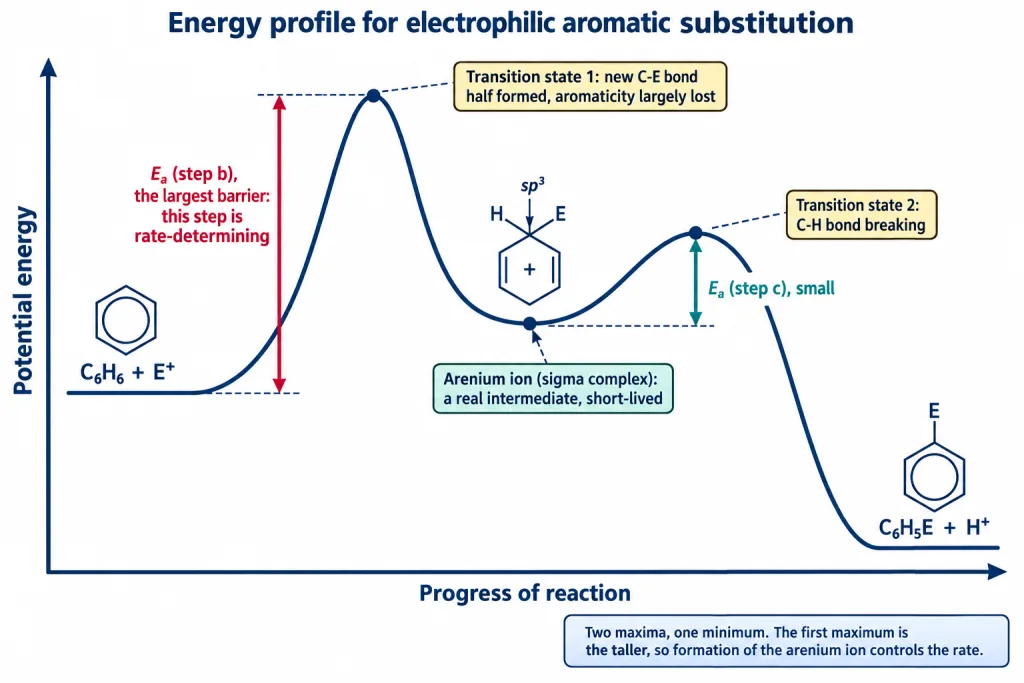
Plot potential energy up the page and progress of reaction across it. The shape of the curve is the argument.
Start. Benzene and the electrophile sit together on the left at the reactant level.
A large first hill. The curve climbs steeply to the first maximum. At the top the new carbon-electrophile bond is only partly made, the attacked carbon is halfway between and , and the aromatic delocalisation is already largely gone. This is the most expensive point of the reaction: the ring has surrendered its resonance energy and has not yet been paid anything back.
A shallow well. Just past that maximum the curve dips into a small hollow, and that hollow is the arenium ion. A genuine minimum means a real intermediate with a real, if short, lifetime — not a transition state. But the well is shallow and sits high above the reactants, so the ion never accumulates.
A small second hill. Climbing out of the well takes little energy, because all the intermediate has to do is let a proton go. The second maximum is much lower than the first.
Finish. The curve then falls well below the starting level to the substituted arene, which is aromatic again and thermodynamically comfortable.
Two maxima and one minimum. Two transition states, one intermediate, and the first maximum is the higher of the two, which is the pictorial statement that step (b) is rate-determining. If the second hill were the taller one, the isotope effect described below would be large; it is not.
One further reading carries into the next section. The first transition state is close to the arenium ion in energy and in structure, so whatever stabilises the arenium ion lowers that barrier too. An electron-donating group on the ring supports the positive charge better, which means a lower first hill and a faster reaction; an electron-withdrawing group does the opposite. Activation, deactivation and direction all fall out of the height of this single hill.
The evidence that the mechanism is right
A mechanism is a proposal, and two pieces of laboratory evidence support this one. Both are worth a line in an answer.
The kinetic isotope effect. Replace every hydrogen of benzene by deuterium and nitrate alongside . A carbon-deuterium bond is harder to break, so if the carbon-hydrogen bond were breaking in the slow step the deuterated compound would react several times more slowly. The two react at essentially the same rate, which places the breaking of that bond in a later step — exactly where step (c) sits.
The honest qualification: this is not universal. Sulphonation, and reactions with bulky electrophiles, do show a measurable isotope effect, because the arenium ion there reverts to starting material fast enough that proton loss begins to matter for the overall rate. The three steps survive; what changes is which of them is slowest.
Isolation of arenium salts. Intermediates can in principle be caught. Treating a methyl-substituted benzene with a strong acid and a Lewis acid at low temperature gives a deeply coloured salt that can be kept and examined below room temperature, and its spectrum shows a carbon bearing two hydrogens where the ring used to have one — the signature of an ring carbon. Warm the salt and it loses a proton and returns to the arene. A species that can be bottled is a real minimum on the energy curve.
Neither experiment proves the mechanism the way a theorem is proved. Together they rule out the obvious alternatives: a one-step concerted substitution cannot account for a bottled intermediate, and a rate-determining proton loss cannot account for the missing isotope effect.
Worked items
Question 1: Benzene with 2-chloropropane
Give the product of benzene with 2-chloropropane and anhydrous , with the balanced equation.
Answer:
The catalyst pulls the chloride off. 2-Chloropropane is a secondary halide, so the cation it gives is already secondary; there is no better cation for it to become, so it attacks the ring as it is.
Nine carbons, thirteen hydrogens and one chlorine on each side.
Ans: Isopropylbenzene (cumene), .
Question 2: Benzene with 1-chloropropane
Why does benzene treated with 1-chloropropane give isopropylbenzene rather than n-propylbenzene?
Answer:
The electrophile has to be made first, and a primary halide gives the primary propyl cation — the least stable kind there is. It does not live long enough to reach the ring unchanged.
A hydrogen on the middle carbon moves across to the positive carbon with its bonding pair. The charge is left on the middle carbon, which now carries two methyl groups, so the cation is secondary.
The ring then meets the isopropyl cation.
Ans: The primary propyl cation rearranges by a 1,2-hydride shift to the secondary isopropyl cation before it attacks, so the product is cumene.
Watch out: The rearrangement happens in the electrophile, before the ring is involved. The ring rearranges nothing.
Question 3: A straight three-carbon chain on the ring
Propose a reliable preparation of n-propylbenzene from benzene.
Answer:
Alkylation is ruled out by the previous item, so I go through the ketone.
The acylium ion has a complete octet, so all three carbons arrive in a row, and the reduction turns into without touching the skeleton.
Ans: Acylate with propanoyl chloride and anhydrous , then reduce the ketone (Clemmensen, or Wolff-Kishner).
Question 4: Labelling the three steps
Say which mechanistic step each equation is, and name the intermediate.
Answer:
The one that makes the attacking species out of reagent and catalyst is step (a) — that is (ii), where sulphuric acid protonates nitric acid and the water expelled is itself protonated by the excess acid. The one in which ring and electrophile join is step (b) — that is (iii), and its product is the arenium ion, or sigma complex. The one in which a base removes a proton and the aromatic ring reappears is step (c) — that is (i).
Ans: (ii) is step (a), (iii) is step (b) giving the arenium ion, (i) is step (c). The true order is (ii), (iii), (i).
Watch out: Step (b) is the slow one, so the rate law follows its equation, not the first one listed.
Question 5: Chlorobenzene as an alkylating agent
Chlorobenzene and are heated with benzene. Predict the outcome and explain it.
Answer:
Alkylation would need the catalyst to strip chloride from chlorobenzene and leave a phenyl cation. The chlorine sits on an carbon and donates a lone pair into the ring, so that bond has partial double-bond character and is short and strong. Worse, the phenyl cation would have its empty orbital in the plane of the ring, pointing outwards, where the pi electrons cannot reach it.
Ans: No reaction. Aryl halides do not undergo Friedel-Crafts alkylation, because the aryl cation is far too unstable to be generated.
Question 6: Nitrobenzene refuses
Nitrobenzene is treated with methyl chloride and anhydrous . What happens, and why is nitrobenzene used as a solvent for Friedel-Crafts reactions?
Answer:
Nothing happens. The nitro group withdraws electron density by induction and by resonance, so the ring is badly electron-poor, and the rate-determining step is an attack by that drained pi cloud. The same unreactivity makes nitrobenzene a useful solvent: it dissolves aluminium chloride and the organic reagents and sits out the reaction instead of competing for the electrophile.
Ans: No reaction. A strongly deactivated ring undergoes neither alkylation nor acylation, which is exactly why nitrobenzene serves as an inert solvent for them.
Question 7: Methyl chloride in excess
Benzene is treated with an excess of methyl chloride and anhydrous . What is obtained, and how would you get a good yield of toluene instead?
Answer:
Toluene forms first, but a methyl group is activating and ortho, para directing, so toluene is attacked faster than benzene. The xylenes follow, then the trimethylbenzenes. To favour toluene I reverse the ratio: a large excess of benzene with a limited amount of methyl chloride, so an electrophile is far more likely to collide with benzene. The unreacted benzene is recovered by distillation.
Ans: A mixture of toluene, xylenes and trimethylbenzenes. A large excess of benzene keeps the product mainly toluene.
Question 8: The rate-determining step
Which step of electrophilic aromatic substitution is rate-determining, and why?
Answer:
Step (b), the attack of the electrophile on the pi cloud to form the arenium ion.
Forming that ion breaks up the delocalised sextet: one ring carbon becomes and loses its p orbital, cutting the ring of overlapping orbitals. The stabilisation given up is the resonance energy of benzene, about , and the cation that replaces it is delocalised over only five carbons, so it recovers far less.
Ans: Step (b), formation of the arenium ion, because it costs the resonance energy of the aromatic ring.
Question 9: What the isotope experiment shows
and are nitrated under identical conditions and react at almost the same rate. What does this show?
Answer:
A carbon-deuterium bond needs more energy to break than a carbon-hydrogen bond, so if that bond were breaking in the slow step, would be several times slower. It is not.
The carbon-hydrogen bond therefore breaks in step (c), after the rate-determining step.
Ans: Carbon-hydrogen bond breaking happens after the rate-determining step, which supports arenium ion formation as the slow step.
Watch out: A missing isotope effect says which step is slow. The isolation of arenium salts, not this experiment, is the evidence that the intermediate is real.
Question 10: Why the acylium ion stays put
Draw the two contributing structures of the acylium ion from acetyl chloride and explain why it never rearranges.
Answer:
In the first, carbon has three bonds, six electrons and the charge. In the second, an oxygen lone pair has come in to make a triple bond: carbon now has four bonds and a full octet, oxygen has three bonds and one lone pair, and the charge sits on oxygen. The second is the major contributor.
A cation rearranges when a shift gives something more stable. Here the positive centre already has an octet and is already spread over two atoms.
Ans: The acylium ion is resonance stabilised with a complete octet on carbon in its major contributor, so it has no driving force to rearrange.
Question 11: Isobutylbenzene, two routes
Which route gives from benzene: alkylation with 1-chloro-2-methylpropane, or acylation followed by reduction?
Answer:
Alkylation first. The catalyst takes the chloride from to give a primary cation. A hydrogen shifts from the neighbouring carbon, which carries two methyl groups, and the charge lands there, giving . The product is tert-butylbenzene, which is not what was asked for.
Acylation instead. 2-Methylpropanoyl chloride gives , which does not rearrange.
Ans: Acylation with 2-methylpropanoyl chloride, then reduction. Direct alkylation rearranges to tert-butylbenzene.
Question 12: The arenium ion described
State the hybridisation of the attacked carbon in the arenium ion, say how many carbons share the positive charge, and say whether the ion is aromatic.
Answer:
The attacked carbon has four sigma bonds — two into the ring, one to the incoming group, one to the hydrogen it already had — so it is and tetrahedral, with the group and the hydrogen above and below the ring plane.
That carbon has no unhybridised p orbital left, so the cyclic overlap is broken. The remaining four pi electrons are shared over the other five carbons, which between them carry the charge; the three contributing structures place it on the two carbons next to the carbon and on the one directly across the ring. Aromaticity requires every ring atom to carry a p orbital in the cyclic system, and one carbon breaks that condition.
Ans: The attacked carbon is ; the charge is delocalised over the remaining five carbons; the ion is not aromatic.
Question 13: Reading the profile
The energy profile of an electrophilic aromatic substitution has two maxima and one minimum. Identify each, and say which maximum is taller.
Answer:
The first maximum is the transition state for forming the arenium ion: the new bond is half made and the delocalisation is already mostly lost. The minimum between them is the arenium ion, a shallow well high above the reactants, which is why the ion is genuine but short-lived. The second maximum is the transition state for losing the proton, and it is low, because restoring the sextet repays the resonance energy.
Ans: The first maximum is arenium ion formation and is the taller; the minimum is the arenium ion; the lower second maximum is proton loss.
Question 14: Substitution rather than addition
The arenium ion is a carbocation. Why does it lose a proton rather than capture a chloride ion?
Answer:
Both paths start from the same ion. Capturing chloride would put a second carbon into the ring, giving a dichlorocyclohexadiene with no aromatic sextet, so the whole spent in step (b) would be lost for good. Losing the proton returns its electron pair to the ring, that carbon flattens back to , and the six-electron delocalisation is rebuilt.
Ans: Loss of a proton restores aromaticity and recovers the resonance energy; nucleophile capture would destroy the aromatic system permanently, so substitution is much the lower-energy path.