
The alkyne family and its first member
An alkyne is an unsaturated hydrocarbon carrying at least one carbon-carbon triple bond. That one feature fixes the formula, the shape, the naming and the chemistry.
Key Point (Definition): Alkynes have the general formula and contain at least one carbon-carbon triple bond. The series begins at with ethyne, , written .
Count hydrogens across the three families at four carbons: butane , butene , butyne . Each new pi bond uses one bonding position on each of two carbons, so each step removes two hydrogen atoms. One triple bond is therefore two degrees of unsaturation, and an alkyne takes up two moles of dihydrogen on full hydrogenation where an alkene takes one.
Ethyne is better known by its common name acetylene. Burnt with oxygen it gives the oxyacetylene flame used for welding and cutting metal, and it is the industrial starting point for acetaldehyde, acetic acid and vinyl chloride — which is why the carbide route below is run on a factory scale.
A warning before any counting
is the alkyne formula, but not the alkyne formula alone. Two degrees of unsaturation can also be spent on two double bonds (a diene), on one double bond plus a ring (a cycloalkene), or on two rings. So fits but-1-yne, and equally fits buta-1,3-diene and cyclobutene. Read whether a question wants isomeric alkynes or all isomers of the molecular formula before writing a number.
The series, with both sets of names
In the common system an alkyne is named as a derivative of acetylene.
| Formula | Structure | Common name | IUPAC name | |
|---|---|---|---|---|
| 2 | Acetylene | Ethyne | ||
| 3 | Methylacetylene | Propyne | ||
| 4 | Ethylacetylene | But-1-yne | ||
| 4 | Dimethylacetylene | But-2-yne |
Acetylene, methylacetylene and dimethylacetylene are common names only. Recognise them on a reagent bottle; write the IUPAC name in an answer.
One piece of vocabulary runs through the rest of the alkyne chapters. An alkyne with a hydrogen sitting directly on a triply bonded carbon is a terminal alkyne; one with the triple bond buried inside the chain is internal. But-1-yne is terminal, but-2-yne is internal, and the acidity story in the next section turns on that difference.
Structure of the triple bond — one sigma and two pi bonds
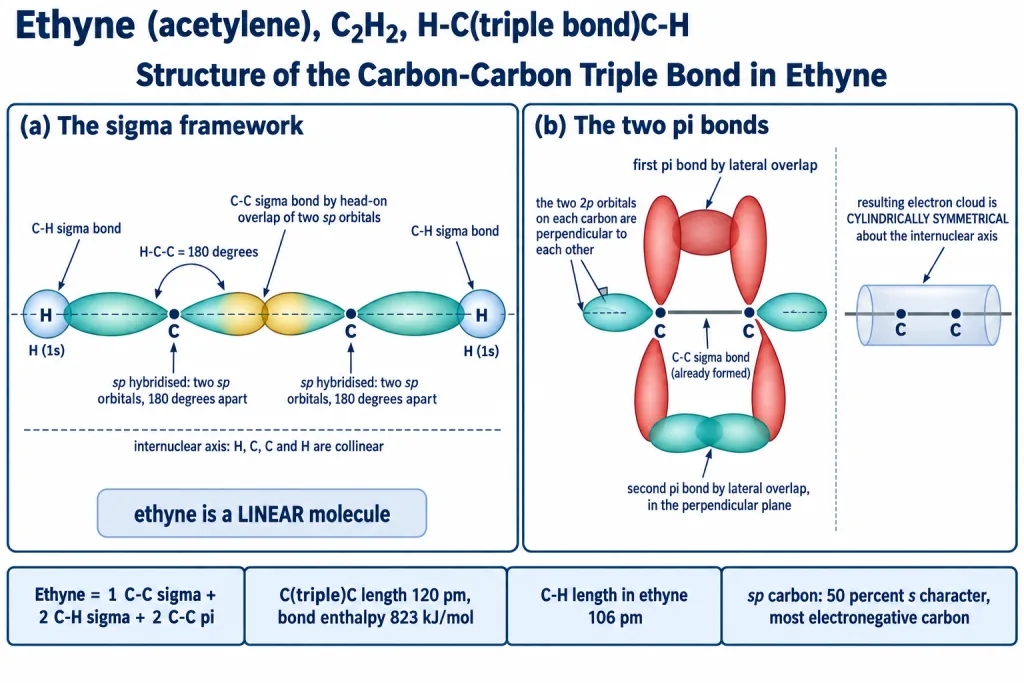
Ethyne carries the same arrangement that every alkyne has at its triply bonded carbons.
The carbons are sp hybridised
Each triply bonded carbon mixes one 2s orbital with one 2p orbital to give two sp hybrid orbitals, leaving two 2p orbitals untouched.
The two sp hybrids point in exactly opposite directions, apart on one straight line — two orbitals on a single centre repel each other as far as they can, and that means collinear. The two unhybridised 2p orbitals on each carbon are perpendicular to each other and both perpendicular to that line.
The sigma framework makes the molecule linear
One sp orbital of each carbon overlaps head-on with an sp orbital of the other, giving the C-C sigma bond. The remaining sp orbital on each carbon overlaps along the internuclear axis with a hydrogen 1s orbital, giving the two C-H sigma bonds. Since both sp orbitals on a carbon lie on the same line, hydrogen, carbon and carbon are collinear.
Key Point: In ethyne the H-C-C bond angle is and all four atoms lie on one straight line, so ethyne is a linear molecule.
Two pi bonds, in perpendicular planes
The 2p orbitals of one carbon are parallel to the corresponding 2p orbitals of the other, so they overlap sideways. The first parallel pair gives one pi bond; the second pair, in the plane at right angles to the first, gives a second pi bond.
Ethyne therefore contains one C-C sigma bond, two C-H sigma bonds and two C-C pi bonds — three sigma and two pi, holding four atoms in a straight line.
The shape of the pi cloud
The two pi clouds are not two flat slabs side by side. Each has a lobe above and below its own plane, and the planes are at right angles, so four lobes spaced at around the axis smear into a continuous sheath around the line joining the carbons.
Key Point: The electron cloud between the two carbon atoms is cylindrically symmetrical about the internuclear axis.
An alkene is different. A C=C has one pi bond, so its cloud sits in one identifiable plane, and twisting one end by destroys the overlap. That is why rotation about a C=C is restricted and cis-trans isomerism exists. A triple bond has no such plane to preserve.
The sp carbon is a different kind of carbon
An sp hybrid is built from one s and one p orbital, so it has 50% s character, against 33.3% for sp and 25% for sp. An s orbital hugs the nucleus, so more s character means electrons held closer in. Two examined consequences follow: bonds to an sp carbon are short, and an sp carbon is the most electronegative kind of carbon, in the order — which is the whole reason a terminal alkyne is acidic.
Bond length, bond enthalpy, and a paradox worth resolving
| Bond | Hybridisation | Bond length | Bond enthalpy | Geometry at carbon |
|---|---|---|---|---|
| sp | 154 pm | 348 kJ/mol | tetrahedral, | |
| sp | 134 pm | 681 kJ/mol | trigonal planar, about | |
| sp | 120 pm | 823 kJ/mol | linear, |
The C-H bonds shorten along the same series for the same reason: 109 pm in ethane, 108 pm in ethene, 106 pm in ethyne. A C-H bond enthalpy of 414 kJ/mol is the figure to quote where one is needed.
Two effects shorten the carbon-carbon bond as pi bonds are added. Extra sideways overlap pulls the nuclei together, and rising s character holds the sigma pair closer in. Both push the same way, so 154 pm falls to 134 pm and then to 120 pm.
The enthalpies do not add the way students expect
823 is nowhere near three times 348. Work the differences:
- single to double: kJ/mol for the first pi bond
- double to triple: kJ/mol for the second pi bond
The second pi bond is worth less than half the first. Sideways overlap is poor to begin with, and once the first pi bond is built the two carbons are already crowded with electron density, so the second lateral overlap buys much less.
The paradox, and its resolution
The triple bond is the strongest carbon-carbon bond in the chapter, yet alkynes readily add bromine, hydrogen halides and water. A strong bond ought to be unreactive.
The resolution: an electrophile never attacks the sigma framework. The 823 kJ/mol is the cost of pulling the two carbons completely apart, and no reaction here does that. What an electrophile attacks is the pi electron density — loosely held, sitting outside the internuclear axis where it is exposed, and easy to donate. Breaking one pi bond while the sigma bond and the other pi bond survive costs only about 142 kJ/mol, and the addition pays that back by forming two new sigma bonds.
Key Point: The strength of a triple bond is the strength of its sigma skeleton plus two pi bonds together. Reactivity towards electrophiles comes from the loosely held pi electrons alone, which is why the strongest C-C bond still sits in a reactive, unsaturated molecule.
One refinement: an alkyne adds an electrophile slightly more slowly than the corresponding alkene, because the pi electrons of a shorter bond built on sp carbons are held closer to the nuclei. It still adds — and, having two pi bonds, it adds twice.
Naming an alkyne
These are the alkene rules with one suffix changed.
Rule 1 — the parent chain is the longest continuous chain that contains the triple bond. A longer chain that misses the triple bond is not eligible.
Rule 2 — the suffix is -yne. Drop the -ane of the corresponding alkane and put -yne there. Two triple bonds give -diyne, keeping the letter "a": buta-1,3-diyne.
Rule 3 — number from the end nearer the triple bond, so it gets the lowest locant. Quote the lower of the two triply bonded carbon numbers.
Rule 4 — the locant goes immediately before the suffix: but-2-yne, pent-1-yne, hex-3-yne, never 2-butyne.
Rule 5 — substituents are numbered from the same end the triple bond fixed, and are listed alphabetically. The triple bond decides the numbering; a substituent never overrules it.
Rule 6 — a double bond with a triple bond gives the ending -en-yne. Number for the lowest set of locants for the two together; if that still leaves a choice, the double bond takes the lower number.
Structures to names
— four carbons. From the right the triple bond is at 1, from the left at 3, so: but-1-yne.
— the triple bond gets locant 2 from either end: but-2-yne.
— the longest chain through the triple bond is five carbons. From the right the triple bond starts at C2, from the left at C3, so number from the right; the branch then falls on C4: 4-methylpent-2-yne.
— the longest chain containing the triple bond runs through only four carbons, and the quaternary carbon carries two methyl branches: 3,3-dimethylbut-1-yne. Reading it as a pentyne is the standard slip.
— locant set from either end, so the tie-break gives the double bond the lower number: but-1-en-3-yne, commonly vinylacetylene.
Names to structures
Hex-3-yne is . 3-Methylpent-1-yne is . 4-Methylpent-1-yne is — same chain, same triple bond, methyl moved one carbon along.
The name that cannot exist
"2-Methylbut-2-yne" appears in every set of trap questions. But-2-yne is , and C2 is one of the triply bonded carbons: three bonds to its partner and one to the C1 methyl, all four spent. Another methyl there needs a carbon with five bonds.
Key Point: A triply bonded carbon has only one bonding position left, so it can carry one hydrogen or one group and nothing more. No substituent locant may ever fall on a triply bonded carbon.
[Board] Marks go regularly for the IUPAC name of a branched alkyne, and they are lost by numbering from the wrong end. Fix the triple bond's locant first, then number the substituents from the end that decision forced on you.
Isomerism in the alkynes
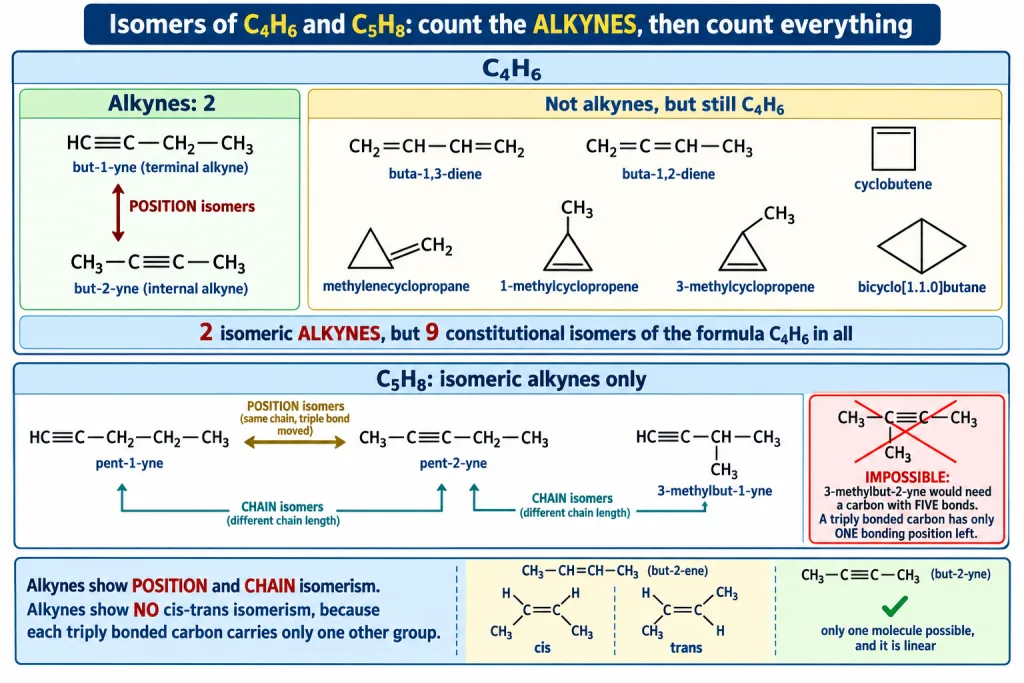
Alkynes show position isomerism and chain isomerism, and — the examined negative — no cis-trans isomerism at all.
Position isomerism starts at four carbons
Ethyne and propyne have nowhere to move the triple bond. Four carbons give a real choice: , but-1-yne, and , but-2-yne. Same formula, same chain, triple bond moved — position isomers.
Chain isomerism starts at five carbons
| Structure | IUPAC name |
|---|---|
| Pent-1-yne | |
| Pent-2-yne | |
| 3-Methylbut-1-yne |
Pent-1-yne and pent-2-yne share a chain, so they are position isomers. 3-Methylbut-1-yne has a shorter chain with a branch, so pairing it with either of the others gives a chain isomer pair.
Key Point: Isomeric alkynes of : three — pent-1-yne, pent-2-yne and 3-methylbut-1-yne.
There is no "3-methylbut-2-yne", because in both C2 and C3 have all four bonds spent. A branch there needs a five-bonded carbon.
Six carbons: seven alkynes
| Structure | IUPAC name |
|---|---|
| Hex-1-yne | |
| Hex-2-yne | |
| Hex-3-yne | |
| 3-Methylpent-1-yne | |
| 4-Methylpent-1-yne | |
| 4-Methylpent-2-yne | |
| 3,3-Dimethylbut-1-yne |
The three hexynes are position isomers of one another; every other pair differs in chain length and is a chain isomer pair. Build such a list systematically — triple bond in each allowed place on the six-carbon chain, then shorten to five and place one methyl anywhere that is not a triply bonded carbon, then shorten to four for two methyls.
What really contains
"How many isomers has ?" has two correct answers, depending on what is counted.
Alkynes only: two — but-1-yne and but-2-yne.
Every isomer of the molecular formula: nine. The two degrees of unsaturation can also be spent on two double bonds, or on a ring plus a double bond, or on two rings:
- dienes — buta-1,3-diene, , and buta-1,2-diene,
- one ring plus a double bond — cyclobutene, methylenecyclopropane (the hangs outside the ring), 1-methylcyclopropene and 3-methylcyclopropene
- two rings, no double bond — bicyclo[1.1.0]butane
Key Point: has two isomeric alkynes and nine constitutional isomers altogether. State which you are counting before you write a number.
behaves the same way: three alkynes, but the formula also covers pentadienes, cyclopentene and several ring compounds, so the full count is much larger.
No cis-trans isomerism, and the reason
Cis-trans isomerism needs two different groups on each of the doubly bonded carbons, so that "like groups on the same side" and "like groups on opposite sides" are genuinely different molecules. But-2-ene has that: each doubly bonded carbon carries a methyl and a hydrogen.
Key Point: A triply bonded carbon has only one other atom or group attached. With one substituent per carbon there is no pair of groups to arrange, so alkynes show no cis-trans isomerism. The linear geometry reinforces it: with a bond angle of at each triply bonded carbon, the four atoms round the triple bond are collinear, and a straight line has no sides.
Valency is the primary reason and geometry the second. There is nothing for restricted rotation to preserve either: the pi cloud is cylindrically symmetrical about the internuclear axis and both remaining groups lie on that axis, so turning one end of a triple bond produces nothing new.
[NEET] "Which shows cis-trans isomerism: but-2-ene, but-2-yne, but-1-ene, propene" has one answer. But-2-yne fails on valency; but-1-ene and propene fail because their terminal carries two identical hydrogen atoms.
Preparation 1 — from calcium carbide, the industrial route
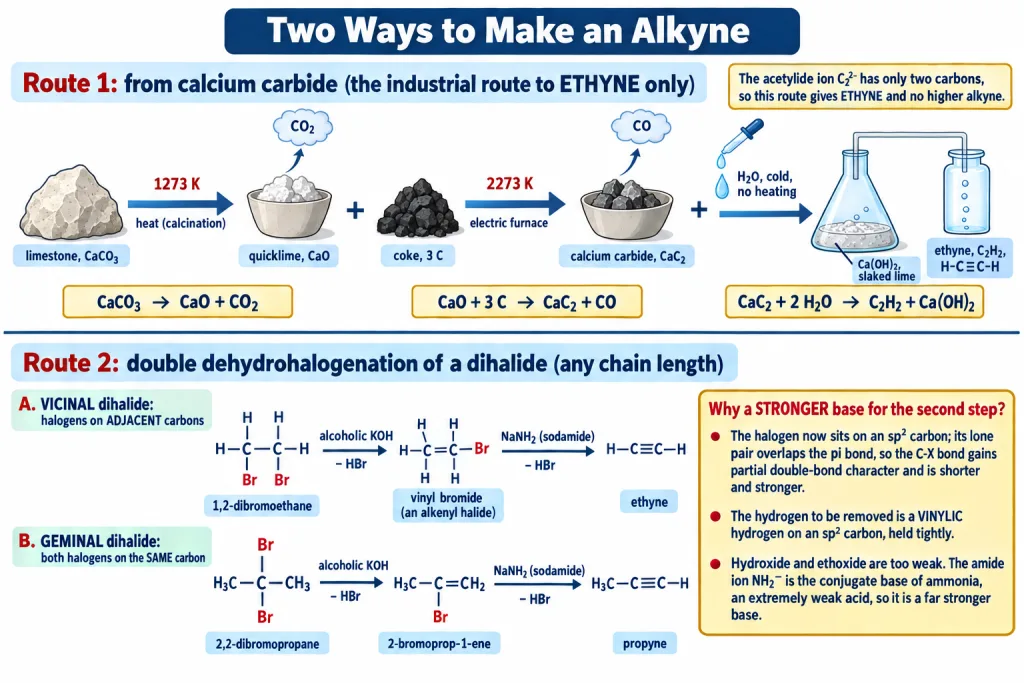
Ethyne on any scale comes from calcium carbide and water. The carbide has to be made first, through three reactions and two furnace temperatures.
Limestone to quicklime, at 1273 K:
Atom check: Ca 1 and 1; C 1 and 1; O 3 and . Balanced.
Quicklime with coke, at 2273 K, in an electric furnace:
Atom check: Ca 1 and 1; O 1 and 1; C 3 and . Balanced — and the coefficient 3 on carbon is what makes it balance, so it must not be dropped.
Carbide with water, cold, with no heating at all:
Atom check: Ca 1 and 1; C 2 and 2; H 4 and ; O 2 and 2. Balanced.
Key Point: The carbide route in full — , then , then .
Calcium carbide is an ionic carbide: with the acetylide ion , the doubly deprotonated form of ethyne. Water is a far stronger acid than ethyne, so it hands over two protons without any encouragement, fast and exothermically — which is how carbide lamps worked, by dripping water onto lumps of carbide.
That also fixes the limit of the method. The acetylide ion has only two carbons, so the carbide route gives ethyne and nothing else. Propyne and the higher alkynes have to be made another way.
Commercial ethyne from carbide smells faintly of garlic. Pure ethyne is odourless; the smell is phosphine, arsine and hydrogen sulphide, formed when water reaches the phosphide, arsenide and sulphide impurities in industrial carbide.
Preparation 2 — double dehydrohalogenation of a dihalide
Building a triple bond from a dihalide means removing two molecules of hydrogen halide from the same pair of carbons. The two removals are not equally easy, and that is the content of this preparation.
- A vicinal dihalide has its two halogens on adjacent carbons. Adding to an alkene gives one directly.
- A geminal dihalide has both halogens on the same carbon. An aldehyde or ketone with gives one, as does adding two moles of to an alkyne.
Either way the sequence is the same two steps.
From a vicinal dihalide
Step 1 — alcoholic KOH removes the first HX, leaving an alkenyl (vinyl) halide:
Atoms balance: C 2, H 5, Br 2, K 1, O 1 on each side.
Step 2 — sodamide removes the second HX. Alcoholic KOH will not do it:
Atoms balance: C 2, H 5, Br 1, Na 1, N 1 on each side.
The same pair of reagents on 1,2-dibromobutane, made from but-1-ene and bromine, gives but-1-yne.
Why the second step needs a much stronger base
Two independent arguments, both worth having ready.
The C-X bond in a vinyl halide is unusually strong. The halogen now sits on an sp carbon that is part of a double bond, and one of its lone pairs overlaps with the pi system. The C-X bond gains partial double-bond character: shorter, stronger and much harder to break than an ordinary C-X bond. The same effect makes chlorobenzene resist nucleophilic substitution.
The hydrogen to be removed is a vinylic hydrogen on an sp carbon, where higher s character holds the C-H electrons tightly, so it is harder to pull off as a proton than an ordinary alkyl hydrogen on an sp carbon.
Hydroxide, and the ethoxide it forms in alcohol, are not strong enough for either job. The amide ion is: ammonia is an extraordinarily weak acid, so its conjugate base is an extraordinarily strong base.
Key Point: A vicinal or geminal dihalide loses its first HX to alcoholic KOH, giving a vinyl halide; the second HX needs sodamide, , because the vinyl halide has a C-X bond with partial double-bond character and a tightly held vinylic hydrogen.
If the product is a terminal alkyne, sodamide also takes its acidic hydrogen to give the sodium salt, so an excess of sodamide is used and the mixture is finally treated with water to return the free alkyne. An internal alkyne has no such hydrogen and needs no extra base.
From a geminal dihalide
The same two steps with both halogens starting on one carbon. 2,2-Dibromopropane gives propyne:
Atoms balance: C 3, H 7, Br 2, K 1, O 1 on each side.
Atoms balance: C 3, H 7, Br 1, Na 1, N 1 on each side.
Both halogens left the same carbon, so that carbon and one neighbour become the triply bonded pair — here C2 with C1 or C3, which are the same molecule by symmetry.
Reversing the route is the commoner exam question. Find the two triply bonded carbons; put one halogen on each for a vicinal starting material, or both on one of them for a geminal one; then fill in hydrogens until every carbon has four bonds. Hex-3-yne comes from 3,4-dibromohexane, itself just hex-3-ene plus bromine, or from 3,3-dibromohexane.
The whole section on one page
| Item | Value |
|---|---|
| General formula | , |
| Degrees of unsaturation per triple bond | 2 |
| Hybridisation at a triply bonded carbon | sp, 50% s character |
| H-C-C bond angle | , molecule linear |
| Bonds in ethyne | 1 C-C sigma, 2 C-H sigma, 2 C-C pi |
| Shape of the pi cloud | cylindrically symmetrical about the internuclear axis |
| 120 pm, 823 kJ/mol | |
| 134 pm, 681 kJ/mol | |
| 154 pm, 348 kJ/mol | |
| C-H in ethyne | 106 pm |
Isomeric alkynes: two, three, seven. Position and chain isomerism only — no cis-trans, because a triply bonded carbon carries one other group.
| Route | Reagents and conditions | Product |
|---|---|---|
| Limestone to quicklime | heat at 1273 K | |
| Quicklime with coke | 2273 K, 3 moles of C | |
| Carbide with water | cold water, no heating | |
| Dihalide, first HX | alcoholic KOH | vinyl halide |
| Vinyl halide, second HX | alkyne |
The carbide route makes ethyne only; the dihalide route makes an alkyne of any chain length.
Worked items
Question 1: Formula from a relative molecular mass
A hydrocarbon of the alkyne family has relative molecular mass 54. Find its molecular formula and write the isomeric alkynes with names.
Answer:
An alkyne is , so its mass is .
Setting gives , so the formula is .
Four carbons cannot be branched and still hold a triple bond, so the triple bond just moves along the chain.
Ans: ; but-1-yne, , and but-2-yne, , which are position isomers. Watch out: Had the question asked for all isomers of rather than the isomeric alkynes, the answer would be nine, since the dienes and the rings fit the formula too.
Question 2: Naming a branched alkyne
Give the IUPAC name of .
Answer:
The longest chain containing the triple bond runs from the right-hand methyl through the triple bond and on to the left: five carbons, so pentyne.
Numbering from the right puts the triple bond at C2; from the left it starts at C3. Lower wins, so I number from the right, and the branch methyl then falls on C4.
Ans: 4-Methylpent-2-yne. Watch out: Numbering from the left to give the methyl a lower locant is wrong. The triple bond fixes the direction; the substituent takes whatever number it gets.
Question 3: Isomeric alkynes of
Write all the alkynes of formula , name them, and say what kind of isomerism each pair shows.
Answer:
I take the continuous five-carbon chain first and move the triple bond along it: , pent-1-yne, and , pent-2-yne. A triple bond starting at C3 is pent-2-yne read from the other end, so there is no third pentyne.
Then I shorten the chain to four carbons and add a methyl. It cannot go on a triply bonded carbon, so with the triple bond at C1-C2 the only free position is C3: , 3-methylbut-1-yne.
Ans: Three — pent-1-yne, pent-2-yne and 3-methylbut-1-yne. Pent-1-yne with pent-2-yne is a position isomer pair; both pairs involving 3-methylbut-1-yne are chain isomer pairs.
Question 4: Why alkynes have no cis-trans isomers
But-2-ene exists as two geometrical isomers but but-2-yne does not. Explain.
Answer:
In but-2-ene, , each doubly bonded carbon carries two different things, a methyl and a hydrogen. Rotation about the double bond is restricted, so the methyls are locked either on the same side or on opposite sides — two different compounds.
In but-2-yne each triply bonded carbon spends three bonds on its partner. One bond is left, and it goes to a methyl. With one group per carbon there is nothing to arrange.
The bond angle at each triply bonded carbon is as well, so the four atoms round the triple bond are collinear, and a straight line has no two sides.
Ans: No cis-trans isomerism, because each triply bonded carbon carries only one other group, and the linear geometry leaves no sides to arrange it on. Watch out: Valency is the primary reason and geometry the second. Answering only "because it is linear" leaves out that three of the four bonds are already used.
Question 5: Bond data, and the paradox
Arrange the carbon-carbon bonds in ethane, ethene and ethyne in order of increasing bond length, quote the enthalpies, and explain why the strongest of the three sits in the most easily attacked molecule.
Answer:
Ethyne has sp carbons, ethene sp, ethane sp. More s character holds the bonding pair closer to the nucleus, and each extra pi bond pulls the carbons together. Increasing length: ethyne 120 pm, ethene 134 pm, ethane 154 pm. Enthalpies run the other way: 823, 681 and 348 kJ/mol.
For the paradox: 823 kJ/mol is the cost of separating the two carbons completely, which no electrophile does. An electrophile attacks the pi density, loosely held outside the internuclear axis. Removing the outer pi bond alone costs about kJ/mol, which the two new sigma bonds repay.
Ans: Length 120 pm 134 pm 154 pm; enthalpy 823 681 348 kJ/mol. The triple bond is reactive because the loosely held pi electrons are attacked, not the sigma bond.
Question 6: The three carbide equations
Write the equations, with conditions, for manufacturing ethyne from limestone, and check that each balances.
Answer:
Ca 1 and 1, C 1 and 1, O 3 and .
Ca 1 and 1, O 1 and 1, C 3 and .
Ca 1 and 1, C 2 and 2, H 4 and , O 2 and 2.
Ans: The three equations above, with limestone decomposed at 1273 K and quicklime heated with coke at 2273 K. Watch out: The coefficient 3 on carbon is the one people drop. Without it the equation has 1 carbon on the left and 3 on the right.
Question 7: A carbide calculation
What volume of ethyne at STP comes from 128 g of pure calcium carbide, and what mass of calcium hydroxide forms with it? Take Ca = 40, C = 12, H = 1, O = 16.
Answer:
From the mole ratio of carbide to ethyne to hydroxide is 1 : 1 : 1.
Molar mass of g/mol, so 128 g is 2 mol.
That gives 2 mol of ethyne, and at STP one mole occupies 22.4 L, so L.
Molar mass of g/mol, and 2 mol weigh 148 g.
Ans: 44.8 L of ethyne at STP, together with 148 g of calcium hydroxide.
Question 8: Vicinal dihalide to alkyne
Convert 1,2-dibromopropane into propyne, giving both steps with reagents and balancing each equation.
Answer:
1,2-Dibromopropane is , and the two eliminations come from C1 and C2.
Atoms balance: C 3, H 7, Br 2, K 1, O 1 on each side.
Atoms balance: C 3, H 7, Br 1, Na 1, N 1 on each side.
Ans: . Watch out: Propyne is terminal, so sodamide also deprotonates the product. An excess is used and water is added at the end to recover the free alkyne.
Question 9: Why sodamide and not alcoholic KOH
Alcoholic KOH removes the first molecule of hydrogen halide from a vicinal dihalide but not the second. Give two reasons why the second elimination needs sodamide.
Answer:
After the first elimination the substrate is a vinyl halide, and two things about it resist a second.
The halogen sits on an sp carbon of a double bond, so one of its lone pairs overlaps the pi system, giving the C-X bond partial double-bond character: shorter, stronger, harder to break.
The hydrogen that must leave is vinylic, on an sp carbon, whose higher s character holds the C-H electrons tightly.
Hydroxide and ethoxide are too weak for either job. The amide ion is the conjugate base of ammonia, an extremely weak acid, so it is a far stronger base.
Ans: The vinyl halide has a strengthened C-X bond with partial double-bond character and a tightly held vinylic hydrogen, so it needs rather than alcoholic KOH.
Question 10: Geminal dihalide, and where the triple bond lands
Predict the product when 1,1-dichloropropane is treated first with alcoholic KOH and then with sodamide, and explain where the triple bond forms.
Answer:
1,1-Dichloropropane is , with both chlorines on C1.
Alcoholic KOH removes one HCl, and the hydrogen has to come from C2, the only neighbour:
Atoms balance: C 3, H 7, Cl 2, K 1, O 1 on each side.
Both eliminations used C1 and C2, so the triple bond forms there, at the end of the chain.
Ans: Propyne, , with the triple bond between C1 and C2. Watch out: With a geminal dihalide the triple bond always forms between the carbon that held both halogens and one neighbour. It does not migrate into the middle of the chain.
Question 11: Working the route backwards
Name one vicinal and one geminal dihalide that would give hex-3-yne, and say how the vicinal one is itself made.
Answer:
Hex-3-yne is , with the triple bond between C3 and C4.
For a vicinal starting material I put one bromine on C3 and one on C4 and fill in hydrogens until every carbon has four bonds: , 3,4-dibromohexane.
For a geminal one both bromines go on a single carbon: , 3,3-dibromohexane.
The vicinal dihalide comes straight from hex-3-ene and bromine, the addition in which the red-brown colour is discharged.
Ans: 3,4-Dibromohexane (vicinal) or 3,3-dibromohexane (geminal); the vicinal one from hex-3-ene plus . Watch out: The vicinal dihalide is the safer answer. A geminal dihalide can eliminate towards either neighbour, so 3,3-dibromohexane could in principle lose its two HBr towards C2 instead and give hex-2-yne.