
Ethene and hydrogen bromide raise no question at all. The two carbons of the double bond are identical, so it makes no difference which one takes the hydrogen and which one takes the bromine.
But-2-ene behaves the same way. Each carbon of its double bond carries one hydrogen and one methyl group, so the two conceivable products turn out to be the same molecule written two ways.
Propene breaks the symmetry
Propene is . Its second carbon carries one hydrogen; its first carries two. Bromine can land on either, and the two answers are different compounds.
Both equations balance. Three carbons, seven hydrogens and one bromine appear on each side of each, and each consumes one molecule of alkene and one of acid. On paper there is nothing whatever to choose between them.
In the flask there is. Pass dry hydrogen bromide into propene in the dark, with no peroxide anywhere near it, and what comes out is 2-bromopropane, with 1-bromopropane present only in traces. The reaction picks a side, and picks it hard. The whole of this section is about what does the picking.
The two words that set the problem up
Key Point (Definition): An alkene is unsymmetrical when the two carbons of its double bond do not carry the same groups, as in propene and 2-methylpropene. A reagent is unsymmetrical when the two fragments it splits into are different, as in , , and . A question of orientation arises only when both are unsymmetrical.
That last sentence is worth holding on to, because it kills a large family of examination traps in one move. Hydrogen and the halogens are symmetrical reagents, so and never raise the question. Ethene, but-2-ene, cyclohexene and 2,3-dimethylbut-2-ene are symmetrical alkenes, so they never raise it either, no matter what is added to them.
What is being asked for
Chemists call the position taken by each incoming fragment the orientation of the addition, and a reaction that delivers one of two possible orientations almost exclusively is called regioselective. Addition of hydrogen halides to unsymmetrical alkenes is strongly regioselective, and it was regioselective long before anyone could explain why. The explanation and the rule arrived in the opposite order from the one a textbook suggests: the pattern was spotted first, in 1869, and the reason for it took another sixty years.
Vladimir Markovnikov, a Russian chemist, studied a long list of these additions and in 1869 wrote down the generalisation that carries his name.
Key Point (Definition): Markovnikov's rule. When an unsymmetrical reagent adds to an unsymmetrical alkene, the negative part of the reagent attaches itself to the carbon atom carrying the fewer hydrogen atoms.
Applied to propene and hydrogen bromide, the rule runs in three moves.
- Find the two carbons of the double bond and count the hydrogens on each. In the terminal carbon has two, the middle carbon has one.
- Decide which fragment of the reagent is the negative one. In bromine is the more electronegative atom, so carries the and hydrogen the .
- Put the negative fragment on the carbon with fewer hydrogens and the hydrogen on the other.
Bromine goes to the middle carbon, hydrogen to the terminal one, and the product is 2-bromopropane. That is exactly what the flask delivers.
2-methylpropene, , makes the count even easier. The substituted carbon carries no hydrogen at all and the terminal carbon carries two, so bromine goes to the substituted carbon.
Count the atoms: four carbons, nine hydrogens and one bromine on the right; plus on the left gives the same.
The old mnemonic
Generations of students have remembered the rule as "the rich get richer" — the carbon already richer in hydrogen is the one that gains the extra hydrogen. It is a fair memory hook, and this section will not use it again. It is a way of recalling the sentence, not a reason for the sentence, and a student who has only the mnemonic has nothing to say when the examiner asks why, and nothing to fall back on when the rule as stated turns out to be the wrong tool.
One caution on the wording
The rule speaks of the negative part of the reagent, not of the halogen. Usually these coincide, but not always. In iodine monochloride, , chlorine is the more electronegative of the two, so chlorine is the negative part and iodine the positive one; chlorine therefore goes to the carbon with fewer hydrogens. A student who has memorised "halogen goes to the carbon with fewer hydrogens" gets that one backwards. Identify the fragment first, every time.
[Board] In a board answer, state the rule in the examiner's own words first, apply it to the specific alkene with the hydrogen count written out, and only then give the mechanism. Marks are usually split between the statement and the reason, and the statement is the easier half to secure.
Markovnikov's rule describes what happens. It does not explain it, and an answer that stops at the rule stops halfway. The explanation comes from the mechanism of electrophilic addition, which is the same two-step mechanism used in the previous section.
Hydrogen bromide is a polar molecule, . The alkene offers a loose, exposed pair of pi electrons. The electron-poor end of the reagent, the proton, is therefore what attacks, and it attacks first. Everything else follows from that one fact.
Step 1 (slow). The proton is captured by the pi bond. Two of the four electrons that held the double bond together are used to make a new carbon-hydrogen sigma bond, and the carbon at the other end of the old double bond is left with only three bonds, six electrons and a positive charge. It is a carbocation.
Step 2 (fast). The bromide ion, a nucleophile, attacks the positive carbon and the addition is complete.
Propene, worked through both branches
The proton has a choice in step 1, and the two choices lead to different intermediates.
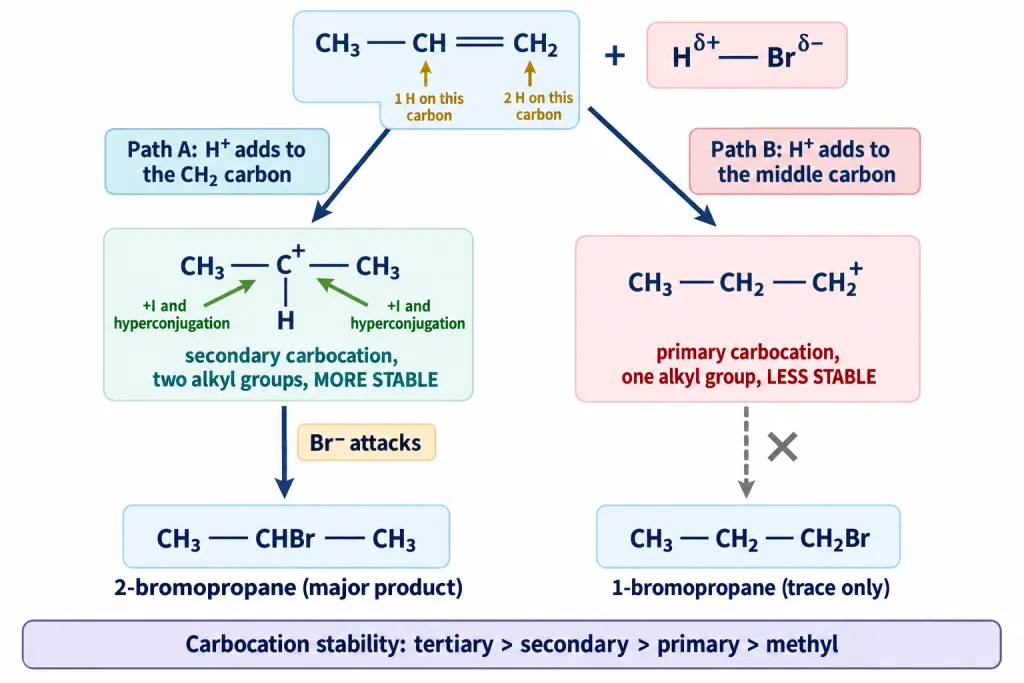
Branch A — proton to the terminal carbon. The end becomes and the charge is left on the middle carbon.
The positive carbon has two methyl groups attached to it. This is a secondary carbocation, the propan-2-yl (isopropyl) cation.
Branch B — proton to the middle carbon. The charge is left on the terminal carbon.
Here the positive carbon has just one alkyl group on it. This is a primary carbocation, the propan-1-yl cation.
Chapter 8 gave the stability order, and it decides the contest outright:
An alkyl group releases electron density into the empty orbital by its effect and by hyperconjugation, so the more alkyl groups sit on the charged carbon, the more the positive charge is spread out and the lower the energy of the ion. The secondary cation of branch A is the lower-energy species, it is reached through the lower-energy transition state, and so it is formed faster. Branch A wins, and it wins by a wide margin because carbocation energies differ by a great deal.
Bromide then attacks the positive carbon, which is the middle carbon:
Overall, , and the bromine has ended up on the carbon that had fewer hydrogens — precisely what the rule predicted, arrived at without using the rule.
2-methylpropene, where the contest is not close
Proton to the terminal leaves a tertiary cation with three methyl groups spreading the charge; proton to the substituted carbon leaves a primary cation with one. Tertiary against primary is the widest gap in the whole order, so 2-methylpropene adds hydrogen bromide with almost complete selectivity to give 2-bromo-2-methylpropane. The same reasoning explains why tertiary centres dominate the products of every acid-catalysed addition in this chapter.
The sentence that matters
Key Point: Markovnikov's rule is a consequence of carbocation stability, not an independent law. The proton adds wherever it must in order to leave behind the more stable carbocation. Counting hydrogens is only a quick way of spotting where that is, because the carbon with fewer hydrogens is usually the one carrying more alkyl groups.
Two situations show that the counting is the servant and the carbocation is the master.
Where both carbons of the double bond carry the same number of hydrogens, the count gives no answer at all. Pent-2-ene, , has one hydrogen on each; both possible cations are secondary and close in energy, so hydrogen bromide gives a mixture of 2-bromopentane and 3-bromopentane rather than one major product.
Where the first-formed cation can rearrange into a more stable one, the product is not the one the hydrogen count predicts: 3-methylbut-1-ene with hydrogen chloride gives mainly 2-chloro-2-methylbutane, because the secondary cation formed first shifts a hydride from the neighbouring carbon and becomes tertiary before chloride ever reaches it.
[JEE Main] Whenever a question gives an alkene whose Markovnikov product would be a secondary halide while a tertiary centre sits one carbon away, check for a hydride or methyl shift before answering. That single check separates the students who have learnt the rule from the students who have understood it.
Markovnikov's rule governs every reagent that adds across a double bond as a proton plus an anion. The list is short and it is worth writing out in full, because examiners rotate through it.
The three hydrogen halides
All three add, and the rate order given in the previous section is . All three follow Markovnikov orientation.
Each balances as three carbons, seven hydrogens and one halogen. The halide changes; the orientation does not, because the first step is the same proton attacking the same pi bond and leaving the same secondary cation.
Cold concentrated sulphuric acid
Sulphuric acid adds as . The hydrogen sulphate group is the negative part, so it takes the carbon with fewer hydrogens.
The product is propan-2-yl hydrogen sulphate, an alkyl hydrogen sulphate. Boiling it with water hydrolyses the sulphate ester and hands the acid back:
Check the second equation: on the left, plus gives 3 C, 10 H, 1 S, 5 O; on the right, propan-2-ol () plus gives the same. The two steps together convert propene into propan-2-ol and are known as the indirect hydration of an alkene.
Water with acid
Water adds directly in the presence of dilute sulphuric acid, again with Markovnikov orientation, so propene gives the secondary alcohol and not the primary one.
The reason is unchanged. The catalyst supplies a proton, the proton adds to the terminal carbon to give the secondary cation, water attacks that cation, and the extra proton is lost at the end to regenerate the catalyst. Section 10 takes hydration further, including the loss of the proton at the end and the position of the equilibrium.
Propan-1-ol cannot be reached from propene by any acid-catalysed route, because an acid-catalysed route has to pass through a carbocation and the cation that would deliver propan-1-ol is the primary one.
Where the rule does not apply
- Symmetrical reagents. over nickel, palladium or platinum, and in , split into two identical halves. There is no negative part to place.
- Symmetrical alkenes. Ethene, but-2-ene, cyclohexene and 2,3-dimethylbut-2-ene give one product whichever way round the reagent adds.
- A tie in the hydrogen count. Pent-2-ene gives a mixture, as described above. Hex-3-ene does not belong here: it is symmetrical, so protonation at either end of its double bond gives the same secondary cation and the single product 3-bromohexane.
[NEET] Alkynes obey Markovnikov's rule too, and by the same carbocation argument; propyne with one equivalent of hydrogen bromide gives 2-bromopropene, and with a second equivalent gives the geminal dihalide 2,2-dibromopropane. That reappears in the alkyne section, but the reasoning is already complete here.
In 1933, at the University of Chicago, M. S. Kharasch and F. R. Mayo found that the same reaction between propene and hydrogen bromide gave a different product depending on how clean the glassware was. Traces of peroxide — deliberately added benzoyl peroxide, or the peroxide that forms slowly when an ether or an alkene stands open to air — turned the addition completely round.
The product is 1-bromopropane: the bromine has gone to the carbon carrying more hydrogens, the opposite of what Markovnikov's rule predicts. The reaction is called the peroxide effect, the Kharasch effect, or simply anti-Markovnikov addition. The overall equation is still ; only the orientation has changed.
The peroxide has not altered the rule. It has replaced the mechanism. Without it the reaction is ionic and led by a proton; with it the reaction is a free-radical chain led by a bromine atom, and a chain reaction has the same three phases as the chlorination of methane in section 4.
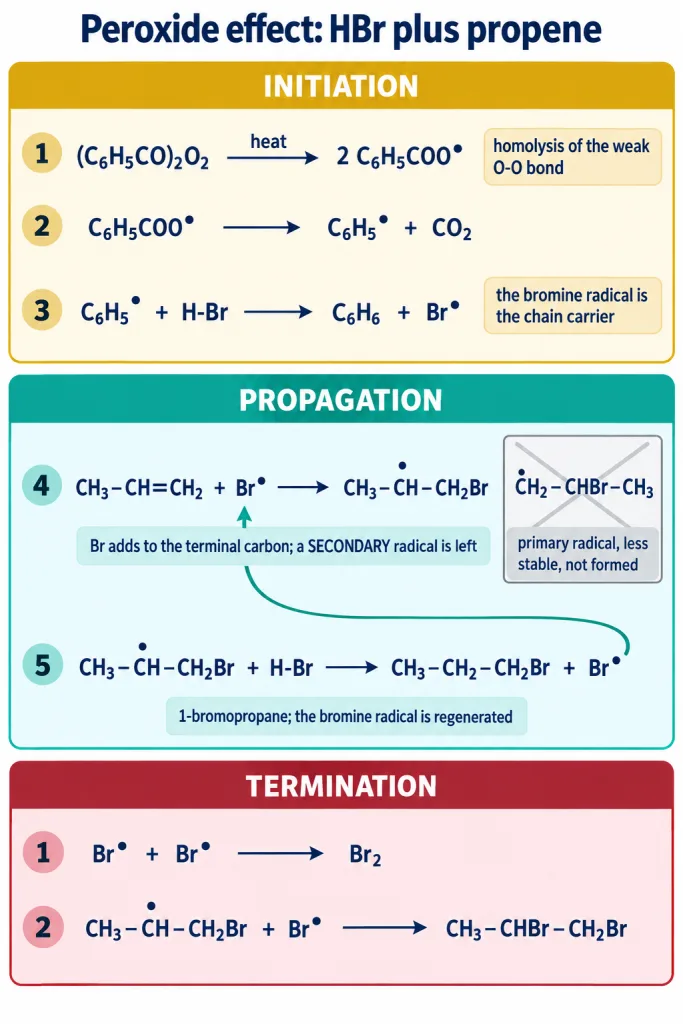
Initiation
Step 1. The oxygen-oxygen bond of benzoyl peroxide is weak, and gentle warming or light snaps it homolytically. Each oxygen takes one electron of the shared pair, and two benzoyloxy radicals result.
Step 2. The benzoyloxy radical throws off carbon dioxide and becomes a phenyl radical.
Step 3. The phenyl radical abstracts the hydrogen atom of hydrogen bromide, taking one electron of the pair with it and leaving the other on bromine. Benzene and a bromine radical are produced.
The bromine radical is the chain carrier. Everything up to this point exists only to make it.
Propagation
Step 4. The bromine radical adds to the double bond. One electron of the pi pair pairs up with the odd electron on bromine to form the new carbon-bromine bond; the other stays behind on the far carbon as an odd electron. The bromine atom has a choice of carbon, exactly as the proton did, and again the choice is settled by the stability of what is left behind.
Free radicals rank in the same order as carbocations, tertiary > secondary > primary > methyl, and for the same reason: the odd electron sits in an orbital on an electron-deficient carbon, and neighbouring alkyl groups spread it by hyperconjugation and . The secondary radical is the more stable, so bromine attaches to the terminal carbon.
Step 5. The secondary radical pulls a hydrogen atom off another molecule of hydrogen bromide. The product is completed and a fresh bromine radical is handed back, which is what makes this a chain: one initiation event can drive thousands of additions.
Steps 4 and 5 added together give , with the bromine radical cancelling from both sides.
Termination
Any two radicals that meet pair their odd electrons and leave the chain.
Two carbon radicals can also combine to a dimer. All three consume chain carriers without making any, which is what termination means.
Why the answer flips
Key Point: Both mechanisms obey one principle — the intermediate that forms is the more stable one. In the ionic route the proton adds first, so the positive charge is left on the more substituted carbon and bromine finishes there, giving the Markovnikov product. In the radical route the bromine atom adds first, so the odd electron is left on the more substituted carbon and bromine is stranded on the terminal carbon, giving the anti-Markovnikov product. Same principle, opposite product, because a different particle leads.
Written that way there is nothing to memorise separately. Ask which species attacks first, place it so that the intermediate left behind is the more stable one, and the orientation falls out on its own.
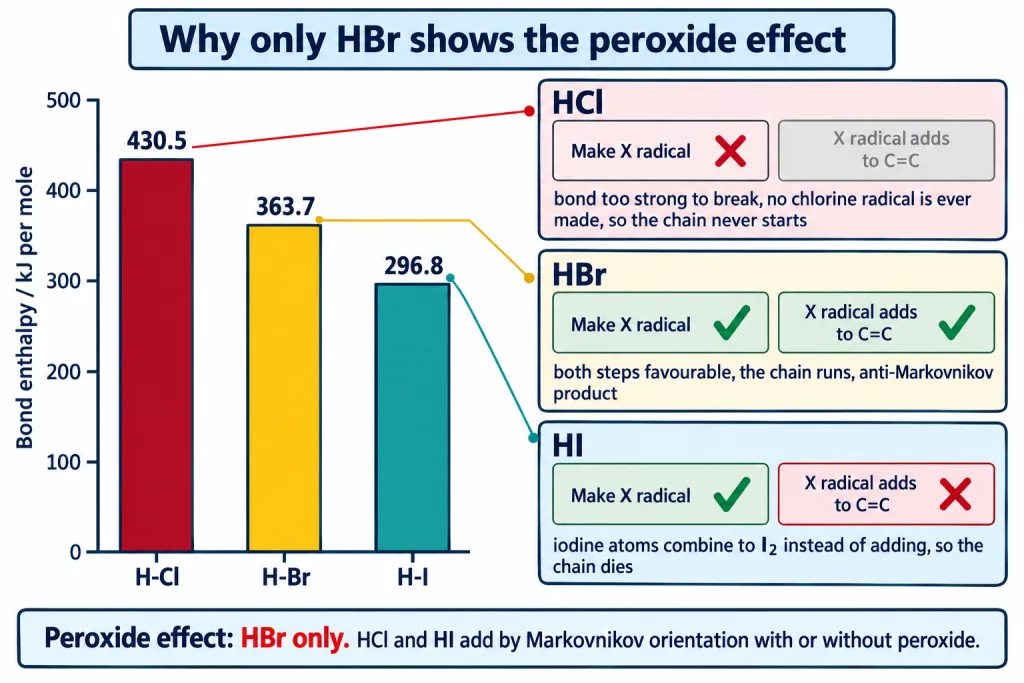
The peroxide effect is confined to hydrogen bromide. It is not seen with hydrogen chloride, and it is not seen with hydrogen iodide. That is a standard question, and it has a real answer built out of the two propagation steps.
Hydrogen chloride fails at the hydrogen-abstraction step
Bond enthalpies decide it. The bond is worth about kJ per mole, against kJ per mole for and kJ per mole for . The benzoyloxy or phenyl radical produced in initiation simply cannot pull a hydrogen atom off hydrogen chloride: the bond is too strong to be broken by a radical of that energy. No chlorine radical is ever generated, so step 4 has nothing to start it and the chain never begins. The ionic route is left as the only route available, and hydrogen chloride adds by Markovnikov orientation whether peroxide is present or not.
Hydrogen iodide fails at the addition step
Hydrogen iodide has the opposite problem. Its bond is the weakest of the three, so iodine radicals are produced without difficulty. But an iodine atom adds to a carbon-carbon double bond only very reluctantly; that step is endothermic and reverses as fast as it runs forward, so the carbon radical needed for step 5 never accumulates. The iodine radicals instead find one another and combine into molecular iodine. The chain cannot propagate, and hydrogen iodide too adds by Markovnikov orientation with or without peroxide.
Bromine sits in the window
Hydrogen bromide is the only one of the three for which both propagation steps are favourable: the bond is weak enough for a radical to break, and the bromine atom adds to the double bond exothermically. Fail either test and the chain dies, and only bromine passes both.
The two reactions side by side
| Feature | Alkene + HBr, no peroxide | Alkene + HBr with benzoyl peroxide |
|---|---|---|
| Mechanism | electrophilic (ionic) addition | free-radical chain addition |
| Attacks first | from the polarised | from homolysis of the peroxide |
| Intermediate | a carbocation | a carbon free radical |
| Which intermediate forms | the more stable one | the more stable one |
| Where the intermediate sits | on the more substituted carbon | on the more substituted carbon |
| Where bromine ends up | on the carbon with fewer hydrogens | on the carbon with more hydrogens |
| Orientation | Markovnikov | anti-Markovnikov |
| Product from propene | 2-bromopropane | 1-bromopropane |
| Product from 2-methylpropene | 2-bromo-2-methylpropane | 1-bromo-2-methylpropane |
| Which reagents behave this way | HBr, HCl, HI, , with acid | HBr and no other |
| Effect on a symmetrical alkene | one product | the same one product |
Three conditions, all of them needed
For a peroxide to change the answer, every one of these must hold at once.
- The reagent must be hydrogen bromide. HCl and HI are untouched by peroxide.
- A peroxide or another radical source must be present.
- The alkene must be unsymmetrical. There has to be a choice for the mechanism to make differently.
Miss any one and the peroxide changes nothing. Ethene, but-2-ene and cyclohexene deliver bromoethane, 2-bromobutane and bromocyclohexane respectively, with peroxide or without, because both routes lead to the same molecule.
[NEET] The commonest single mistake on this topic is answering "1-bromobutane" for but-2-ene with HBr and peroxide. Check the alkene for symmetry before applying the peroxide effect; a symmetrical alkene makes the whole question decoration.
Question 1: Propene and hydrogen bromide in the dark
Dry hydrogen bromide is passed into propene with no peroxide present. Predict the major product and justify it from the mechanism rather than from the rule.
Answer:
Hydrogen bromide is polarised , so the proton is the electrophile and it attacks the pi bond first. I try it both ways.
Proton to the terminal leaves the charge in the middle:
Proton to the middle carbon leaves the charge at the end:
Secondary beats primary in the order tertiary > secondary > primary > methyl, because two alkyl groups spread the positive charge better than one. The secondary cation forms faster, so bromide attacks that one.
Ans: 2-bromopropane. Watch out: Bromide never attacks the alkene. Sending a negative ion at an electron-rich pi bond is the wrong way round, and writing that step is an automatic loss of the mechanism marks.
Question 2: 2-methylpropene and hydrogen bromide
Give the major product of with HBr in the absence of peroxide and name the intermediate.
Answer:
The substituted carbon carries no hydrogen and the terminal carbon carries two, so I put the proton on the terminal carbon. That leaves a carbon with three methyl groups on it.
The alternative, proton on the substituted carbon, gives , a primary cation. Tertiary against primary is the widest gap in the stability order, so the selectivity here is almost total. Bromide then attacks the tertiary carbon.
Ans: 2-bromo-2-methylpropane, through the tertiary butyl carbocation .
Question 3: The chain for propene, HBr and benzoyl peroxide
Write the initiation, propagation and termination steps for the reaction of propene with HBr in the presence of benzoyl peroxide, and give the product.
Answer:
Initiation, three steps, all of them just to make a bromine radical.
Propagation. The bromine radical adds so as to leave the more stable radical behind, which means it takes the terminal carbon and leaves a secondary radical.
Termination, any two radicals pairing off.
Ans: 1-bromopropane, by a free-radical chain. Watch out: The bromine radical adds to the alkene; the hydrogen radical does not exist in this scheme. Starting the propagation with a hydrogen atom adding to the double bond is the commonest way of getting the orientation backwards.
Question 4: Hex-1-ene, with and without peroxide
Write the IUPAC names of the products of adding HBr to hex-1-ene (i) without peroxide and (ii) with peroxide.
Answer:
Hex-1-ene is ; C1 carries two hydrogens and C2 carries one.
Without peroxide the proton goes to C1 and leaves a secondary cation at C2, so bromine finishes at C2.
With peroxide the bromine radical goes to C1 and leaves a secondary radical at C2, so bromine finishes at C1.
Both products are , from plus .
Ans: (i) 2-bromohexane; (ii) 1-bromohexane.
Question 5: But-2-ene with and without peroxide
Predict the product of but-2-ene with HBr (i) in the absence and (ii) in the presence of benzoyl peroxide.
Answer:
But-2-ene is . Each carbon of the double bond carries one hydrogen and one methyl, so the alkene is symmetrical. Whichever carbon the proton lands on, the cation is the butan-2-yl cation; whichever carbon the bromine radical lands on, the radical is the butan-2-yl radical. Both routes lead to bromine on a carbon that is second from an end.
Ans: 2-bromobutane in both cases; the peroxide makes no difference. Watch out: "Peroxide present, so anti-Markovnikov, so 1-bromobutane" is the trap. Anti-Markovnikov only means anything when the two ends of the double bond differ, and here they do not.
Question 6: Cyclohexene with and without peroxide
What does cyclohexene give with HBr, with and without peroxide?
Answer:
Both carbons of the double bond in cyclohexene carry one hydrogen and one ring carbon, so it is a symmetrical alkene. Hydrogen goes on one of them and bromine on the other, and since the ring is otherwise unsubstituted the same molecule results either way.
Ans: Bromocyclohexane in both cases.
Question 7: Why only hydrogen bromide
Explain why the peroxide effect is observed with HBr but not with HCl or HI.
Answer:
The chain needs two propagation steps to work: a halogen radical has to be made by abstracting hydrogen from H-X, and that halogen radical then has to add to the double bond.
Hydrogen chloride fails the first. The bond is worth about kJ per mole, too strong for the benzoyloxy or phenyl radical to break, so no chlorine radical is produced and there is nothing to start the chain.
Hydrogen iodide fails the second. Its bond, about kJ per mole, breaks easily and iodine radicals form freely, but an iodine atom adds to a double bond only reluctantly; the addition is endothermic and reverses, so the iodine radicals combine into instead and the chain never propagates.
Hydrogen bromide, at about kJ per mole, is weak enough to be broken and gives a bromine atom that adds to the double bond exothermically. Both steps run, so only HBr sustains the chain.
Ans: HCl gives no halogen radical; HI gives one that will not add. Only bromine passes both tests.
Question 8: 2-methylbut-2-ene and hydrogen chloride
Give the major product of with HCl and name the carbocation.
Answer:
The two carbons of the double bond are C2, which carries two methyl groups and no hydrogen, and C3, which carries one hydrogen and one methyl. The proton adds to C3, the carbon with the hydrogen, leaving the charge on C2 with three alkyl groups round it.
That is a tertiary cation. Chloride attacks it.
Ans: 2-chloro-2-methylbutane, through the tertiary 2-methylbutan-2-yl cation.
Question 9: Propene, cold concentrated sulphuric acid, then boiling water
Write both steps and name both products.
Answer:
Sulphuric acid adds as , and is the negative part, so it takes the middle carbon.
Boiling with water hydrolyses the ester and returns the acid.
Ans: Propan-2-yl hydrogen sulphate first, then propan-2-ol. Watch out: The alcohol produced is the secondary one. Writing propan-1-ol here means the sulphate group was put on the wrong carbon in the first step.
Question 10: Why propan-1-ol cannot be made this way
Propene is treated with water and dilute sulphuric acid. Why is propan-2-ol formed rather than propan-1-ol?
Answer:
The acid supplies a proton and the proton attacks the pi bond first. Propan-1-ol would require the proton to add to the middle carbon, which would leave a primary cation, . The alternative leaves the secondary cation , which is lower in energy and forms far faster. Water attacks that one, and losing a proton afterwards gives the secondary alcohol.
Ans: Propan-2-ol, because the route must pass through the more stable secondary carbocation. Watch out: There is no peroxide effect for water. Peroxides turn round the addition of HBr and nothing else.
Question 11: 3-methylbut-1-ene and hydrogen chloride
Predict the major product and explain why the hydrogen count alone gets it wrong.
Answer:
3-methylbut-1-ene is . Counting hydrogens, chlorine should go to C2 and give 2-chloro-3-methylbutane. The proton does add to C1 and does leave a secondary cation on C2, but that cation sits next to a tertiary carbon.
A hydride shifts from C3 to C2, and the charge moves to the tertiary carbon:
Chloride then attacks the tertiary centre.
Ans: 2-chloro-2-methylbutane, formed after a 1,2-hydride shift. Watch out: This is the standard demonstration that Markovnikov's rule is a consequence of carbocation stability. When the two disagree, carbocation stability wins.
Question 12: Pent-2-ene and hydrogen bromide
What happens when pent-2-ene is treated with HBr in the absence of peroxide?
Answer:
Pent-2-ene is . Both carbons of the double bond carry exactly one hydrogen, so counting hydrogens gives no prediction at all. Turning to the mechanism, proton to C2 leaves a secondary cation at C3, and proton to C3 leaves a secondary cation at C2. Two secondary cations of very similar energy form at comparable rates.
Ans: A mixture of 2-bromopentane and 3-bromopentane, with no single major product. Watch out: The alkene is unsymmetrical, so a hasty reading says the rule applies. What the rule needs is a difference in hydrogen count, and here there is none.
Question 13: Propene, hydrogen iodide and benzoyl peroxide
Propene is treated with HI in the presence of benzoyl peroxide. What is the major product?
Answer:
Peroxide affects hydrogen bromide alone. With HI the iodine radicals that form simply recombine to iodine rather than adding to the double bond, so no chain runs and the ordinary ionic mechanism is the only one operating. The proton adds to the terminal carbon, the secondary cation forms, and iodide attacks it.
Ans: 2-iodopropane, the Markovnikov product. Watch out: The presence of a peroxide in the question is not by itself a signal to reverse the orientation. Check the halide first.
Question 14: Working backwards from the product
1-bromo-2-methylpropane is to be made from an alkene in one step. Name the alkene and the conditions.
Answer:
1-bromo-2-methylpropane is . Removing HBr across the terminal two carbons gives , 2-methylpropene. Bromine is sitting on the carbon with more hydrogens, so this is the anti-Markovnikov product and a peroxide is needed.
Checking it forwards: the bromine radical adds to the terminal , leaving the tertiary radical , which then takes a hydrogen from HBr to give .
Ans: 2-methylpropene with HBr in the presence of benzoyl peroxide. Watch out: The same alkene with HBr and no peroxide gives 2-bromo-2-methylpropane instead, a tertiary halide and a completely different compound.