
Four ways to put a double bond into a molecule
A double bond appears when two atoms or groups sitting on adjacent carbons are pulled off and the electrons left behind pair up sideways into a pi bond. That one idea covers three of the four preparations here. The fourth works the other way round: it starts from a triple bond and adds hydrogen, but stops halfway.
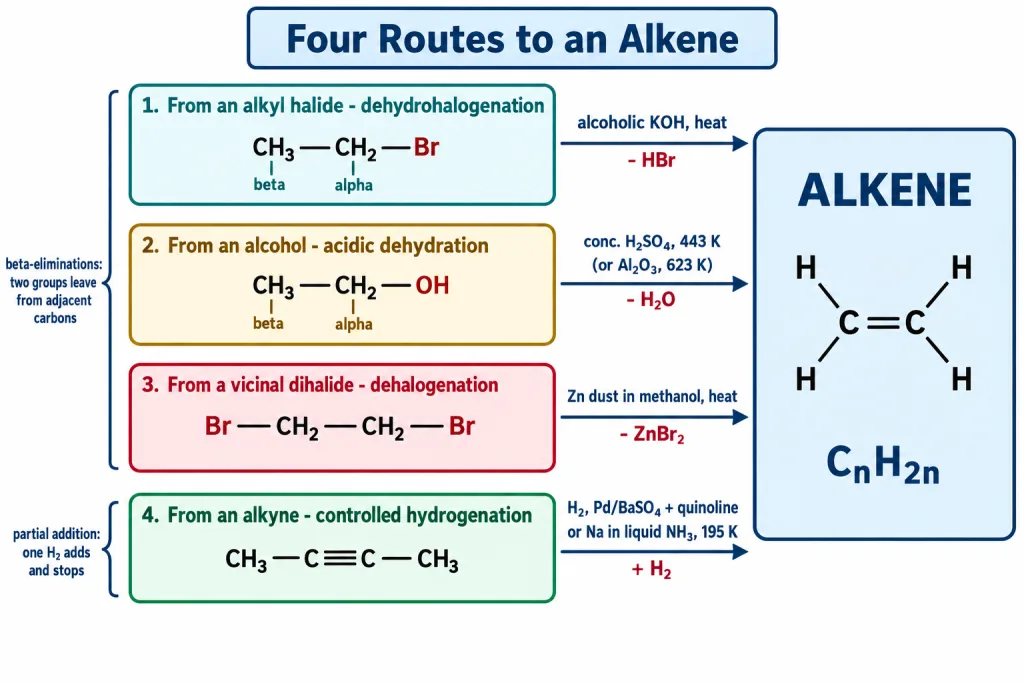
The four routes, with what is removed or added in each:
| Starting material | What happens | What leaves or adds |
|---|---|---|
| Alkyl halide | dehydrohalogenation | and leave as |
| Alcohol | acidic dehydration | and leave as |
| Vicinal dihalide | dehalogenation | two leave as |
| Alkyne | controlled hydrogenation | one adds |
The first three are eliminations, and more precisely 1,2-eliminations or beta-eliminations, because the two departing pieces come from neighbouring carbons. The last is a partial addition, and the only one of the four where you choose the geometry of the product.
Three things decide almost every problem here: the reagent with its temperature and solvent, which alkene is major when two are possible, and which reagent gives cis and which gives trans.
Naming the carbons: alpha and beta
The carbon carrying the leaving group is the alpha carbon, and any carbon directly bonded to it is a beta carbon. In the carbon holding bromine is alpha and the methyl carbon is beta. A hydrogen on a beta carbon is a beta hydrogen, and that is the one the base takes.
Key Point (Definition): A beta-elimination removes a leaving group from the alpha carbon and a hydrogen from a beta carbon, and puts a double bond between those two carbons. No beta hydrogen means no elimination, whatever the reagent.
Neopentyl bromide, , has plenty of hydrogens, but its only beta carbon is the quaternary carbon, which carries none. Alcoholic potash gives it no route to an alkene at all.
Dehydrohalogenation: alkyl halide with alcoholic potash
Heating an alkyl halide with potassium hydroxide dissolved in ethanol — alcoholic potash — strips out one molecule of hydrogen halide and leaves an alkene behind.
Two concrete cases, both balanced:
Chloroethane gives ethene; 2-bromopropane gives propene, and both lines balance for every atom.
Key Point: Dehydrohalogenation is the removal of from an alkyl halide by a strong base. The reagent is alcoholic KOH, heated. The hydrogen comes from a beta carbon, the halogen from the alpha carbon.
Why the solvent decides the product
The same bottle of potassium hydroxide gives two completely different products depending on what it is dissolved in, and this contrast is examined more often than the reaction itself.
In water, potassium hydroxide is fully ionised and the bulk species is the hydroxide ion, , a good nucleophile: it attacks the carbon bearing the halogen, displaces halide, and the product is an alcohol.
In ethanol, the alcohol reacts with the potash to set up an equilibrium supplying ethoxide ion:
Ethoxide is a stronger and bulkier base than hydroxide. Being bulky, it struggles to reach the crowded carbon carrying the halogen, but reaches a beta hydrogen on the edge of the molecule easily. It pulls that hydrogen off as a proton, the electrons of the broken bond swing across to form the pi bond, and the halide leaves at the same moment. The product is an alkene.
Water also solvates hydroxide strongly through hydrogen bonds, blunting its basic strength while leaving it nucleophilic enough to attack carbon; ethanol instead keeps free hydroxide scarce by turning much of it into alkoxide.
Key Point: Aqueous KOH gives substitution — the alkyl halide becomes an alcohol. Alcoholic KOH gives elimination — the alkyl halide becomes an alkene. The switch is caused by the base that the solvent actually supplies: hydroxide from water, alkoxide from alcohol.
[JEE/NEET] If a stem says "aq. KOH" and the options are alkenes, none of them is right. If it says "alc. KOH" and the options are alcohols, the same applies. Read the two letters before you read the structures.
Which halide reacts fastest
The halogen leaves as , so the weaker the carbon-halogen bond, the faster it goes. The bond is the longest and weakest of the four, and iodide is the most stable of the halide ions in solution.
Fluorides are useless here — the bond is far too strong.
Which alkyl group reacts fastest
Two reasons run in the same direction. A tertiary halide carries more alkyl groups round the alpha carbon, so it has more beta hydrogens on offer, and the alkene it produces is more substituted and therefore more stable. A crowded alpha carbon is also hard for a base to attack directly, which shuts down the competing substitution and leaves elimination as the only road open.
Saytzeff's rule: choosing between two possible alkenes
A halide such as 2-bromobutane has beta hydrogens on two different carbons, so two different alkenes can form. The base does not split them evenly.
Key Point: Saytzeff's rule — in a dehydrohalogenation or a dehydration that can give more than one alkene, the major product is the more substituted alkene, that is, the one carrying the larger number of alkyl groups on the doubly bonded carbons. It is the major product because it is the more stable alkene.
Keep this apart from Markovnikov's rule, which governs addition to an alkene and decides where the negative part of the reagent goes. Saytzeff governs elimination and decides which alkene forms. Confusing the two is one of the commonest errors in the chapter.
Why the more substituted alkene is the more stable one
Every alkyl group attached to an carbon of the double bond donates electron density into the pi system by hyperconjugation, spreading the charge and lowering the energy. The more such groups, the more hyperconjugative structures, and the more stable the alkene. Counting the hydrogens on the carbons attached directly to the double bond gives that number:
- but-1-ene, : one alkyl group on the double bond, 2 such hydrogens
- but-2-ene, : two alkyl groups, 6 such hydrogens
But-2-ene wins on both counts, and it is the major product from 2-bromobutane. The general stability order is
Case 1: 2-bromobutane
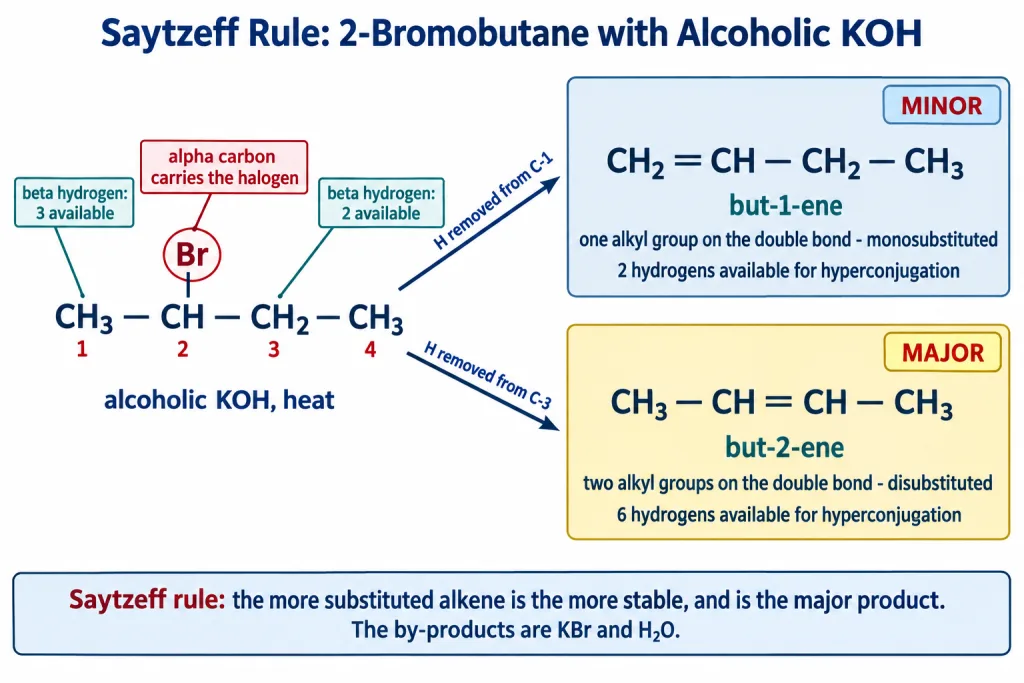
The bromine sits on C-2. Beta hydrogens are available on C-1 and on C-3.
- Taking a hydrogen from C-1 gives , but-1-ene — one alkyl group on the double bond.
- Taking a hydrogen from C-3 gives , but-2-ene — two alkyl groups on the double bond.
But-2-ene is the major product, but-1-ene the minor one. There are three beta hydrogens on C-1 and only two on C-3, so a statistical count predicts the opposite; stability overrides the count, which is why the rule has to be stated.
Case 2: 2-bromo-2-methylbutane
Bromine sits on C-2, flanked by C-1, C-3 and a methyl branch — three beta positions, but only two different alkenes.
- A hydrogen from C-1 or from the branch methyl gives , 2-methylbut-1-ene, disubstituted.
- A hydrogen from C-3 gives , 2-methylbut-2-ene, trisubstituted.
2-Methylbut-2-ene is the major product. This is the standard Saytzeff illustration, because the two candidates differ by a clear one degree of substitution.
Case 3: 2-bromopentane
- From C-1: , pent-1-ene, monosubstituted.
- From C-3: , pent-2-ene, disubstituted and the major product.
Pent-2-ene also has cis and trans forms, and the trans form predominates because the two alkyl groups are further apart in it. Saytzeff picks the position of the double bond; crowding then picks the geometry.
When there is no choice at all
1-Bromopropane has beta hydrogens on only one carbon, so propene is the only possible alkene. 2-Bromo-2-methylpropane, , has three equivalent methyl groups, so every route leads to the same alkene, 2-methylpropene. Check for a genuine choice before you invoke the rule.
Acidic dehydration of an alcohol
An alcohol heated with concentrated sulphuric acid at 443 K loses water and gives an alkene. Water removed in the presence of an acid makes this acidic dehydration, and it is again a beta-elimination: the leaves the alpha carbon and a hydrogen leaves a beta carbon.
The classic case is ethanol to ethene:
Six hydrogens and one oxygen on the left; four hydrogens in ethene plus two in water, one oxygen, on the right. Balanced.
A vapour-phase alternative avoids the acid altogether: passing the alcohol vapour over alumina, , at 623 K dehydrates it just as effectively, with the alumina acting as a catalyst.
Key Point: Dehydration of an alcohol: concentrated at 443 K, or at 623 K. Both remove one molecule of water and give an alkene.
How the acid does it, in three moves
The alcohol is a poor substrate on its own, because is a terrible leaving group. The acid fixes that.
- Protonation. The lone pair on oxygen picks up a proton, turning into .
- Loss of water. leaves as a neutral water molecule, an excellent leaving group, and a carbocation is left behind. This is the slow step.
- Loss of a proton. A base takes a beta hydrogen and the electrons form the pi bond.
Ease of dehydration
The order follows from step 2. A tertiary alcohol gives a tertiary carbocation, the most stable of the three, so its slow step is the easiest and it dehydrates under the mildest conditions. A primary alcohol would have to make a primary carbocation, the least stable, so it needs the harshest treatment.
Because the intermediate is a carbocation, a hydride or methyl shift can move the positive charge to a more stable carbon before the proton is lost, so a dehydration can give a rearranged alkene whose skeleton is not the one you started with — 3,3-dimethylbutan-2-ol, for instance, gives mainly 2,3-dimethylbut-2-ene.
Saytzeff applies here too
Wherever two alkenes are possible, the more substituted one is again the major product.
Butan-2-ol gives but-2-ene as the major product and but-1-ene as the minor one, for the reason given for 2-bromobutane. Likewise 2-methylbutan-2-ol gives 2-methylbut-2-ene in preference to 2-methylbut-1-ene:
Both sides carry five carbons, twelve hydrogens and one oxygen.
[Board] Two things earn the marks: the reagent written as concentrated sulphuric acid with 443 K beside it, and the major product named by Saytzeff's rule with a line of justification.
Dehalogenation of a vicinal dihalide
A vicinal dihalide carries its two halogen atoms on adjacent carbons. Warming one with zinc dust in methanol pulls both halogens off as zinc halide and leaves an alkene.
Two worked cases:
1,2-Dibromoethane gives ethene; 1,2-dibromopropane gives propene. Carbon, hydrogen, bromine and zinc all balance in each line.
Key Point: Dehalogenation removes two halogen atoms from adjacent carbons. The reagent is zinc dust in methanol, heated, and the by-product is . A geminal dihalide, with both halogens on the same carbon, does not give an alkene this way.
Zinc is the reducing agent. It hands two electrons to the molecule and leaves as with the two halide ions; the two carbons keep the electrons and pair them into a pi bond.
The reaction that runs backwards
Bromine adds to an alkene to give exactly this kind of vicinal dibromide, and that addition is the standard test for unsaturation. Dehalogenation reverses it.
Run one way then the other and you get your alkene back unchanged. That makes the pair useful in two practical ways.
Protection. A double bond can be turned into a dibromide first. The dibromide is unreactive towards the reagents that attack alkenes, so the rest of the molecule can be worked on safely, and zinc dust in methanol restores the double bond at the end.
Purification. Bromine converts a liquid alkene into a dibromide that is often a solid and can be recrystallised until pure. Zinc dust in methanol then releases a pure alkene from the crystals.
Because it hands back the alkene you began with, dehalogenation stores a carbon skeleton rather than building a new one. The other three preparations genuinely convert one class of compound into another.
Controlled hydrogenation of an alkyne: choosing cis or trans
An alkyne has two pi bonds, and an ordinary catalyst hydrogenates both, running straight through to the alkane. To stop at the alkene, the reduction must be slowed down or run by a different mechanism altogether — and the two ways of doing that give opposite geometries.
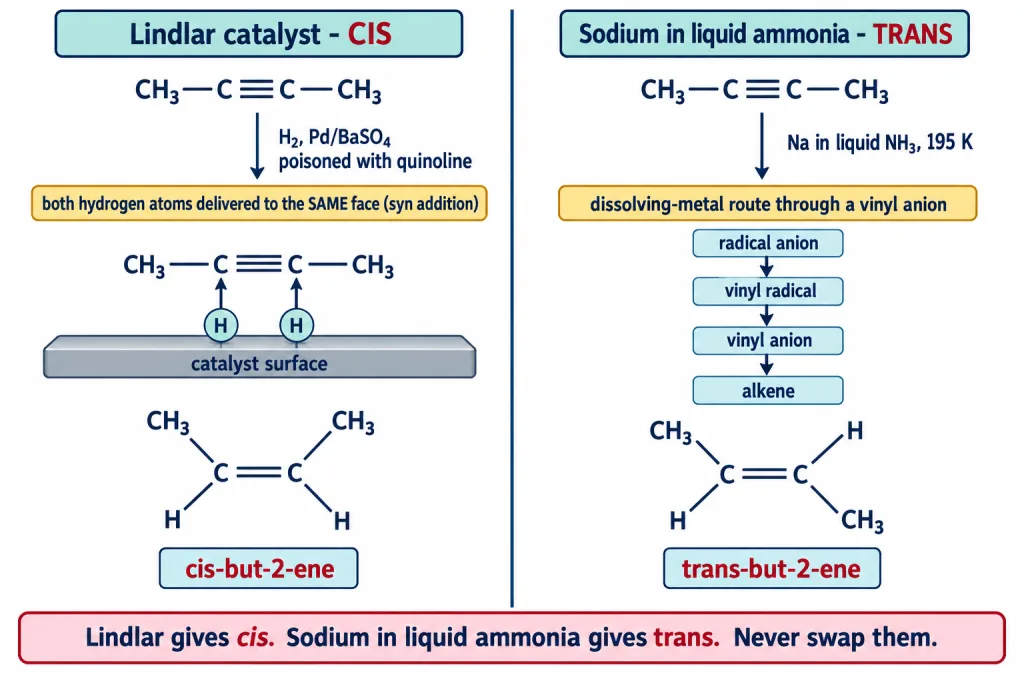
Key Point: with palladium on barium sulphate poisoned by quinoline or sulphur — Lindlar's catalyst — gives the CIS alkene. Sodium in liquid ammonia at 195 K gives the TRANS alkene. These two are always set as a pair, and swapping them costs the whole mark.
Lindlar's catalyst gives the cis alkene
But-2-yne, , plus one gives — cis-but-2-ene. Palladium supported on barium sulphate is a good hydrogenation catalyst; quinoline or a sulphur compound is added as a poison, which partly deactivates the surface. The poisoned catalyst still reduces a triple bond, which binds strongly, but no longer attacks the alkene once it forms, so the reduction stops cleanly at one stage.
The geometry follows from where the hydrogens come from. The alkyne lies flat on the metal surface, and the two hydrogen atoms are already adsorbed on that same surface. They are delivered to the same face of the triple bond, one to each carbon. Adding two atoms to one face is syn addition, and it leaves the two groups on the same side of the new double bond. That is the cis alkene.
Sodium in liquid ammonia gives the trans alkene
Check the atoms: six hydrogens in but-2-yne plus six in two ammonia molecules make twelve; on the right, eight in but-2-ene and four in two molecules of sodamide. Two sodium and two nitrogen on each side.
No catalyst surface is involved, and no molecular hydrogen either. Sodium dissolves in liquid ammonia to give a deep blue solution of sodium ions and solvated electrons, and those free electrons do the reducing. The route is a dissolving-metal reduction and runs in four moves:
- One electron enters the pi system of the alkyne, giving a radical anion.
- Ammonia protonates it, giving a vinyl radical.
- A second electron converts that radical into a vinyl anion.
- Ammonia protonates the vinyl anion, giving the alkene.
The geometry is set at step 3. The vinyl anion can place its lone pair and its two substituents in either of two arrangements, and it settles into the one where the two bulky groups are as far apart as possible — on opposite sides of the forming double bond. The final protonation freezes that arrangement. The product is the trans alkene.
Reading the pair correctly
Two riders matter. The alkyne must be internal for geometry to arise at all: reducing propyne, , gives propene, which cannot show cis-trans isomerism because one of its doubly bonded carbons carries two identical hydrogens. And sodium in liquid ammonia does not reduce a terminal alkyne to an alkene — the acidic terminal hydrogen is removed instead, giving the acetylide.
[JEE Main] A stem that names quinoline, sulphur, barium sulphate or the word "poisoned" is asking for cis. A stem that names liquid ammonia, 195 K or a blue solution is asking for trans.
The decision table
Everything in this section collapses into one table.
| Starting material | Reagent and conditions | Product | What decides the major product |
|---|---|---|---|
| Alkyl halide | alcoholic KOH, heat | alkene | Saytzeff: more substituted alkene wins |
| Alkyl halide | aqueous KOH | alcohol — substitution, no alkene | hydroxide acts as a nucleophile, not a base |
| Alcohol | conc. , 443 K | alkene | Saytzeff; a carbocation may rearrange first |
| Alcohol | , 623 K | alkene | same as above, no acid needed |
| Vicinal dihalide | Zn dust in methanol, heat | alkene | no choice; the parent alkene comes back |
| Geminal dihalide | Zn dust in methanol | no alkene | the two halogens are on one carbon |
| Alkyne, internal | , + quinoline | cis alkene | both hydrogens delivered to one face |
| Alkyne, internal | Na in liquid , 195 K | trans alkene | trans vinyl anion intermediate |
The three rate orders
- Halogen in dehydrohalogenation: — the weakest carbon-halogen bond breaks first.
- Alkyl group in dehydrohalogenation: tertiary > secondary > primary — more beta hydrogens, and a more stable alkene.
- Alcohol in dehydration: tertiary > secondary > primary — a tertiary carbocation is the most stable intermediate.
The last two read the same way: crowding at the alpha carbon helps every elimination.
A short checklist for any preparation question
- Identify the starting class — halide, alcohol, dihalide or alkyne.
- Write the reagent with its conditions. Solvent for potash, temperature for dehydration, poison for Lindlar, 195 K for sodium in ammonia.
- Find every beta carbon that carries a hydrogen. No beta hydrogen, no elimination.
- List every alkene that could form, then apply Saytzeff to pick the major one.
- Ask whether geometry is possible. Only if each doubly bonded carbon carries two different groups.
- Balance the equation, including , or on the product side.
Steps 3 and 6 lose the most marks — a beta hydrogen assumed rather than checked, and the inorganic by-product left off.
Worked items
Question 1: Ethanol to ethene
Write the balanced equation for the dehydration of ethanol and give the reagent with its temperature.
Answer:
Ethanol is . The is on C-1, so C-2 is the beta carbon. Removing one beta hydrogen and the takes out a molecule of water and puts a double bond between C-1 and C-2.
Atoms: 2 C, 6 H and 1 O on the left; 2 C, 4 H in ethene plus 2 H in water, and 1 O on the right.
Ans: , using concentrated at 443 K. Watch out: The temperature is part of the answer. The same acid on ethanol at a much lower temperature gives ethoxyethane instead, so an unlabelled "conc. " is an incomplete reagent.
Question 2: Major product from 2-bromobutane
2-Bromobutane is heated with alcoholic KOH. Predict the major product and justify the choice.
Answer:
I draw the chain: , with bromine on C-2. The base can take a beta hydrogen from C-1 or from C-3, so two alkenes are possible.
From C-1 I get , but-1-ene, with one alkyl group on the double bond. From C-3 I get , but-2-ene, with two.
Saytzeff's rule makes the more substituted alkene the major product, because more alkyl groups on the carbons means more hyperconjugation and a lower energy. But-2-ene has six hydrogens on the carbons attached to the double bond, but-1-ene only two.
Ans: But-2-ene is the major product and but-1-ene the minor one. Watch out: C-1 has three beta hydrogens and C-3 only two, so counting hydrogens predicts the wrong answer. Stability, not statistics, decides it.
Question 3: The same halide with aqueous potash
2-Bromobutane is heated with aqueous KOH instead. What is the product, and why does the answer change?
Answer:
In water, potassium hydroxide supplies hydroxide ion, a strong nucleophile that attacks the carbon carrying the bromine rather than a beta hydrogen. The bromide leaves and an takes its place.
In ethanol the potash converts much of itself into ethoxide, a stronger and bulkier base. Bulk keeps it away from the crowded alpha carbon but not from a beta hydrogen on the edge, so elimination takes over.
Ans: Butan-2-ol, by substitution. Aqueous potash substitutes; alcoholic potash eliminates. Watch out: The change of product comes from the base the solvent supplies, not from temperature or concentration.
Question 4: Major product from 2-bromo-2-methylbutane
Predict the major alkene formed when 2-bromo-2-methylbutane is treated with alcoholic KOH, and justify it.
Answer:
The structure is . Bromine is on the tertiary C-2, whose beta carbons are C-1, C-3 and the branch methyl.
Taking a hydrogen from C-1 or from the branch methyl gives the same alkene, , 2-methylbut-1-ene, whose double bond carries two alkyl groups. Taking one from C-3 gives , 2-methylbut-2-ene, whose double bond carries three.
Eleven hydrogens in the halide plus one in KOH; ten in the alkene plus two in water. Twelve on each side.
Ans: 2-Methylbut-2-ene is the major product, being trisubstituted; 2-methylbut-1-ene is the minor product.
Question 5: Ordering three halides
Arrange 2-chlorobutane, 2-bromobutane and 2-iodobutane in order of the rate at which they give but-2-ene with alcoholic KOH, and explain.
Answer:
The rate-deciding step breaks the carbon-halogen bond. That bond is longest and weakest for iodine and shortest and strongest for chlorine, and the halide released is most stable for iodide, so the iodide goes fastest.
Ans: 2-iodobutane > 2-bromobutane > 2-chlorobutane. Watch out: This is bond strength and leaving-group ability, not electronegativity. Chlorine is the most electronegative of the three and still reacts slowest.
Question 6: Getting the cis alkene
Name the reagent and conditions that convert but-2-yne into cis-but-2-ene, and explain why the geometry comes out cis.
Answer:
I need to add exactly one molecule of hydrogen and stop there, with both hydrogens arriving on the same side. Lindlar's catalyst does both. It is palladium on barium sulphate poisoned with quinoline or a sulphur compound, and the poison deactivates the surface just enough that the alkene formed is left alone.
The alkyne lies flat on the metal surface and takes both hydrogen atoms from that same surface, one to each carbon. Adding to one face is syn addition, and it leaves the two methyl groups on the same side of the new double bond.
Ans: with poisoned by quinoline — Lindlar's catalyst — gives cis-but-2-ene.
Question 7: Getting the trans alkene
Which reagent turns pent-2-yne into trans-pent-2-ene, and what intermediate fixes the geometry?
Answer:
Sodium in liquid ammonia at 195 K. There is no catalyst surface and no molecular hydrogen; sodium dissolves in ammonia to give solvated electrons, which reduce the triple bond.
An electron adds to give a radical anion, ammonia protonates it to a vinyl radical, a second electron gives a vinyl anion, and ammonia protonates that. The vinyl anion is the key: it arranges its methyl and ethyl groups as far apart as it can, which puts them on opposite sides, and the last protonation locks that geometry in.
Atoms: 8 H in the alkyne plus 6 H in the two ammonias on the left, 10 H in the alkene plus 4 H in the two sodamides on the right. Fourteen each side, with 5 C, 2 Na and 2 N throughout.
Ans: Sodium in liquid ammonia at 195 K, through a trans vinyl anion, gives trans-pent-2-ene. Watch out: This reagent works on an internal alkyne. Given a terminal alkyne, sodium simply removes the acidic terminal hydrogen and gives the acetylide instead of an alkene.
Question 8: 1,2-dibromopropane with zinc
Write the equation for the action of zinc dust in methanol on 1,2-dibromopropane, and say what would happen with 1,1-dibromopropane.
Answer:
1,2-Dibromopropane, , is a vicinal dihalide — one bromine on C-1 and one on C-2. Zinc takes both off as zinc bromide and a double bond forms between those two carbons.
Three carbons, six hydrogens, two bromines and one zinc on each side.
1,1-Dibromopropane, , is a geminal dihalide with both bromines on one carbon. Removing them would leave two electrons on a single carbon rather than one on each of two neighbours, so no carbon-carbon double bond can form.
Ans: 1,2-Dibromopropane gives propene and ; 1,1-dibromopropane gives no alkene.
Question 9: Major product from butan-2-ol
Butan-2-ol is heated with concentrated sulphuric acid at 443 K. Predict the major product and justify it.
Answer:
Butan-2-ol is , with the on C-2. The acid protonates the oxygen, water leaves, and a secondary carbocation forms on C-2. A beta hydrogen then goes from C-1, giving but-1-ene, or from C-3, giving but-2-ene. Saytzeff's rule picks but-2-ene, which carries two alkyl groups on the double bond against one for but-1-ene.
Four carbons, ten hydrogens and one oxygen on each side.
Ans: But-2-ene is the major product, but-1-ene the minor one. Watch out: This carbocation is secondary with no better place to go, so no rearrangement occurs. Where the skeleton offers a tertiary neighbour, a hydride or methyl shift can change it before the alkene forms.
Question 10: Which alcohol dehydrates more easily
Which of 2-methylpropan-2-ol and propan-1-ol needs the milder conditions for dehydration, and why?
Answer:
2-Methylpropan-2-ol, , is tertiary; propan-1-ol, , is primary.
The slow step is loss of water from the protonated alcohol to give a carbocation. The tertiary alcohol gives , the most stable of its class because three alkyl groups feed electron density towards the positive carbon. The primary alcohol would have to give , the least stable. The easier the carbocation forms, the milder the conditions needed.
Ans: 2-Methylpropan-2-ol dehydrates more easily; ease of dehydration runs tertiary > secondary > primary.
Question 11: A halide that gives no alkene
Explain why 1-bromo-2,2-dimethylpropane gives no alkene with alcoholic KOH, however long it is heated.
Answer:
The structure is . The bromine sits on the group, so that is the alpha carbon, and its only neighbour — the only beta carbon — is the central one.
That central carbon is bonded to three methyl groups and to the group. Four bonds, all to carbon, and no hydrogen at all. With no beta hydrogen for the base to remove, a beta-elimination is impossible.
Ans: It has no beta hydrogen, so no elimination can occur and no alkene forms. Watch out: Its nine hydrogens are all on gamma carbons. Being present in the molecule is not enough; the hydrogen has to sit on a carbon next to the one bearing the halogen.
Question 12: Protecting a double bond
Describe, with equations, how bromine and zinc can be used together to protect the double bond of propene while another part of a molecule is treated.
Answer:
First I add bromine across the double bond in carbon tetrachloride. The alkene disappears and a vicinal dibromide takes its place.
The dibromide has no pi bond, so reagents that would have attacked the alkene leave it alone while the rest of the molecule is worked on. When that work is finished I warm the dibromide with zinc dust in methanol, which strips both bromines off and hands back the alkene.
The same pair purifies an alkene: the dibromide is often a well-formed solid that can be recrystallised, and zinc then releases the pure alkene.
Ans: Add to make the vicinal dibromide, do the other chemistry, then use Zn dust in methanol to regenerate propene.
Question 13: Geometry after a Lindlar reduction
Propyne is reduced with hydrogen over Lindlar's catalyst. Name the product and say whether it shows cis-trans isomerism.
Answer:
The product is propene: plus gives .
For cis-trans isomerism, each of the two doubly bonded carbons must carry two different groups. In propene, C-1 carries two hydrogens, which are identical, so swapping them changes nothing and only one propene exists.
Ans: Propene, and it shows no cis-trans isomerism because one doubly bonded carbon carries two identical hydrogen atoms. Watch out: Lindlar's catalyst still delivers both hydrogens to one face here; the product simply has no geometry to display.