
Rate and orientation are two separate questions
Every mechanism here answers two questions, and an examiner usually asks one at a time. What fixes the rate? The slowest step, which is almost always the one that makes the high-energy intermediate. What fixes the orientation? Where more than one product could form, the branch running through the more stable intermediate wins.
Key Point: A more stable intermediate sits lower, is reached across a lower barrier, and so forms faster. That single sentence carries Markovnikov's rule, Saytzeff's rule, the ease order for halogenation, the peroxide effect and the whole of directive influence.
| Mechanism | Intermediate | Rate-determining step | What fixes orientation |
|---|---|---|---|
| Free-radical substitution | alkyl free radical | abstraction of H by the halogen radical | radical stability, times the number of such hydrogens |
| Ionic electrophilic addition | carbocation | attack of the pi electrons on the electrophile | carbocation stability, which is Markovnikov |
| Halogen addition | cyclic bromonium ion | formation of the bridged ion | no regiochemical choice; the answer is anti |
| Radical addition of HBr | alkyl free radical | addition of the bromine radical | radical stability, reading anti-Markovnikov |
| Aromatic substitution | arenium ion | attack of the ring on the electrophile | stability of the ortho, meta and para arenium ions |
Name the intermediate in every mechanism answer, and label every step slow or fast. Marks are given for both.
Mechanism 1 — free-radical substitution
Chlorination of methane, every species named.
Initiation. Homolysis of the weakest bond present.
Propagation, step 1. The chlorine radical abstracts a hydrogen atom, leaving the methyl free radical, a planar carbon with three bonds and one unpaired electron in a p orbital.
Propagation, step 2. The alkyl radical attacks chlorine and regenerates the carrier, which makes this a chain.
Termination. Any two radicals meeting.
What fixes the rate. Of the two propagation steps the first is slower, since a C-H bond of must break while the second breaks only the weak halogen-halogen bond. The overall rate follows halogen reactivity, .
What fixes the orientation. The same abstraction step decides which hydrogen leaves, so the product ratio follows the stability of the radical left behind, , weighted by how many hydrogens of each kind there are.
2-Methylpropane has nine primary and one tertiary hydrogen, so counting alone predicts for the primary chloride. The tertiary product's real share is well above that.
Why bromination is the selective one. Abstraction by is endothermic, since the H-Br bond made is weaker than the C-H bond broken, so its late transition state resembles the radical, the full stability difference is felt, and the tertiary position dominates. Abstraction by is exothermic, its transition state comes early and still resembles the alkane, so a genuine mixture results.
Key Point: Chlorination is fast and unselective; bromination is slow and highly selective. Asked for the single main product of radical halogenation of a branched alkane, name the tertiary bromide.
Mechanism 2 — electrophilic addition through the carbocation
Propene and HBr, no peroxide.
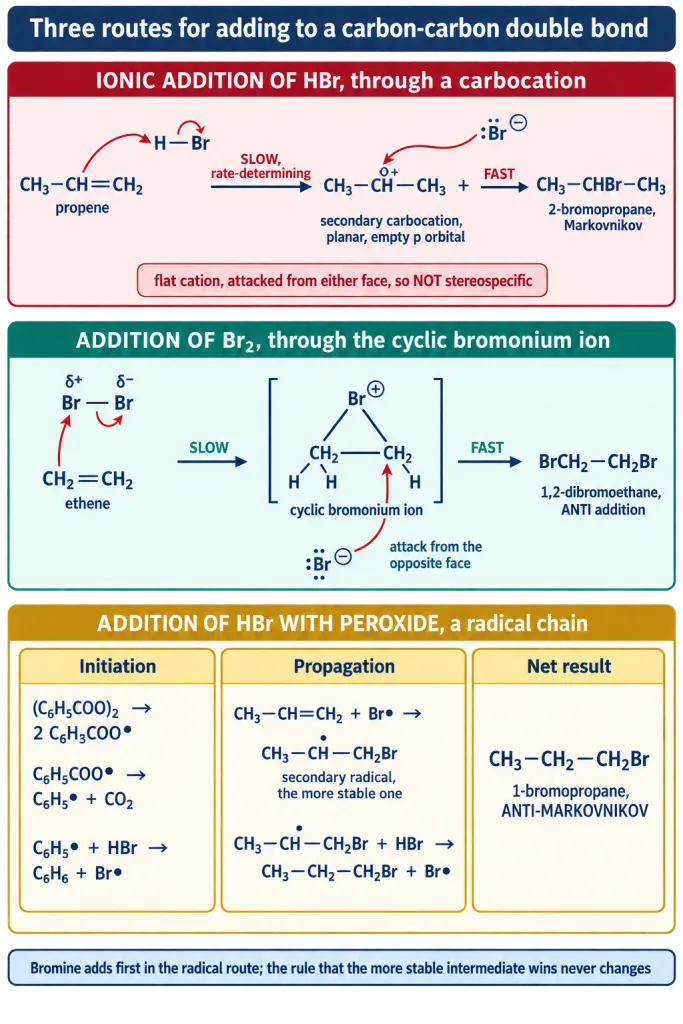
Step 1, slow and rate-determining. The pi electrons reach the hydrogen and the H-Br bond breaks heterolytically, giving a secondary carbocation: planar, , six valence electrons, one empty p orbital.
Step 2, fast. Bromide fills the empty orbital.
Rate. How easily step 1 makes its cation. Alkyl groups on the double bond raise the electron density, so 2-methylpropene adds faster than propene and propene faster than ethene. Among reagents, .
Orientation. Protonation at gives a secondary cation, at a primary one, so bromide ends on the carbon that began with fewer hydrogens. Markovnikov's rule, derived rather than quoted.
The consequence usually missed. The cation is flat, so bromide attacks either face, and ionic addition of HX is not stereospecific.
Mechanism 3 — halogen addition through the bromonium ion
Step 1, slow. The approaching pi cloud polarises , the Br-Br bond breaks heterolytically, and the positive bromine bonds to both carbons at once. The intermediate is the cyclic bromonium ion: a three-membered ring of two carbons and one positively charged bromine, using a lone pair for the second bond. A bridge, not an open cation, and that settles the stereochemistry.
Step 2, fast. Bromide cannot reach the bridged face, so it attacks a ring carbon from the opposite face.
Rate. Electron density of the double bond, as before. Orientation. With there is no regiochemical choice, so the question is stereochemical and the answer is anti. Regiochemistry appears only when the two added atoms differ: in bromine water the water attacks the more substituted carbon, which carries more of the positive charge, and the addition is still anti.
Mechanism 4 — the peroxide effect as a radical chain
Initiation.
Propagation. The bromine radical, not a proton, reaches the double bond first.
Termination. Any two radicals combining. Net: propene and HBr give 1-bromopropane.
Why the answer flips. The rule has not changed — the more stable intermediate still wins. What changed is which particle arrives first. Bromine adds to the terminal carbon because that leaves a secondary radical, and hydrogen then lands on the carbon that held the odd electron.
Key Point: The peroxide effect is HBr only. The H-Cl bond is too strong for a radical to break in the chain-transfer step, and the H-I bond is so weak that the iodine radicals simply recombine instead of adding.
Mechanism 5 — aromatic substitution through the arenium ion
Nitration of benzene as the model.
(a) Generation of the electrophile.
(b) Attack on the pi cloud — slow and rate-determining. Two delocalised electrons bond the nitronium ion to one ring carbon, which becomes and carries both a hydrogen and the nitro group; the other four pi electrons spread the positive charge over the remaining five carbons. This is the arenium ion, and aromaticity is lost in it, which is why the step is expensive.
(c) Loss of a proton — fast. A hydrogen sulphate ion removes the proton from the carbon and the sextet is restored.
Rate. Step (b). Anything raising the ring's electron density raises the rate; anything draining it lowers it. Orientation. Step (b) again, through the relative stabilities of the three possible arenium ions.
The evidence that (c) is not rate-determining. Replacing the ring hydrogens by deuterium barely changes the rate, and a C-D bond breaks measurably more slowly than a C-H bond, so no C-H bond breaks in the slow step.
The step the basic treatment leaves out — carbocation rearrangement
A carbocation is not obliged to stay where it was made.
Key Point (Definition): In a 1,2-hydride shift a hydrogen moves from the carbon next door to the positive carbon, taking its bonding pair. In a 1,2-methyl shift a methyl group does the same. The migrating group takes both electrons, so the positive charge is left behind on the carbon it came from. A shift happens only when it gives a more stable cation — , , — never the reverse.
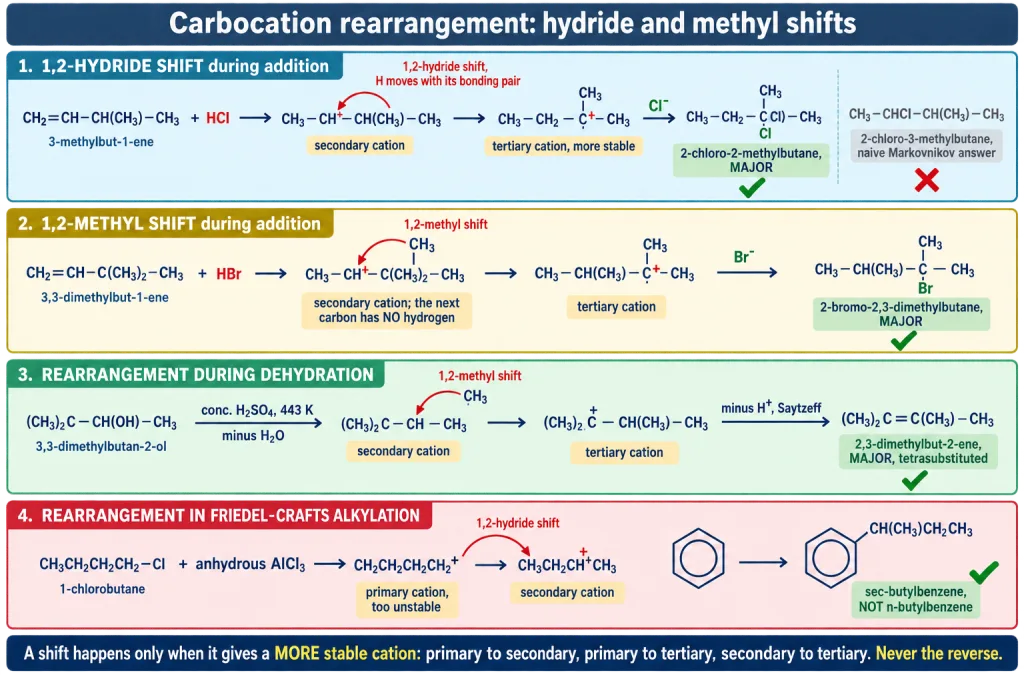
Case 1 — addition, hydride shift. 3-Methylbut-1-ene with HCl. Protonation at gives a secondary cation; a hydride shift from makes it tertiary, and chloride attacks it.
Naive Markovnikov predicts 2-chloro-3-methylbutane. The major product is 2-chloro-2-methylbutane.
Case 2 — addition, methyl shift. 3,3-Dimethylbut-1-ene with HBr gives the secondary cation . has no hydrogen at all, so a methyl group migrates and the cation becomes tertiary. Naive answer: 2-bromo-3,3-dimethylbutane. Actual: 2-bromo-2,3-dimethylbutane.
Case 3 — dehydration. 3,3-Dimethylbutan-2-ol loses water to give a secondary cation, a methyl shift makes it tertiary, and Saytzeff picks the most substituted alkene.
Naive answer: 3,3-dimethylbut-1-ene. Actual: 2,3-dimethylbut-2-ene, tetrasubstituted.
Case 4 — Friedel-Crafts alkylation. Benzene with 1-chlorobutane and anhydrous : the primary butyl cation shifts a hydride before it reaches the ring, giving sec-butylbenzene. With 1-chloro-2,2-dimethylpropane a methyl shift gives the tertiary cation and the product is 2-methyl-2-phenylbutane.
Spotting a rearrangement before it catches you
- Does the mechanism go through a free carbocation? Addition of HX, acid dehydration and Friedel-Crafts alkylation do. Radical additions, halogen addition through the bridge and acylation do not.
- Is the first cation primary or secondary? A tertiary or benzylic cation stays put.
- Look at the carbon next door. A branch there is the warning sign; a quaternary carbon there is a guarantee.
[JEE Main] A branch one carbon away from where the cation must form means the answer wanted is the rearranged one.
Stereochemistry of addition — same face or opposite faces
Two atoms add to a double bond either on the same face (syn) or on opposite faces (anti), and the intermediate decides which.
Anti, because of the bridge. The bromonium ion occupies one face completely, so bromide has only the other.
- cis-But-2-ene with in gives 2,3-dibromobutane as a pair of mirror-image forms in equal amount — a racemic mixture, inactive because the rotations cancel.
- trans-But-2-ene gives the meso form, inactive because one half of the molecule cancels the other.
- Cyclohexene gives trans-1,2-dibromocyclohexane only, the anti relationship visible in the name.
Syn, because of the surface. Catalytic hydrogenation holds the alkene flat against the metal and delivers both hydrogens from that side, so 1,2-dimethylcyclohexene with and Pt gives cis-1,2-dimethylcyclohexane. The same delivery is why Lindlar's catalyst, poisoned with quinoline, gives the cis alkene from an alkyne, while sodium in liquid ammonia at 195 K uses no surface and gives the trans alkene.
Syn again, with Baeyer's reagent. Cold dilute alkaline adds both hydroxyl groups to one face through a cyclic manganese ester, so cis-but-2-ene gives meso-butane-2,3-diol and trans-but-2-ene the racemic pair.
No stereochemistry when the intermediate is open. A flat carbocation lets the nucleophile come from either face, so HX addition gives both outcomes.
| Reaction | Intermediate | Addition | cis-alkene gives | trans-alkene gives |
|---|---|---|---|---|
| in | cyclic bromonium ion | anti | racemic pair | meso |
| , Pt or Pd or Ni | adsorbed on the metal | syn | achiral alkane, no stereocentres formed; the syn delivery shows only in a ring, as in 1,2-dimethylcyclohexene giving cis-1,2-dimethylcyclohexane | achiral alkane, no stereocentres formed; the syn delivery shows only in a ring, as in 1,2-dimethylcyclohexene giving cis-1,2-dimethylcyclohexane |
| Cold dilute alkaline | cyclic manganese ester | syn | meso | racemic pair |
| HX, no peroxide | open carbocation | neither | mixture | mixture |
Ozonolysis and oxidative cleavage, worked backwards
Each doubly bonded carbon keeps what it was carrying and gains an oxygen. Zinc is present to destroy the hydrogen peroxide that would otherwise oxidise an aldehyde to an acid.
The workup decides how far each fragment is oxidised
| Fragment of the double bond | With and | With |
|---|---|---|
| , no hydrogen | ketone | ketone, unchanged |
| , one hydrogen | aldehyde | carboxylic acid |
| , two hydrogens | methanal | methanoic acid, oxidised on to and |
The oxidative column is also what hot or acidic gives, which is why a terminal always shows up as a lost carbon in a permanganate cleavage.
Working backwards
Write the carbonyl carbons facing each other, delete both oxygens, join them by a double bond.
Two products means an open chain. Propanone and butanal in equal moles rebuild as , 2-methylhex-2-ene.
Three products means a diene, cut twice, the middle fragment carrying two carbonyl groups. Two moles of methanal with one of 2-oxopropanal, : each methanal supplies a end and the middle fragment , giving , 2-methylbuta-1,3-diene (isoprene).
One dicarbonyl product means a ring, since cutting the double bond of a cyclic alkene opens it into a single chain with a carbonyl group at each end.
- Cyclopentene gives pentanedial, .
- 1-Methylcyclohexene gives 6-oxoheptanal, — the methyl-bearing carbon has no hydrogen and becomes a ketone, the other becomes an aldehyde.
- 1,2-Dimethylcyclohexene gives octane-2,7-dione, .
Key Point: Methanal among the products always means a terminal , and carbon dioxide from an oxidative cleavage means the same thing. A ketone means a fully substituted alkene carbon. One dicarbonyl product and nothing else means the alkene was cyclic.
Aromaticity — the cases beyond benzene
The four conditions do not change: planar, cyclic, completely conjugated, pi electrons. What changes is how hard they are to check.
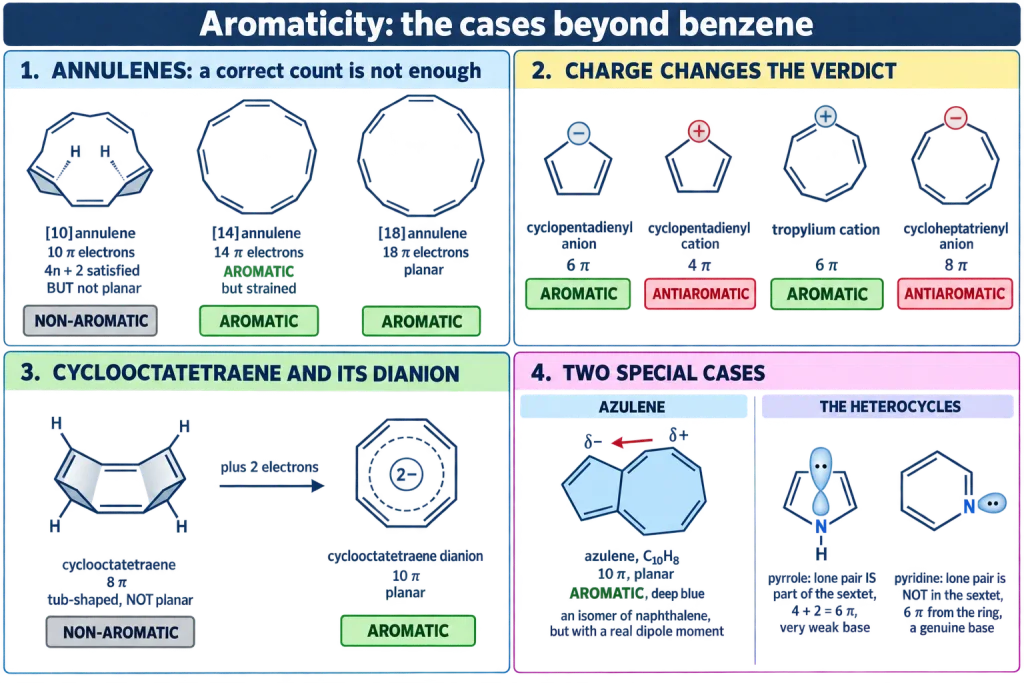
Annulenes. An annulene is one completely conjugated ring of carbons, ; benzene is annulene.
- annulene, 10 pi electrons, : the count is right and it is still not aromatic, because two hydrogens point into the middle and force the ring out of plane.
- annulene, 14 pi electrons, , large enough to hold its inner hydrogens: aromatic, though strained.
- annulene, 18 pi electrons, , roomy and flat: the clean large aromatic annulene.
Key Point: A count is necessary, not sufficient. Check planarity before awarding aromaticity — the annulenes are where that check earns its marks.
The charged rings. The cyclopentadienyl anion has 6 pi electrons and is aromatic; the cation has 4 and is antiaromatic; the radical has 5, fits neither rule, and is non-aromatic. The tropylium (cycloheptatrienyl) cation has 6 and is aromatic; the cycloheptatrienyl anion has 8 and is antiaromatic. Charge alone moves one skeleton through all three.
Cyclooctatetraene and its dianion. has 8 pi electrons, a number. Rather than pay the antiaromatic price it folds into a tub with alternating long and short bonds, so the p orbitals never overlap all round and it escapes as merely non-aromatic. The dianion has , a count with , and flattens into a planar octagon to collect the stabilisation: aromatic.
Azulene. , the same formula as naphthalene but built as a five-membered ring fused to a seven-membered one. Planar, fully conjugated, 10 pi electrons, aromatic. It is deep blue, and unlike naphthalene it has a real dipole moment: density drifts from the seven-ring to the five-ring, so one half resembles a cyclopentadienyl anion and the other a tropylium cation.
The heterocycles. In pyrrole the nitrogen lone pair is part of the sextet; in pyridine it is not — it sits in an orbital in the ring plane. Pyrrole's sextet is with the nitrogen pair supplying the 2, so binding a proton there would destroy the aromaticity and pyrrole is an extremely weak base. Pyridine already has 6 pi electrons from its ring double bonds, so its lone pair is spare and pyridine is a genuine base whose cation is still aromatic. Furan and thiophene each put one of two lone pairs into the p orbital and leave the other in the plane.
Ranking questions — acidity, alkene stability, cations and radicals
Acidity of hydrocarbons
Two arguments in order. Hybridisation: more s character means the carbon holds its electrons closer, is more electronegative, and leaves a more stable anion. Aromaticity of the anion, which beats hybridisation whenever it applies.
- Cyclopentadiene heads the list although its acidic hydrogen sits on an carbon, because losing it gives the aromatic cyclopentadienyl anion, 6 pi electrons in a flat ring. It is about as acidic as water.
- Ethyne follows: carbon, 50 per cent s character. It remains a very weak acid overall, far weaker than water; the comparison is only with other hydrocarbons.
- Benzene and ethene, both at 33.3 per cent, sit close together with benzene marginally ahead.
- Ethane is last, at 25 per cent, with nothing to stabilise its anion.
Only a terminal alkyne has an acidic hydrogen; but-2-yne has none, which is what the silver and copper tests detect.
Alkene stability and heat of hydrogenation
Between geometrical isomers trans beats cis, the bulky groups being further apart. The heat of hydrogenation measures this, provided the alkenes give the same alkane: the three straight-chain butenes all give butane, at about kJ/mol for trans-but-2-ene, for cis-but-2-ene and for but-1-ene. Ethene releases about kJ/mol but cannot join that table, giving ethane.
Key Point: Stability order and heat-of-hydrogenation order are the same list read in opposite directions. The most stable alkene releases the least heat.
Carbocations and radicals
Both are electron-deficient carbons stabilised by the same two things: alkyl groups pushing in by and hyperconjugation, and any pi system that can delocalise the deficiency. The benzylic and allylic species win because resonance spreads the charge over a whole pi system. A vinyl or aryl cation falls below even methyl, its empty orbital sitting on an carbon that no alkyl group can reach and no resonance assists — which is why vinyl and aryl halides fail in Friedel-Crafts alkylation.
Directive influence at the level it is actually asked
Ortho, para directing and activating: , , , , , alkyl, . Ortho, para directing but deactivating: the halogens , , , , which are and together. Meta directing and deactivating: , , , , , , , .
Where the third group goes
Ask each group present where it wants the next one, then apply three rules.
- If they agree, nothing is left to decide. In 4-nitrotoluene the methyl directs ortho to itself and the nitro group directs meta to itself, and those are the same two carbons. Nitration gives 2,4-dinitrotoluene, and a third gives 2,4,6-trinitrotoluene.
- If they disagree, the stronger activator wins. In 4-chlorotoluene the methyl is an activator and chlorine a deactivator, so the new group goes ortho to the methyl.
- A position flanked by two groups is left alone, being too crowded.
Getting the order of introduction right
The same two reagents in the opposite order give different compounds. Decide which group must be on the ring while the other is being introduced.
| Target | Correct order | Why the other order fails |
|---|---|---|
| -nitrobenzoic acid from toluene | oxidise with , then nitrate | nitrating toluene gives ortho and para, and oxidation cannot move them |
| -nitrobenzoic acid from toluene | nitrate, then oxidise with | oxidising first puts on a meta director |
| -bromonitrobenzene | nitrate benzene, then brominate | bromine first is ortho, para directing |
| -bromonitrobenzene | brominate benzene, then nitrate | nitro first is meta directing |
| -nitroacetophenone | acylate with and anhydrous , then nitrate | nitrobenzene is far too deactivated for any Friedel-Crafts reaction |
Blocking with a sulphonic acid group
Sulphonation is the one reversible electrophilic substitution, which makes a removable stopper. To reach -nitrotoluene, where ordinary nitration gives mostly the para isomer: sulphonate toluene with fuming sulphuric acid so takes the para position, nitrate so the nitro group is forced ortho to the methyl, then heat with dilute acid or superheated steam to strip the off.
[JEE Main] An ortho target from an ortho, para pair is asking for the blocking sequence; a question pairing a Friedel-Crafts step with a nitration wants the Friedel-Crafts step first.
Distinguishing tests, as a system
One reagent, one visible observation for each compound.
| Pair | Reagent | What is seen |
|---|---|---|
| Ethane and ethene | in , in the dark | ethene discharges the red-brown colour; ethane leaves it unchanged |
| Cyclohexane and cyclohexene | Baeyer's reagent | cyclohexene discharges the pink colour and deposits brown ; cyclohexane does nothing |
| Ethene and ethyne | ammoniacal | ethyne gives a white precipitate of silver acetylide; ethene none |
| Propene and propyne | ammoniacal cuprous chloride | propyne gives a red precipitate of copper acetylide; propene none |
| But-1-yne and but-2-yne | ammoniacal | but-1-yne gives a white precipitate; but-2-yne has no terminal hydrogen and gives none |
| Benzene and cyclohexene | bromine water | cyclohexene decolourises it; benzene does not react without a catalyst |
| Benzene and toluene | hot | toluene is oxidised to benzoic acid and the purple colour goes; benzene is untouched |
| Hexane and benzene | burn a little in air | benzene burns with a sooty luminous flame; hexane burns far more cleanly |
The order to test an unknown in. Burn a drop: a sooty luminous flame means an arene. Then ammoniacal silver nitrate: a white precipitate means a terminal alkyne. Then bromine in carbon tetrachloride in the dark, or Baeyer's reagent: decolourisation means unsaturation. A compound failing all three is an alkane.
The trap in the bromine test. An alkane reacts with bromine in sunlight by free-radical substitution and the colour fades then too — but hydrogen bromide fumes come off and turn moist blue litmus red. Work in the dark, or read the litmus as well.
Conformational analysis of butane, in full
Rotation is free about a C-C single bond. About the front carbon of butane carries three hydrogens and the picture is ethane's. The interesting bond is the central bond, where each carbon carries one methyl group and two hydrogens, and the angle to watch is the dihedral angle between the two methyl groups.
| Dihedral angle | Conformation | Staggered or eclipsed | Energy |
|---|---|---|---|
| fully eclipsed | eclipsed, methyl on methyl | highest maximum | |
| gauche | staggered | shallow minimum | |
| eclipsed | eclipsed, methyl on hydrogen | lower maximum | |
| anti | staggered | lowest minimum | |
| eclipsed | eclipsed, methyl on hydrogen | lower maximum | |
| gauche | staggered | shallow minimum |
Key Point: About the bond the stability order is anti > gauche > eclipsed > fully eclipsed, and the energy order is that list reversed.
Reading the profile matters as much as the order itself.
- A full turn gives three maxima and three minima, as in ethane, but they are not all the same height. Ethane's three identical peaks stand above three identical troughs; butane's are unequal.
- The peak at is tallest because two strains act together: torsional strain from the eclipsing bonds and steric strain from two methyl groups jammed into one space. It stands higher than ethane's barrier for that reason.
- The peaks at and carry torsional strain only, each methyl eclipsing a hydrogen.
- Gauche is a real minimum, not a transition state. Being staggered it has no torsional strain; it sits above anti only because the methyl groups are apart and crowd.
- Anti is the most populated form, though gauche is not negligible, there being two gauche positions to one anti.
- The barriers stay far below any bond enthalpy, so no conformer of butane can be isolated.
[JEE Main] Two rules settle almost any conformation ranking: staggered beats eclipsed, and within a class the form with the bulky groups further apart wins.
Worked items
Question 1: The bromination mechanism, written out
Give the mechanism of bromination of benzene with and anhydrous , naming every intermediate and labelling each step.
Answer:
Step (a). The Lewis acid pulls a bromide away from bromine.
Step (b), slow. Two delocalised electrons bond to one ring carbon, which becomes and carries both a hydrogen and the bromine; the other five share the charge. That intermediate is the arenium ion, and aromaticity is lost in it.
Step (c), fast. takes the proton off the carbon and the sextet is restored.
Ans: generated, slow attack giving the arenium ion, fast loss of a proton restoring aromaticity.
Watch out: The catalyst is regenerated, since gives back and .
Question 2: A methyl shift during addition
Predict the major product from 3,3-dimethylbut-1-ene and HBr.
Answer:
The alkene is . The proton adds to , leaving a secondary cation on .
carries three carbon groups and no hydrogen, so a hydride shift is impossible. A methyl group migrates with its bonding pair instead, and the charge lands on , now tertiary.
Ans: 2-Bromo-2,3-dimethylbutane.
Watch out: The naive Markovnikov answer, 2-bromo-3,3-dimethylbutane, is the distractor these items are built on. A quaternary carbon beside the cation guarantees a methyl shift.
Question 3: A hydride shift during addition
3-Methylbut-1-ene is treated with HCl. Give the major product.
Answer:
Protonation of at gives the secondary cation at . carries a hydrogen and two methyl groups, so moving that hydrogen across as a hydride leaves the charge on a carbon with three alkyl groups.
Chloride attacks that.
Ans: 2-Chloro-2-methylbutane, with a little unrearranged 2-chloro-3-methylbutane alongside.
Question 4: Rearrangement during dehydration
3,3-Dimethylbutan-2-ol is heated with concentrated at 443 K. Give the major alkene.
Answer:
The acid protonates the and water leaves, putting a secondary cation on . is quaternary, so a methyl group migrates and the cation becomes tertiary. A proton is then lost, and Saytzeff picks the neighbour that gives the more substituted alkene.
Ans: 2,3-Dimethylbut-2-ene, tetrasubstituted.
Watch out: Two rules run one after the other. The shift decides where the cation ends up; Saytzeff then decides which proton goes.
Question 5: Explaining the peroxide effect through the intermediate
Why does HBr with benzoyl peroxide put bromine on the terminal carbon of propene, when HBr alone puts it on the middle carbon?
Answer:
The rule is the same both times: the more stable intermediate wins. Only the first-arriving particle differs.
Without peroxide the proton arrives first; adding it to leaves a secondary carbocation, so bromide finishes on .
With peroxide the chain carrier arrives first; adding it to leaves the secondary radical , while adding it to would leave a primary one. Hydrogen is then abstracted from HBr onto .
Ans: The orientation rule never changed; bromine simply adds first in the radical route.
Question 6: Bromine on the two but-2-enes
What does in give from cis-but-2-ene and from trans-but-2-ene?
Answer:
The bridged bromonium ion blocks one face, so bromide attacks from the other and the addition is anti in both cases.
From the cis alkene, anti delivery gives the two mirror-image forms of 2,3-dibromobutane in equal amount. From the trans alkene the same delivery gives the meso form, in which one half of the molecule cancels the rotation of the other.
Ans: cis gives the racemic pair; trans gives the meso compound.
Watch out: Both are optically inactive, for two different reasons. "Inactive" alone is not an answer.
Question 7: Syn addition, three ways
Give the products of 1,2-dimethylcyclohexene with and Pt; but-2-yne over Lindlar's catalyst; but-2-yne with sodium in liquid ammonia at 195 K.
Answer:
Catalytic hydrogenation happens on the metal surface, so both hydrogens reach whichever face lies against the metal and the two methyl groups finish on the same face.
Lindlar's catalyst is still a surface, so the two hydrogens again arrive together on one face of the triple bond.
Sodium in liquid ammonia uses no surface: electrons are delivered one at a time in solution and the intermediate settles with the methyl groups apart.
Ans: cis-1,2-dimethylcyclohexane; cis-but-2-ene; trans-but-2-ene.
Question 8: A diene from three fragments
Ozonolysis followed by and gives two moles of methanal and one mole of . Identify the hydrocarbon.
Answer:
Three fragments means two cuts, so two double bonds, and the middle fragment carries both carbonyl groups.
Each methanal came from a end. In the ketone carbon carries a methyl and the aldehyde carbon a hydrogen, so it supplies . Joining a to each end:
Ans: 2-Methylbuta-1,3-diene, isoprene.
Question 9: A cyclic alkene gives one product
Ozonolysis of 1,2-dimethylcyclohexene followed by and gives a single compound. Name it.
Answer:
Cutting the double bond of a ring opens it into one chain instead of splitting the molecule. Both doubly bonded carbons carry a methyl group and no hydrogen, so both become ketones, and the four other ring carbons stay as a chain between them.
Eight carbons, carbonyl groups at positions 2 and 7.
Ans: Octane-2,7-dione. A single product carrying two carbonyl groups is the signature of a cyclic alkene.
Question 10: Zinc and water against hydrogen peroxide
Give the ozonolysis products of 2-methylbut-2-ene and of 2-methylbut-1-ene, first with and and then with .
Answer:
In one carbon has no hydrogen and gives propanone either way. The other has one hydrogen, so it is an aldehyde under reductive workup and an acid under oxidative workup.
In the substituted carbon gives butan-2-one either way, and the end gives methanal with zinc and water but methanoic acid with hydrogen peroxide, which goes on to carbon dioxide and water.
Ans: Propanone with ethanal, and propanone with ethanoic acid; butan-2-one with methanal, and butan-2-one with methanoic acid going on to .
Watch out: A ketone fragment is untouched by the change of workup. Only fragments with a hydrogen on the carbonyl carbon respond.
Question 11: Four aromaticity verdicts
Classify as aromatic, antiaromatic or non-aromatic: annulene, the cyclooctatetraene dianion, azulene, the cycloheptatrienyl anion.
Answer:
annulene has 10 pi electrons, which fits , but two inner hydrogens push the ring out of plane, so there is no ring-wide overlap.
The cyclooctatetraene dianion has , and reaching an aromatic count is worth enough that the tub flattens into a planar octagon.
Azulene is a five-membered ring fused to a seven-membered ring, planar, fully conjugated, 10 pi electrons.
The cycloheptatrienyl anion has , a number, in a flat ring that cannot escape it.
Ans: Non-aromatic; aromatic; aromatic; antiaromatic.
Watch out: Neutral cyclooctatetraene is non-aromatic and its dianion is aromatic. Two electrons move the same skeleton between categories.
Question 12: Ranking five hydrocarbons by acidity
Arrange ethane, ethene, ethyne, benzene and cyclopentadiene in decreasing acidity, and justify the top and bottom.
Answer:
For the middle of the list I use s character: more of it means the carbon holds its electrons more tightly and leaves a more stable anion, so beats beats .
Cyclopentadiene goes above all of them despite its acidic hydrogen sitting on an carbon, because the anion left behind has 6 pi electrons in a flat five-membered ring and is aromatic, which is worth more than any hybridisation difference.
Ans: cyclopentadiene ethyne benzene ethene ethane.
Watch out: Ethyne is still an extremely weak acid in absolute terms, far weaker than water. The list compares hydrocarbons only.
Question 13: Choosing the order of two steps
From toluene, give routes to -nitrobenzoic acid, -nitrobenzoic acid and -nitrotoluene.
Answer:
For the para acid I nitrate first: the methyl group is an ortho, para director, so concentrated with concentrated at 323-333 K gives -nitrotoluene, which I separate and oxidise with .
For the meta acid I oxidise first: gives benzoic acid, and is a meta director, so nitration then lands meta.
For -nitrotoluene I block: fuming sulphuric acid puts on the para position, nitration is forced ortho to the methyl, and dilute acid or superheated steam then removes the .
Ans: Nitrate then oxidise; oxidise then nitrate; sulphonate, nitrate, desulphonate.
Watch out: The blocking trick works only because sulphonation is the one reversible substitution.
Question 14: Butane through a full rotation
Rank the conformations of butane about the bond with their dihedral angles, and say why the profile differs in shape from ethane's.
Answer:
I watch the angle between the two methyl groups. At it is staggered with the methyls as far apart as possible: anti, the lowest point. At and it is staggered with the methyls close: gauche, a real minimum a little higher. At and the bonds eclipse with each methyl against a hydrogen: a maximum. At the bonds eclipse and the methyls sit on each other: fully eclipsed, the tallest maximum, since torsional and steric strain act together.
Ethane's three peaks are identical and stand above three identical troughs, because its only substituents are hydrogens. Butane has two sizes of group, so its peaks and troughs come out unequal.
Ans: anti () gauche (, ) eclipsed (, ) fully eclipsed (); unlike ethane the maxima and minima differ in height.
Question 15: Four bottles, four tests
Hexane, hex-1-ene, hex-1-yne and benzene are in unlabelled bottles. Give a scheme that identifies all four.
Answer:
I burn a little of each. Benzene burns with a sooty luminous flame from its high carbon content; the other three burn far more cleanly.
To the remaining three I add ammoniacal silver nitrate. Hex-1-yne has a hydrogen on an carbon and gives a white precipitate of silver acetylide; the others give none.
To the last two I add bromine in carbon tetrachloride, in the dark. Hex-1-ene discharges the red-brown colour at once; hexane leaves it unchanged.
Ans: Sooty flame for benzene, white precipitate for hex-1-yne, decolourisation in the dark for hex-1-ene, no reaction for hexane.
Watch out: In sunlight hexane would undergo free-radical substitution, the colour would fade and hydrogen bromide fumes would appear, making the alkane look unsaturated.