
Addition of water — the alkene becomes an alcohol
Water on its own does nothing to an alkene: water is not an electrophile, and a pi cloud has no reason to attack it. Add a little acid and everything changes, because the acid supplies a proton, the simplest electrophile there is.
Key Point: An alkene treated with water in the presence of dilute sulphuric acid adds a molecule of water across the double bond to give an alcohol. The addition follows Markovnikov's rule — the goes to the carbon carrying the fewer hydrogen atoms.
Ethene is symmetrical, so orientation does not arise and there is only one product:
That single line is the industrial route to ethanol. Cracking petroleum fractions gives ethene in enormous quantity, and hydrating it over an acid catalyst turns it into the ethanol used as a solvent and as a feedstock. Fermentation is the older route; hydration of ethene supplies the tonnage.
Propene gives propan-2-ol, not propan-1-ol
The terminal carbon carries two hydrogen atoms and the middle carbon one, so the lands in the middle and the product is propan-2-ol.
2-Methylpropene gives a tertiary alcohol
The choice here is between a carbon with two hydrogen atoms and a carbon with none at all. The goes to the one with none, giving 2-methylpropan-2-ol.
The mechanism, and why the orientation comes out that way
Markovnikov orientation is a consequence of which carbocation forms, not a rule standing on its own.
Step 1 — the pi bond takes a proton from the present in the acid, leaving a carbocation:
The proton can land on either doubly bonded carbon. Landing on the terminal leaves a secondary cation; landing in the middle would leave the primary cation . Two alkyl groups feed electron density into the secondary cation by the effect and by hyperconjugation against one for the primary, so the secondary cation forms.
Step 2 — water attacks the carbocation with one of its lone pairs:
Step 3 — a second water molecule takes the extra proton away.
The proton put in at Step 1 comes back out at Step 3, so the acid is a genuine catalyst. That is why dilute acid is enough and why the overall equation is written as a plain addition of water.
The indirect route: cold concentrated sulphuric acid first
Cold concentrated sulphuric acid adds across the double bond by itself, again with Markovnikov orientation, giving an alkyl hydrogen sulphate:
Boiling that product with water hydrolyses it and returns the acid:
Two steps, same alcohol. Cold concentrated acid alone stops at the alkyl hydrogen sulphate; dilute acid with water goes straight through to the alcohol.
Oxidation with Baeyer's reagent — the glycol and the test
Permanganate behaves in two entirely different ways depending on how it is served. Cold, dilute and alkaline, it adds two hydroxyl groups and stops. Hot, or acidic, it saws the molecule in half. Attach each set of conditions to the right outcome and the whole topic collapses into two lines.
Key Point (Definition): Baeyer's reagent is a cold, dilute, alkaline solution of potassium permanganate. It converts an alkene into a vicinal glycol — a 1,2-diol, with the two groups on adjacent carbons.
Ethene is the worked case:
Written out in full, with the permanganate shown as what it actually becomes:
That balances: six carbons, twenty hydrogens, twelve oxygens, two potassiums and two manganeses on each side. The product, ethane-1,2-diol, is ethylene glycol, the antifreeze in a car radiator.
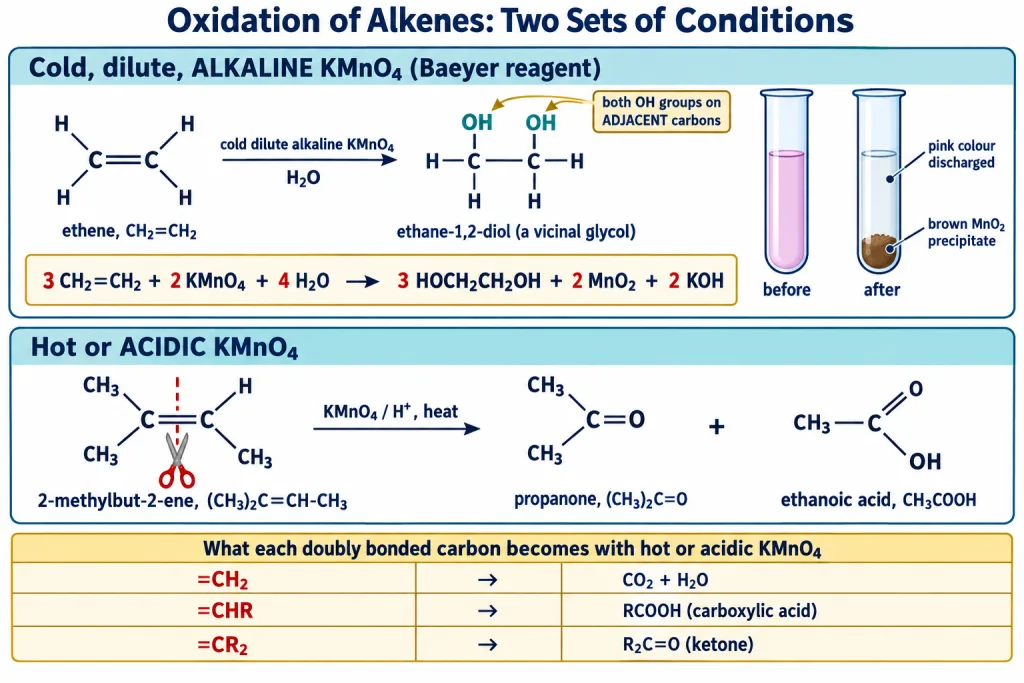
What you actually see
solution is pink when dilute and deep purple when stronger, with manganese in the state. Oxidising the alkene drops it to , which is , an insoluble brown solid.
Key Point: In a positive Baeyer test the pink or purple colour is discharged and a brown precipitate of manganese dioxide appears. Both changes together are the test for unsaturation.
The colour going is the eye-catching half, but the brown precipitate is the half that confirms it — fading could be dilution, while brown settling out can only be permanganate that has been reduced.
The glycols from some common alkenes
| Alkene | Glycol formed |
|---|---|
| Ethene, | ethane-1,2-diol |
| Propene, | propane-1,2-diol |
| But-1-ene, | butane-1,2-diol |
| But-2-ene, | butane-2,3-diol |
| 2-Methylpropene, | 2-methylpropane-1,2-diol |
| Cyclohexene | cyclohexane-1,2-diol |
The carbon skeleton is untouched: the double bond has simply become a single bond carrying two groups. That is the signature of the cold alkaline conditions.
[JEE Main] Both oxygen atoms come from the same permanganate ion and reach the same face of the flat alkene, so the addition is syn. Cyclohexene therefore gives the cis diol.
What a negative test tells you, which is the more useful half
If the pink colour survives, nothing reduced the permanganate: no carbon-carbon double or triple bond is available for oxidation. Such a sample is saturated or aromatic — an alkane, a haloalkane, or benzene.
That last case matters later in this chapter. Benzene, , is written with three double bonds and yet it does not decolourise Baeyer's reagent and does not decolourise bromine water. A negative test from something with the formula of a triene is a hard experimental fact, and one of the pieces of evidence that forces the delocalised picture of benzene.
A positive test is weaker evidence, because the reagent is a general oxidising agent — alkynes decolourise it too, and so do aldehydes and many alcohols. So:
- colour stays — no , no ; a firm conclusion.
- colour goes, brown solid appears — something oxidisable is present, and a second test is needed to pin it down.
Oxidation with acidic or hot permanganate — the double bond is cut
Change the conditions and permanganate stops being polite. Acidic permanganate, hot permanganate, or acidic potassium dichromate takes the glycol it would have formed and keeps oxidising, until the bond between the two carbons that used to be doubly bonded is broken outright.
Key Point: Acidic , or hot , cleaves the double bond. The molecule comes apart into two fragments, and each fragment ends up as a ketone, a carboxylic acid or carbon dioxide, according to what was attached to that carbon.
The fragment rule — learn these three lines and nothing else is needed
Look at each doubly bonded carbon separately and ask how many hydrogen atoms it carries.
| That carbon in the alkene | Hydrogens on it | What it becomes |
|---|---|---|
| (terminal) | two | and |
| one | a carboxylic acid, | |
| none | a ketone, |
The logic is straightforward oxidation. A carbon with two hydrogens is oxidised right past methanal and methanoic acid to carbon dioxide. A carbon with one hydrogen loses it and gains an , stopping at the acid. A carbon with no hydrogen has nothing left to lose once the oxygen is attached, so it stops at the ketone.
Case 1: But-2-ene
Both doubly bonded carbons are of the kind, with , so both give the same acid.
Two moles of ethanoic acid. Four carbons in, four carbons out. Written out in full:
The shorthand is what examinations expect, but the full equation balances, with forty electrons passing from the five alkene molecules to the eight permanganate ions.
Case 2: Propene
One carbon is and gives an acid; the other is a terminal and is burnt off as carbon dioxide.
Losing a carbon as is the mark of a terminal double bond. Carbon dioxide among the products means the alkene had a group.
Case 3: 2-Methylbut-2-ene
The disubstituted carbon has no hydrogen and stops at propanone; the other has one hydrogen and goes on to ethanoic acid. One ketone and one acid — a very common examination pattern.
Case 4: 2-Methylpropene
Propanone, plus a lost carbon.
Case 5: 2,3-Dimethylbut-2-ene
Neither carbon has a hydrogen, so nothing is lost and two moles of propanone are formed.
[NEET] The commonest slip is answering a cold-alkaline question with a cleavage product or the other way round. Read the words in front of first: cold, dilute, alkaline means the glycol; acidic or hot means the cut.
Ozonolysis — cutting the molecule where the double bond was
Ozonolysis does the same cutting job as hot permanganate but stops one oxidation level earlier, at the aldehyde. That is what makes it useful: the products keep a record of what was attached to each doubly bonded carbon, hydrogen atoms included.
The two steps
Step 1. Ozone adds across the double bond, and the unstable first adduct rearranges to a five-membered ring holding three oxygen atoms, the ozonide.
Step 2. Zinc dust and water break the ozonide up. Adding the hydrolysis to the removal of the peroxide by zinc, both written out below, gives the balanced overall change:
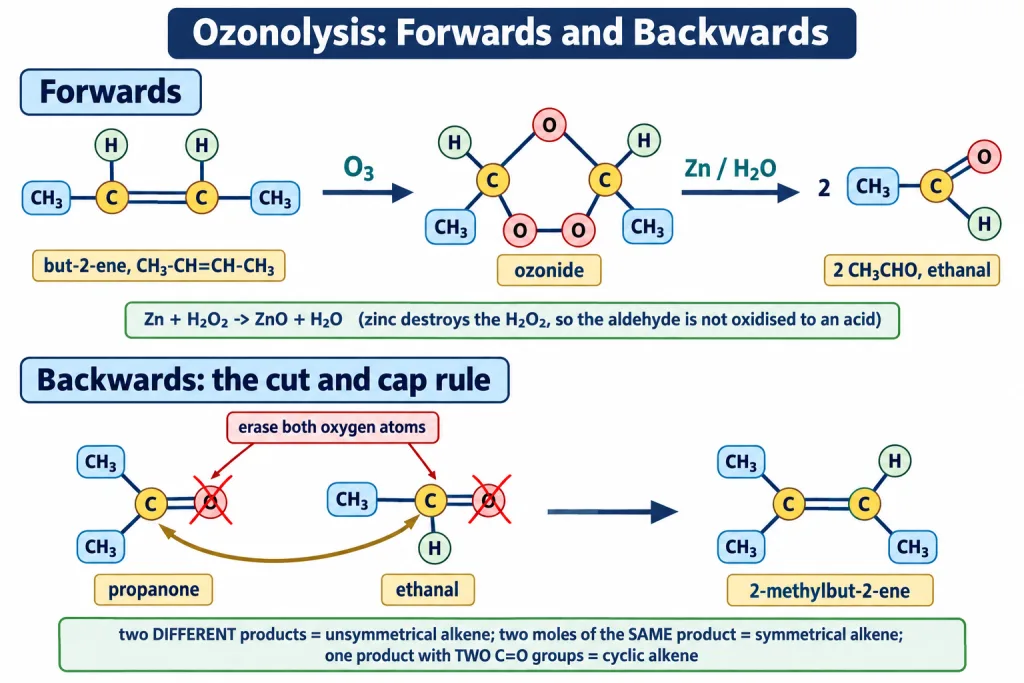
Key Point: Ozonolysis is the addition of ozone to an alkene to form an ozonide, followed by cleavage of that ozonide with zinc and water to give aldehydes and/or ketones. Each carbon of the broken double bond ends up as a carbonyl carbon.
Why zinc is in the flask
Water alone would split the ozonide, but it would also release hydrogen peroxide:
Hydrogen peroxide is an oxidising agent, and an aldehyde is the easiest thing in the flask to oxidise. Left alone it would turn the ethanal into ethanoic acid, destroying the evidence — an original carbon could no longer be told from an original carbon. Zinc removes the peroxide as fast as it forms:
Key Point: Zinc is added as a reducing agent, to destroy the hydrogen peroxide produced when the ozonide is hydrolysed. Without zinc, any aldehyde formed would be oxidised further to a carboxylic acid.
The fragment rule going forwards
Cut the double bond down the middle, and cap each cut end with a doubly bonded oxygen atom. Everything else stays where it was.
| That carbon in the alkene | What it becomes on ozonolysis |
|---|---|
| methanal, | |
| an aldehyde, | |
| a ketone, |
Set that beside the hot-permanganate table and the difference is one oxidation step on the middle row: permanganate takes to , ozonolysis with zinc stops at . The bottom rows are identical, because a ketone cannot be oxidised further without breaking a carbon-carbon bond.
Worked forwards, four alkenes
| Alkene | Structure | Ozonolysis products |
|---|---|---|
| Pent-2-ene | ethanal + propanal | |
| 3,4-Dimethylhept-3-ene | butan-2-one + pentan-2-one | |
| 2-Ethylbut-1-ene | methanal + pentan-3-one | |
| 1-Phenylbut-1-ene | benzaldehyde + propanal |
Check the second against the fragment rule. Its left-hand doubly bonded carbon carries an ethyl group, a methyl group and no hydrogen, giving butan-2-one, . The right-hand carbon carries a methyl and a propyl group and no hydrogen, giving pentan-2-one, . No carbon is lost.
[JEE/NEET] A cyclic alkene holds both doubly bonded carbons in the same molecule, so the ring opens and a single compound with two carbonyl groups comes out. Cyclohexene gives hexanedial, .
Working backwards from the carbonyl products
This is why ozonolysis earns its place in the syllabus. Given the carbonyl compounds, you can reconstruct the alkene and say precisely where its double bond was. Papers ask it far more often than they ask the forward reaction.
Key Point: To go backwards, erase the two oxygen atoms from the two carbonyl compounds and join the two carbonyl carbons together with a double bond. Everything else is copied across untouched.
Three checks keep you out of trouble:
- Count the carbons. Carbons in the alkene = carbons in fragment one + carbons in fragment two, because nothing is lost in ozonolysis with zinc.
- Two different products means an unsymmetrical alkene.
- One product, two moles of it, means a symmetrical alkene. One product with two carbonyl groups in the same molecule means a cyclic alkene.
Case A: ethanal and pentan-3-one
Ethanal leaves the fragment ; pentan-3-one leaves . Join them:
Carbon count: , matching the structure. The longest chain through the double bond is five carbons, the double bond starts at the second, and an ethyl group hangs off the third. The alkene is 3-ethylpent-2-ene.
Case B: two moles of an aldehyde of molar mass 44 u
An aldehyde of relative molecular mass 44 is , ethanal (). Two moles of the same aldehyde means a symmetrical alkene with on each side:
But-2-ene. A stated bond count of three carbon-carbon sigma bonds, eight carbon-hydrogen bonds and one pi bond agrees with it. But-1-ene and 2-methylpropene fit that bond count equally well, so it is the ozonolysis result, not the bond count, that picks out but-2-ene.
Case C: propanal and pentan-3-one
Propanal gives ; pentan-3-one gives . Joined:
Eight carbons, . The longest chain containing the double bond is six carbons; numbering so the substituent takes the lower locant puts the double bond at position 3 with an ethyl group also at position 3: 3-ethylhex-3-ene.
Case D: two moles of propanone
Propanone is , so each fragment is . Joining two of them:
2,3-Dimethylbut-2-ene. The double bond carries four methyl groups and no hydrogen, which is why hot acidic permanganate also gives two moles of propanone from it.
Case E: methanal and propanone
Methanal gives ; propanone gives :
2-Methylpropene. Methanal among the products always means the alkene had a terminal group.
Case F: a single product, hexanedial
carries both carbonyl groups in one molecule. Joining the two carbonyl carbons to each other closes a ring of six carbons, giving cyclohexene.
[JEE Main] Ozonolysis products do not distinguish cis from trans. Both but-2-enes give two moles of ethanal, because the reaction destroys the geometry along with the double bond. Identifying an alkene from ozonolysis alone gives the constitution, never the configuration.
Polymerisation — many small molecules become one large one
Under high temperature and high pressure, with a catalyst, the pi bond of one alkene molecule opens and bonds to the next, and that one to the next, thousands of times over. Nothing is thrown away; every atom of every monomer ends up in the chain.
Key Point (Definitions): A monomer is the small molecule that repeats. A polymer is the large molecule built from many of them. The repeating unit is the fragment that recurs along the chain, written inside brackets with outside. Addition polymerisation joins the monomers with no small molecule eliminated, so the polymer has the same percentage composition as the monomer.
Polythene from ethene
The repeating unit is , exactly the atoms of one ethene molecule with the double bond turned into two single bonds to its neighbours. A chain of relative molar mass was built from ethene molecules, and that arithmetic is a standard one-mark question.
Polypropene from propene
The methyl group does not take part; it simply hangs off every alternate carbon of the backbone.
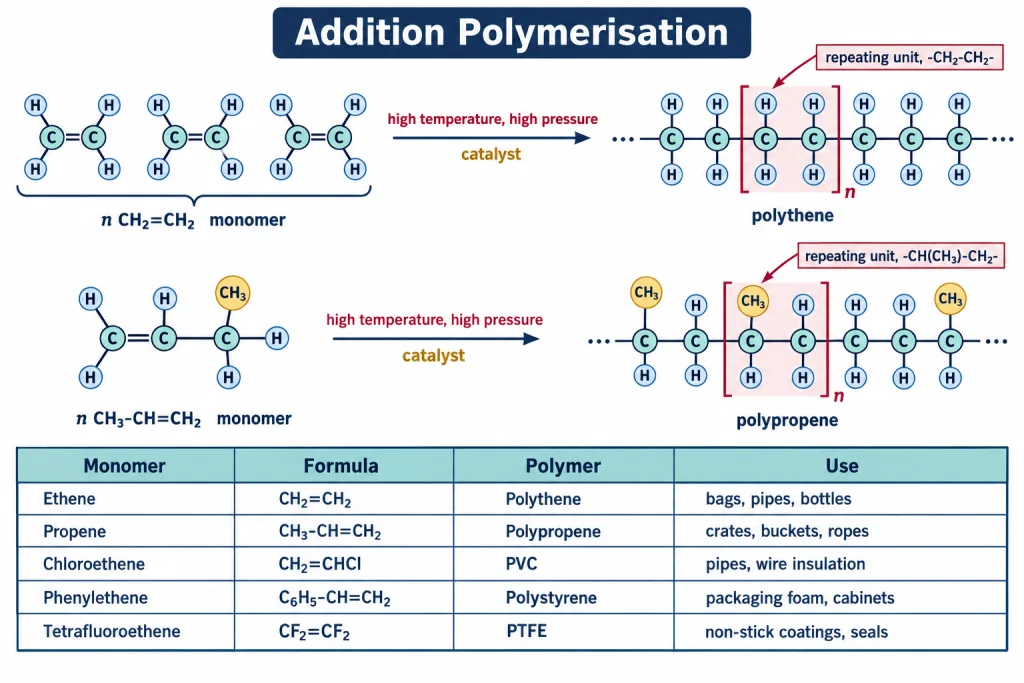
The common addition polymers
| Monomer | Monomer formula | Polymer | Typical uses |
|---|---|---|---|
| Ethene | polythene | carry bags, sheets, squeeze bottles, refrigerator dishes, pipes, toys | |
| Propene | polypropene | milk crates, plastic buckets, moulded articles, ropes | |
| Chloroethene (vinyl chloride) | polyvinyl chloride, PVC | water pipes, insulation on electrical wire, raincoats, floor tiles | |
| Phenylethene (styrene) | polystyrene | packaging foam, thermal insulation, toys, radio and television cabinets | |
| Tetrafluoroethene | polytetrafluoroethene, PTFE | non-stick coating on cookware, gaskets, chemically resistant seals |
Every one of those monomers has a carbon-carbon double bond, and every one of the polymers is saturated. A polymer will not decolourise bromine water or Baeyer's reagent, because the pi bonds were all spent in making the chain.
The cost
These materials are cheap, light and durable, and the durability is the problem. Polythene and polypropene do not rot and are not attacked by ordinary soil bacteria, so discarded bags and bottles persist for decades, choke drains and are swallowed by animals. Excessive use of both is a matter of serious concern.
Every alkene reaction so far, on one page
Nothing in this table is new. It gathers the whole of the alkene chemistry — hydrogen, halogens and hydrogen halides, Markovnikov and the peroxide effect, and this section's reactions — with reagent, conditions, product and what would be seen in a test tube.
| Reagent | Conditions | Product from the alkene | Observation and notes |
|---|---|---|---|
| Ni, Pt or Pd; heat (Ni at 573 K) | the alkane | gas absorbed; the standard reduction | |
| in , room temperature | vicinal dibromide | red-brown colour discharged — test for unsaturation; anti addition through a cyclic bromonium ion | |
| in water (bromine water) | addition product | orange colour discharged; the everyday form of the same test | |
| dry, no peroxide; reactivity | alkyl halide | Markovnikov: X to the carbon with fewer hydrogens; via the more stable carbocation | |
| with benzoyl peroxide | alkyl bromide, anti-Markovnikov | peroxide (Kharasch) effect; free-radical chain; HBr only | |
| conc. | cold | alkyl hydrogen sulphate | Markovnikov; boiling with water then gives the alcohol |
| dilute | alcohol | Markovnikov; industrial ethanol from ethene | |
| cold, dilute, alkaline (Baeyer) | vicinal glycol, a 1,2-diol | pink colour discharged, brown appears — the Baeyer test | |
| acidic, or hot | cleavage: ketones and/or acids, from a terminal | skeleton broken; carbons can be lost | |
| , then | ozonide first, then reductive cleavage | aldehydes and/or ketones | locates the double bond; zinc destroys |
| itself | high temperature, high pressure, catalyst | addition polymer | polythene from ethene, polypropene from propene |
The three questions that separate the conditions
Which permanganate? Cold, dilute and alkaline gives a diol and keeps every carbon. Acidic or hot cuts the chain and can burn a terminal carbon off as .
Permanganate or ozone for the cut? Both break the double bond in the same place, but ozonolysis with zinc stops at the aldehyde while hot acidic permanganate goes on to the acid. A carbon gives ethanal with ozone and ethanoic acid with permanganate.
Markovnikov or anti-Markovnikov? Anti-Markovnikov happens only for HBr with a peroxide. Hydration, hydrohalogenation without peroxide and addition of concentrated sulphuric acid are all Markovnikov.
Worked items
Question 1: Hydration of but-1-ene
Give the product when but-1-ene is treated with water and a little dilute sulphuric acid, and name it.
Answer:
But-1-ene is . The two doubly bonded carbons are C1, which carries two hydrogens, and C2, which carries one.
Markovnikov says the negative part, , goes to the carbon with fewer hydrogens, so it goes to C2 and the hydrogen goes to C1.
Ans: Butan-2-ol.
Watch out: Butan-1-ol is the tempting wrong answer. It needs the on the end carbon, which means a primary carbocation forming in preference to a secondary one, and that does not happen.
Question 2: Distinguishing propane from propene
You have two unlabelled gas jars, one of propane and one of propene. Describe a test with Baeyer's reagent and say exactly what is seen in each jar.
Answer:
Baeyer's reagent is cold, dilute, alkaline , and it is pink. I shake a little of it with the gas from each jar.
With propene the pink colour disappears and a brown precipitate of settles out, because the double bond is oxidised to a glycol:
With propane nothing happens; there is no pi bond to oxidise, so the solution stays pink.
Ans: Propene decolourises the reagent and deposits brown ; propane leaves it pink.
Question 3: Glycol from but-1-ene, with a balanced equation
Write the product of but-1-ene with cold dilute alkaline and give a balanced equation using itself.
Answer:
Both hydroxyl groups go on the carbons that were doubly bonded, C1 and C2, so the product is butane-1,2-diol, . For the equation I use the same stoichiometry as for ethene, three alkene to two permanganate:
Checking: carbon 12 each side; hydrogen against ; oxygen against ; potassium 2 and manganese 2 each side.
Ans: Butane-1,2-diol, by the equation above.
Question 4: Reading a negative test
A colourless liquid of molecular formula does not decolourise Baeyer's reagent and does not decolourise bromine water. What does that tell you, and what does it not tell you?
Answer:
A formula of has four degrees of unsaturation, so on paper the molecule looks like a triene or worse.
The negative Baeyer test says there is no reactive carbon-carbon double or triple bond, and the negative bromine water test says the same thing independently.
What neither says is that the molecule is saturated. The pi electrons may be present but tied up in a delocalised system that will not give them up, which is the case for benzene.
Ans: No ordinary or is present. The compound is benzene, whose six pi electrons are delocalised and unreactive towards these reagents.
Watch out: A negative test is firm; a positive one is not, because Baeyer's reagent also reacts with alkynes, aldehydes and many alcohols.
Question 5: Hot acidic permanganate on pent-2-ene
What are the products when pent-2-ene is heated with acidic ?
Answer:
Pent-2-ene is . Its left-hand doubly bonded carbon carries one hydrogen and a methyl group, so it becomes ; the right-hand one carries one hydrogen and an ethyl group, so it becomes .
Carbon count , matching pent-2-ene, so nothing was lost.
Ans: Ethanoic acid and propanoic acid.
Question 6: Hot acidic permanganate on 2-methylbut-2-ene
Predict the products.
Answer:
2-Methylbut-2-ene is . The carbon on the left has two methyl groups and no hydrogen, so it cannot be oxidised past a ketone and gives propanone. The carbon on the right has one hydrogen, so it goes on to ethanoic acid.
Ans: Propanone and ethanoic acid.
Question 7: When carbon dioxide appears
An alkene of formula gives propanone, carbon dioxide and water on treatment with hot acidic . Identify it.
Answer:
Carbon dioxide among the products means one doubly bonded carbon was a terminal , since only a carbon with two hydrogens is oxidised all the way to . Propanone accounts for the other end, so that carbon was . Putting the ends back together gives , which is as required.
Ans: 2-Methylpropene.
Watch out: But-1-ene is also with a terminal , but its other carbon carries a hydrogen, so it gives propanoic acid, not a ketone.
Question 8: Ozonolysis of four named alkenes
Give the IUPAC names of the ozonolysis products of (i) pent-2-ene, (ii) 3,4-dimethylhept-3-ene, (iii) 2-ethylbut-1-ene and (iv) 1-phenylbut-1-ene.
Answer:
For each I cut between the doubly bonded carbons and cap each cut carbon with .
(i) . Left end: methyl and one hydrogen, so . Right end: ethyl and one hydrogen, so .
(ii) . Left carbon: ethyl and methyl, no hydrogen, so . Right carbon: methyl and propyl, no hydrogen, so . Carbon count , matching the nine carbons of the alkene.
(iii) . The terminal gives methanal; the other carbon carries two ethyl groups, so .
(iv) . The carbon bearing the phenyl group has one hydrogen, so ; the other gives .
Ans: (i) ethanal and propanal; (ii) butan-2-one and pentan-2-one; (iii) methanal and pentan-3-one; (iv) benzaldehyde and propanal.
Watch out: In the last one the benzene ring is untouched. Ozone attacks the isolated alkene double bond, not the delocalised ring.
Question 9: Backwards from ethanal and pentan-3-one
An alkene A on ozonolysis gives a mixture of ethanal and pentan-3-one. Write the structure and the IUPAC name of A.
Answer:
I strip the oxygen off each carbonyl compound and keep the carbon it was on. Ethanal leaves and pentan-3-one leaves . Joining the two former carbonyl carbons with a double bond:
Seven carbons, matching . The longest chain containing the double bond is five carbons, so it is a pentene with the double bond at position 2 and an ethyl group at position 3.
Ans: , which is 3-ethylpent-2-ene.
Question 10: Backwards from a bond count and one aldehyde
An alkene A contains three carbon-carbon sigma bonds, eight carbon-hydrogen bonds and one carbon-carbon pi bond. On ozonolysis A gives two moles of an aldehyde of molar mass 44 u. Give the IUPAC name of A.
Answer:
An aldehyde of molar mass 44 is , since ; methanal is 30 and propanal 58. Two moles of the same aldehyde means a symmetrical alkene with on both sides:
The bond count agrees: three carbon-carbon sigma bonds — the two single bonds plus the sigma part of the double bond — with carbon-hydrogen bonds and one pi bond.
Ans: But-2-ene.
Watch out: But-1-ene and 2-methylpropene also have three carbon-carbon sigma bonds and eight carbon-hydrogen bonds. The bond count alone does not settle it; the two identical aldehyde molecules do.
Question 11: Backwards from propanal and pentan-3-one
Propanal and pentan-3-one are the ozonolysis products of an alkene. Give its structural formula and name.
Answer:
Propanal leaves and pentan-3-one leaves . Joining them:
Eight carbons, matching . The longest chain through the double bond is six carbons, and numbering from the end that gives the substituent the lower locant puts the double bond between C3 and C4 with the ethyl group on C3.
Ans: , which is 3-ethylhex-3-ene.
Question 12: Backwards from a single ketone and from a single dialdehyde
(i) An alkene gives two moles of propanone on ozonolysis. (ii) A different alkene gives only hexanedial, . Identify both.
Answer:
(i) Propanone leaves , and two of those joined give : six carbons, four methyl groups on the double bond.
(ii) Both carbonyl groups are in the same molecule, so the two doubly bonded carbons belonged to the same ring. Joining the two carbons closes a six-membered ring with one double bond in it.
Ans: (i) 2,3-Dimethylbut-2-ene. (ii) Cyclohexene.
Watch out: Two moles of one product means a symmetrical open-chain alkene; one product carrying two carbonyl groups means a cyclic alkene. Reading that difference wrongly is the standard mistake here.
Question 13: Why zinc, and what happens without it
Explain why zinc dust is added when an ozonide is hydrolysed, and state what would be obtained from the ozonide of but-2-ene if the zinc were left out.
Answer:
Hydrolysis of the ozonide releases hydrogen peroxide along with the carbonyl compounds:
Hydrogen peroxide is an oxidising agent and an aldehyde is very easily oxidised, so the ethanal would not survive. Zinc removes it as it forms:
Without zinc the ethanal would be oxidised on to ethanoic acid, and an original carbon could no longer be told from an original carbon.
Ans: Zinc destroys the hydrogen peroxide produced on hydrolysis. Without it, but-2-ene would give two moles of ethanoic acid instead of two moles of ethanal.
Question 14: Comparing the three cutting reagents on one alkene
For 2-methylbut-2-ene, give the products with (i) cold dilute alkaline , (ii) followed by , and (iii) hot acidic .
Answer:
The alkene is .
(i) Cold dilute alkaline permanganate adds two groups and keeps the skeleton whole, giving , 2-methylbutane-2,3-diol; the pink colour goes and brown appears.
(ii) Ozonolysis cuts the bond and caps each carbon with oxygen: propanone from the disubstituted carbon, ethanal from the other.
(iii) Hot acidic permanganate cuts in the same place but oxidises further, so propanone again, but ethanoic acid from the carbon that had a hydrogen.
Ans: (i) 2-Methylbutane-2,3-diol. (ii) Propanone and ethanal. (iii) Propanone and ethanoic acid.
Watch out: The ketone is the same in all three answers. Only the fragment that carried a hydrogen changes, and it is that fragment which reveals the reagent.
Question 15: Repeating unit and chain length
Write the repeating unit of polypropene, and find how many ethene molecules are joined in a polythene molecule of relative molar mass .
Answer:
Propene is , and in the polymer its double bond becomes two single bonds to neighbouring units, so the repeating unit is .
Addition polymerisation throws nothing away, so the chain's molar mass is times that of ethene, , which is .
Ans: Repeating unit ; ethene molecules.
Watch out: The double bond does not survive polymerisation — every pi bond is spent joining one unit to the next. Polythene is saturated, so it does not decolourise bromine water or Baeyer's reagent, even though ethene does both.