
The arenes — one family, two shapes
Aromatic hydrocarbons are also called arenes. The name is an accident of history: the first members of the class came from balsams, resins and aromatic oils and had a strong, pleasant smell, and the Greek aroma means a pleasant smell. The label stuck long after chemists found that most aromatic compounds smell of nothing much. Today "aromatic" says nothing about odour; it describes a kind of ring, a kind of stability and a kind of chemistry.
Key Point (Definition): Arenes are hydrocarbons built around one or more highly unsaturated rings that show unusual stability and undergo substitution in preference to addition. Most of them contain a benzene ring.
Benzenoid and non-benzenoid
Aromatic compounds containing a benzene ring are benzenoid. Benzene, toluene, naphthalene and every ordinary aromatic compound met at this level is benzenoid.
A smaller group contain no benzene ring at all. Their rings are of a different size, but they are still planar, still fully conjugated and still hold a delocalised electron cloud, so they behave aromatically. These are the non-benzenoid aromatics — the tropylium (cycloheptatrienyl) cation and the cyclopentadienyl anion are the standard examples. Section 15 gives the exact test that decides which rings qualify.
Mononuclear and polynuclear
An arene with one benzene ring is mononuclear. An arene with two or more rings fused together, sharing a pair of carbon atoms along a common edge, is polynuclear.
| Arene | Formula | Rings | Type |
|---|---|---|---|
| Benzene | 1 | mononuclear | |
| Toluene (methylbenzene) | 1 | mononuclear | |
| Xylene (dimethylbenzene) | 1 | mononuclear | |
| Styrene (vinylbenzene) | 1 | mononuclear | |
| Cumene (isopropylbenzene) | 1 | mononuclear | |
| Naphthalene | 2 fused | polynuclear | |
| Anthracene | 3 fused, in a line | polynuclear | |
| Phenanthrene | 3 fused, angular | polynuclear |
Anthracene and phenanthrene share the formula and differ only in how the third ring is attached — straight on in anthracene, bent round in phenanthrene. They are a pair of isomers worth remembering together.
Biphenyl, , is a trap. Its two benzene rings are joined end to end by an ordinary carbon-carbon single bond and share no edge, so it counts as two linked mononuclear rings, not a polynuclear hydrocarbon.
Naphthalene is the substance of mothballs. Benzene, toluene and the xylenes come commercially from coal tar and from the reforming of petroleum fractions; the aromatisation of -hexane over at 773 K and 10-20 atm, met with the alkanes, is the same chemistry run deliberately.
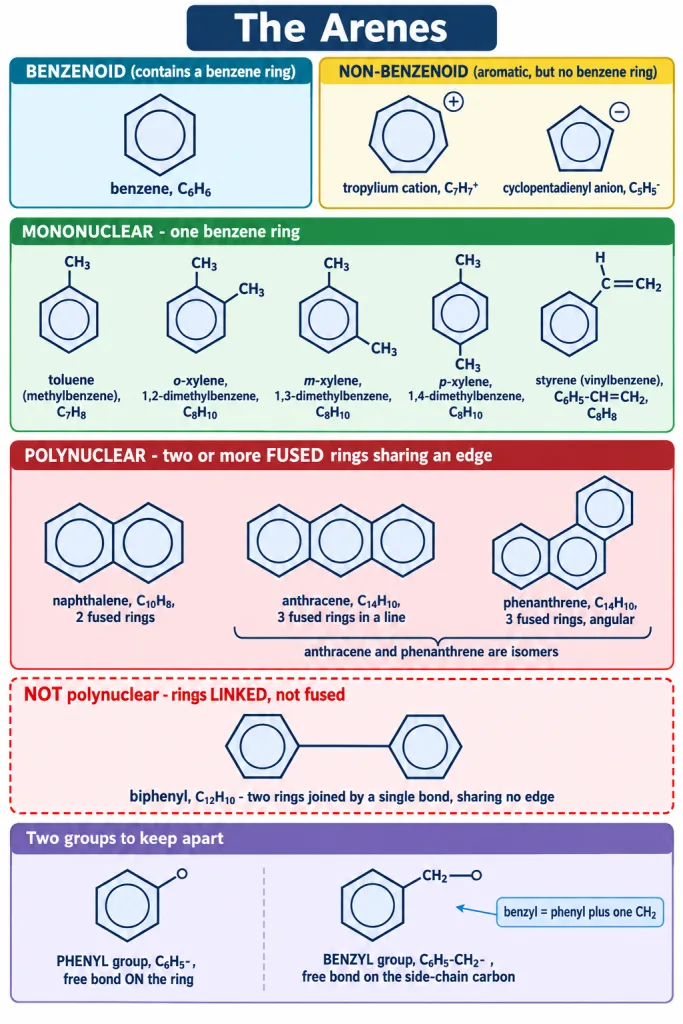
[NEET] Fused rings share an edge; linked rings share only a bond between two carbon atoms. Naphthalene, anthracene and phenanthrene are fused. Biphenyl is linked.
Naming a benzene derivative
Chapter 8 gave the naming rules in full. What follows is the working set for arenes, in the compact form that is actually used.
Benzene is the parent
For a single substituent the prefix goes straight in front of the word benzene, with no locant, because all six positions are the same.
chlorobenzene, nitrobenzene, ethylbenzene, propylbenzene.
The retained names that are still used
A handful of common names were retained by the IUPAC and are used constantly. Both names must be recognised on sight.
| Retained name | Systematic name | Formula |
|---|---|---|
| Toluene | methylbenzene | |
| Xylene | dimethylbenzene | |
| Styrene | vinylbenzene (ethenylbenzene) | |
| Cumene | isopropylbenzene | |
| Mesitylene | 1,3,5-trimethylbenzene |
Toluene, phenol, aniline, benzaldehyde and benzoic acid also act as parent names in their own right. When one of them is the parent, the group that gives it its name takes position 1 and the ring is numbered from there.
Two or more substituents
Number the ring so that the substituents get the lowest set of locants, and cite the prefixes in alphabetical order. Where the direction is still open, the substituent first in alphabetical order gets the lower number.
with the groups on adjacent carbons is 1-methyl-2-nitrobenzene, or as a toluene derivative 2-nitrotoluene. A ring with a methyl group at 1 and bromine at 4 is 1-bromo-4-methylbenzene, or 4-bromotoluene.
Phenyl and benzyl — the two groups that get confused
Key Point: is the phenyl group (benzene minus one hydrogen). is the benzyl group (toluene minus one hydrogen from the methyl group). Benzyl has one carbon more than phenyl, and the attachment point is on that extra carbon, not on the ring.
is chlorobenzene, also called phenyl chloride. is benzyl chloride, systematically (chloromethyl)benzene — the chlorine sits on the side chain, not on the ring. Writing "chlorotoluene" for it puts the chlorine in the wrong place entirely.
The phenyl name is used when the ring is a substituent rather than the parent, which happens when the attached chain outranks a six-carbon ring: is 1-phenylheptane, while the shorter stays ethylbenzene.
[Board] Styrene is the monomer of polystyrene and cumene is the industrial route to phenol and acetone. Both retained names are examined by name, so learn the structure behind each.
Isomerism in substituted benzenes
One monosubstituted product, and what it proves
Replace one hydrogen of benzene by chlorine and you get chlorobenzene, every time. No second monochlorobenzene has ever been isolated, and the same holds for bromine, for the nitro group and for a methyl group.
Key Point: Benzene gives one and only one monosubstituted product. All six hydrogen atoms, and therefore all six carbon atoms, are equivalent. Any proposed structure for benzene must have that symmetry.
Three disubstituted isomers
Put two groups on the ring and three arrangements are possible, no more.
| Arrangement | Locants | Prefix | Name of the dimethyl case |
|---|---|---|---|
| Adjacent carbons | 1,2 | ortho (-) | -xylene, 1,2-dimethylbenzene |
| One carbon between them | 1,3 | meta (-) | -xylene, 1,3-dimethylbenzene |
| Directly across the ring | 1,4 | para (-) | -xylene, 1,4-dimethylbenzene |
Counting the other way round the ring changes nothing. Going anticlockwise the adjacent position is carbon 6, so 1,6 is the same compound as 1,2, and 1,5 is the same as 1,3. The lowest-locant rule picks 1,2 and 1,3 and settles it. There is no fourth dimethylbenzene to find.
The -, - and - prefixes work only for two substituents. Three or more need numbers.
Trisubstituted rings: again three
For three identical groups, , there are exactly three isomers: 1,2,3 (vicinal, all three together), 1,2,4 (asymmetrical) and 1,3,5 (symmetrical). The 1,3,5-trimethyl compound is mesitylene.
Isomers of a given formula
— four. Six carbons go into the ring and two are left. Joined, they give ethylbenzene; separated, they give -, - and -xylene.
— eight. Three carbons are left after the ring, and they go on as one group of three, as two plus one, or as three separate groups.
- One chain, two ways: propylbenzene, , and isopropylbenzene (cumene), .
- Ethyl plus methyl, three ways: 1-ethyl-2-, 1-ethyl-3- and 1-ethyl-4-methylbenzene.
- Three methyl groups, three ways: 1,2,3-, 1,2,4- and 1,3,5-trimethylbenzene.
Two plus three plus three gives eight. The usual slips are forgetting that a three-carbon chain has a branched form, and inventing a fourth trimethyl arrangement by treating 1,2,6 as different from 1,2,3.
The structure problem: a formula that says one thing and a flask that says another
Michael Faraday isolated benzene in 1825 from the oily residue of compressed illuminating gas, and its formula turned out to be . Fixing a structure on it took the better part of a century, and the argument chemists went through is the argument examiners still ask for.
Step 1 — the formula predicts a wildly unsaturated compound
A saturated open-chain compound with six carbons is , from the general formula . Benzene has eight hydrogen atoms fewer. Every ring and every pi bond costs two hydrogen atoms, so
Four degrees of unsaturation. Compare hexane (zero), hex-1-ene (one), hex-1-yne (two). Benzene is as hydrogen-poor as a compound with two triple bonds, so the formula says it should be violently unsaturated.
Step 2 — the flask flatly refuses
Shake benzene with bromine water: nothing happens and the orange colour stays. Shake it with Baeyer's reagent, cold dilute alkaline : the pink colour stays and no brown appears. Offer it : no addition. An alkene does all three in seconds.
What benzene does instead is substitute. Bromine with anhydrous replaces a hydrogen and gives out hydrogen bromide:
Six carbon and six hydrogen on the left; six carbon and six hydrogen on the right, five on the ring and one in ; two bromine each side. Balanced, and the ring survives untouched. Benzene behaves as though it were saturated while being formally more unsaturated than an alkyne.
Step 3 — but the unsaturation is genuinely there
Benzene adds three molecules of ozone to give a triozonide, which is what a compound with three carbon-carbon double bonds does. Under force it also adds hydrogen and chlorine:
Both take three moles of reagent, so three double bonds are present. Neither happens under mild conditions.
The five facts a structure has to satisfy
- The formula is , giving four degrees of unsaturation.
- All six hydrogen atoms are equivalent — one monosubstituted product only.
- Exactly three disubstituted isomers exist.
- Three double bonds are present (triozonide, three moles of , three moles of ).
- The compound is unusually stable and prefers substitution to addition.
[JEE Main] The degrees-of-unsaturation calculation is worth doing on sight for any aromatic formula. Four for means one ring plus three pi bonds, and that combination is the fingerprint of a benzene ring.
Kekule's ring, and where it breaks
The proposal, 1865
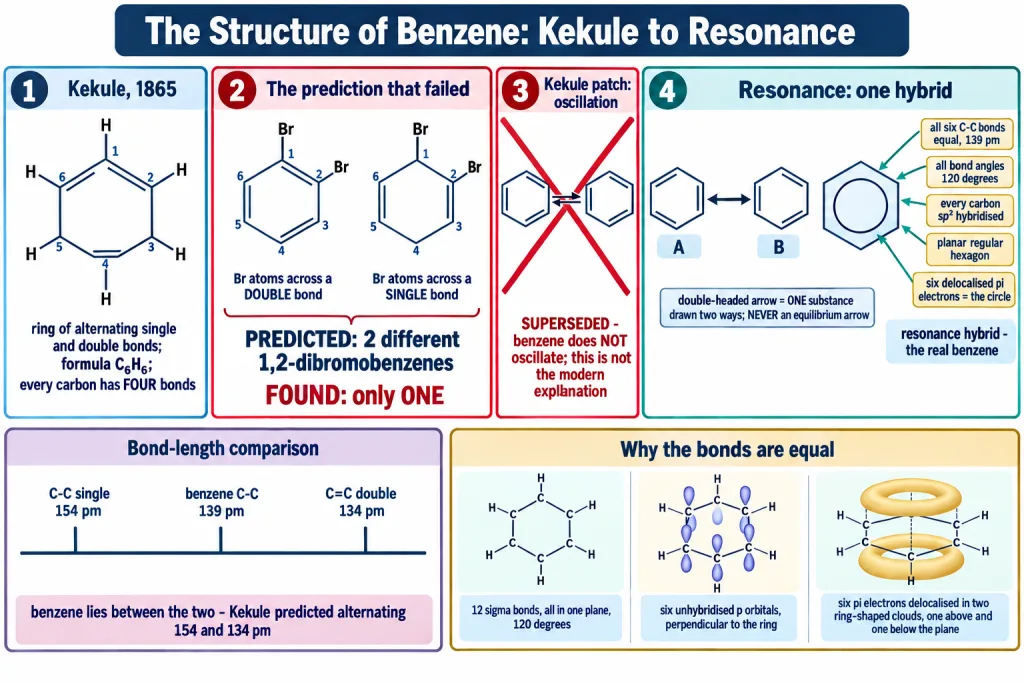
August Kekule proposed that the six carbon atoms of benzene are joined in a closed ring with alternating single and double bonds, each carbon carrying one hydrogen atom. Written out, the ring runs back to .
Every carbon there has four bonds: a single bond to one neighbour, a double bond counting two to the other, and one bond to hydrogen. The formula comes out as exactly.
The structure clears three of the five hurdles at once. The formula is right. Three double bonds account for the triozonide and the three moles of hydrogen. And every carbon sits in the same environment of one single bond, one double bond and one hydrogen, so monosubstitution can give only one product.
The break: two ortho isomers where only one exists
Take the Kekule ring and put a bromine on carbon 1 and a bromine on carbon 2. Two different compounds appear on paper:
- one in which and are joined by a double bond;
- one in which and are joined by a single bond.
Those are different molecules on the page, with different bond lengths between the substituted carbons, so they ought to be separable substances with different melting points. Chemists looked hard. Only one 1,2-dibromobenzene has ever been isolated.
Meta and para escape the problem, since the 1,3 pair is separated by one carbon either way and the 1,4 pair sits across the ring. The whole difficulty is at the ortho position.
Kekule's patch: oscillating structures
Kekule's answer was that the two forms are not fixed. The double bonds shift round the ring and back so rapidly that no method could catch a molecule in one form or separate the two ortho compounds; only the average would ever be observed.
The patch works as bookkeeping and is worth knowing as history. It is not the modern explanation, and benzene does not oscillate.
What the patch still could not do
Two problems survived it.
Stability. Nothing in a ring of shifting double bonds explains why benzene is so much harder to attack than an ordinary triene, or why it insists on substitution when every other unsaturated hydrocarbon adds.
Bond lengths. Alternating single and double bonds mean alternating lengths — 154 pm next to 134 pm all the way round, a lopsided hexagon. Oscillation does not change that; each individual form still has long and short bonds.
X-ray diffraction settled it. All six carbon-carbon bonds in benzene are equal, at 139 pm, intermediate between 154 and 134 pm, and the ring is a regular planar hexagon with every angle 120 degrees. There is no long bond and no short bond to be found.
A structure with three genuine double bonds cannot give six identical bonds. The Kekule structure, patched or unpatched, is not the structure of benzene.
Resonance: one molecule, two contributors
The modern account keeps Kekule's ring and discards the alternating bonds as a description of a real molecule.
Key Point (Definition): The two Kekule arrangements, and , are contributing (resonance) structures. Neither is benzene. Benzene is a single substance, a resonance hybrid of the two, and its bonding is spread evenly round the ring. Contributors are written with a double-headed arrow: .
Resonance is not an equilibrium
This has to be said flatly, because the wrong picture is the most common error in the whole aromatic chapter.
- Benzene does not flick between two structures. There is no oscillation. The oscillation idea was Kekule's historical patch and resonance replaced it.
- The flask does not hold a mixture of molecules and molecules. Every molecule in the bottle is identical, and each is the hybrid.
- and could not be isolated at any temperature. They are two incomplete drawings of one thing.
- The arrow is , a double-headed arrow, never . The equilibrium arrow says two species interconvert; the double-headed arrow says one species, drawn twice.
The nuclei do not move between contributors. Only the way the electrons are drawn changes.
The orbital picture
Each carbon in benzene is hybridised.
- Two of its three orbitals overlap with those of the neighbouring carbons, giving six C-C sigma bonds round the ring.
- The third overlaps with the orbital of a hydrogen atom, giving six C-H sigma bonds.
- All twelve sigma bonds lie in one plane at 120 degrees to one another: a planar regular hexagon.
- Each carbon keeps one unhybridised orbital, perpendicular to that plane and holding one electron.
Those six orbitals stand side by side all the way round, and each can overlap sideways with the orbital on its left or the one on its right. Pairing -, -, - is exactly as good as pairing -, -, -, and those two possibilities are the two Kekule contributors.
Since neither is preferred, the overlap goes on all round the ring at once. The six pi electrons are delocalised over all six carbon nuclei and form two ring-shaped clouds, one above the plane and one below. A delocalised cloud is pulled on by six nuclei instead of two, so it lies lower in energy than three pi bonds locked between fixed pairs.
Every carbon-carbon bond is then one sigma bond plus an equal share of the pi cloud, so all six are 139 pm; every angle is 120 degrees; and benzene is far more stable than a hypothetical cyclohexatriene.
The inscribed circle
The hybrid is drawn as a plain hexagon with a circle inscribed inside it: the hexagon is the sigma framework, the circle stands for the six delocalised pi electrons.
Use the circle for the hybrid itself — aromatic character, equal bond lengths, the stability of the ring.
Use a Kekule form with localised double bonds whenever electrons have to be counted or moved: resonance contributors, the arenium ion of an electrophilic substitution, tracking which carbon carries a charge. A circle cannot be pushed with a curly arrow, and a circle in every ring of a fused system misleads — naphthalene has ten pi electrons in total, not six in each of its two rings.
Resonance energy: putting a number on the stability
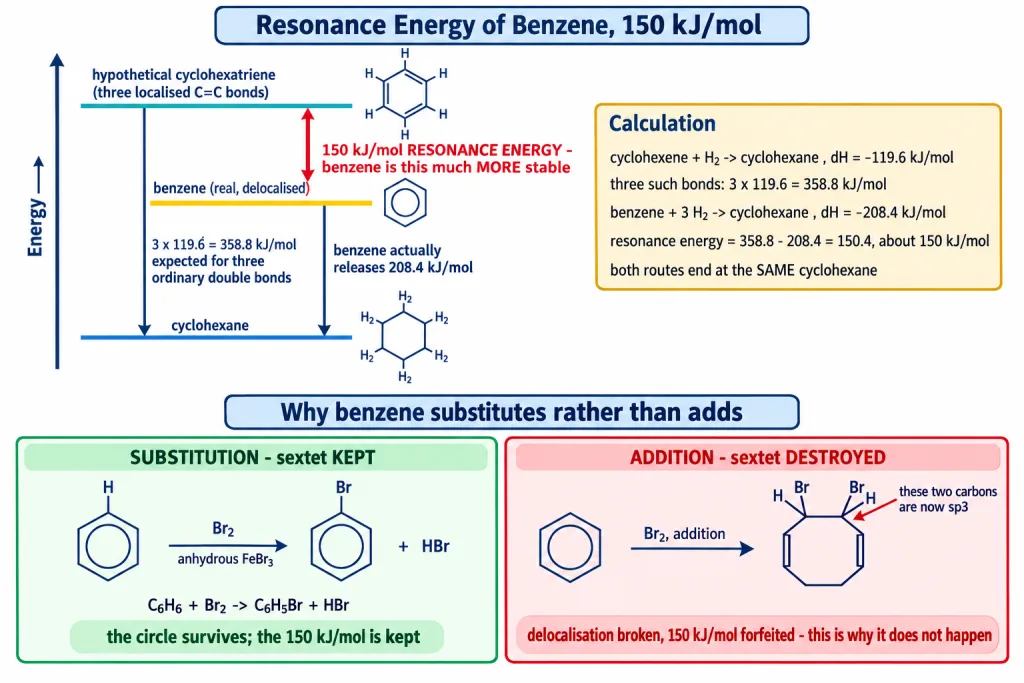
Key Point (Definition): The resonance energy is the difference in energy between the actual molecule and the most stable single contributing structure. For benzene it is about 150 kJ/mol. Benzene lies 150 kJ/mol lower in energy than a hypothetical cyclohexatriene with three ordinary localised double bonds.
Where the number comes from
The hypothetical molecule cannot be put in a flask, so its energy is estimated from the heat a real, ordinary double bond gives out on hydrogenation.
One double bond. Cyclohexene takes up one mole of hydrogen to give cyclohexane, releasing about 119.6 kJ/mol:
Three of them, if benzene were an ordinary triene. Three isolated double bonds should give three times as much:
What benzene actually gives. It takes up three moles of hydrogen, lands on the same cyclohexane, and releases far less:
Both routes end at exactly the same molecule, so a shortfall in heat is a shortfall in the starting energy:
Benzene started 150 kJ/mol lower than the imaginary cyclohexatriene. That deficit is the resonance energy, and it is the price the delocalised sextet exacts from anything that tries to break it up.
Why this decides how benzene reacts
An addition across one of benzene's carbon-carbon bonds spends two of the six pi electrons and turns two ring carbons into centres. The circle is broken, delocalisation is gone and the 150 kJ/mol is forfeited; the product is an ordinary reactive cyclohexadiene.
A substitution takes a hydrogen off the ring and puts a new group in its place. The six pi electrons are never touched, and the ring that comes out is the aromatic ring that went in, sextet intact.
Key Point: Benzene undergoes electrophilic substitution in preference to addition because substitution preserves the delocalised sextet, while addition destroys it and costs the resonance energy.
That sentence is the hinge of the next several sections. It is why bromine with gives bromobenzene and hydrogen bromide rather than a dibromide, why concentrated nitric and sulphuric acids give nitrobenzene, why oleum gives benzenesulphonic acid, and why aluminium chloride with an alkyl or acyl halide alkylates or acylates the ring.
All those substitutions run through an intermediate called the arenium ion, in which aromaticity is temporarily lost and then handed straight back; sections 16 to 18 take that apart. What matters here is why the ring insists on getting its sextet back: 150 kJ/mol of stability, and the fact that benzene is one delocalised hybrid rather than two structures taking turns.
Worked questions
Question 1: Counting the unsaturation in benzene
Work out the degrees of unsaturation in and say what accounts for them.
Answer:
The saturated open-chain formula for six carbons is , so . Benzene is short by hydrogen atoms, and each ring and each pi bond costs two.
For benzene the four are one ring plus three carbon-carbon double bonds.
Ans: Four degrees of unsaturation — one ring and three double bonds. Watch out: Forgetting the ring gives 3. A ring counts exactly as much as a double bond here.
Question 2: Retained name to systematic name
Give the systematic name of toluene, -xylene, styrene, cumene and mesitylene.
Answer:
I take benzene as the parent and name each side chain as a substituent.
- Toluene, : one methyl group, no locant needed — methylbenzene.
- -Xylene: two methyl groups on adjacent carbons — 1,2-dimethylbenzene.
- Styrene, : a vinyl side chain — vinylbenzene (ethenylbenzene).
- Cumene, : an isopropyl side chain — isopropylbenzene.
- Mesitylene: three methyl groups, symmetrically placed — 1,3,5-trimethylbenzene.
Ans: Methylbenzene, 1,2-dimethylbenzene, vinylbenzene, isopropylbenzene, 1,3,5-trimethylbenzene.
Question 3: Systematic name to prefix
Name 1,3-dimethylbenzene and 1,4-dimethylbenzene using the ortho, meta, para system.
Answer:
I look at the gap between the substituted carbons. In 1,3-dimethylbenzene one unsubstituted carbon sits between the methyl groups, the meta relationship, so it is -xylene. In 1,4-dimethylbenzene they face each other across the ring, which is para, so it is -xylene.
Ans: -Xylene and -xylene. Watch out: The -, -, - prefixes cover two substituents only. Three groups on a ring must be numbered.
Question 4: The three xylenes
Enumerate every dimethylbenzene and explain why 1,6-dimethylbenzene is not a fourth one.
Answer:
I fix one methyl group at carbon 1 and walk the second round the ring.
- Carbon 2: 1,2-dimethylbenzene, -xylene.
- Carbon 3: 1,3-dimethylbenzene, -xylene.
- Carbon 4: 1,4-dimethylbenzene, -xylene.
- Carbon 5: the same molecule as 1,3, numbered anticlockwise instead; 1,3 is the lower set.
- Carbon 6: adjacent to carbon 1 going anticlockwise, so this is 1,2 again.
Ans: Three — -, - and -xylene, all . Watch out: Numbering direction is a choice, not a property of the molecule. Two locant sets related by reversing the direction describe one compound.
Question 5: All aromatic isomers of
Write every isomer of that contains a benzene ring.
Answer:
The ring uses six carbons and leaves two. Joined on one ring position they make an ethyl group: ethylbenzene, . On separate positions they make two methyl groups, arranged three ways: -, - and -xylene.
Ans: Four — ethylbenzene and the three xylenes. Watch out: Ethylbenzene is the one people drop. Splitting the spare carbons is not the only option; joining them is a separate isomer.
Question 6: All aromatic isomers of
Write every isomer of that contains a benzene ring, and count them.
Answer:
Three carbons are left after the ring, and I take the partitions in turn.
One chain of three (two isomers): propylbenzene, , and isopropylbenzene (cumene), .
An ethyl plus a methyl (three isomers): 1-ethyl-2-methylbenzene, 1-ethyl-3-methylbenzene, 1-ethyl-4-methylbenzene.
Three methyl groups (three isomers): 1,2,3-, 1,2,4- and 1,3,5-trimethylbenzene (mesitylene).
Ans: Eight isomers. Watch out: The two traps are dropping the branched isopropyl chain and inventing a fourth trimethylbenzene. Three identical groups on a six-membered ring give exactly three arrangements.
Question 7: Phenyl against benzyl
Name and , and say what distinguishes the two groups.
Answer:
is the phenyl group, benzene less one hydrogen, so the free bond is on a ring carbon. Chlorine there gives chlorobenzene.
is the benzyl group, toluene less one hydrogen from the methyl group, so the free bond is one carbon out from the ring. Chlorine there gives benzyl chloride, systematically (chloromethyl)benzene.
Benzyl is phenyl plus a , and the attachment point moves off the ring.
Ans: Chlorobenzene and benzyl chloride. Watch out: Benzyl chloride is not a chlorotoluene. A chlorotoluene has the chlorine on the ring with the methyl group untouched.
Question 8: Why one ortho isomer sank the Kekule structure
Explain why a single 1,2-dibromobenzene contradicts the Kekule structure, and how the difficulty was resolved.
Answer:
The Kekule structure fixes three single and three double bonds alternately round the ring. Putting bromine on two adjacent carbons then gives two different pictures:
- 1,2-dibromobenzene with , the bromines across a double bond;
- 1,2-dibromobenzene with , the bromines across a single bond.
The distance between the substituted carbons differs, so these should be two separable compounds. Two ortho isomers are predicted; experiment gives one.
Kekule's own answer was that the double bonds oscillate round the ring too fast for the forms to be caught or separated. That saves this one observation and explains nothing else, and each individual form still has unequal bond lengths.
The resolution is resonance. The two Kekule drawings are contributing structures, not molecules. Benzene is one hybrid with its six pi electrons delocalised evenly, so the - bond is identical to every other bond at 139 pm. With no difference left between "across a double bond" and "across a single bond", there is only one ortho compound to find.
Ans: Kekule predicts two ortho isomers and only one exists; resonance removes the distinction by making all six bonds identical. Watch out: Do not answer with oscillation. It was the historical patch and it was superseded. Benzene does not oscillate; it is a single hybrid.
Question 9: What the unsaturation tests show
Benzene and hex-1-ene are each shaken with bromine water and separately with Baeyer's reagent. State what is seen and what it proves.
Answer:
Hex-1-ene has a localised double bond, so it adds bromine and is oxidised by permanganate. Benzene does neither.
- Hex-1-ene with bromine water: the orange colour is discharged.
- Hex-1-ene with Baeyer's reagent: the pink colour is discharged and brown appears; the product is a vicinal glycol.
- Benzene with bromine water: no change.
- Benzene with Baeyer's reagent: no change, no brown solid.
Benzene has four degrees of unsaturation against hex-1-ene's one, yet fails both tests: its pi electrons are locked into a delocalised sextet, not a reactive localised double bond.
Ans: Both tests positive for hex-1-ene, both negative for benzene, so benzene has no ordinary localised double bond. Watch out: A negative bromine-water test does not mean there are no pi electrons; it means they are delocalised.
Question 10: The bond-length evidence
State the bond lengths the Kekule structure predicts, the values measured, and what the comparison rules out.
Answer:
An ordinary carbon-carbon single bond is 154 pm and a double bond is 134 pm, so a Kekule ring predicts three of each, alternating — an irregular hexagon.
X-ray diffraction finds all six carbon-carbon bonds equal at 139 pm, between the two values, with every angle 120 degrees and the ring a regular planar hexagon.
A single bond shares one pair between two carbons, a double bond two. One length right round the ring means every adjacent pair shares the same amount of bonding, between one pair and two — which is what a delocalised pi cloud gives and no Kekule structure, static or oscillating, can give.
Ans: Kekule predicts alternating 154 pm and 134 pm; measurement gives six equal bonds of 139 pm, ruling out localised alternating double bonds. Watch out: Oscillation does not explain equal bond lengths. Each form on its own still has unequal bonds; only a single delocalised hybrid has equal ones.
Question 11: Resonance energy from heats of hydrogenation
Hydrogenation of cyclohexene releases 119.6 kJ/mol; hydrogenation of benzene to cyclohexane releases 208.4 kJ/mol. Find the resonance energy and say what it means.
Answer:
Both reactions end at the same molecule, cyclohexane, so I can compare their starting energies directly.
One ordinary double bond releases 119.6 kJ/mol. Three such bonds, if benzene were simply cyclohexatriene, should release
Benzene releases only 208.4 kJ/mol, so the shortfall is
A smaller drop to the same finishing point can only mean benzene started lower. It sits about 150 kJ/mol below the hypothetical cyclohexatriene.
Ans: About 150 kJ/mol; benzene is that much more stable than a triene with three localised double bonds. Watch out: Do not subtract 119.6 from 208.4. The comparison is three ordinary double bonds against benzene, so triple the 119.6 first.
Question 12: The right arrow, and the wrong one
A student joins the two Kekule structures with and calls benzene an equilibrium mixture of the two in equal amounts. Identify every error.
Answer:
The arrow. says two species interconvert. Contributing structures take the double-headed arrow , which says one species drawn two ways.
"Equilibrium". An equilibrium needs two real substances, separable in principle, whose ratio shifts with temperature. Neither Kekule structure is a substance, and neither can be isolated at any temperature.
"Mixture" and "equal amounts". A bottle of benzene holds one kind of molecule, and counting the contributors presupposes that they exist.
Interconversion. Benzene does not oscillate. Its nuclei sit at the corners of a fixed regular hexagon and the pi electrons are delocalised over all six carbons at all times.
Correct statement: benzene is a single resonance hybrid of the two Kekule contributors, with six equal bonds of 139 pm, joined by .
Ans: The arrow, the words equilibrium, mixture and equal amounts, and the idea of interconversion are all wrong; benzene is one hybrid. Watch out: Describing resonance as a rapid interconversion is Kekule's discarded oscillation in modern words, and it costs marks every year.
Question 13: Counting substituted benzenes
For a benzene ring carrying only chlorine atoms, how many isomers exist for , and ?
Answer:
. All six ring positions are equivalent, so wherever the chlorine goes the molecule is the same. One isomer.
. Fixing one chlorine, the second is adjacent (1,2, ortho), one carbon away (1,3, meta) or across the ring (1,4, para); positions 5 and 6 repeat 1,3 and 1,2. Three isomers.
. All three together (1,2,3), two together with the third one place away (1,2,4), or all three separated (1,3,5). Three isomers.
Ans: One, three and three. Watch out: Three chlorines leave three hydrogens, so the trichloro arrangements match the dichloro ones one for one. The equal counts are not a coincidence.
Question 14: Why substitution rather than addition
Benzene with and anhydrous gives bromobenzene, not a dibromo addition product. Write the equation and explain.
Answer:
Six carbon and six hydrogen each side, five hydrogen on the ring and one in ; two bromine each side. Balanced.
Benzene's stability comes from six pi electrons delocalised right round the ring, worth about 150 kJ/mol.
Addition would spend two of those electrons on new sigma bonds and make two ring carbons . Delocalisation is destroyed, the 150 kJ/mol is thrown away and the product is an ordinary reactive cyclohexadiene.
Substitution takes a hydrogen off a ring carbon and puts bromine there. Not one pi electron is disturbed, and the ring leaving the flask is the aromatic ring that entered it. Offered a path costing 150 kJ/mol and a path costing nothing, benzene takes the second.
Ans: Substitution preserves the delocalised sextet and its 150 kJ/mol of resonance energy; addition destroys it. Watch out: Benzene is not incapable of addition. Hydrogen over nickel at 473-573 K gives cyclohexane and chlorine in ultraviolet light gives — both under forcing conditions, which is the point.