
The alkane family
Alkanes are saturated open-chain hydrocarbons. Every carbon-carbon bond is a single bond and every valency left over is filled by hydrogen, so the molecule already holds as much hydrogen as it can.
The general formula is . Put and you get , methane, the first member and the gas of coal mines and marshy ground. Replace one hydrogen of methane by a group and you get , ethane. Do it again for , then , and so on without limit.
| Formula | Name | Root | |
|---|---|---|---|
| 1 | methane | meth | |
| 2 | ethane | eth | |
| 3 | propane | prop | |
| 4 | butane | but | |
| 5 | pentane | pent | |
| 6 | hexane | hex | |
| 7 | heptane | hept | |
| 8 | octane | oct | |
| 9 | nonane | non | |
| 10 | decane | dec |
Each member differs from the one before by a unit, 14 u of mass. A set related like this, with one general formula and a graded change in properties, is a homologous series.
The shape of an alkane
Every carbon in an alkane is hybridised, with four equivalent hybrid orbitals pointing to the corners of a tetrahedron, so the bond angles are close to . A carbon-carbon bond comes from head-on overlap of two orbitals, a carbon-hydrogen bond from an orbital overlapping the orbital of hydrogen. Both are sigma bonds.
- bond length 154 pm, bond enthalpy 348 kJ/mol
- bond enthalpy 414 kJ/mol; the bond in ethane is 109 pm
A longer alkane is a string of tetrahedra joined at their corners, which is why a chain drawn as a straight line on paper is really a zig-zag in space.
Why they were called paraffins
Alkanes do not react with acids, with bases, with common oxidising or reducing agents, or with most metals under ordinary conditions. Early chemists named them paraffins, from the Latin parum, meaning little, and affinis, meaning affinity: little affinity for anything.
The reason sits in the bonds. Both and are strong sigma bonds, and the electronegativity difference between carbon and hydrogen is small, so neither carries much polarity. There is no lone pair, no pi cloud and no partial charge for a reagent to attack. An alkane has to be forced to react, by heat, by light or by a free radical.
Key Point (Definition): An alkane is a saturated open-chain hydrocarbon of general formula in which every carbon is hybridised with bond angles close to . The older name paraffin records the fact that alkanes have very little affinity for ordinary reagents.
Nomenclature, in brief
The full rules were built up in the previous chapter, so what follows is a working reminder.
An alkane name is root + ane, and the root counts the carbons in the longest chain: meth, eth, prop, but, pent, hex, hept, oct, non, dec. A seven-carbon straight chain is heptane.
Alkyl groups
Remove one hydrogen from an alkane and what is left is an alkyl group, general formula , written when the identity does not matter, with the ending -ane changed to -yl. These nine must be recognised on sight.
| Common name | Structure | IUPAC substitutive name | Kind of attachment carbon |
|---|---|---|---|
| Methyl | methyl | primary | |
| Ethyl | ethyl | primary | |
| Propyl (n-propyl) | propyl | primary | |
| Isopropyl | 1-methylethyl | secondary | |
| Butyl (n-butyl) | butyl | primary | |
| Isobutyl | 2-methylpropyl | primary | |
| sec-Butyl | 1-methylpropyl | secondary | |
| tert-Butyl | 1,1-dimethylethyl | tertiary | |
| Neopentyl | 2,2-dimethylpropyl | primary |
Two of these trip students up. Isobutyl attaches through a group, so its attachment carbon is primary even though the group is branched. Neopentyl is the same trap one carbon further on: a attachment with the quaternary carbon next door.
The numbering rules, condensed
- Pick the longest continuous chain of carbon atoms as the parent. If two chains tie in length, take the one carrying more substituents.
- Number from the end that gives the lowest locant to the substituent met first.
- If there is still a choice, take the lowest set of locants when the whole set is compared term by term.
- Cite substituents in alphabetical order, separated by commas and hyphens.
- Multiplying prefixes di-, tri-, tetra- are not counted when alphabetising, and neither are the italicised prefixes sec- and tert-. The prefixes iso- and neo- are counted, because they are read as part of the substituent name.
- Check at the end that every carbon in the written structure has four bonds.
Rule 5 is where marks are lost. In 5-sec-butyl-4-isopropyldecane the sec is ignored, so the group files under b while isopropyl files under i. A branched substituent is numbered outward from the carbon that joins it to the main chain and bracketed, as in 5-(2,2-dimethylpropyl)nonane.
[Board] A name is wrong if a longer chain exists. 2-Ethylpentane is not a real name: the ethyl group and part of the pentane chain together make a six-carbon chain, so the compound is 3-methylhexane.
Chain isomerism
Methane, ethane and propane each have one structure and nothing else is possible. From butane onwards a second arrangement appears, because the skeleton can be strung out or branched. Compounds with the same molecular formula but different structures are structural isomers; when the difference lies in the carbon skeleton itself they are chain isomers.
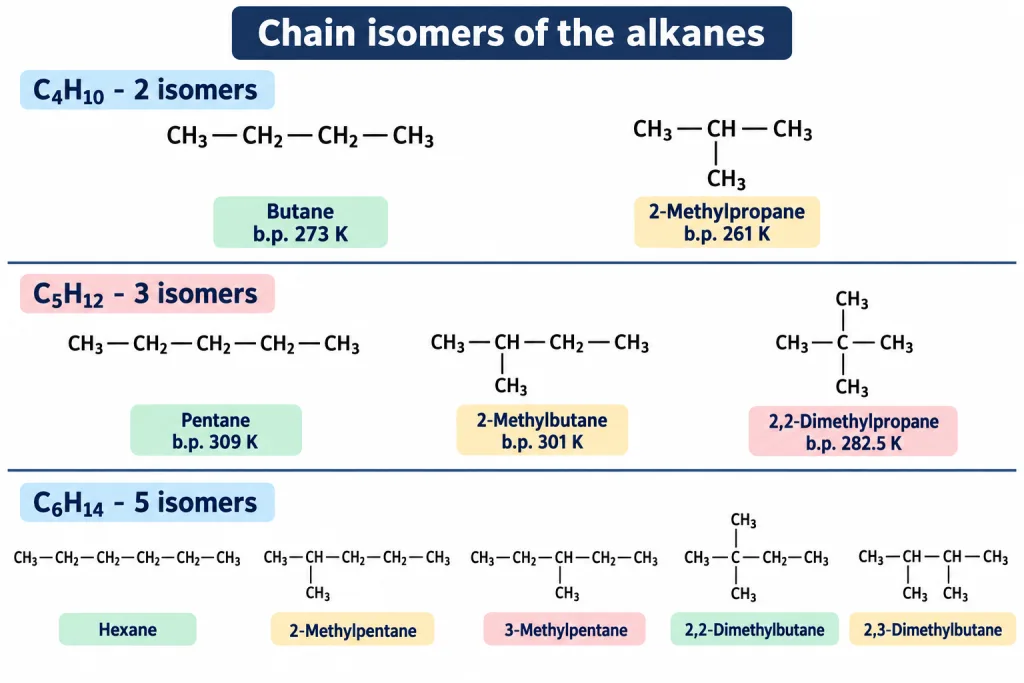
— two isomers
- Butane (n-butane), , b.p. 273 K. A continuous chain of four.
- 2-Methylpropane (isobutane), , b.p. 261 K. A chain of three with a methyl on the middle carbon.
There is no third structure: a methyl on carbon 1 of propane simply rebuilds butane.
— three isomers
- Pentane (n-pentane), , b.p. 309 K.
- 2-Methylbutane (isopentane), , b.p. 301 K.
- 2,2-Dimethylpropane (neopentane), , b.p. 282.5 K.
3-Methylbutane is not a fourth isomer. Numbered from the other end the same molecule comes out as 2-methylbutane, and the lower locant wins.
— five isomers
- Hexane,
- 2-Methylpentane,
- 3-Methylpentane,
- 2,2-Dimethylbutane,
- 2,3-Dimethylbutane,
The reliable way to generate a set like this is to work down by chain length — six carbons, then five with one methyl, then four with two methyls — and the first worked item below does exactly that.
How the count grows
| Formula | Chain isomers |
|---|---|
| 2 | |
| 3 | |
| 5 | |
| 9 | |
| 18 | |
| 75 |
Heptane has nine isomers and octane eighteen; decane has 75. Memorise the numbers, but no formula generates them, and only the first three formulae are small enough to enumerate reliably by hand.
Key Point: Chain isomers differ in the skeleton, not in the position of a functional group. has 2, has 3, has 5, has 9 and has 18.
Branching changes real properties. Read the three pentanes in order: 309 K, 301 K, 282.5 K. More branching, lower boiling point.
Primary, secondary, tertiary and quaternary
A carbon atom is classified by how many other carbon atoms it is joined to, and by nothing else. Hydrogens do not enter the count.
- Primary () — attached to one other carbon, or to none at all. Every terminal carbon is primary, and so is the lone carbon of methane.
- Secondary () — attached to two other carbons.
- Tertiary () — attached to three other carbons.
- Quaternary () — attached to four other carbons; also called a neo carbon.
A hydrogen takes the label of the carbon it sits on, so a hydrogen on a primary carbon is a primary hydrogen. A quaternary carbon has spent all four bonds on carbon, so it carries no hydrogen at all.
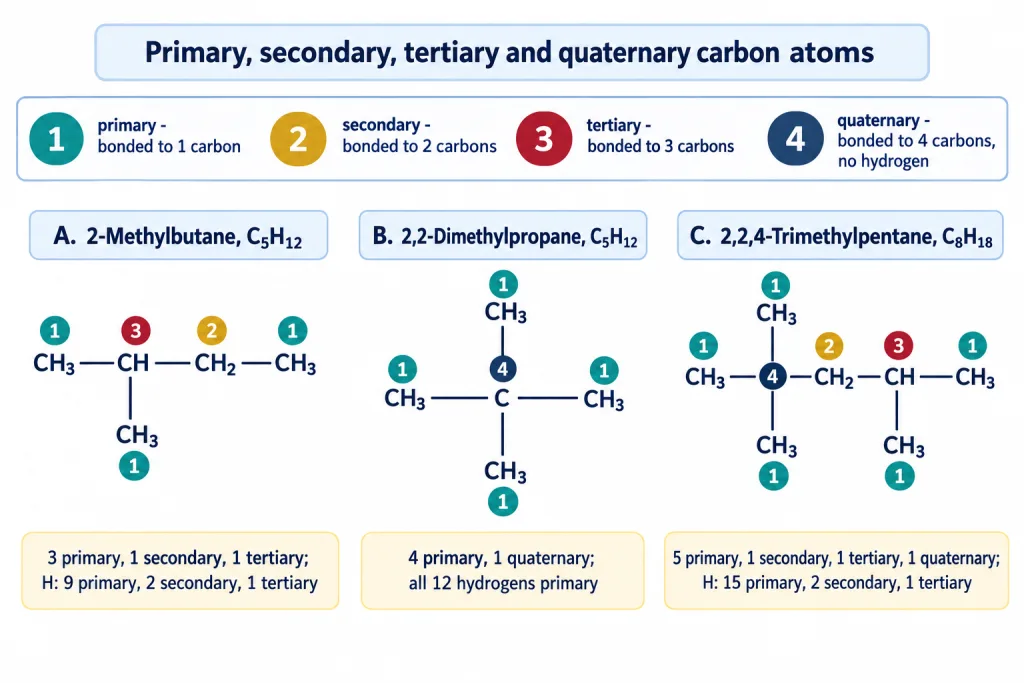
Worked through, structure by structure
2-Methylbutane, . Carbon 1 is joined only to carbon 2, so it is primary. Carbon 2 is joined to carbon 1, carbon 3 and the branch methyl, three carbons in all, so it is tertiary. Carbon 3 is joined to carbons 2 and 4, so it is secondary. Carbon 4 and the branch methyl each touch one carbon, so both are primary. Count: 3 primary, 1 secondary, 1 tertiary, 0 quaternary. Hydrogens: primary, 2 secondary, 1 tertiary, total 12, matching .
2,2-Dimethylpropane, . The central carbon is joined to four carbons, so it is quaternary and carries no hydrogen. The four methyls are primary. Count: 4 primary, 1 quaternary, and all 12 hydrogens are primary. Neopentane is the smallest alkane with a quaternary carbon.
2,3-Dimethylbutane, . Carbons 2 and 3 each carry three carbons, so both are tertiary; the four methyls are primary. Count: 4 primary, 0 secondary, 2 tertiary, 0 quaternary; 12 primary and 2 tertiary hydrogens, total 14.
2,2,4-Trimethylpentane, . Carbon 2 is quaternary. Carbon 3 is a joined to carbons 2 and 4, so it is secondary. Carbon 4 is joined to carbon 3, carbon 5 and a methyl, so it is tertiary. Carbons 1 and 5 and the three branch methyls give five primary carbons. Count: 5 primary, 1 secondary, 1 tertiary, 1 quaternary — all four kinds in one molecule; primary, 2 secondary and 1 tertiary hydrogen, total 18, matching .
The check that catches errors
Add up the hydrogens of every kind and compare with the molecular formula. A mismatch means a carbon has been misclassified. The arithmetic is quick: a primary carbon in a chain carries 3 hydrogens, a secondary 2, a tertiary 1 and a quaternary none.
[JEE Main] This classification is the basis of the next stage of alkane chemistry. Ease of replacement of hydrogen by halogen runs tertiary > secondary > primary, so halogenation questions ask you to count each kind of hydrogen first. Get the counting automatic now.
Key Point: A carbon is primary, secondary, tertiary or quaternary according to whether it is bonded to one, two, three or four other carbon atoms. A hydrogen inherits the label of its carbon, and a quaternary carbon has none.
Preparation 1: hydrogenation of an alkene or an alkyne
Petroleum and natural gas supply alkanes in bulk. In the laboratory there are five standard routes, each defined by its reagent.
Dihydrogen adds across a multiple bond in the presence of a finely divided metal catalyst — platinum, palladium or nickel. The process is hydrogenation, and with nickel it is the Sabatier-Senderens reaction, run at 573 K.
An alkyne needs two moles of dihydrogen, because it has two pi bonds to saturate.
The metal adsorbs dihydrogen on its surface and weakens the bond, which makes the addition possible at a workable temperature. Platinum and palladium work at room temperature; nickel is cheaper but needs heat and some pressure.
Worked case. To make hexane, hydrogenate hex-1-ene, hex-2-ene, hex-3-ene or hex-1-yne — any of them, since only the multiple bond disappears.
Limitation. The product skeleton is fixed by the starting skeleton, so this route can never lengthen or branch a chain, and it cannot make methane, there being no one-carbon alkene or alkyne. It converts; it does not build.
Preparation 2: the Wurtz reaction
Two molecules of an alkyl halide are joined by sodium metal in dry ether, free from moisture.
Bromomethane gives ethane, bromoethane gives butane, and the ether must be dry because sodium destroys water instantly.
The limitations, which are the examinable part
Four separate restrictions follow from the single fact that the reaction joins two alkyl groups end to end.
- It gives symmetrical alkanes cleanly. is all you get from one halide, and both halves are the same.
- Two different halides give a mixture. Take and together and three couplings happen at once: methyl with methyl, ethyl with ethyl, and methyl with ethyl.
Ethane and butane come out alongside that propane, three alkanes of similar boiling point separable only by fractional distillation. The yield of any one is poor, so the mixed Wurtz reaction is not a preparation at all.
- From a single halide only an even number of carbons is possible. Joining two identical groups doubles the carbon count, and a doubled number is always even. Propane, pentane and heptane are out of reach this way.
- Methane cannot be prepared by the Wurtz reaction at all. Methane has one carbon. The smallest thing the reaction can build is with , which is ethane with two carbons. There is no alkyl group with zero carbons, so the reaction has no way to stop short of two.
A practical fifth point: a tertiary halide mostly eliminates rather than couples, so Wurtz works best on primary halides.
Key Point: Wurtz reaction — in dry ether gives . It yields only symmetrical alkanes, only with an even number of carbons from a single halide, a mixture from two different halides, and never methane.
Preparation 3: reduction of an alkyl halide
An alkyl halide is reduced to the alkane by zinc and dilute hydrochloric acid, or by a zinc-copper couple in ethanol. The halogen is replaced by hydrogen and nothing else changes.
The zinc and the acid generate the hydrogen on the spot, at the moment it is needed. The zinc-copper couple in ethanol does the same job under milder, neutral conditions.
Why this route is worth having. The skeleton comes through exactly as it went in. It makes methane from chloromethane and an odd-chain alkane such as propane from 1-chloropropane — both jobs Wurtz cannot do.
Limitation. Alkyl fluorides are not reduced this way, so the method covers chlorides, bromides and iodides only, and the product is fixed by the halide.
Preparation 4: decarboxylation with soda lime
The sodium salt of a carboxylic acid, heated with soda lime, loses carbon dioxide and gives an alkane. Soda lime is a mixture of sodium hydroxide and calcium oxide, the calcium oxide being there to stop the alkali melting and attacking the glass.
The loss of carbon dioxide from a carboxylic acid or its salt is decarboxylation, and the arithmetic is the fact to carry away: the alkane has one carbon fewer than the acid. Sodium ethanoate gives methane, sodium butanoate gives propane.
Limitation. The chain shortens by exactly one, never more and never less, so the route works only when you hold the acid with one extra carbon, and it cannot be pushed further.
Preparation 5: Kolbe electrolysis
Electrolyse a concentrated aqueous solution of the sodium or potassium salt of a carboxylic acid. The alkane appears at the anode.
Sodium propanoate gives butane.
What happens at each electrode
At the anode the carboxylate ion loses an electron and the radical formed throws off carbon dioxide:
At the cathode water is reduced, which is where the dihydrogen and the alkali come from:
Limitations. Two methyl radicals combining is a doubling, exactly as in the Wurtz reaction, so Kolbe electrolysis gives symmetrical alkanes with an even number of carbons, and methane cannot be prepared by it either: that would need , and two hydrogen radicals give dihydrogen. Two salts together give a mixture of three alkanes, for the same reason as before.
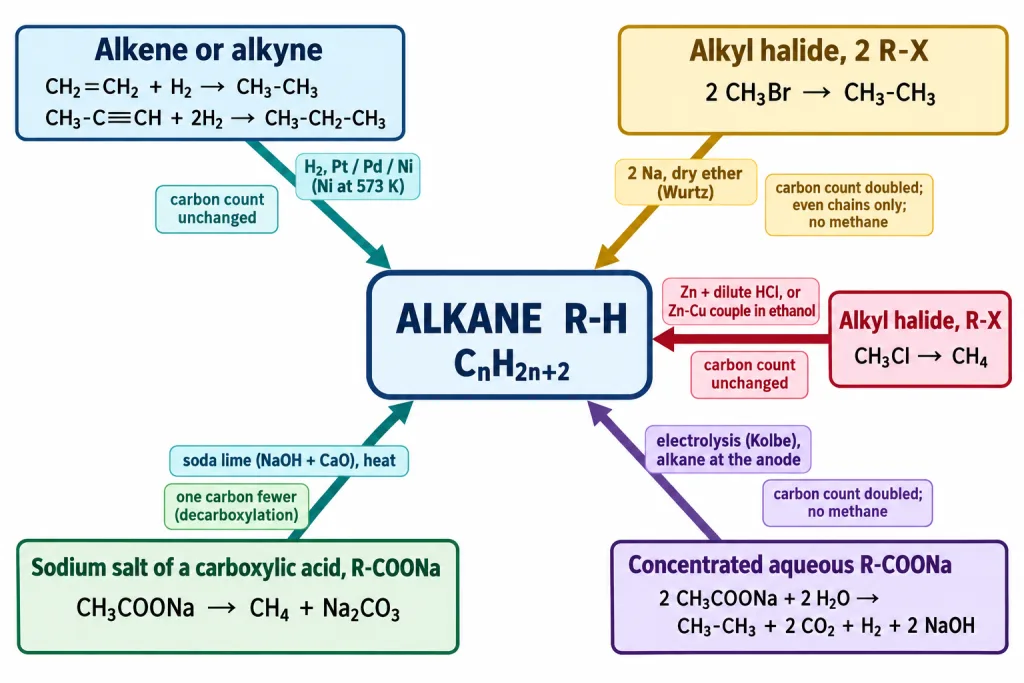
[NEET] Kolbe and Wurtz are constantly swapped in answer options. Wurtz starts from an alkyl halide with sodium in dry ether; Kolbe starts from a carboxylate salt and electrolyses the concentrated aqueous solution. Both end at , and the starting material tells them apart.
Choosing a route for a given alkane
Each method is defined by what it does to the carbon count. Hydrogenation and halide reduction leave it unchanged, decarboxylation cuts it by one, Wurtz and Kolbe double it. Fix that and the choice makes itself.
| Target alkane | Route to choose | Why |
|---|---|---|
| Methane | sodium ethanoate + soda lime, or with Zn and dilute HCl | Wurtz and Kolbe both join two alkyl groups, so neither can stop at one carbon |
| Ethane | Wurtz on bromomethane, or Kolbe on sodium ethanoate, or hydrogenation of ethene | two carbons, symmetrical, even |
| Propane or any odd chain | hydrogenation of propene or propyne, or 1-chloropropane with Zn and dilute HCl, or sodium butanoate + soda lime | an odd carbon count cannot come from doubling |
| Butane, hexane, octane | Wurtz on the halide with half the carbons, or Kolbe on the salt with half plus one | symmetrical and even, exactly what doubling gives |
| Same skeleton as a halide you hold | Zn and dilute HCl, or a zinc-copper couple in ethanol | only is replaced by |
| One carbon fewer than an acid you hold | soda lime (), heat | decarboxylation removes |
| A branched alkane | hydrogenation of the matching alkene, or reduction of the matching halide | the coupling methods build only symmetrical products |
Three questions settle almost every "how would you prepare" problem.
- Odd or even in carbons? Odd rules out Wurtz and Kolbe from a single starting material.
- Symmetrical about its middle bond? If not, coupling will not give it cleanly.
- What am I allowed to start from? A halide points to Wurtz or zinc reduction; a carboxylate salt to soda lime or electrolysis; an alkene or alkyne to hydrogenation.
Key Point: Hydrogenation and halide reduction keep the carbon count; decarboxylation drops it by one; Wurtz and Kolbe double it. Neither doubling method can give methane, and neither can give an odd-carbon alkane from a single starting material.
Question 1: All five hexanes
Write the structures and IUPAC names of every chain isomer of .
Answer:
I work down by the length of the longest chain, so that I do not miss one or count one twice.
Six carbons in a row: , hexane.
Five carbons with one methyl, which can sit on carbon 2 or carbon 3 only, since on carbon 1 or 5 it would rebuild the six-chain. That gives , 2-methylpentane, and , 3-methylpentane.
Four carbons with two methyls. Both on carbon 2 gives , 2,2-dimethylbutane; one each on carbons 2 and 3 gives , 2,3-dimethylbutane. Both on carbon 3 is the first of these read from the other end.
Three carbons cannot take three methyls without giving some carbon five bonds.
Ans: Hexane, 2-methylpentane, 3-methylpentane, 2,2-dimethylbutane, 2,3-dimethylbutane — five in all. Watch out: 3,3-Dimethylbutane is 2,2-dimethylbutane renumbered, and 2-ethylbutane has a five-carbon longest chain, so it is really 3-methylpentane. Neither is an extra isomer.
Question 2: Four kinds of carbon in one molecule
Classify every carbon in 2,2,4-trimethylpentane and count the hydrogens of each kind.
Answer:
The structure is . I take each carbon and count only the carbons attached to it.
Carbon 2 holds carbon 1, carbon 3 and two methyls — four carbons, so quaternary, with no hydrogen. Carbon 3 is a between carbons 2 and 4 — two carbons, so secondary, 2 hydrogens. Carbon 4 holds carbon 3, carbon 5 and one methyl — three carbons, so tertiary, 1 hydrogen. Carbon 1, carbon 5 and the three branch methyls each touch one carbon, giving five primary carbons and hydrogens.
Check: hydrogens on 8 carbons, so .
Ans: 5 primary, 1 secondary, 1 tertiary and 1 quaternary carbon; 15 primary, 2 secondary and 1 tertiary hydrogen.
Question 3: Counting hydrogens in 2,3-dimethylbutane
How many primary, secondary and tertiary hydrogen atoms does 2,3-dimethylbutane contain?
Answer:
The structure is . Carbons 2 and 3 each carry three other carbons, so both are tertiary with 1 hydrogen each. The four methyls are primary, hydrogens. There is no anywhere, so no secondary hydrogens exist.
Check: hydrogens on 6 carbons, giving .
Ans: 12 primary, 0 secondary, 2 tertiary.
Question 4: Ethane from bromomethane
How would you prepare ethane from bromomethane? Give the balanced equation.
Answer:
Ethane has two carbons and bromomethane one, so I need to double the count, and doubling is what the Wurtz reaction does. I treat bromomethane with sodium metal in dry ether.
Both halves of the product are methyl, so ethane is symmetrical and the yield is clean.
Ans: in dry ether gives . Watch out: The ether must be dry. Sodium reacts with water faster than it reacts with the halide, and wet ether destroys the reaction.
Question 5: Butane, by two different routes
Prepare n-butane (a) from bromoethane and (b) from a carboxylic acid salt.
Answer:
Butane has four carbons and is symmetrical about its central bond, so both doubling methods work. The Wurtz reaction joins two ethyl groups:
For the second route I need the salt whose alkyl group is ethyl, sodium propanoate. Electrolysing its concentrated aqueous solution gives butane at the anode:
Ans: Wurtz reaction on bromoethane, or Kolbe electrolysis of concentrated aqueous sodium propanoate. Watch out: For Kolbe the salt carries one carbon more than the half you want, since each carboxylate loses before coupling.
Question 6: Two methods that cannot make methane
Explain why methane can be prepared neither by the Wurtz reaction nor by Kolbe electrolysis.
Answer:
Both reactions work by joining two alkyl groups. The Wurtz reaction couples two groups from ; Kolbe electrolysis couples two radicals left after is lost from . In each case the product is , with twice the carbons of one .
Methane has one carbon, and one cannot be written as twice anything whole. The smallest alkane either method can build is ethane, from .
Forcing it makes the point. For methane by Kolbe I would need , that is sodium formate, , and two hydrogen radicals joining give , not . There is no alkyl group with zero carbons.
Ans: Both methods double the carbon count, and methane has one carbon, so neither can make it. Use soda lime on sodium ethanoate, or reduce chloromethane with zinc and dilute hydrochloric acid.
Question 7: Propane from 1-bromopropane
Your friend suggests preparing propane by treating 1-bromopropane with sodium in dry ether. Explain why this fails and give a method that works.
Answer:
Sodium in dry ether is the Wurtz reaction, which joins two propyl groups. Three carbons plus three is six, so the product is hexane, not propane.
Propane has an odd carbon count, so no doubling method can give it from a single halide. I need a reagent that swaps the halogen for hydrogen and leaves the skeleton alone, and zinc with dilute hydrochloric acid does that:
Ans: Wurtz gives hexane. Reduce the halide with zinc and dilute hydrochloric acid instead, or heat sodium butanoate with soda lime, or hydrogenate propene.
Question 8: Methane from ethanoic acid
Starting from ethanoic acid, how would you obtain methane?
Answer:
Methane has one carbon and ethanoic acid two, so I need a method that cuts the count by exactly one, which is decarboxylation. I neutralise the acid to its sodium salt, then heat the dry salt with soda lime.
Counting atoms: left, 2 C, 4 H, 3 O, 2 Na; right, gives 1 C and 4 H, gives 1 C, 3 O and 2 Na. The sides match.
Ans: Convert to sodium ethanoate and heat with soda lime, . Watch out: The free acid is not used directly. The salt is the substrate, and the calcium oxide is there to keep the sodium hydroxide dry and manageable, not to react.
Question 9: A mixed Wurtz reaction
Bromomethane and bromoethane are treated together with sodium in dry ether. What is formed?
Answer:
Sodium generates methyl and ethyl fragments in the same flask, and they pair up in every combination available. Methyl with methyl gives ethane, ; ethyl with ethyl gives butane, ; methyl with ethyl gives propane:
Three alkanes come out, none in good yield, and separating them takes fractional distillation.
Ans: A mixture of ethane, propane and butane — three alkanes, which is why a mixed Wurtz reaction is useless as a preparation.
Question 10: 2-Methylpropane
Suggest two ways of preparing 2-methylpropane.
Answer:
The target is , four carbons but branched, and not symmetrical about any central bond, so coupling two identical alkyl groups can never produce it. Wurtz and Kolbe are ruled out at the start.
Both workable routes preserve the skeleton. Hydrogenate 2-methylprop-1-ene:
Or reduce 1-chloro-2-methylpropane:
Ans: Hydrogenation of 2-methylprop-1-ene, or reduction of 1-chloro-2-methylpropane with zinc and dilute hydrochloric acid. Watch out: A two-carbon halide under Wurtz gives butane, not its branched isomer. Joining chains end to end cannot create a branch.
Question 11: Kolbe on sodium butanoate
Write the balanced equation for the electrolysis of a concentrated aqueous solution of sodium butanoate and name the alkane formed.
Answer:
Each butanoate ion loses at the anode, leaving a propyl radical, and two propyl radicals join to give a six-carbon chain.
Balance check. Left: 8 C, 18 H, 6 O, 2 Na. Right: hexane 6 C and 14 H, 2 C and 4 O, 2 H, 2 Na with 2 O and 2 H — again 8 C, 18 H, 6 O and 2 Na.
Ans: Hexane, together with carbon dioxide at the anode and dihydrogen with sodium hydroxide at the cathode.
Question 12: An intramolecular Wurtz reaction
What happens when 1,4-dibromobutane is treated with sodium in dry ether?
Answer:
Both ends of the same molecule carry a bromine, four carbons apart, so sodium joins them to each other rather than to a second molecule and a four-membered ring closes.
Both sides carry 4 C, 8 H, 2 Br and 2 Na.
Ans: Cyclobutane, by an intramolecular Wurtz coupling. Watch out: A cycloalkane is , so this product does not fit .
Question 13: Two names that are wrong
Explain what is wrong with the names 2-ethylpentane and 5-ethyl-3-methylheptane, and give the correct names.
Answer:
For 2-ethylpentane I draw a five-carbon chain with an ethyl group on carbon 2: . Reading through the ethyl and along the chain gives a continuous run of six carbons, and the longest chain must be the parent. Renumbering that six-carbon chain leaves a methyl on carbon 3.
For 5-ethyl-3-methylheptane the chain length is right but the numbering is not. From the other end the ethyl falls on carbon 3 and the methyl on carbon 5, so the locant set is 3,5 either way. The tie is broken alphabetically, and ethyl comes before methyl.
Ans: 3-Methylhexane, and 3-ethyl-5-methylheptane.
Question 14: Working backwards from an alkane
Name three different unsaturated hydrocarbons that all give 2-methylbutane on catalytic hydrogenation.
Answer:
2-Methylbutane is . Hydrogenation touches only the multiple bond, so the alkene must already carry that skeleton. I put a double bond in each place the skeleton allows.
Between carbons 1 and 2: , 2-methylbut-1-ene. Between carbons 2 and 3: , 2-methylbut-2-ene. With the double bond at the far end instead, so that the branch is numbered 3 rather than 2: , 3-methylbut-1-ene.
Each takes one mole of over Pt, Pd or Ni and gives the same alkane.
Ans: 2-Methylbut-1-ene, 2-methylbut-2-ene and 3-methylbut-1-ene. Watch out: A different skeleton gives a different alkane. Pent-2-ene has an unbranched five-carbon chain, so it gives pentane, not 2-methylbutane.