
The four conditions, applied in order
The word aromatic began as a description of smell and has nothing to do with smell now. It means a ring whose pi electrons are spread all the way round it, and which is far more stable than a count of its double bonds would suggest. Benzene was the first member; once the reason for its stability was understood, the same test could be applied to any ring — carbon or heteroatom, neutral or charged.
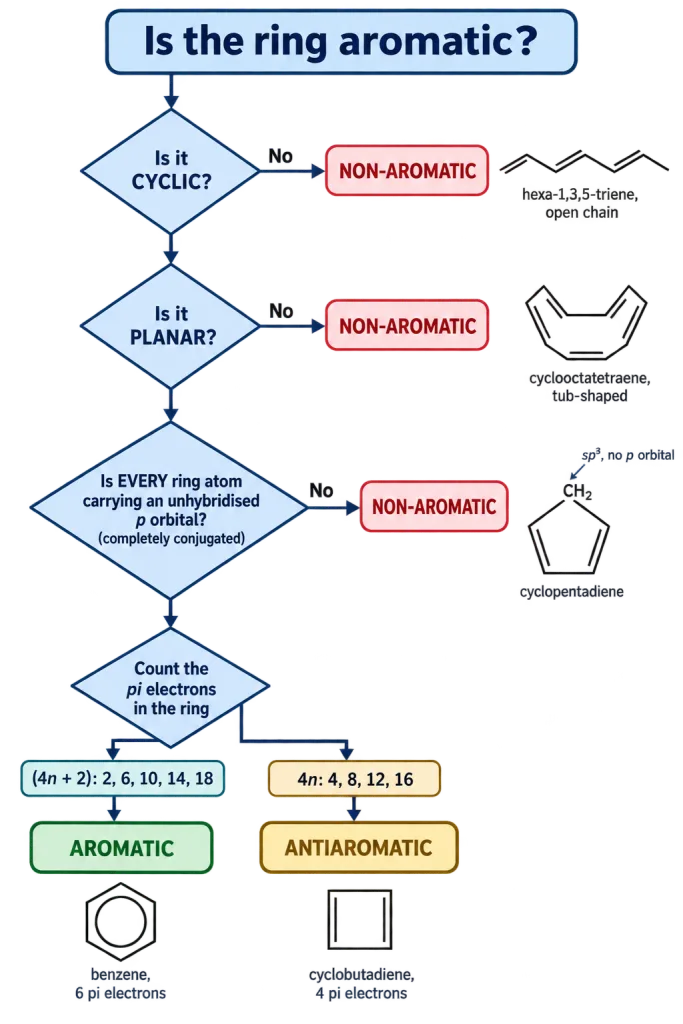
Key Point (Definition): A species is aromatic if it satisfies all four of the following: it is cyclic; it is planar; it is completely conjugated, meaning every atom of the ring carries an unhybridised p orbital that overlaps with those on both its neighbours; and it holds (4n+2) pi electrons in that cyclic system, with The last condition is Huckel's rule.
Take the four in order, and stop at the first failure.
Condition 1 — is it cyclic? The delocalised system has to close on itself. Hexa-1,3,5-triene is fully conjugated and is nowhere near aromatic, because its chain has two loose ends. Six pi electrons in a chain is not six pi electrons in a ring.
Condition 2 — is it planar? Every p orbital must point the same way, perpendicular to the ring, so that each one overlaps its neighbours sideways. A buckled ring cannot manage it: at a fold, two neighbouring p orbitals sit at an angle and the overlap collapses. Cyclooctatetraene is the standard example.
Condition 3 — is it completely conjugated? Walk round the ring atom by atom. Every atom must be (or ) hybridised and carry an unhybridised p orbital in the cyclic array. One atom ends the story: it has no spare p orbital, so the delocalisation runs into it and stops. A group inside a ring of double bonds is an insulating brick in the wall.
Condition 4 — count the pi electrons. Only when 1, 2 and 3 all pass does the count decide anything. A count of — 2, 6, 10, 14, 18 — is aromatic. A count of — 4, 8, 12, 16 — is antiaromatic.
Key Point (Definition): A ring that is cyclic, planar and completely conjugated but holds pi electrons is antiaromatic. It is not merely short of extra stability; it is less stable than the corresponding open-chain compound. A species that fails condition 1, 2 or 3 is neither aromatic nor antiaromatic. It is non-aromatic, and it behaves like an ordinary alkane, alkene or polyene.
Three verdicts, not two. Cyclooctatetraene and cyclobutadiene both fail to be aromatic, and they fail in different ways.
[JEE Main] A question that offers cyclooctatetraene with eight pi electrons is testing whether you check planarity before you reach for the arithmetic. Eight is a number, but the molecule never gets as far as condition 4, so it is non-aromatic and not antiaromatic.
Counting the pi electrons without going wrong
Most wrong answers in this topic are counting errors, not reasoning errors. The rules are short, and they need to be applied literally.
Key Point: Count two electrons for every double bond that lies inside the ring. Count a lone pair only if it occupies an unhybridised p orbital that is part of the cyclic array — a lone pair in an orbital lying in the plane of the ring is outside the pi system and contributes nothing. A carbanion lone pair counts, because that pair moves into the p orbital to join the delocalisation. An empty p orbital contributes no electrons but does not break the conjugation — it is a genuine member of the cyclic array, just an unoccupied one.
Four further points close the usual gaps.
Sigma electrons never count. The C-H bonds, the ring C-C single bonds, the N-H bond of pyrrole — none of them contribute.
A pi bond that points out of the ring does not count. Electrons in a bond from a ring atom to an atom outside the ring are not circulating round the ring, so they are left out.
An atom donates at most one lone pair. Oxygen in furan has two. It is hybridised, so it has exactly one unhybridised p orbital and only one pair can sit in it; the second stays in an orbital in the plane. Sulphur in thiophene behaves the same way.
Charge changes the count. A negative charge on a ring carbon means a lone pair, so it adds two. Loss of a hydride ion from a ring carbon leaves an empty p orbital, so it adds nothing — the electrons removed came from a sigma bond, which never counted.
Worked through, the cyclopentadienyl anion goes like this. Five carbons, two of the bonds between them double, giving electrons. The fifth carbon carries the negative charge, so its lone pair occupies its p orbital: . Total 6, the ring is flat and every carbon is , so the anion is aromatic.
The same arithmetic on the cyclopentadienyl cation gives 4: two double bonds, and an empty p orbital that adds nothing. The conjugation is unbroken and the ring is planar, so the species reaches condition 4 and fails it, because 4 is a number. The cation is antiaromatic.
| Species | Ring double bonds | Lone pair in a p orbital | Total |
|---|---|---|---|
| Cyclopentadienyl anion | 2 | one, on the carbanion carbon | 6 |
| Cyclopentadienyl cation | 2 | none, the p orbital is empty | 4 |
| Tropylium cation | 3 | none, the p orbital is empty | 6 |
| Pyrrole | 2 | one, on nitrogen | 6 |
| Pyridine | 3, one of them | none, it is in an orbital | 6 |
Why and not
The rule looks arbitrary until you see where the numbers come from. When p orbitals are joined into a ring, the molecular orbitals they produce fall into a very particular pattern: one lowest orbital on its own, then pairs of orbitals of equal energy above it, and so on up.
Electrons fill from the bottom: two in that single lowest orbital, four in the first degenerate pair, four in the next. The totals that give a completely filled set are therefore
which is exactly for A closed, completely filled set of bonding orbitals is what makes an aromatic ring so hard to disturb.
Now take a count. In an eight-electron system, six electrons fill the lowest orbital and the first pair, and the remaining two go one each into the next degenerate pair, leaving two half-filled orbitals. That is not a closed shell, and the molecule pays for it: it is destabilised, and it distorts, reacts or dimerises to escape.
| , aromatic | , antiaromatic | |
|---|---|---|
| 0 | 2 | - |
| 1 | 6 | 4 |
| 2 | 10 | 8 |
| 3 | 14 | 12 |
| 4 | 18 | 16 |
Read the two columns as lists to recognise on sight. Aromatic numbers: 2, 6, 10, 14, 18. Antiaromatic numbers: 4, 8, 12, 16. A count that is even but not of the form is a warning, not a verdict: the ring still has to be planar and completely conjugated before the word antiaromatic can be used.
Key Point: pi electrons in a planar, cyclic, fully conjugated ring gives extra stability relative to the open-chain analogue. pi electrons in the same kind of ring gives less stability than the open-chain analogue. Failing planarity or conjugation gives neither — the molecule simply behaves like an ordinary polyene.
One more thing about : it is only a counter, not the number of rings and not the number of double bonds. Solve and check that is a whole number and not negative. If it is not, the count is not an aromatic one.
The carbocyclic list, one species at a time
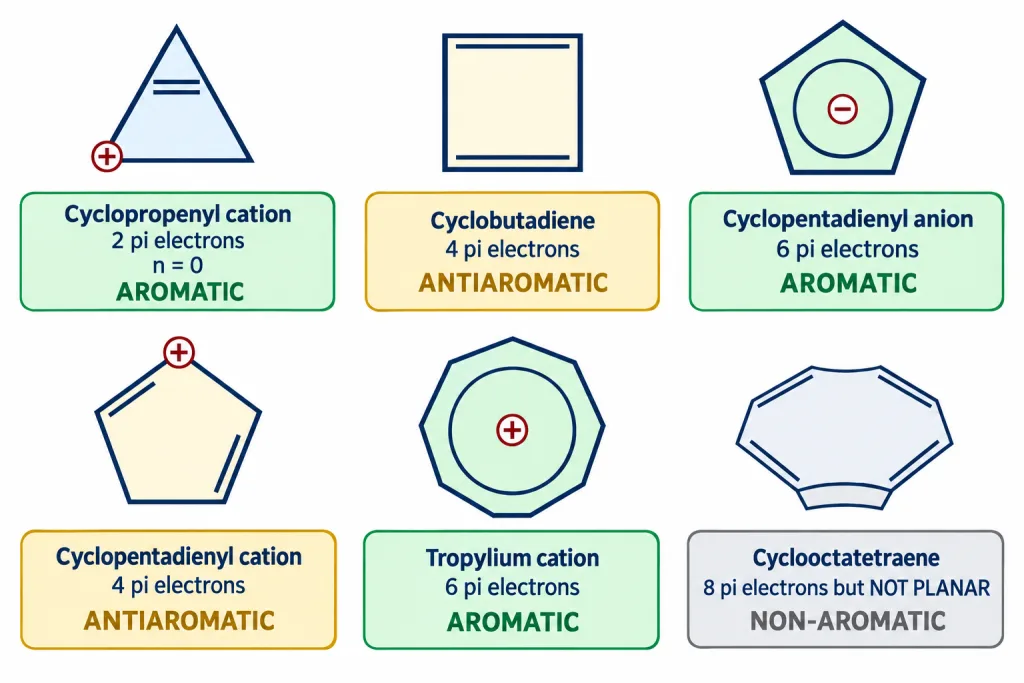
Benzene, . Cyclic, planar, six carbons each with a p orbital, three ring double bonds giving 6 pi electrons, . Aromatic. All six C-C bonds are equal at 139 pm, every angle is 120 degrees, and the resonance energy is 150 kJ/mol.
Naphthalene, , and anthracene, . Two rings fused along an edge, and three fused in a line. All the carbons are and coplanar, with five and seven double bonds respectively: 10 pi electrons, , and 14 pi electrons, . Both aromatic.
Cyclopropenyl cation, . A three-membered ring, one double bond and one carbon bearing the positive charge with an empty p orbital. Count: pi electrons, and gives . Aromatic — the smallest aromatic system there is. Its ring angles are strained at 60 degrees and it is stable anyway, which shows how much aromatic stabilisation is worth.
Cyclobutadiene, . A four-membered ring with two double bonds: 4 pi electrons, a number with . Cyclic, conjugated and flat, so it reaches condition 4 and fails it. Antiaromatic. It cannot be kept at ordinary temperatures; it escapes by distorting to a rectangle with two long and two short bonds and by dimerising almost at once.
Cyclopentadienyl anion, . Two double bonds plus the carbanion lone pair: 6 pi electrons, . Planar, every carbon . Aromatic, and unusually easy to make.
Cyclopentadienyl cation, . The same ring with an empty p orbital instead of the lone pair: 4 pi electrons. Antiaromatic. Two electrons separate the anion and the cation, and they sit in opposite categories.
Tropylium (cycloheptatrienyl) cation, . A seven-membered ring, three double bonds and one positively charged carbon with an empty p orbital: pi electrons, . Aromatic. All seven carbons are , the charge is spread equally over all of them, and cycloheptatrienyl bromide is an ionic, water-soluble salt rather than a covalent alkyl bromide.
Cyclooctatetraene, . Eight carbons, four double bonds, 8 pi electrons. Cyclic and conjugated on paper, but not planar: it takes up a tub shape with alternating long single and short double bonds. The p orbitals at the folds cannot overlap, so there is no ring-wide delocalisation, condition 2 fails and the count is never reached. Non-aromatic, and it adds bromine as any polyene would.
Cyclohexane and cyclohexene. Cyclohexane has no p orbitals at all, every carbon being ; cyclohexene has one double bond, so four of its six carbons are . Both fail complete conjugation. Non-aromatic, as is every acyclic conjugated system — buta-1,3-diene, hexa-1,3,5-triene and the rest — which fails condition 1 whatever its pi electron count.
Pyrrole against pyridine — the distinction to get right
A heteroatom does not stop a ring being aromatic. It only makes the count harder, because nitrogen, oxygen and sulphur bring lone pairs, and a lone pair may or may not be part of the pi system. This whole topic turns on where a particular lone pair sits.
Pyrrole
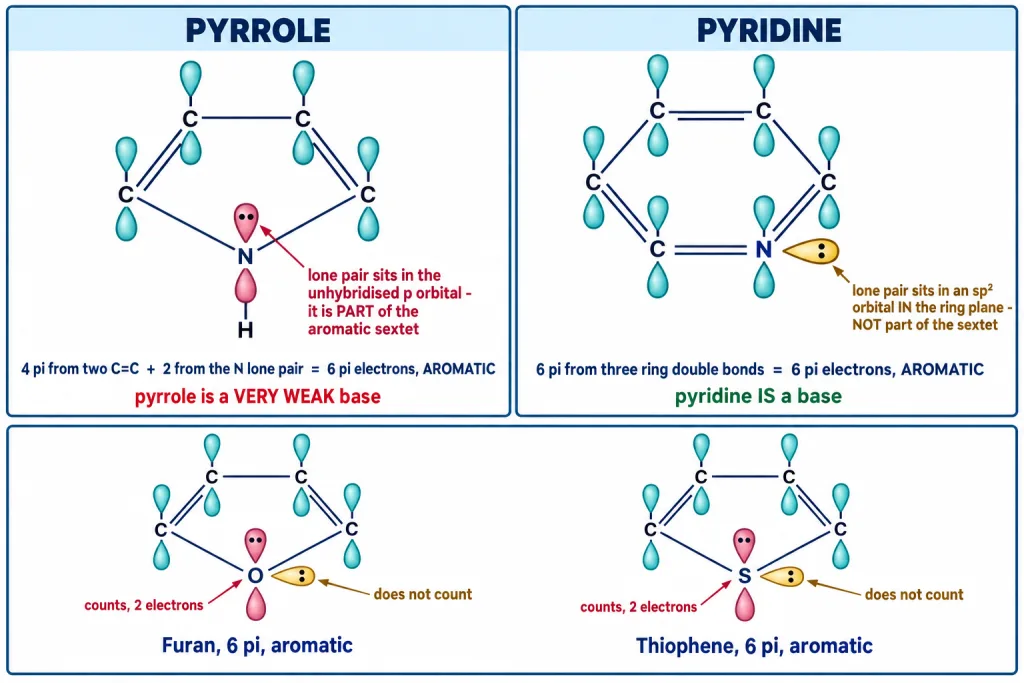
Pyrrole is a five-membered ring: four carbons and one nitrogen carrying a hydrogen. Two C-C bonds are double, giving 4 pi electrons, and 4 is not an aromatic number.
The nitrogen supplies the missing pair. It is hybridised, using its three orbitals for the two ring bonds and the N-H bond, which leaves its lone pair in the unhybridised p orbital, perpendicular to the ring. That p orbital lines up with the four carbon p orbitals, so the lone pair joins the ring system.
Key Point: In pyrrole the nitrogen lone pair is part of the aromatic sextet. It is not available to a proton. That is why pyrrole is a very weak base — using the lone pair to bond a proton would take those two electrons out of the ring and destroy the aromaticity.
Pyridine
Pyridine is a six-membered ring: five carbons and one nitrogen, and no hydrogen on the nitrogen. Its three ring double bonds — two and one — give 6 pi electrons on their own, so the sextet is complete before the lone pair is considered.
The nitrogen is hybridised. Two of its orbitals make the ring bonds; the third holds the lone pair, in the plane of the ring, pointing outwards. An in-plane orbital is at right angles to the p orbitals, so it cannot overlap with them and takes no part in the delocalisation.
Key Point: In pyridine the nitrogen lone pair sits in an orbital in the ring plane, outside the pi system. It is free to bond a proton, and the sextet is untouched when it does. That is why pyridine is a base, and why the pyridinium ion formed when it accepts a proton is still aromatic.
Furan and thiophene
Furan has an oxygen in a five-membered ring, thiophene a sulphur. Each heteroatom carries two lone pairs and is hybridised, so it has exactly one unhybridised p orbital: one pair goes into it and joins the ring, the other stays in an orbital in the plane and does not.
Both are aromatic, with six pi electrons and .
| Compound | Ring size | Pi from ring double bonds | Heteroatom contribution | Total | Verdict |
|---|---|---|---|---|---|
| Pyrrole | 5 | 4 | 2, the lone pair from the p orbital | 6 | aromatic, very weak base |
| Furan | 5 | 4 | 2, one of two lone pairs | 6 | aromatic |
| Thiophene | 5 | 4 | 2, one of two lone pairs | 6 | aromatic |
| Pyridine | 6 | 6, including one | 0, the pair is in the plane | 6 | aromatic, a base |
[NEET] Asked to rank pyrrole and pyridine as bases, put pyridine first: its lone pair is outside the sextet, pyrrole's is inside it.
The whole list on one page, and why aromaticity matters
| Species | Pi electrons | Verdict | |
|---|---|---|---|
| Benzene | 6 | 1 | aromatic |
| Naphthalene | 10 | 2 | aromatic |
| Anthracene | 14 | 3 | aromatic |
| Cyclopentadienyl anion | 6 | 1 | aromatic |
| Tropylium cation | 6 | 1 | aromatic |
| Cyclopropenyl cation | 2 | 0 | aromatic |
| Pyrrole | 6 | 1 | aromatic |
| Furan | 6 | 1 | aromatic |
| Thiophene | 6 | 1 | aromatic |
| Pyridine | 6 | 1 | aromatic |
| Cyclobutadiene | 4 | - | antiaromatic, |
| Cyclopentadienyl cation | 4 | - | antiaromatic, |
| Cyclooctatetraene | 8 | - | non-aromatic, tub-shaped |
| Cyclohexane | 0 | - | non-aromatic, all |
| Cyclohexene | 2 | - | non-aromatic, no ring conjugation |
| Any open chain | any | - | non-aromatic, not cyclic |
What the label buys a molecule
Extra stability that can be measured. Benzene's heat of hydrogenation falls short of three times the value for cyclohexene, and the shortfall is the resonance energy, 150 kJ/mol — what a molecule would pay to give up its delocalisation.
Resistance to addition. Benzene has four degrees of unsaturation and yet decolourises neither bromine water nor Baeyer's reagent, both of which an alkene discharges instantly. The pi electrons are there, held in a closed delocalised shell and not available to be attacked in the ordinary way.
A preference for substitution. When benzene does react with an electrophile it replaces a hydrogen rather than adding across a double bond, because substitution restores the delocalised sextet while addition would destroy it permanently. The arenium ion intermediate has lost the aromaticity for a moment, and forming it is the slow, rate-determining step; the fast loss of a proton brings the aromaticity back.
Forcing conditions when addition is unavoidable. Hydrogenation needs hydrogen with nickel at 473-573 K and three moles of hydrogen; chlorine adds only under ultraviolet light, by a radical route, giving benzene hexachloride. And the delocalisation shows in the structure itself: all six C-C bonds are 139 pm, between the 154 pm single bond and the 134 pm double bond, in a planar regular hexagon.
Effects met again. Aromaticity decides the acidity of cyclopentadiene, the basicity of pyrrole and pyridine, the stability of the tropylium ion and, later, the behaviour of every substituted benzene.
Cyclopentadiene and cycloheptatriene — two rings that ionise to become aromatic
Nothing shows the value of aromaticity better than a molecule that will throw away a hydrogen to get it.
Cyclopentadiene is an unusually strong hydrocarbon acid
Cyclopentadiene, , is a five-membered ring with two double bonds and one group. That carbon is and has no p orbital, so the conjugation stops there and cyclopentadiene itself is non-aromatic.
Remove one of the two hydrogens on that as a proton. The carbon left behind rehybridises to and its lone pair moves into the new p orbital. Every ring atom now carries one, the ring is flat, and the count is .
The anion is aromatic, so losing the proton is far more rewarding here than in an ordinary hydrocarbon, and the equilibrium sits much further to the right than a C-H bond has any right to expect.
Key Point: Cyclopentadiene has a of about 16, close to that of water, while an ordinary alkane C-H is near 50. The whole of that enormous difference is aromatic stabilisation of the cyclopentadienyl anion, which has six delocalised pi electrons in a planar five-membered ring. Sodium metal deprotonates cyclopentadiene readily, giving sodium cyclopentadienide and hydrogen.
The negative charge is not parked on one carbon but spread equally over all five, which is why all five C-C bonds in the anion are the same length and all five hydrogens are equivalent.
Cycloheptatriene ionises the other way
Cycloheptatriene, , is a seven-membered ring with three double bonds and one group. Again the carbon breaks the conjugation, so cycloheptatriene is non-aromatic.
It cannot reach a count by losing a proton: taking from the would leave an anion with pi electrons, an antiaromatic number. So it goes the other way and loses a hydride ion, . That carbon is left with an empty p orbital, the conjugation closes up, and the count is .
The product is the tropylium cation, aromatic, with a positive charge shared over all seven carbons. Cycloheptatrienyl bromide dissolves in water and conducts, which no ordinary alkyl bromide does.
The pattern
| Ring | Loses | Ion formed | Pi electrons | Verdict |
|---|---|---|---|---|
| Cyclopropene | cyclopropenyl cation | 2 | aromatic | |
| Cyclopentadiene | cyclopentadienyl anion | 6 | aromatic | |
| Cycloheptatriene | tropylium cation | 6 | aromatic |
One rule covers the table: a ring with an carbon gives up whatever particle takes it to a count — a proton if the ring is two electrons short, a hydride ion if it is two over.
[JEE Main] A favourite item gives cyclopentadiene and cycloheptatriene together and asks which is acidic and which forms a stable cation. Answer with the count: the five-membered ring reaches 6 by gaining a pair, the seven-membered ring reaches 6 by losing one.
Worked items
Question 1: Sorting cyclopentadienyl anion
Apply the four conditions to and give the verdict with the pi electron count.
Answer:
Cyclic, yes — five carbons in a closed ring. Planar, yes — every carbon is , including the one carrying the charge. Completely conjugated, yes — four carbons have p orbitals as part of double bonds, and the fifth has a p orbital holding its lone pair.
The count: two ring double bonds give 4 and the carbanion lone pair gives 2, so I have 6, and gives .
Ans: Aromatic, 6 pi electrons, .
Watch out: The carbanion lone pair is the whole point. Leaving it out gives 4 and the wrong verdict.
Question 2: The cyclopentadienyl cation
The same five-membered ring, but with a positive charge. Aromatic, antiaromatic or non-aromatic?
Answer:
Cyclic, yes. Planar, yes — the positive carbon is with an empty p orbital, which keeps the ring flat. Completely conjugated, yes: an empty p orbital holds no electrons but it passes the delocalisation along.
Count: two double bonds give 4, and the empty p orbital gives nothing. Total 4, which is with .
The species has cleared conditions 1 to 3 and failed only the count, so it is not merely non-aromatic.
Ans: Antiaromatic, 4 pi electrons.
Watch out: The anion and the cation of the same ring land in opposite categories, so check the charge before counting.
Question 3: Tropylium from cycloheptatriene
Cycloheptatriene reacts with bromine and the product, on standing, is an ionic solid soluble in water. Explain, with the pi electron count.
Answer:
Cycloheptatriene is a seven-membered ring with three double bonds and one group, and that carbon breaks the conjugation, so the parent is non-aromatic.
The carbon-bromine bond formed at the carbon ionises, because the cation left behind is the cycloheptatrienyl cation: that carbon becomes with an empty p orbital, so all seven carbons now carry one.
Count: three ring double bonds give 6, the empty p orbital gives 0. Total 6, , and an aromatic cation is stable enough to exist as a free ion.
Ans: The tropylium cation, 6 pi electrons, aromatic, so the bromide is ionic.
Question 4: Cyclooctatetraene and its dianion
Cyclooctatetraene has eight pi electrons. Why is it not antiaromatic, and what happens when two electrons are added to it?
Answer:
Conditions in order: cyclic, yes; planar, no. Cyclooctatetraene takes up a tub shape with alternating long and short bonds, and the p orbitals at the folds do not overlap.
It fails condition 2, so it never reaches the electron count. A species must be planar and fully conjugated before it can be called antiaromatic.
Adding two electrons gives the dianion, , with pi electrons. Ten is with , and the ring flattens to collect the stabilisation.
Ans: Cyclooctatetraene is non-aromatic because it is not planar; the dianion, with 10 pi electrons, is aromatic.
Watch out: Eight is a number, which tempts everybody into writing antiaromatic. The verdict is settled at condition 2, before the arithmetic.
Question 5: Pyrrole
Count the pi electrons in pyrrole and explain why it is such a weak base.
Answer:
The ring is four carbons and one nitrogen, and its two C-C double bonds give 4 pi electrons.
The nitrogen is : two orbitals for the ring bonds, one for the N-H bond, and the lone pair left in the unhybridised p orbital. That p orbital is parallel to the carbon p orbitals, so the lone pair joins the ring and contributes 2. Total 6, , aromatic.
Basicity needs an available lone pair, and pyrrole's only one is inside the sextet. Protonating the nitrogen would pull those two electrons out of the ring and destroy the aromaticity, so it barely happens.
Ans: 6 pi electrons, aromatic; a very weak base because the nitrogen lone pair is part of the sextet.
Question 6: Pyridine
Do the same for pyridine, and say whether the pyridinium ion is still aromatic.
Answer:
The ring is five carbons and one nitrogen with no hydrogen on it. Going round, there are three double bonds — two and one — giving pi electrons on their own.
The nitrogen is . Two orbitals make ring bonds and the third holds the lone pair, lying in the plane of the ring and pointing outwards. An in-plane orbital is perpendicular to the p orbitals, so it cannot overlap with them and is not counted. Total 6, , aromatic.
Because the lone pair is outside the pi system, a proton can take it without touching the sextet, and the pyridinium ion still has its six delocalised pi electrons.
Ans: 6 pi electrons, aromatic; the lone pair is in an orbital in the plane, so pyridine is a base and the pyridinium ion remains aromatic.
Watch out: Counting the nitrogen lone pair as well as the bond double-counts nitrogen and gives 8.
Question 7: Furan and thiophene
Oxygen and sulphur each carry two lone pairs. How many of them go into the ring, and what is the count?
Answer:
Both heteroatoms are hybridised here, and an atom has exactly one unhybridised p orbital. One lone pair goes into it and joins the delocalisation; the second has nowhere in the pi system to go and sits in an orbital in the plane.
Count for each: two ring double bonds give 4, plus 2 from the participating lone pair, giving 6.
Ans: Exactly one lone pair from each heteroatom enters the ring; furan and thiophene both have 6 pi electrons and both are aromatic.
Watch out: Counting both lone pairs gives 8 and turns two aromatic compounds into a wrong answer.
Question 8: The cyclopropenyl pair
Compare the cyclopropenyl cation and the cyclopropenyl anion.
Answer:
Both are three-membered rings with one double bond, so both start with 2 pi electrons.
In the cation, the third carbon carries the positive charge and an empty p orbital: . Solving gives , so it is aromatic — the smallest aromatic system there is.
In the anion, that carbon carries a lone pair in its p orbital: . Four is , and the ring is cyclic, planar and conjugated, so the verdict is antiaromatic.
Ans: The cation is aromatic with 2 pi electrons and ; the anion is antiaromatic with 4.
Watch out: is allowed. Assuming starts at 1 rejects the cyclopropenyl cation wrongly.
Question 9: Cyclobutadiene
Cyclobutadiene cannot be kept in a bottle. Account for that, and give its classification.
Answer:
Four carbons, two double bonds, all , ring flat and fully conjugated. Count 4, which is with .
It passes the first three conditions and fails the fourth, so it is antiaromatic — less stable than an open-chain diene with the same number of double bonds.
That destabilisation is why it survives only at very low temperature in a frozen matrix. Left to itself it distorts to a rectangle with two long and two short bonds, and dimerises almost immediately.
Ans: Antiaromatic, 4 pi electrons.
Question 10: Naphthalene and anthracene
Give the pi counts and the values of .
Answer:
Naphthalene is two six-membered rings fused along one bond, , with ten carbons and five double bonds. Ten pi electrons, and gives .
Anthracene is three rings fused in a line, , with fourteen carbons and seven double bonds. Fourteen pi electrons, and gives .
Both are flat and every ring atom carries a p orbital, so both are aromatic.
Ans: Naphthalene 10 pi electrons with ; anthracene 14 with .
Watch out: is not the number of rings. That it equals 2 and 3 here is a coincidence, and it fails at once for the cyclopentadienyl anion, where one ring gives .
Question 11: Three non-aromatic species with three different reasons
Classify cyclohexane, cyclohexene and hexa-1,3,5-triene, and say which condition each one fails.
Answer:
Cyclohexane is cyclic, but every carbon is and there are no p orbitals at all, so it fails complete conjugation.
Cyclohexene has one double bond, so two carbons are and four are . It fails complete conjugation as well, but differently: there is a pi system, it just does not close.
Hexa-1,3,5-triene has six pi electrons, an aromatic number, and is fully conjugated — but it is not cyclic, so it fails at condition 1 and the count never matters.
Ans: All three are non-aromatic — cyclohexane and cyclohexene for want of complete conjugation, hexa-1,3,5-triene for want of a ring.
Question 12: Why cyclopentadiene is so acidic
Cyclopentadiene has a of about 16 while cyclopentane is near 50. Explain.
Answer:
Acidity is decided by the stability of the anion left behind.
Cyclopentadiene has two double bonds and one group. Taking a proton off that leaves a carbanion whose carbon rehybridises to , so its lone pair moves into a p orbital and every ring atom then carries one.
The count in the anion is and the ring is flat, so it is aromatic and the negative charge is spread equally over all five carbons. Cyclopentane offers nothing of the kind: its anion is a localised carbanion with no delocalisation at all.
Ans: The cyclopentadienyl anion is aromatic with 6 delocalised pi electrons, which is worth the enormous difference in .
Watch out: Cyclopentadiene itself is not aromatic — its carbon breaks the ring conjugation. Only the anion is.
Question 13: A mixed sorting item
Classify each of these: a planar six-membered ring of five carbons and one nitrogen with three ring double bonds and no hydrogen on nitrogen; a flat five-membered all-carbon ring with two double bonds and a positive charge; a flat five-membered ring with an oxygen, two double bonds and two lone pairs on the oxygen; an eight-membered all-carbon ring with four double bonds in a tub shape.
Answer:
The first is pyridine. Three ring double bonds give 6, and the nitrogen lone pair sits in an in-plane orbital, so it adds nothing. Aromatic.
The second is the cyclopentadienyl cation. Two double bonds give 4 and the empty p orbital gives nothing; it is planar and conjugated, so 4 makes it antiaromatic.
The third is furan: two double bonds give 4, one oxygen lone pair from the p orbital gives 2, total 6. Aromatic.
The fourth is cyclooctatetraene, which is not planar and so fails at condition 2. Non-aromatic.
Ans: Aromatic, antiaromatic, aromatic, non-aromatic — 6, 4, 6 and 8 pi electrons respectively.