
What this set is
Forty worked items covering the whole chapter, in the order the chapter itself runs — from the first classification rule to the last directive-influence argument. Nothing new is introduced. Every reagent, catalyst, temperature and value matches the one already used earlier in the chapter.
Inside each group the items build. The first one in a group is usually a single step; the last one needs two or three ideas held together at once. Working a group in order is worth more than picking items at random.
How to work through it
- Cover the answer, write yours out in full, then compare. Reading a worked answer feels productive and teaches almost nothing.
- Write every reagent with its catalyst, solvent, temperature and pressure. A reaction quoted without its conditions earns nothing in either paper.
- Check the valency of every carbon you draw. Four bonds, every time, including the ones hidden inside a condensed formula.
- A Watch out line means the item contains a trap that has caught students before. Items without one are straightforward.
Roadmap
| Questions | Topic | What it tests |
|---|---|---|
| 1-3 | Classification, general formulae and degree of unsaturation | Turning a molecular formula into a family |
| 4-6 | Alkane naming, isomerism and kinds of carbon | Longest chain, lowest locants, counting primary to quaternary |
| 7-9 | Alkane preparation, combustion and boiling points | Decarboxylation against Kolbe, gas volumes, chain length against branching |
| 10-13 | Free-radical halogenation | Counting hydrogen environments, reactivity per hydrogen, selectivity |
| 14-16 | Conformations | Torsional energy, Newman projections, anti against gauche |
| 17-19 | Alkene structure, naming and cis-trans isomerism | The double bond decides the numbering; the test for geometrical isomerism |
| 20-22 | Alkene preparation | Saytzeff, and Lindlar against sodium in liquid ammonia |
| 23-26 | Electrophilic addition | Markovnikov through the carbocation, and the peroxide effect |
| 27-30 | Oxidation and ozonolysis | Cutting a double bond, and rebuilding the alkene from the pieces |
| 31-33 | Alkynes | Terminal acidity, the precipitate tests, hydration to a ketone |
| 34-36 | Benzene and aromaticity | Sigma and pi counting, Huckel, and what an aromatic ring refuses to do |
| 37-40 | Electrophilic substitution and directive influence | Order of steps, ring against side chain, and the halogen trap |
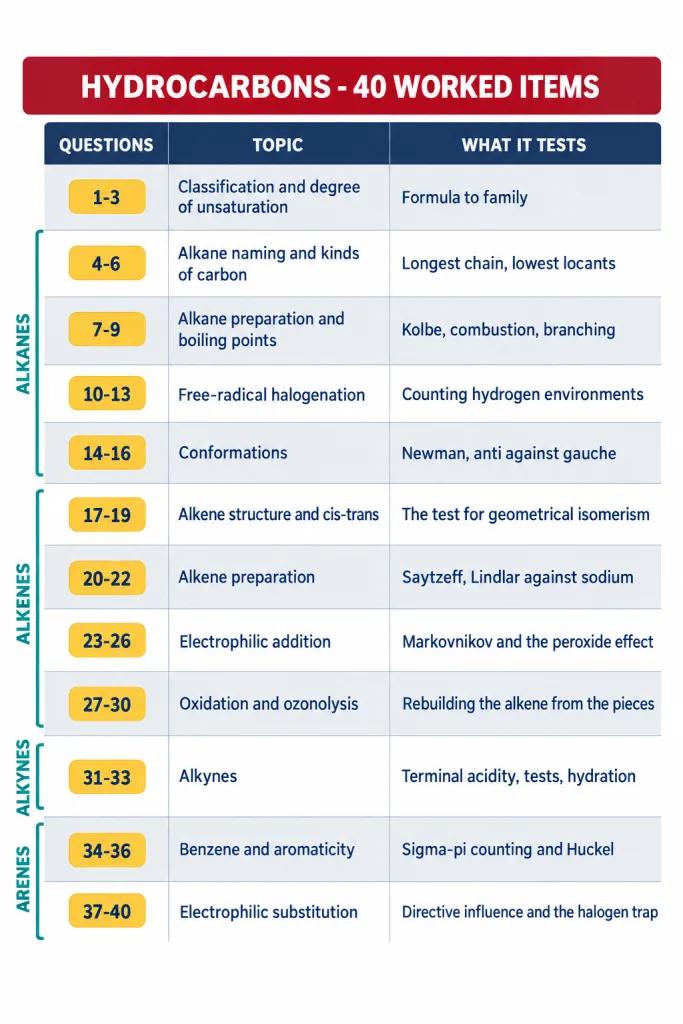
[JEE/NEET] The four groups that repay the most practice are free-radical halogenation counting, ozonolysis worked backwards, the Lindlar against sodium pair, and the halogen directive-influence trap. Between them they account for most of the hydrocarbon questions that are decided by one line of reasoning rather than recall.
Classification, general formulae and degree of unsaturation
Question 1: Degrees of unsaturation from three formulae
Work out the degree of unsaturation of , and , and say what each compound could be.
Answer:
For a compound of carbon and hydrogen only, I compare the hydrogen count with the saturated open-chain value and halve the shortfall.
For : , so , and . Nothing is missing, so the compound is a saturated open-chain alkane — hexane or one of its branched isomers.
For : . Two units are missing. A ring counts one, a double bond counts one, a triple bond counts two. So this could be hex-1-yne (one triple bond), hexa-1,3-diene (two double bonds), cyclohexene (a ring and a double bond), or a bicyclic compound.
For : , , and . A benzene ring uses up exactly four — one for the ring and three for the double bonds in it — so toluene fits with nothing left over.
Ans: 0, 2 and 4; hexane, an alkyne or diene or cycloalkene, and toluene.
Watch out: A triple bond counts two, not one, and a ring counts one. Forgetting that the ring itself costs a degree is why gets answered as three.
Question 2: Formula from a percentage composition
A gaseous hydrocarbon is 85.7% carbon and 14.3% hydrogen by mass, and its relative molecular mass is 56. Find the molecular formula and say which two families it could belong to.
Answer:
I take 100 g of the compound and turn masses into moles.
Carbon: mol. Hydrogen: mol.
Dividing both by the smaller, , gives . The empirical formula is , of empirical mass .
, so the molecular formula is .
Degree of unsaturation: . One unit is missing, which is one double bond or one ring.
Ans: ; it could be an alkene (but-1-ene, but-2-ene, 2-methylprop-1-ene) or a cycloalkane (cyclobutane, methylcyclopropane).
Watch out: is not a promise of a double bond. Bromine water settles it in one shake — decolourised means alkene, unchanged means cycloalkane.
Question 3: The four general formulae on seven carbons
Write the molecular formula of a seven-carbon compound that is (a) an open-chain alkane, (b) an open-chain alkene with one double bond, (c) an open-chain alkyne with one triple bond, (d) a cycloalkane. Which two share a formula, and why does that matter?
Answer:
I put into each general formula.
(a) Alkane, : . (b) Alkene with one double bond, : . (c) Alkyne with one triple bond, : . (d) Cycloalkane, : .
The alkene and the cycloalkane come out the same. Closing a ring costs two hydrogens, exactly what making a double bond costs, so a formula alone cannot tell them apart. The same thing happens one step further down: fits an alkyne, a diene, a cycloalkene and a bicyclic alkane.
Ans: , , and ; the alkene and the cycloalkane share , so a chemical test, not the formula, decides between them.
Alkane naming, isomerism and kinds of carbon
Question 4: Naming a doubly branched alkane
Name and give its molecular formula.
Answer:
First I look for the longest continuous chain. Reading straight across gives six carbons. Turning out through the ethyl branch at the fourth carbon also gives six. Every six-carbon chain I can trace carries two branches, so there is no tie to break on branch count and they all give the same name.
Now the numbering. From the left the branches land on carbons 2 and 4; from the right they land on 3 and 5. At the first point of difference , so wins and I number from the left.
That puts a methyl on C2 and an ethyl on C4. In the name, substituents are listed alphabetically, so ethyl comes before methyl.
Counting the carbons: six in the chain, one in the methyl, two in the ethyl — nine in all, and a saturated open-chain compound with nine carbons has hydrogens.
Ans: 4-ethyl-2-methylhexane, .
Watch out: Alphabetical order sets the order of the names, not the size of the group and not its locant. Writing "2-methyl-4-ethylhexane" loses the mark even though both numbers are right.
Question 5: Which hexanes have a tertiary carbon, and which a quaternary one
The five isomers of are n-hexane, 2-methylpentane, 3-methylpentane, 2,3-dimethylbutane and 2,2-dimethylbutane. How many contain at least one tertiary carbon, and how many contain a quaternary carbon?
Answer:
I take each carbon in turn and count only the carbon atoms attached to it: one makes it primary, two secondary, three tertiary, four quaternary.
n-Hexane, : the two ends touch one carbon each, the four inner carbons touch two each. Primary and secondary only, so no tertiary carbon.
2-Methylpentane, : C2 touches C1, C3 and the branch methyl — three carbons, so tertiary.
3-Methylpentane, : C3 touches C2, C4 and the branch methyl — tertiary again.
2,3-Dimethylbutane, : C2 and C3 each touch three carbons, so there are two tertiary carbons.
2,2-Dimethylbutane, : C2 touches C1, C3 and two branch methyls — four carbons, so quaternary. Every other carbon here is primary or secondary, so this isomer has no tertiary carbon at all.
Ans: Three isomers contain a tertiary carbon — 2-methylpentane, 3-methylpentane and 2,3-dimethylbutane; one contains a quaternary carbon — 2,2-dimethylbutane.
Watch out: A quaternary carbon carries no hydrogen, so it can never be attacked in halogenation. And the isomer that has the quaternary carbon is the one with no tertiary carbon — the two do not travel together.
Question 6: Counting all four kinds of carbon in a nine-carbon alkane
Draw 3-ethyl-2,2-dimethylpentane, give its molecular formula, and count its primary, secondary, tertiary and quaternary carbons. Then check the count using the hydrogens.
Answer:
The parent is pentane, with two methyls on C2 and an ethyl on C3:
Going through the carbons:
- C1 touches only C2 — primary, 3 hydrogens.
- C2 touches C1, C3 and two branch methyls — four carbons, so quaternary, 0 hydrogens.
- The two branch methyls on C2 each touch one carbon — primary, 3 hydrogens each.
- C3 touches C2, C4 and the first carbon of the ethyl group — three carbons, so tertiary, 1 hydrogen.
- C4 touches C3 and C5 — secondary, 2 hydrogens.
- C5 touches C4 — primary, 3 hydrogens.
- The ethyl touches C3 and its own methyl — secondary, 2 hydrogens.
- The ethyl touches one carbon — primary, 3 hydrogens.
Totals: 5 primary, 2 secondary, 1 tertiary, 1 quaternary. That is carbons.
Hydrogen check: . And with gives 20. The two agree.
Ans: ; 5 primary, 2 secondary, 1 tertiary and 1 quaternary carbon.
Alkane preparation, combustion and boiling points
Question 7: One salt, two methods, two different alkanes
Sodium propanoate is treated in two ways: (i) heated with soda lime, and (ii) a concentrated aqueous solution of it is electrolysed. Write a balanced equation for each and name the alkane obtained.
Answer:
(i) Soda-lime decarboxylation. Soda lime is mixed with . It strips the group off as carbonate, so the alkane has one carbon fewer than the salt.
Atom check — carbon ; hydrogen ; oxygen ; sodium . The product is ethane, two carbons from a three-carbon salt.
(ii) Kolbe electrolysis. The carboxylate ion loses an electron at the anode, then carbon dioxide, and the two ethyl radicals left behind pair up. Hydrogen comes off at the cathode.
Atom check — carbon ; hydrogen and ; oxygen and ; sodium . The product is n-butane, four carbons from a three-carbon salt.
Ans: Soda lime gives ethane; Kolbe electrolysis gives n-butane.
Watch out: Decarboxylation subtracts one carbon from the alkyl part; Kolbe doubles it. The same salt, two methods, and the carbon counts go in opposite directions.
Question 8: Gas volumes for a propane burner
5 L of propane is burnt in excess air. All gas volumes are measured at the same temperature and pressure, at which water is a liquid. Find the volume of oxygen used and the volume of carbon dioxide formed.
Answer:
First the balanced equation. The general form is , and for that is moles of oxygen.
Atom check — carbon ; hydrogen ; oxygen .
For gases at the same temperature and pressure, volumes are in the same ratio as moles. So 1 volume of propane needs 5 volumes of oxygen and gives 3 volumes of carbon dioxide.
Oxygen: L. Carbon dioxide: L.
Ans: 25 L of oxygen used, 15 L of carbon dioxide formed.
Watch out: The 4 moles of water would be 20 L as a gas, but the question fixes conditions at which it is a liquid, so it contributes nothing to the measured gas volume.
Question 9: Ranking four alkanes by boiling point
Arrange n-hexane, n-heptane, 2-methylhexane and 2,2-dimethylpentane in decreasing order of boiling point.
Answer:
Two rules are at work, and they have to be applied in the right order.
Chain length first. Boiling point rises with the number of carbons, because a longer molecule has more surface for van der Waals forces to act over. Three of these are and only n-hexane is , so n-hexane sits at the bottom.
Branching second, within the set. A branched molecule is more nearly spherical, so less of its surface touches its neighbours and the forces between molecules are weaker. n-Heptane has no branch, 2-methylhexane has one, and 2,2-dimethylpentane has two on the same carbon and is the most compact of the three.
Ans: n-heptane > 2-methylhexane > 2,2-dimethylpentane > n-hexane.
Watch out: Branching lowers the boiling point, but not usually far enough to push a seven-carbon alkane below a six-carbon one. Compare the carbon counts first, and only then compare shapes within a set.
Free-radical halogenation
Question 10: Counting the monochloro products of 2-methylpentane
How many distinct monochloro products can 2-methylpentane give, ignoring stereoisomers? Name them.
Answer:
The skeleton is : a five-carbon chain with a methyl branch on C2.
I sort the hydrogens into sets of equivalent ones, because each set gives one product.
- C1 and the branch methyl are two methyl groups joined to the same carbon, so they are equivalent — set 1.
- The single hydrogen on C2 is tertiary and alone — set 2.
- The two hydrogens on C3 — set 3.
- The two hydrogens on C4 — set 4.
- The three hydrogens on C5, a methyl hanging off a and so in a different environment from the other two methyls — set 5.
Five sets, five products.
- Chlorine on C1 or the branch methyl: , 1-chloro-2-methylpentane
- Chlorine on C2: , 2-chloro-2-methylpentane
- Chlorine on C3: , 3-chloro-2-methylpentane
- Chlorine on C4: , 2-chloro-4-methylpentane
- Chlorine on C5: , 1-chloro-4-methylpentane
The fourth name is worth a second look. Numbering from either end puts the two substituents on carbons 2 and 4, so the locant set ties at . The tie is broken by giving the lower number to whichever substituent comes first alphabetically, and chloro beats methyl.
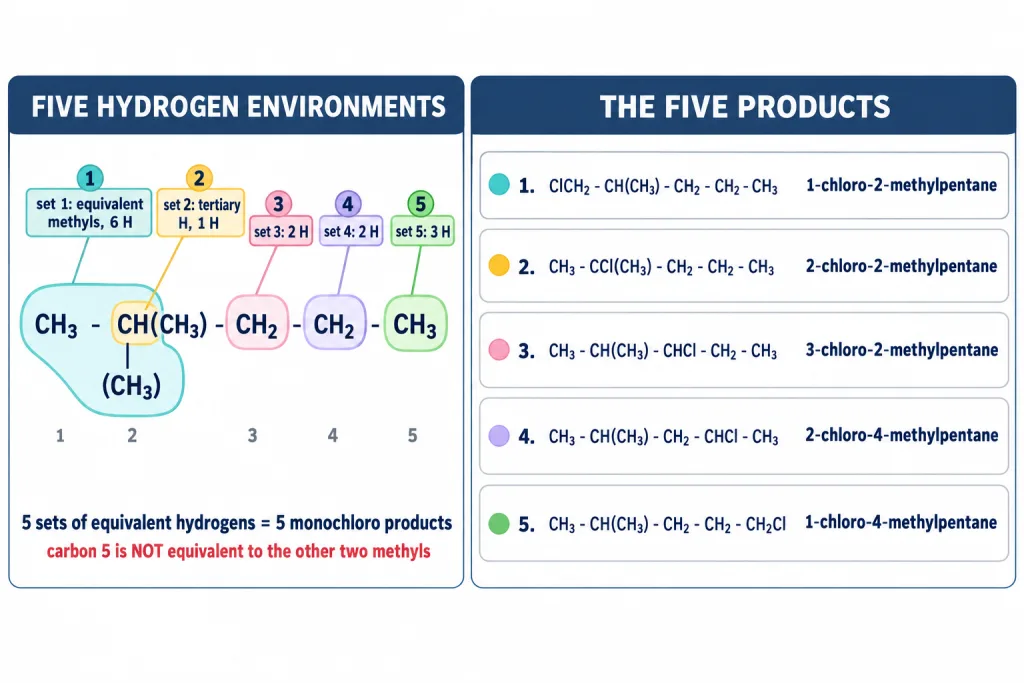
Ans: Five — 1-chloro-2-methylpentane, 2-chloro-2-methylpentane, 3-chloro-2-methylpentane, 2-chloro-4-methylpentane and 1-chloro-4-methylpentane.
Watch out: C1 and the branch methyl are equivalent, but C5 is not one of them — it hangs off a group, not off the branched carbon. Lumping all three methyls together gives four products and is the standard slip on this molecule.
Question 11: Turning percentages into a reactivity ratio
In one experiment the chlorination of propane in sunlight gives 45% of 1-chloropropane and 55% of 2-chloropropane. Use these figures to compare how easily a secondary hydrogen is replaced with how easily a primary one is.
Answer:
Propane is . C1 and C3 carry three hydrogens each, all primary, so there are 6 primary hydrogens. C2 carries two, both secondary, so there are 2 secondary hydrogens.
The percentages are shares of product, not measures of reactivity, because there are three times as many primary hydrogens waiting to be hit. So I divide each share by the number of hydrogens that produced it.
Per primary hydrogen: .
Per secondary hydrogen: .
Ratio: .
Ans: A secondary hydrogen is replaced about 3.7 times as readily as a primary one, which is the order tertiary > secondary > primary showing up as a number.
Watch out: Comparing 55% with 45% straight off makes the two look almost equally easy. The head count has to be divided out first.
Question 12: Two products from 2-methylpropane
2-Methylpropane is chlorinated in sunlight. Name the monochloro products and explain why neither of them is formed alone.
Answer:
The structure is . There are two sets of hydrogens: nine primary hydrogens on three equivalent methyl groups, and one tertiary hydrogen on the central carbon. So there are two products.
- Chlorine on a methyl: , 1-chloro-2-methylpropane.
- Chlorine on the central carbon: , 2-chloro-2-methylpropane.
Two things pull in opposite directions. The tertiary hydrogen is the one most easily replaced, since ease of replacement runs tertiary > secondary > primary — but there is only one of it. The primary hydrogens are the hardest to replace, but there are nine of them, so a chlorine atom is nine times as likely to meet one.
Reactivity multiplied by number leaves both products in the flask in comparable amounts.
Ans: 1-Chloro-2-methylpropane and 2-chloro-2-methylpropane, both formed in appreciable quantity.
Watch out: "Tertiary is fastest" compares one hydrogen with one hydrogen. On its own it does not predict the major product — the number of each kind has to go into the arithmetic too.
Question 13: Why bromine is fussier than chlorine
Chlorination of 2-methylpropane gives both monochlorides in comparable amounts, but bromination under similar conditions gives almost entirely 2-bromo-2-methylpropane. Account for the difference.
Answer:
The halogens react in the order , and reactivity and choosiness run opposite ways.
A chlorine atom is very reactive. It abstracts whichever hydrogen it happens to collide with and barely distinguishes one kind from another, so the nine-to-one head count in favour of the primary hydrogens largely decides the outcome, and a mixture results.
A bromine atom is far less reactive. It is not energetic enough to take just any hydrogen, so it waits for the one that comes off most easily — the single tertiary hydrogen. Selectivity now overwhelms the head count, and one product dominates.
Ans: Bromination gives almost only 2-bromo-2-methylpropane, because the less reactive halogen atom is the more selective one.
Watch out: Less reactive is not less useful. For making one clean product from a branched alkane, bromine is the better reagent, and fluorine — so violent that it shatters carbon chains — is the worst.
Conformations
Question 14: The cost of a single eclipsing pair
The eclipsed conformation of ethane lies 12.5 kJ/mol above the staggered one, and three pairs of C-H bonds eclipse at the same moment. Work out the cost of one eclipsing pair and say whether rotation is free at room temperature.
Answer:
I look along the bond. The front carbon has three hydrogens and the back carbon has three. In the eclipsed form each front hydrogen lines up exactly behind one back hydrogen, so there are three eclipsing pairs at once.
Splitting the barrier equally between them:
The whole barrier is 12.5 kJ/mol, which is tiny beside the bond enthalpy of 348 kJ/mol. Molecules collide with energies of this size constantly at room temperature, so the barrier is crossed billions of times a second.
Ans: About 4.2 kJ/mol per eclipsing pair; the total of 12.5 kJ/mol is far too small to stop rotation, so the conformers cannot be isolated.
Question 15: Dipole moment of 1,2-dibromoethane
In the anti conformation of the two bonds point in opposite directions. Predict the dipole moment of that conformation, and explain why a real sample still shows a small dipole moment.
Answer:
Each bond is polar, with on bromine and on carbon, so each contributes a bond dipole.
In the anti conformation the dihedral angle between the two bromines is . The two bond dipoles are equal in size and exactly opposed, so they cancel and that conformation has zero dipole moment.
A sample, though, is not one conformation. Rotation about the single bond is free, so the molecule passes through anti and gauche arrangements over and over, and at any instant a fraction of the molecules are gauche. In a gauche form the bromines are only apart and their dipoles do not cancel.
The measured dipole moment is an average over the whole population, so it comes out small but not zero.
Ans: The anti conformation has zero dipole moment; the sample has a small non-zero value because gauche conformations are populated as well.
Watch out: Zero for one conformation is not zero for the compound. Contrast trans-1,2-dichloroethene, where rotation about the double bond is restricted, so the cancellation is locked in and the measured dipole moment really is zero.
Question 16: Newman projections of 1-chloropropane
Look along the bond of 1-chloropropane. Describe the staggered conformations available and say which is the most stable.
Answer:
The compound is . Looking along , the front circle is C1 carrying , , ; the back circle is C2 carrying , , .
In a staggered arrangement the back three groups sit exactly between the front three. Turning the back carbon through a full passes three staggered positions, and I sort them by where the methyl group ends up relative to the chlorine:
- methyl from the chlorine — the anti conformation, one of them
- methyl from the chlorine, on one side — a gauche conformation
- methyl from the chlorine, on the other side — the second gauche conformation, the mirror image of the first
All three are free of torsional strain, so the ranking is settled by crowding between the two large groups, chlorine and methyl. They are furthest apart in the anti form.
Ans: Three staggered conformations — one anti and two equivalent gauche forms; the anti conformation, with and apart, is the most stable.
Watch out: Staggered against eclipsed is decided by torsional strain. Anti against gauche, with both staggered, is decided by crowding between the bulky groups — a different effect with a different name.
Alkene structure, naming and cis-trans isomerism
Question 17: Naming a branched alkene
Name .
Answer:
First I look for the longest chain that has the double bond in it. Reading straight across gives six carbons with the double bond inside, so the parent is hexene. Going out through the methyl branch cuts the chain short, so six is the best I can do.
Next the numbering, and the double bond has first claim on the low number. From the left the double bond starts at C2; from the right it starts at C4. So I number from the left.
That leaves the methyl branch on C4.
Locant style: the number for the double bond goes immediately before the suffix, so it is hex-2-ene, not 2-hexene.
Ans: 4-methylhex-2-ene.
Watch out: The double bond decides the direction of numbering, not the branch. Numbering from the branch end would give "3-methylhex-4-ene", with a larger number on the double bond, and is wrong.
Question 18: Counting the geometrical isomers of a diene
How many cis-trans isomers has hexa-2,4-diene, ?
Answer:
I test each double bond separately. A double bond shows cis-trans isomerism only if each of its two carbons carries two different groups.
The bond: C2 carries a methyl and a hydrogen — different. C3 carries a hydrogen and the rest of the chain — different. It passes.
The bond is the same molecule seen from the other end, so it passes too.
Each bond can be cis or trans on its own, which suggests arrangements: cis-cis, cis-trans, trans-cis and trans-trans.
But the molecule is symmetrical about its middle. Turning a cis-trans molecule end for end produces a trans-cis one, so those two are the same compound counted twice.
That leaves cis-cis, cis-trans and trans-trans.
Ans: Three.
Watch out: Doubling for every double bond over-counts whenever the molecule has a symmetry that swaps the two bonds. Check for that symmetry before multiplying.
Question 19: Two dichloroethenes compared
1,2-Dichloroethene exists as a cis form and a trans form. Which has the larger dipole moment, and which has the higher melting point?
Answer:
Rotation about the bond is restricted, so the two arrangements are separate compounds that can be bottled apart.
Dipole moment. Each bond is polar. In the trans form the two chlorines are on opposite sides, so the two bond dipoles point in opposite directions and cancel — the trans isomer has zero dipole moment. In the cis form both chlorines are on the same side, so the two dipoles have a component pointing the same way and add up.
Melting point. Melting depends on how neatly molecules stack in a crystal. The trans isomer is the more symmetrical and the straighter of the two, so it packs closely into the lattice and more energy is needed to break it apart.
Ans: The cis isomer has the larger dipole moment; the trans isomer has the higher melting point.
Watch out: The two answers point at different isomers, and mixing them up is easy. Polarity raises boiling point, so cis usually boils higher; symmetry and packing raise melting point, so trans usually melts higher.
Alkene preparation, Saytzeff and the two partial hydrogenations
Question 20: Saytzeff on 2-bromo-3-methylbutane
2-Bromo-3-methylbutane is heated with alcoholic . Give both possible alkenes and name the major product.
Answer:
The halide is .
Alcoholic potash removes the bromine from C2 and a hydrogen from a carbon next door, which is beta-elimination. C2 has two neighbours that carry hydrogen, so there are two ways to go.
Taking a hydrogen from C1, a methyl group:
That is 3-methylbut-1-ene, and its double bond carries just one alkyl group.
Taking a hydrogen from C3, the branched carbon:
That is 2-methylbut-2-ene, and its double bond carries three alkyl groups.
Saytzeff's rule says the more substituted alkene, being the more stable, is the major product.
Ans: 2-Methylbut-2-ene is the major product; 3-methylbut-1-ene is the minor one.
Watch out: Count the alkyl groups attached to the two doubly bonded carbons, not the carbons in the whole molecule. Both products here are , so size cannot separate them.
Question 21: The same alkyne, two geometries
Starting from hex-3-yne, give the reagent and conditions leading to cis-hex-3-ene and those leading to trans-hex-3-ene, and say why each stops at the alkene.
Answer:
The alkyne is , symmetrical, with an ethyl group on each end.
For the cis alkene I use hydrogen with Pd/BaSO4 poisoned by quinoline, which is Lindlar's catalyst.
The alkyne lies flat on the metal surface and both hydrogen atoms are delivered from that same surface, so they arrive on the same face. The two ethyl groups are pushed to the other side together, which is the cis arrangement. The quinoline poisons the catalyst just enough that the alkene leaves the surface before it can take up a second molecule of hydrogen.
For the trans alkene I use sodium in liquid ammonia at 195 K.
Here the metal hands over electrons one at a time rather than delivering two hydrogens together, and the intermediate settles into the shape with the two ethyl groups as far apart as they can get before the second hydrogen arrives. An ordinary isolated double bond is not attacked by sodium in ammonia, so the reaction has nowhere further to go.
Ans: Lindlar's catalyst gives cis-hex-3-ene; sodium in liquid ammonia at 195 K gives trans-hex-3-ene.
Watch out: These two are set as a pair more often than either is set alone. Lindlar means cis; sodium in liquid ammonia means trans. Swapping them costs the whole answer.
Question 22: Two alcohols, one alkene
2-Methylbut-2-ene is wanted as the major product of dehydration with concentrated at 443 K. Name two alcohols that would give it, and say which is the better starting material.
Answer:
I work backwards. Dehydration removes from one carbon and from a neighbour, so the sat on one of the two carbons that now share the double bond. The alkene is , so those carbons are C2 and C3 of a 2-methylbutane skeleton.
on C2 gives , which is 2-methylbutan-2-ol, a tertiary alcohol. Losing water with a hydrogen from C3 gives 2-methylbut-2-ene; losing it with a hydrogen from C1 or the branch methyl would give 2-methylbut-1-ene instead, and Saytzeff puts the trisubstituted alkene in front.
on C3 gives , which is 3-methylbutan-2-ol, a secondary alcohol. Losing water with a hydrogen from the branched carbon gives the same 2-methylbut-2-ene; the other route gives 3-methylbut-1-ene as the minor product.
Ease of dehydration runs tertiary > secondary > primary, so the tertiary alcohol goes under milder conditions and gives a cleaner result.
Ans: 2-Methylbutan-2-ol and 3-methylbutan-2-ol; the tertiary alcohol 2-methylbutan-2-ol is the better choice.
Electrophilic addition, Markovnikov and the peroxide effect
Question 23: 2-Methylbut-1-ene with hydrogen chloride
Predict the major product and justify it through the intermediate.
Answer:
The alkene is . Both the alkene and the reagent are unsymmetrical, so Markovnikov decides the outcome.
The slow step is the proton joining the double bond, and it can go either way.
If the proton adds to C1, the positive charge is left on C2, which carries a methyl and an ethyl group — a tertiary carbocation.
If the proton adds to C2, the charge is left on C1, a group — a primary carbocation.
Tertiary beats primary by a wide margin, so only the first route matters. Chloride then attacks the tertiary carbon.
Atom check — carbon , hydrogen , chlorine .
The chlorine has landed on the carbon that carried no hydrogen, which is exactly what Markovnikov's rule states: the negative part of the reagent goes to the carbon with fewer hydrogens.
Ans: 2-Chloro-2-methylbutane.
Watch out: Markovnikov's rule is a shorthand for "the more stable carbocation forms first". Name the carbocation and the rule follows; assert the rule alone and a rearranging substrate will catch you out.
Question 24: Ranking three alkenes for rate
Arrange ethene, propene and 2-methylpropene in increasing order of rate of addition of in the dark.
Answer:
The slow step is the proton attaching itself to the pi cloud and leaving a carbocation. Two effects run the same way here.
The alkene. An alkyl group pushes electron density into the double bond by and by hyperconjugation, making the pi cloud richer and a better target for . Ethene, , has no alkyl group; propene, , has one; 2-methylpropene, , has two on the same carbon.
The cation. Ethene can only give a primary carbocation, propene gives a secondary one, and 2-methylpropene gives a tertiary one. The more stable the cation, the easier it is to reach.
Ans: ethene < propene < 2-methylpropene.
Question 25: Working backwards through the peroxide effect
Which alkene, treated with in the presence of benzoyl peroxide, gives 1-bromo-2-methylpropane? What does the same alkene give with and no peroxide?
Answer:
The product is . To undo an addition I take the bromine off one carbon and a hydrogen off the carbon next to it, then join those two carbons with a double bond. Bromine from C1 and hydrogen from C2 gives , which is 2-methylpropene.
Now I check the direction, because the answer has to be consistent with the peroxide mechanism.
With benzoyl peroxide the chain carrier is a bromine radical, and it is the bromine, not the hydrogen, that adds first. It adds wherever it leaves the more stable radical behind. Adding to C1 leaves the unpaired electron on C2, which is tertiary; adding it to C2 would leave a primary radical. So bromine goes to the carbon carrying more hydrogens — the anti-Markovnikov position — and the product is the primary bromide, as given.
Without peroxide the proton adds first, leaving the tertiary carbocation on C2, and bromide attacks there.
Ans: 2-Methylpropene; without peroxide it gives 2-bromo-2-methylpropane.
Watch out: Both routes pass through the more stable tertiary intermediate. What changes is which atom arrives first — a bromine radical with peroxide, a proton without it — and that puts the bromine at opposite ends of the molecule.
Question 26: Propan-1-ol into propan-2-ol
Convert propan-1-ol into propan-2-ol in two steps, giving reagents and conditions.
Answer:
The hydroxyl group has to move from C1 to C2, and a double bond is the way to move it: making the alkene wipes out the memory of where the used to be, and putting it back follows a rule rather than the history.
Step 1 — dehydration. Concentrated at 443 K.
Atom check — carbon , hydrogen , oxygen .
Step 2 — hydration. Water with dilute as catalyst, which adds by Markovnikov. The proton goes to the end, a secondary carbocation forms on the middle carbon, and water attacks there.
Ans: Concentrated at 443 K, then water with dilute .
Watch out: Markovnikov hydration cannot put the back on a terminal carbon, so this route runs one way only — primary to secondary, never the reverse.
Oxidation, ozonolysis and working backwards
Question 27: Ozonolysis of a diene
Buta-1,3-diene is treated with ozone and the ozonide is then worked up with zinc and water. Give the products.
Answer:
The diene is . Ozone attacks every carbon-carbon double bond it finds, so both are cut, and the single bond between C2 and C3 is left alone.
Each cut caps the two carbons with oxygen:
- C1 was , so it becomes , methanal.
- C4 was , so it also becomes .
- C2 and C3 are joined to each other by a single bond, which ozone leaves alone, so they come away still joined and each picks up an oxygen, giving , ethanedial.
Carbon and hydrogen check — carbon ; hydrogen . The oxygen is supplied by the ozone.
The zinc is there to destroy the hydrogen peroxide formed during the work-up. Without it the peroxide would oxidise both aldehydes to acids and the products would be wrong.
Ans: Two moles of methanal and one mole of ethanedial (glyoxal) for every mole of diene.
Question 28: Backwards from two different carbonyl compounds
An alkene of formula gives ethanal and butanone on ozonolysis followed by . Identify and name it.
Answer:
Ozonolysis cuts the double bond and puts one oxygen on each of the two carbons that shared it. To run it backwards I strip the oxygen off each carbonyl carbon and join those two carbons with a double bond.
Ethanal, , came from the fragment .
Butanone, , came from the fragment .
Joining them:
Formula check — carbons ; hydrogens . That is , as required.
Now the name. The longest chain containing the double bond runs , five carbons, so the parent is pentene. Numbering from the left puts the double bond at 2 and the methyl branch at 3; from the right the double bond would be at 3.
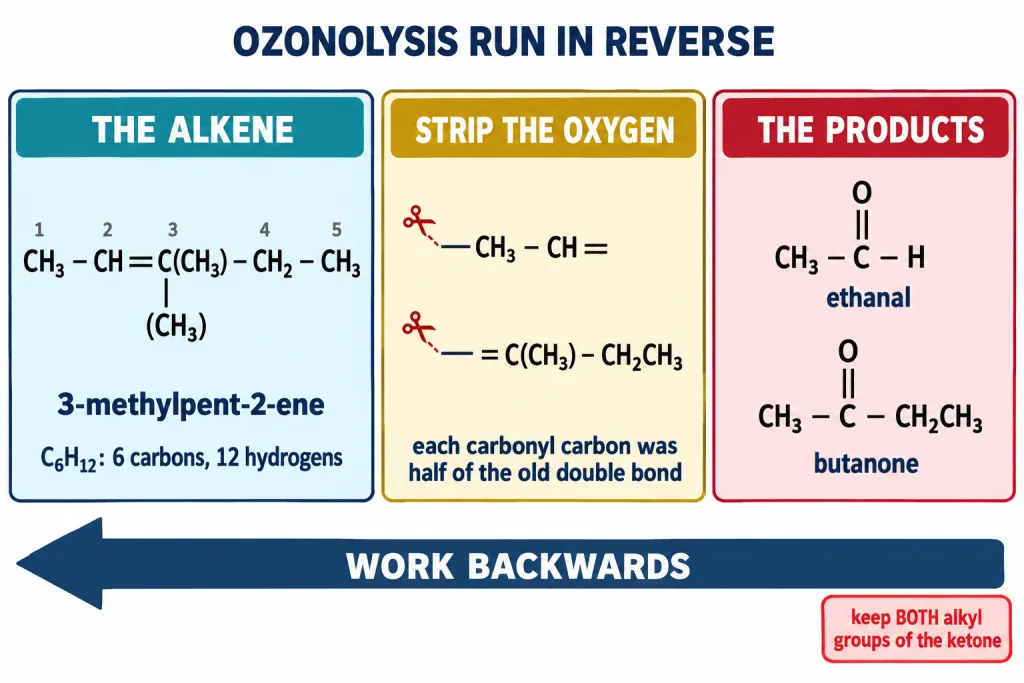
Ans: , 3-methylpent-2-ene.
Watch out: A ketone fragment keeps both its alkyl groups. Dropping the ethyl group and answering 2-methylbut-2-ene loses a carbon and fails the formula check.
Question 29: A hydrocarbon that fails both tests
A hydrocarbon of formula leaves bromine water unchanged and does not discharge the pink colour of Baeyer's reagent. Identify it, and say what an alkene of the same formula would have done.
Answer:
The degree of unsaturation is . One unit is missing, so the molecule has either one double bond or one ring.
Both tests are tests for a carbon-carbon double bond, and both come out negative. So there is no double bond, and the missing unit has to be the ring.
A five-carbon ring with no double bond is cyclopentane, a saturated compound that behaves like an alkane.
An alkene of the same formula — pent-1-ene, say — would have discharged the orange colour of bromine water at once, and would have turned Baeyer's reagent from pink to colourless with brown settling out, leaving pentane-1,2-diol behind.
Ans: Cyclopentane; an alkene would have decolourised both reagents.
Watch out: Reading as "alkene" without testing is exactly the mistake this question is built around.
Question 30: Backwards from two acids
A hydrocarbon A, , decolourises bromine water. Heated with acidic it gives ethanoic acid and propanoic acid. Identify A.
Answer:
Bromine water decolourised means a carbon-carbon double bond, so A is an alkene, not a cycloalkane.
Hot acidic permanganate cuts the double bond and oxidises each end as far as it will go. A doubly bonded carbon that carried one hydrogen ends up as ; one that carried two hydrogens is oxidised all the way to ; one that carried none stops at a ketone.
Both products here are carboxylic acids and no carbon dioxide is mentioned, so each doubly bonded carbon carried exactly one hydrogen.
Ethanoic acid, , came from .
Propanoic acid, , came from .
Joining them gives : five carbons and ten hydrogens, matching .
Ans: A is pent-2-ene, .
Watch out: The absence of carbon dioxide in the product list is a piece of evidence, not an omission. It rules out pent-1-ene, whose terminal would have been burnt off as .
Alkynes — acidity, distinguishing tests and hydration
Question 31: Hydration of an unsymmetrical internal alkyne
Pent-2-yne is treated with water in the presence of dilute and 1% at 333 K. What is formed?
Answer:
The alkyne is , with the triple bond between C2 and C3.
Water adds across the triple bond to give an enol, a compound with attached to a doubly bonded carbon. The enol is unstable and tautomerises at once to a carbonyl compound.
The can land on C2 or on C3, and the two are not equivalent — one carries a methyl, the other an ethyl. Markovnikov's rule is no help, because neither alkyne carbon carries any hydrogen at all, so there is nothing to compare.
on C2 gives the enol , which tautomerises to , pentan-2-one.
on C3 gives the enol , which tautomerises to , pentan-3-one.
Taking two molecules of the alkyne so that both products can be written in one balanced equation:
Atom check — carbon ; hydrogen ; oxygen .
No aldehyde is possible, because neither carbon of the triple bond is at the end of the chain.
Ans: A mixture of pentan-2-one and pentan-3-one.
Watch out: Ethyne is the only alkyne whose hydration gives an aldehyde, ethanal. Every other alkyne gives a ketone, and an unsymmetrical internal alkyne gives two of them.
Question 32: Which of five hydrocarbons gives a white precipitate
Propane, propene, propyne, but-1-yne and but-2-yne are each shaken with ammoniacal silver nitrate. Which give a white precipitate, and why do the others fail?
Answer:
The reagent removes a hydrogen that is attached to an carbon. Only a terminal alkyne has one, so the test picks out terminal alkynes and nothing else.
Propyne, — terminal, one hydrogen on an carbon. White precipitate of silver propynide.
Hydrogen check — left ; right . Nitrogen , silver , oxygen .
But-1-yne, — terminal as well. White precipitate.
But-2-yne, — the triple bond sits in the middle and both carbons carry a methyl group, so there is no hydrogen on an carbon. No precipitate.
Propene — its hydrogens are on carbons, which have 33.3% character. The bond is much less polarised, so nothing happens.
Propane — carbons, 25% character, the least acidic of the three kinds. No reaction.
Ans: Propyne and but-1-yne only.
Watch out: The test detects a terminal triple bond, not a triple bond. But-2-yne is a perfectly good alkyne and gives nothing at all.
Question 33: Acidity read against bond length
For ethane, ethene and ethyne, quote the bond length and arrange the three in order of acidity. Say which property explains which trend.
Answer:
The lengths are ethane 109 pm, ethene 108 pm, ethyne 106 pm.
The carbon is in ethane, in ethene and in ethyne, so the character goes 25%, 33.3%, 50%.
An orbital is held closer to the nucleus than a orbital. The more character a hybrid orbital has, the tighter it holds the bonding pair and the nearer it draws the hydrogen. That is the falling bond length.
The same concentration of electron density near the nucleus makes the carbon the most electronegative of the three, so the bond in ethyne is the most polarised and the proton leaves most readily. It also stabilises what is left behind: the carbanion's lone pair sits in the orbital with the most character, closest to the nucleus.
Ans: Bond lengths 109 pm > 108 pm > 106 pm; acidity . The character of the carbon orbital explains both.
Watch out: Ethyne is still a very weak acid overall, far weaker than water. It is acidic only by the standards of other hydrocarbons, which is why sodium reacts with it and sodium hydroxide does not.
Benzene, aromaticity and Huckel counting
Question 34: Counting bonds and electrons in two arenes
For benzene and for naphthalene, count the sigma bonds, the pi bonds and the delocalised pi electrons, and check each against Huckel's rule.
Answer:
Benzene, . Six carbons in a ring need six sigma bonds to close it, and each carbon carries one hydrogen, giving six sigma bonds. That is 12 sigma bonds. Three pi bonds sit on top of three of the sigma bonds, so 3 pi bonds and 6 pi electrons.
Huckel: gives , a whole number. The ring is planar, cyclic and completely conjugated — every carbon is with an unhybridised orbital — so benzene is aromatic.
Naphthalene, . Ten carbons in two rings fused along one edge. Ten atoms joined in a chain would need nine bonds, and closing each of the two rings adds one more, so there are 11 bonds. Only eight carbons carry a hydrogen, because the two carbons on the shared edge are joined to three carbons each and have no room for one. So 8 bonds, and 19 sigma bonds. There are 5 pi bonds and 10 pi electrons.
Huckel: gives , a whole number, and naphthalene is planar and fully conjugated, so it is aromatic.
Ans: Benzene — 12 sigma, 3 pi, 6 delocalised electrons, . Naphthalene — 19 sigma, 5 pi, 10 delocalised electrons, . Both aromatic.
Watch out: The two carbons shared between the rings carry no hydrogen, which is why naphthalene has ten carbons but only eight hydrogens. Writing throws the whole count out.
Question 35: Identifying an arene from its oxidation product
An aromatic hydrocarbon of formula is heated with and gives benzene-1,4-dicarboxylic acid. Identify it, and say what ethylbenzene would have given under the same conditions.
Answer:
Degree of unsaturation: . A benzene ring accounts for exactly four, so the two extra carbons are in saturated side chains, not in a second ring or a double bond.
Permanganate cuts every alkyl side chain back to and leaves the ring untouched. The product carries two groups, so the starting material had two separate side chains, and the 1,4 positions of the acid tell me where they were.
Two side chains sharing two carbons means one carbon each, so both were methyl groups on a ring, at positions 1 and 4.
Ethylbenzene has the same formula but only one side chain, of two carbons. That whole chain is cut back to a single , so ethylbenzene gives benzoic acid, a monocarboxylic acid.
Ans: -Xylene, 1,4-dimethylbenzene; ethylbenzene would give benzoic acid. (-Xylene would give benzene-1,2-dicarboxylic acid and -xylene benzene-1,3-dicarboxylic acid.)
Watch out: The number of groups counts the side chains, not the carbons in them. A two-carbon chain and a one-carbon chain both end as one .
Question 36: Cyclooctatetraene against benzene
Cyclooctatetraene, , has four double bonds in an eight-membered ring. Predict what it does with bromine water and with Baeyer's reagent, and contrast with benzene.
Answer:
First I test it against Huckel's rule.
The electron count: four double bonds means 8 pi electrons. Setting gives , which is not a whole number, so the count already fails.
The shape: the eight-membered ring is tub-shaped, not planar. Its orbitals cannot line up all the way round, so the ring is not completely conjugated either. Two of the four conditions are broken, and cyclooctatetraene is non-aromatic.
With no aromatic stabilisation, its four double bonds behave like ordinary isolated alkene double bonds. So it decolourises bromine water, and it discharges the pink colour of Baeyer's reagent, leaving brown behind.
Benzene does neither. Its six electrons are delocalised over a flat ring with a resonance energy of 150 kJ/mol standing behind them, so an addition reaction that destroyed the sextet would cost far more than it gained. Benzene substitutes instead.
Ans: Cyclooctatetraene decolourises both reagents; benzene decolourises neither, because cyclooctatetraene is non-aromatic and benzene is aromatic.
Watch out: Cyclooctatetraene is non-aromatic, not antiaromatic. It has a electron count, which would make it antiaromatic if it were flat — puckering into a tub is precisely how it escapes that penalty.
Electrophilic substitution and directive influence
Question 37: A two-step route, and why the order cannot be reversed
Prepare -nitroacetophenone from benzene. Give both steps with reagents and conditions, and explain why running them in the other order fails.
Answer:
Acetophenone is , so the two jobs are to put an acetyl group on the ring and then a nitro group meta to it. The order is what the question is really about.
Step 1 — Friedel-Crafts acylation. Benzene with ethanoyl chloride and anhydrous . The catalyst pulls the chloride off to generate the acylium ion , which attacks the ring. The product is acetophenone.
Atom check — carbon ; hydrogen ; chlorine ; oxygen .
Step 2 — nitration. Concentrated with concentrated at 323-333 K, which generates the nitronium ion . The group now on the ring is and , so it is deactivating and meta directing, and the nitro group enters at position 3.
The reverse order breaks at the second step. Nitrating benzene first gives nitrobenzene, and deactivates the ring so strongly that it will not react with a Friedel-Crafts electrophile at all. Nitrobenzene is in fact used as a solvent for Friedel-Crafts reactions, precisely because it sits them out.
Ans: Acylation with and anhydrous first, then nitration with conc. and conc. at 323-333 K.
Watch out: A ring carrying a strongly deactivating group will not undergo a Friedel-Crafts reaction. Any synthesis that needs both a Friedel-Crafts step and a nitration must do the Friedel-Crafts step first.
Question 38: Toluene and chlorine, two ways
Toluene is treated with chlorine (i) with anhydrous in the dark and (ii) in ultraviolet light with no catalyst. Give the products of each.
Answer:
The conditions decide which attacking species is generated, and the two species go for different parts of the molecule.
(i) Catalyst, in the dark. The Lewis acid polarises the bond and generates , an electrophile. An electrophile attacks the electron-rich pi cloud of the ring. The methyl group already there is and hyperconjugating, so it is activating and ortho, para directing.
(ii) Ultraviolet light, no catalyst. Light splits homolytically into two chlorine atoms. A chlorine atom is a radical, not an electrophile, so it has no interest in the pi cloud; it abstracts a hydrogen, and the side chain is the alkane-like part where that happens.
Atom check — carbon ; hydrogen ; chlorine . With more chlorine the same side chain is substituted again.
Ans: With in the dark, -chlorotoluene and -chlorotoluene by ring substitution; in ultraviolet light, benzyl chloride by side-chain substitution.
Watch out: Both products are , so the formula cannot tell them apart. Catalyst and dark means the ring; light means the side chain.
Question 39: Two groups that agree
-Nitrotoluene is brominated with and anhydrous . Where does the bromine go, and which group decides?
Answer:
I put the methyl group on C1 and the nitro group on C4, then classify each.
is activating and ortho, para directing. Its ortho positions are C2 and C6; its para position is C4, and that one is already occupied.
is deactivating and meta directing. Its meta positions are C3 and C5 counted from itself — which, numbered from the methyl, are C2 and C6.
Both groups point at the same two carbons, so there is no contest to settle. C2 and C6 are equivalent by the symmetry of the ring, so both give the same compound.
Ans: Bromine enters ortho to the methyl group, giving 2-bromo-4-nitrotoluene; the two groups agree on the position, and the activating methyl is what makes the reaction go at all.
Watch out: When two groups disagree, the more strongly activating one wins. Check for agreement first — it turns a hard-looking question into a one-line answer.
Question 40: Deactivating, and still ortho, para
Chlorobenzene is nitrated more slowly than benzene, yet the nitro group still enters ortho and para. Explain both halves of that through the arenium ion.
Answer:
Chlorine does two opposite things to the ring, and each half of the question comes from one of them.
Why it is slower — the effect. Chlorine is much more electronegative than carbon, so it pulls electron density out of the ring through the sigma framework. Every carbon is left poorer than the corresponding carbon in benzene, so is attracted less strongly and the rate-determining attack is slower wherever it happens. Chlorine deactivates.
Why it is still ortho, para — the effect. Chlorine also carries lone pairs, and one of them can be pushed into the ring.
If the electrophile attacks the carbon ortho or para to chlorine, the arenium ion that forms has a contributor in which the positive charge sits on the carbon that carries the chlorine. Chlorine can then donate a lone pair to that carbon, giving an extra contributor with a complete octet on every atom and the positive charge moved onto chlorine. That extra contributor lowers the energy of the intermediate.
If the attack is at the meta position, the positive charge is spread over carbons that never include the one bearing the chlorine, so no such contributor exists and none of that stabilisation is available.
The ortho and para intermediates are therefore the lower in energy, and since forming the arenium ion is the slow step, those are the positions that react — even though all three routes are slower than they would be on benzene.
Ans: withdraws from the whole ring, so chlorobenzene is deactivated; stabilises only the ortho and para arenium ions, so substitution still goes there. The products are -chloronitrobenzene and -chloronitrobenzene.
Watch out: The halogens are the only common groups that deactivate and still direct ortho, para. Pairing "deactivating" with "meta" out of habit is the single most-missed answer in the aromatic section.