
Three ways to make benzene
Commercial benzene is not synthesised at all. It is separated from coal tar, the dark viscous liquid that distils over when coal is heated out of contact with air, and it is pulled out of petroleum by catalytic reforming — the aromatisation of section 3, in which n-hexane over at 773 K and 10-20 atm closes into a ring and gives up four moles of hydrogen.
The three preparations that follow are laboratory methods. The first builds the ring out of smaller pieces; the other two start with the ring already there and take a group off it.
Route 1 — cyclic polymerisation of ethyne
Ethyne is passed through a red-hot iron tube at 873 K. Three molecules join head to tail and close into a six-membered ring.
Six carbons and six hydrogens on each side. Nothing is lost and no by-product forms — three units simply become one . Three triple bonds go in and a delocalised sextet comes out.
This is the cyclic polymerisation of section 13, and of the three preparations here it is the only one with a genuine industrial counterpart, because ethyne is cheap from calcium carbide. The other two are laboratory methods and nothing more.
Route 2 — reduction of phenol with zinc dust
Phenol vapour is passed over heated zinc dust, and the product is distilled off.
Six carbons, six hydrogens, one oxygen and one zinc on each side. Zinc is the reducing agent: it strips the oxygen out of the group, leaves a hydrogen on the ring in its place, and comes out as zinc oxide. The ring itself is untouched, and the vapour phase exposes the phenol to far more of the zinc surface than a liquid would.
Route 3 — decarboxylation of sodium benzoate
Sodium benzoate is heated with soda lime, which is sodium hydroxide fused with quicklime, and .
Seven carbons, six hydrogens, three oxygens and two sodiums on each side — six ring carbons plus one in the carbonate.
This is the decarboxylation of section 2, run on an aromatic acid instead of an aliphatic one, so the product has one carbon fewer than the salt. Calcium oxide takes no part in the chemistry: it keeps the sodium hydroxide dry and granular, stops it attacking the glass, and makes a solid that can be heated in an open tube.
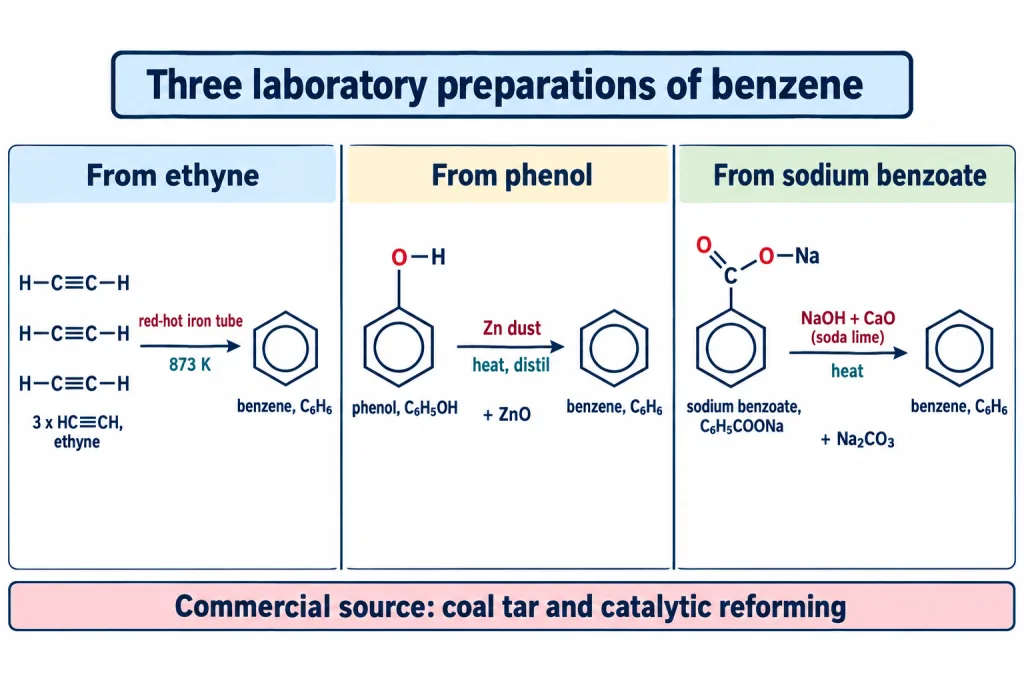
Key Point: Three preparations of benzene, with conditions: three moles of ethyne through a red-hot iron tube at 873 K; phenol vapour over heated zinc dust, distilled; sodium benzoate heated with soda lime. Coal tar and catalytic reforming are the commercial sources.
[Board] A question that asks for "the preparation of benzene" wants all three, each with its reagent and its temperature or its heating condition, and each equation balanced. The 873 K and the soda lime are the marks.
Substitution, not addition
Benzene has four degrees of unsaturation and a pi system sitting in a cloud above and below the ring. Every rule from the alkene sections says it should add bromine and decolourise it. It does not. It hands over a hydrogen instead and keeps its ring exactly as it was.
The reason is the resonance energy of 150 kJ/mol. Addition across a ring bond would convert two carbons into carbons, and an carbon has no unhybridised p orbital, so the ring of overlapping orbitals is cut there, delocalisation stops and the sextet is destroyed. Whatever an addition gains from two new sigma bonds, it pays 150 kJ/mol first.
Substitution costs nothing. A hydrogen on an ring carbon is swapped for another group, not one of the six pi electrons is used up, and the ring that comes out is the aromatic ring that went in.
Key Point: Benzene undergoes electrophilic substitution rather than addition because substitution preserves the delocalised sextet, while addition destroys it and forfeits the 150 kJ/mol of resonance energy.
The attacker has to be an electrophile
The pi cloud is a region of high electron density spread over six carbons. An electron-rich reagent has nothing to gain by approaching it; an electron-poor one does. Every characteristic reaction of benzene therefore starts with an electrophile, and the general equation for the whole family is one line:
Charge balances at on each side, and so do the atoms. The hydrogen leaves as a proton, taken up by whatever base is around — a hydrogensulphate ion, a tetrachloroferrate ion, a water molecule. The abbreviation for the family is : S for substitution, E for electrophilic.
The five reactions, and the three in this section
| Reaction | Reagent and conditions | Electrophile | Product |
|---|---|---|---|
| Nitration | conc. + conc. , 323-333 K | , nitronium ion | nitrobenzene |
| Sulphonation | fuming sulphuric acid (oleum), heat | benzenesulphonic acid | |
| Halogenation | + anhydrous , or | halobenzene | |
| Friedel-Crafts alkylation | + anhydrous | alkylbenzene | |
| Friedel-Crafts acylation | or + anhydrous | acylium, | aryl ketone |
The first three are this section. The two Friedel-Crafts reactions and the step-by-step mechanism that all five share are section 17.
Two things are worth reading straight off that table. Every electrophile is generated in the flask — none is poured in from a bottle. And the middle column is the examinable content: a reaction quoted without its acid, catalyst or temperature earns nothing.
Nitration
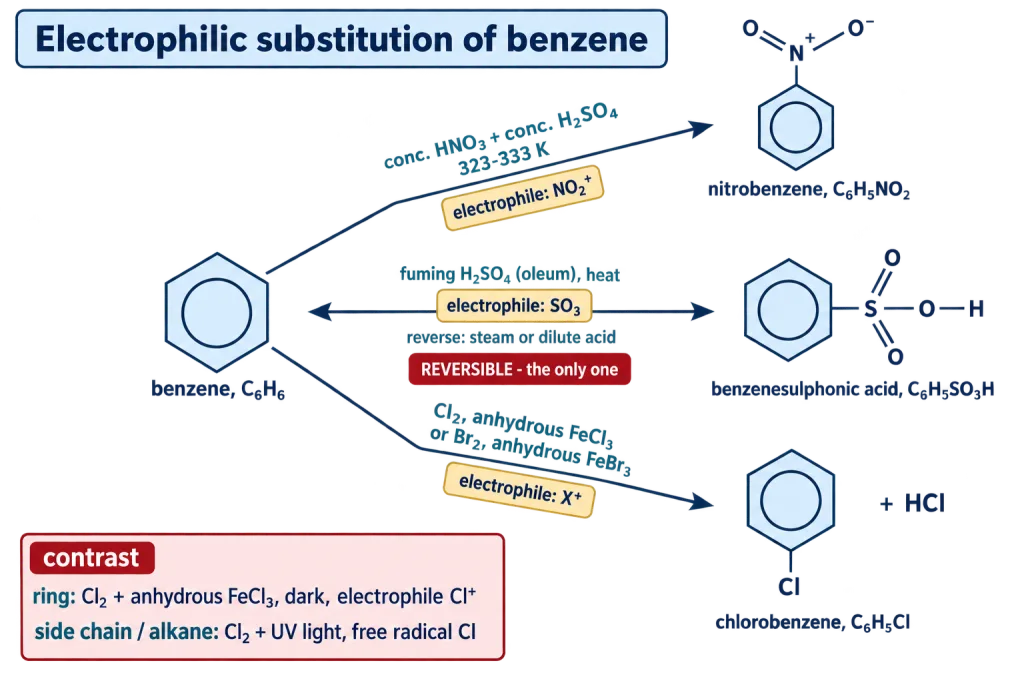
A nitro group, , replaces a ring hydrogen when benzene is heated with a mixture of concentrated nitric acid and concentrated sulphuric acid at 323-333 K. The mixture has a name of its own: the nitrating mixture.
Left: six carbons, seven hydrogens, one nitrogen, three oxygens. Right: six carbons, five ring hydrogens plus two in the water, one nitrogen, two oxygens in the nitro group plus one in the water. Balanced.
The product is nitrobenzene, — a pale yellow oily liquid smelling of bitter almonds, denser than water and highly toxic.
The temperature range matters. Below it the reaction is impractically slow; above it the ring picks up a second nitro group. A water bath is used because nitration is strongly exothermic and will otherwise run away.
Generating the nitronium ion
Nitric acid on its own is a poor nitrating agent. What attacks the ring is the nitronium ion, , and sulphuric acid is there to make it.
Step I — protonation. Sulphuric acid is the stronger of the two acids, so it protonates nitric acid.
Three hydrogens, one nitrogen, seven oxygens and one sulphur on each side; charge zero on the left and on the right.
The species is protonated nitric acid: the proton has gone onto the oxygen, turning it into an group.
Step II — loss of water. That group is water with a positive charge on it, and water is an excellent leaving group. It falls off.
Two hydrogens, one nitrogen and three oxygens on each side; charge on each side.
What is left is , a linear ion with the nitrogen hybridised, two double bonds and a full positive charge on nitrogen. It is isoelectronic with carbon dioxide and is one of the strongest electrophiles in ordinary organic chemistry.
Adding the two steps, and letting the water take another proton from the acid, gives the overall equilibrium:
Five hydrogens, one nitrogen, eleven oxygens and two sulphurs on each side; total charge zero on each side.
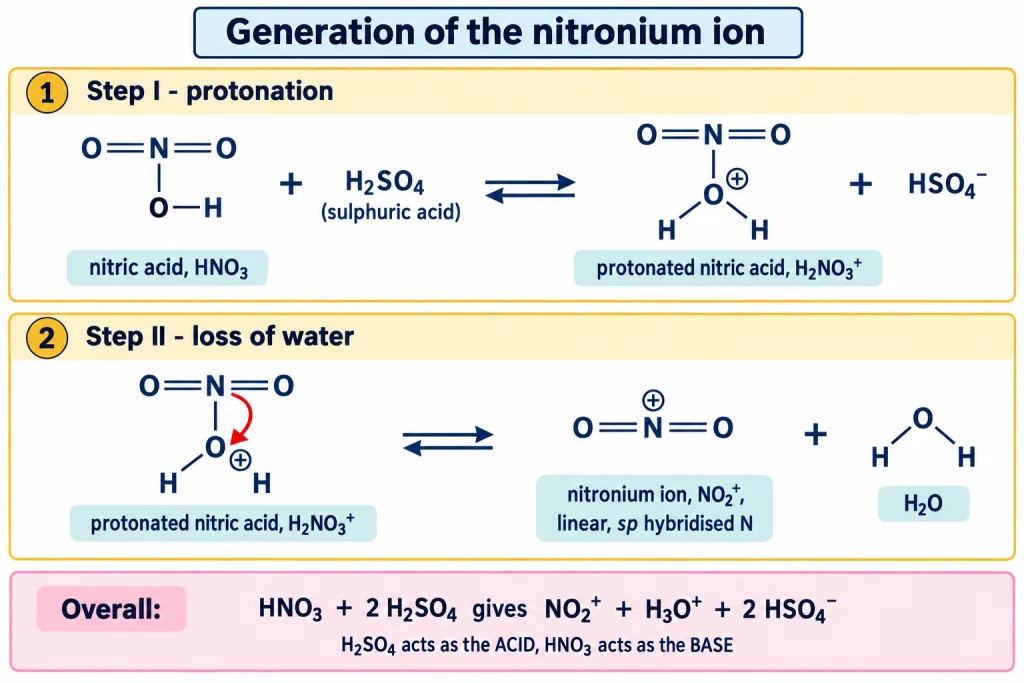
Key Point: In the generation of the nitronium ion, sulphuric acid acts as the acid and nitric acid as the base. Nitric acid, which is an acid towards water, is forced to behave as a base towards a stronger acid. The whole thing is an ordinary acid-base equilibrium.
The trap is to name nitric acid as the acid because it supplies the nitro group. It supplies the group; it accepts the proton.
Nitration on a ring that already carries a group
Toluene nitrates faster than benzene, because the methyl group pushes electron density into the ring and makes the pi cloud a better target.
Seven carbons, nine hydrogens, one nitrogen and three oxygens on each side. The product is a mixture of 2-nitrotoluene and 4-nitrotoluene — the new group goes ortho and para to the methyl.
Nitrobenzene does the opposite. The nitro group already there pulls electron density out, the ring is deactivated, and a second nitration needs a higher temperature and a longer time. The second group goes meta, giving 1,3-dinitrobenzene. Section 18 gives the reasoning behind both results.
Sulphonation
Replacing a ring hydrogen by a sulphonic acid group, , is sulphonation, carried out by heating benzene with fuming sulphuric acid (oleum).
Six carbons, six hydrogens, one sulphur and three oxygens on each side. The hydrogen taken off the ring is not expelled as a separate molecule — it ends up on an oxygen of the new group, which is why there is no by-product.
Written with sulphuric acid itself as the reagent, the same reaction is:
Six carbons, eight hydrogens, one sulphur and four oxygens on each side. The product is benzenesulphonic acid, a crystalline solid, freely soluble in water and about as strong an acid as sulphuric acid itself.
Oleum, and why it is used
Fuming sulphuric acid is concentrated sulphuric acid with sulphur trioxide dissolved in it, which is the whole point of using it: the electrophile is already in solution and no generation step is needed. With ordinary concentrated acid the has to be made first, by self-ionisation:
Four hydrogens, two sulphurs and eight oxygens on each side; charge zero on each side. The equilibrium lies well to the left, which is why concentrated acid sulphonates slowly and oleum sulphonates fast.
A neutral electrophile
carries no charge, which makes it the odd one out in a table of , and . An electrophile does not need a positive charge — it needs an electron-poor atom.
Sulphur trioxide is planar, with sulphur bonded to three oxygens. Three electronegative oxygens pulling at once leave the sulphur with a large , and the ring attacks it. The pair handed over is absorbed by an bond becoming , so the oxygens act as an electron sink.
Key Point: The electrophile in sulphonation is , a neutral molecule. It is electrophilic at sulphur, which carries a large because three electronegative oxygens withdraw from it.
Sulphonation is reversible, and nothing else here is
This is the one property that separates sulphonation from every other reaction here. Heat benzenesulphonic acid with steam or dilute acid and the group comes straight off:
Six carbons, eight hydrogens, one sulphur and four oxygens on each side. This is desulphonation, the sulphonation equation read backwards.
Both directions are the same mechanism run opposite ways: forward, attacks the ring and a proton leaves; backward, a proton attacks the carbon carrying the group and leaves. Concentrated acid and heat push it forward by removing water; dilute acid and steam pull it back by supplying water.
Key Point: Sulphonation is reversible. Concentrated or fuming sulphuric acid puts the group on; dilute acid or superheated steam takes it off. It is the only reversible reaction among the electrophilic substitutions of benzene.
The blocking group trick
Suppose a ring carries an ortho-para directing group and the ortho isomer alone is wanted. Ordinary substitution gives a mixture in which para usually dominates, because it is the less crowded position.
The way round it is to block the para position first. Sulphonate the ring, and the bulky group goes largely to para and sits there. Now run the reaction that matters — a nitration, say — and with para occupied the new group has to go ortho. Finally heat with dilute acid or steam: the group falls off and the pure ortho product is left. A group put on to occupy a position and then removed is a blocking group, and only a reversible substitution can do the job.
[JEE Main] "Which electrophilic substitution of benzene is reversible?" has one answer, sulphonation, and the follow-up asks what removes the group: superheated steam or dilute acid.
Halogenation
Benzene reacts with chlorine or bromine in the presence of a Lewis acid — anhydrous , or — to give a haloarene. A Lewis acid in this role is called a halogen carrier.
Each balances: six carbons, six hydrogens and two halogens on each side. The products are chlorobenzene and bromobenzene. The catalyst is often generated in the flask by dropping iron filings into bromine, which is why equations sometimes show iron rather than iron(III) bromide over the arrow.
Generating the halonium electrophile
Chlorine and bromine are non-polar. Neither end of is electron-poor, so the pi cloud of benzene — a mild nucleophile, far weaker than an alkene — cannot get the reaction started on its own.
A Lewis acid is an electron-pair acceptor. Iron in and aluminium in are electron deficient, and each accepts a lone pair from one halogen atom. That polarises the bond: the attached halogen pulls electron density towards the metal, leaving the far halogen with a substantial .
One iron and five chlorines on each side; charge zero on the left and on the right.
Both balance for atoms and for charge in the same way.
A free is a shorthand: what exists is the polarised complex , and the ring attacks the chlorine while leaves as a unit. The shorthand is accepted in an answer and carries the idea that matters: the catalyst manufactures an electron-poor halogen out of a neutral one.
The catalyst is regenerated at the end, when the proton lost by the ring is taken by the tetrachloroferrate ion:
One hydrogen, one iron and four chlorines on each side. The comes back untouched and goes round again, which is what makes it a catalyst rather than a reagent.
Key Point: The Lewis acid must be anhydrous. Water destroys and by hydrolysing them, and even traces of moisture leave a hydroxide or oxychloride with no vacant orbital and so no Lewis acidity. A damp catalyst gives no reaction at all.
Iodine and fluorine
Halogen reactivity runs , the same order as in the alkanes of section 4, and both ends of it are unusable.
Fluorination is too violent. The reaction is so exothermic that it does not stop at substitution; the ring is destroyed and the process cannot be controlled, so fluorobenzene is made indirectly.
Iodination is reversible, because the hydrogen iodide formed reduces iodobenzene straight back:
The fix is an oxidising agent such as or , which destroys the hydrogen iodide as it forms and pulls the equilibrium across. Chlorination and bromination need nothing but the Lewis acid; iodination is run directly as well, but only with that oxidising agent present.
Further substitution, and a substituted ring
With an excess of chlorine and anhydrous the substitution does not stop at one. Every ring hydrogen goes in turn, ending at hexachlorobenzene:
Six carbons, six hydrogens and twelve chlorines on each side.
On a ring that already carries a halogen, chlorination gives mainly the ortho and para products: chlorobenzene with more chlorine and gives 1,2-dichlorobenzene and 1,4-dichlorobenzene. It gives them slowly, because a halogen deactivates the ring while still directing ortho and para. That combination is the most-missed fact in the aromatic section, and section 18 explains it.
Two halogenations with the same bottle of chlorine
Chlorine plus a hydrocarbon appears twice in this chapter with completely different outcomes. In section 4, methane and chlorine in sunlight gave chloromethane by a free-radical chain; here, benzene and chlorine with anhydrous give chlorobenzene by electrophilic substitution. Same reagents, nothing else in common.
Both balance, both are substitutions, both give out hydrogen chloride. The mechanisms share no step at all.
| Ring halogenation | Alkane halogenation | |
|---|---|---|
| Substrate | benzene, the aromatic ring | an alkane, or an alkyl side chain |
| Conditions | anhydrous Lewis acid, dark, no light needed | sunlight, ultraviolet light or 573-773 K |
| Catalyst | anhydrous , or | none; a peroxide initiator may be used |
| Attacking species | , an electrophile | , a free radical |
| What is attacked | the pi electron cloud of the ring | a sigma bond |
| Intermediate | arenium ion, a carbocation | alkyl radical |
| Bond breaking | heterolytic, both electrons go one way | homolytic, one electron each way |
| Mechanism type | , three steps, no chain | free-radical chain: initiation, propagation, termination |
The reason for the split is the substrate. Benzene has loosely held pi electrons on the outside of a flat ring and an electrophile can reach them. An alkane has nothing but strong non-polar sigma bonds, so only a species violent enough to rip a hydrogen off — a radical — gets anywhere.
The same molecule, both ways
Toluene makes the point in a single flask, having both a ring and a side chain.
With anhydrous in the dark, goes for the pi cloud and substitutes on the ring, ortho and para to the methyl group:
With ultraviolet light and no catalyst, chlorine atoms form and pull a hydrogen off the side chain, because the benzyl radical left behind is stabilised by the ring:
Both balance: seven carbons, eight hydrogens and two chlorines on each side. The products are 2-chlorotoluene and 4-chlorotoluene on the one hand, benzyl chloride on the other.
Key Point: Light gives the side chain; a Lewis acid in the dark gives the ring. The examiner's shorthand for the pair is ", " against ", anhydrous ", and the whole answer turns on which one is printed over the arrow.
What to carry forward
Three preparations, three substitutions, three electrophiles. The section compresses into a short list, worth knowing cold before section 17 opens the mechanism.
Making benzene. Three moles of ethyne through a red-hot iron tube at 873 K; phenol vapour over heated zinc dust; sodium benzoate heated with soda lime. Coal tar and catalytic reforming commercially.
The three substitutions. Nitration with concentrated nitric acid and concentrated sulphuric acid at 323-333 K, through , giving nitrobenzene. Sulphonation with fuming sulphuric acid, heated, through neutral , giving benzenesulphonic acid — and reversible, which is what makes usable as a blocking group. Halogenation with chlorine or bromine over anhydrous , or , through , giving chlorobenzene and bromobenzene; iodination needs an oxidising agent and fluorination is too violent to run.
Two questions stay open, and each has a section to itself.
The first is how the electrophile and the ring react once they meet. All three of these reactions, and the two Friedel-Crafts reactions named so far, go through the same three steps: generate the electrophile, attack the pi cloud to give an arenium ion in which one carbon turns and aromaticity is temporarily lost, then lose a proton and get the sextet back. The middle step is slow and rate-determining. Section 17 takes that apart, alongside Friedel-Crafts alkylation and acylation and the three limitations that make acylation the more useful of the pair.
The second is where the new group lands when the ring is not bare. Toluene nitrates ortho and para; nitrobenzene nitrates meta; chlorobenzene chlorinates ortho and para but slowly. Those results have been quoted here and not justified. Section 18 justifies them through the resonance contributors of the arenium ion, and sorts every common substituent into ortho-para directing and activating, ortho-para directing but deactivating, or meta directing and deactivating.
Worked items
Question 1: Three routes to the same ring
Write balanced equations, with conditions, for the preparation of benzene from ethyne, from phenol and from sodium benzoate.
Answer:
I take them one at a time and count atoms on each side.
From ethyne, three molecules close into a ring:
Six carbons and six hydrogens each side. From phenol, zinc dust takes the oxygen:
Six carbons, six hydrogens, one oxygen and one zinc each side. From sodium benzoate, soda lime removes the carboxyl carbon as carbonate:
Seven carbons, six hydrogens, three oxygens and two sodiums each side.
Ans: Ethyne through a red-hot iron tube at 873 K; phenol vapour over heated zinc dust; sodium benzoate heated with soda lime. Watch out: The soda lime equation needs written as a reactant, not only over the arrow, or the sodium and the oxygen will not balance.
Question 2: How much ethyne
What volume of ethyne at STP is needed to prepare 39 g of benzene by cyclic polymerisation, assuming the reaction goes to completion?
Answer:
The equation gives the ratio: three moles of ethyne make one mole of benzene.
Molar mass of is 78 g/mol, so moles of benzene mol, and moles of ethyne mol.
At STP one mole of gas occupies 22.4 L, so the volume is L.
Ans: 33.6 L of ethyne at STP. Watch out: The three in the balanced equation is the whole question. Using 22.4 L straight for 0.5 mol of benzene gives 11.2 L and scores nothing.
Question 3: Making the nitronium ion
Show, with balanced equations, how the nitronium ion is generated in a nitrating mixture. State which reagent acts as the acid and which as the base.
Answer:
Sulphuric acid is the stronger acid, so it hands a proton to nitric acid:
Three hydrogens, one nitrogen, seven oxygens, one sulphur each side; charge zero each side.
The proton lands on the oxygen, making it — water with a positive charge, which leaves:
Two hydrogens, one nitrogen, three oxygens each side; charge each side.
Sulphuric acid donated the proton, so it is the acid; nitric acid accepted it, so it is the base.
Ans: , then . Sulphuric acid is the acid, nitric acid is the base. Watch out: Nitric acid supplies the nitro group but accepts the proton. Supplying the group does not make it the acid.
Question 4: Why the sulphuric acid is there
Nitric acid supplies every atom of the nitro group. Why can benzene not simply be heated with concentrated nitric acid alone?
Answer:
Benzene is attacked by electrophiles only, and it is a weak nucleophile because its pi electrons are delocalised and held tightly. A molecule of is not electrophilic enough to get at them.
Sulphuric acid turns it into something that is: it protonates the group, which leaves as water, and what remains is . The acid also soaks up the water expelled in step II, and removing water pushes both equilibria towards the nitronium ion.
Ans: Sulphuric acid generates the electrophile from nitric acid, and absorbs the water formed, driving the equilibrium forward. Nitric acid alone is too weak an electrophile to attack the ring.
Question 5: Why the catalyst must be dry
Chlorination of benzene is carried out with anhydrous . What happens if the catalyst is damp, and why?
Answer:
works because iron in it is electron deficient and has a vacant orbital, so it accepts a lone pair from a chlorine atom and polarises the bond. That is what a Lewis acid does.
Water has lone pairs too, and it gets there first: it coordinates to the iron and hydrolyses the chloride to hydroxide and oxychloride species. The vacant orbital is gone, the Lewis acidity disappears, and the catalyst can no longer polarise chlorine. With no there is no electrophile, so non-polar and a delocalised ring simply sit in the flask.
Ans: Water destroys the Lewis acidity of by coordinating to and hydrolysing it, so no is generated and no reaction occurs. The catalyst must be anhydrous. Watch out: The failure is total, not partial. A damp catalyst does not give a slow reaction; it gives none.
Question 6: Name the reagent and conditions
Give the reagent and conditions for each conversion, and name the product.
(a) benzene to nitrobenzene (b) benzene to benzenesulphonic acid (c) benzene to bromobenzene
Answer:
(a) Concentrated nitric acid with concentrated sulphuric acid at 323-333 K, giving nitrobenzene, .
(b) Fuming sulphuric acid, oleum, with heating, giving benzenesulphonic acid, .
(c) Bromine with anhydrous , giving bromobenzene, .
Ans: (a) conc. + conc. , 323-333 K, nitrobenzene; (b) fuming (oleum), heat, benzenesulphonic acid; (c) with anhydrous , bromobenzene. Watch out: "Dilute nitric acid" and "dilute sulphuric acid" are both wrong for (a), and leaving out the temperature loses the mark that the question was set to test.
Question 7: Putting a group on and taking it off
Write equations for the sulphonation of benzene and for the reverse reaction, giving the conditions for each direction.
Answer:
Forward, with oleum and heat:
Six carbons, six hydrogens, one sulphur and three oxygens each side. Backward, with superheated steam or dilute acid:
Six carbons, eight hydrogens, one sulphur and four oxygens each side.
Ans: Oleum and heat put the group on; superheated steam or dilute acid takes it off. Sulphonation is reversible. Watch out: Reversibility belongs to sulphonation and to nothing else in this section. Nitration, chlorination and bromination are not reversed by steam.
Question 8: Using the reversibility
Explain how the group is used as a blocking group, and why no other group in this section can do the job.
Answer:
The problem it solves is unwanted para product: a ring with an ortho-para directing group gives a mixture, and para usually wins because it is less crowded.
I sulphonate first, and the bulky group takes the para position. Then I run the reaction I want — a nitration, say — and with para blocked the nitro group has to go ortho. Finally I heat with dilute acid or steam, the group falls off, and the pure ortho compound is left. The trick depends on removing the blocking group without disturbing anything else, and only a reversible substitution allows that.
Ans: is put on to occupy the para position, the desired substitution is forced to go ortho, and the group is then removed with steam or dilute acid. Only sulphonation is reversible, so only can be used this way.
Question 9: The electrophile in bromination
Show how the electrophile is generated when benzene is brominated with and anhydrous , and show what happens to the catalyst at the end.
Answer:
Iron in is electron deficient, so it accepts a lone pair from one bromine of , polarising the bond and leaving the far bromine electron poor:
One iron and five bromines each side; charge zero each side. The ring then loses a proton to the tetrabromoferrate ion, which gives back the catalyst:
One hydrogen, one iron, four bromines each side; charge zero each side.
Ans: ; at the end , so the catalyst is regenerated. Watch out: A catalyst that ended up as and stayed there would be a reagent, and would be needed in full stoichiometric amount. The second equation is what makes it catalytic.
Question 10: One flask, two answers
Toluene is treated with chlorine (i) in the presence of anhydrous in the dark, and (ii) in ultraviolet light with no catalyst. Give the product in each case and name the mechanism.
Answer:
With in the dark, the catalyst polarises chlorine and produces . An electrophile goes for the richest electron density available, the pi cloud, so substitution happens on the ring, ortho and para to the methyl group:
With ultraviolet light and no catalyst, chlorine splits homolytically. The radical abstracts the hydrogen that gives the most stable radical, a side-chain one, because the benzyl radical is delocalised into the ring:
Seven carbons, eight hydrogens and two chlorines on each side of both.
Ans: (i) 2-chlorotoluene and 4-chlorotoluene, by electrophilic substitution on the ring; (ii) benzyl chloride, , by free-radical substitution on the side chain. Watch out: Light means side chain; Lewis acid in the dark means ring. Read what is written over the arrow before writing anything else.
Question 11: The two halogens that do not work
Why is fluorobenzene not made by treating benzene with fluorine, and why does direct iodination of benzene need an oxidising agent?
Answer:
Fluorine is the most reactive halogen by a wide margin. Its reaction with benzene is violently exothermic and does not stop at one hydrogen; the heat released drives further substitution and breaks the ring apart, so fluorobenzene is made indirectly.
Iodine is the least reactive halogen, and the iodination equilibrium
sits well to the left, because the hydrogen iodide produced is a good reducing agent and converts iodobenzene straight back. An oxidising agent such as or destroys the as it forms and pulls the equilibrium to the right.
Ans: Fluorination is too violent and uncontrollable; iodination is reversible, so an oxidising agent such as or is added to remove the hydrogen iodide. Watch out: The same two exceptions were made for the alkanes in section 4. The reason is the halogen itself, not the hydrocarbon.
Question 12: Chlorine to the limit
Benzene is treated with an excess of chlorine in the presence of anhydrous . Write the balanced equation for the final product and name it.
Answer:
Each substitution replaces one ring hydrogen with a chlorine and releases one . With chlorine in excess this repeats until no ring hydrogen is left, and benzene has six.
Six carbons, six hydrogens and twelve chlorines on each side.
Ans: ; the product is hexachlorobenzene. Watch out: This is still substitution, so hydrogen chloride comes off at every step. Writing is the addition product from chlorine in ultraviolet light, a completely different reaction.