
Why a single bond can rotate and a double bond cannot
Every carbon-carbon bond in an alkane is a sigma bond, made by head-on overlap of an hybrid orbital on one carbon with an hybrid orbital on the other. The electron cloud of the resulting sigma molecular orbital is cylindrically symmetrical about the internuclear axis — the line joining the two carbon nuclei.
That symmetry is the whole reason conformations exist. Picture the sigma cloud as a sausage wrapped around the C-C axis, and spin one carbon about that axis. The cloud looks exactly the same after the spin as before, because a cylinder rotated about its own axis is unchanged. The two hybrid orbitals still point straight at each other, the overlap is as good as it was, and not one joule of bond energy has been spent. Only the hydrogens have moved to new positions in space.
Contrast this with the carbon-carbon double bond in an alkene. A is one sigma bond plus one pi bond, and the pi bond is made by sideways overlap of two unhybridised orbitals, one on each carbon, standing perpendicular to the plane of the molecule. Sideways overlap survives only while those two orbitals stay parallel. Twist one carbon through 90 degrees and they end up at right angles; the overlap falls to zero and the pi bond is destroyed. Breaking it costs about , and nothing at ordinary temperature can pay that bill.
The rule is short, and it decides two different pieces of chemistry:
Key Point: Rotation about a single bond is essentially free, because a sigma cloud is cylindrically symmetrical and rotation does not disturb its overlap. Rotation about a double bond is blocked, because it would have to break the pi overlap. Free rotation gives conformations; restricted rotation gives cis-trans isomerism.
Keep the two apart from the start. Conformations belong to alkanes, interconvert on their own and cannot be bottled. Cis and trans forms belong to alkenes, are locked, and can be bottled and sold as separate compounds with different melting points and dipole moments.
[JEE/NEET] A stem that begins "free rotation is possible about…" is answered by the words sigma and cylindrically symmetrical. A stem that begins "restricted rotation…" is answered by the words pi and sideways overlap.
What the rotation produces
Turning one carbon relative to its neighbour moves the attached atoms into a new arrangement in space. Since no bond is broken and none is made, the two arrangements are the same molecule caught in two different postures.
Key Point (Definition): The different spatial arrangements of the atoms of a molecule that arise purely from rotation about a single bond, and that can be converted into one another by that rotation, are called conformations. They are also called conformers, conformational isomers or rotamers. The three words mean the same thing.
Rotation is continuous, so the carbon can stop at any angle at all — one degree, half a degree, a thousandth of a degree. An alkane therefore has an infinite number of conformations, and only those at the top and the bottom of the energy curve are worth naming.
A point that is quietly examined: in every conformation the bond lengths and the bond angles are unchanged. The distance stays at , every angle stays near degrees, and each carbon stays tetrahedral. Only the relative orientation of the two sets of bonds about the shared axis changes.
The conformations of ethane: eclipsed, staggered and skew
Ethane, , is the smallest molecule with a single bond, so it is the standard case: one bond, three hydrogens on each carbon.
Take a ball-and-stick model. Hold the left-hand carbon still and turn the right-hand one about the axis. Every hydrogen on the moving carbon sweeps out a circle while the three on the fixed carbon stay put, so the relationship between the two sets changes continuously. Among the infinite number of arrangements there are two extremes.
Key Point (Definition): In the eclipsed conformation the hydrogens on the two carbons are as close together as possible — each front hydrogen sits directly in front of a rear hydrogen, hiding it from view along the axis. In the staggered conformation the hydrogens are as far apart as possible — each rear hydrogen sits exactly halfway between two front hydrogens.
Every arrangement between the two extremes is called a skew conformation — not a special shape, just the name for the molecule caught partway through the turn.
Three things follow immediately, and all three are asked:
- Ethane has an infinite number of conformations, not two. Eclipsed and staggered are the limiting cases, not a complete list.
- The eclipsed form comes back three times in one full turn, and so does the staggered form, because a methyl group has threefold symmetry — turning it by 120 degrees reproduces the same picture.
- It is the same molecule throughout, so none of these forms has a separate formula, name or boiling point.
The eye cannot see along a bond, so chemists agreed on two flat drawings that put the three-dimensional relationship on paper. Both are drawn below for ethane.
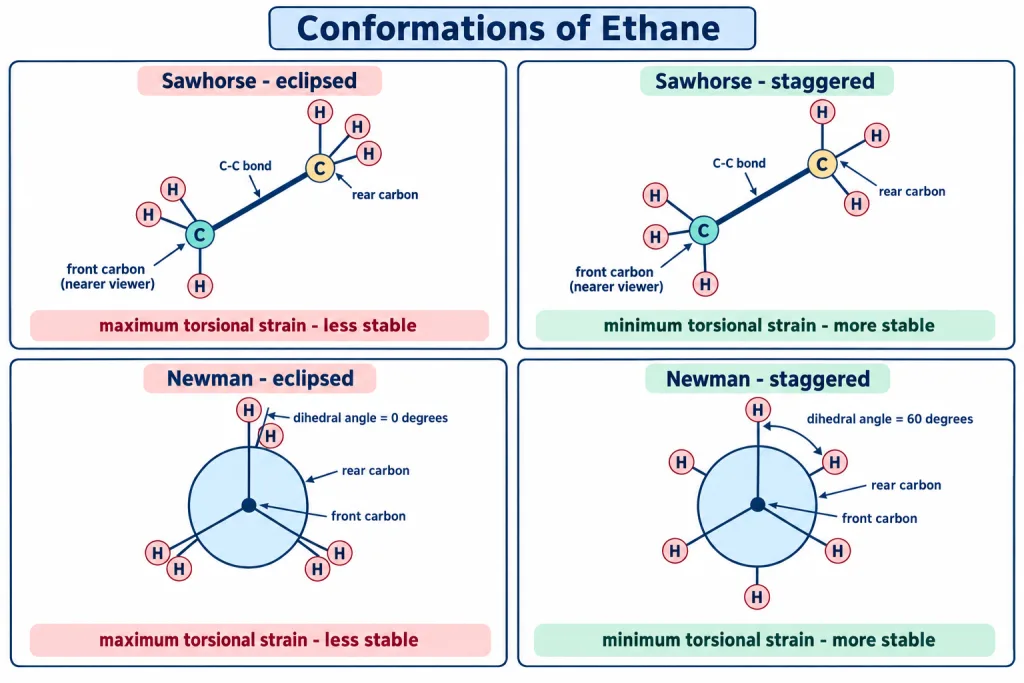
[Board] A two-mark question almost always reads "draw the eclipsed and staggered conformations of ethane by sawhorse and Newman projections". Practise the four drawings until they take under a minute.
Sawhorse projection
The sawhorse projection is the more picture-like of the two, and the description matters as much as the drawing:
- The bond is drawn as a straight diagonal line, made deliberately a little longer than scale so that there is room to work. The line runs from lower left to upper right.
- The carbon at the lower left end of the diagonal is the front carbon, the one nearer the viewer. The carbon at the upper right end is the rear carbon, further away.
- Three lines radiate from each end, one for each remaining bond on that carbon — three bonds at each end in ethane. They are drawn about 120 degrees apart, so that with the bond they suggest a tetrahedron.
The name comes from the four-legged wooden trestle a carpenter rests timber on; the drawing has the same splayed-legs look.
How to tell the two forms apart in a sawhorse drawing. Compare the three lines at the front carbon with the three at the rear.
- Staggered: the rear bonds point into the gaps left by the front bonds. Going round the drawing, front and rear bonds alternate, front, rear, front, rear, and no two of them are parallel or in line.
- Eclipsed: each rear bond lies along the same direction as a front bond. The two sets are lined up, so the drawing looks as if the rear bonds are shadows of the front ones. In a strictly correct drawing they would be hidden completely, so the rear bonds are pulled a little to one side to keep them visible.
Use the sawhorse when you want to keep some sense of depth, since it shows both carbons and the whole molecule at once. Its weakness is that with larger groups the lines start to cross. That is where the Newman projection takes over.
Newman projection
The Newman projection throws away depth on purpose and gains clarity in return. The molecule is viewed head on, straight down the bond, so that the front carbon and the rear carbon lie one exactly behind the other and the bond itself is a point.
The drawing rules:
- The front carbon — the one nearer the eye — is represented by a point, at the centre of the drawing. Three lines are drawn from that point, reaching outwards, at 120 degrees to each other. These are its three bonds.
- The rear carbon — the one away from the eye — is represented by a circle drawn round that point. The circle is not an atom and not a bond; it is a device that says "there is a second carbon hidden behind the first". Its three bonds are drawn as shorter lines starting at the edge of the circle and going outwards, again 120 degrees apart.
- The bond itself is never drawn; it points straight at you.
The commonest beginner error is to run a rear line through the circle to the centre. Rear lines begin at the circumference, front lines begin at the centre, and that is the only visual difference between the two carbons.
How to tell the two forms apart in a Newman projection.
- Staggered: the three rear lines bisect the angles between the front lines. Each rear bond appears 60 degrees away from the front bond on either side of it. The finished drawing looks like a six-spoked wheel with the spokes evenly spaced.
- Eclipsed: the three rear lines lie directly behind the three front lines. In a perfectly drawn version they would be invisible, so each rear line is displaced by a few degrees — just enough to peep out from behind its front partner. The finished drawing looks like a three-spoked wheel with each spoke slightly doubled.
Key Point: Six evenly spread spokes means staggered. Three doubled spokes means eclipsed. Read the picture that way and you never have to count angles.
Newman projections are the working tool of conformational analysis: once the substituents get bigger, a methyl group instead of a hydrogen say, you can see at a glance which groups are crowding which. Every butane problem below is solved on one.
Torsional strain and the dihedral angle
The two forms are not equal in energy, and the reason is a repulsion.
Every bond is a pair of electrons, and pairs of electrons repel one another. In the staggered form the bonds on the front carbon and the bonds on the rear carbon are as far apart as the geometry allows, so this repulsion is at its smallest. Rotating towards the eclipsed form brings each front bond into line with a rear bond; the two electron clouds are pushed close together and the repulsion rises. To hold the molecule in that crowded arrangement, energy has to be supplied.
Key Point (Definition): The repulsive interaction between the electron clouds of bonds on adjacent atoms, which appears when rotation brings those bonds close to one another, is called torsional strain. It is greatest in the eclipsed conformation and least in the staggered conformation, so the staggered form is the more stable of the two.
What torsional strain is not: it is not atoms bumping into each other, since hydrogen atoms are far too small for that in ethane, and it is neither a distortion of bond angles nor a stretching of bonds, both of which stay fixed throughout the rotation. It is bond-pair against bond-pair repulsion, nothing more.
Measuring the rotation: the dihedral angle
One number says how far the molecule has turned.
Key Point (Definition): The dihedral angle, also called the torsional angle, is the angle of rotation about the bond. In a Newman projection it is read directly as the angle between a chosen front bond and the rear bond nearest to it.
For ethane the two extremes occur at fixed values of this angle, and these values are worth memorising:
| Conformation | Dihedral angles in one full turn | Torsional strain | Stability |
|---|---|---|---|
| Eclipsed | , , | maximum | least stable |
| Staggered | , , | minimum | most stable |
| Skew | every other value | intermediate | intermediate |
is the same arrangement as , so it is not counted twice.
Two checks on the numbers: eclipsed and staggered alternate every 60 degrees, and each form recurs every 120 degrees, which is the threefold symmetry of a methyl group showing up in the arithmetic.
The size of the torsional barrier depends on the bond. Across single bonds in general it falls in the range to — small on the scale of chemistry, where breaking the same bond costs .
[JEE Main] If a question gives a dihedral angle, convert it to a form before doing anything else: any multiple of 120 starting from 0 is eclipsed, any odd multiple of 60 is staggered.
The energy profile of ethane through a full rotation
Plot the potential energy of an ethane molecule against the dihedral angle, from round to . Describing the resulting curve in words is worth as much as drawing it.
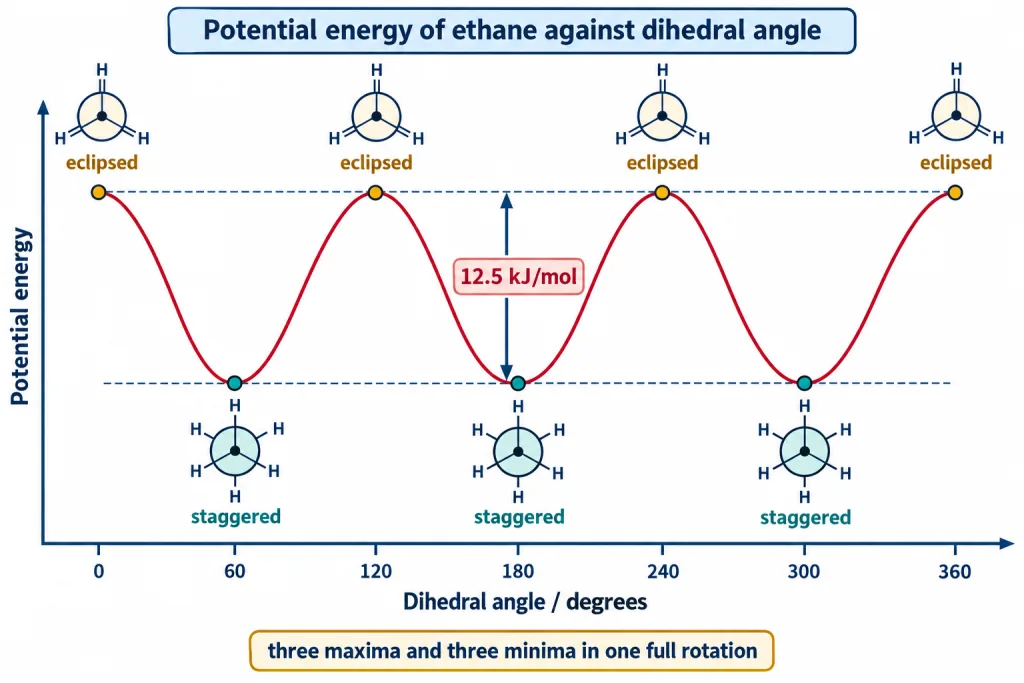
Read it from the left:
- At the molecule is eclipsed. Torsional strain is at its worst, so the curve is at a maximum.
- Turning to relieves that strain steadily, and the curve falls to a minimum at the staggered form.
- Turning on to brings the bonds back into line — eclipsed again, another maximum of exactly the same height as the first.
- : staggered, another minimum, exactly as deep as the first.
- : eclipsed, third maximum.
- : staggered, third minimum.
- : eclipsed again, and identical to where the plot started.
So one complete rotation gives three maxima and three minima, evenly spaced 120 degrees apart, with maxima and minima alternating every 60 degrees. The curve is a smooth wave, not a sequence of steps; the molecule passes through every skew arrangement on the way from one extreme to the next.
The vertical distance from a minimum to the next maximum is the quantity that matters.
Key Point: For ethane, the energy difference between the eclipsed and the staggered conformation is . This is the torsional barrier — the energy a molecule must have to pass through the eclipsed arrangement and complete the turn.
Because the barrier is finite rather than zero, rotation about the bond in ethane is not completely free — a statement examiners like. But is very small, and the practical consequence comes next.
Free rotation, and why conformers cannot be isolated
At ordinary temperature the molecules of a gas collide constantly, exchanging energy at every collision, and a barrier of is trivial next to what those collisions supply. An ethane molecule is knocked over the eclipsed maximum again and again and spins through complete turns without pause. Two consequences follow, and students routinely get the second one wrong.
First: rotation is free for all practical purposes. The barrier does exist, so the phrase "completely free rotation" is not strictly exact. But no ethane molecule is ever stuck. Every molecule is passing continuously through every conformation, from eclipsed through skew to staggered and on again. At any instant more molecules are near a staggered arrangement than near an eclipsed one — staggered is the lower-energy and hence the preferred conformation — but no molecule stays there.
Second: the conformers cannot be separated or isolated. Separating two substances requires each one to stay what it is long enough to be distilled, crystallised or run down a column. Ethane conformers do not. The interconversion is far too fast to freeze out, and every attempt gives back the same ordinary ethane. Staggered ethane and eclipsed ethane have never been isolated as separate substances, and they cannot be.
Key Point: Conformers differ only in an angle of rotation, they interconvert billions of times faster than any separation technique works, and they therefore cannot be isolated as distinct compounds. For this reason conformers are not isomers in the ordinary sense of the word, even though the name "conformational isomers" is in common use.
Fix that distinction, because cis-trans isomerism in alkenes comes next and looks superficially similar — two arrangements in space, differing in where groups sit. The difference is total:
| Conformers of an alkane | Cis and trans forms of an alkene | |
|---|---|---|
| Interconverted by | rotation about a single bond | nothing short of breaking the pi bond |
| Energy needed | for ethane | about |
| Happens at room temperature | continuously | never |
| Can they be separated | no | yes |
| Separate melting point, boiling point, dipole moment | no | yes |
| Are they true isomers | no | yes, geometrical isomers |
[NEET] Assertion-reason items pair "conformers cannot be separated" with "the energy barrier to rotation is very small". Both statements are true and the second explains the first.
Conformations of butane: steric strain enters
Ethane is the clean case: all six substituents are hydrogens, so every eclipsed arrangement is like every other. Butane, , is the first alkane where they are not alike, and it introduces a second kind of strain.
Number the chain to and consider rotation about the central bond. Looking along that bond in a Newman projection:
- the front carbon carries one methyl group () and two hydrogens;
- the rear carbon carries one methyl group () and two hydrogens.
The dihedral angle to watch is the one between the two methyl groups, and four distinct arrangements appear.
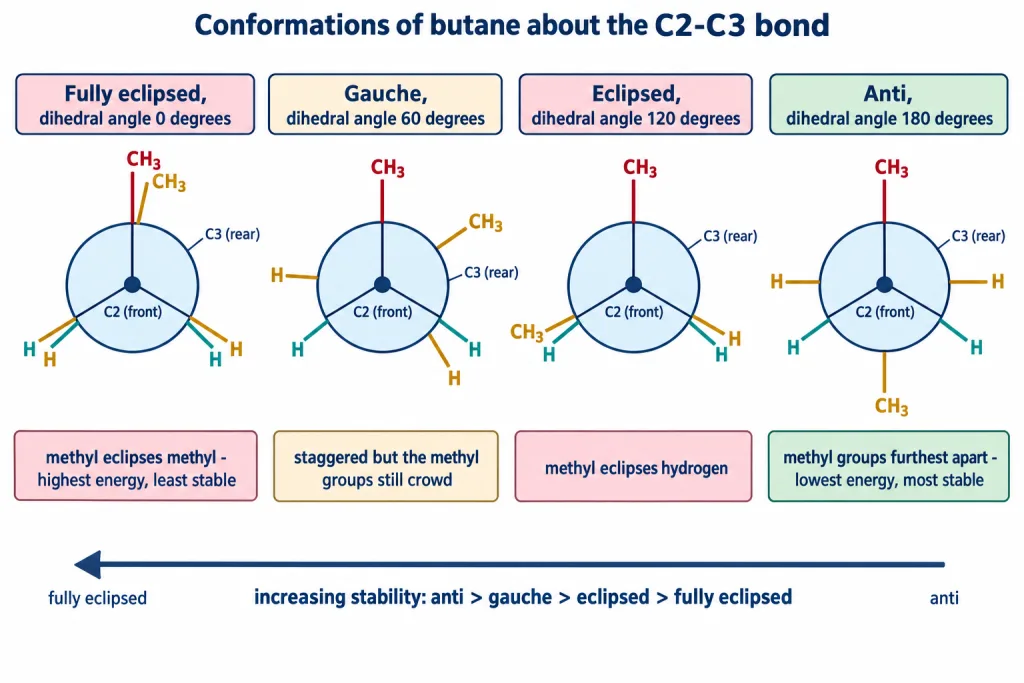
Anti (dihedral angle ). Staggered, with the two methyl groups pointing in exactly opposite directions, as far apart as they can get. No bonds are eclipsing and the bulky groups are not crowding. This is the most stable conformation of butane and the one most molecules are found in.
Gauche (dihedral angle , and again at ). Also staggered, so no torsional strain, but the methyl groups are only 60 degrees apart and their bulk begins to get in the way. A genuine energy minimum, but above anti.
Eclipsed (dihedral angle , and again at ). Bonds lined up, so torsional strain is present, but each methyl eclipses a hydrogen rather than the other methyl. An energy maximum, though not the worst one.
Fully eclipsed (dihedral angle ). Bonds are lined up and the two methyl groups are eclipsing each other, jammed into the same region of space. Torsional strain and crowding at the same time make this the highest-energy, least stable conformation of butane.
The second kind of strain
Key Point (Definition): Steric strain is the repulsion that arises when two bulky groups are forced into the same region of space, so that their electron clouds and their atoms overlap. It depends on the size of the groups. Torsional strain, by contrast, is the repulsion between the electron clouds of bonds that have been brought into line by rotation, and it is present even when the substituents are only hydrogens.
Ethane shows torsional strain and nothing else, because hydrogens are too small to crowd. Butane shows both, which is why its four arrangements come out unequal in energy. Putting them in order:
Key Point: For butane, about the bond, the stability order is anti > gauche > eclipsed > fully eclipsed.
Reading that order backwards gives the energy order, since the least stable form has the highest energy: fully eclipsed highest, then eclipsed, then gauche, then anti at the bottom.
The energy profile of butane through still shows three maxima and three minima, but unlike ethane they are no longer all of the same height. The maximum at (methyl against methyl) stands taller than the two at and (methyl against hydrogen), and the minimum at (anti) sits lower than the two at and (gauche).
Everything said about ethane still applies. The butane barriers are still small next to bond enthalpies, rotation is still fast at room temperature, and the anti, gauche and eclipsed forms cannot be separated from one another either.
[JEE Main] Butane conformations are asked as a ranking. Two rules settle almost every one: staggered always beats eclipsed, and among forms of the same type the one with the big groups further apart wins.
Worked items
Question 1: Naming a conformation from a Newman drawing
A Newman projection of ethane is drawn. Three lines come out of the central point, 120 degrees apart. Three shorter lines come out of the circle, and each of them lies exactly halfway between two of the central lines. Name the conformation and give its dihedral angle.
Answer:
The rear bonds bisect the angles between the front bonds, so the picture is a six-spoked wheel with the spokes evenly spread. That is the staggered arrangement.
The angle between any front bond and its nearest rear bond is half of 120 degrees, which is 60 degrees. So the dihedral angle is (or equivalently or — all three are staggered).
Ans: Staggered; dihedral angle .
Question 2: Naming a conformation from a sawhorse drawing
In a sawhorse drawing of ethane, each of the three lines at the upper-right carbon points in the same direction as one of the three lines at the lower-left carbon. Which conformation is it, and which carbon is nearer the viewer?
Answer:
Front bonds and rear bonds pointing in the same directions means the two sets are lined up, one hiding the other along the axis. That is eclipsed.
In the sawhorse convention the lower-left end of the diagonal is the carbon nearer the viewer, so the lower-left carbon is the front one.
Ans: Eclipsed; the lower-left carbon is nearer the viewer.
Watch out: In a true eclipsed sawhorse the rear bonds would be completely hidden. They are drawn slightly to one side so you can see them, and that small offset is a drawing device, not a real twist.
Question 3: Dihedral angles of the extremes
List all the dihedral angles in one complete rotation of ethane at which the molecule is eclipsed, and all at which it is staggered.
Answer:
I start at the eclipsed form and call that . Turning by 60 degrees takes me to staggered, another 60 degrees back to eclipsed, and so on. So the two alternate every 60 degrees.
Eclipsed: , , . Staggered: , , .
I do not count separately, because it is the same arrangement as .
Ans: Eclipsed at , , ; staggered at , , .
Question 4: Which is more stable and by how much
Which conformation of ethane is more stable, and what is the energy difference between the two extremes?
Answer:
In the staggered form the electron clouds of the bonds on the two carbons are as far apart as they can be, so the bond-pair repulsion — the torsional strain — is at its minimum. Minimum repulsion means minimum energy means maximum stability.
Rotating to the eclipsed form brings each front bond in line with a rear one, the repulsion rises, and the energy rises with it.
Ans: The staggered conformation is more stable; the difference is .
Question 5: Why conformers cannot be isolated
Explain why the staggered and eclipsed conformations of ethane cannot be separated from one another.
Answer:
The two forms are separated by a barrier of only , which is tiny beside the needed to break the bond itself.
At ordinary temperature molecules collide and exchange energy constantly, so a barrier that small is crossed over and over, and every molecule rotates continuously through all the conformations.
To separate two substances, each has to stay itself long enough to be distilled or crystallised. These interconvert far faster than any separation technique operates, so whatever I isolate is just ordinary ethane.
Ans: The barrier is far too small to stop rotation at room temperature, so the forms interconvert continuously and no separation is possible.
Question 6: Conformers against cis-trans isomers
Are conformers isomers in the same sense as the cis and trans forms of but-2-ene? Justify.
Answer:
No. The test is whether the two forms can exist independently.
Cis and trans but-2-ene are locked, because converting one into the other needs the pi bond broken, at a cost of about . That does not happen at room temperature, so the two can be separated and bottled, and they have different melting points and dipole moments.
Ethane conformers are separated by and interconvert continuously, so nothing can be bottled.
Ans: No — conformers interconvert freely and cannot be isolated, so they are not isomers in the sense that geometrical isomers are.
Watch out: The name "conformational isomers" is used everywhere, so the word isomer in that phrase is loose usage. If a question asks whether they are isomers that can be separated, the answer is no.
Question 7: Counting maxima and minima
Sketch in words the plot of potential energy against dihedral angle for ethane over to , and say how many maxima and minima it has.
Answer:
I start at with the eclipsed form, the high-energy one, so the curve starts at a peak. By the molecule is staggered and the curve has fallen to a trough. At , eclipsed again — another peak. At , a trough. At , a peak. At , a trough. At I am back where I started.
The curve is a smooth wave, because the molecule passes through every skew arrangement in between. All the peaks are of equal height and all the troughs of equal depth, because the six hydrogens are identical.
Ans: Three maxima (at , , ) and three minima (at , , ), the peaks above the troughs.
Question 8: Ranking butane conformations
Arrange the four conformations of butane obtained by rotation about the bond in decreasing order of stability, and give the dihedral angle between the two methyl groups in each.
Answer:
I look along the bond. Each carbon carries a methyl and two hydrogens.
Staggered arrangements have no torsional strain, so they beat eclipsed ones straight away, putting anti and gauche above both eclipsed forms.
Between the staggered pair: anti has the methyls 180 degrees apart, gauche only 60, so gauche suffers crowding. Anti wins.
Between the eclipsed pair: at each methyl eclipses a hydrogen, at the two methyls eclipse each other. Methyl against methyl is worse, so fully eclipsed is bottom.
Ans: anti () > gauche () > eclipsed () > fully eclipsed ().
Question 9: Torsional strain against steric strain
Distinguish torsional strain from steric strain, and say which of them is absent in ethane.
Answer:
Torsional strain is the repulsion between the electron clouds of bonds on neighbouring atoms when rotation brings those bonds into line. It depends on how nearly the bonds are eclipsing, not on how big the groups are.
Steric strain appears when two bulky groups are pushed into the same region of space, so it depends on the size of the groups.
Ethane carries only hydrogens, far too small to crowd one another, so it shows torsional strain alone. Butane shows both — its fully eclipsed form has the two methyl groups eclipsing and crowding at once.
Ans: Torsional strain is eclipsing bond-pair repulsion; steric strain is bulk-against-bulk repulsion. Steric strain is absent in ethane.
Question 10: The odd one out in butane
Why are the three energy maxima of butane not all the same height, when the three maxima of ethane are?
Answer:
In ethane all six substituents are hydrogen atoms, so every eclipsed arrangement looks exactly like every other one. Three identical peaks follow.
In butane the front carbon carries a methyl and two hydrogens, and so does the rear carbon. At the methyl of one carbon eclipses the methyl of the other — torsional strain plus steric strain. At and each methyl eclipses only a hydrogen, so there is torsional strain but very little crowding.
Ans: Because butane has two different kinds of eclipsing; the methyl-against-methyl peak at is higher than the methyl-against-hydrogen peaks at and .
Watch out: For the same reason the three minima are unequal too — the anti minimum at is lower than the two gauche minima.
Question 11: Propane compared with ethane
Would you expect the barrier to rotation about the bond of propane to be larger or smaller than that of ethane? Reason it out without quoting a number.
Answer:
Propane is . Looking along one of its bonds, the front carbon carries three hydrogens but the rear carbon carries a methyl group and two hydrogens.
So in the eclipsed form one of the eclipsing pairs is a bond against a bond, instead of against as in ethane. A methyl is bulkier and its bond carries more electron density, so that eclipsing costs more.
Ans: Larger than in ethane, because replacing an eclipsing hydrogen by a methyl group increases the repulsion in the eclipsed form.
Question 12: A statement to correct
A student writes: "Ethane has two conformations, staggered and eclipsed, and at room temperature all the molecules are staggered." Correct both errors.
Answer:
The first error is the count. Rotation is continuous, so the carbon can stop at any angle whatever; ethane has an infinite number of conformations, of which staggered and eclipsed are only the extremes, with skew forms in between.
The second error is the word "all". Staggered is the preferred conformation because it is lower in energy, so at any instant more molecules are near it than near the eclipsed arrangement. But no molecule stays there — collisions knock every one of them over the barrier, and all of them rotate continuously through every conformation.
Ans: Ethane has infinitely many conformations, not two; and the staggered form is only the preferred one, not the only one occupied.