
Polynuclear aromatic hydrocarbons
Fuse benzene rings edge to edge and the carbon sheet that results has a larger total resonance energy than benzene, though less per ring, which is why naphthalene and anthracene are actually more reactive than benzene — and past a certain size it is dangerous.
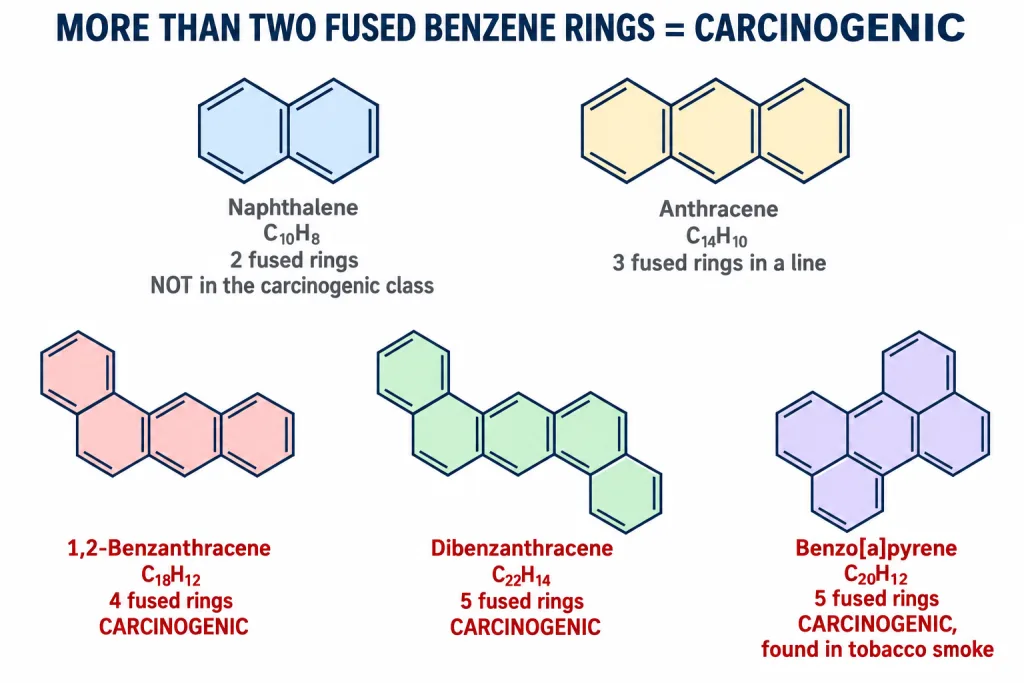
Key Point (Definition): A polynuclear aromatic hydrocarbon (PAH) is an arene built from two or more benzene rings fused together, each neighbouring pair sharing one edge. More than two fused benzene rings is the warning sign for toxicity and carcinogenicity, and the PAHs named as carcinogens in this chapter are the bent four- and five-ring compounds.
The ring count is a guide, not a guarantee. It tells you which compounds to suspect; the shape of the fused sheet decides.
| Compound | Molecular formula | Fused rings | In the carcinogenic class |
|---|---|---|---|
| Naphthalene | 2 | no, only two rings | |
| Anthracene | 3, in a straight line | no — three rings and still not carcinogenic; the named carcinogens are the bent four- and five-ring compounds | |
| 1,2-Benzanthracene | 4 | yes | |
| Benzo[a]pyrene | 5 | yes | |
| Dibenzanthracene | 5 | yes |
The three named carcinogens are the ones to be able to describe.
- 1,2-Benzanthracene is anthracene — three rings fused in a straight line — with a fourth benzene ring fused across the edge of one end ring. That fourth ring sits at an angle rather than continuing the line, so the molecule is bent.
- Dibenzanthracene is the same idea done twice: anthracene with an extra ring fused angularly onto each end ring, giving five rings in a shallow zig-zag.
- Benzo[a]pyrene starts from pyrene, a compact block of four fused rings, and adds a fifth benzene ring on one edge. It is the best studied carcinogen of the group and the one named in tobacco smoke.
Where they come from
PAHs are made by the incomplete combustion of organic material. When carbon burns with too little oxygen it never reaches carbon dioxide; small unsaturated fragments survive in the flame — ethyne among them — and recombine. Three ethyne molecules closing into a benzene ring is a reaction already met in this chapter, and in a sooty flame the same chemistry keeps going: ring adds to ring, and the sheets that grow are the PAHs.
The everyday sources make up the list examiners ask for.
- Tobacco smoke — cigarette, bidi and hookah smoke all carry benzo[a]pyrene.
- Coal — coal smoke, and coal tar, which is very largely a PAH mixture.
- Petroleum — its combustion products, and diesel exhaust with the soot in it.
- Charred food — meat grilled over a flame, burnt toast, the crust on anything over-roasted.
- Burning crop residue and wood, incense sticks and mosquito coils.
[Board] Two marks go for the class and the ring criterion, two for naming benzo[a]pyrene with a source.
Why a PAH causes cancer
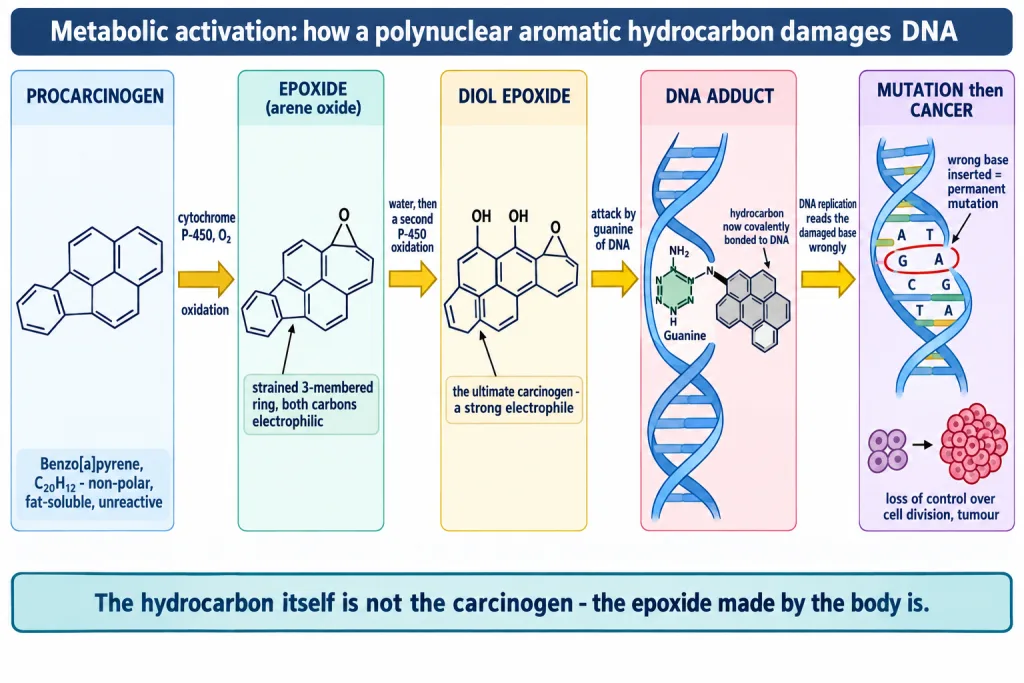
A polynuclear aromatic hydrocarbon on its own is chemically dull: no polar group, insoluble in water, unreactive at body temperature. That is the first half of the problem — being non-polar and fat-soluble, it passes through cell membranes, lodges in fatty tissue and cannot be flushed out in urine.
The body's response is to make it water-soluble by putting oxygen into it. Enzymes of the cytochrome P-450 family in the liver do exactly that, and in doing it they turn a harmless-looking hydrocarbon into a dangerous one.
Step 1 — oxidation to an epoxide. P-450 delivers a single oxygen atom across one carbon-carbon double bond of a ring. The product is an epoxide (an arene oxide): a three-membered ring of two carbons and one oxygen on the edge of the aromatic system. That ring is badly strained, and the strain makes both its carbons electrophilic.
Step 2 — on to the diol epoxide. Water opens the first epoxide to a diol, and a second P-450 oxidation puts a fresh epoxide on the neighbouring double bond. This diol epoxide sits in a crowded corner of the molecule that water reaches only slowly, so it survives to reach the cell nucleus.
Step 3 — attack on DNA. The nitrogen atoms of the DNA bases carry lone pairs and are nucleophiles. The amino nitrogen of guanine attacks the strained epoxide carbon and opens the ring, joining the hydrocarbon to DNA by a covalent bond — a DNA adduct.
Step 4 — mutation. The bulky adduct distorts the double helix there. When the cell next copies its DNA, the copying enzyme misreads the damaged base and puts the wrong partner opposite it: the sequence is permanently altered, a mutation.
Step 5 — cancer. Most mutations do nothing. If one lands in a gene controlling when a cell may divide, that control is lost and the descendants of that single cell become a tumour.
Key Point: The PAH is not itself the carcinogen. It is a procarcinogen, and the body's own attempt to detoxify it manufactures the electrophilic epoxide that attacks DNA. This is called metabolic activation.
Two features follow from the mechanism. The damage is cumulative and probabilistic — every exposure adds adducts, and no dose is small enough to make an adduct impossible, only unlikely. And the delay is long, years to decades between exposure and disease, which is why the link between smoke and cancer took so long to be accepted.
The toxicity of benzene
Benzene is classed as a known human carcinogen, and its target organ is the bone marrow, the tissue that manufactures red cells, white cells and platelets.
Repeated exposure over months and years lowers the counts of all three cell types. Severe cases give aplastic anaemia, in which the marrow largely stops producing, and benzene is firmly linked to acute myeloid leukaemia.
The chemistry runs along the same track as the PAHs. Benzene has no side chain, so the only part of it the liver can oxidise is the ring itself. Cytochrome P-450 gives benzene oxide, an epoxide, which rearranges to phenol and is oxidised further to hydroquinone and catechol. These metabolites collect in the marrow, where they damage the blood-forming stem cells.
Acute exposure is a separate matter: at high concentration the vapour gives dizziness, headache, drowsiness and a fast irregular heartbeat, and at high enough concentration unconsciousness and death. Benzene smells faintly sweet, so the smell is no deterrent.
For all these reasons benzene has been withdrawn as a general laboratory and industrial solvent, even though it dissolves most organic compounds well. Its usual replacements are toluene, and after that cyclohexane, petroleum ether and dichloromethane.
Why toluene of all things should be the substitute is a piece of this chapter's own chemistry. Toluene carries a methyl side chain, and the body oxidises side chains in preference to rings — the same selectivity as cutting toluene back to benzoic acid while leaving the ring untouched. Inside the body the sequence is
the acid being joined to the amino acid glycine before excretion. The ring never has to be attacked, so no epoxide is ever formed. Toluene is not harmless — inhaled deliberately in quantity it damages the nervous system — but it is not a recognised human carcinogen, and that is the difference.
Key Point: Benzene is dangerous because its ring is the only thing available to oxidise, and oxidising an aromatic ring makes an epoxide. Toluene offers the body an easier target in its side chain, so the ring survives.
[JEE/NEET] The one-liner: benzene is no longer used as a solvent because it is carcinogenic and attacks the bone marrow. The replacement to name is toluene.
Carbon monoxide and the hazards of the fuel gases
Carbon monoxide
Complete combustion gives carbon dioxide and water. Starve the flame of air — a blocked chimney, a gas geyser in a sealed bathroom, an engine idling in a shut garage — and the carbon stops one oxygen short:
Carbon is 2 on each side, hydrogen 8 on each side, oxygen 6 on the left and on the right.
Carbon monoxide is colourless, odourless, tasteless and does not irritate the eyes or throat, so a room can fill with it and nothing warns the people inside. That absence of warning makes it the commonest fatal poisoning in the home.
Haemoglobin carries oxygen by binding it reversibly to the iron(II) at the centre of each of its four haem groups. Carbon monoxide binds at that same iron, in the same reversible way, but roughly 200 times more strongly. A small fraction of CO in the air therefore ties up a large fraction of the haemoglobin as carboxyhaemoglobin, so the blood carries less oxygen — and the haemoglobin still holding oxygen releases it to the tissues less readily.
Symptoms follow the oxygen debt: headache and nausea, then confusion, then unconsciousness. The binding is reversible, so treatment is fresh air and, in hospital, oxygen at high partial pressure to drive the CO off the iron.
Key Point: Carbon monoxide is poisonous because it competes with oxygen for the same site on haemoglobin and wins that competition by a factor of about 200, so the blood loses its ability to transport oxygen.
Methane and LPG
Neither methane nor LPG is a poison. Their hazards are physical, and there are three.
Asphyxiation. A leak fills a room with a gas that is not air. The oxygen fraction falls and a person suffocates without ever being poisoned, which is why cylinders are never stored in a cellar.
Flammability. A hydrocarbon burns only over a range of composition in air: methane between roughly 5 and 15 per cent by volume, LPG over a lower and narrower band of roughly 2 to 10 per cent, so a much smaller LPG leak is already explosive.
Where the leaked gas goes. Methane has and air an average of about 29, so leaked CNG rises and escapes through a high window. LPG is propane () and butane (), both denser than air, so leaked LPG sinks, spreads along the floor and collects in a low corner, a pit or a drain. That is why an LPG leak indoors is the more dangerous of the two.
Why LPG smells
Pure LPG and pure natural gas have no smell at all. A trace of a mercaptan (a thiol) is added at the bottling plant, usually ethanethiol, . The nose detects a mercaptan far below the lower flammability limit, so the warning arrives long before the mixture can catch fire, and the amount added is tiny.
On smelling gas: close the regulator, open doors and windows, and touch no electrical switch — a switch sparks as it moves, and a spark is all the mixture needs.
Hydrocarbons and the atmosphere
Greenhouse gases
Burning a hydrocarbon completely gives carbon dioxide and water, and carbon dioxide is the largest single contributor to the enhanced greenhouse effect simply because so much of it is made.
Methane is the hydrocarbon to name. Molecule for molecule it absorbs infrared radiation far more effectively than carbon dioxide — of the order of 25 times as much over a century — but there is far less of it in the air and it is oxidised away within about a decade. Unburnt methane reaches the atmosphere from leaking gas wells and pipelines, flooded paddy fields, landfill, cattle and coal mines. Methane that escapes does more warming than the carbon dioxide burning it would have produced, so leak control matters as much as combustion efficiency.
Photochemical smog
Three ingredients are needed, and all three come from traffic in sunlight.
- Unburnt hydrocarbons, from incomplete combustion and from evaporating fuel.
- Oxides of nitrogen, made in the hot engine cylinder from the nitrogen and oxygen of the air itself:
- Strong sunlight, which drives the rest.
In the air NO is oxidised to ; sunlight splits that again, releasing an oxygen atom that adds to dioxygen:
Ground-level ozone, with aldehydes and peroxyacetyl nitrate (PAN) from the hydrocarbons, gives the mixture its character. This is an oxidising smog: a brownish haze that stings the eyes, cracks rubber and damages crops, building up on bright still afternoons in cities with heavy traffic. The older London smog was the opposite kind, a reducing smog of sulphur dioxide, smoke and fog.
The catalytic converter
A catalytic converter is a ceramic honeycomb in the exhaust line, coated with platinum, palladium and rhodium. It is called three-way because it handles three pollutants at once, oxidising two and reducing the third.
In the last one: carbon 2 each side, nitrogen 2 each side, oxygen on the left and on the right.
A converter demands unleaded petrol. Lead from tetraethyllead, once added as an antiknock agent, coats the precious metal and destroys the catalyst permanently; removing lead from petrol was forced by the converter, and the antiknock job passed to branched and aromatic components instead. Diesel vehicles add a particulate filter, soot being the pollutant that matters most for them.
[NEET] The examinable triple is: converter oxidises CO and unburnt hydrocarbons, reduces oxides of nitrogen to , and needs unleaded fuel.
The uses of alkanes
Alkanes are unreactive, and that is what makes them useful. A substance that does not attack its container, the skin or the air around it can be stored, pumped and sold in bulk, and its one great reaction is held back until a spark is supplied.
As fuels. This takes the bulk of world alkane production.
| Fuel | Chief alkanes | Where it is burnt |
|---|---|---|
| CNG | methane | buses, cars, piped domestic supply |
| LPG | propane and butane | cooking gas, auto LPG, lighters |
| Petrol | to | spark-ignition engines |
| Kerosene | to | stoves, lanterns, jet engines |
| Diesel | to | compression-ignition engines, generators |
As lubricants and protective solids. The heavier fractions are not burnt at all. Lubricating oil ( to ) and the greases thickened from it keep metal surfaces apart. Paraffin wax ( to ) goes into candles, waxed paper, crayons and polishes. Petroleum jelly is the base of ointments and a barrier that keeps water in the skin; liquid paraffin is a laxative and a cosmetic ingredient. Bitumen surfaces the roads.
As chemical feedstock. Each of these appeared earlier in the chapter with its conditions.
- Naphtha and ethane are cracked to ethene and propene, the start of the plastics industry.
- Methane with steam over Ni at 1273 K gives , the industrial source of dihydrogen and hence of ammonia and methanol.
- Controlled oxidation gives methanol ( tube, K, atm) and methanal ().
- Free-radical chlorination of methane gives , (a solvent and paint stripper), and .
- Aromatisation of -hexane over at K and to atm gives benzene.
- Deliberately incomplete combustion of heavy residue gives carbon black for tyres and printing ink.
The uses of alkenes
Alkenes are the feedstock family. A pi bond is loosely held and opens to almost any electrophile, so an alkene converts far more readily than an alkane, and the world's plastics, antifreeze and industrial alcohol all begin here. Ethene is the largest-tonnage organic chemical made anywhere.
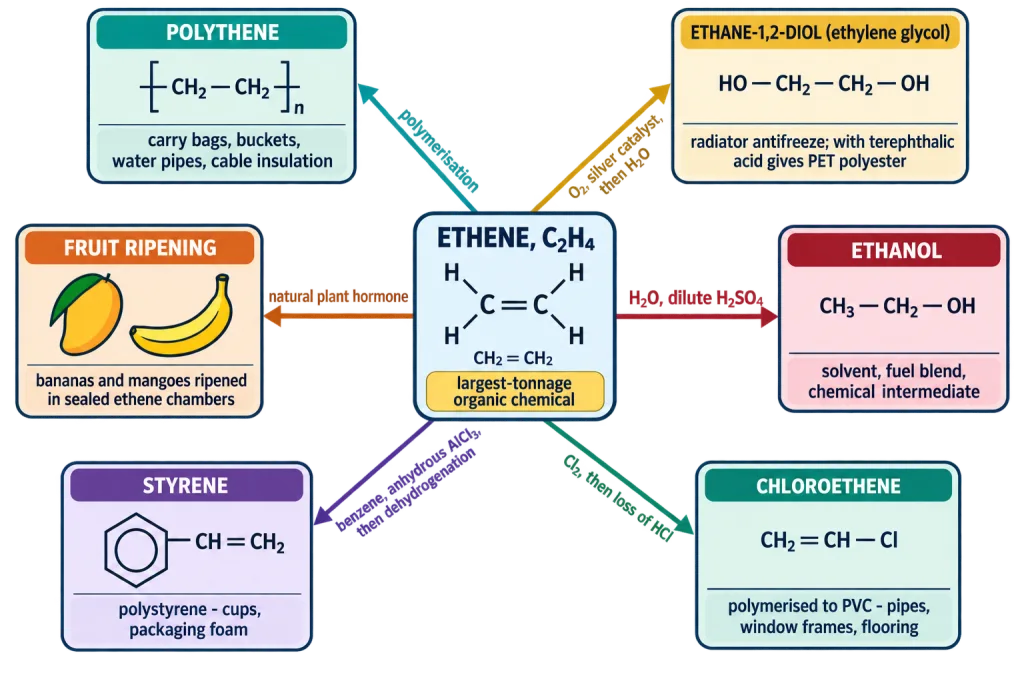
Polymers. Ethene polymerises to polythene — carry bags, milk pouches, buckets, water pipes, cable insulation. Propene gives polypropene — ropes, woven sacks, car bumpers, food containers that survive boiling water. Both are addition polymers: the pi bond opens and its electrons join monomer to monomer.
PVC. Ethene with chlorine gives 1,2-dichloroethane, which loses HCl to give chloroethene (vinyl chloride); that polymerises to poly(vinyl chloride) for pipes, window frames and flooring.
Antifreeze and polyester. Ethene oxidised over a silver catalyst gives epoxyethane, and water opens that ring to ethane-1,2-diol (ethylene glycol). In radiator water it depresses the freezing point and raises the boiling point, so it serves as antifreeze. The same diol, condensed with terephthalic acid, is half of PET polyester.
Ethanol. Hydration of ethene with dilute gives ethanol directly — a solvent, a fuel additive and a chemical intermediate.
Styrene. Benzene alkylated with ethene gives ethylbenzene, and dehydrogenation gives styrene, which polymerises to polystyrene — disposable cups, packaging foam, appliance housings.
The ripening hormone. Ethene is a natural plant hormone. A ripening fruit makes it, and what it releases ripens the fruit around it. Commercially, mangoes and bananas are picked hard and ripened in sealed chambers holding a few hundred parts per million of ethene.
The uses of alkynes
Ethyne is the only alkyne made on a large scale, and its two roles were set out in full earlier in this chapter.
As a flame. Burnt in pure dioxygen at a torch tip, ethyne gives the hottest flame in ordinary industrial use, hot enough to melt steel, so the oxy-acetylene torch welds and cuts metal. Three reasons combine: ethyne has a positive enthalpy of formation and carries stored energy, pure oxygen means no nitrogen is heated for nothing, and the short flame concentrates the heat in a small cone.
As a starting material. Most ethyne is converted rather than burnt.
| Reagent and conditions | First product | What it is made into |
|---|---|---|
| , dil. + 1% , K | ethanal | oxidised on to ethanoic acid |
| with | chloroethene | polymerised to PVC |
| with cuprous chloride | acrylonitrile | acrylic fibre, nitrile rubber |
| itself, over a catalyst | polyacetylene | conducting films, battery electrodes |
| itself, red-hot iron tube, K | benzene | the whole aromatic industry |
Ethyne mimics ethene closely enough to ripen fruit, which is why calcium carbide was once used for it; the practice is banned in India because commercial carbide releases arsine and phosphine along with the ethyne.
The uses of arenes
Benzene is no longer a solvent, but it remains one of the most important industrial feedstocks, and almost every route starts from a reaction in this chapter.
- Benzene ethylbenzene (Friedel-Crafts with ethene) styrene polystyrene.
- Benzene + propene cumene air oxidation and acid phenol and propanone. Phenol goes to bakelite, to aspirin and to antiseptics.
- Benzene + conc. and conc. at to K nitrobenzene reduction aniline, the parent of the azo dyes, of many drugs and of rubber chemicals.
- Benzene + over Ni at to K cyclohexane adipic acid and caprolactam nylon.
- Benzene alkylated with a long chain linear alkylbenzene sulphonated detergent; and benzene with in ultraviolet light benzene hexachloride (BHC, lindane), once a major insecticide and now restricted.
Toluene is the workhorse solvent that replaced benzene — paints, thinners, adhesives, inks — and a petrol component with a high octane rating. Nitrated three times it gives TNT; oxidised with it gives benzoic acid, whose sodium salt is a food preservative.
The xylenes are separated and used apart. -Xylene is oxidised to terephthalic acid, which with ethane-1,2-diol makes PET polyester — bottles, films and most synthetic clothing fibre. -Xylene gives phthalic anhydride for plasticisers and paints; mixed xylene is a solvent.
Naphthalene is the familiar mothball, and is oxidised commercially to phthalic anhydride and converted into dyes. It is not harmless: the vapour and the balls are toxic if swallowed and can destroy red blood cells in susceptible people. Anthracene goes to anthraquinone dyes.
Alternative fuels, weighed fairly
Each fuel below is judged on the same three things: carbon dioxide per unit of energy, what else comes out of the pipe, and what it costs in convenience.
CNG and LPG against petrol and diesel
The carbon dioxide advantage of a gaseous fuel is arithmetic. Methane has four hydrogens to one carbon, the highest ratio a hydrocarbon can have; octane has to , a ratio of . More of methane's energy comes from making water, so CNG releases roughly a quarter less carbon dioxide per unit of energy than petrol.
| CNG | LPG | Petrol | Diesel | |
|---|---|---|---|---|
| Chief constituent | methane | propane, butane | to | to |
| per unit energy | lowest | low | higher | higher still |
| Particulates and soot | almost none | almost none | low | highest |
| Storage | bar cylinder | liquid, modest pressure | liquid at 1 atm | liquid at 1 atm |
| Leak behaviour | rises, disperses | sinks and pools | liquid spill | liquid spill |
CNG also has a very high octane rating, so a dedicated engine can run at high compression. Against that, the cylinder is heavy and eats luggage space, range is short, filling stations are fewer, and a converted engine gives slightly less power. Because methane is itself a strong greenhouse gas, leakage between well and burner eats into the advantage.
Diesel is the most efficient liquid fuel per litre and gives less carbon dioxide per kilometre than petrol, but emits the most soot and oxides of nitrogen — precisely what a crowded city breathes.
Biofuels
Ethanol is fermented from sugarcane molasses, damaged grain or crop residue and blended into petrol; blends of 10 and 20 per cent are in use in India. The carbon it releases was taken from the air by the crop within the last year, so the fuel is renewable in a way petroleum is not, and its octane rating is high. The qualifications are real: tractors, fertiliser and distillation consume fossil energy, so the saving is partial; sugarcane is water-hungry and competes with food; and ethanol carries less energy per litre, so mileage falls a little.
Biodiesel is made by treating vegetable oil or used cooking oil with methanol, giving esters of the fatty acids. It is strictly not a hydrocarbon, since the ester group carries oxygen, and that oxygen is why it burns with less soot. Compressed biogas from crop residue is chiefly methane and is used as CNG is.
Key Point: No fuel here is clean in an absolute sense. Each moves the pollution somewhere else — a different gas, a different place, a different stage of the supply chain — and the comparison is always relative.
Worked items
Question 1: Naming the class
Which class of hydrocarbons is described as cancer producing, and what structural feature decides it? Name three members.
Answer:
The class is the polynuclear aromatic hydrocarbons, arenes built from benzene rings fused edge to edge. The feature is the ring count: more than two fused benzene rings marks a compound out as toxic and carcinogenic. The count is a guide rather than a guarantee — anthracene has three rings in a straight line and is not a carcinogen — and the three named here are all bent.
Ans: Polynuclear aromatic hydrocarbons with more than two fused rings; benzo[a]pyrene, 1,2-benzanthracene and dibenzanthracene. Watch out: Naphthalene has only two fused rings, so it falls outside this class.
Question 2: Where they come from
Give the process that produces carcinogenic PAHs and name four everyday sources.
Answer:
They form by the incomplete combustion of organic material: burning with too little oxygen leaves unsaturated fragments in the flame that recombine into fused rings.
Ans: Incomplete combustion; tobacco smoke, coal smoke and coal tar, petroleum and diesel exhaust, and food charred over a flame.
Question 3: Why grilling raises the PAH content
Explain why meat grilled over a flame carries more benzo[a]pyrene than the same meat cooked in a pan.
Answer:
Fat drips into the flame below and burns there in a hot, poorly oxygenated zone — exactly the condition that builds fused rings — and the smoke carrying those PAHs rises and deposits on the meat above. A pan gives no dripping into flame and no smoke returning to the food.
Ans: Dripping fat burns incompletely and the PAH-laden smoke coats the food; raising the grill or trimming the fat reduces it.
Question 4: Why the hydrocarbon itself is not the culprit
A student says benzo[a]pyrene reacts with DNA as soon as it is inhaled. Correct the statement.
Answer:
Benzo[a]pyrene is unreactive and non-polar. It becomes dangerous only after the body tries to dispose of it: cytochrome P-450 oxidises it to an epoxide and further oxidation gives a diol epoxide. That strained ring is electrophilic, so the amino nitrogen of guanine attacks it and the hydrocarbon ends up covalently bonded to DNA; the distorted base is then copied wrongly, giving a mutation.
Ans: It is a procarcinogen; the epoxide formed by the body's own metabolism is the electrophile that damages DNA. Watch out: Do not call the PAH itself the ultimate carcinogen. The activation step is the whole mechanism.
Question 5: Benzene as a solvent
Benzene dissolves most organic compounds well. Why has it been withdrawn from general use as a solvent, and what replaced it?
Answer:
Benzene is a known human carcinogen whose target is the bone marrow; long exposure causes aplastic anaemia and acute myeloid leukaemia. Having no side chain, its ring is the only thing the liver can oxidise, and oxidising an aromatic ring makes a reactive epoxide.
Ans: Withdrawn because it is carcinogenic and attacks the bone marrow; toluene is the usual replacement.
Question 6: Toluene against benzene
Toluene is an arene too. Explain why it is the accepted substitute.
Answer:
The body oxidises a side chain in preference to a ring, the same selectivity as turning toluene into benzoic acid. Toluene goes to benzoic acid, which is joined to glycine as hippuric acid and passed out in urine. The ring is never attacked, so no epoxide forms.
Ans: Its methyl group offers an easier oxidation site, so the ring survives and no DNA-damaging epoxide is produced. Watch out: Toluene is a narcotic on heavy inhalation. Safer is not the same as safe.
Question 7: Why carbon monoxide kills
State how carbon monoxide is formed from a cooking gas flame and why a small amount of it in a room is fatal.
Answer:
With too little air the carbon stops one oxygen short:
CO binds to the iron(II) of haemoglobin at the same site as oxygen but about 200 times more strongly, giving carboxyhaemoglobin, so the blood carries less oxygen and releases what it has less readily.
Ans: Incomplete combustion makes it; it out-competes oxygen for haemoglobin by a factor of about 200, so the blood stops transporting oxygen. Watch out: CO is colourless, odourless and non-irritant, so there is no warning at all.
Question 8: LPG and its smell
Why is a mercaptan added to LPG, and why is an LPG leak in a kitchen worse than a CNG leak?
Answer:
Pure LPG has no smell, so a leak would go undetected until it exploded. A trace of ethanethiol, , is added, and the nose picks it up far below the lower flammability limit.
Propane () and butane () are denser than air (), so leaked LPG sinks and pools at floor level; methane () is lighter, rises and escapes through a high window.
Ans: The mercaptan gives a warning smell well before the mixture can ignite; LPG is the worse leak because its vapour is denser than air and collects near the floor.
Question 9: Photochemical smog
Name the three ingredients of photochemical smog and the three jobs of a catalytic converter.
Answer:
Unburnt hydrocarbons, oxides of nitrogen from the hot engine cylinder, and sunlight. Sunlight splits to give an oxygen atom that makes ozone, and the hydrocarbons give aldehydes and PAN. The converter oxidises CO to , oxidises unburnt hydrocarbons to and water, and reduces nitrogen oxides to .
Ans: Hydrocarbons, oxides of nitrogen and sunlight; the converter oxidises CO and hydrocarbons and reduces . Watch out: It needs unleaded petrol — lead poisons the catalyst permanently.
Question 10: Matching hydrocarbon to use
Name the hydrocarbon used for each: welding steel, the plastic in a carry bag, antifreeze in a radiator, polyester shirt fabric, mothballs.
Answer:
Welding needs the oxy-acetylene flame, so ethyne. A carry bag is polythene from ethene. Antifreeze is ethane-1,2-diol, made from ethene through epoxyethane. Polyester needs terephthalic acid from -xylene. Mothballs are naphthalene.
Ans: ethyne; ethene; ethene; -xylene; naphthalene.
Question 11: The hydrogen-to-carbon argument
CNG gives less carbon dioxide per unit of energy than petrol. Support this with a structural reason.
Answer:
CNG is methane, , four hydrogens per carbon — the highest ratio any hydrocarbon can reach. Petrol is around , a ratio of . More of methane's energy comes from burning hydrogen to water, so each unit of energy carries less carbon.
Ans: Methane has the highest hydrogen-to-carbon ratio, so more of its heat comes from making water; CNG gives roughly a quarter less per unit energy than petrol. Watch out: Leaked methane is itself a strong greenhouse gas, so the advantage depends on a tight supply chain.
Question 12: Weighing ethanol blending
Give one genuine advantage and two real limitations of blending ethanol into petrol.
Answer:
The carbon in ethanol was pulled from the air by the crop within the last year, so the fuel is renewable, and its octane rating is high. Against that, growing and distilling the crop uses fossil energy so the saving is partial, sugarcane is water-hungry and competes with food, and ethanol holds less energy per litre so mileage falls slightly.
Ans: Advantage — renewable carbon and a high octane rating. Limitations — partial saving once farming and distillation are counted, competition with food and water, and lower energy per litre.