
Ethyne joining to itself — two roads
Pi electrons are loosely held, and ethyne has two pi bonds. Given a catalyst or a hot tube, one molecule attacks the pi cloud of another and the pi bonds are traded for new sigma bonds between the units. No atoms are lost, and which product forms depends only on the conditions.
Key Point (Definition): Polymerisation is the joining of many small molecules (monomers) into one large molecule with no other product. Ethyne polymerises linearly, to an open chain called polyacetylene, and cyclically, where exactly three molecules close into a ring to give benzene.
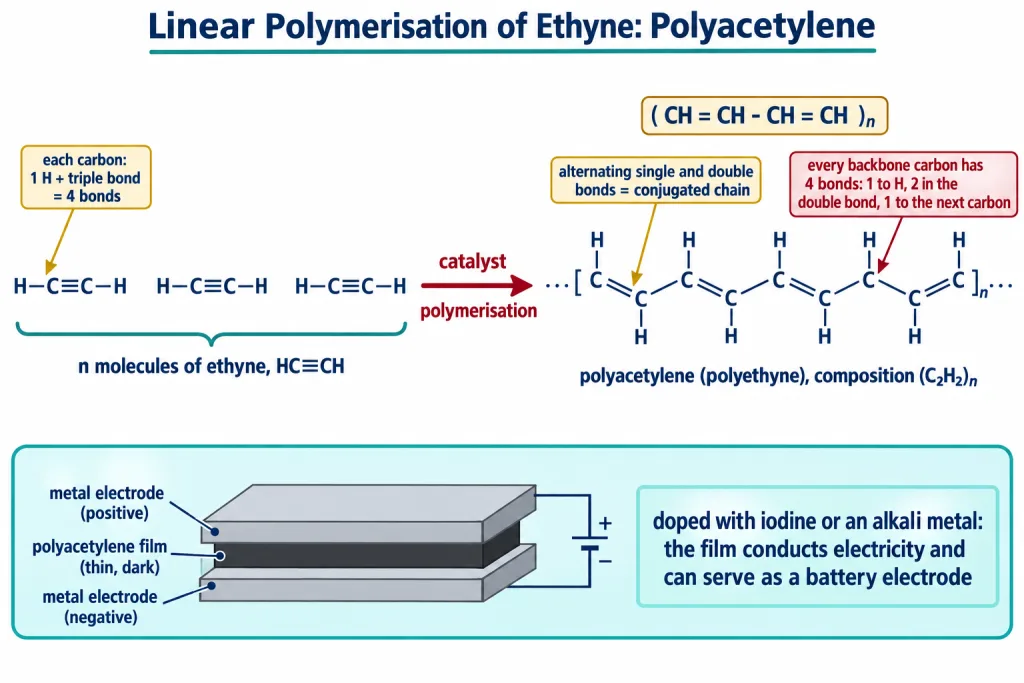
Linear polymerisation — polyacetylene
Under suitable conditions, with a transition-metal catalyst, ethyne joins end to end:
The chain is written with a four-carbon repeating unit, , but the pattern is simpler than that looks. Every backbone carbon carries one hydrogen, and the bonds along the chain alternate single, double, single, double without a break.
Count the bonds on one chain carbon: one to its hydrogen, two in the double bond to one neighbour, one to the other neighbour — four, as every carbon must have.
Each four-carbon repeating unit is built from two molecules of ethyne, which is why the equation above takes of them. The composition is still that of the monomer, , since polymerisation is pure addition, so a sample of relative molar mass came from molecules of ethyne. The product is polyacetylene or polyethyne, a high molecular mass polyene.
The conjugated chain, and doping
A long run of alternating single and double bonds is a conjugated system: the pi electrons spread along the backbone instead of staying with one pair of carbons.
Pure polyacetylene is not a conductor. Doped — treated with a little of an electron acceptor such as iodine, or an electron donor such as an alkali metal — it conducts along the chain, and a thin film works as a battery electrode, lighter and cheaper than a metal conductor. The discovery of such conducting polymers was recognised with the Nobel Prize in Chemistry in 2000.
Set against polythene
Polythene is saturated, because ethene's one double bond is entirely used up in joining the units. Ethyne has two pi bonds, so one double bond per two carbons survives — which is why polyacetylene is coloured, conjugated and dopable while polythene is a colourless insulating wax.
[Board] Ethene gives a saturated polymer; ethyne gives an unsaturated conjugated polymer that conducts when doped. A question asking why polyacetylene conducts is asking about the conjugated chain, not about the catalyst.
Cyclic polymerisation — three ethynes make benzene
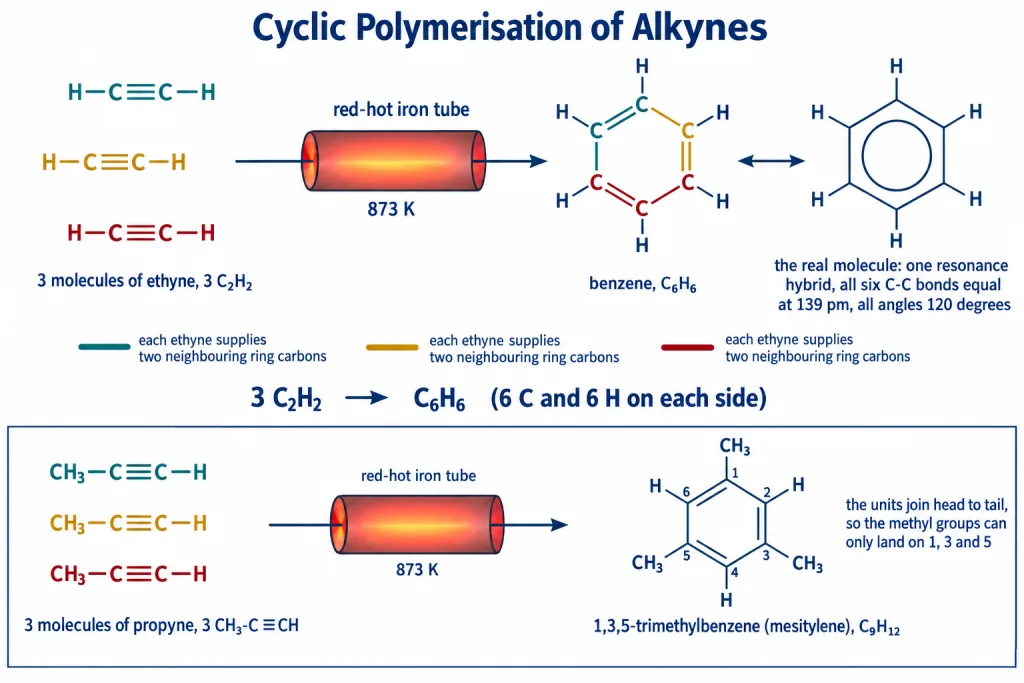
Passed through a red-hot iron tube at 873 K, ethyne does not make a long chain. Three molecules close on themselves and the ring shuts:
Balance it. Left: three molecules of , 6 carbons and 6 hydrogens. Right: benzene, 6 carbons and 6 hydrogens. Nothing else appears, because polymerisation loses no atoms.
Each ethyne supplies two adjacent ring carbons, each carrying one hydrogen. Of its two pi bonds, one is spent making the sigma bonds that close the ring and one is left over — which is why the ring comes out with three double and three single bonds in the alternating Kekule pattern.
Key Point: Ethyne passed through a red-hot iron tube at 873 K trimerises to benzene. This is the cheapest route from a two-carbon aliphatic gas to a benzene ring, and the standard bridge from aliphatic to aromatic chemistry.
The alternating-bond picture is how the product is drawn on paper. Benzene itself is one resonance hybrid: all six carbon-carbon bonds equal at 139 pm, every angle , carbons, six delocalised pi electrons. Section 14 does that properly.
One of the three preparations of benzene
| Route | Reagent and conditions |
|---|---|
| Cyclic polymerisation of ethyne | red-hot iron tube, 873 K, three molecules |
| From phenol | phenol + zinc dust, distilled |
| From a salt of benzoic acid | sodium benzoate + soda lime, heated (decarboxylation) |
Section 16 uses this reaction again as the first entry in that list. Benzene made this way is the starting point for the derivatives of benzene, and from them for dyes, drugs and plastics.
Propyne gives mesitylene
The same trimerisation works on a substituted alkyne. Three molecules of propyne give 1,3,5-trimethylbenzene, common name mesitylene:
Left: is 9 carbons and 12 hydrogens. Right: a benzene ring with three methyl groups, so carbons and hydrogens. It balances.
The methyls come out at 1, 3 and 5 and nowhere else. Each propyne puts one substituted and one unsubstituted carbon into the ring, and the units join head to tail, so a substituted carbon always has an unsubstituted neighbour.
But-2-yne carries a methyl on each ring-bound carbon, so its trimer is hexamethylbenzene, — and either way.
The uses of ethyne
The oxy-acetylene flame
Ethyne burnt at a torch tip in pure dioxygen gives the hottest flame in ordinary industrial use — hot enough to melt steel, which is what makes welding and cutting possible.
Carbon 4 each side; hydrogen 4 each side; oxygen 10 on the left and on the right.
Three things put the temperature so high.
The molecule is stored energy. Ethyne is one of the few hydrocarbons with a positive standard enthalpy of formation: energy was supplied to build the triple bond out of its elements, and it comes back out along with the ordinary heat of combustion.
It is burnt in oxygen, not air. Four-fifths of air is nitrogen, dragged through the flame and heated without contributing anything; removing it means the same heat warms a far smaller mass of gas.
The heat appears in a small volume. Ethyne burns in a short two-stage flame, so the heat is concentrated in a tight bright cone at the tip — a welder needs a small hot spot, not a large warm one.
Burnt in air instead, ethyne gives a sooty, smoky, luminous flame: its carbon content by mass is , about 92 per cent, and air cannot supply oxygen fast enough to burn all of it.
Ethyne as a starting material
Most industrial ethyne is converted rather than burnt.
| Reagent and conditions | Product from ethyne | What it becomes |
|---|---|---|
| , dil. + 1% , 333 K | ethanal, | oxidised on to ethanoic acid |
| , catalyst | chloroethene (vinyl chloride) | polymerised to PVC — pipes, cable insulation, flooring |
| , cuprous chloride catalyst | acrylonitrile, | acrylic fibre, synthetic rubber |
| , zinc ethanoate | vinyl acetate | poly(vinyl acetate) adhesives and paints |
| excess | a heavy solvent | |
| itself, catalyst | polyacetylene | conducting films, battery electrodes |
Two of them in full:
Ripening fruit, and the carbide lamp
Both older uses start from calcium carbide and water:
A carbide lamp dripped water onto lumps of carbide and burnt the ethyne at a jet. The flame is bright because it is sooty, and no battery was needed, so such lamps lit mines, bicycles and lighthouses for decades.
Ethyne also mimics ethene, the plant hormone that ripens fruit, so carbide was used to ripen mangoes and bananas artificially. The practice is banned in India, because commercial carbide carries phosphide, arsenide and sulphide impurities that give off phosphine, arsine and hydrogen sulphide along with the ethyne.
Alkanes, alkenes and alkynes — the consolidation
Everything from here on is revision, gathered so that one table answers a comparison question instead of three sections.
| Property | Alkane | Alkene | Alkyne |
|---|---|---|---|
| General formula | |||
| First member | methane, | ethene, | ethyne, |
| Two-carbon member (the bond data below refer to it) | ethane, | ethene, | ethyne, |
| Carbon-carbon bond | one sigma | one sigma + one pi | one sigma + two pi |
| Hybridisation | |||
| s character | 25% | 33.3% | 50% |
| C-C bond length | 154 pm | 134 pm | 120 pm |
| C-C bond enthalpy | 348 kJ/mol | 681 kJ/mol | 823 kJ/mol |
| Bond angle at carbon | about | ||
| Shape at that carbon | tetrahedral | trigonal planar | linear |
| C-H bond length | 109 pm | 108 pm | 106 pm |
| Degree of unsaturation | 0 | 1 | 2 |
Three readings of that table are worth stating in words.
The bond gets shorter and stronger from left to right. More pi bonds pull the carbons closer (154, 134, 120 pm) and the enthalpy needed to break the whole bond rises (348, 681, 823 kJ/mol).
The whole bond enthalpy is not the reactive part. Of an alkene's 681 kJ/mol, about 397 kJ/mol is sigma and only about 284 kJ/mol is pi. The pi part is what a reagent breaks, and it is weaker than any sigma bond in the molecule — which is why alkenes are reactive and alkanes are not.
Carbon gets more electronegative as its s character rises, so , which explains the acidity order below.
The angles in ethene are not exactly : H-C-H is about and H-C-C about . The C-H bond enthalpy, 414 kJ/mol, is much the same in all three families.
Characteristic reaction, and why it is that one
| Family | Characteristic reaction | Attacking species | The reason |
|---|---|---|---|
| Alkane | free-radical substitution | a free radical, from heat or ultraviolet light | no pi cloud and no polar bond, so nothing attracts an electrophile or a nucleophile; only homolysis starts it |
| Alkene | electrophilic addition | an electrophile | pi electrons stand exposed above and below the plane and are loosely held; one weak pi bond is exchanged for two strong sigma bonds |
| Alkyne | electrophilic addition twice over, plus acidic behaviour if terminal | an electrophile; a strong base for the acidic hydrogen | two pi bonds allow two successive additions; the C-H bond is polarised enough to lose its proton |
| Benzene | electrophilic substitution | an electrophile | substitution preserves the delocalised sextet, addition would destroy it |
[JEE/NEET] A question naming a hydrocarbon and a reagent is asking which of those four rows applies. Radical plus alkane means substitution and a mixture; electrophile plus alkene or alkyne means addition; electrophile plus benzene means substitution and one product.
The tests, in one table
Every entry has appeared already. What matters is reading down a column and across a row with equal fluency, since an identification question hands you a row and asks for a column.
| Reagent | Alkane | Alkene | Terminal alkyne | Non-terminal alkyne |
|---|---|---|---|---|
| Bromine water (orange) | no change in the dark | discharged at once | discharged | discharged |
| in (red-brown) | no change in the dark | discharged; 1 mol per mol | discharged; 2 mol per mol | discharged; 2 mol per mol |
| Baeyer's reagent, cold dilute alkaline (pink) | no change | pink discharged, brown | pink discharged, brown | pink discharged, brown |
| Ammoniacal silver nitrate | no reaction | no reaction | white precipitate, silver acetylide | no reaction |
| Ammoniacal cuprous chloride | no reaction | no reaction | red precipitate, copper acetylide | no reaction |
| Sodium metal, liq. , 273 K | no reaction | no reaction | evolved, sodium acetylide formed | no reaction |
| Combustion in air | clean, non-sooty, faintly blue flame | luminous, some soot | sooty, smoky, luminous | sooty, smoky |
| Carbon by mass, member | 80% | 85.7% | 92.3% | — |
Benzene is negative to bromine water, to Baeyer's reagent, to both metal reagents and to sodium, and burns with a sooty luminous flame. A negative unsaturation test on a liquid as hydrogen-poor as is itself the evidence for aromaticity.
The equations behind the positive metal tests:
The silver equation balances: 2 silver, 2 carbon, 4 nitrogen, 2 oxygen each side, and hydrogen against .
One trap in the bromine test
An alkane and bromine do react in sunlight, by substitution, giving an alkyl bromide and fumes of hydrogen bromide, so the colour eventually fades. The test for unsaturation is a test for immediate decolourisation in the dark or in diffused light, with no acid fumes.
The acidity order
The hydrogen sits on an carbon in ethyne, an carbon in ethene and an carbon in ethane. More s character holds the electrons closer to the nucleus, so carbon is more electronegative and the C-H bond more polarised; the lone pair left behind after the proton goes also sits closer to the nucleus, so the anion is more stable. Both halves of the argument agree.
Only a terminal hydrogen counts:
But-2-yne and every other internal alkyne have no acidic hydrogen — theirs are all on carbons — which is why they fail the silver and copper tests.
Ethyne is still a very weak acid overall, far weaker than water. Calling it acidic means only that it is acidic compared with other hydrocarbons, so that a strong base such as sodium metal or sodamide can take its proton.
Reactivity towards an electrophile — the counter-intuitive one
An alkyne has four pi electrons where an alkene has two, so the expected answer is the wrong way round. Two reasons account for it.
The electrons are held more tightly, between carbons that are more electronegative than the carbons of an alkene, in a compact cylindrical cloud around a short 120 pm axis. Less of it is available to an approaching electrophile.
The intermediate is worse. An electrophile adding to an alkene leaves an ordinary carbocation; adding to an alkyne it leaves a vinyl cation on an carbon, markedly less stable, so the rate-determining step costs more.
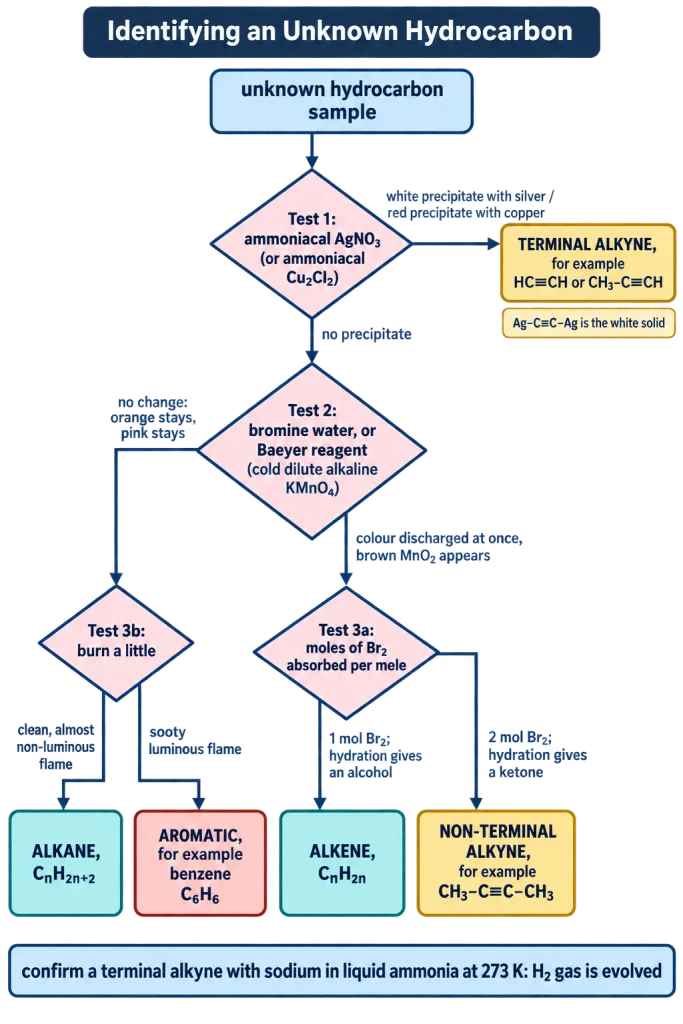
Identifying an unknown hydrocarbon — the order to test in
Each test should split the possibilities as far as it can, so the most decisive comes first.
Step 1 — ammoniacal silver nitrate, or ammoniacal cuprous chloride. A white precipitate with the silver reagent, or a red precipitate with the copper reagent, means a terminal alkyne and nothing else in the syllabus. A positive result finishes the identification. No precipitate rules out a terminal alkyne and rules out nothing else.
Step 2 — bromine water, or Baeyer's reagent. Colour discharged at once means a reactive carbon-carbon multiple bond, so the sample is an alkene or a non-terminal alkyne, Step 1 having excluded the terminal alkyne. No change means no reactive multiple bond: an alkane, or an aromatic compound.
Step 3a — after a positive Step 2, to separate an alkene from a non-terminal alkyne. Measure the bromine taken up: an alkene absorbs one mole per mole, an alkyne two. Or hydrate with dilute and 1% at 333 K — an alkene gives an alcohol, an internal alkyne a ketone.
Step 3b — after a negative Step 2, to separate an alkane from an arene. Burn a little: an alkane gives a clean, almost non-luminous flame, benzene and its homologues a sooty luminous flame. The formula settles it too, since an alkane must fit .
Step 4 — sodium metal, as confirmation: hydrogen evolved confirms the acidic terminal of Step 1.
| Result pattern | Identification |
|---|---|
| Precipitate with the silver or copper reagent; bromine water discharged | terminal alkyne |
| No precipitate; bromine water discharged; 2 mol absorbed; hydration gives a ketone | non-terminal alkyne |
| No precipitate; bromine water discharged; 1 mol absorbed; hydration gives an alcohol | alkene |
| No precipitate; bromine water and Baeyer's reagent unchanged; clean flame | alkane |
A negative test never proves the absence of a multiple bond — only of a reactive one. Benzene has three formal double bonds and fails every unsaturation test.
Worked items
Question 1: Balancing the trimerisation, and a mass from a volume
Write the equation for the cyclic polymerisation of ethyne with its conditions, and find the mass of benzene obtainable from 6.72 litres of ethyne at STP.
Answer:
The reaction needs a red-hot iron tube at 873 K, and three molecules go in.
Left: 6 carbons and 6 hydrogens. Right: 6 carbons and 6 hydrogens.
At STP one mole occupies 22.4 litres, so mol. Three moles of ethyne give one mole of benzene, so I get 0.10 mol. The molar mass of is 78, so the mass is g.
Ans: 7.8 g of benzene.
Watch out: The ratio is 3 : 1; skipping the division gives 23.4 g.
Question 2: Bromine water decolourised, no silver precipitate
An unknown gas decolourises bromine water but gives no precipitate with ammoniacal silver nitrate. What is it?
Answer:
Bromine water going colourless says there is a reactive carbon-carbon multiple bond, so the gas is neither an alkane nor an aromatic compound.
No precipitate with ammoniacal silver nitrate says there is no hydrogen on an carbon, so it is not a terminal alkyne.
Two possibilities survive: an alkene, or a non-terminal alkyne such as but-2-yne. To choose, I measure the bromine absorbed — one mole for the alkene, two for the alkyne.
Ans: An alkene or a non-terminal alkyne, separated by the moles of bromine absorbed.
Watch out: Answering "an alkene" alone is half right. The silver test separates a terminal alkyne from everything else, not an alkyne from an alkene.
Question 3: A white precipitate and a decolourised Baeyer's reagent
A colourless gas discharges the pink of Baeyer's reagent, leaving a brown solid, and gives a white precipitate with ammoniacal silver nitrate. Identify the class, and write the equation for the precipitate taking the gas as ethyne.
Answer:
The Baeyer test shows a reactive multiple bond, and the brown solid is . Only a terminal alkyne gives the white precipitate, which settles the class.
Both hydrogens of ethyne are terminal, so both are replaced and the precipitate is the disilver acetylide.
Ans: A terminal alkyne; with ethyne the precipitate is silver acetylide, .
Question 4: A gas inert to both reagents
A gas leaves bromine water orange and Baeyer's reagent pink, and burns with a clean, almost non-luminous flame. What is it?
Answer:
Both negatives say there is no reactive multiple bond, leaving an alkane or an aromatic hydrocarbon.
The flame decides. A sooty luminous flame marks a carbon-rich compound such as benzene; a clean, faintly blue flame marks an alkane, whose hydrogen content lets the air burn all its carbon. Being a gas also fits an alkane of one to four carbons, while benzene is a liquid.
Ans: An alkane.
Question 5: , no red precipitate, hydration gives a ketone
A hydrocarbon decolourises bromine water, gives no red precipitate with ammoniacal cuprous chloride, and with dilute containing 1% at 333 K gives butan-2-one. Identify it.
Answer:
fits with , so it is an alkyne or a diene. No red precipitate rules out a terminal alkyne, so but-1-yne is out, and a ketone rather than an aldehyde on hydration confirms an alkyne other than ethyne. The only alkyne left is but-2-yne.
Atom check: , and butan-2-one is .
Ans: But-2-yne.
Question 6: Hydrogen evolved with sodium
A gaseous hydrocarbon liberates dihydrogen with sodium metal in liquid ammonia at 273 K and decolourises in . What is it, and what is the solid product?
Answer:
No alkane and no alkene reacts with sodium; only the hydrogen on an carbon of a terminal alkyne is acidic enough to be removed.
The bromine test confirms the multiple bond independently.
Ans: A terminal alkyne, ethyne being the simplest; the solid is monosodium acetylide.
Watch out: The question says hydrocarbon. Sodium also releases hydrogen from an alcohol or an acid, so this identifies a terminal alkyne only within the hydrocarbons.
Question 7: Two gases, one reagent
You have a cylinder of ethene and a cylinder of ethyne, and only ammoniacal cuprous chloride. Which observation identifies them, and would bromine water have worked?
Answer:
Ammoniacal cuprous chloride gives a red precipitate with ethyne, which has terminal acidic hydrogens; ethene has none and gives nothing.
Bromine water would not have worked: both gases have pi bonds and both discharge the colour.
Ans: A red precipitate with ethyne, no change with ethene; bromine water fails.
Question 8: 0.05 mole of a gas and 16 g of bromine
A hydrocarbon gas of molar mass 40 g/mol absorbs bromine quantitatively: 0.05 mol of it takes up 16.0 g of bromine. Identify the gas.
Answer:
is 160 g/mol, so 16.0 g is 0.10 mol, twice the 0.05 mol of hydrocarbon, and two moles of bromine per mole means two pi bonds.
Molar mass 40 fits , which is with . Two isomers answer to that formula: propyne, , and propadiene, . Each takes up two moles of bromine, so the bromine data alone cannot choose between them. Ammoniacal silver nitrate can: propyne carries a hydrogen on a triply bonded carbon and gives a white precipitate, while propadiene gives none.
Carbon 3, hydrogen 4 and bromine 4 on each side.
Ans: Propyne or propadiene; ammoniacal silver nitrate distinguishes them.
Watch out: Propadiene is also and also absorbs two moles of bromine. The silver test separates them: propyne precipitates, propadiene does not.
Question 9: Mesitylene from propyne
Name the product of passing propyne over a red-hot iron tube at 873 K, and explain why the substituents land where they do.
Answer:
Three molecules trimerise, exactly as ethyne does:
The product is a benzene ring with methyl groups on alternate carbons: 1,3,5-trimethylbenzene, or mesitylene. Round the ring the pattern is , , , , , , because each propyne supplies two neighbouring ring carbons, one with the methyl and one with a hydrogen, and the units join head to tail.
Ans: 1,3,5-Trimethylbenzene (mesitylene), .
Question 10: The oxy-acetylene flame
Write the balanced equation for the complete combustion of ethyne and give two reasons why the oxy-acetylene flame is hotter than the same gas burnt in air.
Answer:
Carbon 4 each side; hydrogen 4 each side; oxygen 10 on the left and on the right.
First, air is mostly nitrogen, which absorbs heat and carries it away without taking part; in pure oxygen the same heat raises a much smaller mass of gas. Second, ethyne has a positive standard enthalpy of formation, so the energy stored in the molecule is released along with the ordinary heat of combustion.
Ans: The equation above; the absence of nitrogen, and the positive enthalpy of formation of ethyne.
Question 11: Ethyne to PVC
Show how ethyne is converted into poly(vinyl chloride), with reagents.
Answer:
One molecule of hydrogen chloride adds across the triple bond, and the addition is stopped there.
Atom check: , which is chloroethene. It then polymerises through its double bond, the same addition polymerisation that turns ethene into polythene:
Ans: Ethyne with HCl over gives chloroethene, which polymerises to PVC.
Watch out: A second molecule of HCl would give 1,1-dichloroethane by Markovnikov addition. The process is controlled to stop at vinyl chloride, because the polymerisation needs that double bond.
Question 12: Ethyne to ethanoic acid
Convert ethyne into ethanoic acid, giving reagents and conditions.
Answer:
Water adds first, with the mercury catalyst, and the enol formed tautomerises to the aldehyde:
The ethanal is then oxidised:
Carbon 4, hydrogen 8 and oxygen 4 on each side.
Ans: Hydration at 333 K to ethanal, then oxidation to ethanoic acid.
Watch out: Ethyne is the only alkyne whose hydration gives an aldehyde; every other alkyne gives a ketone.
Question 13: Ordering three gases three ways
Arrange ethane, ethene and ethyne in order of increasing carbon-carbon bond length, decreasing acidity, and decreasing reactivity towards an electrophile, with a reason for each.
Answer:
Bond length, increasing: ethyne (120 pm) < ethene (134 pm) < ethane (154 pm), because more pi bonds pull the carbons closer.
Acidity, decreasing: ethyne > ethene > ethane. The hydrogen is on an , an and an carbon; more s character means a more electronegative carbon, a more polarised C-H bond and a more stable anion.
Reactivity to an electrophile, decreasing: ethene > ethyne > ethane. Ethane has no pi cloud, and of the other two the alkyne holds its pi electrons more tightly and adds through an unstable vinyl cation.
Ans: Length ethyne < ethene < ethane; acidity ethyne > ethene > ethane; electrophilic reactivity ethene > ethyne > ethane.
Watch out: The acidity order and the electrophilic-reactivity order are not the same. Ethyne heads the acidity order and comes second in the reactivity one.
Question 14: Separating three gases with two reagents
Propane, propene and propyne are in three unlabelled jars. Give a scheme using two reagents, with the observations.
Answer:
Ammoniacal silver nitrate first: only propyne has a hydrogen on an carbon, so only propyne gives a white precipitate.
Hydrogen on the left is , and on the right .
Bromine water on the remaining two: propene discharges the orange colour at once, propane leaves it unchanged in the dark.
Ans: Silver nitrate picks out propyne by a white precipitate; bromine water then picks out propene, leaving propane.
Watch out: Bromine water first wastes a test, since propene and propyne both decolourise it.