
Alkanes are the paraffins
Alkanes were named paraffins, from the Latin parum affinis, meaning little affinity, and the name is a fair description of their chemistry. They do not react with acids or bases, and they ignore ordinary oxidising and reducing agents. Their physical properties all follow one idea, the strength of the van der Waals forces between the molecules, and their chemistry is a short list of reactions forced on them by heat, by a catalyst or by a free radical.
Key Point: Everything in the physical properties of alkanes comes from one fact — the only force between two alkane molecules is the weak van der Waals (London dispersion) force, and the size of that force depends on how much molecular surface the two molecules can press together.
Physical state with chain length
Because the forces holding one alkane molecule to the next are so weak, the small members boil below room temperature. As the chain lengthens the forces build up, and the alkane condenses to a liquid and finally sets to a solid. At 298 K:
| Carbon atoms | Physical state | Examples |
|---|---|---|
| to | gases | methane, ethane, propane, butane |
| to | liquids | pentane, hexane, octane, decane |
| and above | solids | octadecane, icosane, paraffin wax |
Alkanes are colourless and odourless; the smell of domestic cooking gas comes from a sulphur compound added on purpose so that a leak can be detected. Candle wax is a mixture of alkanes above .
[Board] The three ranges to , to , and above are asked as a one-mark recall item. Learn the cut-offs as numbers, not as "small, medium, large".
Boiling point
The rise with chain length
Boiling means pulling molecules apart. The more strongly they are held, the more heat is needed.
Along the alkane series the boiling point climbs steadily with molecular mass: methane 111.7 K, ethane 184.6 K, propane 231.1 K, and so on up the family. The reason is the growing surface. Two long chains lying side by side make contact along their whole length, and every point of contact is one more spot where the fluctuating electron clouds can attract each other, so the total van der Waals attraction grows with molecular size and surface area.
Key Point: Boiling point rises with chain length because van der Waals forces increase with the surface area of the molecule, not because the bonds inside the molecule get stronger. No covalent bond is broken when an alkane boils.
The branching effect
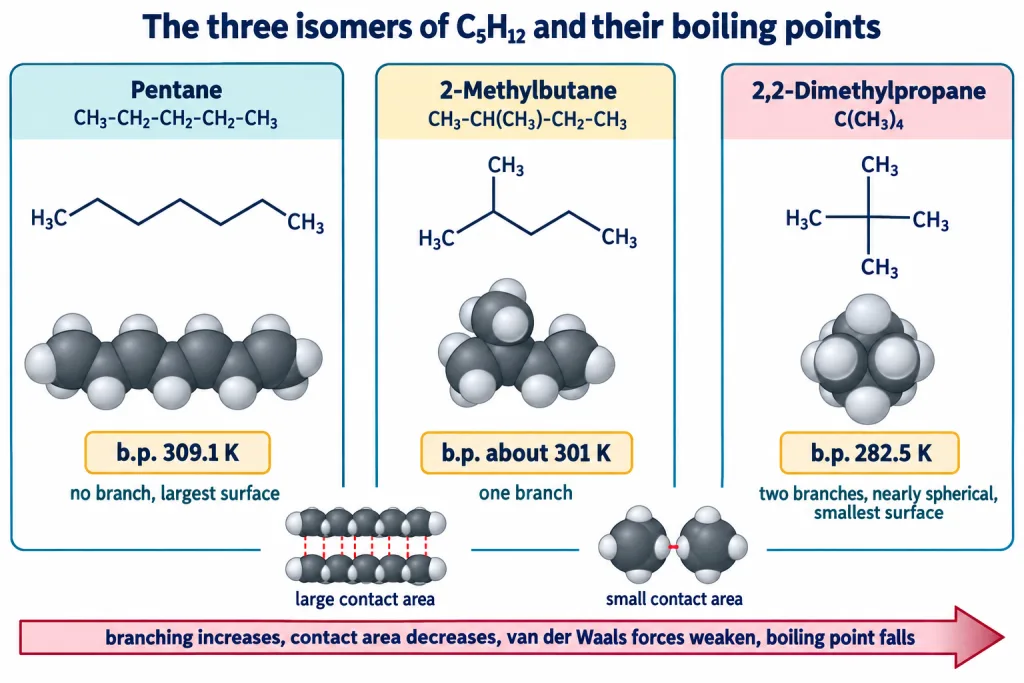
Two isomers have the same molecular formula and the same molecular mass, so molecular mass cannot separate them. Surface area can. Straighten a molecule out and it is long and thin, with a large surface. Fold the same atoms into a branched skeleton and the molecule becomes compact and more nearly spherical. A sphere is the shape with the least surface for a given volume, so a branched isomer offers the smallest area of contact to its neighbours. Less contact means weaker forces, and weaker forces are overcome at a lower temperature.
Key Point (Definition): Branching lowers the boiling point. The more branched the isomer, the more nearly spherical it is, the smaller its area of contact with a neighbouring molecule, the weaker the intermolecular forces, and the lower the boiling point.
The three isomeric pentanes
has exactly three isomers, and they are the standard illustration of the branching effect.
| Isomer | Structure | Branches | Boiling point |
|---|---|---|---|
| pentane | none, straight chain | 309.1 K | |
| 2-methylbutane | one methyl branch | about 301 K | |
| 2,2-dimethylpropane | two methyl branches, nearly spherical | 282.5 K |
The order is
Pentane, with its unbroken chain of five carbons, has the largest surface and the highest boiling point. 2,2-dimethylpropane has a central carbon carrying four methyl groups, which packs the molecule into a ball, and it boils nearly 27 K lower even though all three have the mass of .
The same reasoning ranks any set of isomers. For the order runs n-hexane, then 2-methylpentane and 3-methylpentane, then 2,2-dimethylbutane last.
[JEE Main] A ranking question gives you isomers, never different formulae. Count branches first: fewest branches boils highest, most branches boils lowest.
Melting point
Melting points also rise along the series, for the same reason — a longer chain has more surface and is held more tightly in the solid. The rise, however, is not smooth.
The even-odd alternation
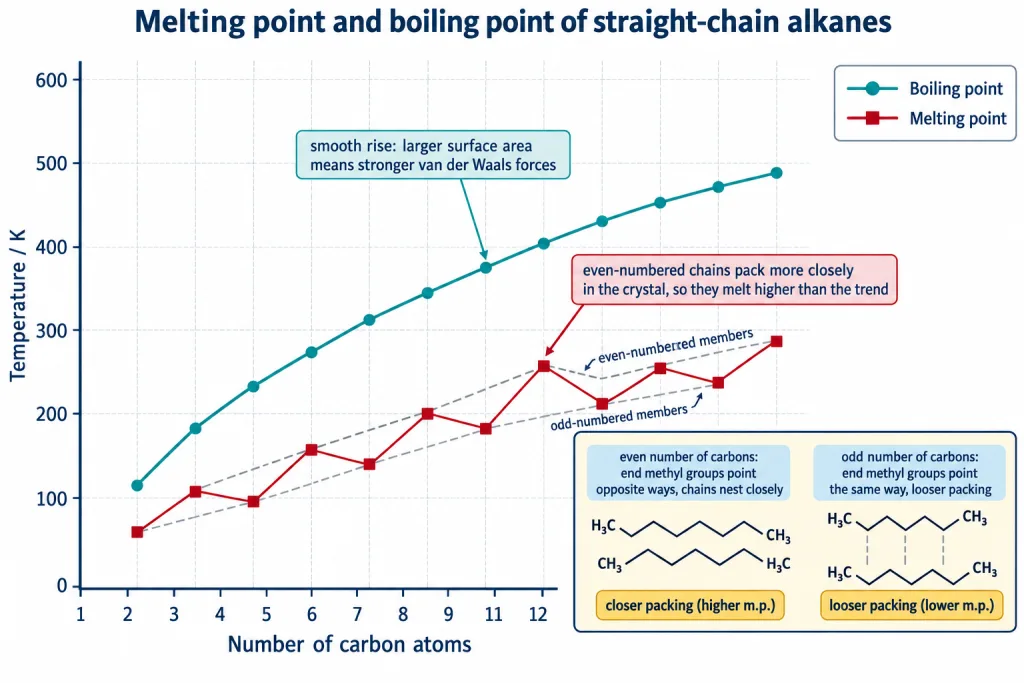
Plot melting point against the number of carbon atoms and the points fall on two interleaved lines, an upper one for the alkanes with an even number of carbons and a lower one for those with an odd number. Each even member melts higher than a line drawn through its two odd neighbours would predict.
Melting breaks up a crystal lattice, and a lattice is about packing. In the solid an alkane chain is stretched out in the zig-zag shape the tetrahedral carbons impose. With an even number of carbons the two end methyl groups point in opposite directions, and such chains stack with very little wasted space. With an odd number the two ends point the same way, the chains cannot nest as closely, the lattice is looser, and less heat is needed to break it down.
Key Point: Boiling point depends on surface area alone and rises smoothly. Melting point depends on how well the molecules pack in the solid, so it shows an alternation — even-numbered alkanes pack more efficiently, melt higher than the trend predicts, and produce a saw-tooth curve.
Branching affects the melting point too, but not in the simple downward way it affects boiling point. A highly symmetrical branched molecule can pack into a lattice better than the straight chain, and then it melts higher. 2,2-dimethylpropane melts at 256.5 K, well above pentane at 143.3 K, even though it boils lowest of the three: a near-spherical molecule fits neatly into a crystal but presents almost no surface to a neighbour in the liquid.
[JEE/NEET] Never carry the branching rule across from boiling point to melting point. Branching always lowers the boiling point, but it raises or lowers the melting point depending on symmetry.
Solubility and density
An alkane has only and bonds. Carbon and hydrogen differ very little in electronegativity, so neither bond carries an appreciable dipole and the molecule has no dipole moment. Alkanes are non-polar.
Insoluble in water
Water molecules hold on to one another through strong hydrogen bonds. For an alkane molecule to dissolve, it would have to break some of those bonds to make room for itself, and it has nothing to offer in return — no lone pair to accept a hydrogen bond, no polar hydrogen to donate one, only feeble van der Waals attraction. The energy books do not balance, so the alkane stays out. Alkanes are insoluble in water and are described as hydrophobic.
Soluble in non-polar solvents
Put the same alkane in benzene, ether, carbon tetrachloride or another alkane and it dissolves freely. The forces it must break in the solvent are van der Waals forces of the same kind and strength as the ones it can form, so mixing costs nothing.
Key Point (Definition): Like dissolves like. A polar solute dissolves in a polar solvent, a non-polar solute in a non-polar solvent, because the solute-solvent forces must be comparable in kind and strength to the forces they replace.
Grease and oil are mixtures of higher alkanes, which is why they are non-polar and hydrophobic, why water alone will not shift a grease stain, and why petrol and the lighter petroleum fractions are used for dry cleaning.
Why alkanes float on water
The density of every liquid alkane is less than , running from about 0.6 to about 0.8 against 1.0 for water. The molecules are loosely packed because the forces between them are weak, so a given mass occupies more volume. Being lighter than water and unable to mix with it, an alkane spreads out as a separate layer on top, which is why an oil spill floats on the sea.
Why alkanes are unreactive
A reagent attacks a molecule at a site that offers it something. Alkanes offer nothing.
The bonds are strong. The bond enthalpy is and the bond enthalpy . Breaking either costs a lot of energy, and no ordinary reagent supplies it at room temperature.
The bonds are non-polar. Carbon and hydrogen have almost the same electronegativity, so there is no end and no end anywhere in the molecule. An electrophile looks for high electron density and finds none; a nucleophile looks for a partial positive charge and finds none.
There is no lone pair and no pi bond. Every valence electron is locked into a sigma bond between two nuclei, so there is no loosely held pi cloud of the kind that makes alkenes and alkynes easy to attack.
Carbon is already saturated. Each carbon has four sigma bonds, so nothing can add on without something else leaving first.
Key Point: Alkanes are inert towards acids, bases, oxidising agents and reducing agents because their and bonds are strong and non-polar, and the molecule carries no lone pair, no pi bond and no partial charges. Neither a nucleophile nor an electrophile has a site to attack.
If ionic reagents cannot start a reaction, the only species that can is one that does not need a charge to work — a free radical. So the characteristic reaction of an alkane is free-radical substitution, and halogenation is its main example; the halogen reactivity order, the chain mechanism and the mixture of products are worked through in full in the next section. Everything else an alkane does has to be forced on it by high temperature, high pressure or a catalyst, and the reactions below are that list.
1. Combustion
Heated in air or dioxygen, an alkane burns completely to carbon dioxide and water, releasing a very large amount of heat.
The general equation for any alkane:
Check the oxygen count on both sides before you write it down. The left side has oxygen atoms. The right side has in the carbon dioxide and in the water, and . The equation balances for every value of .
For methane gives moles of dioxygen, and for butane gives . Multiply through by 2 if you dislike the fraction: .
Why the heat matters
Natural gas, LPG, petrol, diesel and kerosene are all alkanes burned for the heat. The enthalpy of combustion is large and negative because strong and bonds form in the products while weaker , and bonds break in the reactants.
Incomplete combustion
With an insufficient supply of air the oxidation stops short of carbon dioxide. Carbon monoxide is formed, and with a still poorer supply, free carbon appears as soot or carbon black.
Carbon black is collected on purpose and used in printing ink, in writing ink, as a black pigment and in filters. The carbon monoxide is the danger: it is colourless, odourless and binds to haemoglobin far more strongly than dioxygen does.
[NEET] Complete combustion gives and . Limited air gives . Very poor air gives carbon black. The question usually names the air supply, and the air supply picks the product.
2. Controlled oxidation
Burn an alkane and everything ends up as carbon dioxide. Feed the dioxygen in a regulated way, at the right pressure, with the right catalyst, and the oxidation stops at a useful intermediate. Each of the following is a separate industrial process, and the catalyst is what the examiner asks for.
(i) Methane to methanol — copper tube, 523 K, 100 atm.
Count the atoms: 2 carbon, 8 hydrogen and 2 oxygen on each side.
(ii) Methane to methanal — molybdenum(III) oxide catalyst, heated.
One carbon, four hydrogen and two oxygen on each side. Methanal is one oxidation step beyond methanol, so it takes a whole molecule of dioxygen and throws out a molecule of water.
(iii) Ethane to ethanoic acid — manganese acetate, heated.
Left side: 4 carbon, 12 hydrogen, 6 oxygen. Right side: 4 carbon in the two acid molecules, 8 hydrogen there plus 4 in the two waters gives 12, and 4 oxygen there plus 2 in the waters gives 6. Balanced.
(iv) A tertiary hydrogen with potassium permanganate. Alkanes ordinarily resist permanganate completely. The one exception is an alkane with a tertiary hydrogen, that is a hydrogen on a carbon joined to three other carbons. That single hydrogen is oxidised to , giving a tertiary alcohol.
2-Methylpropane gives 2-methylpropan-2-ol. The primary hydrogens in the same molecule are untouched, because the tertiary bond is the weakest and the tertiary radical left behind is the most stable.
Key Point: Match the catalyst to the product. Copper at 523 K and 100 atm gives methanol. gives methanal. Manganese acetate on ethane gives ethanoic acid. works only where there is a tertiary hydrogen, and gives a tertiary alcohol.
[JEE Main] The commonest slip is swapping the first two. Copper, high pressure, methanol; molybdenum oxide, methanal. Fixing the pressure 100 atm to the alcohol is the easiest way to keep them apart.
3. Pyrolysis, also called cracking
Key Point (Definition): Pyrolysis (or cracking) is the decomposition of a higher alkane into smaller fragments — lower alkanes, alkenes and dihydrogen — by the application of heat alone. It is believed to proceed by a free-radical mechanism.
Heated to 773 K, a long chain falls apart. The bonds are the weakest links in the molecule, and at that temperature the thermal energy is enough to break them homolytically. The radicals produced then recombine and disproportionate, so the result is a mixture.
Hexane cracked at 773 K gives a mixture, and each way of splitting it balances on its own. splitting into and accounts for 6 carbon and hydrogen:
Splitting into and accounts for 6 carbon and hydrogen. Losing dihydrogen alone gives .
The industrial example from the textbook is dodecane, a constituent of kerosene, cracked over platinum, palladium or nickel at 973 K:
Carbon: . Hydrogen: . Balanced.
Why the process matters
Crude oil yields far more heavy fraction than anyone wants and far less petrol than the market needs, and cracking converts one into the other. It also generates the small alkenes — ethene, propene and the butenes — which are the feedstock of the whole plastics and petrochemical industry. Preparation of oil gas or petrol gas from kerosene works on this principle.
[Board] Quote the temperature. 773 K for pyrolysis in general, and 973 K over for the dodecane example. A cracking answer without a temperature is an incomplete answer.
4. Isomerisation
A straight-chain alkane heated with anhydrous aluminium chloride and hydrogen chloride gas rearranges into its branched isomers.
n-Hexane gives 2-methylpentane and 3-methylpentane as the major products. All three are , so nothing is gained or lost; only the skeleton changes. The industrial point is octane number: a branched alkane burns more smoothly in an engine than its straight-chain isomer, so isomerisation upgrades poor-quality petrol without changing the molecular formula at all.
5. Aromatisation, also called reforming or hydroforming
Key Point (Definition): Aromatisation is the dehydrogenation and cyclisation of an n-alkane having six or more carbon atoms in a chain into benzene or one of its homologues, over an oxide of chromium, vanadium or molybdenum supported on alumina, at 773 K and 10-20 atm.
Carbon: 6 on each side. Hydrogen: 14 on the left, and on the right. Balanced.
The molecule first curls round so that carbon 1 reaches carbon 6, closing a six-membered ring, then loses four molecules of dihydrogen to build the aromatic sextet. The six-carbon requirement follows from that: five carbons cannot close a six-membered ring, so pentane and everything below it gives no benzene.
A seven-carbon chain gives the methyl derivative. n-Heptane on reforming gives toluene:
Six of the seven carbons make the ring and the seventh stays outside as the methyl group.
6. Reaction with steam
Methane and steam passed over a nickel catalyst at 1273 K give carbon monoxide and dihydrogen.
Carbon: 1 each side. Hydrogen: on the left, on the right. Oxygen: 1 each side. Balanced.
This is the industrial preparation of dihydrogen. The mixture of carbon monoxide and dihydrogen is called synthesis gas, and it feeds the manufacture of ammonia and of methanol. The severity of the conditions — a red heat of 1273 K plus a metal catalyst — measures how hard methane is to attack.
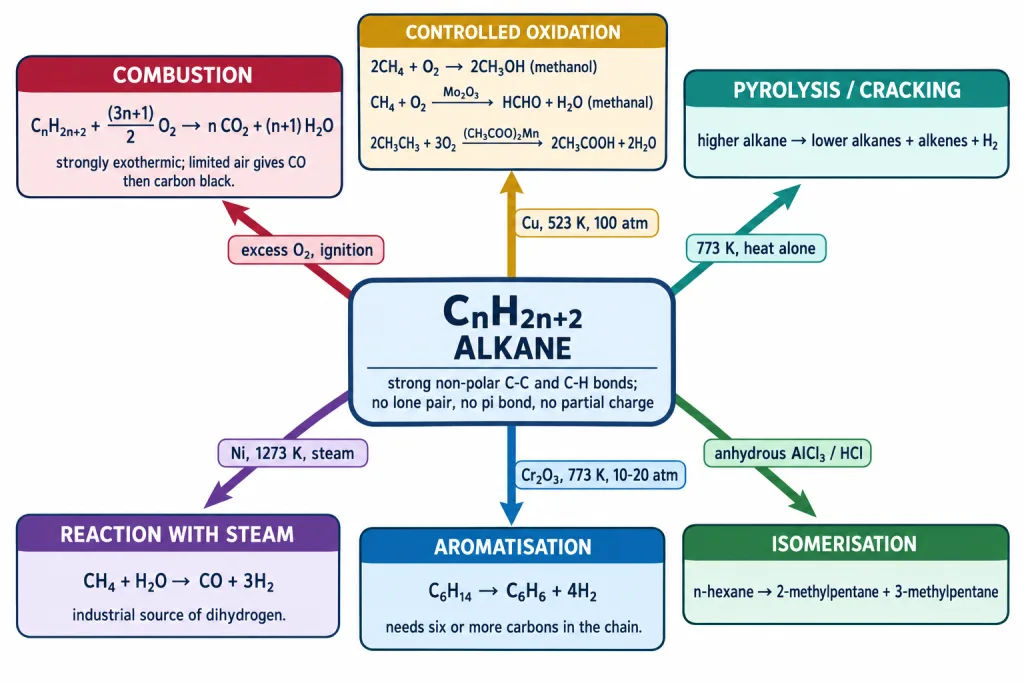
[JEE/NEET] Three temperatures sit close together in this section and get swapped constantly. 523 K with copper at 100 atm gives methanol. 773 K gives cracking, and 773 K with at 10-20 atm gives benzene. 1273 K with nickel and steam gives dihydrogen.
Summary table of alkane reactions
| Reaction | Reagent / catalyst | Conditions | Product |
|---|---|---|---|
| Complete combustion | excess or air | ignition | , strongly exothermic |
| Incomplete combustion | limited | ignition | , then carbon black |
| Controlled oxidation | 523 K, 100 atm | (methanol) | |
| Controlled oxidation | heat | (methanal) | |
| Controlled oxidation | heat | ||
| Oxidation of a tertiary H | — | tertiary alcohol | |
| Pyrolysis / cracking | none needed (heat alone) | 773 K | lower alkanes, alkenes, |
| Isomerisation | anhydrous and | heat | branched-chain isomers |
| Aromatisation | (or , ) on alumina | 773 K, 10-20 atm | benzene from n-hexane; six or more carbons needed |
| Reaction with steam | 1273 K | ||
| Halogenation | sunlight, ultraviolet light or 573-773 K | haloalkanes; covered in full in the next section |
Read the table by its middle two columns. In every row it is the reagent and the conditions, not the alkane, that decide the product.
The physical properties in one place
| Property | Trend | Reason |
|---|---|---|
| Physical state | - gas, - liquid, and above solid | van der Waals forces build with size |
| Boiling point | rises with chain length | larger surface area, stronger van der Waals forces |
| Boiling point | falls with branching | more spherical, smaller contact area, weaker forces |
| Melting point | rises overall, alternates | even-numbered members pack better in the lattice |
| Solubility | insoluble in water, freely soluble in benzene and ether | like dissolves like |
| Density | 0.6 to 0.8 , so they float on water | loose packing from weak intermolecular forces |
Question 1: Ranking the three pentanes
Arrange pentane, 2-methylbutane and 2,2-dimethylpropane in decreasing order of boiling point and justify the order.
Answer:
All three are , so molecular mass cannot separate them. I count branches instead.
Pentane has none, a straight chain of five carbons. 2-methylbutane has one methyl branch. 2,2-dimethylpropane has two methyl branches on the same carbon, which makes it almost a sphere.
More branching means a more compact molecule, a smaller area of contact with the next molecule, weaker van der Waals forces and a lower boiling point.
Ans: pentane (309.1 K) > 2-methylbutane (about 301 K) > 2,2-dimethylpropane (282.5 K).
Watch out: Do not let the melting points confuse you. 2,2-dimethylpropane melts highest of the three because its symmetry lets it pack well in a crystal, and it still boils lowest.
Question 2: Ranking hexane isomers
Arrange n-hexane, 2-methylpentane and 2,2-dimethylbutane in increasing order of boiling point.
Answer:
Again all three are , so I count branches. 2,2-dimethylbutane has two, 2-methylpentane has one, n-hexane has none.
Most branched boils lowest, so increasing boiling point runs from the most branched to the least branched.
Ans: 2,2-dimethylbutane < 2-methylpentane < n-hexane.
Question 3: The saw-tooth melting curve
Why do the melting points of the alkanes not rise smoothly with the number of carbon atoms?
Answer:
Melting breaks up a crystal lattice, so what matters is how tightly the molecules pack in the solid, not just how big they are.
An alkane chain in the solid is a zig-zag. When the number of carbons is even, the two terminal methyl groups point in opposite directions and the chains nest very closely. When the number is odd, both ends point the same way and the chains cannot nest as well, so the lattice is looser.
Ans: even-numbered alkanes pack more efficiently in the crystal and melt higher than the trend predicts, giving an alternating saw-tooth curve.
Watch out: Branching always lowers the boiling point, but it does not always lower the melting point. 2,2-Dimethylpropane melts higher than pentane because its symmetry lets it pack well.
Question 4: Grease, water and petrol
Water will not remove a grease stain but petrol will. Account for both observations.
Answer:
Grease is a mixture of higher alkanes, so it is non-polar and hydrophobic.
Water is strongly hydrogen-bonded. For a grease molecule to dissolve it would have to break those hydrogen bonds and give nothing comparable back, since it has no lone pair and no polar hydrogen.
Petrol is itself a mixture of alkanes, so it is non-polar. The forces the grease must break in petrol are van der Waals forces of the same kind and strength as the ones it can form, so mixing costs nothing.
Ans: like dissolves like — non-polar grease is insoluble in polar water but freely soluble in non-polar petrol.
Question 5: The combustion equation for octane
Write the balanced equation for the complete combustion of octane, , and find the moles of dioxygen needed per mole of octane.
Answer:
I put into . Dioxygen needed is moles, with 8 carbon dioxide and 9 water.
Checking oxygen: 25 atoms on the left, and on the right.
Ans: ; 12.5 moles of per mole of octane.
Watch out: , not . Test your memory of the formula on methane, where the answer must come out as 2.
Question 6: Products of incomplete combustion
What is formed when methane burns in a poor supply of air, and what is one of those products used for?
Answer:
With limited dioxygen the oxidation stops before carbon dioxide, and carbon monoxide forms first. With a still poorer supply, free carbon appears as soot or carbon black:
Carbon black is collected and used in printing and writing inks, as a black pigment and in filters.
Ans: carbon monoxide and then carbon black, along with water; carbon black is used in inks, black pigments and filters.
Question 7: Naming the product and the conditions
Give the product, the catalyst and the conditions for the controlled oxidation of methane to methanol and of methane to methanal.
Answer:
Two different catalysts give two different products from the same reactants. Copper at 523 K and 100 atm stops the oxidation at the alcohol:
Molybdenum(III) oxide with heat takes it one step further, to the aldehyde, and expels water:
Ans: at 523 K and 100 atm gives methanol; on heating gives methanal.
Watch out: The 100 atm belongs to the methanol route. Attaching high pressure to the alcohol is the quickest way to stop swapping the two.
Question 8: Ethane to an acid
Name the reagent and product when ethane undergoes controlled oxidation, and check that the equation balances.
Answer:
The catalyst is manganese acetate, , and the product is ethanoic acid.
Carbon is 4 each side. Hydrogen is 12 on the left, and on the right 8 in the acids plus 4 in the waters. Oxygen is 6 on the left, and on the right 4 in the acids plus 2 in the waters.
Ans: manganese acetate on heating; the product is ethanoic acid, .
Question 9: The only alkane permanganate will touch
Which of butane, 2-methylpropane and 2,2-dimethylpropane is oxidised by potassium permanganate, and what is the product?
Answer:
Permanganate attacks an alkane only where there is a tertiary hydrogen, that is a hydrogen on a carbon bonded to three other carbons.
Butane, , has only primary and secondary hydrogens. 2,2-dimethylpropane, , has a quaternary central carbon with no hydrogen on it at all. 2-methylpropane, , has exactly one tertiary hydrogen, and that one is replaced by .
Ans: 2-methylpropane, giving 2-methylpropan-2-ol, a tertiary alcohol.
Question 10: Cracking dodecane
Write an equation for the cracking of dodecane and say why the process is industrially important.
Answer:
Over platinum, palladium or nickel at 973 K, dodecane gives heptane and pentene among other products.
Carbon: . Hydrogen: .
Crude oil gives too much heavy fraction and too little petrol, and cracking converts one into the other. It is also the main source of the small alkenes the plastics industry needs.
Ans: ; it upgrades heavy fractions to petrol and supplies alkene feedstock.
Watch out: Pyrolysis in general is quoted at 773 K. The 973 K figure belongs to this particular dodecane example over .
Question 11: Isomerising n-hexane
Name the reagent and the major products when n-hexane is isomerised.
Answer:
The reagent is anhydrous aluminium chloride together with hydrogen chloride gas. The skeleton rearranges but the formula does not change, so both products are still , each carrying a single methyl branch, at position 2 and at position 3.
Ans: anhydrous with ; the major products are 2-methylpentane and 3-methylpentane.
Question 12: Which alkane gives toluene
Toluene, , is the methyl derivative of benzene. Which alkane would you use to prepare it by aromatisation, and under what conditions?
Answer:
Aromatisation closes a six-membered ring and then strips off dihydrogen, so the starting alkane must supply six carbons for the ring. Toluene needs a seventh carbon left outside as the methyl group, so I need n-heptane.
Carbon: 7 each side. Hydrogen: 16 on the left, and on the right.
Ans: n-heptane, over supported on alumina at 773 K and 10-20 atm.
Watch out: n-Pentane cannot be aromatised at all. Five carbons cannot close a six-membered ring, which is why the rule says six or more.
Question 13: The industrial route to dihydrogen
Write the equation, with conditions, for the reaction of methane with steam, and say why it is important.
Answer:
Methane and steam are passed over nickel at 1273 K.
Hydrogen: on the left, on the right. Carbon and oxygen are 1 each on both sides. It is the industrial preparation of dihydrogen, and the mixture it produces feeds the manufacture of ammonia and methanol.
Ans: over at 1273 K; it is the main industrial source of dihydrogen.
Question 14: Matching conditions to products
Give the product in each case: (a) n-hexane at 773 K with at 10-20 atm, (b) n-hexane with anhydrous and , (c) hexane heated alone to 773 K.
Answer:
The three differ only in what is present besides the heat. With a chromium oxide catalyst at 10-20 atm the chain cyclises and loses dihydrogen, giving benzene. With anhydrous and the skeleton rearranges, giving 2-methylpentane and 3-methylpentane. Heat alone breaks bonds, giving a mixture of lower alkanes, alkenes and dihydrogen.
Ans: (a) benzene, (b) 2-methylpentane and 3-methylpentane, (c) cracked mixture of smaller alkanes and alkenes.
Watch out: 773 K appears in both (a) and (c). The catalyst and the pressure, not the temperature, decide which reaction you get.