
A hydrocarbon is a compound of carbon and hydrogen only. No oxygen, no nitrogen, no halogen, no sulphur — two elements and nothing more. That single restriction earns the family a chapter of its own. With only two elements available, every difference in melting point, in reactivity, in what a compound is good for has to come from how the carbon atoms are joined together.
Key Point (Definition): A hydrocarbon is an organic compound made up of carbon and hydrogen atoms only.
Where you already meet them
Almost every fuel burned in the country is a hydrocarbon mixture, and the abbreviations on the cylinder and the fuel pump are worth pinning down.
- LPG, liquefied petroleum gas, is chiefly propane and butane, compressed until it liquefies inside the cylinder. It is the domestic cooking fuel and the least polluting of the common ones.
- CNG, compressed natural gas, is chiefly methane, stored as a gas at high pressure. Vehicles running on it pollute less than diesel vehicles.
- LNG, liquefied natural gas, is the same methane-rich gas liquefied by cooling rather than compressed, so a tanker can carry it across an ocean.
- Petrol, diesel and kerosene are cuts taken from crude oil by fractional distillation, and coal gas comes from the destructive distillation of coal.
Confusing LPG with CNG is the commonest slip in this part of the chapter: LPG is propane and butane, CNG is methane.
Beyond fuel
Burning is the least interesting thing a hydrocarbon does. The petrochemical industry takes the same molecules and builds almost everything else out of them. Ethene is polymerised to polythene, propene to polypropene, styrene to polystyrene. Higher hydrocarbons are the solvents in paints and adhesives, and benzene and toluene are the starting points for dyes, drugs, detergents and pesticides. Grease is itself a mixture of higher alkanes, which is why a petrol-range fraction lifts a grease stain out of cloth.
Almost every synthesis in Class 12 organic chemistry begins with a hydrocarbon: an alkyl halide from an alkane or an alkene, an alcohol from an alkene, a carbonyl compound from an alkyne, an aromatic amine from benzene by way of nitrobenzene.
Where they come from
Two sources supply nearly all of them, and both are fossil in origin — the buried remains of once-living material, altered by heat, pressure and millions of years without oxygen.
- Petroleum ("rock oil") formed from marine plankton and other organisms buried in sea-floor mud. Heated under later sediment, the organic matter became a liquid mixture of hundreds of hydrocarbons, which migrated upwards through porous rock until an impermeable cap trapped it.
- Natural gas collects in the upper strata of the same reservoir and is struck first when an oil well is drilled. Compressing it gives CNG.
- Coal formed from land plants buried in swamps. Destructive distillation — heating coal out of contact with air — drives off coal gas and coal tar, and coal tar is the classical source of benzene, toluene and naphthalene.
Both stocks are finite, which is why every refinery process in this chapter is designed around squeezing more useful product out of the same barrel.
Hydrocarbons are sorted on two independent features of the carbon skeleton.
- Whether the skeleton is an open chain or closes into a ring.
- Whether every carbon-carbon bond is single, or a double or triple bond is present.
The first splits them into open chain (acyclic, also called aliphatic) and cyclic; the second into saturated and unsaturated.
Key Point (Definition): A saturated hydrocarbon contains carbon-carbon and carbon-hydrogen single bonds only, and so holds the largest number of hydrogen atoms its carbon skeleton can hold. An unsaturated hydrocarbon contains at least one carbon-carbon double or triple bond, and therefore carries fewer hydrogens than its skeleton could.
A third category has to be pulled out separately. Aromatic hydrocarbons are cyclic and by the hydrogen count look badly unsaturated, yet refuse to behave like alkenes: benzene will not decolourise bromine water, while hex-1-ene does so at once. That contradiction earns them their own branch of the tree and the last third of this chapter.
The tree
Hydrocarbons
- Open chain (aliphatic)
- Saturated — alkanes, general formula . Example: propane, .
- Unsaturated
- Alkenes, general formula for one double bond. Example: ethene, .
- Alkynes, general formula for one triple bond. Example: ethyne, .
- Cyclic
- Alicyclic (rings that behave like open-chain compounds)
- Cycloalkanes, general formula . Example: cyclohexane, .
- Cycloalkenes, general formula for one ring and one double bond. Example: cyclohexene, .
- Aromatic (arenes). Example: benzene, ; toluene, .
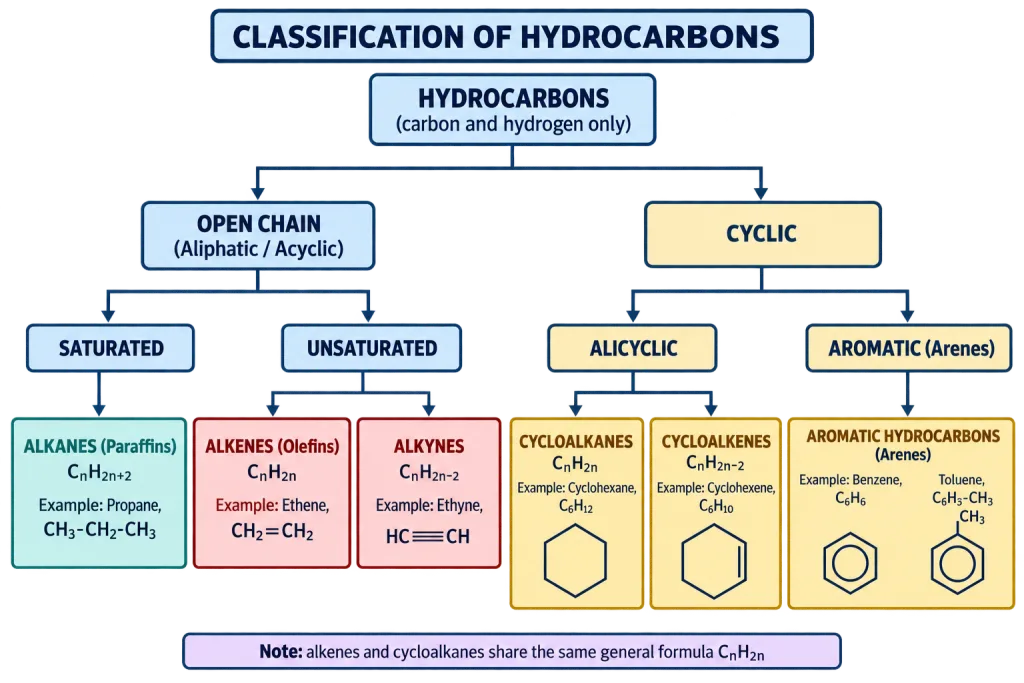
The word alicyclic is a contraction of aliphatic and cyclic: a ring whose chemistry is that of an open chain, closed up. Cyclohexane burns and undergoes free-radical substitution just as hexane does, and cyclohexene decolourises bromine water just as hex-1-ene does. Only benzene breaks the pattern, and only because of delocalisation.
[JEE/NEET] A question that asks you to "classify" a compound is asking for two labels, not one: open chain or cyclic, and saturated or unsaturated — with aromatic as its own answer where the ring is benzenoid.
Alkanes
Alkanes are open-chain hydrocarbons with carbon-carbon single bonds only. Methane, , is the first member; it occurs in coal mines and marshy ground, hence the old name marsh gas. Every carbon is hybridised and tetrahedral, all angles are , and the C-C bond length is pm.
Replacing one hydrogen of methane by a group gives ethane, ; repeating gives propane, butane, pentane. Each member differs from the one before by a unit, a mass difference of u — a homologous series, sharing one general formula with a graded change in properties.
Alkanes are unreactive towards acids, bases and most reagents under ordinary conditions, which is why they were once called paraffins, from the Latin parum (little) and affinis (affinity).
Alkenes
An alkene contains at least one carbon-carbon double bond. A double bond costs the molecule two hydrogen atoms relative to the alkane with the same number of carbons, so with one double bond present:
Ethene, , is the first member; an alkene needs at least two carbons. The doubly bonded carbons are hybridised and trigonal planar, and the C=C bond is pm long, made of one sigma and one pi component.
Alkenes are also called olefins, meaning oil forming, because the lower members react with chlorine to give oily liquid products.
Alkynes
An alkyne contains at least one carbon-carbon triple bond. A triple bond costs four hydrogens relative to the alkane, so with one triple bond present:
Ethyne, , better known as acetylene, is the first member. Its carbons are hybridised and the molecule is linear, the bond angle and the triple bond pm long, made of one sigma and two pi bonds.
The three series side by side
| Alkane, | Alkene, | Alkyne, | |
|---|---|---|---|
| 1 | methane, | none possible | none possible |
| 2 | ethane, | ethene, | ethyne, |
| 3 | propane, | propene, | propyne, |
| 4 | butane, | but-1-ene, | but-1-yne, |
| 5 | pentane, | pent-1-ene, | pent-1-yne, |
| 6 | hexane, | hex-1-ene, | hex-1-yne, |
Reading across a row: the alkene has two hydrogens fewer than the alkane, the alkyne four fewer. That arithmetic is the whole basis of the unsaturation count set out below. One double bond removes two hydrogens; one ring also removes two, because closing a chain uses up one hydrogen at each end; one triple bond removes four, being worth two of the others.
[Board] The general formulae carry a mark on their own and are worth writing down before anything else in a classification question.
Alicyclic hydrocarbons
Join the two ends of a carbon chain and a ring results. Cycloalkanes are saturated rings; the smallest is cyclopropane, since three carbons are the fewest that can close. Closing the chain removes two hydrogens, so:
cyclopropane , cyclobutane , cyclopentane , cyclohexane .
Putting a double bond into the ring as well removes two more hydrogens:
cyclopentene , cyclohexene .
Aromatic hydrocarbons (arenes)
Arenes contain a benzene ring or a set of fused benzene rings: benzene , toluene , the three xylenes , naphthalene , anthracene . Single-ring benzene homologues fit with , but the fused-ring arenes do not, so the arenes as a whole have no one general formula.
The chemical point, developed in full later, is that benzene has four degrees of unsaturation and still does not decolourise bromine water or Baeyer's reagent. Its six pi electrons are delocalised over all six carbons rather than locked into three separate double bonds, all six carbon-carbon bonds are equal at pm, and the arrangement is worth about kJ/mol of extra stability. Benzene substitutes where an alkene would add.
One formula, two families — the trap
Look at the two general formulae just written:
- alkenes:
- cycloalkanes:
They are identical. The same clash repeats one step further down: alkynes, cycloalkenes and open-chain dienes all share .
Key Point: A molecular formula fixes only how many atoms of each element are present. It cannot say whether the missing hydrogens were lost to a ring or to a pi bond, so a molecular formula alone can never fix a structure.
is the standard example. It fits hex-1-ene, hex-2-ene and 2-methylpent-2-ene — and equally well cyclohexane, methylcyclopentane and the dimethylcyclobutanes. Every one of these is an isomer of every other. behaves the same way: but-1-yne and but-2-yne (one triple bond), buta-1,3-diene (two double bonds), cyclobutene (a ring plus a double bond) and even bicyclobutane (two rings) all share it.
Separating the possibilities takes a chemical test, not arithmetic. Bromine in carbon tetrachloride is decolourised by hex-1-ene and untouched by cyclohexane, and Baeyer's reagent loses its pink colour with hex-1-ene only. Benzene is the exception that responds to neither in spite of its pi electrons.
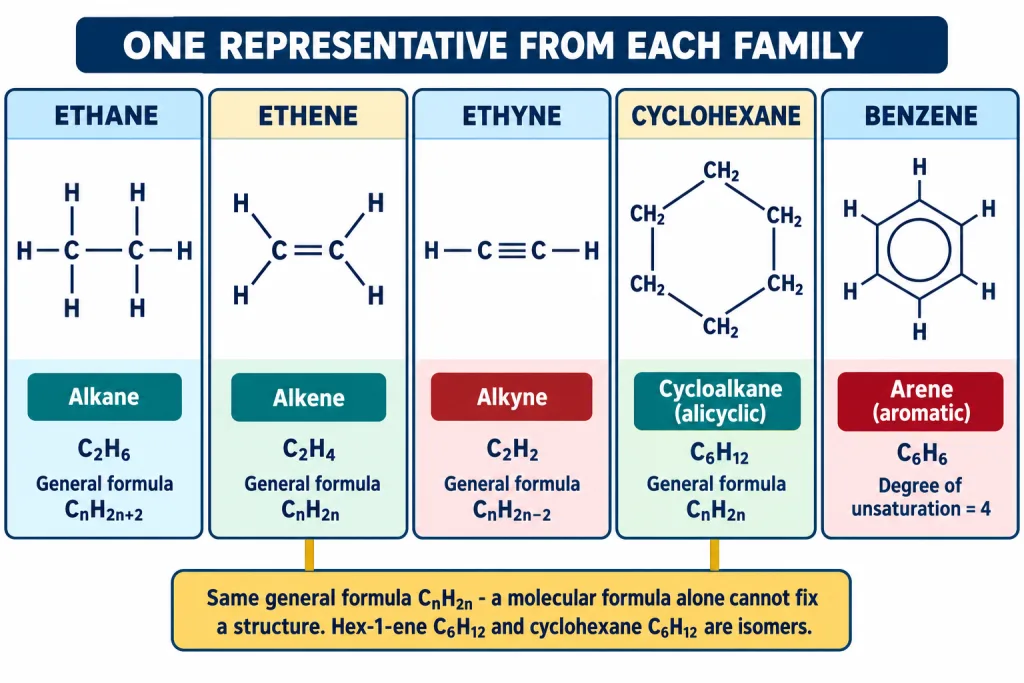
The hydrogen shortfall can be turned into a number, and it is the first thing to calculate when a molecular formula appears in a question.
Key Point (Definition): The degree of unsaturation (also called the index of hydrogen deficiency, or the double bond equivalent) is the number of pairs of hydrogen atoms a compound is short of the saturated open-chain compound with the same carbon skeleton. Each unit corresponds to one ring or one pi bond.
For a compound containing carbon, hydrogen, nitrogen and halogen:
- , , and count the carbon, hydrogen, nitrogen and halogen atoms.
- A halogen is monovalent and stands where a hydrogen would have stood, so it is counted as a hydrogen and subtracted.
- Nitrogen is trivalent and lets the molecule carry one extra hydrogen, so it adds one to the numerator.
- Oxygen and sulphur are divalent and slip into a chain without altering the hydrogen count, so they are ignored.
For a pure hydrocarbon the formula shortens to
What one unit can be
| Structural feature | Units it is worth |
|---|---|
| one carbon-carbon double bond | 1 |
| one carbon-carbon triple bond | 2 |
| one ring of any size | 1 |
| one benzene ring | 4, being three pi bonds plus the ring |
| one carbonyl group | 1 |
Worked counts
Benzene, .
Four units, which in benzene are one ring plus three pi bonds. They need not be arranged that way: hexa-1,5-diyne, , has the same formula and spends all four on two triple bonds with no ring.
.
One unit — one ring or one double bond, and the number cannot say which. Cyclohexane spends it on a ring, hex-1-ene on a double bond.
.
Two units, spendable as one triple bond (but-1-yne), two double bonds (buta-1,3-diene), one ring and one double bond (cyclobutene), or two rings (bicyclobutane).
Toluene, .
Four again. The methyl group adds one carbon and two hydrogens and so changes nothing — every alkyl side chain is invisible to this count. Any compound carries four units, and a single benzene ring is the usual reason.
Naphthalene, . , which is two fused rings plus five pi bonds.
Two cautions
A negative or fractional result means the formula is impossible. gives , and five carbons cannot hold more than twelve hydrogens.
The count says how many units there are, never what kind. Separating a ring from a pi bond is a laboratory job — bromine water, Baeyer's reagent, hydrogenation — never an arithmetic one.
Question 1: Sorting six hydrocarbons into families
Classify each of the following and give the general formula of the family it belongs to: propane, hex-1-ene, but-2-yne, cyclopentane, cyclohexene, toluene.
Answer:
I ask two things about each one — chain or ring, and single bonds only or not.
Propane, , is an open chain with single bonds only: an alkane, .
Hex-1-ene is an open chain with one double bond: an alkene, .
But-2-yne is an open chain with one triple bond: an alkyne, . The triple bond sitting in the middle rather than at the end does not change the family.
Cyclopentane is a ring with single bonds only: a cycloalkane, .
Cyclohexene is a ring carrying one double bond and no aromatic sextet: a cycloalkene, .
Toluene is a benzene ring with a methyl group: an arene, and its benzene homologue formula is .
Ans: alkane; alkene; alkyne; cycloalkane; cycloalkene; arene. Watch out: Cyclohexene is not aromatic. A ring plus a double bond is not enough — aromatic means a benzene ring with its delocalised sextet.
Question 2: One formula, two families
Write one open-chain and one cyclic hydrocarbon with the molecular formula , and explain why the formula cannot decide between them.
Answer:
The count first: , so exactly one ring or one pi bond.
Spending it on a double bond gives hex-1-ene, .
Spending it on a ring gives cyclohexane, a six-membered ring of groups.
Both have six carbons and twelve hydrogens, and the molecular formula records nothing beyond the atom count. Closing a ring and adding a double bond each remove exactly two hydrogens, so the count cannot separate them.
Ans: hex-1-ene (open chain) and cyclohexane (ring); the formula records atom counts, not connectivity. Watch out: These two are isomers of each other, not the same compound written twice.
Question 3: Four structures for one formula
Give the degree of unsaturation of and four structurally different hydrocarbons that fit it.
Answer:
Two units, and there are four ways to spend them: one triple bond, worth two units, giving but-1-yne, ; two double bonds, giving buta-1,3-diene, ; one ring plus one double bond, giving cyclobutene; or two rings, giving bicyclobutane.
Ans: 2 units; but-1-yne, buta-1,3-diene, cyclobutene and bicyclobutane are four possibilities.
Question 4: A halogen in the formula
Find the degree of unsaturation of bromobenzene, .
Answer:
Bromine is monovalent, so it stands where a hydrogen would have stood and is subtracted along with the hydrogens.
Four units, which fits a benzene ring, and the answer is the same as for benzene itself.
Ans: 4. Watch out: Ignoring the bromine gives . A half-integer answer always means a monovalent atom has been left out of the subtraction.
Question 5: A cracking equation
Hexadecane, , is cracked to give octane and one other product with eight carbons. Write the equation and name the second product.
Answer:
Carbon must balance, so the second fragment has carbons; hydrogen must balance too, so it has hydrogens, giving .
has , so it carries one double bond. Written as a straight chain with the double bond at the end it is oct-1-ene.
Ans: ; the second product is an octene, for example oct-1-ene. Watch out: Both products cannot be alkanes. Two saturated eight-carbon chains would need hydrogens and only 34 are available.
Crude oil as it comes out of the ground is a dark, viscous mixture of hundreds of hydrocarbons — mostly alkanes, cycloalkanes and aromatics — carrying water, salt, sand and small amounts of sulphur, nitrogen and oxygen compounds. Refining turns it into products of defined boiling range.
Fractional distillation
After the water and salt are removed, the crude is heated in a furnace to roughly K and the hot vapour is fed into the bottom of a tall fractionating column, hottest at the bottom and coolest at the top and carrying dozens of trays across its width. Vapour rising through the trays cools, and at each level the components whose boiling range matches that temperature condense and are drawn off as a side stream.
The physical basis is a longer molecule having more surface, so more van der Waals contact and a higher boiling point. Big molecules condense low down; small ones travel to the top. The separation is by boiling point and nothing else, so each cut is still a mixture, just one with a narrow range.
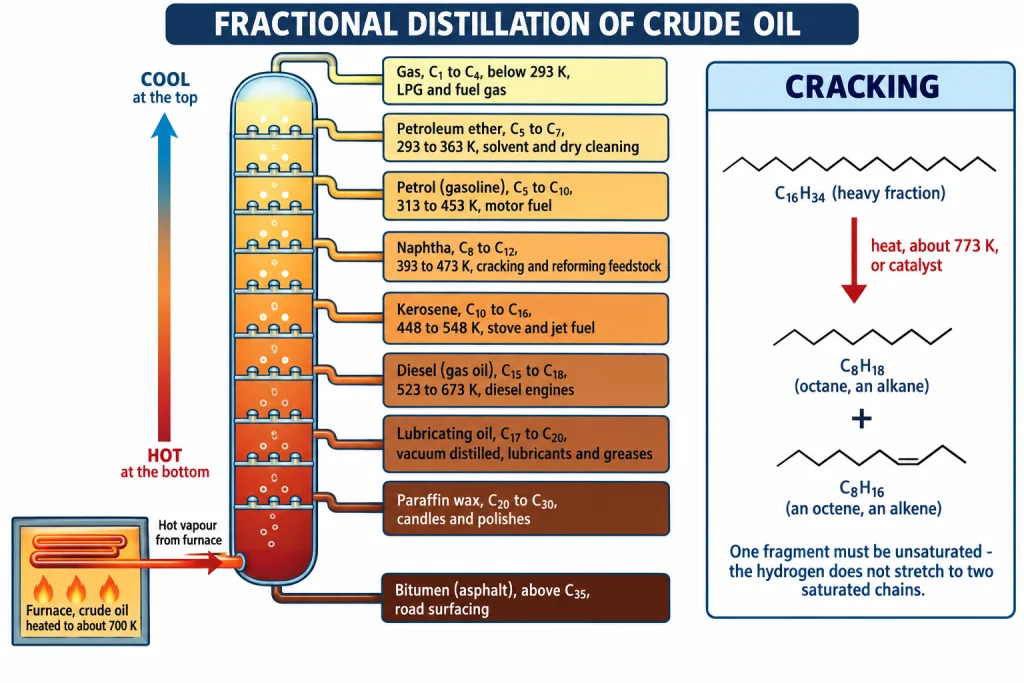
| Fraction | Approximate carbon range | Approximate boiling range | Main use |
|---|---|---|---|
| Uncondensed gas | to | below K | LPG, refinery fuel, petrochemical feedstock |
| Petroleum ether | to | to K | laboratory solvent, dry cleaning |
| Petrol (gasoline) | to | to K | motor fuel |
| Naphtha | to | to K | feedstock for cracking and reforming, solvent |
| Kerosene | to | to K | stove fuel, jet fuel |
| Diesel (gas oil) | to | to K | diesel engines, furnace oil |
| Lubricating oil | to | distilled under vacuum | lubricants, greases |
| Paraffin wax | to | vacuum residue | candles, waxed paper, ointments, polishes |
| Bitumen (asphalt) | above | non-volatile residue | road surfacing, waterproofing, roofing |
The ranges overlap because a refinery chooses where to make each cut. The heavy residue is redistilled under reduced pressure, since at atmospheric pressure it would decompose before boiling; that vacuum distillation yields the lubricating oils and the wax and leaves bitumen behind.
Cracking
Fractional distillation only sorts. A typical barrel yields far more heavy gas oil and residue than petrol, while demand runs the other way, and cracking closes the gap by breaking long chains into short ones.
Key Point (Definition): Cracking is the breaking of a large hydrocarbon molecule into smaller ones, converting surplus heavy fractions into the light, high-value fractions that are in demand.
A hydrogen count fixes what cracking must produce. A sixteen-carbon alkane holds 34 hydrogens, while two saturated eight-carbon chains would need 36. The hydrogen is not there, so one fragment always comes out unsaturated:
That is why cracking is the source of industrial ethene and propene, and so of polythene and polypropene, as well as of petrol.
Three versions are worth knowing by name.
- Thermal cracking: heat alone, around K, by a free-radical mechanism, giving a wide spread of small alkanes, alkenes and dihydrogen.
- Catalytic cracking: a zeolite or silica-alumina catalyst at a lower temperature, working through carbocations. These rearrange towards the more stable branched forms, so this petrol is richer in branched and aromatic hydrocarbons and is a better fuel.
- Steam cracking: naphtha or ethane mixed with steam in a very hot tube, tuned to make ethene and propene for the polymer industry rather than fuel.
Alongside cracking sits reforming, or aromatisation, which rebuilds the chain instead of shortening it. Passing -hexane over at K and to atm cyclises and dehydrogenates it to benzene; six or more carbons in the chain are needed. Reforming turns poor straight-chain petrol components into good branched and aromatic ones.
[NEET] Fraction order from the top of the column down — gas, petroleum ether, petrol, naphtha, kerosene, diesel, lubricating oil, paraffin wax, bitumen — is the form these questions almost always take.
Knocking
In a petrol engine the fuel-air mixture is drawn in, compressed and ignited by a spark, and a flame front spreads outward from the plug and pushes the piston down. If part of the unburnt charge ahead of that flame front gets hot enough under compression to ignite by itself, a second pressure wave starts and collides with the first — a sharp metallic rattle, loss of power, overheating and, over time, damage to the piston and bearings.
Key Point (Definition): Knocking is the premature, spontaneous ignition of part of the fuel-air mixture in a petrol engine ahead of the spark-initiated flame front, heard as a metallic knock and accompanied by loss of power.
Octane number
Resistance to knocking is reported on a scale fixed by two reference fuels.
- iso-Octane, that is 2,2,4-trimethylpentane, resists knocking extremely well and is assigned 100.
- -Heptane knocks badly and is assigned 0.
Key Point (Definition): The octane number of a fuel is the percentage by volume of iso-octane in an iso-octane and -heptane mixture that knocks to the same extent as the fuel under test.
Structure decides the rating. Branched alkanes and aromatic hydrocarbons resist knocking best, being harder to set off by compression alone. Straight-chain alkanes are the worst, and they get worse as the chain lengthens: -octane knocks more readily than -heptane, so its rating is below zero. Cycloalkanes and alkenes sit between the extremes. A refinery therefore raises its octane number by reforming straight chains into branched and aromatic hydrocarbons and blending in high-rated components.
Tetraethyl lead
For most of the twentieth century the cheap route to a high octane number was an additive. Tetraethyl lead, , added at a few grams per litre, broke down in the cylinder into lead and ethyl radicals that intercepted the radical chains responsible for premature ignition, raising the rating by several points.
It has since been withdrawn worldwide, on two independent grounds.
- Health. Lead is a cumulative poison. It builds up in bone and soft tissue and damages the nervous system, children worst of all, and every litre burned put lead into the air along a road.
- Catalyst poisoning. Lead deposits coat the platinum and rhodium in a catalytic converter and destroy its activity permanently, so any vehicle fitted with one has to run on unleaded petrol.
Unleaded petrol reaches its rating instead through catalytic reforming, isomerisation of straight chains to branched ones, and oxygenated additives such as ethanol.
Diesel engines have the opposite requirement. A diesel has no spark plug and relies on the fuel igniting under compression, so easy self-ignition is a virtue and diesel quality is graded by cetane number, on which straight-chain alkanes score well.
The rest of the chapter takes the four families in turn, each with one characteristic reaction type that follows from its structure.
| Family | Sections | Characteristic reaction | Why |
|---|---|---|---|
| Alkanes | 2 to 5 | free-radical substitution | no pi cloud and no polar site, so a reagent must break a C-H bond, and only a radical will |
| Alkenes | 6 to 10 | electrophilic addition | the pi cloud sits outside the sigma framework, loosely held, and attracts an electrophile |
| Alkynes | 11 to 13 | electrophilic addition, plus the acidity of a terminal C-H | two pi bonds to open, and an carbon that holds a proton weakly |
| Arenes | 14 to 19 | electrophilic substitution | addition would destroy the delocalised sextet, substitution preserves it |
How the sections run
Alkanes (2 to 5). Naming and chain isomerism, then the preparations — hydrogenation, the Wurtz reaction, reduction of an alkyl halide, decarboxylation with soda lime and Kolbe electrolysis. Then the physical gradation with chain length and branching, the reactions alkanes undergo at high temperature, and halogenation with its full free-radical chain mechanism. Section 5 turns to conformations, possible because rotation about a C-C single bond is essentially free.
Alkenes (6 to 10). The double bond as one sigma plus one pi, naming, and cis-trans isomerism, which exists because rotation about a C=C is restricted — the opposite of the conformations just before it, and the two are constantly mixed up. Then preparation by elimination, and the addition reactions: hydrogen, halogens, hydrogen halides, Markovnikov's rule and the peroxide effect, water, oxidation with permanganate, ozonolysis and polymerisation.
Alkynes (11 to 13). The triple bond, preparation from carbide and from dihalides, the additions, and the one property no other hydrocarbon shares: a terminal alkyne loses its proton to sodium and gives precipitates with ammoniacal silver nitrate and with ammoniacal cuprous chloride, which separates it from an alkene and from an internal alkyne.
Arenes (14 to 19). Naming, the structure of benzene from Kekule to resonance, aromaticity and Huckel's rule, then nitration, sulphonation, halogenation and the two Friedel-Crafts reactions with their reagents and electrophiles, the three-step mechanism through the arenium ion, and the directive influence that decides where a second substituent goes. Section 19 closes with the carcinogenicity of the polynuclear aromatic hydrocarbons.
Two threads run through all of it. Reagents and conditions are the examinable content — a reaction quoted without its catalyst and temperature is worth nothing. And structure explains behaviour: hybridisation fixes bond lengths and angles, bond type fixes what a reagent can attack, and delocalisation explains the one family that breaks the pattern.
Question 6: What an octane number means
A petrol is sold as octane number 87. State what the number means and which two compounds define the scale.
Answer:
The scale runs between two reference fuels: 2,2,4-trimethylpentane, called iso-octane, is set at 100 because it resists knocking very well, and -heptane is set at 0 because it knocks badly. A petrol of octane number 87 knocks, in a standard test engine, like a blend of 87 parts by volume of iso-octane with 13 parts of -heptane.
Ans: It knocks like a mixture of 87% iso-octane and 13% -heptane by volume; the scale is fixed by iso-octane at 100 and -heptane at 0. Watch out: The 100 mark is the branched 2,2,4-trimethylpentane, not -octane. The straight-chain octane actually knocks worse than -heptane.
Question 7: Ranking knock resistance
Arrange -heptane, -octane, 2,2,4-trimethylpentane and benzene in increasing order of resistance to knocking.
Answer:
Branched and aromatic molecules resist knocking; straight chains do not, and a straight chain gets worse as it lengthens. -Octane is longer than -heptane, so it is the worst of the four; -heptane is the zero of the scale; 2,2,4-trimethylpentane is highly branched and defines 100; benzene is aromatic and rates at or above 100.
Ans: -octane < -heptane < 2,2,4-trimethylpentane < benzene. Watch out: Assuming -octane must beat -heptane because it has more carbons reverses the true order.
Question 8: Three six-carbon rings compared
Cyclohexane, cyclohexene and benzene all have a six-membered carbon ring. Classify each, give its molecular formula and its degree of unsaturation.
Answer:
Cyclohexane is a saturated ring, so alicyclic: , , spent on the ring.
Cyclohexene is a ring with one double bond and no aromatic sextet, so alicyclic and unsaturated: , , one for the ring and one for the double bond.
Benzene is aromatic: , , one for the ring and three for the delocalised pi bonds.
Ans: cyclohexane, alicyclic, , 1; cyclohexene, alicyclic, , 2; benzene, aromatic, , 4. Watch out: All three are cyclic, but only benzene is aromatic.
Question 9: LPG and CNG
Name the main constituents of LPG and of CNG, and write the balanced combustion equation for the chief constituent of CNG.
Answer:
LPG is liquefied petroleum gas, chiefly propane and butane , held as a liquid under pressure in the cylinder. CNG is compressed natural gas, chiefly methane , stored as a gas at high pressure. Burning methane completely:
Carbon: one on each side. Hydrogen: four on each side. Oxygen: four on each side.
Ans: LPG is propane and butane; CNG is methane; . Watch out: Swapping the two is the standard error. Propane and butane liquefy under modest pressure; methane does not, which is why it is compressed rather than liquefied for vehicle use.
Question 10: Which fraction, and what for
A refinery stream has an average chain length of about thirteen carbon atoms. Name the fraction it belongs to, state roughly where it condenses in the column relative to petrol, and give one use.
Answer:
Thirteen carbons falls in the range to , the kerosene cut. Kerosene boils higher than petrol because the longer chains have more surface and stronger van der Waals attraction, so it condenses lower down the column, on a hotter tray. It is used as a stove fuel and, after treatment, as jet fuel.
Ans: Kerosene; it condenses below the petrol draw-off, and is used as stove and jet fuel. Watch out: Higher up the column means cooler and lighter, so a heavier fraction never comes off above a lighter one.