
Alkenes: one double bond, and the formula that follows
An alkene is an unsaturated hydrocarbon that contains at least one carbon-carbon double bond. Start from an alkane, , pull one hydrogen off each of two neighbouring carbons and join those two carbons by a second bond. Two hydrogen atoms are gone, so the general formula drops by two.
Key Point (Definition): Alkenes are unsaturated hydrocarbons of general formula containing one carbon-carbon double bond. Every double bond costs the molecule two hydrogen atoms compared with the alkane of the same carbon count.
Putting into gives , which is a carbene and not an alkene at all — a carbon-carbon double bond needs two carbons — so the series starts at with ethene, .
Alkenes carry a second family name, olefins, meaning oil-forming. Ethene reacts with chlorine to give an oily liquid, and that observation named the whole family long before anyone drew a double bond on paper.
| Molecular formula | Structure | IUPAC name | Common name | |
|---|---|---|---|---|
| 2 | ethene | ethylene | ||
| 3 | propene | propylene | ||
| 4 | but-1-ene | — | ||
| 5 | pent-1-ene | — |
Successive members differ by , so the alkenes are a homologous series in exactly the sense the alkanes are.
One consequence of has to be settled at the start, because it decides half the isomer-counting questions in this chapter. A cycloalkane has the same general formula: cyclopropane is and so is propene, cyclobutane is and so is but-1-ene. A ring and a double bond each account for one degree of unsaturation, so an alkene and a cycloalkane with the same carbon count are isomers of one another. When a question says "isomers of ", decide first whether rings are being counted, and say which count the answer gives.
[Board] An alkene written as has exactly one degree of unsaturation, and that one degree can be spent either on a double bond or on a ring.
The double bond: one sigma bond and one pi bond
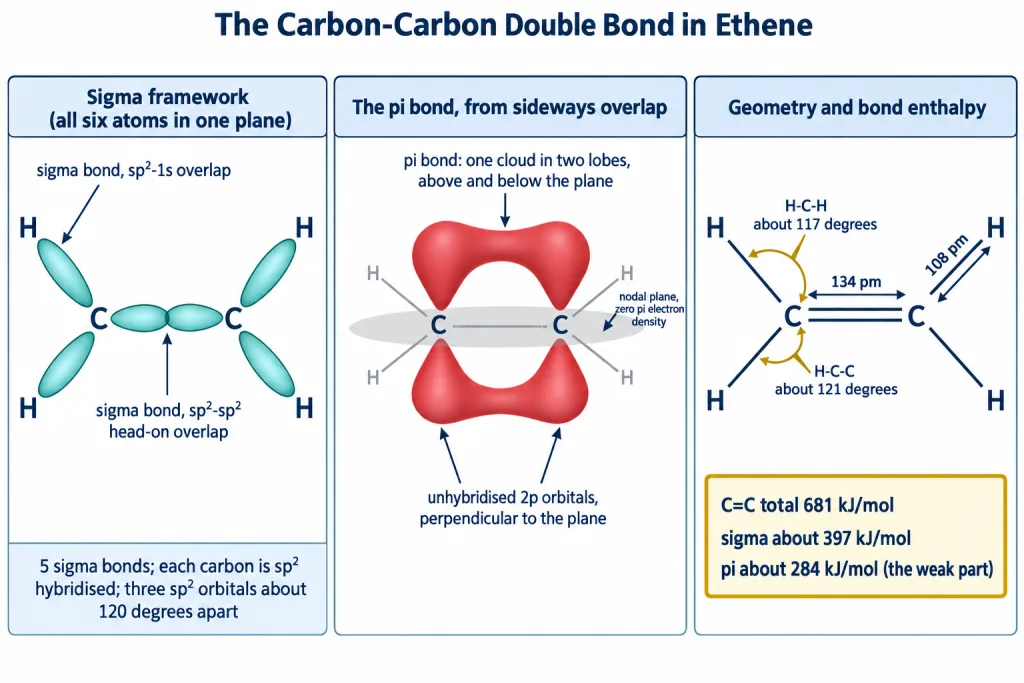
Each of the two doubly bonded carbon atoms is hybridised. One orbital and two of the three orbitals mix to give three hybrid orbitals, which lie in one plane and point to the corners of an equilateral triangle, about 120 degrees apart. The third orbital is left unhybridised and stands perpendicular to that plane, one lobe above it and one below.
Build ethene from two such carbons. One orbital on each carbon points straight at the other; they overlap head-on and give the carbon-carbon sigma bond. The remaining two orbitals on each carbon overlap head-on with hydrogen orbitals, giving four carbon-hydrogen sigma bonds. That is five sigma bonds, and since all are built from orbitals lying in one plane, all six atoms of ethene lie in a single plane. Ethene is flat.
The pi bond comes from what is left over. The two unhybridised orbitals are parallel to each other and both perpendicular to the molecular plane, and they overlap sideways, lobe against lobe, above and below the plane at the same time. The resulting pi bond is not a single region between the nuclei; it is one cloud in two lobes, one over the plane and one under it, with the plane itself a node where the pi electron density is zero.
Key Point: A carbon-carbon double bond is one sigma bond from head-on - overlap plus one pi bond from sideways overlap of the two unhybridised orbitals. Ethene has five sigma bonds and one pi bond, and all six of its atoms are coplanar.
The measured geometry of ethene fits this picture but is not perfectly regular:
| Quantity | Value |
|---|---|
| bond length | 134 pm |
| bond length | 108 pm |
| bond angle | about 117 degrees |
| bond angle | about 121 degrees |
Neither angle is exactly 120 degrees. Four electrons sit in the double bond against two in each carbon-hydrogen bond, so the crowded region between the carbons pushes the two carbon-hydrogen bonds on each carbon slightly towards each other: the angle opens above 120 and the angle closes below it. The three angles at each carbon still add to a full circle, as they must for a planar carbon, since with one degree lost to rounding.
Counting bonds is then routine. Every pair of bonded atoms is joined by exactly one sigma bond, and each extra line in a double bond is a pi bond, so propene, , has eight sigma bonds and one pi bond.
Shorter and stronger overall, weakest in the pi part
Set the double bond against the single bond it replaces:
| Bond | Length | Bond enthalpy | Carbon hybridisation |
|---|---|---|---|
| in ethane | 154 pm | ||
| in ethene | 134 pm |
The double bond is 20 pm shorter. Two shared pairs pull the nuclei closer together than one pair can, and the orbital doing the head-on overlap has 33.3 per cent character against 25 per cent in . An electron sits closer to its nucleus, so the more character a hybrid orbital has, the shorter and more tightly held the bond it makes.
The enthalpy is where the examinable detail lies. The figure of is not twice anything; it splits into two unequal parts:
The sigma part, about , is stronger than an ordinary carbon-carbon single bond at , because head-on overlap of two orbitals across 134 pm beats head-on overlap of two orbitals across 154 pm. The pi part, about , is the weakest of the three numbers. Sideways overlap is a poorer overlap than head-on overlap: the two lobes meet along their sides rather than pointing at each other, so less electron density collects on the line joining the nuclei, where it would do most good.
Key Point: The double bond as a whole is shorter and stronger than a single bond, but its pi component at about is weaker than the single bond at . Addition to an alkene breaks the pi bond and leaves the sigma bond intact.
Two consequences run through the whole of alkene chemistry.
The first is energetic. When a reagent adds across the double bond, the pi bond is the part that goes and two new sigma bonds are made in its place. Two strong sigma bonds for one weak pi bond is a favourable trade, which is why addition to an alkene is exothermic and why alkenes are far more reactive than alkanes.
The second is electronic, and it sets up the next four sections. The pi cloud lies above and below the molecular plane, further from both nuclei than any sigma pair, loosely held and mobile. It is the most exposed electron density in the molecule, sticking out of the flat face of a flat molecule, and any reagent short of electrons is drawn straight to it. Such a reagent is called an electrophile.
Key Point: The pi electrons of an alkene are loosely held and exposed above and below the plane of the molecule. That single fact is why alkenes are attacked by electrophiles, and it explains bromine water, Markovnikov's rule, the peroxide effect and hydration all at once.
Naming an alkene
The IUPAC rules for alkenes are the alkane rules with the double bond given first claim on everything.
- Suffix. Replace the -ane of the alkane by -ene: ethane becomes ethene, propane becomes propene.
- Parent chain. Choose the longest chain that contains the double bond. If that conflicts with the longest chain in the molecule, the double bond wins and the longer chain becomes a substituent.
- Numbering. Number from the end nearer the double bond, which takes precedence over any substituent.
- The locant. The double bond is identified by the lower of the two carbon numbers it joins, written immediately before the -ene: pent-2-ene has the double bond between C2 and C3.
- Substituents. Name them alphabetically with their locants in front, as for alkanes.
- Ties. If both directions give the double bond the same locant, the substituents take the lowest possible locants.
Working from structure to name:
| Structure | Reasoning | IUPAC name |
|---|---|---|
| five-carbon chain, double bond from the right-hand end | pent-1-ene | |
| five-carbon chain, double bond 2 from the left, 3 from the right | pent-2-ene | |
| longest chain through the double bond is three carbons | 2-methylprop-1-ene | |
| four-carbon chain, methyl on C3 | 3-methylbut-1-ene | |
| double bond is 2 either way, so lowest substituent locant decides | 2-methylbut-2-ene | |
| double bond 2 from the left beats 3 from the right | 4-methylpent-2-ene |
Working from name to structure, the locant says where the double bond goes before anything is decorated. 2,3-Dimethylbut-2-ene: four-carbon chain, double bond between C2 and C3, a methyl on each of them, giving . 3-Methylpent-2-ene: five-carbon chain, double bond between C2 and C3, methyl on C3, giving . Hex-3-ene: six-carbon chain with the double bond in the middle, .
The trap in rule 2 is worth a line of its own. In the longest chain runs propyl-carbon-propyl and is seven carbons long, but it does not contain the double bond. The longest chain that does contain it is five carbons, so the compound is 2-propylpent-1-ene and not a heptene.
Modern IUPAC puts each number next to the part of the name it describes: pent-2-ene, hexa-1,3-diene, 4-methylpent-2-ene. The older style, 2-pentene, is understood but should not be written.
More than one double bond, and the names that came before IUPAC
A molecule with two carbon-carbon double bonds is a diene, one with three is a triene, one with four a tetraene. Both locants are given, the multiplying prefix goes in front of -ene, and the a of the stem is kept so that the name stays pronounceable: buta-1,3-diene, not but-1,3-diene.
| Structure | IUPAC name |
|---|---|
| buta-1,3-diene | |
| penta-1,4-diene | |
| hexa-1,3-diene | |
| hexa-1,3,5-triene | |
| octa-1,3,5,7-tetraene |
An open-chain diene has the general formula , since each double bond costs two hydrogen atoms, so buta-1,3-diene is . Double bonds separated by exactly one single bond, as in buta-1,3-diene, are conjugated; those separated by two or more single bonds, as in penta-1,4-diene, are isolated.
Several common names remain in daily use and must be recognised, but they are not IUPAC names and should not be offered when a question asks for one.
| Common name | IUPAC name | Structure |
|---|---|---|
| ethylene | ethene | |
| propylene | propene | |
| isobutylene | 2-methylprop-1-ene |
Two group names from the same tradition appear constantly: vinyl for and allyl for . Vinyl chloride is and allyl chloride is , and the one group between them changes the chemistry completely.
Structural isomerism: chain and position
Ethene and propene each have one structure and no isomeric alkenes — propene's only isomer is the ring compound cyclopropane. From upwards there is a choice, and it comes in two kinds: where the double bond sits on a given skeleton, and what the skeleton is.
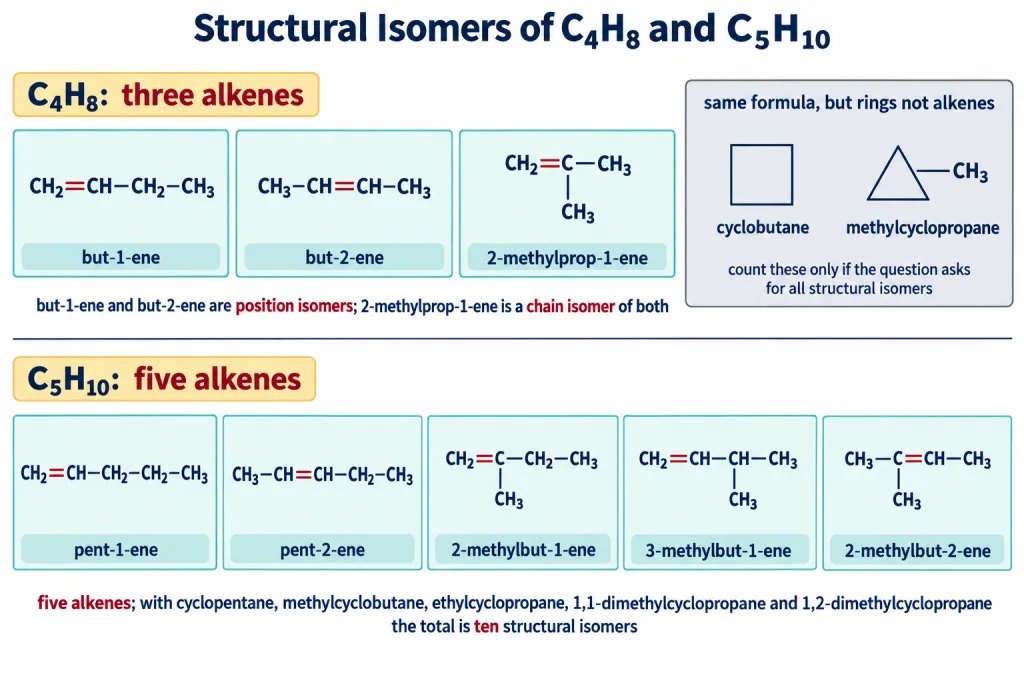
can be written as an alkene in three ways.
| Structure | IUPAC name | |
|---|---|---|
| I | but-1-ene | |
| II | but-2-ene | |
| III | 2-methylprop-1-ene |
Structures I and II have the same skeleton, an unbranched chain of four carbons, and differ only in where the double bond sits. They are position isomers. Structure III has a different skeleton, a three-carbon chain with a methyl branch, so III is a chain isomer of I and a chain isomer of II.
Key Point (Definition): Position isomers have the same carbon skeleton with the functional group or double bond in different places. Chain isomers have different carbon skeletons. Both are kinds of structural isomerism, in which the atoms are joined up differently.
The ring question has to be answered. Cyclobutane and methylcyclopropane are also . Counting only alkenes, has three structural isomers. Counting cycloalkanes as well, it has five.
gives five isomeric alkenes.
| Structure | IUPAC name | |
|---|---|---|
| (a) | pent-1-ene | |
| (b) | pent-2-ene | |
| (c) | 2-methylbut-1-ene | |
| (d) | 3-methylbut-1-ene | |
| (e) | 2-methylbut-2-ene |
Sorting them: (a) and (b) share the straight five-carbon skeleton and are position isomers. Compounds (c), (d) and (e) all sit on the branched 2-methylbutane skeleton and are position isomers of one another. Every member of the first pair is a chain isomer of every member of the second group.
The cyclic compounds are cyclopentane, methylcyclobutane, ethylcyclopropane, 1,1-dimethylcyclopropane and 1,2-dimethylcyclopropane, five more. So has five isomeric alkenes and ten structural isomers in total.
[JEE/NEET] Read the wording before counting. "Isomeric alkenes of " is five; "structural isomers of " is ten; and neither number includes cis-trans pairs, which are not structural isomers at all.
Cis-trans isomerism, and the restricted rotation behind it
Rotation about a carbon-carbon single bond is free for all practical purposes. A sigma bond is cylindrically symmetrical about the line joining the two nuclei, so spinning one carbon relative to the other leaves the overlap untouched and costs almost nothing. That is why the conformations of ethane cannot be separated.
A double bond behaves in the opposite way. Its pi bond comes from sideways overlap of two orbitals that must stay parallel for the overlap to exist. Twist one carbon relative to the other and those orbitals swing out of alignment; at 90 degrees the overlap is zero and the pi bond is gone. Breaking it costs about , far more than the molecule can collect from collisions at ordinary temperature. Rotation about a is blocked, the two ends are locked, and whatever groups sit on them keep their positions.
A cardboard model makes the point at once. Join two pieces of card with one nail and either turns freely; join them with two nails and neither will turn. The second case is the double bond.
Key Point: Cis-trans (geometrical) isomerism exists because rotation about a carbon-carbon double bond is restricted. Free rotation about a single bond gives conformations, which interconvert and cannot be separated; restricted rotation about a double bond gives configurational isomers, which are different compounds and can be bottled separately.
Each doubly bonded carbon carries two further groups. If a carbon carries two identical groups, swapping them gives the same molecule back and there is nothing to isomerise.
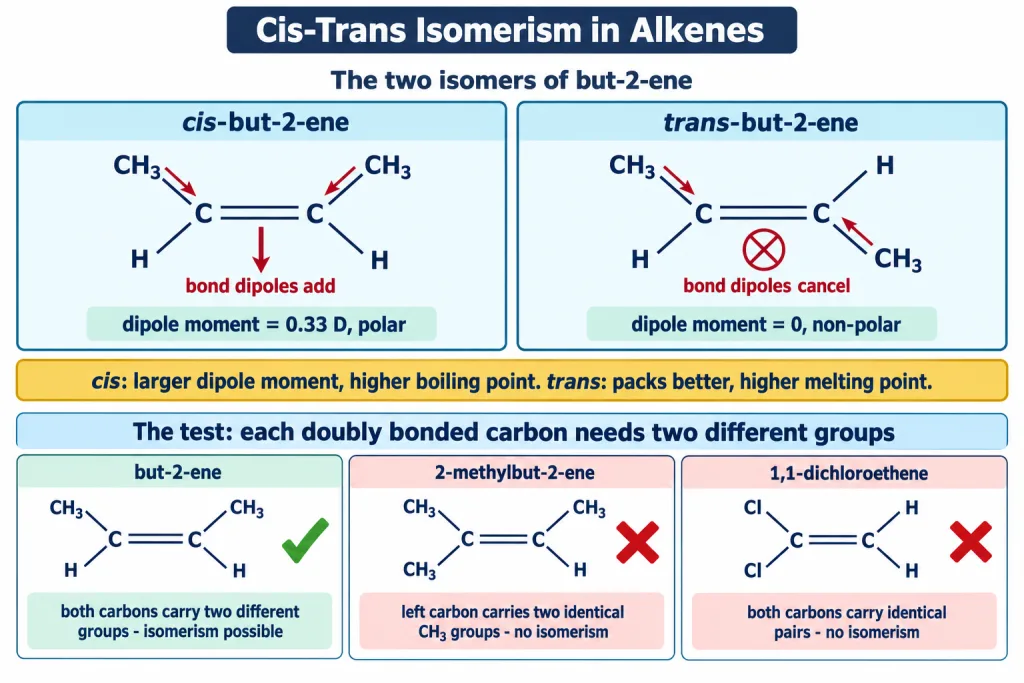
Key Point (Definition): An alkene shows cis-trans isomerism only when each of the two doubly bonded carbon atoms carries two different groups.
For a general alkene two arrangements exist in space. Where the two identical groups lie on the same side of the double bond the isomer is cis; where they lie on opposite sides it is trans. The two are stereoisomers: identical structure, different configuration.
The test is applied compound by compound by listing the two groups on each carbon.
| Compound | Structure | First carbon carries | Second carbon carries | Cis-trans? |
|---|---|---|---|---|
| but-2-ene | and H | and H | yes | |
| pent-2-ene | and H | and H | yes | |
| 1,2-dichloroethene | Cl and H | Cl and H | yes | |
| propene | and H | H and H | no | |
| but-1-ene | H and H | and H | no | |
| 2-methylbut-2-ene | and | and H | no | |
| 1,1-dichloroethene | H and H | Cl and Cl | no |
Every failure has the same cause: one carbon carries a matched pair. In propene and but-1-ene it is the terminal with its two hydrogen atoms, which is why no terminal alkene can ever show cis-trans isomerism. In 2-methylbut-2-ene it is the carbon with two methyl groups, and in 1,1-dichloroethene both carbons fail at once.
What cis and trans actually do differently
Cis and trans isomers are separate compounds with the same molecular formula and the same connectivity but a different arrangement of atoms in space, and that difference shows up in melting point, boiling point, dipole moment and solubility. The two forms can be isolated and stored in separate bottles.
Dipole moment. In cis-but-2-ene the two methyl groups sit on the same side of the double bond, so the two carbon-methyl bond dipoles point to the same side and add rather than cancel, giving a resultant of 0.33 D. In trans-but-2-ene the methyl groups point in opposite directions, the two bond dipoles are equal and opposite, and they cancel exactly, leaving a dipole moment of essentially zero. As a general rule, the cis isomer is the more polar of a pair.
Boiling point. Boiling pulls molecules apart from one another. Both butenes have the same molar mass and similar van der Waals forces, but the cis form has a dipole moment and so has dipole-dipole attraction in addition, so cis-but-2-ene boils higher than trans-but-2-ene.
Melting point. Melting breaks down a crystal lattice, and the energy that takes depends on how neatly the molecules stack. The trans form is the more symmetrical, more nearly linear shape and packs into a regular lattice with the forces well used. The cis form is bent, packs badly, and its lattice falls apart at a lower temperature, so trans-but-2-ene melts higher than cis-but-2-ene.
Key Point: For a cis-trans pair, the cis isomer usually has the larger dipole moment and the higher boiling point, while the trans isomer packs better in the solid and has the higher melting point. The two orders run opposite ways, and confusing them is the standard error.
The same reasoning applies to 1,2-dichloroethene: the cis form has a substantial resultant dipole, while in the trans form the two carbon-chlorine dipoles oppose each other exactly and the molecule has no net dipole at all, despite containing two strongly polar bonds.
The E-Z system. The words cis and trans need a pair of identical groups to refer to, and that pair is not always there — and even when it is there, it does not always point the same way as a proper ranking by priority. In 3-methylpent-2-ene, , one doubly bonded carbon carries a methyl group and a hydrogen atom while the other carries a methyl group and an ethyl group. Two distinct arrangements exist, so this is a genuine geometrical isomer pair. A methyl group does sit on each of the two carbons, so a matched pair is available to refer to — but referring to it is unsafe, because the reference is ambiguous. The modern system ranks the two groups on each carbon by priority, based in the first instance on atomic number, and asks where the two higher-priority groups sit. Both on the same side gives Z, from the German zusammen, together; on opposite sides gives E, from entgegen, opposite. Apply that here. On C2 the methyl outranks the hydrogen, but on C3 the ethyl outranks the methyl, so in the arrangement with the two methyl groups on the same side the two higher-priority groups end up on opposite sides: what a student would call the cis form is in fact the E isomer. A reference pair that can be read two ways settles nothing, and that ambiguity is exactly why the E-Z system replaced cis and trans. For a simple case such as but-2-ene, Z corresponds to cis and E to trans. The full priority rules belong to a later treatment; what matters here is that E-Z is the general system and cis-trans the everyday special case.
[JEE Main] Geometrical isomerism asks only that each doubly bonded carbon carry two groups that differ from each other. It does not ask for a pair of identical groups spanning the bond, so wherever the cis-trans reference is ambiguous — or missing altogether — the isomers are still real and are labelled E and Z instead.
Worked items
Question 1: Naming a straight-chain alkene
Give the IUPAC name of .
Answer:
Five carbons in one chain, and the chain holds the double bond, so the parent is a pentene. I number from the end nearer the double bond. From the right it starts at C2, from the left at C3, and 2 is lower. No substituents.
Ans: pent-2-ene
Watch out: The locant sits immediately before the -ene. Writing 2-pentene is the old style.
Question 2: When the longest chain is the wrong chain
Name .
Answer:
A group is doubly bonded to a central carbon which also carries two propyl groups, so that central carbon has two bonds in the double bond and one to each propyl, making four.
The longest chain runs propyl-central carbon-propyl and is seven carbons, but the double bond is not inside it. The longest chain that does contain the double bond runs from the , through the central carbon and down one propyl group: five carbons. Both propyls are identical, so the choice does not matter. Parent pent-1-ene, with the second propyl on C2.
Ans: 2-propylpent-1-ene
Watch out: The rule is the longest chain containing the double bond, not the longest chain in the molecule.
Question 3: Double bond against substituent
Name .
Answer:
The chain containing the double bond has five carbons, with a methyl branch. Numbering from the left puts the double bond at 2 and the methyl at 4. Numbering from the right puts the double bond at 3 and the methyl at 2. The double bond has first claim on the lower locant, and 2 beats 3.
Ans: 4-methylpent-2-ene
Watch out: 2-Methylpent-3-ene comes from giving the substituent priority. In an alkene the double bond always outranks a substituent.
Question 4: Breaking a tie
Name .
Answer:
The parent is a butene with one methyl branch. From the left the double bond is at 2 and the methyl at 2; from the right the double bond is at 2 again and the methyl at 3. The double bond locant ties, so the tie goes to the direction giving the substituent the lower number.
Ans: 2-methylbut-2-ene
Question 5: From name to structure
Draw 2,3-dimethylbut-2-ene and 3-methylbut-1-ene, and check the valency of every carbon.
Answer:
For 2,3-dimethylbut-2-ene: a four-carbon chain, double bond between C2 and C3, a methyl on each of them, giving . Carbon 2 has two bonds in the double bond, one to C1 and one to its methyl, which is four; carbon 3 is the same. The formula is , fitting .
For 3-methylbut-1-ene: a four-carbon chain, double bond between C1 and C2, methyl on C3, giving . Carbon 3 is bonded to C2, C4, its methyl and one hydrogen, which is four. The formula is .
Ans: and
Question 6: Counting the structural isomers of
How many structural isomers has , and how are they related?
Answer:
On the straight four-carbon chain the double bond can go at position 1 or 2, giving but-1-ene and but-2-ene. Branching the skeleton leaves a three-carbon chain with a methyl on the middle carbon, and the double bond can only go to the end: 2-methylprop-1-ene. That is three alkenes.
But-1-ene and but-2-ene share a skeleton, so they are position isomers; 2-methylprop-1-ene has a different skeleton, so it is a chain isomer of both. The formula also fits cyclobutane and methylcyclopropane.
Ans: three isomeric alkenes; five structural isomers in all if cycloalkanes are counted
Watch out: Cis- and trans-but-2-ene are not structural isomers of each other, so they are never added to a structural isomer count.
Question 7: Counting and naming the isomers
Write the structures and names of all the alkenes of formula , then give the total structural isomer count.
Answer:
On the straight five-carbon chain the double bond goes at 1 or 2 — position 3 is position 2 counted from the other end — giving (pent-1-ene) and (pent-2-ene).
The branched 2-methylbutane skeleton gives three more: (2-methylbut-1-ene), (3-methylbut-1-ene) and (2-methylbut-2-ene). The neopentane skeleton gives nothing, since its central carbon already has four single bonds.
The rings are cyclopentane, methylcyclobutane, ethylcyclopropane, 1,1-dimethylcyclopropane and 1,2-dimethylcyclopropane.
Ans: five isomeric alkenes; ten structural isomers of in all
Question 8: Sigma and pi bonds in a tetraene
Count the sigma and pi bonds in octa-1,3,5,7-tetraene.
Answer:
The structure is . Two terminal groups give 4 hydrogen atoms and six groups give 6 more, so it is .
Every pair of bonded atoms is joined by exactly one sigma bond. Eight carbons in one chain means seven carbon-carbon links, plus ten carbon-hydrogen bonds, so 17 sigma bonds. Each of the four double bonds adds one pi bond.
Ans: 17 sigma bonds and 4 pi bonds
Question 9: A shortcut for the same count
Count the sigma and pi bonds in 2-propylpent-1-ene, .
Answer:
The carbons are ; the hydrogens are 2 on the , none on the central carbon and 7 on each propyl, so 16. The compound is .
For any open-chain hydrocarbon the skeleton has carbon-carbon links whether branched or not, so the sigma count is . One double bond gives one pi bond.
Ans: 23 sigma bonds and 1 pi bond
Watch out: The shortcut holds only for open chains. A ring has one extra carbon-carbon bond, and a triple bond is one sigma plus two pi.
Question 10: Applying the cis-trans test
Which of these show cis-trans isomerism: (i) , (ii) , (iii) , (iv) ?
Answer:
I list the two groups on each doubly bonded carbon and check that neither carbon has a matched pair.
(i) Methyl and hydrogen on one carbon, but two hydrogen atoms on the terminal . Matched pair, so no.
(ii) Two hydrogen atoms on one carbon and two bromine atoms on the other. Both fail, so no.
(iii) Phenyl and hydrogen on one carbon, methyl and hydrogen on the other. Both pass, so yes.
(iv) Methyl and hydrogen on one carbon, methyl and chlorine on the other. Both pass, so yes.
Ans: (iii) and (iv) show cis-trans isomerism
Watch out: One carbon carrying two identical groups kills the isomerism however varied the other carbon is.
Question 11: Two look-alikes with opposite answers
Explain why 2-methylbut-2-ene shows no geometrical isomerism while 3-methylpent-2-ene does, and say how the second is labelled.
Answer:
2-Methylbut-2-ene is , and its C2 carries two methyl groups. Interchanging two identical groups returns the same molecule, so only one arrangement exists.
3-Methylpent-2-ene is . Its C2 carries a methyl and a hydrogen, its C3 a methyl and an ethyl, so each carbon has two different groups and two arrangements exist. A methyl group does span the bond, so cis and trans look as though they have something to refer to, but that reference is ambiguous. Priority on C2 goes to the methyl over the hydrogen, while on C3 it goes to the ethyl over the methyl, so the form with the two methyl groups on the same side has its two higher-priority groups on opposite sides and is the E isomer, not the cis one. Because the two readings disagree, the pair is labelled E and Z rather than cis and trans.
Ans: 2-methylbut-2-ene has a carbon bearing two identical methyl groups, so no isomerism; 3-methylpent-2-ene is a genuine pair labelled E and Z
Question 12: Dipole moments of the two but-2-enes
Account for the dipole moments of cis-but-2-ene and trans-but-2-ene.
Answer:
Each carbon-methyl bond carries a small dipole, because an carbon is slightly more electronegative than an carbon. In the cis isomer both methyl groups lie on the same side, so the two bond dipoles point to the same side and their resultant is not zero; measurement gives 0.33 D. In the trans isomer the methyl groups point in opposite directions, so the two equal dipoles cancel exactly.
Ans: cis-but-2-ene 0.33 D; trans-but-2-ene effectively zero, and non-polar
Question 13: Ranking boiling points
Arrange cis-but-2-ene, trans-but-2-ene and cis-pent-2-ene in increasing order of boiling point.
Answer:
Pent-2-ene has one carbon more, so a larger surface and stronger van der Waals attraction, which puts it at the top before polarity is considered. Between the two butenes the molar mass and dispersion forces match, so the dipole decides: the cis form has 0.33 D and gains dipole-dipole attraction, the trans form has none.
Ans: trans-but-2-ene < cis-but-2-ene < cis-pent-2-ene
Question 14: Ranking melting points
Which of cis- and trans-but-2-ene melts higher, and why is the answer the reverse of the boiling point answer?
Answer:
Melting breaks down a crystal, and what matters there is packing. Trans-but-2-ene is the more symmetrical, nearly straight molecule; it stacks into a compact regular lattice that needs a higher temperature to collapse. The cis form is bent and packs badly. Boiling asks a different question — how strongly one molecule is held in the liquid, where packing does not matter and the dipole does.
Ans: trans-but-2-ene melts higher; cis-but-2-ene boils higher
Watch out: Quoting "cis is higher" for both is the standard slip. Cis wins on dipole moment and boiling point, trans on melting point.
Question 15: Reading the bond data
Using the data for ethane and ethene, say which bond breaks when bromine adds to ethene, and why the addition is favourable.
Answer:
The single bond in ethane is 154 pm and . The double bond in ethene is shorter at 134 pm and stronger overall at , but that total splits into a sigma part of about and a pi part of about .
The pi part is the smallest of those figures, smaller even than the ordinary single bond, because sideways overlap is poorer than head-on overlap. So the pi bond breaks and the sigma bond survives, keeping the two carbons joined, while two new carbon-bromine sigma bonds form. Two strong sigma bonds for one weak pi bond releases energy.
Ans: the pi bond breaks, costing about , and two new sigma bonds form in its place
Watch out: "The double bond is stronger, so the alkene is less reactive" is the wrong reading. Reactivity is set by the weakest component, and the pi bond is weaker than a single bond.